Month: April 2013

  • A Tale: Encountering Irish Wit at a Lunch Station — John L. Stoddard, 1896

    Larry's Lunch Station
    Larry Mathews, center, holding court at Norris Lunch Station.

    The developers of Yellowstone Park located their grand hotels at major sights a day’s drive apart by horse and buggy. That necessitated construction of lunch stations about halfway between the hotels to provide mid-day meals.  

    The manager of the Norris Lunch Station, Larry Mathews, was a colorful character who found a place in many traveler’s journals. An Irish immigrant with a broad accent, Mathews was famous for his jocular manners and his ability to entertain customers as he rushed them through their sparse meals.

    The famous writer and lecturer, John L. Stoddard, met Larry at the Norris Lunch Station in 1896. Here’s how Stoddard described the encounter in Volume 10 of his famous set of travelogues, Stoddard’s Lectures.

    ∞§∞

    John L. Stoddard
    John L. Stoddard

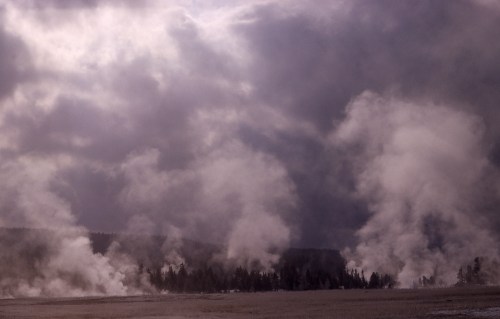
    For half an hour we had been hearing, more and more distinctly, a dull, persistent roar, like the escape of steam from a transatlantic liner. At last we reached the cause. It is a mass of steam which rushes from an opening in the ground, summer and winter, year by year, in one unbroken volume. The rock around it is as black as jet; hence it is called the Black Growler. Think of the awful power confined beneath surface here, when this one angry voice can be distinctly heard four miles away. Choke up that aperture, and what a terrible convulsion would ensue, as the accumulated steam burst its prison walls! It is a sight which makes one long to lift the cover from this monstrous caldron, learn the cause of its stupendous heat, and trace the complicated and mysterious aqueducts through which the steam and water make their way.

    Returning from the Black Growler, we halted at a lunch station, the manager of which is Larry. All visitors to the Park remember Larry. He has a different welcome for each guest: “Good. day, Professor. Come in, my Lord. The top of the morning to you, Doctor.” These phrases flow as lightly from his tongue as water from a geyser. His station is a mere tent; but he will say, with most amusing seriousness: “Gintlemen, walk one flight up and turn to the right. Ladies, come his way and take the elevator. Now thin, luncheon is ready. Each guest take one seat, and as much food as he can get.”

    “Where did you come from, Larry?” I asked.

    “From Brooklyn, Sor,” was his reply, “but I’ll niver go back there, for all my friends have been killed by the trolley cars.”

    Larry is very democratic. The other day a guest, on sitting down to lunch, took too much room upon the bench.

    “Plaze move along, Sor,” said Larry. The stranger glared at him. “I am a Count,” he remarked at last.

    “Well, Sor,” said Larry, “here you only count wun!” “Hush!” exclaimed a member of the gentleman’s suite, “that is Count Schouvaloff.”

    “I’ll forgive him that,” said Larry, “if he won’t shuffle off this seat.” Pointing to my companion, Larry asked me: “What is that that gentleman’s business?”

    “He is a teacher of singing,” I answered.

    “Faith,” said Larry, “I’d like to have him try my voice. There is something very strange about my vocal chords. Whenever I sing, the Black Growler stops. One tourist told me it was a case of professional jealousy, and said the Black Growler was envious of my forte tones. ‘I have not forty tones,’ I said, ‘I’ve only one tone.’ ‘Well,’ says he, ‘make a note of it!’”

    Only once in his life has Larry been put to silence. Two years ago, a gentleman remarked to him: “Well, Larry, good. by; come and visit me next winter in the East. In my house you shall have a nice room, and, if you are ill, shall enjoy a doctor’s services free of all expense.”

    “Thank you,” said Larry, “plaze give me your card.”

    The tourist handed it to him; and Larry, with astonishment and horror, read beneath the gentleman’s name these words: “Superintendent of the Insane Asylum, Utica, New York.”

    ∞§∞

    — From “Yellowstone Park,” pages 207-304 in Volume 10 of Stoddard’s Lectures, Chicago: John L. Schuman & Co., 1898,

    — Lunch station photo from Stoddard’s Lectures. Stoddard photo from Wikipedia Commons.

    — You might also enjoy Stoddard’s description of Fountain Geyser.

  • A Tale: Finding a Goldilocks Pool at Mammoth Hot Springs — John W. Barlow, 1871

    Reports from the Washburn Expedition of 1870 stimulated so much interest in the Upper Yellowstone that the U.S. Government decided to send two expedition to explore the area systematically the next year. One was under the direction of Dr. Ferdinand V. Haden of the U.S. Geological Survey, and another was under Colonel John W. Barlow of the Army Corp of Engineers. The two expeditions worked in tandem to measure and map the wonders of the area. One of those wonders was “Soda Mountain,” what is now known as Mammoth Hot Springs.

    Bath Pools from Whylie by CalfeeIn an era when water for bathing often was heated in a teakettle, the copious amount of hot water flowing down the mountainside at Mammoth Hot Springs intrigued the explorers. Here’s how Colonel Barlow described it.
    ∞§∞

    A system of hot springs of great beauty, flowing from the top and sides of a large hill of calcareous deposit, and called Soda Mountain, is found five miles up the left bank of Gardners River. Here, at the foot of this curious white mountain, we encamped, and remained until the 24th [of July], examining the wonderful spring formation of this region, and the country around it.

    The central point of interest is the Soda Mountain, occupying an area of a hundred acres, and rising like the successive steps of a cascade, to the height of over 200 feet above the plateau at its base. The upper surface is a plain, composed of many hot springs, constantly sending up volumes of vapor slightly impregnated with sulphurous fumes.

    The sides of the hill down which the waters of these hot springs flow have become terraced into steps of various heights and widths, some twelve inches in dimension, while others are as many feet. In each terrace there is generally a pool of water, standing in a scalloped basin of gypsum, deposited at the edges by the water as it becomes cooler. These basins are often tinged with pink, gray, and yellow colors, giving to the whole a very beautiful effect.

    The rock in all directions has evidently been deposited in the same manner as the Soda Mountain is now being built up. When the formation ceases from a change in the course of the water, the rock becomes friable and disintegrates. After a time vegetation springs up and covers the surface. Many of the basins have the size and shape of bathtubs, and were used by members of the party for bathing purposes. The temperature varies in the different pools from fifty degrees all the way up to one hundred and eighty, so there is no difficulty in finding a bath of suitable temperature.

    [A few days later, Barlow left Mammoth Hot Springs to explore the area. When he returned in again enjoyed the hot water again.]

    Toward evening I enjoyed a bath among the natural basins of Soda Mountain. The temperature was delightful, and could be regulated at pleasure by simply stepping from one basin to another. They were even quite luxurious, being lined with spongy gypsum, soft and pleasant to the touch. I walked over a part of the hill by the faint light of the new moon, which gave to its deep-blue pools of steaming water a wild and ghostly appearance. The photographer has taken numerous views of these springs and the country in their vicinity, which will serve to convey a much more definite idea of their beautiful formation than can be given by any written description. A special survey was made of this locality, and careful observations of its latitude and longitude.

    ∞§∞

    —Excerpts from Colonel John W. Barlow, Report of a Reconnaissance of the Basin of the Upper Yellowstone in 1871, U.A. 42d Cong. 2d sess. Senate Ex Doc. 66, 1871, pp. 2-43.

    — Illustration from William Wallace Wylie, Yellowstone Park, or The Great American Wonderland. Kansas City, Missouri: Ramsey Millett & Hudson, 1882. Based on a Henry B. Calfee photograph.

    — You might enjoy:

  • A Tale: Prospectors Say They Have Seen the Fires of Hell — Montana Post, 1867

    Midway geyser basin YDSF
    Midway Geyser Basin

    The first indication of startling geothermal features on the Upper Yellowstone was a buffalo hide map that was sent to President Thomas Jefferson in 1805 by James Wilkinson, governor of the newly purchased Louisiana Territory. Governor Wilkinson said of the map, “a volcano is distinctly described in the Yellowstone River.” 

    About 1809 John Colter told his old boss, Captain William Clark of the Lewis and Clark Expedition, about the “Hot Spring Brimstone” he had seen along the shore of Lake Yellowstone, and Clark published a map containing that information information in 1814. 

     Eastern newspapers reported startling geothermal features in the area that became Yellowstone Park as early and early as 1827. Following that, there a steady stream of accounts in newspapers, government reports, journals and reminiscence. 

     But these reports did little to affect public awareness. In fact, William Wallace Wylie, in his guidebook published in1882, marveled that the area had been known for only a short time. Wylie, who invented the Wylie Way method of touring the park with stops permanent camps, searched Montana territorial newspapers and concluded this article published by The Montana Post in 1867 was the first one describing the area’s geothermal features. 

     ∞§∞

    It is indeed strange that this remarkable portion of country, now set apart by our Government as National pleasure-grounds, has been known to the world for so short a time. It may be authentically stated that the Park has been known to the general public for the short period of eleven years.

    Although trappers and prospectors had at different times passed through and seen some portions of the Park, and had tried to convince others of what they beheld, yet their stories were received as characteristic lies, and the general public lived on in ignorance of the fact that the greatest natural wonders of the world existed within the borders of our republic.

    The first published statement of these wonders, that the author could find, is that given below, taken from the Montana Post. The communication was dated Yellowstone City, Montana, August 18, 1867. Yellowstone City was a thriving mining village, nearer the boundary of the Park than any town at present is. The communication was written by Davis Willson, now of Bozeman, Montana. As will be seen, his information was obtained second-handed. The article is given entire for the purpose of showing how exaggerated were the ideas then obtained of what is now so well known: —

    A portion of the Bear Gulch stampeders has returned. They have been to the Lake at the head of Yellowstone, and report the greatest wonder of the age.  For eight days they traveled through a volcanic country emitting blue flames, living streams of molten brimstone, and almost every variety of minerals known to chemists. The appearance of the country was smooth and rolling, with long level plains intervening.

    On the summits of these rolling mounds, were craters from four to eight feet in diameter; and everywhere upon the level plains, dotting them like prairie-dog holes, were smaller ones, from four to six inches and upwards.

    The steam and blaze were constantly discharging from these subterranean channels, in regular evolutions or exhaustions, like the boilers of our steamboats, and gave the same roaring, whistling sound. As far as the eye could trace, this motion was observed.

    They were fearful to ascend to the craters, lest the thin crust should give way and swallow them. Mr. Hubbel (one of the party), who has visited this region before, ventured to approach one of the smaller ones. As he neared its mouth, his feet broke through, and the blue flame and smoke gushed forth, enveloping him. Dropping upon his body, he crawled to within a couple of feet of the crater, and saw that the crust around its edge was thin, like a wafer.

    Lighting a match, he extended it to the mouth and instantly it was on fire. The hollow ground resounded beneath their feet as they traveled on, and every moment it seemed liable to break through and bury them in its fiery vaults. The atmosphere was intensely suffocating, and they report that life could not long be sustained there.

    Not a living thing—bird or beast—was seen in the vicinity. The prospectors have given it the significant name—’Hell!’ They declare they have been to that ‘bad place,’ and even seen the ‘Devil’s horns;’ but through the interposition of Providence (not to speak profanely), their ‘souls have been delivered,’ and they emphatically aver, if a ‘straight and narrow’ course, during their sojourn on the Yellowstone, will save them, they will never go there again.

    This article was copied throughout the country by other papers, and doubtless served to awaken an interest concerning this unknown land; yet the general public were indebted for their first knowledge of the marvels of this region.

     ∞§∞

     — Text from “Earliest Publications Concerning Yellowstone Park,”  pages 74-77 in William Wallace Wylie, Yellowstone Park, or The Great American Wonderland. Kansas City, Missouri: Ramsey Millett & Hudson, 1882.

    — Photo from the Yellowstone Digital Slide File.

    — You might be interested in The New York Times story apparently based on this report.

  • A Tale: “Bear That Killed Man Blown to Pieces” — 1917

    Values change. While searching for stories to post here, I frequently find reports of behavior that would outrage today’s sensibilities. Here’s an example published in Popular Mechanics in 1917.

    ∞§∞

    A bear that had severely mauled a government teamster in Yellowstone National Park was blown to pieces by dynamite recently, while the teamster died of his injuries in the hospital at Mammoth Hot Springs.Screen Shot 2013-04-07 at 8.02.58 AM The man was asleep under a supply wagon in the park when he was attacked by the bear. Two companions drove the animal away, after serious injuries had been inflicted on their mate, and when the latter had been removed to the hospital they prepared a warm reception for the bear, knowing it would return. Dynamite, connected with a small electric battery, was placed under a bait of army bacon a short distance from the camp. When the bear came back under cover of darkness and nosed the bait, the mine was sprung and the dynamite did its work most effectively. Bruin disappeared in sections, and the unlucky teamster was avenged.

    ∞§∞

    —  Text and illustration from “Bear That Killed Man Blown to Pieces,” Popular Mechanics, 27(4):561 (1917).