Author: mmarkmiller

  • An Event: Presenting ‘Montana’s Gin Marriage Law’ on Saturday

    Ruth Boyd-Charles Miller Wedding, Silver Star, Montana, August 1935.

    I will reprise my presentation. “The Montana Gin Marriage Law of 1935” on October 9, 2013, at 3 p..m. at Aspen Point in Bozeman. Look for details under the Events button above.

    My parents wedding may have been the only one in Montana in August of 1935. Certainly, it was one of very few. The reason was the Montana Gin Marriage law, which made it impossible to get a wedding license. The law, which went into effect on July 1, required couples to get a health certificate signed by a doctor, and wait three days to get a marriage license. When doctors refused to sign the certificates, Montanans discovered there was no legal way they could get married.

    This Saturday, September 28, at 9:30 a.m., I will tell about efforts to circumvent the little-known law and get it repealed. The presentation at the Pioneer Museum of Bozeman is free and open to the public. It is the last of the Gallatin Historical Society Fall Lecture Series for this year.

    My parents wanted to avoid the cost and hassle of a physical exam, so they bought their wedding license in June and held onto it until the August wedding date that they had been planning for several months. The way things worked back then, a couple could buy a marriage license from the County Clerk and then find a justice of the peace or a clergyman to perform their wedding ceremony whenever they liked. The marriage was official when the couple returned the signed license to the clerk. A few couples bought licenses in June for July weddings, but not many held them for two months like my parents did.

    Many states passed Gin Marriage laws in the 1920s and 30s. But Montana went further than most with the physical exam. It was primarily a eugenics law designed to improve humankind by keeping people from having defective children.

    The new law had teeth. If doctors signed the certificates without a proper physical, they would be guilty of a felony and could lose their medical licenses. Doctors said signing the certificates made them liable if the couple ever came down with any of the listed diseases, or had a defective child. Doctors refused to sign the certificates so County clerks couldn’t issue marriage licenses.

    The law set off a long chain of events. As my mother put it, “There was a rush to the altar in June of 1935, and a rush to the delivery room nine months later.” Mom was right.

    Examination of county records shows there were twice as many marriage licenses issued in June of 1935 as in the same month of 1934 or 1936. Mom said my Uncle Jim and Aunt Sally were typical of the young couples who rushed to get married. They had known each other less than a month on their wedding day.

    The impact of the law on the birth rate was also dramatic. Nine months after the explosion in weddings, March 1936, Saint James Hospital in Butte recorded 177 births, twice as many as in March of the year before. One of those births was my cousin. When Mom went to visit Aunt Sally and her new baby boy at Saint James, expectant mothers lined the hallways on cots. They had to actually deliver their babies before they could get a room with a regular bed.

    Shortly after the law took effect, newspapers began publishing stories about its impact. In Butte a young couple turned away from the county clerk’s office went from doctor to doctor trying to find one who would sign the required health certificate. An Idaho couple that requested a wedding license in Butte left the county clerk’s office in disgust and returned home where marriage laws remained more lax.

    On July 19, William A. Patt, a retired judge in Dubois, Idaho, announced that he was willing to marry Montanans there. “It isn’t right, that system in Montana, that discourages marriage,” Judge Patt said. He offered to perform marriages “at any hour of the day or night.” An Idaho marriage license cost $3 and Judge Patt charged $5 to perform the ceremony. That was a tremendous profit for the kindly old judge.

    By the end of July, a citizens’ group in Billings announced plans for a petition to put the Gin Marriage Law on the 1936 election ballot. The referendum effort, spearheaded by the Billings Commercial Club, was immediately joined by the Billings Federation of Women’s Clubs. They sought help from chambers of commerce, commercial clubs, and women’s’ club federations across the state.

    The Montana Constitution provided that the law would be suspended as soon as at least 5 percent of the voters from at least 40 percent of the counties signed the petition. The signatures had to be collected within six months of the end of the session when the law was passed. That left just over a month to gather signatures, get county clerks to verify them, and submit the petitions to the Secretary of State.

    The people trying to get rid of the law raced to gather signatures, and by September 4, 41 counties turned in its petitions with 21,648 signatures, more than the required number. The Secretary of State immediately announced that the law was suspended. The next day Montana’s began buying wedding licenses and getting married.

    With couples able to marry without hassles, the gin marriage law quickly faded from memory. It did appear on the 1936 ballot, but generated little attention as the public focused on the presidential race that served as a referendum on the New Deal. Voters rejected Gin Marriage with 64 percent opposing it. The fluctuations in marriage and birth rates that are so obvious in monthly statistics cancel out in annual reports so they became invisible. Also, support for eugenics waned when people learned about its horrible applications by the Nazis in the aftermath of World War II. Today few people have even heard of Montana’s Gin Marriage law.

    If you’d like to know more, come to my presentation on Saturday. I’d love to see you there.

     ∞§∞

    — Photo courtesy of Fern Kirley, the bride’s sister.
  • A Tale: Ernest Thompson Seton Describes a Bear Fight — 1896

    In 1886 the army took over administration of Yellowstone National Park and began enforcing a no guns policy. Soon animals that had fled from public view to avoid slaughter reappeared where tourists could see them. When luxury hotels began dumping garbage in nearby forests, bear watching became as popular with tourists as viewing geysers. One tourist who went to the park to watch bears was the famous wildlife artist, naturalist, and writer Ernest Thompson Seton.

    Seton, who helped found the Boy Scouts of America, not only wrote the first Boy Scout Handbook, he also wrote and illustrated popular stories about wild animals for magazines and books. Nearly every boy and girl in America knew about Seton and his stories.
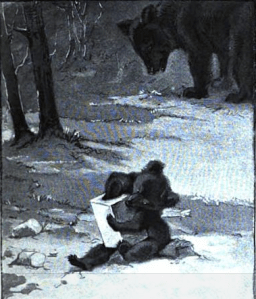
    In 1897 he came to Yellowstone Park to do an inventory of large animals for a magazine that focused on wildlife conservation. On that trip Seton saw a fight between a grizzly and a momma black bear protecting her invalid cub that everybody called “Johnny.” Seton’s story about the fight became the basis for his most famous story, “Johnny Bear.” Seton was so fond of the story that he told it a second time from the perspective of Wahb, the subject of his book Biography of a Grizzly.

    “Johnny Bear” originally appeared in Scribner’s Magazine and was republished in Seton’s book Wild Animals I Have Known. The following is a condensed version.

    ∞§∞

    All the jam pots were at Johnny’s end; he stayed by them, and Grumpy stayed by him. At length he noticed that his mother had a better tin than any he could find, and, as he ran whining to take it from her, he chanced to glance away up the slope. There he saw something that made him sit up and utter a curious little Koff Koff Koff Koff Koff.

    His mother turned quickly, and sat up to see “what the child was looking at” I followed their gaze, and there, oh horrors! was an enormous grizzly bear. He was a monster; he looked like a fur-clad omnibus coming through the trees.

    Johnny set up a whine at once and got behind his mother. She uttered a deep growl, and all her back hair stood on end. Mine did too, but I kept as still as possible.

    With stately tread the grizzly came on. His vast shoulders sliding along his sides, and his silvery robe swaying at each tread, like the trappings on an elephant, gave an impression of power that was appalling.

    Johnny began to whine more loudly, and I fully sympathized with him now, though I did not join in. After a moment’s hesitation Grumpy turned to her noisy cub and said something that sounded to me like two or three short coughs—Koff Koff Koff. But I imagine that she really said, “My child, I think you had better get up that tree, while I go and drive the brute away.”

    At any rate, that was what Johnny did.

    Grumpy stalked out to meet the grizzly. She stood as high as she could and set all her bristles on end; then, growling and chopping her teeth, she faced him.

    The grizzly, so far as I could see, took no notice of her. He came striding tward the feast as though alone. But when Grumpy got within twelve feet of him she uttered a succession of short, coughy roars, and, charging, gave him a tremendous blow on the ear. The grizzly was surprised; but he replied with a left-hander that knocked her over like a sack of hay.

    Nothing daunted, but doubly furious, she jumped up and rushed at him.  Then they clinched and rolled over and over, whacking and pounding, snorting and growling, and making no end of dust and rumpus. But above all their noise I could clearly hear Little Johnny, yelling at the top of his voice, and evidently encouraging his mother to go right in and finish the grizzly at once. . . .

    She scrambled over and tried to escape. But the grizzly was mad now. He meant to punish her, and dashed around the root. For a minute they kept up a dodging chase about it; but Grumpy was quicker of foot, and somehow always managed to keep the root between herself and her foe, while Johnny, safe in the tree, continued to take an intense and uproarious interest.

    At length, seeing he could not catch her that way, the grizzly sat up on his haunches; and while he doubtless was planning a new move, old Grumpy saw her chance, and making a dash, got away from the root and up to the top of the tree where Johnny was perched.

    ∞§∞

    — Excerpt condensed from “Johnny Bear” by Ernest Thompson Seton, Scriberner’s Magazine 28(6):658-671 (December 1900).

    — Illustration by the Seton from the magazine.

    — You might also enjoy:

  • An Event: Getting Ready To Present “The Nez Perce in Yellowstone” at The Pioneer Museum

    The big event on my schedule this week is my presentation, “The Nez Perce in Yellowstone,” at The Pioneer Museum of Bozeman on Saturday at 9:30 a.m. The talk, which is part of the Gallatin Historical Society’s Fall Lecture Series, will focus the dramatic stories told by tourists who survived run-ins with the Indians in the Summer of 1877.

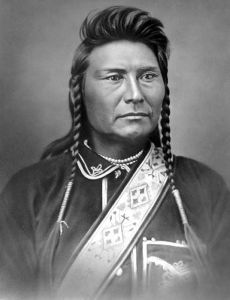
    Chief Joseph

    I’ll begin with an overview of the flight of the Nez Perce who generally had lived peacefully with whites for most of the 1800’s. After gold was discovered on Nez Perce land in 1853, settlers began moving onto their land. In 1877 the Indians were ordered onto a tiny reservation, but they decided instead to flee to the buffalo country on the plains. Most accounts of the flight of the Nez Perce emphasize things that happened outside of Yellowstone Park like broken treaties and battles, but I’ll reverse that pattern and focus in the human drama of the Indians’ encounters with tourists.

    I’ll read from my collection of first-person accounts of travel through Yellowstone Park in the 1800s. I like to present stories in the words of people who lived the adventures because that lets emotions and personalities shine through.

    The first tourist the Nez Perce found in the park was John Shively, a prospector who was familiar with the area. The Indians forced Shively to guide them all the way through the park. He was with them for thirteen days, so his story provides a good overview.

    The next tourists the Nez Perce found were the “Radersburg Party,” which included Emma Cowan and her thirteen-year-old sister, Ida. Emma and Ida were the only women to tangle with the Nez Perce inside the park. I’ll read Emma’s chilling description of the Indians shooting her husband in the head and taking her and her sister captive.

    To slow things down, I’ll talk about “Skedaddlers,” tourists who visited the park in the summer of 1877, but left before the Indians arrived. These include: the famous Civil War General William Tecumseh Sherman; Bozeman Businessman Nelson Story; English nobleman and park popularizer, The Earl of Dunraven and his companions, Buffalo Bill’s sometime partner, Texas Jack Omohundro, and Dunraven’s friend, George Henry Kingsley, a physician who patched up the Nez Perce’ victims at Mammoth Hot Springs.

    Next, I’ll talk about the Helena Party’s trip and contrast that all-male group that entered the park from the north with the co-ed Radersburg Party that entered from the west. Then I’ll read Andrew Weikert’s description of his blazing gun battle with the Nez Perce.

    I’ll describe how survivors of encounters with the Nez Perce were either rescued by soldiers looking for the Indians or made their way to Mammoth Hot Springs. I’ll explain that after Emma Cowan, her sister, and several wounded men left Mammoth for civilization, three men stayed there to see if their missing companions would appear. Then I’ll read Ben Stone’s description of the Indian attack at Mammoth that left another man dead.

    I’ll end with my synthesis of accounts of Emma Cowan’s overnight ride from Helena to Bottler’s Ranch in the Paradise Valley to join her husband who had survived three gunshot wounds and was rescued by the army. That will give me an opportunity to talk about Encounters in Yellowstone, a book I’m writing now.

    ∞§∞

    — The presentation will be at Pioneer Museum of Bozeman,  315 E. Main. It is free and open to the public.  Please tell your friends.

    — The photo of Chief Joseph is in the public domain.

  • A Tale: The New Camp Spirit Gets Arrested— Eleanor Corthell 1903

    Eleanor Corthell’s husband “could only fizz and fume” when she announced in 1903 that she was taking their seven children to Yellowstone National Park by team and wagon. But he could think of no good reason to stop her.

    By then the park had been transformed from a forbidding wilderness into a genteel resort where an unaccompanied woman could travel without fear of being attacked by Indians or bears. The Army Corps of Engineers had completed a network of roads in the park that were among the best in the United States, certainly good enough to be navigated by Mrs. Corthell’s sixteen-year-old son. There were stores where the Corthells could buy supplies and post offices where they could keep in contact with family and friends.

    Although the park had several grand hotels, the Corthells camped out for their entire two-month adventure. This meant that Mrs. Corthell had to manage not only the logistics of the trip but also cooking and laundry—all out of doors. That might sound like an enormous challenge, but as Eleanor would have pointed out, she would have been in charge of all those duties had she stayed at home.

    Despite the relative tranquility of Yellowstone Park at the time, the Corthells had plenty of adventures. Their travels across the ranch country of central Wyoming reminded them of Owen Wister’s novel The Virginian, which many consider to be the first Western. In the park they kept their eyes out for black bear cubs like Johnny Bear and  grizzlies like Wahb, who were the subjects of famous stories by the hugely popular naturalist and writer Ernest Thompson Seton.

    Eleanor’s husband, Nellis, joined his family in the park and promptly ran afoul of regulations that were enforced by the Army, which ran the park then. But Nellis (Eleanor called him “The New Camp Spirit”) was a prominent Wyoming attorney, and he managed to talk himself down to a two-dollar fine.

    Eleanor’s story of her family trek was published in June 1905 in the magazine, Independent.  Here’s an excerpt.

    ∞§∞

    We camped across the road from Old Faithful and saw it play five times; but we shouldn’t have stopped there, we were taking chances. The park rules are very strict in regard to trespass on the formations, and thereby hangs a tale: But then, you would not expect such a large family to pass among a whole valley full of yawning gulfs and smiling springs and shooting geysers, absorbed until they forgot time and place and circumstance and not have something happen, would you? Since none of them fell into a hot spring, what could matter?

    Well, “The New Camp Spirit” got arrested! And that mattered a good deal.

    The horses found feed scarce in the very heavy timber so came into the open where the road lay. Just across, on forbidden territory, was a bunch of grass that poor Star wanted. Now he didn’t intend to swallow Old Faithful, or tramp on its flinty surroundings. We were busy spreading a good, hot dinner on the tablecloth, so failed to notice Star quite quick enough. Presently we saw, and sent a boy to drive him back, but a soldier on horseback got ahead of him, and swearing like a trooper at boy and horse, he came thundering up saying, “Consider yourself under arrest, sir, and come with me!”

    In his very, very sweetest manner and most persuasive tone, Mr. Corthell asked, “May I finish my dinner first?” “Well, yes sir,” the soldier said, somewhat mollified. And he sullenly stood in the background.

    But dinner had lost its savor. This is an experience we had nowhere reckoned on. What if it meant jail—forgotten pocketbooks, broken wagons, floods, nothing ever created such consternation as this. But we didn’t fall into a panic. The chief victim was so placid, so serene, even sweetly content, that the example set composed the rest of us. Before the walk to headquarters was over, sweetness won the day, so the fine was only two dollars when it might have been a hundred. From this point on the “New Camp Spirit” took no more chances and always put out his fires.

    ∞§∞

    — Excerpts from “A Family Trip to the Yellowstone” by Mrs. N. E. Corthell, The Independent, 58:2952, 1460-67 (June 29, 1905).

    — Photo, Pioneer Museum of Bozeman.

    — Read more about Eleanor Corthell’s adventures:


  • An Event: Returning to Old Faithful Inn to Sign Books

    I’m looking forward to returning to Old Faithful In on August 25 and 26 to sign my book Adventures in Yellowstone: Early Travelers Tell Their TalesLook for me between 10 a.m. and 3 p.m. by the clock that tells the next time Old Faithful is expected to erupt.

    I enjoy talking with anyone about early travel to Yellowstone Park, but conversations with young people, like the fellow in the photo above, are the best.

    “Did you write this book?” he asks.

    “I did,” I confess. Then I add, “It’s a collection of adventure stories about early travel to Yellowstone.”

    “Are they true stories?” he asks.

    “Well,” I answer, “They’re stories in the words of the people who lived the adventures, but sometimes people exaggerate when they tell about themselves.”  I like to put it that way so people will know I didn’t make up the stories, and I can’t guarantee that every word is true.

    I sense that he’s losing interest, so I add, “It’s got great adventure stories like the time  a mountain man tangled with Blackfeet or when ‘Bird’ Calfee saved a man who fell into a geyser.

    The boy brightens and turns on his heel to walk away.  “I’ll be be back,” he says over his shoulder. In a few minutes he returns with his mother—and more important her credit card—in tow.

    I sign his book and add a note wishing him “Great adventures in Yellowstone.”  He leaves with a smile.

    I’d love to chat with you next Saturday and Sunday at Old Faithful Inn. But if you can’t make it, remember you can buy Adventures in Yellowstone: Early Travelers Tell Their Tales in gift shops all over the park. And it’s available at your favorite book store.  Amazon has both paperback and Kindle editions.

    ∞§∞

    — Photo by Tamara Miller.

  • An Event: Ready To Sign Adventures in Yellowstone at Old Faithful Inn

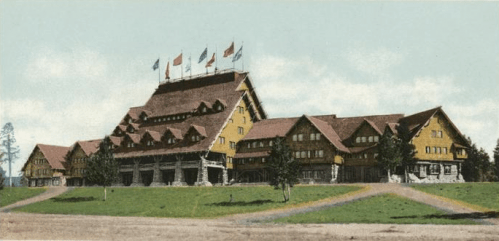
    Grand Geyser was erupting the last time I rode up to Old Faithful Inn for a book signing. I took the towering white plume of water and steam silhouetted against the pale blue sky as an auspicious sign. This will be a good day to sell books, I thought.

    I’ll be in the lobby of the famous inn again on Friday and Saturday (Aug. 10 and 11) from 10 a.m. to 3 p.m. to sign my book Adventures in Yellowstone. Look for me by the clock that tells the next time Old Faithful is expected to erupt. There’ll be an easel with a a description of my book, my biography and a photo of me.

    The last time I was there, I checked in at the gift shop where employees greeted me like an old friend and helped me set up. (It was the fourth time I’ve done book signings at the Inn.) Soon, I was seated behind a table smiling as passers-by and enticing them to buy my book.

    I adjusted to the rhythm of the place, which is governed by Old Faithful’s 90-minute cycle. The lobby is nearly empty when the geysers plays. Then it fills with a rush of people searching for the restrooms, awing over the magnificent lobby and milling around. When things thin out a bit is the best time to sell books.

    I noticed that during slack times—even while Old Faithful was playing—there were a few people who were eager to talk about the stories in my book. I began asking questions and discovered that many of them were tour bus drivers looking for stories to tell their clients during the rides between sights.

    I told them that my book has stories about many of the famous people and events in Yellowstone history. Emma Cowan’s story of being captured by Indians would be one to tell when driving by Nez Perce Creek. Truman Everts’ 37-day ordeal of being lost lost alone in the Yellowstone wilderness would a good one near Yellowstone Lake. And crossing Dunraven Pass, why, the Earl of Dunraven’s hilarious description of how to pack a mule or one of his exciting hunting stories.

    “if there aren’t enough stories in my book,” I said, “you should check out my blog. There are more than hundred tales there.”  When I gave examples, I mentioned William Henry Wright’s efforts to photograph grizzlies at night with flash powder.  ”That’s great,” the bus driver  said, “sometimes I have a whole busload of photographers.”

    When I asked about her current load, she sighed. “Children,” she said, “lots of children.”

    “They’d love Ernest Thompson Seton’s ‘Johnny Bear,’” I replied, and she headed back to her bus to read it.

    So if you’re at Old Faithful Inn on Aug. 10 or 11, I’d love to see you. I’d be glad to sigh a copy of Adventures in Yellowstone for you and talk about park history. And if you miss me then you’ll have another chance. I’ll be back for another book signing the weekend of Aug. 25-26.

    ∞§∞

    — Read about another book signing at Old Faithful Inn here.

    — Image, Postcard of Old Faithful Inn, c, 1906. New York Public Library.

  • Moran’s Legacy 2: Mammoth Hot Springs — Text by Edwin J. Stanley, 1883

    “Hot Springs of the Yellowstone,” Thomas Moran 1871

    Mammoth Hot Springs was the first major feature Thomas Moran encountered when he toured Yellowstone Park in 1871 with the Hayden Expedition. Moron’s diary entries for the three days he spent at Mammoth contain not a word of description. Apparently he was content relying on his watercolor sketches.

    Of course, many travelers did offer written descriptions of the springs. Here’s one by Edwin J. Stanley, a writer, historian, and Methodist minister, who visited Yellowstone Park in 1873.

    ∞§∞

    I came suddenly out in full view of the far famed Hot Springs. Having read glowing descriptions of the place, and being rather despondent from the fatigue of travel, I felt somewhat disappointed, and feared my expectations would not be fully met; but all such impressions vanished at first view of the strangely-beautiful scene, and I felt that the half had not been told, though the sun was obscured by clouds, depriving me of much of the inspiration that the first view would otherwise have furnished.

    The proprietors of the place, two young gentlemen from Bozeman, anticipating the value of these springs as a place of resort for pleasure-seekers and invalids, had taken possession of them before the passage of the bill including them in the National Park, and styled them the Mammoth Hot Springs. But Dr. Hayden, the United States Geologist, doubtless moved by the first impression made upon his mind on arriving here, gave them the title of White Mountain Hot Springs.

    Both titles are quite appropriate, considering their mammoth proportions—surpassing anything of the kind yet discovered—and the vast mountain of white and yellowish deposit made from the mineral solutions contained in the immense volumes of water gurgling up from scores of boiling fountains. This immense calcareous formation, with its numberless and intricate phenomena, baffling all attempts at description, is the chief object of interest here.

    The first impression on beholding it is that of a snowy mountain beautifully terraced, with projections extending out in various directions, resembling frozen cascades, as though the high, foam-crested waves, in their rapid descent over the steep and rugged declivity, were suddenly arrested and congealed on the spot in all their native beauty. There are fifty or sixty of these springs of greater and smaller dimensions, extending over an area of about a mile square; though there are remains of springs of the same kind for miles around, and mountains of the same deposit overgrown with pine-trees, perhaps hundreds of years old.

    Most of the water is at boiling heat, and contains in solution a great amount of lime, sulphur, and magnesia, with some soda, alumina, and other substances, which are slowly deposited in every conceivable form and shape as the water flows along in its course down the mountain-side.

    On each level, or terrace, there is a large central spring, which is usually surrounded by a basin of several feet in diameter, and the water, after leaving the main basin at different portions of the delicately-wrought rim, flows down the declivity, step by step, forming hundreds of basins and reservoirs of every size and depth, from a few inches to six or eight feet in diameter, and from one inch to several feet in depth, their margins beautifully scalloped with a finish resembling bead-work of exquisite beauty. The character of the formation depends upon the temperature and flow of the water, as well as upon the character of prevailing minerals at that particular place. Where the water flows slowly, and with but slight ebullition, the smaller basins and terraces are formed, one below the other, with their delicate partitions and beautifully-fringed borders; and where the volume and momentum are greater, the basins are larger and deeper, and the ornamentation proportionately coarser.

    Where the water flows quite rapidly, the pools are filling up, leaving the deposit in wave-like forms, just like water congealed when flowing over a cascade. Underneath the sides of many of the basins are beautifully-arranged stalactites, formed by the dripping of the water; and, by digging beneath the surface at places where the springs are inactive, the most delicate and charming specimens of every character and form can be obtained—stalactites, stalagmites, grottoes, etc., all delicately arranged as the water filtrates through the crevices and perforations of the deposit. The larger pools, before the erection of bathing-houses, afforded a splendid opportunity to enjoy the luxury of bathing, as water of any temperature desirable could be secured. The sides of the mountain for hundreds of yards in extent are covered with this calcareous incrustation, formerly possessing all the ornamental attractions of the springs now in action. It is a scene sublime in itself to see the entire area with its numerous and terraced reservoirs, and millions of delicate little urns, sparkling with water transparent as glass, and tinged with many varieties of coloring, all glistening under the glare of a noonday sun. But the water is constantly changing its channel, and atmospheric agencies have disfigured much of the work, leaving a great portion of it only the resemblance of an old ruin.

    Every active spring or cluster of springs has its succession of little urns and reservoirs extending in various directions. The largest spring now active, situated about half-way up the mountain on the outer edge of the main terrace, has a basin about twenty-five by forty feet in diameter, in the centre of which the water boils up several inches above the surface, and is so transparent that you can, by approaching the margin, look down into the heated depths many feet below the surface. The sides of the cavern are ornamented with a coral-like formation of almost every variety of shade, with a fine, silky substance, much like moss, of a bright vegetable green, spread over it thinly, which, with the slight ebullition of the water keeping it in constant motion, and the blue sky reflected in the transparent depths, gives it an enchanting beauty far beyond the skill of the finest artist. Here all the hues of the rainbow are seen and arranged.so gorgeously that, with other strange views by Which one is surrounded, you almost imagine yourself in some fairy region, the wonders of which baffle all attempts of pen or pencil to portray them.

    Besides the elegant sculpturing of this deposit, imagine, if you can, the wonderful variety of delicate and artistically-arranged colors with which it is adorned. The mineral-charged fluid lays down pavements here and there of all the shades of red, from bright scarlet to rose-tint, beautiful layers of bright sulphur-yellow, interspersed with tints of green—all elaborately arranged in Nature’s own order. Viewed from the Tower Creek trail, which passes at the base, this section of the mountain has a very architectural appearance.

    But descending the mountain from which we first beheld the springs, and where we left the reader, we come to the first level, or terrace, the base of the principal formation. There are several springs, the water of which is used by the scores of invalids already flocking here to be healed of their maladies. Here, also, are the small bath-houses erected by the proprietors, for the use of which a handsome sum is generally exacted. The medicinal properties of each fountain seem to be different, and the invalid can use that best adapted to his case. Just over there to our right, in the mouth of a little gorge, coming down from the mountain, by the side of the sparkling brook of snowwater, among the pine-trees, where the smoke is curling up from many fires, are the camps of the tourists and invabds who have come hither, and are abiding in rudely-constructed cabins, some in tents, enjoying all the luxuries of camp-life. Rather a motley, though quite a lively, group. Some remarkable cures have been effected here, mostly of diseases of the skin, and rheumatism. But I think that the invigorating mountain-air and the healthful influence of camp-life have much to do with many cures that are effected, as these are known to be wonderful remedies in themselves for many of the ills which flesh is heir to.

    ∞§∞

    — From Edwin James Stanley, Rambles in Wonderland, Or Up The Yellowstone, New York: D. Appleton and Company, 1883.  pages 54-58.

    — Coppermine Photo Gallery Image.

    — You might also enjoy Edwin J. Stanley’s “Guiding the Nez Perce Through Yellowstone Park.”

  • Moran’s Legacy 1: Paintings of the Yellowstone Wonderland

    The Grand Canyon of the Yellowstone by Thomas Moran

    This post begins a series on the legacy of Yellowstone images left by Thomas Moran. Moran accompanied the famous 1871 Hayden Expedition to the area that became Yellowstone National Park a year later. He did studies and water color sketches of more than thirty sights.

    Later he produced dramatic oil paintings like “The Grand Canyon of the Yellowstone.” The U.S. Congress purchased this twelve-by-seven-foot painting and hung it in the U.S. Capital. It’s now on view at the Smithsonian. 

    Images by Moran (along with photographs by William Henry Jackson) were distributed to members of the U.S. Congress before the vote to make Yellowstone the world’s first national park.  While Moran’s images are credited with stimulating the affirmative vote, he didn’t consider himself a documentarian. Here’s Moran’s description of his philosophy of art.

    ∞§∞

    Thomas Moran

    I place no value upon literal transcripts from Nature. My general scope is not realistic; all my tendencies are toward idealization. Of course, all art must come through Nature: I do not mean to depreciate Nature or naturalism; but I believe that a place, as a place, has no value in itself for the artist only so far as it furnishes the material from which to construct a picture.

    Topography in art is valueless. The motive or incentive of my ‘ Grand Canon of the Yellowstone’ was the gorgeous display of color that impressed itself upon me. Probably no scenery in the world presents such a combination. The forms are extremely wonderful and pictorial, and, while I desired to tell truly of Nature, I did not wish to realize the scene literally, but to preserve and to convey its true impression.

    Every form introduced into the picture is within view from a given point, but the relations of the separate parts to one another are not always preserved. For instance, the precipitous rocks on the right were really at my back when I stood at that point, yet in their present position they are strictly true to pictorial Nature; and so correct is the whole representation that every member of the expedition with which I was connected declared, when he saw the painting, that he knew the exact spot which had been reproduced.

    My aim was to bring before the public the character of that region. The rocks in the foreground are so carefully drawn that a geologist could determine their precise nature. I treated them so in order to serve my purpose. In another work, ‘The Mountain of the Holy Cross,’ the foreground is intensely realistic also: its granite rocks are realized to the farthest point that I could carry them; and the idealization of the scene consists in the combination and arrangement of the various objects in it. At the same time, the combination is based upon the characteristics of the place.

    My purpose was to convey a true impression of the region; and as for the elaborated rocks, I elaborated them out of pure love for rocks. I have studied rocks carefully, and I like to represent them.”

    ∞§∞

    Thomas Moran quotation from G. W. Sheldon, American Painters: With Eighty-Three Examples of Their Work Engraved on Wood. New York: D. Appleton and Company, 1879. pages 125-126.

    — Moran portrait is a detail from a Wikipedia Commons photo.

    — You might also enjoy “Thomas Moran Painted His Impression of the Grand Canyon of the Yellowstone.”

  • Moran’s Legacy 1: Paintings of the Yellowstone Wonderland

    The Grand Canyon of the Yellowstone by Thomas Moran

    This post begins a series on the legacy of Yellowstone images left by Thomas Moran. Moran accompanied the famous 1871 Hayden Expedition to the area that became Yellowstone National Park a year later. He did studies and water color sketches of more than thirty sights.

    Later he produced dramatic oil paintings like “The Grand Canyon of the Yellowstone.” The U.S. Congress purchased this twelve-by-seven-foot painting and hung it in the U.S. Capital. It’s now on view at the Smithsonian. 

    Images by Moran (along with photographs by William Henry Jackson) were distributed to members of the U.S. Congress before the vote to make Yellowstone the world’s first national park.  While Moran’s images are credited with stimulating the affirmative vote, he didn’t consider himself a documentarian. Here’s Moran’s description of his philosophy of art.

    ∞§∞

    Thomas Moran

    I place no value upon literal transcripts from Nature. My general scope is not realistic; all my tendencies are toward idealization. Of course, all art must come through Nature: I do not mean to depreciate Nature or naturalism; but I believe that a place, as a place, has no value in itself for the artist only so far as it furnishes the material from which to construct a picture.

    Topography in art is valueless. The motive or incentive of my ‘ Grand Canon of the Yellowstone’ was the gorgeous display of color that impressed itself upon me. Probably no scenery in the world presents such a combination. The forms are extremely wonderful and pictorial, and, while I desired to tell truly of Nature, I did not wish to realize the scene literally, but to preserve and to convey its true impression.

    Every form introduced into the picture is within view from a given point, but the relations of the separate parts to one another are not always preserved. For instance, the precipitous rocks on the right were really at my back when I stood at that point, yet in their present position they are strictly true to pictorial Nature; and so correct is the whole representation that every member of the expedition with which I was connected declared, when he saw the painting, that he knew the exact spot which had been reproduced.

    My aim was to bring before the public the character of that region. The rocks in the foreground are so carefully drawn that a geologist could determine their precise nature. I treated them so in order to serve my purpose. In another work, ‘The Mountain of the Holy Cross,’ the foreground is intensely realistic also: its granite rocks are realized to the farthest point that I could carry them; and the idealization of the scene consists in the combination and arrangement of the various objects in it. At the same time, the combination is based upon the characteristics of the place.

    My purpose was to convey a true impression of the region; and as for the elaborated rocks, I elaborated them out of pure love for rocks. I have studied rocks carefully, and I like to represent them.”

    ∞§∞

    Thomas Moran quotation from G. W. Sheldon, American Painters: With Eighty-Three Examples of Their Work Engraved on Wood. New York: D. Appleton and Company, 1879. pages 125-126.

    — Moran portrait is a detail from a Wikipedia Commons photo.

    — You might also enjoy “Thomas Moran Painted His Impression of the Grand Canyon of the Yellowstone.”

  • A Tale: Gunshot Man Crawls to Safety — George Cowan, 1877

    George Cowan was a 35-year-old attorney from Radersburg, Montana, when he toured Yellowstone Park in August 1877 with his family and friends. That year the Nez Perce passed through the park after fleeing their homeland to make a new life in the buffalo country.

    The Radersburg party was getting ready to go home when a band of Nez Perce captured them. After the Nez Perce shot George Cowan and left him for dead, he regained consciousness only to find himself alone in the wilderness. Despite George’s grievous wounds, his first thought was for the safety of his wife. Here’s his tale of crawling a dozen miles to find help.

    ∞§∞

    George F. Cowan

    In about two hours, I began to come back to life, and as I did so my head felt benumbed. The feeling as near as I can express it was a buzzing, dizziness, and the sensation increased as it grew lighter and lighter. I began to feel soon and then my reason came back to me. My head felt very large, seemingly as large as a mountain, and I mechanically raised my hand and began feeling my face and head. I found my face covered with blood and my hair clotted with blood that had cooled there. I then realized the incidents of the day and remembered the shooting.

    I could not at first discover where I was wounded, but after getting the blood out of my eyes and pulling my hat off with hair and skin sticking to the clotted blood, I discovered that I was shot in the face and head. Running my had over my head, I found great gashes in the scalp, and I then thought the ball had passed entirely through my head some way. Feeling my leg, I found it completely benumbed, but there were no bones broken.

    I again felt the intolerable pangs of thirst, raised myself on my elbow, and looked about me. I then found that I was some ten or twelve feet from the place of shooting. This, I thought, accounted for the wounds in the back of my head. As far as I could see, the Indians were all gone and I could hear nothing but the moaning of the wind in the trees.

    Standing near me was a little pine tree the boughs of which I could just reach, and grasping one, I pulled myself to my feet. My wounds were painful now. As I raised up I saw an Indian close by me sitting on his pony watching me. As I was hobbling away, I glanced backward and saw him on one knee aiming his gun at me. Then followed a twinging sensation in my left side, and the report of the gun and I dropped forward on my face. The ball had struck me on the side above the hip and came out in front of the abdomen.

    I thought that this had “fixed me” beyond hope of recovery and I lay perfectly motionless expecting the Indian to finish the job with the hatchet.

    I must have lain here fully twenty minutes expecting to die every moment, and during the time, I think my mind must have dwelt on every incident of our trip. I supposed my wife had been killed. I knew the fate she and Ida would be subjected, and my whole nature was aroused as I thought of it.

    Directly I heard Indians talking. The were coming up the trail and I could hear them driving numbers of loose horses. They passed within forty feet of me, but I was unnoticed and they were soon out of hearing. I waited for a few moments, then turned over and took a look around me.

    I now took another inventory of my wounds, and in trying to rise found that I could not use either of my lower limbs. They were both paralyzed. I then turned up my face and began crawling by pulling myself with my elbows. I thus managed to get into some willows where I found water which I drank eagerly, and felt greatly refreshed and strengthened. I now began crawling as before, pulling myself on my breast with my elbows. In this way, I crawled to a little stream of warm water, and raised up on my hands and entered the water. I immediately sank to my shoulders in the mud, and the water came up to my chin.

    This would not do, so extricating my hands, I again began crawling as before, and found that I could thus cross it. Having crossed it, I entered the willows on the bank, and began crawling down stream and followed it until I struck the East Fork about a half mile below where I started from. It was now about one or two o’clock in the morning and being completely exhausted I lay down and rested until daybreak.

    At dawn, I again started and crawled until noon, when I again stopped to rest. I had been here but a few moments when I again heard Indians approaching, coming down the trail. They passed within ten feet of me and were soon out of hearing.

    I lay here for an hour or so and again resumed my wearisome journey. By nightfall, I had made four or five miles, and I kept on during the night, resting at short intervals.

    I kept on down the trail, or rather by the side of it, and Indians kept passing by me every little while, driving ponies as they went. I could hear them approaching and then I would lie down and wait till the passed.

    I kept this up until Monday morning, have crossed the East Fork Sunday night, and reached the wagons we had abandoned on Friday. I had crawled about nine miles in sixty hours.

    As I reached the wagon, I found my faithful dog, Dido, laying beneath it. I called to her, and see came bounding to me, and covered my face and wounds with caresses. The pleasure of the meeting was mutual.

    The buggy was laying upon the ground, all of the spokes having been taken from two of the wheels, and I could search it without rising. I found some rags, a portion of a man’s underclothing, which were very acceptable, but I could find nothing to eat.

    It occurred to me that I had spilled some coffee when in camp, on Thursday in the Lower Geyser Basin, and calling my dog we started for it, I crawling as before, and the dog walking by my side. The coffee was four miles distant, but I thought not of that. The only idea was to possess the coffee. I was starving.

    While crawling along close to the trail, my dog stopped suddenly and began to growl. I grasped her by the neck, and placed my hand over her nose to keep her from making noise. Peering through the brush, I saw two Indians sitting beneath a tree but a few feet from me. I began moving back cautiously and made a circuit around them, keeping the dog close by me. I thus avoided them, and reached the Lower Geyser Basin on Tuesday night.

    Here, as I anticipated, I found some coffee, and a few matches. I found about a handful of coffee, and placing it in an empty can that I had found, I pounded it up fine. I then got some water in another empty can that, that had contained molasses, and building a fire, I soon had some excellent hot coffee that refreshed me greatly. This was my first refreshment that I had taken in five days and nights.

    I now began calculating my chances for being picked up. I would not starve, as I could, as a last resort, kill my dog and eat it. I shudder now, as I think of sacrificing my noble, faithful dog, one that money cannot purchase now, but circumstances were such that I did not view it then as I do now. The natural desire for life will force one to any necessity.

    I remained where I was Tuesday night. No one can imagine my thoughts during that time. I supposed that I was the only one of the party left, unless it be my wife, and the speculations upon her fate almost set me mad. It was horrible. All night long I lay there suffering instead of resting, and I hailed with pleasure the break of day.

    I made some more coffee, and drank it, which seemed to give me renewed strength, but as my strength returned I felt more keenly the horrors of my position. I thought now I would crawl to where the East Fork empties into the Fire Hole River, so calling my dog I began my journey.

    I found that I was gradually growing weaker, as I could now crawl but a little ways when I would be compelled to stop and rest. At about a mile and a half distant I came to the place of our first night’s camp on entering the basin. Here again, I had to cross the river, but as the water was not deep, I made it without mishap. Here I rested for a few moments, before starting for the timber, which was about a fourth of a mile distant. I got there about two o’clock in the afternoon, and laid down under a tree and some brush close to the road. I was now exhausted and could go no farther. It was an expiring effort, and having accomplished it I gave myself up for dead.

    In about two hours, I hear the sound of horses coming, but so completely tired out was it that I did not care whether they were Indians or not. My dog began to growl, but I did not try to stop her. The horses drew nearer, and approached and stopped. The riders had seen me. I looked up and saw that they were white men. They alighted and came to me, and one of them asked: “Who are you?”

    I replied that my name was Cowan, and asked them if any news had been received of my wife. They replied that there had not been, and I then cared for nothing further. I turned from them and would have been glad to have died.

    One of them kept talking to me, and asking questions that I cared not to answer, while the other built a fire and made some coffee for me. The told me that they were scouts from Howard’s command, and that the troops would reach me some time during the next day. They left me some “hard tack” and a blanket, and went on to the scene of the massacre to find the bodies of the party. After they were gone and I had eaten, my desire for life returned, and it seems the spirit of revenge took complete possession of me. I knew that I would live and I took a solemn vow that I would devote the rest of my life to killing Indians, especially Nez Perce.

    I laid here until Thursday afternoon, when I heard the sound of approaching cavalry, and shortly afterwards General Howard and some of his officers rode up to me. In a few minutes, I saw Arnold coming. He came up, recognized me, and knelt beside me. We grasped hands, but neither spoke for some minutes. I could only gasp: “My wife!”

    “No news yet, George,” he replied.

    ∞§∞

    The Army took George with them as they pursued the Nez Perce across the roadless wilderness of Yellowstone Park.  He survived the ordeal and was reunited with wife three weeks after he was found.

    — Condensed from George F. Cowan’s account in Frank D. Carpenter, The Wonders of Geyserland, Black Earth, WI: Burnett and Son, 1878, pages  143-148.

    — Image from Progressive Men of the State of Montana.

    — For more stories about tourists’ encounters with the Nez Perce in Yellowstone Park, click “Nez Perce” under the “Categories” button to the left.

    — I’m working on a book about the Nez Perce and tourists, Encounters In Yellowstone.