Author: mmarkmiller

  • A Tale: The Antelope That Got Away — Dunraven, 1874

    While returning from Yellowstone Park in 1874, the Earl of Dunraven discovered he was running out of “grub.” Hunting for food in the Park was legal then, so he decided to replenish the larder by bagging an antelope. He went hunting with pioneer rancher and Yellowstone guide, Fred Bottler, and a helper named Wynn.
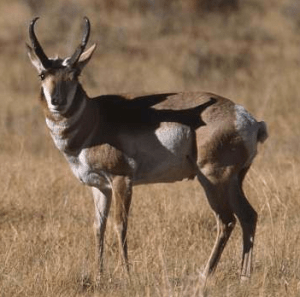
    While the trio was pursuing a large buck, a ferocious hail storm forced them to take cover under a pine tree. When the storm abated, Dunraven spotted the buck, tried a long shot and missed. Here’s his story of what happened after that.

    ∞§∞

    It was blowing so hard, and there was such a noise of storm, that there was no danger of the shot having disturbed anything, and so, as the country looked very gamey, we walked on, leading the horses. Presently we came upon a little band containing six antelopes.

    We were by this time near the summit of a long sloping mountain. The ground fell away rapidly on either side, and in a long but narrow glade the antelopes were lying. While we were peering at them, two does—nasty inquisitive females—got up, walked forward a few steps and stared too. We remained still as statues, and after a while they appeared satisfied and began to crop the grass. We then left our ponies, and signing to Wynne, who just then hove in sight, that there was something ahead, and that he was to catch them, hastened up under cover of some brush.

    By the time we reached the tree nearest to them we found the does had all got up and fled to some distance, but a splendid buck with a very large pair of horns was still lying down. At him I fired, and nailed him. He gave one spring straight into the air from his bed, fell back into the same spot, kicked once or twice convulsively, and lay still. I fired the second barrel at a doe and struck her, for she “pecked” almost on to her head, but she recovered and went on.

    Out we rushed: “Never mind the dead one,” shouts Bottler, his face all aglow; “let’s get the other; she’s twice as good, and can’t go far. You take one side of that clump and I will take the other.” So off we set, best pace, bursting up the hill after the wounded doe. We followed her for half an hour, running our level best, and got each a long shot, but missed; and, as she was evidently quite strong, we gave up the chase and walked back.

    We found Wynne driving up the ponies; and as he appeared to have some little trouble with the poor beasts, rendered sulky and ill-tempered by the wet and cold. I said to Bottler, “You go down and help him, and I will butcher the buck.”

    I had scarcely got the words “butcher the buck” out of my mouth, when the darned thing, apparently not appreciating my intentions, came to life, bounded to his feet, sprang into the air, coming down all four feet together, and, with his legs widely extended, gave a phwit—a sort of half whistle, half snort of surprise, I suppose at his own resurrection—stared a second, and made off.

    “Shoot, Bottler,” I cried, “shoot. In Heaven’s name, man, can’t you see the buck?” and I threw up my own rifle and missed him of course. “By George,” says Bottler, wheeling round, “look at the  ___;” and he let go at him with the same result.

    Wynne yelled and dropped the lariats; Bottler ejaculated terrible things; and I also, I fear, made use of very cursory remarks. But neither for swearing, shouting, nor shooting would he stop. He ran about fifty yards, fell on his head and rolled over and over, jumped up again, ran one hundred yards, pitched head over heels the second time, got up, and went down the hill as if he had never felt better in his life.

    We followed of course, and wasted an hour in searching for him in vain. Never again will I pass a beast, however dead he may appear to be, without cutting his throat by way of making sure.

    ∞§∞

    — Excerpt from Hunting on the Yellowstone by the Earl of Dunraven.

    — Image from the Coppermine Photo Gallery.

    — For more stories about The Earl of Dunraven, click on “Dunraven” under the “Categories” button to the right.

    — You can read more of Dunraven’s stories in my book, Adventures in Yellowstone: Early Travelers Tell Their Tales.

  • A Tale: Rafting Across the Yellowstone to View the Canyon From Artist Point — Holmes, 1896.

    The View from Artist Point

    In 1896 the famous lecturer, film maker and writer, Burton Holmes, visited Yellowstone Park. Holmes, who coined the word “travelogues” wrote about his Yellowstone trip in Volume 6 of his ten-volume series by that name.

    After describing the Grand Canyon of the Yellowstone from several vantage points on the north rim, Holmes told this story about crossing the Yellowstone River on a crude raft made of logs to see the lower fall from “Artist Point.”

    ∞§∞

     Most travelers are content to view the canyon from the points to which I have already led you. Others remain unsatisfied until they have looked into the great chasm from “Artists’ Point,” the one perfect point of view, which is unfortunately on the other bank, and in 1896 was well nigh inaccessible.

    There was no bridge; the crossing of the river below the falls was utterly out of the question; but there remained the possibility of crossing far above the upper gorge, where the waters, although swift-flowing, present a level, navigable surface. But there has not been a boat upon the river since the last one, very fortunately empty, was swept away and dashed to pieces by the cataracts. No boat! No bridge!

    The river being now too deep and swift to ford, I turn in my difficulty to the gallant soldiers of Uncle Sam, who are stationed at the canyon. The sergeant in command at the little military camp enthusiastically comes to my assistance, and at sunrise next morning I find him a little way above the rapids, slowly poling upstream a raft, which he has built expressly for our excursion.

    Rafting Across the Yellowstone

    At last, we reach a point from which he deems it safe to put out into the current, where the waters, swift as those of a millrace, are gliding on in their eagerness to plunge into the yawning canyon, just one mile beyond. There was, of course, no actual danger, yet the thought was ever present that our raft, if left to its own devices, would at once follow unresistingly that treacherous flood, bound through the rapids and plunge over the first fall, then dash through the upper canyon, and finally meet annihilation in the whirlpools at the bottom of the great cataract.

    In safety, however, we arrive on the farther shore. Then we skirt the right bank through a thick growth of pine, and while we are walking through the forest, thundershowers come and go with great frequency and fury.  We are soon drenched to the skin, but pressing on we reach the edge of the forest; the earth appears to open at our feet, and the canyon yawns before us, deep and mysterious. Vapors are surging upward from its depths, but fortunately, the sun is beginning to break through the clouds above.

    A shaft of sunshine touches a portion of the opposing wall, and another brilliantly illuminates the pinnacles of white and gold, while others chase the vapors rapidly away. The fears that rain and fog will render our excursion fruitless are dispelled, as, reaching another point of view, we exchange salutes with friends on the other rim.

    We shout to them, they shout to us; but the sounds meet only halfway and then fall into the depths between. We cannot hear, nor are we ourselves heard. The river’s rumbling mocks our puny efforts to span the deep chasm with a bridge of vocal sound. We must attempt to span it with our gaze.

    Few of the great sights of this world have power to thrill us more than this vista of the canyon of the Yellowstone. We are unable to tell what most impresses us: the immensity of the great gulf, the infinite glory of its colored walls, the struggling river far below, the stately army of tall pines massed on the brink and pressing forward, apparently as eager as we to drink in all the splendor of the scene.

    All these things go to compose the scene, to form that indefinable majesty that inspires us—to hold our peace. Silence is the only eloquence that can avail us here. No man has yet found language to express the majesty of this abyss of color. But, we ask, will no voice ever perfectly express in words what we all feel but dare not, cannot speak? Will no great poet of the new world, inspired by these grandeurs, ever utter the immortal song in which our vaguest thoughts shall find interpretation? Great, great indeed must be the soul of him who would give adequate expression to the reverential awe inspired by a scene like this.

    But what is man that he should strive to utter the unutterable? The emotions that overwhelm us here can be expressed only in one language, and that is not a mortal language; it is the language of those to whom all mysteries have been revealed—the great eternal, wordless language of the soul: a language that we may not understand until the gates of death have closed behind us.

    ∞§∞

    —   From Burton Holmes Travelogues, Volume 6, The McClure Company: New York, 1905. (Pages 104-112)

    —   Artist Point Postcard by F.J. Haynes. Coppermine Photo Gallery.

    —  Photos of rafting across the Yellowstone River by Burton Holmes, Travelogues, Volume 6.

    — You might also enjoy:

  • A Tale: Rolling Boulders Down Gardiner Canyon — Wingate, 1885

    In the summer of 1885, General George W. Wingate took his wife and daughter through Yellowstone Park. Although the system of roads was complete by then, the Wingates decided to make their tour on horseback, the better to see the sights. The General, who was a civil war veteran and later president of the National Rifle Association, wrote a charming book about his adventures in the park. Here’s an excerpt.

    ∞§∞

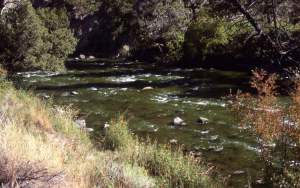
    The Gardiner River

    The 19th being Sunday, the ladies rested in camp, while I took our three men and rode to the Middle Falls of the Gardner. There was no road; merely a blazed trail through the woods, which we had to hunt up. This involved fording the river and considerable skirmishing among fallen timber, and in and out of places where I would never have dreamed at the East of venturing on horseback. Finally, the trail (probably an old elk runway) was found. It was just wide enough for a horse to get through, and led us up the mountain by a comparatively easy grade, but along a precipice, with yawning depths, to glance into which was sometimes quite startling. But we were rapidly becoming accustomed to that sort of thing and took it as naturally as our ponies did.

    After a steady climb of four miles, we found ourselves on the edge of a canyon overlooking the falls. It was a magnificent and most picturesque sight. Mr. Winson’s very accurate guide book gives the depth of the canyon at from 1,200 to 1,500 feet. I think this is an error as this would be deeper than the Great Canyon (which the same authority gives at 1,200 feet) and I should think the latter was considerably the deepest. But whatever the measurement, it is of appalling depth, about 500 yards wide at the top and very narrow at the bottom, not to exceed 150 feet. The sides drop from the brink above in almost perpendicular ledges, as steep as the Palisades on the Hudson River and four times their depth. Into this cleft in the rocks, the river plunges in one unbroken fall of over a hundred feet and then continues its fall in a scries of cascades to the bottom of the dark chasm. The white fall, the tumbling water, and the dark shadows of.the canyon, make a striking picture.

    After fully enjoying the scene, we amused ourselves by rolling large rocks over the cliff. It was wonderful to see a stone the size of a trunk leap into the air in a plunge of 200 or 300 feet, strike the shelf below as if thrown by a catapult, and with such tremendous force as to rebound twenty feet, and after a series of such terrific bounds, make another tremendous leap to the slope below, continuing in bound after bound until it reached the creek, growing smaller and smaller at each movement until it seemed no larger than a foot-ball.

    While indulging in this boyish sport a faint shout came up from below signifying that there was some one down in the canyon. It is unnecessary to say that we at once stopped the stone rolling. Looking down we saw a party of fishermen from the hotel dodging up the bottom of the canyon with great celerity and evident anxiety as to whether any more stones might be expected. So great was the depth, that they looked like children.

    While watching them, Horace’s hat blew off and lodged in the shelf at the foot of the cliff at the brink of which we were standing. It seemed only a short way down, and we undertook to fasten the picket ropes of the horses together so as to aid him to descend, but found they would not begin to reach the distance. Horace was determined to have his hat, and with regular western recklessness started to climb down.

    By selecting places where the fragments from the sides of the canyon had formed a slope, and clinging to the trees and shrubs, he managed to work his way to the shelf below, and up on that to his beloved head-gear. He had to go so far down that he appeared only half his natural size.

    The exploit was more hazardous than we imagined. Mr. Davis, of the Northern Pacific Railroad, as I was afterwards told, undertook to climb up near that very spot only a day or two before. The loose stone slid under his feet, as is common in mountain climbing, but which, though fatiguing, is not dangerous if one keeps moving. Finally, he climbed out on a large boulder, the size of a small house, to look around. Suddenly he discovered that it too was in motion. He slid along upon it for some distance expecting it would roll at every instant, when fortunately, it passed so near a tree that he was enabled to spring into the branches, while the boulder went crashing downwards for a thousand feet, snapping the trees like pipe stems in its course.

    ∞§∞

    — From George Wood Wingate, Through the Yellowstone Park on Horseback. Judd and Judd: New York, 1886. Pages 79-81.

    — Photo, Coppermine Photo Gallery.

    You might also enjoy:

  • Happy Thanksgiving!

    Photo from the Brook Collection, Montana State University Library
    Photo from Brook Collection, Montana State University Library
  • A Scene: The Great Falls of the Yellowstone — Washburn, 1870

    For decades trappers and prospectors told about the wonders in the upper Yellowstone, but their reports usually were dismissed as tall tales and few people visited the remote area. But interest soared within a year of the Washburn Expedition’s return after their exploration in 1870.

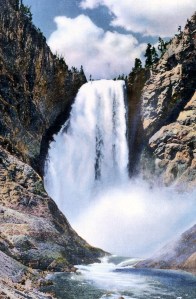
    Lower Falls of the Yellowstone

    Soon the race was on for tourists dollars with Bozeman businessmen building a road up Yankee Jim Canyon on the north and their Virginia City counterparts  doing the same over Targhee Pass on the west. Tourists began arriving before the roads were done. Also, entrepreneurs were building hotels and bathhouses and planning stagecoach service.  

    The reason the Washburn Expedition generated interest while earlier groups had failed was that it included prominent men whose word couldn’t be doubted—and several of them were skilled writers who published their reports immediately in Montana newspapers. One of these writers, was Henry Washburn himself. He was a distinguished Civil War officer and Surveyor General of Montana Territory. Here’s an excerpt describing the Great Falls of the Yellowstone from the report  Washburn wrote for the Helena Daily Herald just days after getting home.

    ∞§∞

    The party crossed over a high range of mountains and in two days reached the Great Falls. In crossing the range, from an elevated peak a very fine view was had. The country before us was a vast basin. Far away in the distance, but plainly seen, was the Yellowstone Lake: around the basin the jagged peaks of the Wind River, Big Horn, and Lower Yellowstone ranges of mountains; while just ever the lake could be seen the tops of the Tetons.

    Our course lay over the mountains and through dense timber. Camping for the night eight or ten miles from the falls, we visited some hot springs that, in any other country, would be a great curiosity, boiling up two or three feet, giving off immense volumes of steam, while their sides were incrusted with sulphur. It needed but a little stretch of imagination on the part of one of the party to christen them “Hellbroth Springs.”

    Our next camp was near the Great Falls, upon a small stream running into the main river between the upper and lower falls. This stream has torn its way through a mountain range, making a fearful chasm through lava rock, leaving it in every conceivable shape. This gorge was christened the’” Devil’s Den.” Below this is a beautiful cascade, the first fall of which is 5 feet, the second 20 feet. and the final leap 84 feet. From its exceedingly clear and sparkling beauty it was named “Crystal Cascade.”

    Crossing above the upper falls of the Yellowstone, you find the river one hundred yards in width, flowing peacefully and quiet. A little lower down it becomes a frightful torrent, pouring through a narrow gorge over loose boulders and fixed rocks, leaping from ledge to ledge, until, narrowed by the mountains and confined to a space of about 80 feet, it takes a sudden leap, breaking into white spray in its descent, 115 feet.

    Two hundred yards below, the river again resumes its peaceful career. The pool below the falls is a beautiful green, capped with white. On the right-hand side a clump of pines grows just above the falls, and the grand amphitheater, worn by the maddened waters on the same side, is covered with a dense growth of the same.

    The left side is steep and craggy. Towering above the falls, half-way down and upon a level with the water, is a projecting crag, from which the falls can be seen in all their glory. No perceptible change can be seen in the volume of water here from what it was where we first struck the river. At the head of the rapids arc four apparently enormous boulders, standing as sentinels in the middle of the stream. Pines are growing upon two of them. From the upper fall to the lower there is no difficulty in reaching the bottom of the canyon.

    The lower falls are about half a mile below the upper. where the mountains again, as if striving for the mastery, close in on either side, and are not more than 70 feet apart. And here the waters are thrown over a perpendicular fall of 350 feet.

    The canyon below is steep and rocky, and volcanic in its formation. The water, just before it breaks into spray, has a beautiful green tint, as has also the water in the canyon below. Just below, on the left-hand side, is a ledge of rock, from which the falls and the canyon may be seen. The mingling of green water and white spray with the rainbow tints is beautiful beyond description.

    The canyon is a fearful chasm, at the lower falls a thousand feet deep, and growing deeper as it passes on, until nearly double that depth. Jutting over the canyon is a rock 200 feet high, on the top of which is an eagle’s nest, which covers the whole top. Messrs. Hauser, Stickney, and Lieutenant Doane succeeded in reaching the bottom, but it was a dangerous journey. Two and a half miles below the falls, on the right, a little rivulet, as if to show its temerity, dashes from the top of the canyon, and is broken into a million fragments in its daring attempt.

    ∞§∞

    — From Henry Washburn, “The Yellowstone Expedition,” Helena Daily Herald, September 27 and 28, 1870.

    — Frank J. Haynes postcard, Yellowstone Digital Slide File.

    — You might also enjoy General Washburn’s description of geysers.

    — For more stories about the Washburn Expedition, click on “Washburn” under the “Categories” button to the left.

  • Twin Bridges To Play for Montana Football Championship

    Twin Bridges High School Football Team, c. 1930.

    I saw in today’s paper that Twin Bridges made it through the football semifinals and will play for the Montana Class C State Championship next week.

    I’m not a sports fan, but when my high school alma mater plays for a state championship, it grabs my attention. In high schools like mine that’s rare event—something that happens every 50 years or so.

    Twin Bridges plays in Montana’s Class C Athletic Division, which consists of high schools of about a hundred students. There are dozens of such schools in Montana so it’s hard to make it through the welter of playoffs to a state championship.

    In these tiny schools nearly every able bodied male—even a clumsy one like me—is on the football team. Even so, it can be hard to field an eleven-man team. The solution: eight-man football with three backs and five linemen. With a larger fraction of players allowed to handle the ball and a smaller field, eight-man is a dynamic game. Some say it’s more fun to watch than eleven-man.

    On Saturday, Twin Bridges beat Ennis in the semifinal 27 to 6. The highlights of the game must have been touchdown passes from quarterback Tyler Lott to Cole Miotke.  (Here’s the story from The Montana Standard.)

    Lott and Miotke must be the grandchildren of people I went to school with. Lott is probably a descendent of the brothers who built toll bridges across the Big Hole and Beaverhead rivers in the 1860s and founded Twin Bridges. The Miotkes are newcomers having arrived in the area about 50 years ago.

    The continuity of communities like Twin Bridges is part of what makes their sports so intense.  If you’re on the team, people probably will compare you not just to your older brother, but also to your uncle, or maybe even your grandfather. I wonder if this year’s team includes any descendents of Twin Bridges football team that played for the state championship on Thanksgiving Day, about 1952.

    I attended that game, but didn’t watch much of it.  A blizzard blew in the night before and temperatures hovered in the low teens on game day—with a stiff wind and blowing snow. It was so damn cold that I spent most of the game in the cab of my father’s truck.  He left the engine running and the heater on, so I got periodic reports from people who froze out and came to the truck to warm up.

    I wish I could remember those reports.  I suspect the game was mostly just the two teams bashing at each other up and down the frozen field. It was too cold and windy to risk a passing game, but I like to think that my brother, who was an end, snagged a dramatic pass that cinched the game.

    I wish this year’s team better weather and better luck this week.  Go Falcons! Beat Fairfield!

    ∞§∞

    —  Photo from the Brooks Collection, Montana State University Libraries.

  • A Tale: Pioneer Photographer Documents Hunting Expedition Near Yellowstone Park — 1889

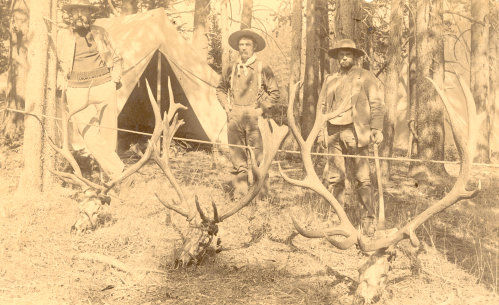
    Jack Bean (left) and a client near Jackson Hole, Wyoming, 1889.

    When I received my copy of the fall issue of the Pioneer Museum Quarterly last week, I was delighted to see an article about Charles D. Loughrey, a Bozeman pioneer photographerI had examined the museum’s collection of Loughrey’s photographs but didn’t know much about him.  

    Jacob Rubow of the museum staff dug through Loughrey’s diary and a reminiscence by his brother-in-law, Jack Bean, to glean stories from their lives. One of those stories was about a hunting trip where Bean guided two Englishmen through the park. Hunting inside the park was illegal then, so Bean took his clients to places nearby so they could bag their trophies. And Loughrey was on hand to document the magnificent specimens.

    I asked Jacob if I could post the hunting story on my blog. I’m delighted that he obliged.

    ∞§∞

    In August, 1889, two Englishmen, Messrs. Lennard and Beach, hired Jack Bean, a resident of Bozeman, Montana, to lead them on a hunting trip through Yellowstone National Park and points beyond. Bean, who then earned a living as a guide for hunters and the cavalry out of Fort Ellis, enlisted his friend and brother-in-law, Charles D. Loughrey, as cook and photographer for the expedition. Loughrey had once owned a photography studio in Bozeman, and although the venture was short lived, his photographs, combined with his dutifully-kept journals, have left behind a rarity among historical sources: an illustrated account of the Gallatin Valley and greater Yellowstone region as he saw it in the late nineteenth century. As a frequent companion on Jack Bean’s hunting trips, Loughrey captured striking views of remote corners of the Gallatin Valley, Yellowstone, and the Snake River and Tetons. His diary entries, which chronicle the daily pace of life in the late nineteenth century as well as his and Bean’s adventures in Yellowstone, run from concise to sparse, but, as the saying goes, his pictures are worth a thousand words.

    On August 8, Loughrey and Bean rode into Bozeman through a haze of late-summer smoke blown before a hard east wind. There, they purchased food and had their horses freshly shod. Loughrey spent the next two days busily repairing and fitting his camera with a new lens, packing supplies, and accompanying his wife Ida and family to town “to see a street dog show given by some medicine men.” Then, on the morning of August 11, Loughrey took a bath and set off through the clearing smoke to meet Bean and his assistant guides. The men camped that night amidst heavy thundershowers in the Gallatin Mountains, and spent the following night cussing the building smoke along the Yellowstone River. On the thirteenth, the party camped above the Yankee Jim Tollgate, and on the fourteenth Loughrey wrote a letter to Ida from their camp above Gardiner. While Bean and the other guides spent the next three days waiting in town for the Englishmen, Loughrey explored Mammoth Hot Springs and claimed the hunting party’s first victim, a rattlesnake.

    On Sunday, August 18, with Englishmen in tow, the expedition crossed into the park, camping first at Tower Falls, then spending a “very wet and disagreeable” night in a snowstorm downstream from the Lower Falls of the Yellowstone. A spell of clear, cold weather followed the snowstorm, and the group traveled quickly past the Grand Canyon and Falls, camped at Yellowstone Lake, and then paused at the Upper Geyser Basin on the 23rd. Loughrey lagged behind to take a view of Lewis Falls before exiting the park on the 25th, and rejoined the party later that afternoon at a camp near the Snake River. The enthusiastic hunters spent their first evening beyond the park boundary searching for elk, but returned to camp empty handed. Loughrey stayed in camp on the 27th, washing clothing and photographing the horses grazing beside a stream in a small park. The hunters went out, and Jack Bean “killed a cow elk, which caused great rejoicing in camp.”

    The men spent the next few weeks crisscrossing the area around the Tetons and Snake River, fishing with great success, but hunting with mixed results. They quickly settled into a routine, with the hunters and guides fishing and hunting in pairs most evenings, and Loughrey tending to the camp, cooking, washing clothing, and diligently maintaining his photographic equipment. The hunters pursued elk, deer, and pronghorn “with blood in their eyes,” and when they met with success Loughrey dutifully marched out to capture views of the hunters posing with their trophies, and to collect the antlers. In addition to these portraits of victorious hunters, Loughrey captured candid views of the men in camp, striking images of the Tetons rising above Jackson Lake, and scenic glimpses of the horses and pack animals grazing in mountain parks. On September 20, returning northward, the party passed through Rexburg, Idaho, where Bean purchased sugar and dried fruit. The next day, they reached Market Lake, and in a flurry of activity, Bean packed the Englishmen’s things while Loughrey made portraits of the group and sent a letter to Ida on the five o’clock train. The men ate dinner that night with Captain Head, with whom they “[drank] liquor and [ate] fruit till half past nine.” The Englishmen left on the three o’clock train the next morning. Loughrey, Bean, and company packed up “with the wind howling and all hands cursing,” and started for home, taking care not to “let any grass grow under the horses [sic] feet.”

    Despite a snowstorm and Loughrey’s brief bout with a bug that prevented his eating breakfast on the 24th, the party continued their rapid pace homeward. They camped at Henry’s Lake, then at a creek near the Upper Madison Basin. From there the men crossed over to the Gallatin River, and set off down the Canyon. The group made a final camp at Sheep Rock on September 29, reaching the Bean and Loughrey farms on Rocky Creek, east of Bozeman, at half-past-two the next afternoon. Bean and Loughrey arrived at Bean’s house to find their wives gone to town. The two ate dinner, and then went out to check the garden. Loughrey ran into the ladies on his way home, and returned with them to Bean’s house where they stayed all night. The following evening, the Beans and Loughreys took dinner in town with their in-laws, the Rowlands. On Wednesday, October 22, 1889, a clear day, Loughrey “pitch forked some potatoes before dinner,” “cleaned the chicken house out and pulled the beans.” It was good to be home.

    ∞§∞

    This piece is a portion of a larger work from the Pioneer Museum Quarterly and draws upon: Jack Bean’s Reminiscences: Real Hunting Trails, and Charles D. Loughrey’s journals both of which are in the collections of the Pioneer Museum of Bozeman.

    — Photo from the Bean Collection, Pioneer Museum of Bozeman.

    — You also might enjoy Jack Bean’s story, Colonel Pickett Gets His Bear.

    — You can read more about Jack Bean in my book Adventures in Yellowstone.

  • Teddy Roosevelt Describes Tame Bears in Yellowstone Park — c. 1914

    When I visited Yellowstone Park with my parents as a boy, my mother admonished my brother and me not to feed the bears, and my father said the warning signs used to read, “Bears Will Eat Candy and Fingers Right Off Your Hands.” Despite regulations forbidding  bear feeding, many people did it to entice the animals for close-up views. And the bears obliged by leaning next to car windows to beg for treats and parading their cubs. Although”bear jams” sometimes blocked traffic for miles, most people figured that was just a price that had to be paid to see their antics. It seemed normal to President Theodore Roosevelt too. Here’s how he described Yellowstone bears about 1914.

    ∞§∞

    It was amusing to read the proclamations addressed to the tourists by the Park management, in which they were solemnly warned that the bears were really wild animals, and that they must on no account be either fed or teased. It is curious to think that the descendants of the great grizzlies which were the dread of the early explorers and hunters should now be semi-domesticated creatures, boldly hanging around crowded hotels for the sake of what they can pick up, and quite harmless so long as any reasonable precaution is exercised. They are much safer, for instance, than any or dairy bull or stallion, or even ram, and, in fact, there is no danger from them at all unless they are encouraged to grow too familiar or are in some way molested.

    Of course, among the thousands of tourists, there is a percentage of thoughtless and foolish people; and when such people go out in the afternoon to look at the bears feeding they occasionally bring themselves into jeopardy by some senseless act. The black bears and the cubs of the bigger bears can readily be driven up trees, and some of the tourists occasionally do this. Most of the animals never think of resenting it; but now and then one is run across which has its feelings ruffled by the performance.

    In the summer of 1902, the result proved disastrous to a too inquisitive tourist. He was traveling with his wife, and at one of the hotels, they went out toward the garbage pile to see the bears feeding. The only bear in sight was a large she, which, as it turned out, was in a bad temper because another party of tourists a few minutes before had been chasing her cubs up a tree. The man left his wife and walked toward the bear to see how close he could get. When he was some distance off, she charged him, whereupon he bolted back toward his wife. The bear overtook him, knocked him down and bit him severely. But the man’s wife, without hesitation, attacked the bear with that thoroughly feminine weapon, an umbrella, and frightened her off. The man spent several weeks in the Park hospital before he recovered.

    Perhaps the following telegram sent by the manager of the Lake Hotel to Major Pitcher illustrates with sufficient clearness the mutual relations of the bears, the tourists, and the guardians of the public weal in the Park. The original was sent me by Major Pitcher. It runs:

    “Lake. 7-27-’03. Major Pitcher, Yellowstone: As many as seventeen bears in an evening appear on my garbage dump. To-night eight or ten. Campers and people not of my hotel throw things at them to make them run away. I cannot, unless there personally, control this. Do you think you could detail a trooper to be there every evening from say six o’clock until dark and make people remain behind danger line laid out by Warden Jones? Otherwise, I fear some accident. The arrest of one or two of these campers might help. My own guests do pretty well as they are told. James Barton Key. 9 A. M.”

    Major Pitcher issued the order as requested.

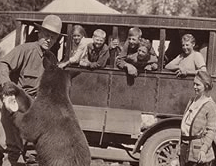
    At times, the bears get so bold that they take to making inroads on the kitchen. One completely terrorized a Chinese cook. It would drive him off and then feast upon whatever was left behind. When a bear begins to act in this way or to show surliness it is sometimes necessary to shoot it. Other bears are tamed until they will feed out of the hand, and will come at once if called. Not only have some of the soldiers and scouts tamed bears in this fashion, but occasionally a chambermaid or waiter girl at one of the hotels has thus developed a bear as a pet.

    The accompanying photographs not only show bears very close up, with men standing by within a few yards of them, but they also show one bear being fed from the piazza by a cook, and another standing beside a particular friend, a chambermaid in one of the hotels. In these photographs, it will be seen that some are grizzlies and some black bears.

    This whole episode of bear life in the Yellowstone is so extraordinary that it will be well worthwhile for any man who has the right powers and enough time, to make a complete study of the life and history of the Yellowstone bears. Indeed, nothing better could be done by some one of our outdoor faunal naturalists than to spend at least a year in the Yellowstone, and to study the life habits of all the wild creatures therein. A man able to do this, and to write down accurately and interestingly what he had seen, would make a contribution of permanent value to our nature literature with their majestic beauty all unmarred.

    ∞§∞

    — Excerpt from Theodore Roosevelt, “Wilderness Reserves,” Pages 23-51 in George Bird Grinnell (ed), American Big Game in Its Haunts. Harper: New York, 1914.

    — Detail from Google Images Photo.

    — You also might enjoy

    — To find more stories about bears, click on “Bears” under the “Categories” button to the left.
  • A Tale: A Dark and Stormy Night in Yellowstone Park — Dunraven, 1874

    Late October is a time for scary stories so I decided to check my collection of tales from Yellowstone Park for one to share here. I didn’t find anything about geyser ghosts and goblins, but I did locate a chilling tale by the Earl of Dunraven.

    Dunraven was hunting in Yellowstone in 1874. (It was legal then.) When a storm came up, the Earl and his guides, Fred Bottler and Texas Jack Omohondro, decided to return to camp, but their companion, Dr. George Kingsley, decided to keep hunting a little longer. The storm grew worse as darkness fell. Here’s the Earl’s story about what happened next.

    ∞§∞

    When Jack and I got in we found camp in a sorry plight, everything soaked through—tents, bedding, and all, and our prospects for the night looked anything but cheerful; but by extending the hide of the wapiti stag between four trees, and hauling it out taut with ropes, we managed to make a tolerable shelter; and, taking from out of our cache some dry birch bark and splinters of fat pine, we lit a huge fire, and sat down to make some tea for supper.

    About dusk, we heard a shot, and visions of fresh venison steaks floated before our eyes. About half an hour passed, but no venison and no Kingsley appeared, and then we heard another shot, and two or three minutes afterwards yet another.

    By this time, it was getting quite dark, and we were puzzled to know what Kingsley could be firing at—unless, indeed, he was treed by a bear. After a short interval we heard the sound of his rifle again, evidently further off, and then it suddenly occurred to us that he was lost and making signals. We fired our rifles, and whooped, and yelled, and shouted, but all to no purpose. The sound of his rifle became fainter and fainter; —he was going in the wrong direction.

    To be left out on such a night might cost a man his life, for it would have been hard for even an old experienced mountain man to have found material dry enough to make a fire; so Jack and Bottler started out into the blackness of the night and the thick fog to look for him, leaving me behind to heap logs on the fire, and occasionally emit a dismal yell to keep them acquainted with the whereabouts of camp.

    For some time I could hear the responsive shouts of the searchers, but after awhile they ceased, and nothing broke the horrid silence except the noises of the night and of the storm.

    The heavy raindrops pattered incessantly on the elk hide; the water trickled and splashed, and gurgled down the hillside in a thousand muddy rills and miniature cascades. The night was very dark, but not so black but that I could dimly see white ghost-like shreds of vapor and great indistinct rolling masses of fog driving up the valley in the gale. The wind rumbled in the caverns of the cliffs, shrieked and whistled shrilly among the dead pine trees, and fiercely shook the frail shelter overhead, dashing the raindrops in my face.

    Every now and then the fire would burn up bright, casting a fitful gleam out into the damp darkness, and lighting up the bare jaws and white skulls of the two elk-heads, which seemed to grin derisively at me out of the gloom; and then, quenched by the hissing rain, it would sink down into a dull red glow.

    My dog moved uneasily about, now pressing close up against me, shivering with cold and fear, nestling up to me for protection, and looking into my face for that comfort, which I had not in me to give him—now starting to his feet, whimpering, and scared when some great gust smote the pine tree overhead, angrily seized and rattled the elk-hide, and scooping up the firebrands tossed them in the air.

    The tall firs bowed like bulrushes before the storm, swaying to and fro, bending their lofty heads like bows and flinging them up again erect, smiting their great boughs together in agony, groaning and complaining, yet fiercely fighting with the tempest.

    At intervals, when the gale paused for a moment as it were to gather strength, its shrill shrieking subdued to a dismal groan, there was occasionally heard with startling distinctness, through the continuous distant din and clamor of the night, a long, painfully-rending cr-r-r-rash, followed by a dull heavy thud, notifying the fall of some monarch of the woods, and making my heart quake within me as I uneasily glanced at the two tall hemlocks overhead that wrathfully ground their trunks together, and whose creaking limbs were wrestling manfully with the storm.

    Strange and indistinct noises would come up from the vale: rocks became detached, and thundered down the far-off crags. A sudden burst of wind would bear upon me the roar of the torrent below with such clearness that it sounded as though it were close at hand. It was an awful night, in the strictest sense of the word. The Demon of the Tempest was abroad in his anger, yelling down the valley, dashing out the water-floods with his hands, laying waste the forest, and filling with dread the hearts of man and beast and every living thing.

    There was not a star or a gleam of moonlight. It was very gruesome sitting there all alone, and I began to feel, like David, “horribly afraid.” I do not know how long I was alone; probably it was only for a short time—a couple of hours or so, at most— but the minutes were as hours to me.

    Most dismal was my condition; and I could not even resort to the Dutch expedient for importing courage, to supply my natural allowance of that quality which had quickly oozed out of my cold fingertips. I had poured into a tin pannikin the last drain of whisky from the keg, and had placed it carefully to settle.

    I knew that Kingsley would really want it, so I could not seek consolation in that way. I could not find even a piece of dry tobacco wherewith to comfort myself; I began to feel very wretched indeed; and it was truly a great relief when I heard the shouts of the returning party.

    They brought in the lost man pretty well exhausted, for he had been out a long time exposed to the weather, had walked a great distance, and had fallen about terribly in the darkness. He had tried in vain to make a fire, and was wandering about without an idea of the direction in which camp lay.

    He was indeed in real need of a stimulant, and when, in answer to his inquiring glance at the keg, I said that there was half a pannikin full, his face beamed with a cheerful smile. But alas! A catastrophe had occurred. A gust of wind or a falling branch had over-thrown all my arrangements, and when I arose to give him the pannikin, behold, it was bottom upwards and dry!

    ∞§∞

    —   From the Earl of Dunraven, Hunting in the Yellowstone, New York: Outing Publishing Company, 1917. (Pages 174-177.)

    —   C.D. Loughrey Photo, c. 1888, Pioneer Museum of Bozeman.

    — To see more stories by by the Earl, click on “Dunraven” under the Categories button on the left side of this page.

  • A Tale: Big Boots to Fill — Carrie Strahorn, 1880

    In October 1880, Carrie Strahorn and her husband, Robert (she called him “Pard”) were the only passengers on the first run of George Marshall’s stage between Virginia City, Montana, and the Lower Geyser Basin. The Strahorns spent their first night in a cabin in the Madison River valley that belonged to Gilman Sawtell, Yellowstone Park’s first commercial guide and builder of the first road to the Lower Geyser Basin.

    Carrie Strahorn

    On their second day of travel, the Strahorns crossed the Continental Divide over Raynolds Pass and went to Henrys Lake where Sawtell had built a two-story building he planed to use as a hotel for Yellowstone tourists. Sawtell wasn’t there because, as Carrie put it, “during the late Indian troubles, he had abandoned this house and cached the doors and windows for fear the house would be burned.” The Strahorns made themselves at home anyway and Marshall fixed them a dinner of canned beans. Carrie told this story about what happened next.

    ∞§∞

    Pard and I gathered our blankets to go back to the stage to fix a place to sleep, but Mr. Marshall insisted there was a nice lot of hay upstairs where we could be more comfortable, and handing us a candle, directed us to the stairway. It was a rickety passage, with the wind howling through every aperture and holding high carnival with every loose board in the house.

    Once upstairs, the room to which we were sent seemed about forty feet square. The glimmering candle would light only a corner of the great black space, and a gust of wind would blow out the glim at intervals until the place seemed full of spooks and goblins. Pard and I gazed at each other when we could, and when we couldn’t, well, maybe I cried—I don’t quite remember.

    He had persuaded me to buy a very heavy pair of shoes in Virginia City, because he had been told the ground was so hot in some sections of the park that thin soles were not at all safe to wear, and would soon be burned through. Then he had proceeded to hold them up to ridicule all day, and I had finally wagered five dollars with him that in spite of their looks I could get both of my feet into one of his shoes. So there in the dim candle light, with any number of sashless and paneless windows, with the pallet of hay down in a dark corner, partly covered with canvas, with the wind shrieking requiems for the dead and threats for the living,  and with the rafters full of bats, I called to him to bring me his shoe, and let me win my wager.

    I put on his number seven and declared my foot was lost and lonesome in it, and he cried out, “Well, then, now put in the other one! Put in the other one!” I began at once taking it off to put it on the other foot, when he cried out, “Oh, no, not that way, but both at once.” But I revolted and said, “No, that was not in the bargain; I had not agreed to put both in at the same time.” In deep chagrin, he threw a five-dollar gold piece at me, which was lost for half an hour in the hay before I could find it, while he gave a grunt or two that will be better not translated. And so we went on with our merrymaking, trying to forget our surroundings, and dispel thoughts of our discomfort, but it was a glad hour that saw us started again on our way with a new sun.

    ∞§∞

    —   Excerpt from “Early Days In Yellowstone,” pages 254-286 in Carrie Adell Strahorn, Fifteen Thousand Miles by Stage, New York: Putnam’s Sons, 1911.

    —   Photo detail from Strahorn’s book.

    You also might enjoy:

    — You can read Carrie Strahorn’s account of her 1880 trip to Yellowstone Park in my book, Adventures in Yellowstone.