Author: mmarkmiller

  • An Event: Getting Reacquainted With Jamie Ford

    I was delighted to renew my acquaintance with Jamie Ford last night at Friends of the MSU Libraries annual dinner. I first met Jamie a couple of years ago when his book, The Hotel at the Corner of Bitter and Sweet, was starting its ascension onto the New York Times best seller list where it has roosted ever since.

    I had just read Hotel and recommended it for the Montana Book Award. (Part of the fun of being a reader for MBA is getting to read brand new books.) When I heard that Jamie would be at Bozeman’s premier independent bookstore, The Country Bookshelf, I decided I had to meet him.

    I arrived at the bookstore early and found Jamie chatting with the owner. I introduced myself and told him how much I admire Hotel. Then I coyly told him I too am a writer. He politely asked about that and I found a copy of Adventures in Yellowstone on the store shelves. He politely admired my book and we chatted amiably about writing and life in Montana.

    A few months later, I met Jamie again at the presentation ceremonies for the Montana Book Award at the Bozeman Public Library. That when my wife, who is Dean of MSU Libraries, recruited him to speak at the Friends dinner.

    I was pleased last night when Jamie greeted me with a smile and recalled that we had met before. After all, his book has enjoyed a bit more success than mine has. Hotel has been translated into a couple dozen languages and is on sale in thirty countries. (I wonder what dialogue between Henry Lee, a 12-year-old Chinese boy, and Keiko Okabe, a 12-year-old Japanese girl, sounds like in Norwegian?)

    Adventures is available only in English, but you can buy it on the web anywhere in the world. (I wonder what Emma Cowan’s story of being captured by the Nez Perce in 1877 would sound like in Norwegian.)

    In his speech last night, Jamie talked about the importance of libraries in his life. He described himself as “a library rat” and said, “I write in the library.”

    He recalled attending a pre-marital counseling session where couples were asked how they met. He said several other people reported stories like: “I woke up one morning with a woman in my bed wearing my t-shirt. I thought I should introduce myself.”

    “I met my wife in the library,” Jamie said. “And a year later I proposed to her—in the library.”

    Throughout the evening, Jamie was friendly and gracious. He found ways to personalize the dedications he put on the books he signed. He answered audience questions candidly and completely. He offered advice to aspiring writers with a smile.

    As I once told my friend Craig Lancaster, the Billings-based author of the novels 600 Hours and Edward and The Summer Son, there’s only one thing I dislike about Jamie Ford. He’s so damn nice I can’t think of reason to dislike him and that makes me feel guilty about envying his success.

    ∞§∞

    You also might enjoy:

  • A Tale: An Arctic Explorer Braves Yellowstone Park in Winter — 1887

    F. J. Haynes, Hayden Valley, 1887

    Today tourists can enjoy the winter wonders of Yellowstone National Park in snow coaches and stay overnight in cozy warm lodges. But in the Nineteenth Century, the very idea of winter travel in the park was so forbodding that the first winter trip there was led by an arctic explorer.

    Lieutenant Frederick Schwatka, who earned his fame exploring the frozen reaches of Alaska and Canada in 1878-80, led a group of a dozen men from Mammoth to Norris Geyser Basin in two days beginning on January 5, 1877.  Schwatka fell ill at Norris, but Yellowstone photographer F. Jay Haynes and three others continued on to the upper geyser basin and Yellowstone Falls. On their return trip, they were stranded on Mount Washburn in a blinding snowstorm for 72 hours.

    Here’s how F. Jay Haynes’ son, Jack Ellis Haynes, told the story in 1920.

    ∞§∞

    In January, 1887, the first successful winter exploration of the Yellowstone region was made. Lieutenant Frederick Schwatka of Arctic fame headed the party consisting of several eastern men, F. Jay Haynes, photographer, and a corps of guides, packers and assistants. Their outfit consisted of astronomical instruments, photographic equipment, sleeping bags and provisions which were drawn on toboggans; the party used Norwegian skis and Canadian web snowshoes, but the snow was so light that they sank readily and the toboggans were exceedingly difficult to draw. It took three days to cover the twenty miles from Mammoth Springs to Norris Basin; and the temperature the first night at Indian Creek was 37° below zero.

    Unfortunately Lieutenant Schwatka fell ill at Norris and was unable to proceed. Mr. Haynes, desirous of obtaining a collection of winter photographs of the Park, employed two of the sturdiest men of the Schwatka party, and with Edward Wilson, a government scout, resumed the journey.

    The toboggans were abandoned and this party packed their equipment and provisions on their backs—each man carrying about forty-five pounds.

    Norris Basin was a gorgeous sight. Craters heretofore unnoticed by these men familiar with the Park in summer, steamed conspicuously. The foliage was heavily laden with ice near the steam vents and geysers, producing all the fantastic forms possible to imagine; while the entire basin resembled a vast manufacturing centre.

    Tall trees buried in the snow appeared like bushes, and the general aspect of the country was completely changed; the average depth of the snow being about eight feet. The steam rising fully two thousand feet from the geysers at Upper Basin could be seen from the Lower Basin.

    The beautifully colored walls of the Grand Canyon were masses of pure white. The north half of the Great Fall hung in immense icicles 200 feet in length. An ice bridge fully 100 feet high was formed at the base of the fall, coming up to the spray line (about one-third the height of the fall.) The brink was frozen over and was hidden in an arch of ice a dozen feet thick.

    Thousands of elk were seen on the exposed ridges of Mount Washburn. The trip over Mount Washburn was one of most unusual hardship and privation; a blinding snowstorm which lasted four days overtook the party of four. During this entire time they wandered day and night without shelter, provisions or fire before reaching Yancey’s ranch, an experience that nearly cost them their lives.

    The circuit covered was about 200 miles, and the thermometer ranged from 10° to 50° below zero during the twenty-nine days of the trip.

    ∞§∞

    — From Jack Ellis Haynes, “Winter Exploration in 1887,”  Haynes New Guide and mortorists’ complete road log of Yellowstone National Park. J. E. Haynes: Saint Paul, 1920.  Pp. 134-137.

    — You also might be interested in:

    ∞§∞

  • A Sight: Rudyard Kipling Watches Beaver Swimming Silently — 1889

    A Beaver Lodge

    With colorful canyons, mountains of glass and boiling geysers to hold their attention, few Yellowstone Park visitors spend time watching that lowly rodent, the beaver. But the famous British author Rudyard Kipling thought they were worth writing about after his visit there in 1889. Here’s his description.

    ∞§∞

    The sun began to sink, and there was a taste of frost about, and we went swiftly from the forest into the open, dashed across a branch of the Firehole River and found a wood shanty, even rougher than the last, at which, after a forty-mile drive, we were to dine and sleep.

    In the cool, crisp quiet of the evening I sought that river, and found a pile of newly gnawed sticks and twigs. The beaver works with the cold chisel, and a few clean strokes suffice to level a four-inch bole. Across the water on the far bank glimmered, with the ghastly white of peeled dead timber, the beaver-lodge—a mass of disheveled branches. The inhabitants had dammed the stream lower down and spread it into a nice little lake. The question was, would they come out for their walk before it got too dark to see.and there were rumors of bears and other cheerful monsters in the woods on the hill at the back of the building.

    They came—blessings on their blunt muzzles, they came—as shadows come, drifting down the stream, stirring neither foot nor tail. There were three of them. One went down to investigate the state of the dam; the other two began to look for supper.

    There is only one thing more startling than the noiselessness of a tiger in the jungle, and that is the noiselessness of a beaver in the water. The straining ear could catch no sound whatever till they began to eat the thick green river-scudge that they call beaver-grass.

    I, bowed among the logs, held my breath and stared with all my eyes. They were not ten yards from me, and they would have eaten their dinner in peace so long as I had kept absolutely still.

    ∞§∞

    — Excerpt from Rudyard Kipling, “The Yellowstone Park.” The Kipling Reader for the Upper Grades. D. Appleton and Company: New York, 1905. Pp. 141-148.

    — Photo, Coppermine Photo Gallery.

    — You also might enjoy “Rudyard Kipling Goes Fishing With Yankee Jim.”

  • Ten Funny Stories From Yellowstone Park

    When I checked my blog statistics last week, I noticed that funny stories don’t seem to get their share of hits. To call attention to them,I decided to create a new category, “Humor.” While assigning stories to Humor, I picked some of my favorites to list here.

    ∞§∞

    Walter DeLacy, “An Optimistic Prospector — 1863”

    You just can’t be generous enough for some people.

    N.P. Langford, “Naming Tower Fall — 1870”

    An explorer’s practical joke backfires.

    Harry J. Norton, “A Million Billion Gallons of Hot Water — 1872”

    Prince Telegraph gets in trouble when he takes a shortcut washing dishers.

    The Earl of Dunraven, “How To Pack A Mule — 1874.”

    When mules get stubborn, ‘You may curse and swear your level best—but it does not a bit of good.’

    George W. Wingate, “Stampeded by an Umbrella — 1885”

    A dashing cowboy creates mayhem with his fancy riding.

    Rudyard Kipling, “Fishing With Yankee Jim — 1889.”

    The famous English author tries to tell bigger lies than Yankee Jim.

    Lewis Ransom Freeman, “Crashing Through Yankee Jim Canyon — 1903”

    A young man’s wooden raft smashes to pieces when tries to impress a girl.

    Henry G. Merry, “Yellowstone’s First Car — 1904”

    When Henry G. Merry tries to crash the gate into the Park, rangers lasso his car and drag it to the Superintendent’s office at Mammoth.

    L. Louise Elliot, “Maud Gets Her Revenge — 1913”

    A camping company employee gets even with a supercilious guest.

    R. Maury, “Nights of Romance — 1919”

    Pop Slocum takes a dive at Norris Geyser Basin so Winsted Tripp can meet the woman of his dreams.

    ∞§∞

    — For more funny stories click on “Humor” under the “Categories” button on the left side of this page.

  • A Tale: Sidford’s Fall on Grand Teton Mountain — Langford, 1872

    Sidford Hamp was just 17 in 1872 when his uncle William Blackmore, fulfilled his dreams by landing him a job on the second Hayden Expedition to Yellowstone Park. Lord Blackmore was wealthy and well connected so he was able to arrange for Sidford to dine with dignitaries in Washington D.C., meet the famous Sioux Chief Red Cloud, visit Niagara Falls, and travel across America on the new transcontinental railroad.

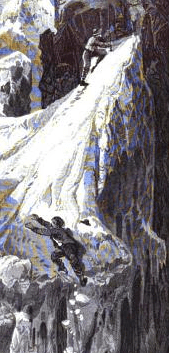
    Perhaps Sidford’s biggest adventure occurred on July 29 when he accompanied Hayden’s second in command, Captain James Stevenson, and Yellowstone first superintendent, N.P. Langford, as they mounted an effort to climb the 13,775-foot Grand Teton Peak in Wyoming. Some say Langford’s and Stevenson surmounted a side peak, not pinnacle of Grand Teton, but it was a grand adventure in any case. Here’s Langford’s description of what happen to Sidford that day.

    ∞§∞

    Very soon after we commenced the ascent, we found ourselves clambering around projecting ledges of perpendicular rocks, inserting our fingers into crevices so far beyond us that we reached them with difficulty, and poising our weight upon shelves not exceeding two inches in width, jutting from the precipitous walls of gorges from fifty to three hundred feet in depth. This toilsome process, which severely tested our nerves, was occasionally interrupted by large banks of snow, which had lodged upon some of the projections or in the concavities of the mountain side—in passing over the yielding surface of which we obtained tolerable foothold, unless, as was often the case, there was a groundwork of ice beneath.

    When this occurred, we found the climbing difficult and hazardous. In many places, the water from the melting snow had trickled through it, and congealed the lower surface. This, melting in turn, had worn long openings between the ice and the mountainside, from two to four feet in width, down which we could look two hundred feet or more. Great care was necessary to avoid slipping into these crevices. An occasional spur of rock or ice, connecting the ice-wall with the mountain, was all that held these patches of snow in their places. In Europe, they would have been called glaciers.

    Distrustful as we all were of their permanency, we were taught, before our toil was ended, to wish there had been more of them. As a general thing, they were more easily surmounted than the bare rock precipices, though on one occasion they came near proving fatal to one of our party.

    Mr. Hamp, fresh from his home in England, knew little of the properties of snow and ice, and at one of the critical points in our ascent, trusting too much to their support, slipped and fell. For a moment, his destruction seemed inevitable, but with admirable dexterity, he threw himself astride the icy ridge projecting from the mountain.

    Impelled by this movement, with one leg dangling in the crevice next the mountain side, and the other sweeping the snow outside the glacier, he slid with fearful rapidity, at an angle of forty-five degrees, for the distance of fifty feet, falling headlong into a huge pile of soft snow, which prevented his descent of a thousand feet or more down the precipitous side of the mountain.

    I saw him fall, and supposed he would be dashed to pieces. A moment afterwards, he crawled from the friendly snow heap and rejoined us unharmed, and we all united in a round of laughter, as thankful as it was hearty.

    ∞§∞

    — Excerpt from N. P. Langford, “The Ascent of Mount Hayden,” Scribners Monthly (June 1873) 6(3):129-157.

    — Illustration from the the Scribner’s article.

    — You also might enjoy:

    — To see more stories by this author, click on “Langford” under the “Categories” button to the left.

    — You can read a  condensed version of N. P. Langford’s book, The Discovery of Yellowstone Park, in my book. Adventures in Yellowstone.

  • A Tale: Jim Bridger’s Descriptions of Yellowstone Wonders — Gunnison, 1852

    Conventional wisdom is that people just didn’t believe trappers’ tales of fountains of boiling water, mountains of glass and the other wonders of the upper Yellowstone. But that’s not entirely true, at least in the case of the famous Mountain Man, Jim Bridger. The U.S. Army apparently found Bridger reliable; they frequently hired him as a scout, included his descriptions in their reports and called him “Major.”

    Jim Bridger

    One of the officers who believed Bridger was John W. Gunnison, a lieutenant in the Army Corps of Topographers. When a severe winter kept Gunnison from doing surveys of the Great Salt Lake Valley in 1849-50, he used the time to do research on the people who lived there. He published a book in 1852 that included this description of Bridger.

    ∞§∞

    The builder of Fort Bridger is one of-the hardy race of mountain trappers who are now disappearing from the continent, being enclosed in the wave of civilisation. These trappers have made a thousand fortunes for eastern men, and by their improvidence have nothing for themselves.

    Major Bridger, or “old Jim,” has been more wise of late, and laid aside a competence; but the mountain tastes fostered by twenty-eight years of exciting scenes, will probably keep him there for life. He has been very active, and traversed the region from the head-waters of the Missouri to the Del Norte—and along the Gila to the Gulf, and thence throughout Oregon and the interior of California.

    His graphic sketches are delightful romances. With a buffalo skin and piece of charcoal, he will map out any portion of this immense region, and delineate mountains, streams, and-the circular valleys called “holes,” with wonderful accuracy; at least we may so speak of that portion we traversed after his descriptions were given.

    He gives a picture, most romantic and enticing, of the head-waters of the Yellowstone. A lake sixty miles long, cold and pellucid, lies embosomed amid high precipitous mountains. On the west side is a sloping plain several miles wide, with clumps of trees and groves of pine.

    The ground resounds to the tread of horses. Geysers spout up seventy feet high, with a terrific hissing noise, at regular intervals. Waterfalls are sparkling, leaping, and thundering down the precipices, and collect in the pool below. The river issues from this lake, and for fifteen miles roars through the perpendicular canyon at the outlet. In this section are the Great-Springs, so hot that meat is readily cooked in them, and as they descend on the successive terraces, afford at length delightful baths. On the other side is an acid spring, which gushes out in a river torrent; and below is a cave which supplies “vermilion” for the savages in abundance.

    Bear, elk, deer, wolf, and fox, are among the sporting game, and the feathered tribe yields its share for variety, on the sportsman’s table of rock or turf.

    ∞§∞

    — From Gunnison, J.W.,  A History of the Mormons. Philadelphia: Lippincott, Grambo  & Co., 1852.   p. 151

    — Photo, Wikipedia Commons.

    — You might also enjoy:

  • A Tale: Watching a Giant Grizzly — Grace Gallatin Seton, 1896

    In 1915 a giant grizzly that roamed between the Meeteesee region of Wyoming and Yellowstone Park was so well known that The New York Times published the news that he had been shot to death. He was Wahb, a bear made famous by the naturalist and writer Ernest Thompson Seton. Seton, who was instrumental in founding the Boy Scouts of America, described Wahb in his popular book, Biography of a Grizzly, and in his story “Johnny Bear.”

    Seton’s wife, Grace Gallatin Seton, also wrote about Wahb. In her version, Grace called her husband “Nimrod,” after the mighty hunter of the Bible. She called A. A. Anderson, the owner of the ranch where she first saw Wahb’s tracks, “The Host.” Here’s Grace’s story.

    ∞§∞

    A fourteen-inch track is big, even for a grizzly. That was the size of Wahb’s. The first time I saw it, the hole looked big enough for a baby’s bathtub. The Host said there was only one bear in that region that could make a track like that; in spite of the fact that this was beyond his range, it must be Meeteetsee Wahb. He got off his horse and measured the track Yes, the hind foot tracked fourteen inches. What a hole in the ground it looked!

    The Host said the maker of it was probably far away, as he judged the track to be several weeks old. I had heard so many tales of this monster that when I gazed upon his track I felt as though I were looking at the autograph of a hero.

    It was not till the next year that I really saw Wahb. It was at his summer haunt, the Fountain Hotel in the Yellowstone National Park. If you were to ask Nimrod to describe the Fountain Geyser or Hell Hole, or any of the other tourist sights thereabouts, I am sure he would shake his head and tell you there was nothing but bears around the hotel. For this was the occasion when Nimrod spent the entire day in the garbage heap watching the bears, while I did the conventional thing and saw the sights.

    About sunset, I got back to the hotel. Much to my surprise, I could not find Nimrod; and neither had he been seen since morning, when he had started in the direction of the garbage heap in the woods some quarter of a mile back from the hotel. Anxiously I hurried there, but could see no Nimrod. Instead, I saw the outline of a Grizzly feeding quietly on the hillside. It was very lonely and gruesome.

    Under other circumstances, I certainly would have departed quickly the way I came, but now I must find Nimrod. It was growing dark, and the bear looked a shocking size, as big as a whale. Dear me, perhaps Nimrod was inside—Jonah style. Just then, I heard a sepulchral whisper from the earth.

    “Keep quiet, don’t move, it’s the Big Grizzly.”

    I looked about for the owner of the whisper and discovered Nimrod not far away in a nest he had made for himself in a pile of rubbish. I edged nearer.

    “See, over there in the woods are two black bears. You scared them away. Isn’t he a monster?indicating Wahb.

    I responded with appropriate enthusiasm. Then after a respectful silence, I ventured to say:

    “How long have you been here?”

    “All day—and such a day—thirteen bears at one time. It is worth all your geysers rolled into one.

    “H’m—Have you had anything to eat?”

    “No.” Another silence, then I began again.

    “Aren’t you hungry? Don’t you want to come to dinner?”

    He nodded yes. Then I sneaked away and came back as soon as possible with a change of clothes. The scene was as I had left it, but duskier. I stood waiting for the next move. The Grizzly made it. He evidently had finished his meal for the night, and now moved majestically off up the hill towards the pine woods. At the edge of these he stood for a moment, Wahb’s last appearance, so far as I am concerned, for, as he posed, the fading light dropped its curtain of darkness between us, and I was able to get Nimrod away.

    ∞§∞

    — Condensed from Grace Gallatin Seton, “What I Know About Wahb of the Big Horn Basin,” A Woman Tenderfoot. Doubleday, Page and Co.: New York, 1900.

    — Illustration from Grace Gallatin Seton, “A Woman Tenderfoot and a Grizzly.” The Puritan: A Journal for Gentlewomen. October 1900. Pp. 109-117.

    You also might enjoy:

  • A Tale: Guiding the Nez Perce Through Yellowstone Park — 1877

    After the bloody Big Hole Battle on August 9, 1877, the Nez Perce fled through Yellowstone Park to avoid the settled areas of Montana. Pursued by Army units under General O.O. Howard, they needed a guide because the route was unfamiliar to them. On August 23, they found one.

    John Shively, who had prospected for gold in the area, was camped near the Lower Geyser Basin when the Indians captured him. Shively had planned to leave the park with a party of tourists from Radersburg, Montana, that he had met earlier.

    The next day, the Nez Perce accosted the Radersburg group, shot two men and took two women captive. The women were treated well and later release.

    Shively traveled with the Nez Perce for thirteen days, then made his escape. (The Indians said they let him go after they reached country they knew.) Several territorial newspapers reported Shively’s adventures and Edwin J. Stanley synthesized them into a single narrative several years later. Here’s Stanley’s version.

    ∞§∞

    On the evening of the second day, after leaving the Radersburg party, I was camped in the Lower Geyser Basin. I was eating my supper, and, on hearing a slight noise, looked up, and, to my astonishment, four Indians, in war-paint, were standing within ten feet of me, and twenty or thirty more had surrounded me not more than forty feet off.

    I sprang for my gun, but was rudely pushed back. I then asked them what Indians they were, and they answered “Sioux.” I said, “No.” Then one of them said, “Nez-Perces.” They then commenced to gesticulate wildly, and a loud conversation was kept up between them.

    I thought the exhibition of a little bravery might help me, so I folded my arms and told them to shoot, that I was not afraid to die. A brother of Looking-Glass then came up, placed his hand on my heart, and held it there a minute or two, and exclaimed, “Hyas, skookum-tum-tum!” meaning ‘strong heart’ in Chinook. He then said in English, “Come with me,” walked a few steps, told me to get on a pony that he pointed out, jumped up behind me, and all started for the main camp, a short distance below.

    While this was taking place, the other Indians had taken my gun, blankets, horses—in fact, everything I had. Arriving at the main camp, a council of the chiefs was formed, and I was told to take a seat inside the circle.

    They asked me who I was, and what I was doing there. I told them. They asked me if I would show them the best trail leading out of the park to Wind River, where they were going. I told them I would, as I knew all about the country. This seemed to be satisfactory, and the council broke up, and the camp moved up a mile or two, where an encampment for the night was formed.

    A robe was given me, and an Indian named Joe was detailed to sleep with me. He spoke very good English; said that I must not attempt to escape; that he would be my friend; that they had come that way to get away from Howard; that the trail by that route to Wind River was not known to them, but other Indians had told them about it, and that if I told them the truth they would not harm me.

    As I could not help myself, I promised all they asked, and kept my promise. All the time I was with them, I always showed a willingness to get on or off a horse when they told me; and, if an Indian rode behind me on the horse, I offered no objections, and to this fact I am probably indebted for kind treatment.

    After breaking camp the next morning, I was ordered to mount. An Indian mounted behind, and I was started ahead with mounted and armed Indians on each side and behind me. While camped the next day, about noon, the Radersburg party were brought into camp.

    Shortly afterward, a march was made toward Yellowstone Lake, I still being kept some distance in the advance. After traveling about a mile, I heard seven distinct shots fired, and supposed all the persons had been killed, but that evening Joe told me that only two men had been shot, and the next morning I saw Mrs. Cowan and Miss Carpenter, and was allowed to speak to them, and we traveled near together all that day.

    Through this terrible ordeal, the sisters behaved nobly and with the utmost fortitude, although Mrs. Cowan’s mental agony at thought of her husband wounded, and perhaps dead, and they three in the hands of savages, was enough to have driven her distracted. With all their savagery and ferocity, let it be said and remembered to the credit of the Nez-Perces, that these ladies were treated with all respect, and protected from all harm, while their prisoners. The next day, Frank Carpenter and his sisters were permitted to go, and the Indians moved to the Yellowstone, and from there moved over to the head-waters, or rather a tributary, of Clark’s fork.

    The first night of our arrival being quite dark, I slipped out of camp and started for the Mammoth Hot Springs, which I reached after traveling two whole nights and one day. Here I found no one, but did find some potatoes already cooked, which greatly revived me after my long fast—having had nothing to eat from the time of leaving the Indian camp.

    I then started for Henderson’s ranch, which I found destroyed, but plenty of provisions lying around. I got some eggs, and, while cooking them, Mr. J. W. Schuler of Butte City, who was returning from the Clark’s Fork mines, rode up. He kindly gave me his horse to ride, he going on foot. That night, early, we reached Dailey’s ranch, where we received the kindest treatment, and Mr. Dailey loaned me a horse on which to ride to Bozeman.

    I was with the Indians thirteen days, and was treated very well all the time. They traveled very leisurely, not averaging, for the whole time, more than five miles a day. Joe said they were not afraid of Howard. He also said that they did not intend to return to Idaho, as the agent there, John Hall, was a bad man, and would not give them what was due them; that they would remain somewhere in the Big Horn country, and, if the soldiers came, they would join in with the Sioux and Crows and whip them.

    ∞§∞

    — Excerpt from Edwin J. Stanley, Rambles in Wonderland. Southern Methodist Publishing House: Nashville, 1885.

    — You also might like:

    — You can read Emma Cowan’s complete story in my book, Adventures in Yellowstone.

    — My next book, Encounters in Yellowstone 1877, will tell the story of the Nez Perce and the people who tangled with them in the park.

  • A Tale: Ajax Takes a Trip to Yellowstone Park —1880

    In the first decade after Yellowstone National Park was established in 1872, dozens of adventurous young men set out to see Wonderland. Usually the had meager supplies and planned to live off the land. That and problems of managing their horses always made such trips an adveture. Here’s a story of such a trip by Alva Josiah Noyes, who called himself “Ajax.”  

    ∞§∞

    A.J. Noyes

    The summer and fall of ’80 was spent in the Elk Park ranch. I remember that I got out a whole lot of timber for fencing. After haying I sold my interest to my uncle. I was to take the money, go to the University of Iowa and enter the Law Department. My uncle was to give me $250 the first year, the same amount for the second.

    Before going to Iowa I made up my mind to take a team and make the trip through the National Park. My object in so doing was to get data for a lecture, providing my cash should not hold out. I thought that I could deliver a lecture on the wonders of that place and probably make a few dollars, as it was then so little known.

    I took a team, one of the horses belonged to my step-mother, and began my journey alone. On my arrival at Bozeman I met several of the Butte boys, ten of them in all. They had just been through the park and were on their way home. I could not get any of them to go back with me.

    I got my dinner that day with George Wakefield, who was then running the Northern Pacific Hotel. Mrs. Wakefield was a schoolmate of mother’s. I met a kid, Link Coberly, who had been pretty near the Park but had not been in it. I proposed that he go with me. He said: “All the money I have is five dollars; that won’t take me very far toward the Park.” I informed him that he didn’t need any, I would put up. He consented to go.

    We camped out on Bear Creek, 10 miles from Bozeman that night, and the next we were at Bottler Brothers, on the Yellowstone. We picketed our horses a short distance from camp. We were up early the next morning. Requesting Link to get the horses, I proceeded to get breakfast. He had been gone but a short time when he came hurrying back with the information that one of the horses was cast, and “his head was as big as a barrel!”

    On making an examination I found that he had, in some way, gotten one of his hind feet in the rope which was around his neck, and in struggling to get up, had choked himself, more or less, also bruising his head. This was a nice state of affairs. A horse that could not be used; miles from home, and anxious to make the trip. What could I do? I went to Bottler and explained my condition.

    He said: “I have a horse that you can have as soon as he comes back from the Park, which should be soon now.” I had to be contented and wait for “Old Bozeman,” as the horse was called, for several days.

    At last he came and we made a new start. It did not require a long time to go, from this ranch, to Mammoth Springs. On arriving there I met Mrs. Carson (mother of Arthur of the North Butte), also Mrs. Ed Reimel of Walkerville, who invited me to have lunch with them, which was accepted with pleasure and much enjoyed.

    When I got back to camp I found a young man, who desired to make one of our company, a George Allen of the Yellowstone. We left the wagon at the Springs and began our trip through the Park. We went via Tower Falls to the Grand Canyon, Great Fall, Sulphur Mountain, Mud Volcano, thence to Mary’s Lake, to the Lower Geyser Basin. We did not go to Yellowstone Lake.

    We enjoyed the scenery very much. The weather was delightful. When we arrived at Midway, or “Hell’s Half Acre,” we crossed the Fire Hole river to investigate the Prismatic Spring and the Caldron, or what was afterward called “Sheridan Geyser.” This is a large body of boiling water, over 100 feet across, and when not in a state of eruption, is some ten to more feet below the surface. Steam arises all the time, as from a great kettle of boiling water.

    Wishing to see more of this wonderful spring, I carefully walked toward it and stopped in awe at the fearful sight that met my gaze when a light breeze wafted the steam from me, as I was at the brink of that hellish hole. One more careless step and—the end.

    When we arrived at the Upper Basin, we found ourselves pretty short of provisions. The boys were successful in getting a nice lot of fool hens, with sticks, but as we had no grease in which to fry them we began to rustle. Link found, in a tree, a can of bacon grease that had been left by the former camper. As this was nice and fresh, we made use of it.

    We returned to the Springs via Norris Geyser Basin. At that place Colonel Norris had a party of men at work on the roads. Link got some brown sugar of them, which, under the circumstances, was the nicest ever.

    The next day we arrived at the Springs, and got as good a meal as McCartney’s Hotel could set up. We purchased a few supplies, and started down the river. When on my way up to the Mammoth Springs I made arrangements with a party to catch some fish for me. When I returned to the place the man had a nice supply, which I hauled to Butte and sold them for 25 cents per pound.

    When I got back to Bottler’s I found that my horse was in no condition to take me home. William Lee had a large number of horses, so I went to his ranch and bought a pony for $40.00, leaving my horse in his care. Link and I arrived in Butte in good season. Owing to the inroads on my cash, I did not have enough to carry me through the first year at Iowa City, so I did not study law. There must have been something of a Providencial nature in this, as we have too many poor lawyers now.

    ∞§∞

    — Adapted from Alva Josiah Noyes, The Story of Ajax: Life in the Big Hole Basin. State Publishing Company:Helena, Montana: 1914.  Pp.  43-45.

    — Photo from the book.

  • A Tale: Photographer Tangles with an Elk — Seton, 1913

    When the Army took over administration of Yellowstone Park in 1886, they stopped all hunting and began sealing guns at the border. Soon Nimrods began fulfilling their hunting urges by stalking big game with cameras. 

    The famous naturalist-writer, Ernest Thompson Seton, told this story about his friend, John Fossum, who was once a soldier in Yellowstone Park. Seton described it as an adventure on a “heroic scale.”

    ∞§∞

    A friend of mine, John Fossum, while out on a camera hunt in early winter, descried afar a large bull Elk lying asleep in an open valley. At once Fossum made a plan. He saw that he could crawl up to the bull, snap him where he lay, then later secure a second picture as the creature ran for the timber.

    The first part of the program was carried out admirably. Fossum got within fifty feet and still the Elk lay sleeping. Then the camera was opened out. But alas! that little pesky “click,” that does so much mischief, awoke the bull, who at once sprang to his feet and ran—not for the woods—but for the man.

    Fossum with the most amazing nerve stood there quietly focussing his camera, till the bull was within ten feet, then pressed the button, threw the camera into the soft snow and ran for his life with the bull at his coat-tails.

    It would have been a short run but for the fact that they reached a deep snowdrift that would carry the man, and would not carry the Elk. Here Fossum escaped, while the bull snorted around, telling just what he meant to do to the man when he caught him; but he was not to be caught, and at last the bull went off grumbling and squealing.

    The hunter came back, recovered his camera, and when the plate was developed it bore the picture.

    It shows plainly the fighting light in the bull’s eye, the back laid ears, the twisting of the nose, and the rate at which he is coming is evidenced in the stamping feet and the wind-blown whiskers, and yet in spite of the peril of the moment, and the fact that this was a hand camera, there is no sign of shake on landscape or on Elk, and the picture is actually over-exposed.

    ∞§∞

    — Ernest Thompson Seton, Wild Animals at Home, Grosset and Dunlap: New York, 1913.  Pp. 71-72.

    — Photo by John Fossum from Seton’s book.