Grand Geyser was erupting as I rode up to Old Faithful Inn on Saturday morning. I took the towering white plume of water and steam silhouetted against the clear pale blue sky as an auspicious sign. This will be a good day to sell books, I thought.
When I went into the lobby, I found an easel with information about my book (Adventures in Yellowstone), my biography and a photo of me. That apparently accounted for the bulge of hits on those things on my blog last week.
I checked in at the gift shop where employees greeted me like an old friend and helped me set up. (It was the third time I’ve done book signings at the Inn.) Soon, I was seated behind a table smiling as passers-by and enticing them to buy my book.
I adjusted to the rhythm of the place, which is governed by Old Faithful’s 90-minute cycle. The lobby is nearly empty when the geysers plays. Then it fills with a rush of people searching for the restrooms, awing over the magnificent lobby and milling around. When things thin out a bit is the best time to sell books.
I noticed that during slack times—even while Old Faithful was playing—there were a few people who were eager to talk about the stories in my book. I began asking questions and discovered that many of them were tour bus drivers looking for stories to tell their clients during the rides between sights.
I told them that my book has stories about many of the famous people and events in Yellowstone history. Emma Cowan’s story of being captured by Indians would be one to tell when driving by Nez Perce Creek. Truman Everts’ 37-day ordeal of being lost lost alone in the Yellowstone wilderness would a good one near Yellowstone Lake. And crossing Dunraven Pass, why, the Earl of Dunraven’s hilarious description of how to pack a mule or one of his exciting hunting stories.
“if there aren’t enough stories in my book,” I said, “you should check out my blog. There are another hundred more of them there.” When I gave examples, I mentioned William Henry Wright’s efforts to photograph grizzlies at night with flash powder. “That’s great,” she said, “sometimes I have a whole busload of photographers.”
When I asked about her current load, she sighed. “Children,” she said, “lots of children.”
In the afternoon, I talked to a guide who works for Xantera, the park concessionaire. She suggested that I talk to her boss about the possibility of setting up a program to help Yellowstone guides find stories to tell their clients and she gave me his phone number.
On Sunday, I called the number and chatted with the boss. He stopped by my table later and we talked some more. We didn’t make any commitments, but it looks like there’s a real possibility that I could present a program on Yellowstone stories for tour guides at Old Faithful Inn next year. I think that would be great fun—and people telling the stories I collected surely would stimulate sales of my book.
∞§∞
— Read about my last book signing at Old Faithful Inn here.
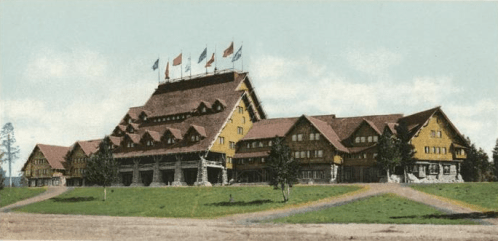
— Image, Postcard of Old Faithful Inn, c, 1906. New York Public Library.
Most journals by early Yellowstone travelers provide descriptions of the sights: geysers, canyons, falls and wildlife, but only a few tell about ordinary activities like preparing food. Ernest Ingersoll, who explored the West in 1874 and 77 with Yellowstone surveyor F.V. Hayden, wrote about such things. In the late nineteenth century, Ingersoll became a famous naturalist, writer and lecturer. Here’s his account of an evening meal as it might have been prepared in the park in 1880.
∞§∞
The place for the camp having been indicated, the riding animals are hastily unsaddled, and then every one turns to help unpack and place the cargo in orderly array. The very first mule unloaded is the staid veteran distinguished by the honor of bearing the cuisine. The shovel and axe having been released from their lashings, the cook seizes them, and hurriedly digs a trench, in which he starts his fire. While it is kindling, he and anybody else whose hands are free cut or pluck up fuel.
We are so stiff sometimes from our eight or ten hours in the saddle that we can hardly move our legs; but it is no time to lie down. Hobbling round after wood and water limbers us up a little, and hastens the preparation of dinner, that blessed goal of all our present hopes.
If a stream that holds out any promise is near, the rod is brought into requisition at once; and, if all goes well, by the time the cook is ready for them, there are enough fish for the crowd. Flies, as a general thing, are rather a delusion to the angler than a snare for the fish. The accepted bait is the grasshopper, except when there are great numbers of this insect, in which case the fish are all so well fed that they will not bite.
We used to keep our eyes open all day, and pounce upon every grasshopper we could find, saving them for the evenings fishing. The usual catch was salmon trout—great two and three-pounders, gleaming, speckled, and inside golden pink, that sunset color called salmon. They were not gamy, though, and we were glad of it, since the object was not sport, but the despised pot. It really was more exciting to capture the lively bait than it was to hook the trout.
But all this happens while the cook gets his fire well a-going. That accomplished, and two square bars of three-quarters inch iron laid across the trench, affording a firm resting place for the kettles, the stove is complete. He sets a pail of water on to heat, jams his bake-oven well into the coals on one side, buries the cover of it in the other side of the fire, and gets out his long knife. Going to the cargo, he takes a side of bacon out of its gunny-bag, and cuts as many slices as he needs, saving the rind to grease his oven.
Then he is ready to make his bread. Flour is more portable than pilot biscuit; therefore warm, light bread, freshly made morning and night, has gratefully succeeded hardtack in all mining and mountain camps. Sometimes a large tin pan is carried, in which to mould the bread; but often a square half-yard of canvas kept for the purpose, and laid in a depression in the ground, forms a sufficiently good bowl, and takes up next to none of the precious room.
When a bread-pan is taken it is lashed bottom up on top of the kitchen-mules pack. If it breaks loose and slips down on his rump, or dangles against his hocks, there is likely to be some fun; and when a sudden squall sweeps down from the high mountains, and the hailstones beat a devils tattoo on that hollow pan, the mule under it goes utterly crazy. The canvas bread-pan is therefore preferred. Sometimes even this is dispensed with, and the bread is mixed up with water right in the top of the flour-bag, and is molded on the cover of a box or some other smooth surface. Baking powder, not yeast, is used, of course.
Sometimes the cook used the Dutch oven which every one knows, a shallow iron pot, with a close fitting iron cover upon which you can pile a great thickness of coals, or can build a miniature fire. Having greased the inside of the oven with a bacon rind, bread bakes quickly and safely.
A better article, however, results from another method. Mold your bread well, lay the round loaf in the skillet and hold it over the fire, turning the loaf occasionally, until it is somewhat stiff; then take it out, prop it upright before the coals with the help of a twig, and turn it frequently. It is soon done through and through, and on both sides alike
The table furniture, and a large portion of the small groceries, such as salt, pepper, mustard, etc., are carried in two red boxes, each two and a half feet long, one and a half feet broad, and a foot high. Each box is covered by a thin board, which sets in flush with the top of the box, and also by two others hinged together and to the edge of the box.
Having got his bread a-baking, the cook sets the two boxes a little way apart, unfolds the double covers backward until they rest against each other, letting the ends be supported on a couple of stakes driven into the ground, and over the whole spreads an enameled cloth. He thus has a table two and a half feet high, one and a half feet wide and six feet long.
Tin and iron ware chiefly constitute the table furniture, so that, as frequently happens, the mule may roll a hundred feet or so down the mountain and not break the dishes. His table set, John returns to his fire, and very soon salutes our happy ears with his stentorian voice in lieu of gong: Grub P-i-i-i-le!
∞§∞
— Excerpt abridged from Ernest Ingersoll, “Rocky Mountain Cookery,” Scribner’s Monthly 29(1)125-132 (May 1880).
— Illustration from Ingersoll’s book, Knocking Around the Rockies. Harpers: New York, 1882.
I’ll return to the lobby of Old Faithful Inn on Saturday and Sunday (August 20 and 21) to sign copies of my book Adventures in Yellowstone: Early Travelers Tell Their Tales. It’s a great venue and I always have fun there.
The Inn probably is the most impressive man-made feature in Yellowtone Park and has been a favorite of visitors since it was finished in 1904, even those who were staying in other accommodations. Below is a description of the Inn by a man who was touring “The Wylie Way,” that is, spending his nights in tents put up for the season. Wylie Way tents weren’t as plush as the park hotels, but they had wooden floors and wood stoves to keep them warm.
Employees of the park concessioners called both hotel guests and Wylie Way tourists “Dudes.” That distinguished them from “Sagebrushers,” people who had their own transportation and horses. Here the story of a baseball game between hotel and Wylie Way Dudes.
∞§∞
We can’t sit and watch Old Faithful forever, so we step over to Old Faithful Inn and inspect that property. This is indeed a wonderful building, rustic throughout, with a chimney that must be at least fifteen feet square at the base. It runs up through the building and out the roof and has an enormous old-fashioned fireplace on each of the four sides. When we see the log fire sending out its cheerful warmth and glow, and the mammoth pans of hot popcorn passing around, and which we sample generously, it suddenly occurs to us that this is a “pretty happy world” after all.
Right here I am reminded of the ball game that occurred directly in front of Old Faithful Inn the next afternoon. One team was made up from the “dudes” stopping at the Inn and the other from the “dudes” that were going the “Wylie Way.” Both teams played good ball in spite of the stiff wind that was blowing, but the Inn “dudes” were a little better than their opponents, the score being somewhere in the neighborhood of 8 to 5. The feature of the game proved to be the first-class, all round rooting of the Wylie drivers who, forty strong, were massed back of third base and cheered every good play made by their men, and kicked at every decision that went against them.
∞§∞
— Excerpt from Fred W. Ellsworth, “Though Yellowstone Park with the American Institute of Banking.” Moody’s Magazine: The National Investors Monthly, November 1912, 14(5)369-375.
— Photo, Coppermine Photo Gallery.
— You can read other descriptions of Old Faithful Inn and my book signings there here, here, and here.
When my Summer 2011 issue of Pioneer Museum Quarterly arrived, I immediately went through it to find my article, “Fred Bottler: Yellowstone Pioneer in Paradise.” It’s always thrill to see my stuff printed on slick paper in justified columns.
Philetus W. Norris
Fred Bottler started the first permanent ranch in the Paradise Valley in 1867 in a spot halfway between Bozeman and Mammoth Hot Springs, a day’s ride from each of them. That made Bottler’s a perfect overnight stop for early travelers on their way to Yellowstone Park. Also, Bottler hunted elk and prospected for gold in the park before he started ranching so he was the perfect guide.
Many early travelers mention Bottler in their journals and reminiscences and I began collecting information about him several years ago. When Pioneer Museum Director John Russell asked me to write an article for the Quarterly, I organized my Bottler file and went to work. The result is an account of Bottler’s life and a collection of stories about him. Here’s a sample.
∞§∞
In 1870, Philetus Norris, who became the second Yellowstone Park Superintendent, hired Bottler to guide him to the wonders of the region. Perhaps driven by the knowledge that others were planning a similar expedition later that summer, Norris and Bottler headed into the park in early June. Deep snow prevented them from getting to the grand geysers, so they decided to try to cross the mountains to Mammoth Hot Springs.
Norris described their trek this way: “Although the snow-capped cliffs and yawning chasms in the basaltic or ancient lava beds, fringed with snow-crushed, tangled timber and impetuous torrents of mingled hot-spring and snow-melt water made our progress—mainly on foot, leading our horses—slow, tedious and dangerous, we persevered until we came to a large river.”
It was the snowmelt-swollen Gardner River, a knee-deep stream 20 feet wide. When Bottler stepped into the rushing water, the torrent knocked him off his feet, swept him away and carried him downstream. Bottler grabbed an overhanging cottonwood branch and hung on. Norris rushed up barely in time to save him. Bottler had lost his rifle and ammunition belt in the icy water.
Norris summarized the situation like this: “With my only companion sadly bruised by the rocks, benumbed, the remnants of his dressed elk-skin garments saturated by snow water, without gun or pistol, in a snow-bound mountain defile in an Indian country, even a June night was far from pleasant for us.”
The next morning, Norris surveyed the area with his powerful field glasses and spotted steam rising from Mammoth Hot Springs eight miles away. The men decided they couldn’t make it to the springs over the mountain torrents swollen by melting snow. Besides, they had only one gun to provide meat and protection from wild animals and Indians. The river accident had banged Bottler up too much for him to climb back over the mountains, so they headed down the second canyon of the Yellowstone River, which later became known as Yankee Jim Canyon.
Bottler returned to his ranch to recuperate, and Norris went to Missoula to attend to business. From Missoula, Norris proceeded to the Pacific coast where he heard in August that a party headed by Montana Surveyor General Henry Washburn had returned from exploring the upper Yellowstone. Apparently, the news that others had beat him to documenting the wonders of the Yellowstone upset Norris greatly. “I was intensely mortified,” he said, “to learn that Messrs. Langford, Hauser and others had gone up the Yellowstone.”
∞§∞
— Excerpt from M. Mark Miller, “Fred Bottler: Yellowstone Pioneer in Paradise,” Pioneer Museum Quarterly, Summer 2011, pp. 13-18.
— You can read the rest of my stories about Fred Bottle by buying a copy of the Quarterly at the Pioneer Museum of Bozeman. Better still, join the Gallatin Historical Society and get a free subscription.
When I was a little boy my father told me the way to catch a bird was to put salt on its tail. If you do that, he assured me, you can reach right out and pick it up. I looked to my mother for confirmation, and she said something like, “I suppose that’s true.”
They armed me with a salt shaker and I spent the afternoon trying to get close enough to a bird to salt its tail. Not until my brothers came home from school and started laughing at me did I get the joke.
The tradition of playing tricks on the naive runs deep in the history of the northern Rockies. The famous Yellowstone explorer, N.P. Langford, told this story in his account of traveling with the second Hayden Expedition to Yellowstone Park in 1872.
∞§∞
Among our own hunters was a trapper named Shep Medary—a lively, roystering mountaineer, who liked nothing better than to get a joke upon any unfortunate “pilgrim” or ” tender foot ” who was verdant enough to confide in his stories of mountain life.
“What a night!” said Shep, as the moon rose broad and clear—”what a glorious night for drivin’ snipe!”
Here was something new. Two of our young men were eager to learn all about the mystery.
“Driving snipe! what’s that, Shep? Tell us about it.”
“Did ye never hear?” replied Shep, with a face expressive of wonder at their ignorance. “Why, it’s as old as the mountains, I guess; we always choose such weather as this for drivin’ snipe. The snipe are fat now, and they drive better, and they’re better eatin’ too. I tell you, a breakfast of snipe, broiled on the buffalo chips, is not bad to take, is it, Dick?”
Beaver Dick, who had just arrived in camp, thus appealed to, growled an assent to the proposition contained in Shep’s question; and the boys, more anxious than ever, pressed Shep for an explanation.
“Maybe,” said one of them, “maybe we can drive the snipe tonight and get a mess for breakfast: what have we got to do, Shep?”
“Oh well,” responded Shep, “if you’re so plaguey ignorant, I’m afeard you won’t do. Howsomever, you can try. You boys get a couple of them gunny-sacks and candles, and we’ll go out and start ’em up.”
Elated with the idea of having a mess of snipe for breakfast, the two young men, under Shep’s direction, each equipped with a gunnysack and candle, followed him out upon the plain, half a mile from camp, accompanied by some half-dozen members of our party. The spot was chosen because of its proximity to a marsh which was supposed to be filled with snipe. In reality it was the swarming place for mosquitoes.
“Now,” said Shep, stationing the boys about ten feet apart, “open your sacks, be sure and keep the mouths of ’em wide open, and after we leave you, light your candles and hold ’em well into the sack, so that the snipe can see, and the rest of us will drive ’em up. It may take a little spell to get ’em started, but if you wait patiently they’ll come.”
With this assurance the snipe-drivers left them and returned immediately to camp.
“I’ve got a couple of green ‘uns out there,” said Shep with a sly wink. “They’ll wait some time for the snipe to come up, I reckon.”
The boys followed directions—the sacks were held wide open, the candles kept in place. There they stood, the easy prey of the remorseless mosquitoes. An hour passed away, and yet from the ridge above the camp the light of the candles could be seen across the plain. Shep now stole quietly out of camp, and, making a long circuit, came up behind the victims and, raising a war-whoop, fired his pistol in the air.
The boys dropped their sacks and started on a two-forty pace for camp, coming in amid the laughter and shouts of their companions.
∞§∞
— Excerpt from N. P. Langford, “The Ascent of Mount Hayden,” Scribner’s Monthly (June 1873) 6(3)129-157.
— Illustration from the article.
— You can read a condensed version of Langford’s The Discovery of Yellowstone Park in my book, Adventures in Yellowstone.
— To see more stories by this author, click on “Langford” under the “Categories” button to the left.
At the dawn of the Twentieth Century, a self-described hunter-naturalist named William Henry Wright decided to start carrying a camera on his various expeditions. He soon began taking excursions just to photograph animals. After a while, he decided to take on the challenges of photographing grizzlies.
Because the grizzlies are shy and tend to be nocturnal, Wright said, chances of taking a daylight photo were slim, so he began experimenting with ways to use batteries and tripwires to ignite flash powder. By 1906 he had perfected his techniques enough to go to Yellowstone Park to try them out.
It took several attempts before Wright succeeded in getting a decent photograph. Here’s his description of his first try.
∞§∞
I followed some of the more travelled trails for several miles and found that nearly all of the grizzlies had their headquarters in the range of mountains around Mt. Washburn. I then selected their largest highway, and after setting up my camera, concealed myself one evening about a hundred feet from the trail and to leeward of it, and watched for the coming of the grizzlies. Across the trail I had stretched a number forty sewing thread, one end attached to the electric switch and the other to a small stake driven into the ground beyond the trail. Just below where I had located, there was an open park in which the bears had been feeding, as was shown by the grass that had been nipped and the holes that had been dug for roots.
For some hours I waited in the bushes and fought gnats and mosquitoes. I saw several black bears pass along the hillside, but not a grizzly showed his nose until after the sun had set and the little marsh in the park was covered with a mantle of fog. Suddenly then, far up the trail, appeared what at first looked like a shadow, so slowly and silently did it move. But I knew at once, by the motion of the head and the long stride, that a grizzly was coming to the bottom for a few roots and a feed of grass.
I was, of course, very anxious to see what he would do when he came to the thread across the trail, and I had not long to wait, for he came on steadily but slowly and, when within ten feet of the thread, he stopped, poked out his nose and sniffed two or three times, raised up on his hind feet, took a few more sniffs, and then bolted up the trail in the direction from which he had come.
A few minutes after he had gone, three more appeared. These were evidently of one litter and appeared to be between two and three years old. They came on with the same cautious movements, and when they were close upon the thread, they also stopped and went through a similar performance. The one in front pushed out his nose and sniffed gingerly at the suspicious object. Those in the rear also stopped, but being curious to learn what was causing the blockade, the second one placed his forefeet on the rump of the one in front, in order to see ahead, while the third one straightened up on his hind legs and looked over the other two.
They made a beautiful group, and just as they had poised themselves, the one in front must have touched the string a little harder than he had intended to, for there was a sudden flash that lit up the surroundings, and I expected to see the bears go tearing off through the timber, but, to my utter surprise, nothing of the kind happened.
They all three stood up on their hind legs, and looked at each other as much as to say, “Now, what do you think of that?” and then they took up their investigation where it had been interrupted, followed the thread to where it was fastened to the stick, clawed up the spool, which I had buried in the ground, sniffed at it, and then went back to the trail, where they had first found the thread. Here they again stood up, and then, having either satisfied their curiosity or becoming suspicious, they turned around and trailed away through the timber.
As far as I could see them they went cautiously, and stopped at frequent intervals to stand up and look behind them to see if there were any more flashes or if anything was following them. Unfortunately this picture was utterly worthless. I had failed to use enough flash powder, and when I came to develop the plate, it showed only the dimmest outline of the animals.
∞§∞
— From William Henry Wright, The Grizzly Bear: The Narrative of a Hunter Naturalist, Scribner’s Sons: New York, 1909.
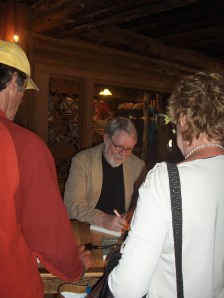
“He seems to really enjoy being here.” I overheard that comment about myself last weekend from a hotel employee as I signed copies of my book, Adventures In Yellowstone, in the lobby of Old Faithful Inn. That never occurred to me before, but it’s true. I do enjoy meeting people and talking about early travel to Yellowstone Park. When I’m lucky, I also get to add a flamboyant signature to a newly purchased book.
I sit at a table near the clock that indicates the next time the geyser will play so people see me when they come in to get that information. Most people just look at the predicted time and check their watches to see how long they’ll have to wait. If they have time, some people will stop to chat.
“Are you the author?” is the most common question.
At first I explained that the book is a collection of the writings by other people so actually I’m the editor or compiler. But that was too much information, so soon I began to just say, “Yes I am,” and smile. Sometimes I add, “I can prove it,” and hold up the book showing the page with a photo of me. People chuckle at that and agree it’s me.
“It’s a collection of a dozen stories of early travel to Yellowstone Park in the words of the people who lived the adventures,” I add to guide attention back to the book.
If people keep listening, I say, “It starts with fur trapper’s story about battling Blackfeet Indians in 1839 and ends in 1904 with a man telling about touring the park in a coach and staying in world-class hotels—like Old Faithful Inn.”
When they ask about my favorite story, I tell them about Eleanor Corthell taking her seven children to the park from Laramie, Wyoming in 1902. That was a twelve-hundred-mile round trip, I add. The conversation might amble anywhere after that.
The crowd pulses every 90 minutes in counterpoint to the eruptions of Old Faithful. Right after the geyser plays, the lobby fills with people marveling at the 500-ton stone fireplace and the eight-story tall log room. It’s hard to talk to people when the room is full, but the crowd soon disperses to the souvenir shop, restrooms, and parking lot, so there’s space around the table to talk. That’s prime book selling time.
The crowd thins and soon the lobby is nearly empty. Then new people start arriving to check the time of the next eruption. While they wait, sometimes I can strike up a conversation. If a book sale results, that’s fine. But if it just gives me a chance to chat with people from all over the world, that’s fine too.
I really do enjoy it. I’ll be back on August 20 and 21.
∞§∞
— Photo by my author support system, Tamara Miller.
By the 1890s Yellowstone Park had been transformed from a roadless wilderness into a genteel resort with comfortable carriages and luxury hotels. That’s when Frank B. King got on a train in California and traveled to Gardiner, Montana, to take a coach tour of the Park. Although the high adventures of thirty years before we gone, there was still plenty to thrill a visitor like Frank. Here’s his description of waiting in the moonlight for a geyser.
∞§∞
Soon we arrived at the famous Great Fountain, which is one of the largest geysers in the Park. Its crater is about twenty feet in diameter, and one can see down into its clear, blue water at least fifteen feet, and watch the bubbles ascend and break upon the surface. Surrounding the main crater is a secondary, flat basin, and it is in the formation of this border that one sees the most beautiful tints that Nature can produce. The shapes and forms are of the most fantastic and artistic. The coloring is of the lighter and more delicate hues, being upon the pink and amber shades. The forms, colored as they are with the beautiful tints and seen through the clear, still water, which gives one the impression of looking through a pure crystal, make one think of fairyland, they are so beautiful and artistically ideal.
After viewing these more gentle elements, we became impatient for the grand. We had come to see an eruption—had almost been promised it at seven o’clock—and here it was nearly eight. We watched the indicators, but they gave no sign of sounding the alarm. We watched the bubbling water of the crater rise and fall, hoping that each rise would be the last grand spurt, and that each fall was the lull before the storm. We asked questions of the guide; talked among ourselves; carried wood, and built a fire. Time passed, the night grew colder, and still there was no eruption. About ten-thirty, it was the general opinion of the party that we had better give the moon and stars our proxies and let them watch the never-ceasing bubbling of the Fountain, and we returned to the hotel, a cold, tired, and disgusted lot.
The next day, as we were returning from our visit to the Upper Basin, we saw a vast column of steam ascend toward heaven from the vicinity of the Fountain, which was a sign that there had been an eruption, and we had just missed it.
The third evening that we were at the Fountain hotel, we were again told that there was to be an eruption of the Great Fountain. We thought perhaps there might be luck in odd numbers, having missed two eruptions. We piled into the bus to make a try for the third. Again we viewed the beauties of the border; again we watched the fluctuation of the water of the crater, and again we became impatient. The hours passed slowly because we expected every minute to be the last. Nine o’clock came and no eruption. Ten o’clock came and no eruption. The moon rose and cast its mellow light upon the water of the crater and the outer basin. The stars blinked and twinkled and watched over us and the geyser. It was a beautiful sight, with the great geyser before us slowly and deliberately preparing for a mighty effort, the pines back of us sighing and whispering to one another, and that little knot of impatient watchers moving to and fro in the firelight. The question was raised, “Shall we go or shall we stay?” and it was decided we should stay with it until the “bitter end.” There was more wood piled upon the fire, and we settled down to wait in earnest. We had gotten to that “don’t care” state, when those who were standing at the edge of the crater rushed back with a cry of, ” Here she comes!”
Slowly and deliberately the water in the crater overflowed into and filled the outer basin. This was an unfailing indication that an eruption was coming. More wood was piled upon the fire, and the flames leaped with joy and reflected themselves in the moving water. The moderate bubbling increased to violent convulsions. There was a low, sullen rumbling; a bulging of that great mass of water, and with a rush and a roar, the whole mass shot into the air one hundred and fifty feet. It was a sight worth the many hours of waiting to see that great volume of water, twenty feet in diameter and one hundred and fifty feet high, rise and then fall and rise again and continue to play. As it rose toward the spangled blue and the reflected glow of the fire fell upon the water and steam, it seemed like a most beautiful and grand electric fountain; then the steam would drift to one side and the moonlight would play upon it. It was a grand and overpowering sight!
The geyser continued to play for nearly an hour, but the first twenty minutes it was at its best and showed its greatest power, making grand spurts which would be followed by the little lull that came before a renewal of vigor. Then, little by little, the spurts became more feeble; the water subsided, the fire smoldered and went out, and the eruption of the Great Fountain was over.
∞§∞
— Frank B. King, “In Nature’s Laboratory: Driving and Fishing in Yellowstone Park.” Overland Monthly, June 1897.
I’ll be signing copies of my book, Adventures in Yellowstone: Early Travelers Tell Their Tales, in the lobby of the world famous Old Faithful Inn this Friday and Saturday reprising an event I had last summer. You shouldn’t visit Old Faithful without going inside the Inn, so if you’re there this weekend look for me. I’d love to sign a book for you. If you can’t make it, remember I’ll be back on August 20 and 21
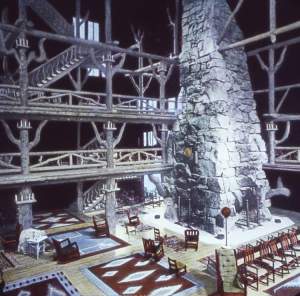
It’s always a thrill to be in the setting that Wikipedia describes like this: “With its spectacular log and limb lobby and massive (500-ton, 85-foot) stone fireplace, the inn is a prime example of the ‘Golden Age’ of rustic resort architecture.”
The inn, which was built using local lumber and stone, is said to be the largest log structure in the world. When Old Faithful Inn opened in 1904, it was a state-of-the-art facility with electric lights and steam heat.
An earthquake in 1959 stalled the clock and damaged the fireplace so only two of its hearths work. There has been some renovation are rearrangement of furniture, but the inn looks pretty much as it did in 1913 when Forest and Stream magazine published the description below.
∞§∞
In this basin, besides … the numerous hot springs and wonderful geysers, is the Old Faithful Inn, one of the most costly and attractive log houses to be seen anywhere. The logs for the most part are rough as they appear in their natural state. Massive logs tapering on each ascending balcony appear as giant trees. The staircase leading to the lookout has split logs for steps. Windows of diamond-shaped glass and dainty French curtains are exquisitely beautiful against the setting of rough logs.” In the center the building rises eight stories high, and from this lofty eminence you have a most charming panoramic view of the Upper Geyser Basin. It was built at a cost of two hundred thousand dollars. The chimney of this immense structure has four large and four small fireplaces, and fastened to the chimney is a great iron clock that keeps Mountain Time.
∞§∞
— Excerpt from “A Trip to Yellowstone Park” by G.S. Wyatt. Forest and Stream, December 27, 1913.
Early travelers assumed the reason that some lakes and streams in Yellowstone Park were barren of fish because of hot water and chemicals from springs and geysers, but systematic studies indicated that the problem was physical barriers like water falls. In 1889 officials initiated a program of stocking fish and proved the studies were right.
By the late 1890s, when Frank B. King and his friend hauled their fly rods and creels through the park, the once barren rivers and lakes were teeming with fish. King has been traveling through the park for several days before he arrived at the Firehole River and finally got an opportunity to test the famous fishing waters of Yellowstone Park. Here’s his story of what happened then.
∞§∞
When we reached the Park, every one told us we could catch fish anywhere and everywhere, but still those rods remained under the seat, and as the days passed by, we wished we could tell some of those people what we thought of them. When we looked into the hot springs, we saw no signs of fish, and in the geysers the finny tribe was missing.
Still we went bravely on, now and then casting a longing glance at the rods, and hoping, at least, that we might some day find some place where we could take them out of their cases and look at them, if nothing more.
As we turned our backs upon Old Faithful and his companions that afternoon, and drove down the Firehole River toward the Fountain House, the shadows were just commencing to lengthen. Through the pines, I could catch here and there tantalizing glimpses of the river as it ran along between its meadowy banks. Now and then, it formed rapids which ran into beautiful pools and then out again into long, open riffles. Here, there would be a log extending out into the water, at the end of which I could see a tempting eddy from which I was almost sure I could coax a “big one.” Next, there would be a long bend with a riffle above and below it. In those riffles, I could imagine I saw several “beauties” waiting for a fly to drop upon the water that they might jump at it.
Well, I stood all this just as long as I could. I was going to get out my rod and make a try, even if I failed. My companion was a little, in fact, very sleepy, and did not care whether there were fish or no fish; what he had his mind on was that long, quiet nap he was to have when he reached the hotel. By promising him that I would only make a few casts, and that he could sleep in the surrey while I tried my luck, he consented to wait just a minute or two.
I pulled on some overalls, a fishing-coat, a pair of “gums;” set up my pet rod; tried the reel to see if it still knew its song; ran the line through the guides; tied on a leader; picked a brown hackle, a royal coachman, and a black gnat, out of my book; and sallied down to the river. Before me was a beautiful pool, one of those long, deep ones with just enough current running through it to make the flies work well.
I crept up as close to the pool as I dared, took the rod in my right hand, and made a long, pretty cast out past the middle of the pool. The flies had no sooner straightened out than there was a break in the water and a streak of gold and black passed over the end hackle and into the water. He had missed it; but he was a beauty. I felt like letting out an Indian whoop—there was a fish in the river anyway, I had seen him. The next thing to do was to catch him.
I was all of a tremble, for if ever I wanted a fish in my life, I wanted that one, if for nothing more than to give me some cause for yelling to my sleepy companion to bring down the landing-net. Once more I drew back and made a long cast, but the flies struck a little too far up stream and had to travel with the current a little distance.
No sooner were they over the spot where I had had the first rise than, zip, something struck the end fly and started up stream, making the line hum through the water and the reel spin. I did not think, as some people tell, that I had a whale or an elephant, I knew what it was—it was a good big trout. There is only one thing that acts the way this something on the end of my line did, and that is a gamy trout.
He ran up stream until the current and strain of the rod was too much, and then he left the water. You can imagine the way he left the water. You know the way a big trout acts. Well, he acted as they all do. When he was back in the water, he started down stream, and when he reached the end of the pool, he broke again and then came toward me and then away from me.
By this time, the first rush was over and I let out a long, deep yell for my sleepy friend. As soon as he heard that yell, he knew just what was up, and he came down that hill with the landing-net in his hand just as fast as a man who was not a bit sleepy. His first words were:
“What have you got? How big is he?”
After a little sulking, a few dashes, and a break or two, came the fight around the landing net, and at last I had him kicking in the grass on the bank. He was a beauty! A Loch Leven that measured nearly twenty inches and weighed over two pounds and a half. As he lay there in the grass, his yellow stripe and red spots upon the black made a very pretty picture. He was a beauty, and he was ours.
Thoughts of a nap left the mind of my companion, and fishing was declared the order of the day. He soon had his “Leonard” set up, and before many minutes had a mate to mine bending it almost double. I never saw any one wake up so quickly in my life. He never had a thought of sleep the rest of the afternoon. The fact was, he did not have time for such thoughts, the fish kept him too busy.
From the time I hooked my first fish up to a little while before dark, we had the finest fishing I ever heard of. When I say it was the finest fishing I ever heard of, I mean it, and I have heard some very tall fish stories. We fished side by side all afternoon and one was working with fish all the time, and part of the time both of us had our hands full.
We lost the biggest one we had hooked, of course; one always does. When we left the stream, we had twenty-two fish that would average over two pounds apiece. Some were Rainbows; some were Loch Levens; some were Cutthroats, and they were all beauties, every one of them a work of art. I never hope to catch such a gamy, beautiful mess of trout again. Such fishing one only has once in a lifetime.
∞§∞
— Frank B. King, “In Nature’s Laboratory: Driving and Fishing in Yellowstone Park.” Overland Monthly, 29(174)594-603 (June 1897).
— Wikipedia photo.
— To see more stories about fishing in Yellowstone Park, choose “Fishing” under the categories button on the right side of this page.
 lashings, the cook seizes them, and hurriedly digs a trench, in which he starts his fire. While it is kindling, he and anybody else whose hands are free cut or pluck up fuel.
 I’ll return to the lobby of Old Faithful Inn on Saturday and Sunday (August 20 and 21) to sign copies of my book Adventures in Yellowstone: Early Travelers Tell Their Tales. It’s a great venue and I always have fun there.
 They armed me with a salt shaker and I spent the afternoon trying to get close enough to a bird to salt its tail. Not until my brothers came home from school and started laughing at me did I get the joke.
 Because the grizzlies are shy and tend to be nocturnal, Wright said, chances of taking a daylight photo were slim, so he began experimenting with ways to use batteries and tripwires to ignite flash powder. By 1906 he had perfected his techniques enough to go to Yellowstone Park to try them out.
 “He seems to really enjoy being here.” I overheard that comment about myself last weekend from a hotel employee as I signed copies of my book, Adventures In Yellowstone, in the lobby of Old Faithful Inn. That never occurred to me before, but it’s true. I do enjoy meeting people and talking about early travel to Yellowstone Park. When I’m lucky, I also get to add a flamboyant signature to a newly purchased book.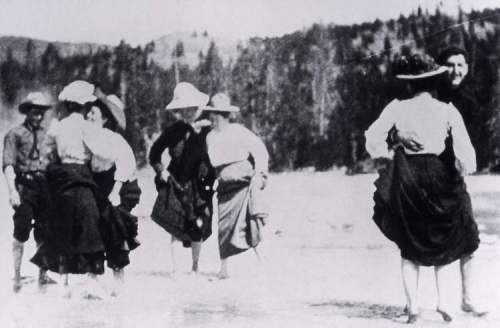
 It’s always a thrill to be in the setting that Wikipedia describes like this: “With its spectacular log and limb lobby and massive (500-ton, 85-foot) stone fireplace, the inn is a prime example of the ‘Golden Age’ of rustic resort architecture.”
 M. Mark Miller, Author