Author: mmarkmiller

  • A Tale: The Last Outpost of Civilization — 1874

    Late in the summer of 1870, men rushed into the area that was to become Yellowstone Park looking to find Truman Everts and claim the reward that was offered for his rescue.

    McCartney's "Hotel"

    Everts, who had become separated from the famous Washburn Expedition, had been alone in the wilderness for thirty-seven days when Jack Baronett found him. Everts refused to pay the reward on the grounds that he would have made it to safety on his own. Baronett said  he found Everts nearly starved to death and raving mad.

    The searchers also discovered Mammoth Hot Springs and immediately saw an opportunity to convert the area into a bath resort. The next summer, two entrepreneurs named James McCarntey and Harry Horr took out homestead claims near the springs and build the first hotel in Yellowstone Park—a 25-by 35-foot log cabin with a sod-covered slab roof. “Guests” at the cabin had to provide their own blankets and sleep on the floor.

    Although the hotel had hot and cold running water (a 40-degree stream on one side and a 150-degree stream on the other), the Earl of Dunraven  wasn’t impressed with the accommodations when he visited in 1874. Here’s his description.

    ∞§∞

    The accommodation at the Mammoth Hot Springs Hotel was in an inverse ratio to the gorgeous description contained in the advertisements of the Helena and Virginia newspapers. No doubt the neighborhood of these springs will some day become a fashionable place. At present, being the last outpost of civilization—that is, the last place where whisky is sold—it is merely resorted to by a few invalids from Helena and Virginia City, and is principally known to fame as a rendezvous of hunters, trappers, and idlers, who take the opportunity to loiter about on the chance of getting a party to conduct to the geysers, hunting a little, and selling meat to a few visitors who frequent the place in summer; sending the good specimens of heads and skeletons of rare beasts to the natural history men in New York and the East; and occupying their spare time by making little basket-work ornaments and nicknacks, which, after placing them for some days in the water so that they become coated with white silicates, they sell to the travelers and invalids as memorials of their trip. They are a curious race, these mountain men, hunters, trappers, and guides—very good fellows as a rule, honest and open-handed, obliging and civil to strangers if treated with civility by them. They make what I should think must be rather a poor living out of travelers and pleasure parties, doing a little hunting, a little mining, and more prospecting during the summer. In the winter they hibernate like bears, for there is absolutely nothing for them to do. They seek out a sheltered canyon or warm valley with a southern aspect, and, building a little shanty, purchase some pork and flour, and lay up till spring opens the rivers and allows of gulch mining operations being recommenced. If you ask a man in the autumn where he is going and what he is going to do, ten to one he will tell you that it is getting pretty late in the season now, and that it won’t be long before we have some heavy snow, and he is going “down the river or up the canyon.”

    ∞§∞

    — The Earl of Dunraven, Hunting in the Yellowstone, Outing Publishing Company, New York, 1917.

    — Photo detail from the Yellowstone Digital Slide File.

    — To see more stories by this author, click on “Dunraven” under the “Categories” button to the left.

    — You might also enjoy Truman Everts’ chilling tale of being “Treed by a Lion.”

  • On Writing: Using Scrivener To Manage Multiple Threads in Narrative History

    This morning when I did my regular pass though my Facebook Page, I paused at the “Scrivener Tip of the Day.

    Scrivener is writing software that I use for nearly all my work these days. It’s far to complicated to describe in a few sentences, but you can read about here. For this discussion, just think of it as a combination word processor and file manager with a suite of tools to help organize complicated writing tasks.

    One of the appeals of Scrivener is that a novice can figure out the basics in a few minutes and go to work, leaving the advanced features for later.  That’s what I’ve been doing. I’ve learned enough about the program to find it very useful, but I still have a lot to learn.  That’s why I always check out the Tip of the Day.

    Often the tip is something I already know; often it’s about a feature that I think I’d never use, and sometimes—like today—it provides a solution to a problem that’s been vexing me for weeks.

    Today’s tip is by British crime novelist David Hewson, who explains how he uses Scrivener to keep track of the things as he writes a novel based on a Danish murder mystery broadcast by the BBC 4 as a television series, “The Killing.”  I’m sure there are major differences between Hewson’s work on a novel based on a TV series and my narrative history on events that happened in Yellowstone Park more than 130 years ago. But his post describes a problem that parallels one that I’ve been working on: how to keep track of a story that has several distinct threads.

    Hewson’s story has three separate threads:

    • A crime story about the pursuit of a killer.
    • A family story about couple struggling to come to grips with a tragedy.
    • A political story about a man’s effort to become mayor of Copenhagen.

    My book, which I’m calling Encounters in Yellowstone, has even more threads:

    • The Nez Perce Indians’ story of fleeing their homeland in Washington and Idaho in hopes of making a new life in the buffalo country of the Montana plains.
    • The Army under General O.O. Howard who pursue the Nez Perce across three states.
    • The Radersburg Party of tourists who have one of their members shot and left for dead, two women taken captive, and several fleeing through the wilderness.
    • The Helena Party of tourists who have two of their members killed in blazing gun fights with the Indians.

    In addition, Encounters will have several compact stories that are contained in single chapters.  These include stories of other army units that hunted for and fought the Nez Perce, settlers who were attacked and robbed, and scouts who scoured the wilderness looking for the Indians.

    Hewson describes how he uses Scrivener’s tools for labeling files, sorting them, and creating collections to keep track of various threads.  (You can see his blog post for the details.)

    Once threads have been assembled in collections, they can be viewed separately to check  for such things as completeness, continuity and style.  Two collections can be viewed simultaneously to check for transitions.  If any problems are spotted, they can be edited on the spot.

    I’ve posted here before about the problems of keeping things straight while writing a narrative history with a several  threads involving a large number of people.

    I said in that post “My job is to analyze the accounts of these people—and of dozens of others—and sift out the truth. Then I’ll try to put the whole thing together in a coherent whole. To do that, I’ll need to look for places where the various viewpoints converge and diverge, overlap and separate, compliment and contradict.”

    Hewson has described how to use Scrivener to help solve those problems.  I’m grateful for his advice and look forward to giving it a try.

    ∞§∞

  • A Tale: Bicycling Through Yellowstone Park in 1898

    When the U.S. Army took over administration of Yellowstone National Park in 1886, they brought the Corps of Engineers with them and began building roads. Hiram Chittenden, the engineer in charge, said Park roads should be the best in America and made that so. By 1898 the Corps had completed Park roads in the “Grand Loop” pattern that exists today.

    The first bicyclists visited the park in 1881. They rode “ordinaries,” ungainly contraptions with tiny rear wheels and front wheels up to 60 inches tall. In 1885 “safety bikes” with equal-size front and rear wheels were invented. By the dawn of the Twentieth Century “wheelmen,” as cyclists called themselves, frequented Yellowstone’s fine roads. Here’s how one of them described his trip in 1898.
    ∞§∞

    From Cinnabar, through the park, the government has graded 170 miles of road and is adding more each year. The air is bracing, the blood tingles in one’s veins. Along an avenue of trees, the roads—which are good—with grades and curves enough to fascinate, soon lead to Beaver lake, quiet, in the valleys. Then to the left that great mountain of jet black glass, Obsidian Cliffs, looms up hundreds of feet high, and next Twin Lakes—one a lovely green, the other a somber black—two sisters, one in bridal garb, the other in deep mourning.

    And just beyond a group of tents suggested that my appetite for things of earth had come back. A dinner for a dollar, and I got all I paid for; then out of the valley came smells of that other country that has been a standing menace to bad boys from time immemorial. Jets of steam raising in the air lead one down the road and suddenly you are in the midst of the grandest group of boiling springs in the world.

    The smell is of the infernal regions. Spouting geysers of crystal water, boiling hot, boiling springs of purple, yellow and green waters are on every side. Awestruck with the mystery of the world, we moved along with hot water, smoke, steam, hissing noises and bad smells on every side.

    Here, in the midst of Nature’s grandest efforts, a storm broke loose, the rain fell, the lightning flashed, and thunder roared and crashed upon the mountainside, until the writer, who had found shelter under an overhanging rock, began to figure up his life insurance. Then the storm cleared away.

    Having gone down hill several miles to cross Gibbon river, I began the climb again, mile after mile along winding hillsides, yet so gradual that very little walking was necessary; then along the summit of the mountain, with elk, antelope and deer in sight every few minutes; then down another long slope until the Madison river is reached; then for miles along an enchanted stream.

    For miles the road leads through these marvels of the world until the Upper Geyser basin is reached, and old Faithful greets you with a spout of crystal water a hundred feet high. The giant roars a welcome. Almost countless boiling springs are on every side.

    The road leads out through the pines, and a start is made for Yellowstone Lake sixteen miles away. Again the mountain road becomes too steep to ride, and we dismount and push our wheel up the winding hill until the summit is reached.

    It is a perfect wheeling road that you traverse for miles after passing the divide. Then comes into view Yellowstone lake, hid away in the midst of snow-capped mountains. The past fifteen miles has been through grand parks, along enchanting streams and meadows, and over roads lined with rarest wild flowers that fill the air with perfume.

    A group of white tents on the bank of the lake, with the smell of roasting beef, broiling trout and coffee, calls one back to life. The wheel is set against a tree while a dinner is stowed away, and then rest on the grassy slopes in the balmy breezes that ruffle the green waters in the midst of God’s grandest hills.

    From this point there is a fine road for eighteen miles skirting the lake. Also, there is a small steamer that will convey you to the other side. Both ways are tempting and it is hard to decide, but sitting on the deck of a steamer is easier than sitting on a wheel. That settles it, and soon we are on the craft for a ride on waters that are magical with their green hues and shadows of the giant mountains.

    It is 4 o’clock in the afternoon when a landing is made at the Yellowstone hotel, a tempting place to stop for the night. But in that latitude there are six hours of daylight still in which to make the seventeen miles to the Grand canon. The roads are fine and a start is made.

    At the hotel a brook trout, hot from the broiler and as large as the platter, is set before one. A good dinner and a good bed followed the day, and the next day to come finds one still fascinated with the magnificence of the scene.

    Another day, and the wheel is pushed three miles to the summit of the range. For three miles the road leads down the mountain past the Virginia Cascades, the road too rough to ride part of the way, then good wheeling except in a few places, back to Cinnabar, thirty-five miles.

    One hundred and seventy-two miles had been made on the wheel, less about fifteen miles of walking up and down hill. Were there any mistakes? Yes, two of them. The wheel bucked one day and a header was taken down the hillside, and a bruised knee and torn trousers resulted, requiring the service of sticking plaster and a tailor.

    Another time, the road being good and winding down hill around the base of a mountain, the wheel was fairly spinning along, when around a curve not twenty feet away was lying in the track a large black bear. There was every indication of a collision head-on, and the wheelman thought he would be telescoped. He yelled, then jumped, rolling over several times in the rose bushes, by the roadside. The wheel shot ahead. All this time the bear was “a humping of himself” to get out of the way. I don’t know what he thought, but he went up the side of that mountain like a bounty jumper going to Canada. The wheel came out of the circus all right, but the rider had to take off his shoes to find his collar button.

    ∞§∞

    — Abridged from C. E  Belknap, “A Wheel Trip in Yellowstone Park.” League of American Wheelmen Bulletin and Good Roads. August 28, 1896.

    — Image, advertisement from League of American Wheelmen Bulletin and Good Roads.

  • A Tale: Buffalo Poacher Provokes a Law That Snares Him — 1894

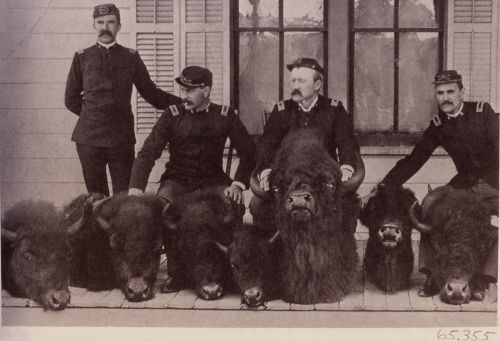
    Buffalo Heads from a Poacher’s Cache

    When the U.S. Army took over administration of Yellowstone Park in 1886, one of it’s primary missions was prevention of the poaching that was decimating the wildlife. The soldiers worked hard to stop illegal hunting, but they lacked authority to anything other than apprehend poachers, escort them out of the Park and order them never to come back. Persistent poachers ignored the orders.

    Finally, in 1894, a poacher was so brazen that he generated public attention and forced Congress to act. Here’s the Park Superintendent’s account of how Ed Howell’s poaching career ended.

    ∞§∞

    Sometime in February I sent a scouting party across the Yellowstone and into the Pelican Valley to look alter the herds of buffalo and elk that usually winter there. On the return of this party they reported to me that they had found an old snowshoe and toboggan trail, but that they were unable to follow it. It apparently headed in the direction of Cooke City.

    While this party was still out, word came to me that Ed Howell, a notorious poacher of Cooke City, had passed the Soda Butte Station one stormy night and had gone on into Cooke for supplies, but that he had not carried any of his trophies with him. A few days after this the sergeant in charge of the Soda Butte Station reported the finding of a trail of this same party with his toboggan and followed it as far as the Park line.

    I then determined on a plan which resulted in the capture of Howell. I waited until I thought it was about time for him to be back in the Pelican country, and then sent out a large search party, with Captain Scott in charge. This party arrived at the Lake Hotel on the evening of March 11. Next day Burgess and Sergeant Troike of the Sixth Cavalry went over into the country previously indicated by me, and made their camp.

    On the morning of the 13th, very soon after starting, they came across some old snowshoe tracks which they could scarcely follow, but by continuing in the direction of them they soon came across a cache of six bison scalps suspended above the ground, in the limbs of a tree.

    Securing these trophies, the party continued on down Astringent Creek to its mouth and then turned down the Pelican. They soon came across a newly-erected lodge, with evidences of occupation, and numerous snowshoe tracks in the vicinity.

    Soon after this they were attracted by the sight of a man pursuing a herd of bison in the valley below them, followed by several shots from a rifle. After completing the killing, the culprit was seen to proceed with the removal of the scalps.

    While thus occupied with the first one my scouting party ran upon him and made the capture. It turned out, as I had anticipated, to be Howell, who coolly remarked that if be had seen the party sooner they could never have captured him, meaning, of course, that he could have shot them before they were near enough to make effective the small pistol, which was the only weapon they carried. They brought him into this place as a prisoner, reaching here on the evening of the 16th of March.

    I at once made full report of the affair and it was widely noted in the newspapers of the country. A suitable recognition, in the way ot a certificate, was made of the coolness and bravery of Burgess and Troike. The scalps, as far as they could be saved, were brought in and properly prepared by a competent taxidermist and placed at the disposal of the Department.

    The feeling aroused in the minds of the public by this act of vandalism stirred Congress to prompt action, so that on May 7 an act for the protection of game in the Park received the President’s signature. In order that it may receive wider distribution, I inclose a copy to be printed with this report.

    Howell denied having killed any bison but those found near him, but I feel sure that he did kill the six found in the cache, and it is quite probable that he killed others which we did not find. In one seuse it was the most fortunate thing that ever happened to the Park, for it was surely the means of securing a law so much needed aud so long striven for.

    On April 25 Howell was released from confinement in the guardhouse by your order aud removed from the Park, and directed never again to return without proper permission. On the evening of July 28 I found him coolly sitting in the barber’s chair in the hotel at this point. I instantly arrested him and reconfined him in the guardhouse, had him reported to the U. S. attorney for this district, and on the evening of August 8 he received the first conviction under the law which he was instrumental in having passed. He was convicted before the ITS. commissioner of returning after expulsion, in violation of the tenth oi the Park regulations, and sentenced to confinement for one month and to a fine of 850.

    With this conviction as a precedent and a strong determination to make other arrests under the new law whenever it is violated, I believe the days of poaching in the Park are nearly at an end.

    ∞§∞

    — Captain George S. Anderson,  Acting Superintendent of Yellowstone Park, Report of the Superintendent of Yellowstone National Park, 1895-1896.

    — Photo, Pioneer Museum of Bozeman.

  • On Writing: Narrative History Requires More Than Getting the Facts Right

    I just finished an article for The Pioneer Museum Quarterly on Fred Bottler, a pioneer rancher in the Yellowstone River’s Paradise Valley north of Yellowstone National Park. Bottler built the first ranch in the valley halfway between Bozeman and Mammoth Hot Springs. That made it an ideal stopping point for early expeditions exploring the park so dozens of park journals and reminiscences mention Bottler’s ranch.

    Gustavus Doane

    Bottler knew the Yellowstone Park area well because he had prospected for gold in there 1860s. That made him an ideal guide, and he accompanied several people who visited the upper Yellowstone in the 1870s.

    My article provides Bottler’s biographical information and recounts stories about him. One of those stories, told by Bottler’s son, Floyd, concerns a pair of needle guns, which were an early type of repeating rifle.

    Floyd said his father won the guns in a card game with soldiers at Fort Ellis, an army post near Bozeman. Although Bottler knew the guns technically were government property, he thought they would be handy if Indians attacked his isolated ranch. He decided to keep them.

    An officer at Fort Ellis, Lieutenant Gustavus Doane (who had a remarkable moustache), heard that Bottler had the guns and decided to retrieve them. Floyd said that when Doane arrived at Bottler’s house, the rancher invited him in and seated him where he could see the guns hanging on a wall.

    Floyd said Doane would look at the guns, then look at Fred, and then back at the guns. Finally, Doane told Bottler that a man living on the edge of Indian country needed such guns and he could keep them—but only if he kept them out of sight when he visited the fort.

    Then, Floyd said, “Their eyes met again and held for a long moment. Then both men rose and the hands met in a strong clasp”

    I couldn’t resist quoting that directly in my article. But when I asked Ann Butterfield, the Pioneer Museum Associate Director, to read a draft of my article, she objected.  She said she liked what I had written, except for that “gazed into each other’s eyes” stuff. “Men just don’t act that way,” she added with a scoff.

    I immediately checked my source and confirmed that I had quoted Floyd accurately. I assured Ann of that, but she was’t really  mollified. That made me think.

    It’s my job to present old stories for today’s readers. I want people to read straight through my stuff and say: “That’s interesting.” I don’t want them stop and say: “This just doesn’t sound right”—even if it is right.

    I also like to quote exactly what people wrote because their word choices make personalities and emotions shine through. It’s always a balancing act to decide when modern sensibilities might collide with old fashioned ways of saying things.

    When I turned in final draft of my article, it didn’t contain the “gazed into each others eyes” quote. Writing narrative history is not just about getting the facts right; it’s also about getting the reader’s experience right. If it distracts, it’s got to go.

    The Pioneer Museum Quarterly will publish my article on Fred Bottler in a few weeks.  I’ll let you know when it’s available.  Then you can decide if I made the right choice.

    ∞§∞

    — Photo detail from the Yellowstone Digital Slide File.

    — You can read an excerpt from my article on Fred Bottler here.

    — To see related posts, click on “Narrative History” under the Categories Button on the right side of this page.

  • A Tale: Building Fires To Light Up Grotto Geyser — 1880

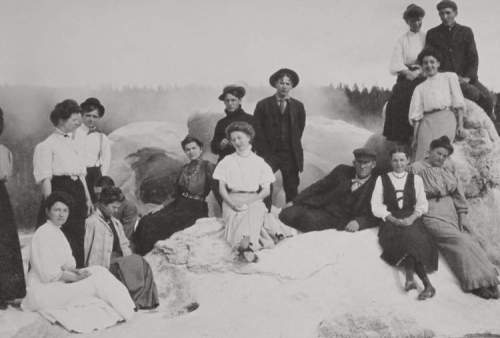
    Visitors on Groto Geyser Cone

    When the U.S. Congress established Yellowstone Park in 1872, they didn’t provide a budget for rangers to enforce regulations. That left people free to do whatever they wanted—and often they did things people today would never imagine.

    Early travelers’ accounts include descriptions of such things as dumping rubble in Old Faithful to see what would happen, shooting bald eagles for sport and doing dishes in hot springs. The Army took over administration of the park in 1886 and guarded it until the Park Service was established in 1916.

    Robert Strahorn, who visited the park in 1880 to write a description for the Union Pacific Railroad, built fires beside Grotto Geyser so he could see it play by firelight. Here’s what he said about that.

    ∞§∞

    Groto Geyser Closeup

    The Grotto is the most singular piece of mechanism among all the geysers. Its dome is some 30 feet long and half as wide, and 20 feet high. It is a miniature temple of almost alabaster whiteness, with arches leading to some interior Holy of Holies, whose sacred places may never be profaned by eye or foot. The hard, calcareous formation about it is smooth and bright as a clean swept pavement.

    Several columns, resembling masses of pearls, rise to a height of eight or ten feet, supporting a roof that covers the entire vent, forming fantastic arches and entrances, out of which the water is ejected, during an eruption, 50 or 60 feet.

    The entire surface is composed of the most delicate bead-work imaginable, massive but elaborately elegant, and so peerlessly beautiful that the hand of desecration has not been laid upon it, and it stands without flaw or break in all its primal beauty—a grotto of pearls.

    Darkness coming on, we built large fires on one side of the Grotto, and from the opposite side were afforded a sight, whose wonderful weirdness we can never forget. The volumes of water then resembled sheets of flame or molten metal and the drenched and dripping arches, through which the flickering blaze was plainly seen, seemed more like a fiery furnace than a real, live geyser.

    We camped by the side of the Grotto during the night, and with the confused noises of hundreds of geysers, steam vents and boiling springs in our ears, and reflection, which would not “down,” upon the almost supernatural experiences of the day, there was more wakefulness than tired bodies warranted.

    ∞§∞

    — Excerpt from Robert E. Strahorn’s book, Montana and Yellowstone Park, 1881.

    — Images from Coppermine Photo Gallery.

    — You also might enjoy this story by Robert Strahorn’s wife, Carrie: An October Snowstorm at Yellowstone Canyon, or John L. Stoddard’s description of Fountain Geyser as a Cloudburst of Jewels.

  • An Event: Presenting at Beavertail Hill Park Was Great Fun


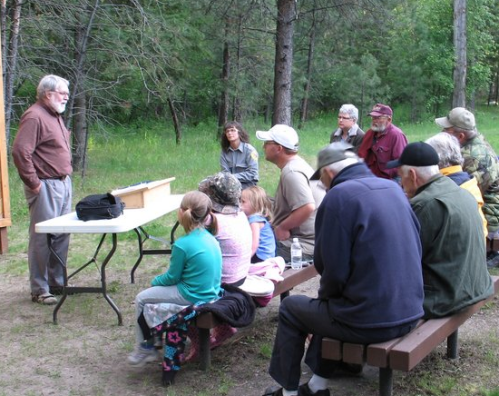
    After my wife, Tam, and I arrived at Beavertail Hill State Park on Friday, we chose a campsite and began setting up. Then something clicked inside our RV and all the doors locked tight. We were left outside with only the clothes on our backs and the stuff in our pockets.

    Fortunately, the stuff in my pockets included my cell phone and my Triple A Card. After the panic surge subsided, we called for service. We were only thirty miles south of Missoula so help should have arrived in plenty of time for me to review my notes and prepare for my presentation at 8 p.m., an hour ahead.

    After half an hour dragged by, I asked Tam to bring my notebook of “Sidesaddles and Geysers” stories as soon as she got into the RV. Then I headed to the amphitheater. I explained the situation to the park rangers and assured them that I could ad lib an hour presentation if I had to. I really do think I could do that, but it would be like a high wire act without a net. Probably everything will be fine—but what if you fall?

    The park rangers kindly put back the start of the program for ten minutes—to allow for stragglers, they said. I was grateful for the delay. At 8:10, a ranger introduced me. As I stepped forward, a breeze began blowing out of the nearby trees and cold air penetrated my lightweight summer shirt. I stuck my hands in my pockets and began to speak.

    My presentation was part of a series on Women in Montana History so I decided to tell a little more  than I usually do about the women whose stories I read. I thought people might be interested in hearing about how pioneer women came to Montana.

    There were three girls, about seven or eight years old, sitting in the front row and I asked them to help. “Every time I mention a new woman,” I said, “You ask: ‘How did SHE get to Montana?’” The girls agreed to help.

    Then I said I was going to start with stories my grandmother used to tell about her trip to Yellowstone Park in 1909. Then I paused. The girls giggled and yelled: “How did she get to Montana?”

    I explained that Grandma was the only woman I was going to talk about who was born in Montana. Then I launched into her stories about cooking  bread in a hot spring, dyeing geysers by tossing red long johns in them and the handkerchief pool.

    Next I said I was going to tell stories about Emma Stone, who was the first white woman to make a full tour of the park in 1872. Then I paused—and waited. Members of the audience prompted the girls who then yelled, “Oh yeah! How did she get to Montana?”

    So it went for the rest of the evening. I would name another Yellowstone pioneer woman and pause. Other audience members would remind the girls of their job and they would giggle and yell.  Everybody enjoyed the game.

    Emma Stone came to Montana up the Missouri River on a steamboat. Emma’s niece, who chronicled that trip, told about how three large families who shared a small stateroom slept in shifts and about the day they saw Indians driving a herd of buffalo into the river. Young Emma said her uncle shot a buffalo and dragged it aboard so they could have fresh meat.

    About then, Tam arrived with my notebook. Perfect timing. My grandmother and Emma Stone didn’t leave written accounts of their adventures, so I have to ad lib them anyway. But I like to read the stories of people who left journals or reminiscences. Their adventures and personalities shine through the words they wrote.

    The sun was slipping behind the trees and I was starting to shiver, so I asked Tam to bring me a sweater. (She’s always my best audience member and I hated to see her miss my presentation, but I was grateful that I have what she calls “an author support system.”)

    Next I told about Sarah Tracy. Like Emma Stone, Sarah Tracy came to Montana on a steamboat up the Missouri, but she was a new bride so she didn’t have to share a stateroom. In her reminiscence about her trip to Yellowstone Park in 1874, Sarah told about the cavalry that escorted her stagecoach from Bozeman to the Paradise Valley, the terrifying ride over the crude new road through Yankee Jim Canyon, and cooking doughnuts in bear grease.

    I finished with Emma Cowan, who came to Montana as a 10-year-old girl in 1864. Emma said she loved the gypsy life of traveling across the prairie in a covered wagon. I usually read Emma’s gripping description of being taken captive  by Indians in Yellowstone Park in 1877. That’s the year the Army chased the Nez Perce through Yellowstone Park after the bloody Big Hole Battle.

    For a change, I decided to read from my next book, Encounters in Yellowstone that describes what happened when Yellowstone tourists and the Indians collided. The section I read is about the unbelievable ride Emma made to be by her husband’s side. As soon as Emma heard that her husband had survived being shot three times and left for dead, she drove 175 miles in 31 hours by team and wagon to the place where he was waiting.

    The audience greeting the end of my reading with silence—which I’ve decided to take as a good sign.  When announced that I had finished my presentation, they applauded vigorously.

    I hung around for a few minutes to sell and sign copies of my book, Adventures in Yellowstone. Then I went back to the unlocked RV where the author support system fixed a hot supper.

    ∞§∞

    — Photo by Vernon Carroll, Montana Department of Fish, Wildlife and Parks.

  • A Tale: Colonel Pickett’s Version of Bagging His First Bear — 1877

    When two people  describe the same event, interesting differences often occur. That certainly happened when Colonel William D. Pickett’s and his guide, Jack Bean, described the Colonel’s first bear hunt.

    Col. Pickett

    The hunt happened shortly after the Nez Perce Indians fled through Yellowstone Park following the bloody Big Hole Battle on August 9, 1877. Although there was still a possibility of danger from Indians remaining in the Park, Pickett was eager to hunt for grizzly bears there so he hired Jack Bean, an old Indian fighter and frontiersman, as his guide.

    Bean’s version of their trip presented the Colonel as a bit of a buffoon. Here’s how Colonel Pickett, who lated became a famous bear hunter, described his first kill.

    ∞§∞

    It was learned the hostile Indians had passed through the National Park, followed by Howard’s forces. As there was still time to make a hasty trip through the Park before the severe winter set in, I determined to do so. I was urged not to make the attempt on account of the hostiles’ sick or wounded that might have been left behind, and of other Indians. I recognized the risk, but since as a youngster I had served during the Mexican war as a mounted volunteer on the northwest frontier of Texas against the Comanches, and all the bad Indians of the Indian Territory and of the Kansas Territory who infested that frontier, I had some knowledge of Indian ways. Added to this, was the experience of four years’ service in the War Between the States. These experiences qualified me to judge of the credence to be placed in war rumors. I was anxious to make the trip.

    Only one man of suitable qualities could be found willing to make the trip—Jack Bean. He knew the routes through the Park; he was a good packer and mountain man, cautious, but resolute. We went light. I rode my hunting mare Kate; Jack his horse, and we packed my little red mule Dollie. I was armed with a .45-90-450 Sharpe long-range rifle, and Jack with a .44-40-200 repeater. In addition to a belt of cartridges, Bean carried around his neck a shot bag pretty full of cartridges, so that in case of being set afoot, they would be handy. When Dollie was packed there was not much visible except her ears and feet.

    We left Bozeman September 11, and nooned in the second canyon of the Yellowstone on the 13th. While there, a portion of the cavalry that accompanied Colonel Gilbert on his trip around from the head of the Madison, passed down toward Fort Ellis, having with them Cowan and Albert Oldham, who had survived the hostile Indians near the Lower Geysers.

    In the afternoon, we passed up the river, by the cabin of Henderson, burned by hostiles, turned up Gardiner’s River and camped within three miles of Mammoth Hot Springs. As this squad of cavalry passed down, we were conscious that we had to depend entirely on our own resources for the remainder of the trip, for there was probably not another white man in the Park. A note in my diary says: “International rifle match commences today.”

    Early on the 14th, we went on to the Hot Springs, and spent two or three hours viewing their beauties and wonders. We passed by the cabin, in the door of which the Helena man had been killed a few days before, after having escaped the attack on the camp above the Grand Falls. During the day’s travel, there were splendid mountain views from the trail.

    In the afternoon of September 15, the trail descended to the valley of the Yellowstone and passed within one mile of Baronett’s Bridge, across which Howard’s command passed on the 5th of September in pursuit of the Nez Perces. We soon dropped into the trail taken by that command and followed it back to Tower Falls.

    September 16, we packed up and began the ascent of the Mt. Washburn range. For a few miles, the trail followed an open ridge, exposing us to a northeast blizzard, accompanied by snow. After descending into the gulch, up which the trail leads to the pass in the range, the snow became deeper, and toward the summit of the range, it was eighteen or twenty inches, knee-deep, which compelled us to dismount and lead the horses, as the ascent was very hard on them. In view of future possibilities, we made every effort to save their strength. It was one of the most laborious day’s work of my experience.

    When near the summit, going through open pine timber, we discovered a large bear approaching us. He was moving along the side of the steep mountain to the left, about on a level, and would have passed out of safe range. I immediately dismounted and cut across as rapidly as the snow and the ascent admitted, to intercept him. He had not discovered us. When within about one hundred yards, watching my opportunity through the timber, I fired at his side. He was hit, but not mortally. As my later experience told me, those bears when hit always either roll down hill or go “on the jump.” On the jump this bear came, passing about twenty yards in our front. A cartridge was ready, and against Jack’s injunction “Don’t shoot,” I fired; yet, it failed to stop him, and Jack turned loose with his repeater, I shooting rapidly with my rifle. By the time the bear had reached the gulch he stopped, to go no further.

    The excitement caused by this incident and my enthusiasm on killing my first grizzly—for I claimed the bear—dispelled at once all feelings of hardship and fatigue. The bear was a grizzly of about four hundred pounds weight, fat and with a fine pelt. We had not time to skin him, nor could the hide have been packed. After getting a few steaks, a piece of skin from over the shoulder and one of his forepaws, we continued our laborious ascent of the mountain. Still excited by this incident, the work was now in the nature of a labor of love.

    ∞§∞

    — Abridged from William D. Pickett, Hunting at High Altitudes, (George Bird Grinnell, ed.) Harper & Brothers: New York, 1913. Pages 62-68.

    —Photo from the book.

    — Read more about Jack Bean in my book Adventures in Yellowstone.

    You might also enjoy these stories:

  • An Event: Win An Autographed Copy of Adventures in Yellowstone

    I need your help. I’ve been working on my presentation of  “Sidesaddles and Geysers: Women’s Adventures in Early Yellowstone  that will be at Beavertail Hill State Park southeast of Missoula this Friday at 8 p.m.  It’s part of a 12-week series at the park on Women in Montana History.

    Beaver Tail Hill State Park, Montana

    The event, which is sponsored by the Humanities Montana Speakers Bureau, has a standing title, but I always  tailor what I say to the occasion. That gives me a reason to review my files and keeps things fresh in case somebody has a chance to hear me twice.

    Here’s how you can help—and win an autographed copy of my book, Adventures in Yellowstone: Early Travelers Tell Their Tales.

    • Click on the “Categories” button on the right side of this page and choose “Women Stories.”
    • Review stories listed (you’ll have to click the “older posts” button at the bottom of the list to see all 16 of them.)
    • In the comments section below list the four stories that you think will make the best presentation.
    Because time is short, the deadling will be Thursday, June 16, 5 p.m. (MDT)

    I’ll choose a winner from the submissions based on the following criteria:

    • Appropriateness to the audience (families of campers and vactioners) and setting (outdoors in a state park).
    • Appropriateness to the topic, “Montana Women’s History.”
    • Variety (adventure, humor, time period, etc.)
    The winner will receive an autographed copy of my book with any dedication they want.  In case of a tie, the earliest submission will win.  Or if I’m in a good mood, there’ll be more than one winner.

    Enter and many times as you want!

    Tell your friends!  Have fun!

    And if you happen to be in the area on Friday stop by for my free presentation.  I’d love to see you!
    ∞§∞
    — Photo from the Montana Department of Fish, Wildlife and Parks.
  • A Tale: A Woman’s Trout Fishing In Yellowstone Park — 1897

    Early explorers discovered many stretches of water in Yellowstone Park were devoid of fish. At first people thought the problem was caused by hot water and chemicals from geysers and hot springs, but soon they discovered that the problem was obstructions like waterfalls.

    Efforts to stock the barren waters with exotic fish caused ecological problems that officials are still trying to fix, but they also resulted in an anglers’ paradise. Soon people from all over the world were coming Yellowstone Park to fish and reporting phenominal catches. Here’s one woman’s story about fishing a once barren stretch of the Firehole River.

    ∞§∞

    In 1888 the United States Fish Commission stocked the Fire Hole with many varieties of trout. They are still uneducated, eager for the fly; a number six or eight gray professor or brown Montreal proved the most killing. The father of all the Pacific trout, the blackspotted or “cut-throat” (Salmo mykiss), with the scarlet splotch on his lower jaw, was most in evidence. With long, symmetrical body and graduated black spots on his burnished sides, he is a brave, dashing fighter, often leaping salmon-like many times from the water before he can be brought to creel. We found him feeding in the open riffs, or rising on the clear surface of some sunlit pool. “The pleasantest angling is to see the fish cut with her golden oars the silver stream.”

    Our dainty Eastern trout, with brilliant red spots and short, thick-set body, had hardly become accustomed to the change from grass-edged streams and sheltered pools, to the fierce struggle for existence in this fire-bound river. The glint of his white-edged fins betrayed him swaying in the eddies at the foot of some big rock or hidden in the shade of an overhanging bank, thereby offering a direct contrast to his more aggressive Western cousin.

    The California rainbow trout proved true to his reputation, as absolutely eccentric and uncertain, sometimes greedily taking a fly, and again refusing to be tempted by the most brilliant array of a carefully stocked book. During several days’ fishing we landed some small ones, none weighing over two pounds, although they are said to have outstripped the other varieties in rapidity of growth, and tales were told of four-pounders landed by more favored anglers.

    A heavy splash, a ray of silvery light, and with lengthened line the fly was carefully dropped on the surface of a swirling pool, edged with water-plants and tangled grasses, where the current had gullied out deep holes around the big boulders; a rise, a strike—now for a fight.

    Long dashes down stream taxed my unsteady footing; the sharp click and whirr of the reel resounded in desperate efforts to hold him somewhat in check; another headlong dash, then a vicious bulldog shake of the head as he sawed back and forth across the rocks. Every wile inherited from generations of wily ancestors was tried until, in a moment of exhaustion, the net was slipped under him. Wading ashore with my prize, I had barely time to notice his size—a good four-pounder, and unusual markings, large yellow spots encircled by black, with great brilliancy of iridescent color—when back he flopped into the water and was gone. However, I took afterward several of the same variety, known in the Park as the Von Baer trout, and which I have since found to be the Salmo fario, the veritable trout of Izaak Walton.

    So, on down the stream, careful placing of the fly and changing of the feathers brought different varieties to the surface. One other fish proved a complete surprise. He was of silvery gray color, covered with small black crescents. Some of the Park fishermen called him a Norwegian trout; others, the Loch Leven. Any country might be proud to claim him, with his harmonious proportions, game fighting qualities and endurance.

    As the river had worn a pathway around the formation much too deep for wading, I climbed around the edge, past its heated springs and over its mosaic paving, and was seldom disappointed in coaxing a rise where the hot sulphur-tainted streams dripped into the water of the Fire Hole.

    When my creel became uncomfortably heavy, and square spotted tails began to overlap its edge, I waded ashore to look at my catch. Fortunately my boots were heavy, for the bank was honeycombed with miniature geysers and mud-pots, bubbling and sputtering in wicked imitation of their bigger sisters. My last captive being still on my line, I swung it from the river into a geyser cone. Unprepared for the temperature, my return cast brought out only a hook with skull and backbone attached; the flesh had instantlv boiled off.

    Surfeited with success, I unjointed my much tried and highly prized Mitchell rod, a veritable Japanese jinjutsu, ” to conquer by yielding,” among fly-rods. It can never more be duplicated, now that the master who engrafted his love of stream, of woods, of trout, into the rod he fashioned, has passed from sight around the bend of life’s stream, beyond which we cannot follow him.

    ∞§∞

    — Excerpt from Mary T. Townsend, ‘A Woman’s Trout Fishing In Yellowstone Park.’Outing: An Illustrated Magazine of Sport, Travel and Recreation 30:165-177  (1897)

    — Image detail from the same source.

    — For more stories about fishing in Yellowstone Park, click on “fishing” under the “Categories” button on the right.