Author: mmarkmiller

  • A Tale: The Facts Are Tangled, But The Stagecoach Robbery Stories Are Fun

    When I got to the Pioneer Museum on Friday for my afternoon of volunteer work, Associate Director Ann Butterfield told me, “I found something that might interest you.” After a few minutes of her muttering “now where did I see that thing,” she pulled out a file folder entitled “QK Club.” QK stands for “quest for knowledge.” The club began in Bozeman in the 1920s and still meets monthly.

    At its meetings, members present learned papers and other members offer critiques on topics ranging from the death of Montana pioneer John Bozeman to the future of nuclear power. The paper Ann handed me contained a marvelous descriptions of stagecoach robberies in Yellowstone National Park.

    It was written by Jefferson Jones, long time publisher of The Bozeman Daily Chronicle, who was critiquing a paper entitled “Road Agents of Early Yellowstone National Park” by the famous Yellowstone photographer, Jack E. Haynes. In it, Jones quoted an interview with Lester Piersdorff, a Bozeman pioneer who claimed to be a witness to “the holdup of the park stages on October 14, 1897.” Piersdorff, who was in his 80s at the time of the interview, also said he knew about a stagecoach robbery in the 1880s, a that Haynes apparently hadn’t heard of.

    The first thing I did was dig through the collection of QK Club papers held at the Pioneer Museum to look for the Haynes paper. Supposedly, it was presented on October 21, 1952, and the Museum’s collection begins with 1956, so I decided to look for it later in the more extensive collection at Montana State University.

    The Museum has an index of QK Club papers that runs back to 1923, so I decided to look there. Not only did the index fail to list a paper by Jack E. Haynes, it didn’t even show a meeting on October 21, 1952.

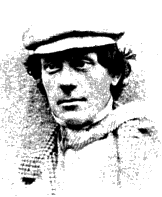
    Next, I decided to check the Museum’s vertical files to see if there was a folder on Piersdorff, who sounded like a very colorful character. I went through the file drawers asking myself “was that ‘I’ before ‘E’ or ‘E’ before ‘I.’”I checked both spellings and was getting ready to give up when I saw a file labeled “Pierstorff,” with a “T.”  I pulled it out and there was a photo of “Lester Pierstorf” peering out from under a hat with a pipe protruding from his walrus mustache. It was a great picture, so I checked the Museum’s photo archive for it—no luck!

    Another clipping in the folder had a headline “Masked Bandits Loot 19 Stages; Lester Piersdorff Driver of One.” This time the spelling went back to “Piersdorff” with a “d,” but said he was a driver in robberies in 1897, but didn’t mention the robbery in the 1880s that he described to  Jones. Also, the clipping (from an unnamed source) had a different date for the robbery. Jones said it happened on August 14, but the clipping said August 7.

    Tired of the contradictory evidence, I decided to look up stagecoach robberies in Aubrey Haines definitive history of Yellowstone Park, The Yellowstone Story. (That’s Haines, the historian, not to be confused with Haynes, the photographer.) Sure enough, historian Haines reports the story that Jones attributes to Piersdorff, but he introduces it this way, “The holdup incident spawned a legend. Jefferson Jones told it this way.” Then Haines offers the story in the identical words that Jones attributed to Piersdorff.

    After repeating the story, Haines says: “It is a beautiful little story, but there is no truth in it.” In a footnote he says, “Told to J.E. Haynes during a discussion of his article “Yellowstone’s Stage Holdups,” [probably by Jones].

    So for what it’s worth, here’s Piersdorff’s account of stagecoach holdup in the 1880s.

    ∞§∞

    The circumstances of the holdup, as I recall them, were somewhat as follows:

    Major McDougle, paymaster of the army in the park, traveling in an ambulance with a bodyguard of six soldiers rounded a turn in the road at Eagles Nest on the Gardner River to find himself confronted by nine mounted road agents, dressed in military uniform, carrying army carbines and their horses bore regulation army saddles and saddle bags.

    Until the command “Hands Up” was issued, Major McDougle though he was looking at a cavalry patrol out on a morning maneuver. With the McDougle party covered by rifles, one road agent dismounted and searched the group for rifles and revolvers, which he took from the men and heaved into the nearby Gardner River.

    He then went to work breaking open the army chest containing $40,000 in gold, all sacked. As the road agent lifted out a sack, he would place it in the saddlebag of one of his confederates. When the robbery was completed, the men saluted the Major and rode down the road toward Gardiner.

    The robbery created much talk at the time, but the men were never apprehended nor the money recovered.

    [Piersdorff then continue with corrections to things Jack Haynes had reported about the 1897 robberies.]

    Jack is in error in stating that only six stagecoaches of the Yellowstone Park Transportation Company were involved in the August 14, 1897, holdup. There were 15 stages in all. [Various accounts put the number of coaches robbed at 6, 15 and 19.] Jack mentions loot taken in that robbery was $400. Not counting the jewelry taken there was approximately $8,000 cash split by the two road agents from that holdup, as I shall tell you about.

    Passengers in the last stagecoach were never robbed and only half of the passengers in Steele’s stage were robbed because at that moment the two road agents spied a Corporal and soldier riding on the old freight road near Spring Creek not far distant and the road agents evidently decided to pull out.

    As Jack states in his paper, I happened to eat opposite Gus Smitzer and George Heeb at the employees’ mess at Canyon the night before the holdup. It was then that I first noted Heeb had a bad scar on his right hand between the thumb and first finger. I little realized at the time how important that scar was to loom in just 14 hours.

    When the following morning the holdup occurred on the Canyon-Norris road, I turned to my passenger in my stage and said: “There’s a holdup going on here and if you have any valuables you better pass them to me.” Purses, billfolds, watches and the like, were all handed to me and I shoved them under the driver’s seat in a water bucket.

    Shortly afterwards when a road agent, who proved to be Heeb, stood opposite us on a bank and shouted, “This is a holdup. Give me your valuables,” only some $15 in loose cash from the pockets of my passengers was handed down. The valuables in the water bucket were never touched.

    The bandit, who had sewed together flour sacks over his head, that extended down to his waist, though which his arms protruded and which had holes for the eyes, pointed his revolver at me with his announcement, “This is a holdup.”

    Being in a higher position on the driver’s seat of the stage than he was, I looked down at the gun. As Jack in his account states, the men had covered their hands with charcoal. I noticed that the right hand of the road agent, which held the revolver, had a scar between the thumb and first finger to which the charcoal had not adhered. I noticed, too, as the road agent held his gun up toward me that the trigger guard had a peculiar “S” mark inscribed on it. When Heeb was captured later, he was carrying a gun with an “S” on the trigger guard. Testimony regarding the scar on Heeb’s right hand and his revolver with the “S” marking I gave in court at the Cheyenne trial was part of the evidence that convicted him.

    ∞§∞

    — Story from the Pioneer Museum of Bozeman.

    — Image, Coppermine Photo Gallery.

    — You might also enjoy

  • A Tale: A Battle With Fleeing Nez Perce — 1877

    My next book, Encounters in Yellowstone 1877, will tell the stories of the several groups of tourists who tangled with the Nez Perce while they fled through Yellowstone Park after the Big Hole Battle.

    Mammoth Hot Springs

    The Army’s pre-dawn attack on the sleeping Indian camp left dozens of women and children dead, which enraged many young Indians. Despite chiefs’ efforts to avoid whites, several groups were attacked in or near Yellowstone Park.

    The most famous encounter is Emma’s Cowan’s ordeal of being captured, but there are other chilling events. Andrew Weikert was touring with a group of young men when they spotted the Indians a few miles south of Mammoth Hot Springs. The group beat a hasty retreat to thick grove of trees and spent the night hiding. The next morning, Weikert and a companion named Wilkie decided to leave the others in camp and go see if the Nez Perce had moved on. Here’s how Weikert described what happened.

    ∞§∞

    We could see where the Indians and their horses had made a trail, so we thought the coast was clear. We started back for camp, but, we ran against an obstacle that made our hair raise and the blood rush to our faces.

    We had gotten into the timber not more than a quarter of a mile when we ran onto a lot of the redskins lying in wait for us. They were under the hill, behind a log, so we did not see them until we got within about seventy-five feet.

    I was riding ahead when I saw them raise up their heads from behind the log. I told Wilkie there were Indians ahead and wheeled my horse. At the same time I was getting my gun up ready to fire. Looking back I saw half a dozen guns leveled at me so I made myself small as I could, with my gun across my knees.

    Bang! bang! bang! then zip! zip! zip! went the balls, but none struck me that time. I was perfectly cool and self-possessed, but will own up that my hair was standing on end when I first saw them. My horse had made a few more jumps, when bang! they went again.

    This time they were a little more successful, for they cut a crease in my shoulder blade about four inches long; did not break a bone, but splintered my shoulder bone a little. And another ball took a piece out of my gunstock. I then began hugging my horse still closer, if such a thing was possible, when they gave us another volley.

    By this time, we were out of range, but the balls flew past thick and fast and we could hear them strike the trees. Now for a race!

    I supposed that they had their horses close at hand, but they did not mount them just then. Just at this time, my horse tripped his foot and fell and came near turning a somersault. I went sprawling on the ground directly in front of him.

    My shoulder was paining considerably, but I did not have long to remain there, for the ‘reds’ were running up again to get another shot at me. I up and let them have one from my repeater. You ought to have seen them dodge. I did this all in a few seconds, and my horse was on his feet again ready to start. I just put my hand on the horn of the saddle, made a bound into it, and was off.

    Wilkie had gotten considerably ahead of me by this time, but I soon made up for lost time. We got back on the prairie again on Alum Creek in the valley, then back in the timber again. The Indians did not follow us. We rode as far as we could, then took it afoot, for the under-brush was so thick that we could hardly get our horses through.

    After we got into the timber quite a ways, we halted to take breath and to see what damage was done. Wilkie asked me if I was hurt; I told him judging from the hole in my shirt on the right shoulder, and the way the blood was running in my boot, I thought that there must be a scratch at least.

    We examined it and bound it up the best we could. Wilkie, being a safe distance from the Indians, did not get hurt. We looked our horses over, and found them all sound, thank fortune. So we mounted and took our direction for camp, rode as lively as we could in hopes that the reds had not been there so we could warn the boys.

    ∞§∞

    —Adapted from Weikert’s Journal published in Contributions to the Montana Historical Society, 1900.

    — Frank J. Haynes postcard, Coppermine Photo Gallery.

    — You might also enjoy:

  • A Tale: Crashing Through Yankee Jim Canyon in a Wooden Boat — c. 1902

    Today it’s easy to hire a boat with a guide to run the rapids through Yankee Jim Canyon north of Yellowstone Park. But that wasn’t always the case, as Lewis Ransome Freeman discovered more than a hundred years ago.

    After graduating from Stanford University in 1898, Freeman decided to become an adventurer and traveled America, Asia, Africa and the Pacific Islands. About 1902, after snowshoeing through Yellowstone Park, he decided to float to the Gulf of Mexico down the Yellowstone, Missouri, and Mississippi Rivers. His first obstacle was to get through Yankee Jim Canyon, a rugged streatch of the Yellowstone River just north of the Park.

    Freeman solicited help from Yankee Jim George, a colorful character who had lived for 30 years  in the canyon that bears his name. The government had taken over Jim’s toll road by then, but he still provided accommodations in his rustic cabin. And, he knew where Freeman could get a boat.

    Freeman covered the Russo-Japanese War beginning in 1905 and continued to work as a war correspondent through World War I. It wasn’t until 1922 that he published this description of running the rapids of Yankee Jim Canyon.

    ∞§∞

    The boat I secured about ten miles down river from the Park boundary. The famous “Yankee Jim” gave it to me. This may sound generous on Jim’s part, but seeing the boat didn’t belong to him it wasn’t especially so. Nor was the craft really a boat.

    We found the craft where it had been abandoned at the edge of an eddy. It was high and dry on the rocks. Plain as it was that neither boat-builder nor even carpenter had had a hand in its construction, there was still no possible doubt of its tremendous strength arid capacity to withstand punishment.

    Jim said that a homesick miner had built this fearful and wonderful craft with the idea of using it to return to his family in Hickman, Kentucky. He had bade defiance to the rapids of the Yellowstone with the slogan “HICKMAN OR BUST.” Kentucky Mule he had called it.

    Our plan of operation was something like this: Bill and Herb, the neighboring ranchers, were to go up and help me push off, while Jim went down to the first fall at the head of the Canyon to be on hand to pilot me through. If I made the first riffle all right, I was to try to hold up the boat in an eddy until Jim could amble down to the second fall and stand-by to signal me my course into that one in turn. And so on down through.

    I was to take nothing with me save my camera. My bags were to remain in Jim’s cabin until he had seen me pass from sight below the Canyon. Then he was to send the stuff on to me at Livingston

    As I swung round the bend above the head of the Canyon, I espied old Jim awaiting my coming on a rocky vantage above the fall. A girl in a gingham gown had dismounted from a calico pony and was climbing up to join us. With fore-blown hair and skirt, she cut an entrancing silhouette against the sun-shot morning sky.

    I think the presence of that girl had a deal to do with the impending disaster, for I would never have thought of showing off if none but Jim had been there. But something told me that the exquisite creature could not but admire the sang froid of a youth who would let his boat drift while he stood up and took a picture of the thundering cataract over which it was about to plunge.

    And so I did it—just that. Then, waving my camera above my head to attract Jim’s attention to the act, I tossed it ashore. That was about the only sensible thing I did in my run through the Canyon.

    As I resumed my steering oar, I saw that Jim was gesticulating wildly in an apparent endeavor to attract my attention to a comparatively rock-free chute down the left bank. Possibly if I had not wasted valuable time displaying my sang froid I might have worried the Mule over in that direction, and headed right for a clean run through.

    As it was, the contrary brute simply took the bit in her teeth and went waltzing straight for the reef of barely submerged rock at the head of the steeply cascading pitch of white water. Broadside on she sunk into the hollow of a refluent wave, struck crashingly fore and aft, and hung trembling while the full force of the current of the Yellowstone surged against her up-stream gunwale.

    Looking back up-stream as the reeling Mule swung in the current, I saw Jim, with the Gingham Girl in his wake, ambling down the bank at a broken-kneed trot in an apparent endeavor to head me to the next fall as per schedule.

    Poor old chap! He was never a hundred-to-one shot in that race now that the Mule had regained her head and was running away down mid-channel regardless of obstacles. He stumbled and went down even as I watched him with the tail of my eye. The Gingham Girl pulled him to his feet and he seemed to be leaning heavily against her fine shoulder as the Mule whisked me out of sight around the next bend.

    With the steering oar permanently unshipped there was more difficulty than ever in exercising any control over the balkiness of the stubborn Mule. After a few ineffectual attempts, I gave up trying to do anything with the oar and confined my navigation to fending off with a cottonwood pike-pole.

    This really helped no more than the oar, so it was rather by good luck than anything else that the Mule hit the next pitch head on and galloped down it with considerable smartness. When she reeled through another rapid beam-on without shipping more than a bucket or two of green water I concluded she was quite able to take care of herself, and so sat down to enjoy the scenery.

    I was still lounging at ease when we came to a sharp right-angling notch of a bend where the full force of the current was exerted to push a sheer wall of red-brown cliff out of the way. Not unnaturally, the Mule tried to do the same thing. That was where I discovered I had over-rated her strength of construction.

    I have said that she impressed me at first sight as being quite capable of nosing the Rock of Gibraltar out of her way. This optimistic estimate was not borne out. That little patch of cliff was not high enough to make a respectable footstool for the guardian of the Mediterranean, but it must have been quite as firmly socketed in the earth. So far as I could see it budged never the breadth of a hair when the Mule, driving at all of fifteen miles an hour, crashed into it with the shattering force of a battering ram. Indeed, everything considered, it speaks a lot for her construction that she simply telescoped instead of resolving into cosmic stardust. Even the telescoping was not quite complete.

    The Mule had ceased to be a boat and become a raft, but not a raft constructed on scientific principles. The one most desirable characteristic of a properly built raft of logs is its stability. It is almost impossible to upset. The remains of the Mule had about as much stability as a toe dancer, and all of the capriciousness.

    She kept more or less right side up on to the head of the next riffle and then laid down and negotiated the undulating waves by rolling. I myself, after she had spilled me out at the head of the riffle, rode through on one of her planks, but it was a railroad tie, with a big spike in it, that rasped me over the ear in the whirlpool at the foot.

    And so I went on through to the foot of “Yankee Jim’s Canyon.” In the smoother water, I clung to a tie, plank or the thinning remnants of the Mule herself. At the riffles, to avoid another clout on the head from the spike-fanged flotsam, I found it best to swim ahead and flounder through on my own. I was not in serious trouble at any time, for much the worst of the rapids had been those at the head of the Canyon. Had I been really hard put for it, there were a dozen places at which I could have crawled out. As that would have made overtaking the Mule again somewhat problematical, I was reluctant to do it. Also, no doubt, I was influenced by the fear that Jim and the Gingham Girl might call me a quitter.

    Beaching what I must still call the Mule on a bar where the river fanned out in the open valley at the foot of the Canyon, I dragged her around into an eddy and finally moored her mangled remains to a friendly cottonwood on the left bank. Taking stock of damages, I found that my own scratches and bruises, like Beauty, were hardly more than skin deep. As the day was bright and warm and the water not especially cold, I decided to make way while the sun shone—to push on toward Livingston.

    The rest of that day’s run was more a matter of chills than thrills, especially after the evening shadows began to lengthen and the northerly wind to strengthen. The Mule repeated her roll-and-reduce tactics every time she came to a stretch of white water.

    There were only three planks left when I abandoned her at dusk, something over twenty miles from the foot of the Canyon, and each of these was sprinkled as thickly with spike-points as a Hindu fakir’s bed of nails. One plank, by a curious coincidence, was the strake that had originally borne the defiant slogan, “HICKMAN OR BUST.” Prying it loose from its cumbering mates, I shoved it gently out into the current.

    Spending the night with a hospitable rancher, I walked into Livingston in the morning. There I found my bags and camera, which good old “Yankee Jim” had punctually forwarded by the train .

    ∞§∞

    —   Condensed from Down the Yellowstone, Lewis Ransom Freeman, 1902.

    —   National Park Service Photo.

    — You might also enjoy “Rudyard Kipling Goes Fishing with Yankee Jim.”

  • A Tale: Ernest Thompson Seton Retells the Story of a Bear Fight

    Wahb, The Grizzly

    Some stories are just so good they deserve to be told twice. Ernest Thompson Seton, who was  an enomously popular writer, artist and naturalist at the dawn of the Twentieth Century, found one when he visited Yellowstone Park in 1898.

    At the time, watching bears at the garbage dumps near the park’s grand hotels was a spectacle not to be missed. One day Seton took his notebook, sketchpad and camera to the dump near the Fountain Hotel and hid out in the garbage to watch bears parade in and hold a banquet. That’s when he saw a mother black bear attack a huge grizzly to protect her sickly little cub.

    The incident not only provided material for Seton’s most famous short story, “Johnny Bear,” it also appeared in his book, The Biography of a Grizzly. The biography chronicles the life of Wahb, a grizzly who lived most of the year east of Yellowstone Park in an area called Meteetsee and was the scourge of ranchers there. But as Seton discovered, Wahb spent his summers dining in the dumps in Yellowstone Park. Here’s an excerpt from The Biography of a Grizzly.

    ∞§∞

    The Bears are especially numerous about the Fountain Hotel. In the woods, a quarter of a mile away, is a smooth open place where the steward of the hotel has all the broken and waste food put out daily for the Bears, and the man whose work it is has become the Steward of the Bears’ Banquet. Each day it is spread, and each year there are more Bears to partake of it. It is a common thing now to see a dozen Bears feasting there at one time. They are of all kinds—Black, Brown, Cinnamon, Grizzly, Silvertip, Roachbacks, big and small, families and rangers, from all parts of the vast surrounding country. All seem to realize that in the Park no violence is allowed, and the most ferocious of them have here put on a new behavior. Although scores of Bears roam about this choice resort, and sometimes quarrel among themselves, not one of them has ever yet harmed a man.

    Year after year they have come and gone. The passing travelers see them. The men of the hotel know many of them well. They know that they show up each summer during the short season when the hotel is in use, and that they disappear again, no man knowing whence they come or whither they go.

    One day the owner of the Palette Ranch came through the Park. During his stay at the Fountain Hotel, he went to the Bear banquet-hall at high meal-tide. There were several Blackbears feasting, but they made way for a huge Silvertip Grizzly that came about sundown.

    “That,” said the man who was acting as guide, “is the biggest Grizzly in the Park; but he is a peaceable sort, or Lud knows what ‘d happen.”

    “That!” said the ranchman, in astonishment, as the Grizzly came hulking nearer, and loomed up like a load of hay among the piney pillars of the Banquet Hall.” That! If that is not Meteetsee Wahb, I never saw a Bear in my life!  Why, that is the worst Grizzly that ever rolled a log in the Big Horn Basin.”

    ” It ain’t possible,” said the other, “for he ‘s here every summer, July and August, an’ I reckon he don’t live so far away.”

    “Well, that settles it,” said the ranchman; “July and August is just the time we miss him on the range; and you can see for yourself that he is a little lame behind and has lost a claw of his left front foot. Now I know where he puts in his summers; but I did not suppose that the old reprobate would know enough to behave himself away from home.”

    The big Grizzly became very well known during the successive hotel seasons. Once only did he really behave ill, and that was the first season he appeared, before he fully knew the ways of the Park.

    He wandered over to the hotel, one day, and in at the front door. In the hall he reared up his eight feet of stature as the guests fled in terror; then he went into the clerk’s office. The man said: “All right; if you need this office more than I do, you can have it,” and leaping over the counter, locked himself in the telegraph-office, to wire the superintendent of the Park: “Old Grizzly in the office now, seems to want to run hotel; may we shoot?”

    The reply came: “No shooting allowed in Park; use the hose.” Which they did, and, wholly taken by surprise, the Bear leaped over the counter too, and ambled out the back way, with a heavy thud thudding of his feet, and a rattling of his claws on the floor. He passed through the kitchen as he went, and, picking up a quarter of beef, took it along.

    This was the only time he was known to do ill, though on one occasion he was led into a breach of the peace by another Bear. This was a large she-Blackbear and a noted mischief-maker. She had a wretched, sickly cub that she was very proud of—so proud that she went out of her way to seek trouble on his behalf. And he, like all spoiled children, was the cause of much bad feeling. She was so big and fierce that she could bully all the other Blackbears, but when she tried to drive off old Wahb she received a pat from his paw that sent her tumbling like a football. He followed her up, and would have killed her, for she had broken the peace of the Park, but she escaped by climbing a tree, from the top of which her miserable little cub was apprehensively squealing at the pitch of his voice. So the affair was ended; in future the Blackbear kept out of Wahb’s way, and he won the reputation of being a peaceable, well-behaved Bear.

    ∞§∞

    — Excerpt from The Biography of a Grizzly, Ernest Thompson Seton, 1900.

    — The illustration is a detail from a drawing by Seton in the same source.

    — You might also enjoy:

    — Read Ernest Thompson Seton’s “Johnny Bear” in my book, Adventures in Yellowstone.

    — To find more stories about bears, click on “Bears” under the “Categories” button to the left.

  • An Event: Presenting The Best Montana Books of 2010 at Country Bookshelf

    I’ve been asked to discuss the 2010 Montana Book Award winner and this year’s honor books on Tuesday, April 12, at 7 p.m. at Country Bookshelf in Bozeman. I’m really excited to speak at this premier independent bookstore where so many great authors have done readings.

    The Montana Book Awards are a great bunch of books this year. As a member of the awards committee, I have read all the nominees. I know it was hard to choose just one winner from all the wonderful titles that were submitted this year. The rules limit the number of Honor Books to four so several really good nominees were left out.

    My talk will come right after the MBA award presentation ceremony at the Montana Library Association meeting in Billings. I’ll get a chance there to chat with the winning authors. Also, I’ll participate in a panel discussion of  the books at MLA. These things should deepen my appreciation of the books and improve my presentation.

    On this blog I’ve already

    I’ve also written the following reviews:

    I hope you’ll join me at Country Bookshelf for a discussion of some really great new Montana Books. Come early and spend some time perussing the great selection of new books and classics.

    And yes, I’d be happy to sign copies of my own book, Adventures in Yellowstone.

    ∞§∞


  • A Tale: Grandma Told Me Abuse Killed the Handkerchief Pool

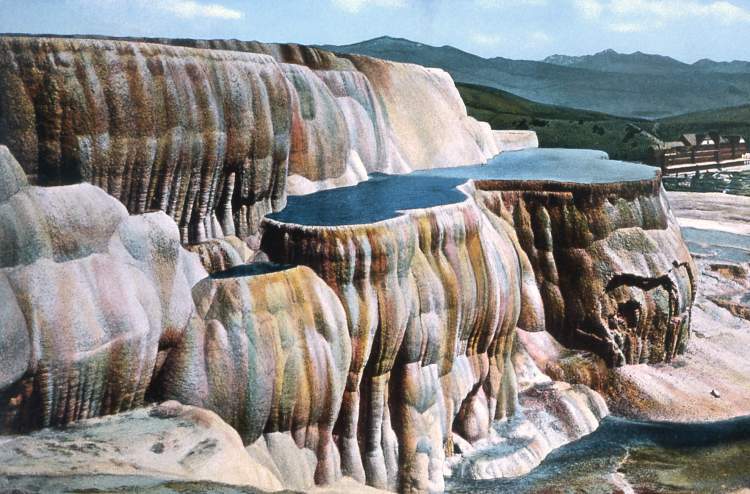
    When I was a little boy, my grandmother used to tell me about The Handkerchief Pool, which was one of the most popular geothermal features in Yellowstone Park when she went there in 1909. I was fascinated by the story, but Grandma explained that I would never see it because tourists threw so much junk into it that it didn’t work any more.

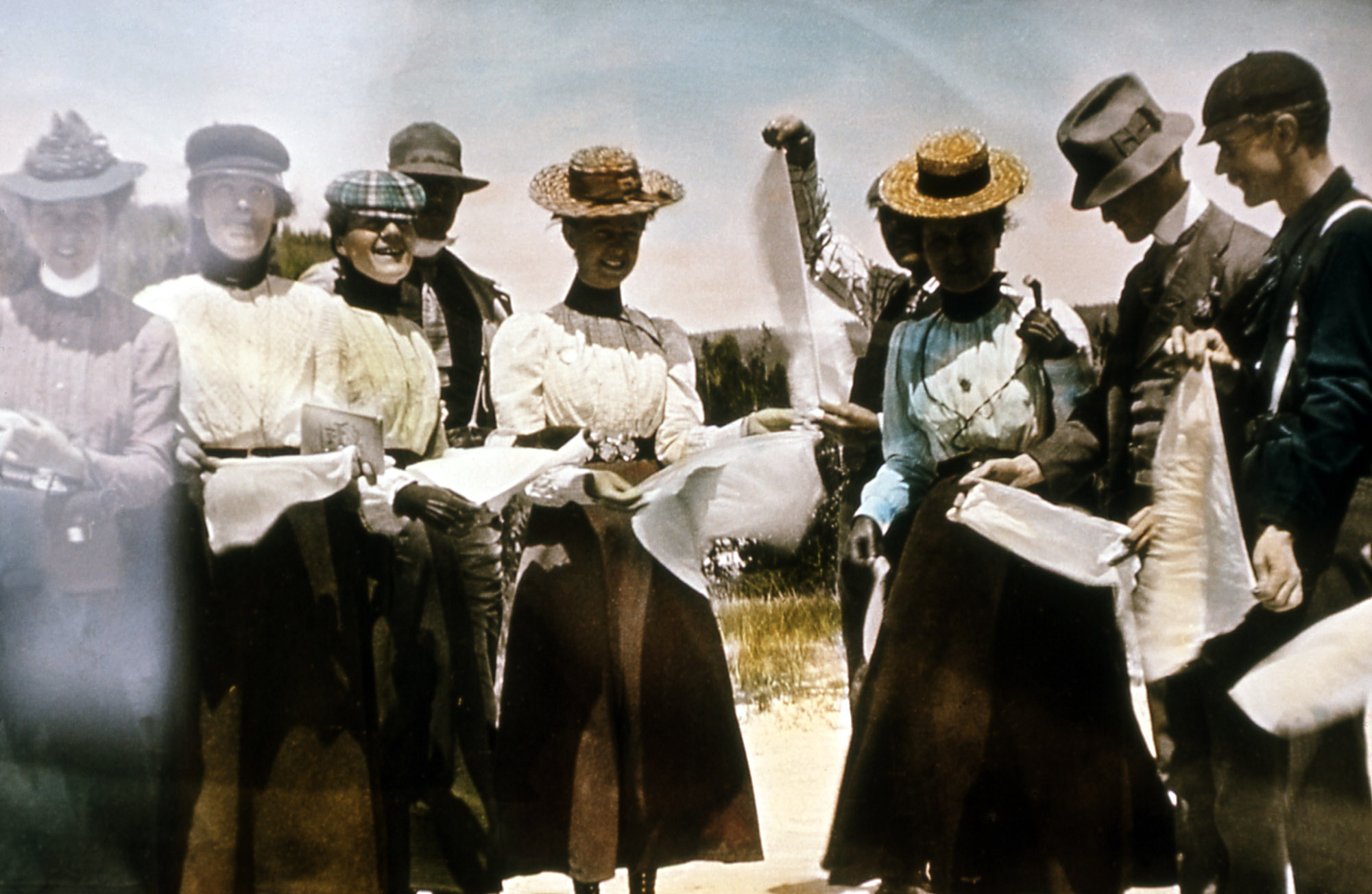
    In 1903 Hester Henshall visited the park with her husband, angling writer and fish biologist Dr. James Henshall. In the Henshal’s tour group was Lillian Elhert, an intrepid young woman who was always thrusting herself into the middle of things. Here’s Hester’s description of Miss Lillian’s antics at the Handkerchief Pool.

    ∞§∞

    The Handkerchief Pool reminded one of a great pot of boiling water, seething, roaring and bubbling, and issuing clouds of steam with a washday odor. Miss Lillian Ehlert must put her handkerchief in the pool, of course. We gathered round to watch it. It floated awhile, circling the pool, then suddenly disappeared down a sucking eddy, out of sight.

    We watched and waited, some of us thinking it had gone forever, but at last it popped up in another part of the pool and floated once more to the surface. It was then taken out with a stick, to be gazed upon by all of the party with something akin to awe. We wondered where it had been when lost to sight—what it had seen underground, and what tale it could tell if gifted with speech.

    Miss Ehlert simply said: “No checky no washee, but I got it all the same.”

    ∞§∞

    — From the journal of Hester Ferguson Henshall, Trip Through Yellowstone National Park 1903. Montana Historical Society Archives.

    — You might also enjoy Hester Henshall’s description of Miss Lilian’s antics in Cruising Lake Yellowstone.

    — Frank J. Haynes postcard, Yellowstone Digital Slide File.

  • A Tale: In a Country Swarming With Grizzly Bears — 1874

    Dr. George Henry Kingsley

    While doing research for my next book, Encounters in Yellowstone , I’ve kept a list of  everbody who was in the park when the Nez Perce passed through there in 1877. I’ve discovered some interesting people who skedaddled before the Indians arrived.

    Among them was an intrepid trio that was reprising a trip they had made to Yellowstone Park in 1874.  They were “Texas Jack” Omohundro, a frontiersman and sometimes partner of Buffalo Bill Cody and his Wild West Show; The Earl of Dunraven, whose book The Great Divide popularized Yellowstone Park in England, and George Henry Kingsley, an English physician and adventurer.

    After Dr. Kingsley’s death, his daughter, Mary Henrietta Kingsley, compiled his papers into a book entitled Notes on Sport and Travel.  Here’s Dr. Kingley’s account of hunting grizzlies in Yellowstone Park in 1874 from that book.

    ∞§∞

    We have had very poor sport, for though we have been in a country swarming with grizzly bears we have only killed one. I was mousing around by myself the other day with the little Ballard—(a little, single-barreled rifle)—and hearing something smashing about in the willow beds, and thinking that it might be a deer, I proceeded quietly to investigate, when out there lounged the great-grandfather of all the grizzlies.

    He looked at me for a moment, and then turned and trotted off, and I trotted after him, when he, being suddenly struck with the idea that valor was the better part of discretion, faced round and walked straight at me, stopping about thirty yards off.

    As I only had the Ballard, and was quite out in the open, away from any decently sized trees, I hardly knew what to do. We stood facing each other thus for a few moments, and I could plainly see his pink tongue licking his lips, and his bright little eyes twinkling with rage.

    I put up the rifle, but could not cover any part of him where a ball would have been mortal, and if I had only wounded him, he would have been at me in a brace of shakes. After interviewing one another thus, he said “hough” and decided to advance, and I decided to retreat, which I did with considerable decision up the thickest sapling in the neighborhood, hoping, however, that he would follow me at least to the foot of it.

    I was in no small state of exultation at the prospect of killing my bear single-handed, but before I was settled, he swerved and went crashing away through the willows, and I saw him no more. He looked as big as an ox.

    Texas Jack quizzed me tremendously about this on my return, but the very next day he came back to camp with a far-away look in his eye and requested whisky. He too had come across a grizzly. He found him in a patch of trees, covering up the carcass of an elk—they are wonderfully cunning, these bears, and will plaster mud and moss over carcasses they don’t want at once, will even plaster over their wounds when they have been shot.

    Jack fired. Hit him. The bear gave one tremendous yell—looked round a moment—then tore up the ground like mad and flew at the trees, sending the bark flying in all directions. Jack lay as flat as a flounder behind a tree, and when, at length, the bear made off, came home a wiser man.

    After hearing his account I was rather glad, on the whole, that my friend had not followed to the foot of my sapling, for had I not killed him first shot, he would certainly have made it a very shaky perch to reload on.

    ∞§∞

    — Frmm Notes on Sport and Travel by George Henry Kingsley, 1900.

    — Illustration from Notes on Sport and Travel.

    — For more stories about The Earl of Dunraven, click on “Dunraven” under the “Categories” button to the right.

  • Montana Book Award Honors The Last Stand by Nathaniel Philbrick

    On June 25, 1876, General George Armstrong Custer attacked a coalition of Sioux and Cheyenne near the Little Bighorn River in Montana Territory. A day later Custer and 268 of his men lay dead after one of the most famous battles in history.

    More than 40 books have been written about that bloody day so it’s easy to question the need for another one. But new facts emerge all the time so every generation deserves a fresh synthesis and interpretation. That’s what Nathaniel Philbrick provides in his 2010 Montana Book Award honoree, The Last Stand.

    Philbrick builds a compelling narrative around two charismatic characters: George Armstrong Custer, who thought his success as a cavalry officer during the Civil and Indian wars might launch him into the U.S. presidency, and Sitting Bull, whose political savvy welded the Sioux and Cheyenne tribes into the largest Indian alliance in history. In addition to these two, Philbrick brings life a large cast of supporting characters. Readers get to know not only combatants—Indians, officers, soldiers and scouts—but also the officers’ wives, the steamboat men who ferried soldiers and supplies up the Yellowstone River, and the people who lined the shores to watch the boat bring survivors to safety.

    Based on his painstaking and comprehensive research, Philbrick braids together the strands of information that come from contemporary accounts of the battle, interviews conducted by participants on both sides, reminiscences, and new findings from archeologists. The result is a compelling narrative about one of the iconic events of American history.

    ∞§∞

  • Montana Book Award Honors Visions of the Big Sky by Dan Flores

    Visions of the Big Sky: Painting the Northern Rocky Mountain West is a gorgeous book, but don’t be fooled into thinking is just a collection of 140 illustrations.  University of Montana history professor Dan Flores has provided erudite essays that elucidate the work of the greatest artists of the American West.

    Flores includes several artists who are famous for their work in other locations, but the bullseye of his target is smackdab in the middle of Montana. Inclusion of artists like Ansel Adams and Albert Bierstadt, who are famous for their work in other locations, shows that the western artists of the Big Sky are world class.

    Because of my interest in Yellowstone National Park, I paid particular attention to Flores’ chapters on William Henry Jackson and Thomas Moran, who accompanied the 1871 Hayden Expedition. Jackson’s photographs are credited with helping to convince the U.S. Congress to establish Yellowstone as the world’s first national park, and Moran’s painting of the Grand Canyon of the Yellowstone was hung in the U.S. Capital. I found Flores’ essays on these two artists accurate and enlightening. Doubtless his descriptions of artists I know less about are too.

    Of course, the book includes the icons of Montana art like Charles M. Russell and Evelyn Cameron. After all, it is part of the Charles M. Russell Series on Art and Photography of the American West from the University of Oklahoma Press.

    Visions of the Big Sky would be a great book to put on your coffee table for your guests to leaf through. But they shouldn’t skip the marvelous text. Neither should you.

    ∞§∞

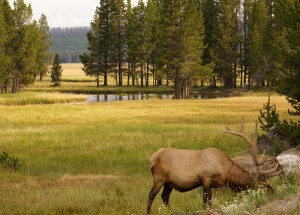
  • News: Climate Change—Not Just Wolves—May Cause Fewer Yellowstone Elk

    Hunters have been blaming the introduction of Wolves for the recent decline in the number of elk in Yellowstone National Park, but new research indicates that climate change may be to blame. New West has provided a nice summary of the evidence.

    The news reminded me that several of the accounts of early travel to Yellowstone Park talk about summer snow storms bigger than anything we see now. Of course, the storytellers may have been exaggerating, but perhaps I should see if travel accounts provide evidence of climate change.

    Also, early travelers who went to the Park in August (apparently to avoid bad weather) often couldn’t find game. Before the Army outlawed hunting in 1886, many groups counted on living off the land, so when game was scarce they went hungry. Several stories tell about the great joy of returning to the ranches near the park and getting “civilized grub.”

    The Earl of Dunraven, who visited the Park in 1874, commented explicitly about how weather affects the migration of elk and other game.

    ∞§∞

    The herds of game move according to the seasons. In Estes Park, for instance, near Denver, you might go out in winter or in early spring, when the snow is deep upon the ranges and shoot blacktail deer till you were sick of slaughter. I daresay you might—if you knew where to go—sit down, and, without moving, get ten, fifteen, or even as many as twenty shots in the day.

    At other seasons you might walk the flesh off your bones without seeing a beast of any kind. Yet the deer are somewhere all the time; and, if you can only find out to what deep recesses of the forest, or to what high mountain pastures they have betaken themselves in their search for cool shelter, or in their retreat from mosquitoes and other insect pests, you would be amply rewarded for your trouble.

    It is the same with wapiti. Sometimes the park will be full of them; you may find herds feeding right down on the plains among the cattle; and in a fortnight there will be none left. All will have disappeared; in what is more, it is almost impossible to follow them up and find them, for they are much shyer than the deer.

    Where do they go? Not across the snowy range, certainly. Where then? Up to the bare fells, just under the perpetual snow, where they crop the short sweet grass that springs amid the debris fallen from the highest peaks; to the deep black recesses of primeval forest; to the valleys, basins, little parks and plains, hidden among the folds of the mountains, where even the wandering miner has never disturbed the solitude.

    ∞§∞

    — Excerpt from The Great Divide by the Earl of Dunraven.

    — New West Photo.

    — You can read a condensed version of the Earl’s 1874 trip to Yellowstone Park in my book, Adventures in Yellowstone.