Most Yellowstone tourist who kept journals struggled to describe geysers. Some relied on quantitative descriptions of such things as how high water was hurled snd how much time separated eruptions. Other’s chose adjectives—”stupendous,” “astounding”—and left their readers to imagine what they meant. And many simply used phrases like “words cannot describe ….”
John L. Stoddard was a professional writer who revealed his emotions and used figures of speech to describe what he saw. Stoddard was a world traveler who turned his experiences into popular lectures that he delivered across American. He published them is a series of books entitled Stoddard’s Lectures. Here’s his description of Fountain Geyser.
∞§∞
“Show me a geyser!” I at last exclaimed impatiently, “I want to see a genuine geyser.” Accordingly our guide conducted us to what he announced as “The Fountain.” I look around me with surprise. I saw no fountain, but merely a pool of boiling water, from which the light breeze bore away a thin transparent cloud of steam. It is true, around this was a pavement as delicately fashioned as any piece of coral ever taken from the sea. Nevertheless, while I admired that, I could not understand why this comparatively tranquil pool was called a geyser, and frankly said I was disappointed. But even as I spoke, I saw to my astonishment the boiling water in this reservoir sink and disappear from view.
“Where has it gone?” I eagerly inquired.
“Stand back!” Shouted the guide, “she’s coming.”
I ran back a few steps, then turned a caught my breath; for at that very instant, up from the pool which I had just beheld so beautiful and tranquil, there rose on great outburst of sublimity, such a stupendous mass of water as I had never imagined possible in vertical form. I knew that it was boiling and that a deluge of those scalding drops would probably mean death, but I was powerless to move. Amazement and delight enchained me spellbound. Talk of a fountain! This was a cloud-burst of the rarest jewels which, till that moment had been held in solution in a subterranean cavern, but which had suddenly crystallized into a million radiant forms on thus emerging into light and air. The sun was shining though the glittering mass; and myriads of diamonds, moonstones, pearls, and opals mingled in splendid rivalry two hundred feet about our head.
∞§∞
— From Stoddard’s Lectures, Volume 10, 1905.
— F. J. Haynes Postcard, Yellowstone Digital Slide File.
I had a really good time with seven scintillating dinner companions at Great Conversation in Helena on Wednesday. I was impressed with the Helena Education Foundation, who sponsored the event and recognized ten great teachers from Helena schools. What a wonderful show of community support for schools, teachers and — most important — students.
I truly enjoyed my dinner companions. They laughed when I told them about Eleanor Corthell who announced to her husband that he should expect a bill because she had bought a team and wagon and was taking their seven children to Yellowstone Park for the summer in 1904. My companions were full of questions about Truman Everts and how he survived thirthy seven days alone in Yellowstone in 1870. And, they were eager to share their own experiences from the time when bears would stall traffic to beg from cars.
I was an overnight houseguest of Denny DeRozier and his wife, Nikki. Denny is a friend from my childhood in Silver Star. After we had a drink at Helena’s Silver Star Steak House, we spent a few minutes reminiscing in front of a historic photo of the Silver Star School.
On Wednesday I’ll travel to Helena to host a table for “Great Conversations,” a fundraiser sponsored by the Helena Education Foundation. My job will be to lead a dinner conversation (scintillating, I hope) with seven people who want to talk about early travel to Yellowstone Park. I’ll get a free dinner, an opportunity to talk about a topic I love, and the satisfaction of supporting Helena schools.
There’ll be twenty-eight tables at the event this year providing discussions for every taste and whim. Topics include “Raising Self-Reliant Children,” “The Neuroscience of Choice,” and “Is There a Plan of Attack for Peace?” You can see the full list of topics.
My topic is “Nineteenth Century Adventures in Yellowstone Park” and I’ve promised to tell exciting, funny and interesting stories. My collection includes hundreds of tales and I’m wondering which to choose. Can you help? Please look around through the posts on this blog and decide which ones would make for the best dinner conversation. Then tell me about your thoughts in the Comments section below.
Just to get you started, here are links to some of my favorites:
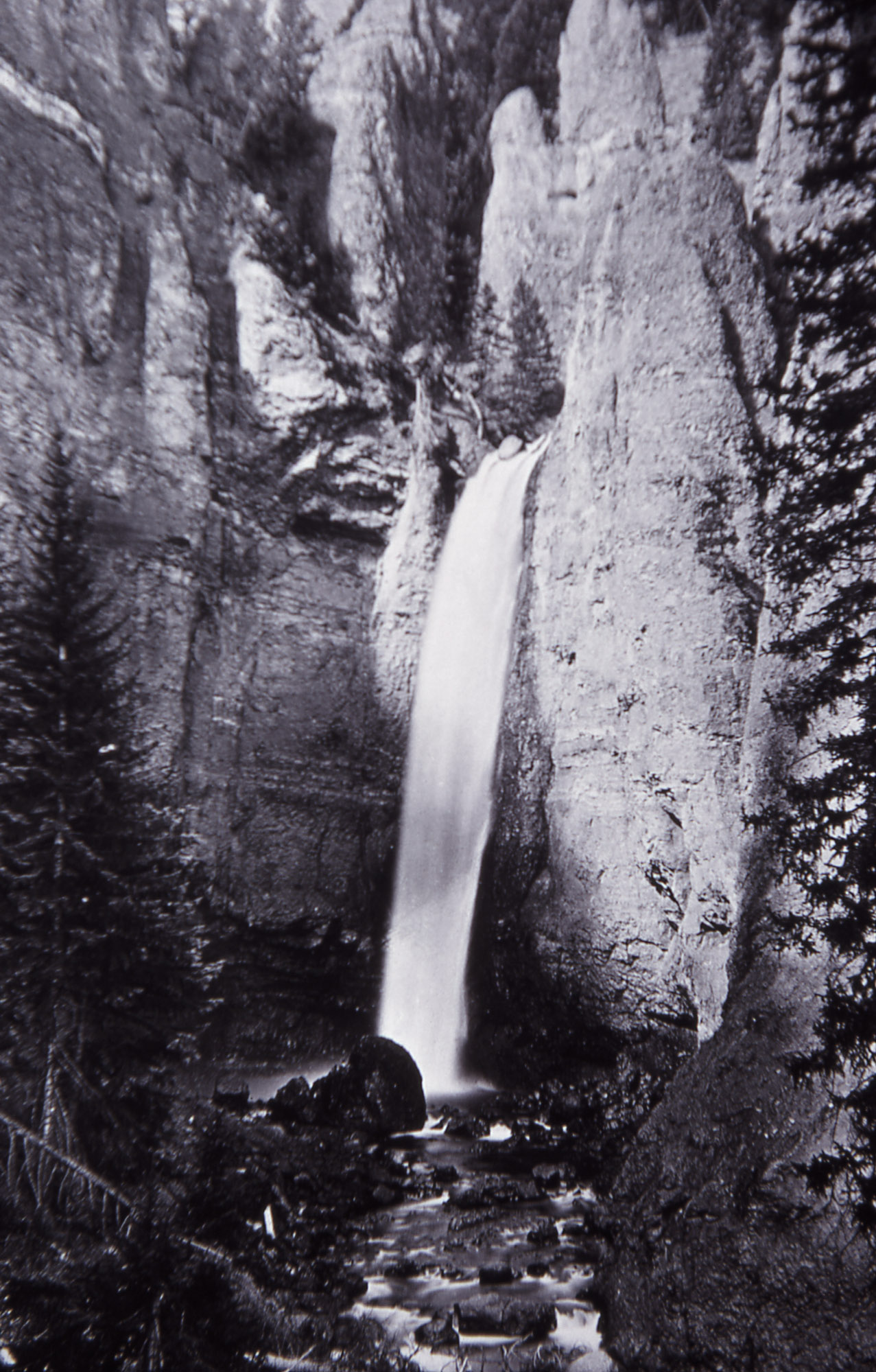
In 1870 the famous Washburn Expedition explored the remote area that became Yellowstone National Park. While the explorers always had be be alert for the dangers of Indians, wild animals, and strange geothermal features, they also found ways to have fun. Here’s Nathaniel P. Langford’s description of one of the pranks they played on each other.
∞§∞
At the outset of our journey we had agreed that we would not give to any object of interest that we might discover the name of any of our party nor of our friends. This rule was to be religiously observed.
While in camp on Sunday, August 28th, on the bank of this creek, it was suggested that we select a name for the creek and fail. Walter Trumbull suggested “Minaret Creek” and “Minaret Fall.” Mr. Hauser suggested “Tower Creek” and “Tower Fall.” After some discussion a vote was taken, and by a small majority, the name “Minaret” was decided upon.
During the following evening Mr. Hauser stated with great seriousness that we had violated the agreement made relative to naming objects for our friends. He said that the well known Southern family—the Rhetts—lived in St. Louis, and that they had a most charming and accomplished daughter named “Minnie.” He said that this daughter was a sweetheart of Trumbull, who had proposed the name her name, “Minnie Rhett” — and that we had unwittingly given to the fall and creek the name of this sweetheart of Mr. Trumbull.
Mr. Trumbull indignantly denied the truth of Hauser’s statement, and Hauser as determinedly insisted that it was the truth. The vote was therefore reconsidered, and by a substantial majority it was decided to substitute the name “Tower” for “Minaret.” Later, and when it was too late to recall or reverse the action of our party, it was surmised that Hauser himself had a sweetheart in St. Louis — a Miss Tower.
∞§∞
—Excerpt from N. P. Langford, The Discovery of Yellowstone Park.
—William Henry Jackson Photo, Yellowstone Digital Archive.
— You can read a condensed version of Langford’s The Discovery of Yellowstone Park in my book, Adventures in Yellowstone.
— To see more stories by this author, click on “Langford” under the “Categories” button to the left.
— For more stories about the Washburn Expedition, click on “Washburn” under the “Categories” button to the left.
Tales of Corbett, the Belgrade Bull, are the stuff of a legend that has lasted more than a hundred years. There are still old timers around who can tell “the true story” just the way their grandfathers told it to them. Of course, “the true story” varies depending on such things as whether grandpa lived in Belgrade or Townsend, or whether his last name was “Teeples” or “Ross.” But community pride and family stories are probably what keep the legend alive.
To read the story beginning with Part 1, click here.
The Belgrade Bull, Part 5, finale.
∞§∞
In 1949—more then 50 years after Corbett retired to be a herd sire in Indiana—the Townsend Star printed obituary that claimed the old cowboy named Jake Ross had ridden the Belgrade Bull. The Belgrade Journal reprinted the obituary setting off flurry of letters to the editor. Most of them described a midnight ride Ross made in Belgrade. Nobody explained the motives behind the ride, but probably it was for the same reason others had purloined Corbett—to try him out before placing a bet.
Jake and a friend found the bull in Belgrade and took him to a flat near a gravel pit. They saddled him and Jake climbed aboard hanging on to a small rope tied around the bull’s horns. The bull jerked his head down pulling Jake’s head and shoulders forward, and then reared up. Jake fell 10 feet away hitting his head in the gravel. Reports vary as to whether he saw “three or four moons” or “a lot of stars.” Ross’s staunchest advocates don’t say he successfully rode Corbett in Belgrade, but they claim the experience helped him make a successful ride in Helena.
In his reminiscence, Ross said he had a medal that proved he was the only man that “ever rode the Belgrade Bull according to the rules.” An article from the Townsend Star, the editor said he had seen the medal, but it had been stolen.
Pres Johnston said of the medal, “Where he got it, I don’t know. Neither my brother nor I ever signed it for him or anything like it for anyone.’
Frank Collins was more blunt: “I don’t know who Jake got to make that medal, but it was a phony. Jake fooled the people with that medal until I think he got to believe it himself.”
Still, Ross had supporters. An article in the Belgrade Journal quoted a Butte man saying, “I saw Jake Ross ride the Belgrade Bull to a finish in Helena” and another man claiming to be an eyewitness who said Ross managed to ride the bull by jumping aboard after the bull made his first jump
It is difficult to make sense of the jumble of claims. Maybe Jake Ross did get a medal for riding an animal called “The Belgrade Bull,” but not the one owed by the Johnston brothers. A Brahma bull called “Sharkey, The Belgrade Bull” appears in rodeo histories and there may have been others,
But if Ross rode another Belgrade Bull, why didn’t he say so? Surely he could tell the difference between a Brahma and a Holstein. Also, Pres Johnston said Jake’s medal bore the Johnston brothers names. Perhaps Pres was mis-remembering events from decades past.
Information about Corbett is buried in decaying newspaper archives across Montana. There is probably more to be discovered in diaries, reminiscences, and letters. Someday someone may find a document that answers the question: Did anyone ever ride Belgrade Bull with a clean saddle?
∞§∞
— To see all of the stories about Corbett, The Belgrade Bull, click on “Belgrade Bull” under “Categories” in the column to the right.
—Illustration from the Saturday Evening Post, September 10, 1910.
Generally, I focus my interest in Yellowstone Park stories on things that happened before 1915, but I couldn’t resist joining the thousands of others who shared this remarkable photo.
Before completion of the Nothern Pacific’s transcontinental railroad in 1883, many early Yellowstone visitors often came long distances by stagecoach—and that wasn’t always safe. In 1872 a young Englishman named Sidford Hamp, who had spent the summer working on the second Hayden expedition documenting Yellowstone Park, told about a stagecoach robbery in a letter to his mother.
∞§∞
About 8 o’clock that evening on October 16, I was asleep when suddenly the coach stopped, which woke me up. I was going to look out (for the blinds were down) when I heard some one outside say, “Put in your head there! Put in your head!”
In a little while the voice said again, “get out one at a time and throw up your hands.” I knew in an instant that the coach was stopped by highwaymen. One of the passengers got out—and then I did—and all the others followed and stood in a row with their hands over their heads.
There were seven of us besides one on the box with the driver and a lady and child inside. When we were outside, I had time to look about and the first thing I saw was a man with a double barreled shotgun—full cocked pointed at the driver. Another man behind the coach had two six barreled pistols in his hand.
I took the end nearest the shotgun man, so that I could see what he was up to. When we were all out the man with the pistols told the coachman to throw out the treasure boxes, which he did. He then took a small hatchet he had with him and split them open but there was nothing in them.
Then he came to us and searched us. He began with me, he first took out my watch, but he only looked at it and put it back, and said he didn’t want it. Then be felt in my other pockets and found a leather case in which I had $8 and all my letters. I told him there was only $8 in it and he said if he thought so he would give it back. I asked him to look inside but he wouldn’t. He asked me what I had been doing as I only had $8 so I told him I was traveling with another fellow. I had 2 pound 5 shilling notes in watch pocket, which he didn’t find.
Then he searched the others and got from the first, $300, the second $2400, third $4000, fourth $150, fifth $0. From the man on the box they got $150. The man who lost none had handed his purse to the lady as he got out—and as she wasn’t searched, he saved it.
They then took the candle out of the coach lamp and searched inside the coach. The man on the box had a bottle of whiskey, which the robbers took from him and handed round for the passengers to drink. I took some just for the joke of it and because I was cold with standing out with my hands up. Fancy such a thing as a highway robbers in England.
∞§∞
— From Sidford Hamp’s Diary, published in Annals of Wyoming, 1942. .
After the Johnston brothers “discovered” The Belgrade’s Bull’s bucking prowess, they bought him and launched his rodeo career. At first, Corbett took on challengers on Sunday afternoons in Belgrade giving the town a circus atmosphere. Then he took to the road performing in cities across southwest Montana.
To read the story beginning with Part 1, click here.
The Belgrade Bull, Part 4.
∞§∞
The Johnston brothers named the bull “Corbett” after the world heavy weight boxing champion and began taking bets on him. They took up collections from Belgrade residents to make up the $25 purse they offered and never had trouble raising the money. Of course the residents were making money by betting, selling liquor, and—as a local doctor who was a regular contributor observed—repairing broken bones.
The first man to ride Corbett in Belgrade was Bill Sitton. Sitton rode with a double cinch that kept the bull from arching his back. That meant he couldn’t make his best jumps so the Johnstons barred such equipment.
Next up was John “Kid” Kelly from Fort Ellis. Kelly got the bull saddled and signaled that he was ready to go. The man who was supposed to remove the bull’s blindfold botched the job so the bull couldn’t see. Corbett bucked and then ran into a nearby wagon that spectators were using as a viewing platform. When the bull crashed into the wagon, he stopped and Kelly got off. The Johnston brothers decided Kelly technically had met the rules, which said a man had to ride until the bull stopped. Although nobody considered it a fair ride, the Johnstons gave Kelly the $25 prize. Pres Johnston said it was the only time they paid.
Men began coming from all over a hundred mile radius to ride the bull and prove their prowess, but Corbett bucked all of them off. The Bozeman Courier joked that the Johnston brothers had made so much money betting on their bull that they planned to start a bank or build a railroad
In December 1893, the Bozeman Chronicle reported that a cowboy named “Starchy” had ridden the bull and won the purse. Apparently they were referring to George “Starkey” Teeples, a cowboy who owned a ranch in Carbon County. Pres Johnston makes no mention of Steeples in his letters. Will Everson said that Steeples used hobbled stirrups (stirrups that were tied together under the bull’s belly), an arrangement that wasn’t allowed.
Corbett’s fame spread and by the summer of 1894 he could draw a crowd wherever he went. Perhaps his largest audience was at the July 4 celebration in Bozeman where he had a conspicuous place in the parade where he marched placidly down the crowded street. In the afternoon, 5,000 people came to watch him but it was difficult to find challengers. Finally two men, named Sam Brumfield and John Foster mounted the bull and got themselves thrown.
In August, a union in Anaconda agreed to pay expenses so Corbett could participate in a Labor Day celebration there. The Anaconda Standard reported that when the bull was led onto the baseball ground where several thousand people waited “he appeared so good natured and easy going and wore an expression of contentedness that applications to ride were made by several persons.” The first up was Martin Johnson who the Standard called “the iceman” apparently because he was in the refrigeration business. Corbett baulked at being saddled and wouldn’t let Johnson mount. Finally the iceman decided to drop onto the bull from above. When Johnson hit Corbett’s back, a chute man released him. The bull jumped 12 feet into the air, arched his back and sent Johnson sprawling several yards away. The Standard reported that the audience laughed and yelled itself hoarse. A man named John Brass who worked at the Standard Brick Works tried next. Corbett threw him on the third jump.
Two weeks later Corbett went to a fair in Butte where he sent a man named Jim Radford into a full somersault and threw a man called “Mormon Ben” on the second jump.
Six days later, Corbett was in Helena where Pres Johnston said nobody was willing to give him a try. The Helena newspapers, however, reported that two men tried—and one of them succeeded. The Helena Herald said a cowboy from Fort Benton won a $200 prize for riding the bull, The Helena Independent said that after several men attempted to ride, “a local ranchman” named Joe Kirkwood stepped forward. “When all was ready, the Helena man jumped lightly into saddle and the circus began. The bull arched his back and gave a succession of jumps. He pranced around and bucked in his best style, but when he got through his performance, much to his chagrin, the man, like the stars and stripes, was ‘still there.’”
The newspaper reports can’t be reconciled with Pres Johnson’s statement in that Corbett’s reputation preceded him to Helena and “no man tried to ride him.” Perhaps the most weight should be given to the newspapers contemporaneous reports. After all, Johnston’s denial appeared in a letter published in the Bozeman Courier in 1948—more than 50 years after the events in question. Also, as will be described in the section on the Jake Smith controversy below, the events in Helena are even more complicated.
After the events in Helena, the Johnstons sold Corbett to Charles Beveridge and Donald Davenport, two Helena businessmen who were starting a wild west show. The Johnstons got $300 for the bull and $50 for ‘young Corbett,’ a calf that Corbett had sired and Pres had trained as a bucker.
The show hired John Mardis of Bozeman and his duties included caring for Corbett. When Mardis retuned home he reported what happened to the show, and the bull.
The Beveridge-Davenport show went to Peoria to train, then began a tour of the East and Southeast. The Bull Durham Tobacco Company presented the bull with a blanket. On the tour, Mardis said, only two men tried to ride the bull. Both were thrown.
The show went broke in Indiana and Corbett was sold there to a farmer who apparently planned to use him as a herd bull.
∞§∞
— To see the next Installment: “The Jake Ross Controversy.” Sixty years after the bucking stopped an old cowboy’s obituary relaunches the legend of Corbett, The Belgrade Bull, click here,
— To see all of the stories about Corbett, The Belgrade Bull, click on “Belgrade Bull” under “Categories” in the column to the right.
— Illustration from the Pioneer Museum of Bozeman.
Many Yellowstone Park tourists describe places where an angler can catch a fish and cook it in a nearby hot spring without taking it off the hook, but few report actually doing it. Henry J. Winser described performing the feat in his 1883 guide for tourists.
∞§∞
It has often been said that it possible to catch trout in the Yellowstone Lake and cook them in a boiling spring close behind the angler—without taking them off the hook. The assertion seems incredible and it is generally doubted. This extraordinary feat may certainly be accomplished, not only at the Yellowstone Lake, but also on the Gardiner River below the Mammoth Hot Springs. The writer performed it at the latter place, and in the presence of nine witnesses.
Selecting a likely pool of the ice-cold stream with a boiling spring fifteen feet distant from the bank, he stood upon a projecting rock and made a cast. His flies soon tempted a trout to his doom. The fish was small enough to be lifted out of the water without the aid of a landing net, and it was quite easy to drop him into the bubbling hot spring behind. His life must have been extinguished instantly.
This procedure was repeated several times, and each of the spectators who had purposely assembled to test the truth of the strange assertion, partook of the fish thus caught and boiled. It required from three to five minutes to thoroughly cook the victims of the experiment, and it was the general verdict that they only needed a little salt to make them quite palatable.
This is a “fish story,” without doubt, but a perfectly true one. A feat so extraordinary could nowhere else be practiced.
∞§∞
— For more stories about fishing in Yellowstone Park, click on “fishing” under the “Categories” button on the right.
— Excerpt from Henry J. Winser, The Yellowstone National Park: A Manual for tourists. New York: G.P. Putnam’s Sons, 1883. (Pages 39-40).
—Frank J. Haynes Postcard, Yellowstone Slide File.
The true story of how Corbett, The Belgrade Bull, got his start is told in a couple of letters written decades after his bucking career ended. In 1937, Preston Johnston, who owned the bull in his heyday in the 1890s, wrote an old friend who had asked how the legend started. That letter is in the collection of Pioneer Museum of Bozeman and outlines Johnston’s recollections. In 1951, Frank Collins, another old timer who was there at the beginning, published a letter in the Belgrade Journal trying to set the record straight after the newspaper published an obituary of a man who claimed to have ridden Corbett. Johnston and Collins’ versions aren’t as colorful as the tale Emerson Hough told in his 1910 Saturday Evening Post article, but they still make for a great story.
To read the story beginning with Part 1, click here.
“The Belgrade Bull,” Part 3.”
∞§∞
When Corbett was a calf, according to Pres Johnston, children would come to the Miller farm after Sunday School at the Dry Creek Missionary Baptist Church and try to ride him. Such contests between a half-grown bull and half-grown humans must have been even matches and glorious fun.
The first person to take on Corbett as a mature bull was Frank Collins, who recalled his adventure decades later. Collins and two of Annie Miller’s sons, Sam and Zach, decided to give the bull a try on Easter Sunday, 1892, when they were all in their late teens. The boys drew straws to see who would try first and Collins pulled the short straw. Collins recalled:
“I stayed on him longer than anyone I ever saw try him. But of course I was not down a straddle of him all the time. I was just riding the air up over him and clawing at every thing I could get a hold of, but finally I missed making good connections. I stood on my head out in front of him.”
Collins and the Miller boys must have talked up the bull’s prowess because experienced riders became interested in him. In the Fall when Preston Johnston and his friend, Lou Kennedy, finished setting up a threshing machine at Annie Miller’s place they were surprised to discover that their crew hadn’t arrived. Threshing was a big job back then and there should have been a crew of a dozen or more men there. Johnston asked around and found out that everybody was waiting to watch a local man, Herbert Brady, ride the bull.
By the time Herbert came riding up on his bronco, quite a crowd had assembled including the men of the threshing crew and the women who came to prepare the huge meals needed to fuel the hard-working crew.
Herbert took his saddle off of his horse and went to the corral where the bull stood. Collins put a halter on the bull and used a sack to blindfold him. After the young cowboy climbed aboard, Collins pulled off the blindfold. Then Corbett let out a snort, and Herbert sailed into the air with one of his stirrups clinging to his foot. Brady landed on the bull with the stirrup between him and the saddle. Collins reported, “Herbert walked in wide order for a few days until he got healed up in places where the stirrup pealed him.”
Brady was just an average rider. He knew that Lou Kennedy was better, so he wanted the more experienced man to take a turn on the bull. But Kennedy took riding seriously and said he wouldn’t do it unless there was something in it for him. Since nobody on the crew had money to bet, the men went to work. After the crew finished at Miller’s, they moved the threshing machine to the Howard Brady place.
The next day when Lou Kennedy and his father, Jim, went to make some repairs on the threshing machine, they discovered a man who was willing to bet $10 on the bull. Jim Kennedy had complete confidence that his son was up to the task and said he was willing to bet a hundred dollars.
When Herbert found out Kennedys had money to bet, he cooked up a scheme to get some of it. He knew Jack Flynn, another neighbor, who was excellent rider. Herbert figured if Jack couldn’t ride the bull, then Lou couldn’t either. Herbert convinced Jack to try the bull so they would know if they should place a bet. This plan resulted in the first time that the bull was “borrowed” in the middle of night and taken away for a practice ride.
Herbert and Jack and some friends went out to the Miller place one bright, moonlit night. They found the bull running loose on the range, but he was so tame that they had no trouble catching and saddling him. Jack looked at his watch and said, “Eleven o’clock, boys, just the right time to ride a bull.” Then he climbed into the saddle. Jack rode for two jumps, but on the third he went high into the air.
Pres Johnston said that before Jack hit the ground he yelled, “By God boys, he done it.
Everybody figured that if Jack couldn’t ride the bull, then Lou Kennedy would not be able to either, so they sent word to the Kennedy’s that they were ready to bet. They didn’t mention their little experiment.
On Sunday morning Lou rode up to the Brady place. Sunday School had just let out and a crowd gathered to watch the ride. Lou had to blindfold the bull to saddle him. After he mounted, he told his father to pull off the blind. The bull gave a snort and sent Lou flying. Lou caught his pants on the saddled horn and they were badly torn so Lou had to make for the tall grass to keep out of sight of the Sunday School crowd. Howard Brady went to the house to retrieve a needle and thread to repair the pants.
Lou’s ride convinced Pres Johnston that he could “have plenty of sport” betting on the bull so he talked his brother, Al, into buying the animal. The next day while Al was on the way to Mrs. Miller’s he met the Kennedys who asked where he was going. When Al said he was going to buy the bull, the Kennedys reported that the animal had thrown Lou. Al told them the bull had thrown Jack Flynn the night before. And that’s how the Kennedys learned they had been set up.
Anna Miller sold the bull to the Johnstons for $15. She was a widow with several daughters, so she probably was glad to be rid of an animal that caused young men to sneak around her place in the dead of night.
∞§∞
— To see the next Installment: “Corbett Throws All Challengers—Maybe,” click here.
— To see all of the stories about Corbett, The Belgrade Bull, click on “Belgrade Bull” under “Categories” in the column to the right.
 Most Yellowstone tourist who kept journals struggled to describe geysers. Some relied on quantitative descriptions of such things as how high water was hurled snd how much time separated eruptions. Other’s chose adjectives—”stupendous,” “astounding”—and left their readers to imagine what they meant. And many simply used phrases like “words cannot describe ….”


 M. Mark Miller, Author