Category: Automobiles

  • A Tale: Confusion Surrounds the First Car Officially in Yellowstone — 1915

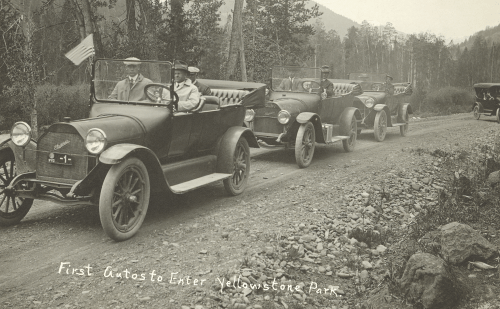
    YNP First Cars 1915 PMB
    Dignitaries in a White Motor Company car lead the official automobile entourage in Yellowstone Park on August 1, 1915.

    The story below claims to describe the trip by the first automobiles admitted to Yellowstone National Park. I’ve learned to be skeptical of such claims so I checked it out in Aubrey Haines’ definitive history, The Yellowstone Story

    According to Haines, Henry G. Merry sneaked in his 1897 Winton in 1902 making it the first car to enter the park. As Merry’s son told the story, his father raced his car past the mounted guards at the Gardiner Entrance. The cavalrymen gave chase on horseback and caught the machine when slowed on steep hill. They tied ropes to the the Winton and dragged it to park headquarters at Mammoth where the park superintendent ordered it out of the park—after demanding a ride.

    People feared that automobiles would frighten horses and wildlife, so the park superintendent issue a general order forbidding cars. Hains says several vehicles entered the park by accident or contrivance before the order was lifted in 1915.

    Political pressure from motorists increased until the Secretary of Interior decided in April 1915 to admit cars on August 1 of that year. However, the park superintendent wasn’t sure that cars could make the trip so he allowed two cars, a Buick and a Franklin, to drive a two-day circuit in June. Then a group of congressmen and government officials motored from the East Entrance to the Lake Hotel on July 4. The new regulation allowing cars was to go into effect on August 1, but the superintendent feared congestion so he issued seven permits on July 31.

    Haines says that officials of the White Motor Company thought one of their cars was the first officially allowed in the park and issued a news release to that effect. The news release apparently was the basis for the story below. A magazine editor asked for clarification from the park superintendent who told him that a Ford had been issued permit number one the day before the White led the official entourage.

    For the first year, private cars shared park roads with touring coaches pulled by four-horse teams, but in 1916 commercial tour busses were admitted. Those buses were made by the White Motor Company.

    ∞§∞

    The first car entered the park at 6 o’clock on the afternoon of July 31, when a party of government officials, riding in a White car, passed through the lava arch at Gardiner, Montana, followed by a large cavalcade of motorists who were waiting for the honor of entering the park on the first day.

    In the official car were Colonel Lloyd M. Brett, U. S. A., acting superintendent of the park, Major Amos A. Fries, U. S. A., chief of the park engineers, H. W. Child, president of the Yellowstone Park Hotel and Transportation Companies, and Robert S. Yard, of the Department of the Interior. The car, followed by the procession of motorists, led the way to the Mammoth Hot Springs Hotel, where the night was spent. The following day it led to a tour of the entire park.

    From the seat of a comfortable motorcar it is possible to see Yellowstone in a way that no other mode of transportation affords. Entering the park at Gardiner, the official car covered a five-mile stretch of road, winding around beautiful hills and high cliffs and skirted by the rugged, foaming Gardiner river. This road brought the party to the Mammoth Hot Springs Hotel.

    Promptly at 7 the next morning, the official White left Mammoth Hotel for a complete circuit of the park. The road requires a sharp ascent and soon overlooks the gleaming white formation of the Mammoth Hot Springs, 6,264 feet, which had appeared as a small mountain when viewed from the porch of the hotel. Three miles farther, Silver Gate and the Hoodoos, massive blocks of travertine, are passed at an altitude of 7,000 feet. One-half mile farther, one of the prettiest spots on the trip is reached. This is Golden Gate, 7,245 feet,  a curving road on the side of a deep canyon. A fine concrete viaduct here shows great engineering skill.

    Golden Gate canyon then emerges into picturesque Swan Lake basin. From this mountain valley can be seen Electric peak, Quadrant mountain, Bannock peak, Antler peak, The Dome, Trilobite point and Mount Holmes. Ten miles from Mammoth Hot Springs, Appollinaris Spring is reached. Two miles farther Obsidian cliff is reached.

    Roaring mountain, fifteen and one-half miles from Mammoth Hot Springs, is the next interesting place. Passing from here Twin Lakes is almost immediately reached. Here are two small lakes of entirely different color, but joined together by a small strip of water. Then comes the Frying Pan, eighteen miles from Mammoth Hot Springs, with an altitude of 7,500 feet. This is a hot spring, which stews and sizzles year in and year out, reminding one of a hot griddle all ready for business.

    At the crossing of the Gibbon River, the tourist comes to the first soldier station, and from there it is only a half mile to Norris Geyser basin, where Norris hotel is located. As the official car pulled up to the steps of the hotel a great crowd collected to see the first motorcar that had ever visited the hotel.

    A great deal of time can be well spent at this point viewing the many geysers— Constant geyser, Whirligig geyser, Valentine geyser, Black Growler, Bathtub, Emerald pool and some small paint pots.as the vari-colored thermal pools are called.

    The official car left Norris at 9:15 a. m., after a brief stop. The next hotel stop is Fountain Hotel, twenty miles farther into the park. Approaching Fountain Hotel another geyser basin is seen. This is the largest in area of the park geyser basins, but the geysers here are scattered and are not of as much importance as others along the route. Fountain Hotel was passed at 11:00 a. m., and after a short ride Mammoth Paint Pots were reached.

    The official party reached Upper geyser basin at 12:00 o’clock, and stopped two and one-half hours for lunch at the beautiful Old Faithful Inn. The stop gave time for a leisurely visit to the area of geysers here, which contains the largest and finest geysers in the world. Of course the center of attraction is Old Faithful geyser, which nearly every one has heard of, and the Giant geyser, the greatest of them all.

    Leaving Old Faithful Inn at 2:30, the official car sped on and began the long climb to the Continental Divide, first along the Fire Hole river and then up Spring Creek canyon. Two miles from the hotel a stop was made to view the beautiful Keppler cascades. The first crossing of the Continental divide is made at an altitude of 8.240 feet, eight and one-half miles from Old Faithful Inn. The road leads down Corkscrew hill, where good brakes and a substantial steering gear come in handy.

    Lake hotel was reached at 6:15 p. m., and it seemed a pity that the schedule required the party to push on to Canyon Hotel without much time to spend enjoying the wonderful view across the Yellowstone lake from the veranda of the Lake Hotel. However, there was a slight delay here, while the White ran back seven miles to rescue the press car, which had stalled and refused to start on one of the long, tortuous hills.

    Starting after dinner from the Lake Hotel at 7:30 p. m., the seventeen miles of road to Canyon Hotel were covered in one and one-half hours, over soft, slippery roads which, added to the frequent turnings, scarcely warranted the speed that “was made. It had rained all of Saturday night and the car was covered with mud. The night was spent at Grand Canyon Hotel.

    Beautiful sights were seen on the morning run from the Canyon Hotel to Tower falls by way of Dunraven pass, 8,800 feet. There is a road that leads to the top of Mt. Washburn, but since the roads in this vicinity were found particularly wet, narrow and slippery, this route was avoided.

    About half way around Mt. Washburn, a brand new auto station built of logs has just been erected, on the outside of the road. Soldiers are stationed here, as elsewhere through the park, to check passing autos and make sure that motor tourists are observing the regulations.

    Leaving Mt. Washburn, the road steadily descends to Tower creek, whose altitude is 6,400 feet. The road along here provides wonderful scenery, as is runs along high above the rock-strewn Yellowstone river.  After the long, descending road from Mt. Washburn another soldier station is passed and, by turning off the main road a half mile, the Petrified Trees may be reached. The sight is well worth the slight detour.

    Approaching the end of the trip a fine view is obtained of the valley in which Fort Yellowstone and Mammoth Hotel are located. The sight of this great group of buildings, flanked by hills and mountains and the white terraces of the Mammoth Hot Springs, is a fitting end to a most remarkable journey. The official car unloaded its passengers in front of the residence of Colonel Brett at 11:15 on August 2, and the first tour of Yellowstone Park ever made by Automobile had been completed in less than one and one-half days.

    However, no one wishing to really enjoy the scenery of Yellowstone Park should make the trip in less than four days. Overnight stops should be made at Mammoth Hot Springs Hotel, Old Faithful Inn, the Lake Hotel and at the Grand Canyon Hotel. While all motor tourists would be required to make the regular schedule between the checking stations, the regulations permit them to lay over at hotels and other points of interest until they are ready to proceed, which may be done when the next schedule of motor cars passes their location.

    At present the privileges of the park are only extended to privately owned motor cars. The present tourist service through the park will be maintained by horse-drawn vehicles operated by the regular transportation companies as heretofore. All regular traffic will move in one general direction in going through the park. Motor cars will leave one-half hour before the stages, from the entrances or from the controls where they are checked in during the journey through the park. The speed at which cars may travel is stated in the regulations and varies according to the requirements of safety in various localities. Fines will be imposed on motorists who arrive or leave the controls not according to schedule.

    A special telephone service has been installed to enable motor tourists to keep in touch with headquarters if breakdowns occur. In such emergencies, if motor cars are unable to reach the next control on time, they must be parked off the road or on the outer edge of it, and wait for the next schedule of motor cars passing that point or, until special permission to proceed is obtained from the park guards.

    Motorists who intend to tour Yellowstone Park should thoroughly familiarize themselves with the rules and know the penalties imposed for any infractions. It is also important to plan the trip before entering the park, so as not to miss any points of interest which one might wish to return to. This cannot be done except by encircling the park and entering again, since travel moves only in one direction.

    ∞§∞

    — Condensed from “Motorists Touring Yellowstone Park,” Automobile Topics. 39(3):189-190 (August 28, 1915.)

    — Photo, Pioneer Museum of Bozeman.

    You might also enjoy

  • A Tale: Nights of Romance in Yellowstone Park — 1919

    Not all stories about Yellowstone Park are high adventures like battling Indians, or tumbling down canyons, or falling in geysers. Some are just sweet little tales about young people falling in love. Here’s an example.

    ∞§∞

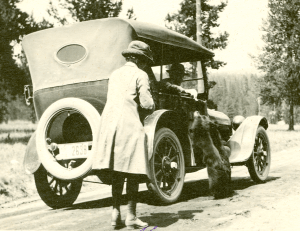
    Yellowstone Bear on the Running Board.

    The giant Speedex hummed out of Bozeman with its load of khaki-clad, riding-trousered women and men in old army uniforms. The running-board was piled high with the dunnage which accompanies an automobile tour, and in back, two burly, grey, spare tires rode majestic. The giant Speedex was bound for the Yellowstone Park.

    Not two minutes behind roared Winsted Tripp’s fiery roadster. The girl was in the big machine ahead. In the hotel the night before, Win had noted the entrance of the party; had heard the clerk describing the route they must take to get to the Park and had observed the girl. So it was that he had arisen early, and was now sailing along with the top down and windshield up, the breeze blowing over his thick hair and over the iron-grey ambrosial locks of old Pop Slocum, who was accompanying him on his trip through the Park.

    All morning long the roadster sped down the Yellowstone Trail on its way to the Gardiner gateway. Win kept a lookout for the Speedex, and twice sighted the big spare tires down the dustless road ahead. He aimed to travel a short distance behind the other party, and if necessary assist Fate in decreeing that they should stop at the same hotel that night.

    They made Mammoth Hot Springs about half-past four and secured a room. Then the young man with his old comrade went for a tour of the great hot springs formation. It was the cool of the afternoon, and the white limestone dust on the formation looked like snow. Old maids, college professors, geologists, guides, bored tourists, were everywhere, giving the multitudinous colored pools, spiderweb limestone deposits, and other wonders the great American “once-over.”

    Win thought once that he glimpsed the girl, but he couldn’t be sure.

    Those nights at Mammoth Hotel! The stars sparkling in the dry air of that high altitude; the arc lights flaring like giant diamonds around the grounds; the dance-floor in the hotel swimming in color as the couples sway to the orchestra’s jangling tunes; the scent of balsam firs that pervades everything in the Park . . . Nights of romance!

    “Go in and dance,” urged Pop Slocum. “You may not know yon gay damsels, but tell ’em you’re a gentleman and are taking as much risk as they are anyhow, and I’ll bet no one will object.”

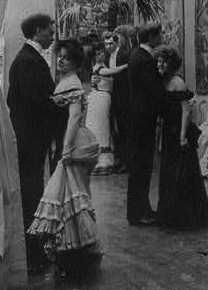
    Ballroom Scene.

    But Win preferred to sit on the sidelines and watch the dancers. He had been a male wallflower since the first dance he had ever attended. He couldn’t talk to girls, that was the trouble; he always felt called on to say something humorous or brilliant, and always managed to stammer out some peculiarly stupid remark.

    And so, melancholy came upon Win, and he began to be afraid of his interest in the girl. She was too far above him, he concluded; she’d never understand. Finally, he went upstairs to bed.

    The travellers went on early the next morning. They were getting into the heart of the great reserve, and the roads were becoming ever more tortuous and steep, though their ribbon-smooth surfacing continued.

    Pop Slocum was surprised by Win’s gloomy silence in the seat beside him. The old man had turned and stared for perhaps thirty seconds, while Win tried to look unconscious of it but felt the hot blood climbing to his ears.

    “My God!” finally boomed the old man. “I might have known as much!”

    “Known what?” asked Win.

    “You’re in love, my boy, in love! That’s my diagnosis!”

    Win grinned like a twelve-year-old boy.

    “Correct you are, Pop,” he admitted.

    ###

    The Norris Geyser Basin rushed upon them around a curve, and Win drove his car off to the side of the road and stopped with a squall of brake linings. Below them was spread the basin, like the roof of hell’s kitchen, smoking and steaming and hissing in a thousand vents.

    The two men set out for the basin They had walked hardly a dozen steps when the old man grasped Win’s arm.

    “There she is, lad!” he whispered, pointing towards the party out on the walk.

    And there indeed she was, clad in an abbreviated yellow coat, khaki breeches, puttees, and battered old army hat. Win quickened his pace, and the old man giggled excitedly.

    “Now, leave it to me, Bud,” he instructed. “Just follow my lead, and keep wide awake.”

    They approached the party with all decent speed; the others had paused to examine a steam vent, and in no time, Win was able to get a satisfactory glance at the group. Pop Slocum was not idle. He had a way with him which never gave offense, yet admitted him to any company on terms of friendly and jovial intimacy. He had introduced himself and Win all around within three minutes.

    And the girl? She smiled at Win frankly, as if she were meeting a friend again. She was about to say something, when Pop suddenly slipped and nearly tumbled into the hot water that lay on the thin crust of the basin. He grasped frantically and in so doing kicked the girl’s foot so as to shove her towards Win.

    She lost her balance, and fell into Win’s arms. Perhaps he held her longer than was really necessary; at any rate he saw that she was thoroughly steady and in no danger of falling before letting her go. Pop had recovered, and the incident passed off. But Dorothy Brown’s cheeks were bright with color; and Winsted Tripp was reduced to embarrassed silence.

    ###

    It was evening at the Grand Canyon Hotel. In the lobby the jazz band was putting “pep” into the couples weaving in and out on the polished floor. On the porch the older men smoked and talked of war and bolshevism and stockmarkets and automobiles, while the women gathered in those familiar gossip-circles which they can never forego, although they have the vote, and sit in Congress.

    A steep winding trail leads down from the Canyon hotel to a platform overlooking the lower falls of the Yellowstone.  Here Win had come, to sit in the moonlight and bid farewell to the romance he had possessed

    The night was bright with a full moon, and the canyon of the Yellowstone stretched away before him into infinity, a grey giant, dreaming under the stars. The roar of the river had become nearly soundless to Win’s ears, its steady noise turning his nerves to its own pitch.

    He was aroused from his reflections by the presence of someone else on the platform. He looked again, and rubbed his eyes.

    “Oh, so it’s you back again,” he said confusedly.

    “Yes,” said Dorothy Brown, “It’s I, back again.”

    Her tone had a little gladness that Win could not mistake. In that moment he knew his heart had found its objective

    ∞§∞

    — Condensed from R. Maury, “A Yellowstone Rencontrem,” The University of Virginia Magazine, October 1919, pp. 221-232.

    — “Bear on the Running Board,”  Pioneer Museum of Bozeman Photo.

    — “Ballroom Scene,” detail from Library of Congress Photo.

  • A Tale: Touring Yellowstone Legally by Car — 1916

    In 1902 when Henry G. Merry raced his 1897 Winton past the cavalry at the North Entrance to Yellowstone Park, the soldiers mounted their horses and chased him down. They took Merry to the Park Superintendent who chastised him and had him escorted out, but not until the Superintendent got a ride in the new fangled contraption. Cars were forbidden because people thought they would frighten wildlife and the horses used by other travelers.

    In 1915 when cars were officially allowed in the park, the action transformed the Yellowstone experience.  As the story below shows, fears of auto-induced mayhem proved to be unfounded.

    ∞§∞

    At the Park boundary is the soldier station. Fortunately the regulations are easily complied with, and in a few minutes the speedometer is again registering the speed limit. One season’s operation of the automobile regulations demonstrated to the powers that be that the average motorist is a saner and more reasonable being than was at first supposed; as a consequence, there has been a considerable downward revision of the rules governing his actions.

    Shortly after the entrance is passed the grade becomes noticeably steeper, and leaving the stream that has been so closely followed, a sharp rise carries the road over the divide through Sylvan Pass at an altitude of eight thousand four hundred feet. Gliding down the western slope through the cool, silent forests affords an indescribably keen enjoyment, and the motorist must have travelled far who has experienced roads as well built and maintained as this, more than a mile and a half above sea-level in the midst of rugged mountain summits.

    Eleanor and Sylvan Lakes are skirted in turn; the latter a dainty body of water set in the depth of an alpine forest and guarded by a grim peak at its head. The waving pines on the islets that dot its surface and the dense growth along its shores dispel any thought of the short distance to timber-line and eternal snow. As the road continues down a gently winding course all expectations are centred on Yellowstone Lake, till at last it flashes afar off through the pines—a great body of water scintillating under the turquoise brilliance of a Wyoming sky. In another instant it is gone and the road turns to hurry down to it in a flowing ribbon that stretches ahead as far as the eye can reach through the forest and across many a meadow of luxuriant grass.

    Half hidden in the long grass of these mountain parks scattered herds of elk and deer may be seen grazing within a few hundred feet of the road, and not even the rasping shriek of the electric horn seems to disturb the peaceful and contented existence of nature’s animals. Prior to the admittance of horseless vehicles to the Park, it was argued that the smell and the unnatural noise of the motors would drive the animal life away from the roads and would bring to an end one of the most fascinating features of this wonderland.

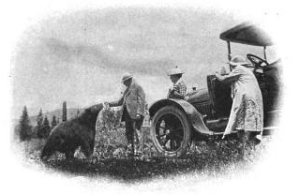
    When, however, the whir of the motor as it toils up the rugged heights of Mt. Washburn, and passes almost unnoticed within two hundred yards of a band of the most wary of wild animals, the Rocky Mountain sheep, and when at night the bears, having feasted on ”beefsteaks that have proved too tough for the tourists,” make bold actually to clamber into the motor-cars and despoil seat cushions in search of sweets unwittingly left in side pockets, it will be appreciated that the contention that the motor-car would frighten these animals was quite without foundation. The whole atmosphere of Yellowstone seems to exert a soothing effect on both man and beast, and it is said that “Even broncs won’t buck in the Park.”

     ∞§∞

    —   Excerpt and photo from Charles J. Beldon “The Motor in Yellowstone,” Scribners Magazine, 63:673-683 (1918).

    — You also might enjoy Henry G. Merry’s story about the first car in Yellowstone.

  • A Tale: Yellowstone’s First Car — 1902

    Henry G. Merry and his Winton

    Cars weren’t officially admitted to Yellowstone Park until 1915, but that doesn’t mean they weren’t there before that. One story says that Henry G. Merry drove his Winton to Mammoth Hot Springs in 1902 to a dance at the National Hotel. He was caught—the story goes—but was allowed to drive out under cover of darkness. Here’s a more colorful version told by his son.

    ∞§∞

    When the Winton car arrived it was the conversation piece of the time. The word reached the commandant at the fort, along with the information that the noise it made was terrifying to horses. Very wisely he issued an order prohibiting this machine and others like if from the confines of the Yellowstone Park. My father knew of this order, but thought he would pilot the car to the fort and talk things over with commandant. In the interim, two troopers had been stationed at the entrance to prevent any such violation of the commandant’s order.

    As related in father’s diary, on June 2nd, 1902, he and  my Mother took off. When the north entrance was reached, he opened up the speed to about 25 mph, and the troopers’ mounts acted up so that they could not block the passage. The machine was well on its way before they got their horses quieted down and started after the car—which was rapidly widening the distance between them.

    All went well as long as the road was level but that was not for long. As the grade became steeper—the speed was reduced—and soon the car came to a stop. The troopers arrived at a hard gallop.

    Fortunately, each one had a lariat and between the two horses they managed to pull the car to the commandant’s office and gave him a report of how things happened. He was quite pleasant and took time to explain to father, who already knew, that the noise of his conveyance posed a threat to the lives of all tourists who were visiting the park in horse-drawn vehicles. Then he became quite stern and reminded him that he was still under arrest and would have to pay a penalty to be released. When my father asked what the penalty would be, the officer very seriously replied, “You will have to take me for a ride in this contraption.” He got his ride and then assigned a detail to escort father to the gate.

    ∞§∞

    —Photo and text from The Pioneer Museum, Bozeman, Montana.

    — You might also enjoy “Touring Yellowstone Legally by Car — 1916.”