Category: Canyons

  • A Tale: Crashing Through Yankee Jim Canyon in a Wooden Boat — c. 1902

    Today it’s easy to hire a boat with a guide to run the rapids through Yankee Jim Canyon north of Yellowstone Park. But that wasn’t always the case, as Lewis Ransome Freeman discovered more than a hundred years ago.

    After graduating from Stanford University in 1898, Freeman decided to become an adventurer and traveled America, Asia, Africa and the Pacific Islands. About 1902, after snowshoeing through Yellowstone Park, he decided to float to the Gulf of Mexico down the Yellowstone, Missouri, and Mississippi Rivers. His first obstacle was to get through Yankee Jim Canyon, a rugged streatch of the Yellowstone River just north of the Park.

    Freeman solicited help from Yankee Jim George, a colorful character who had lived for 30 years  in the canyon that bears his name. The government had taken over Jim’s toll road by then, but he still provided accommodations in his rustic cabin. And, he knew where Freeman could get a boat.

    Freeman covered the Russo-Japanese War beginning in 1905 and continued to work as a war correspondent through World War I. It wasn’t until 1922 that he published this description of running the rapids of Yankee Jim Canyon.

    ∞§∞

    The boat I secured about ten miles down river from the Park boundary. The famous “Yankee Jim” gave it to me. This may sound generous on Jim’s part, but seeing the boat didn’t belong to him it wasn’t especially so. Nor was the craft really a boat.

    We found the craft where it had been abandoned at the edge of an eddy. It was high and dry on the rocks. Plain as it was that neither boat-builder nor even carpenter had had a hand in its construction, there was still no possible doubt of its tremendous strength arid capacity to withstand punishment.

    Jim said that a homesick miner had built this fearful and wonderful craft with the idea of using it to return to his family in Hickman, Kentucky. He had bade defiance to the rapids of the Yellowstone with the slogan “HICKMAN OR BUST.” Kentucky Mule he had called it.

    Our plan of operation was something like this: Bill and Herb, the neighboring ranchers, were to go up and help me push off, while Jim went down to the first fall at the head of the Canyon to be on hand to pilot me through. If I made the first riffle all right, I was to try to hold up the boat in an eddy until Jim could amble down to the second fall and stand-by to signal me my course into that one in turn. And so on down through.

    I was to take nothing with me save my camera. My bags were to remain in Jim’s cabin until he had seen me pass from sight below the Canyon. Then he was to send the stuff on to me at Livingston

    As I swung round the bend above the head of the Canyon, I espied old Jim awaiting my coming on a rocky vantage above the fall. A girl in a gingham gown had dismounted from a calico pony and was climbing up to join us. With fore-blown hair and skirt, she cut an entrancing silhouette against the sun-shot morning sky.

    I think the presence of that girl had a deal to do with the impending disaster, for I would never have thought of showing off if none but Jim had been there. But something told me that the exquisite creature could not but admire the sang froid of a youth who would let his boat drift while he stood up and took a picture of the thundering cataract over which it was about to plunge.

    And so I did it—just that. Then, waving my camera above my head to attract Jim’s attention to the act, I tossed it ashore. That was about the only sensible thing I did in my run through the Canyon.

    As I resumed my steering oar, I saw that Jim was gesticulating wildly in an apparent endeavor to attract my attention to a comparatively rock-free chute down the left bank. Possibly if I had not wasted valuable time displaying my sang froid I might have worried the Mule over in that direction, and headed right for a clean run through.

    As it was, the contrary brute simply took the bit in her teeth and went waltzing straight for the reef of barely submerged rock at the head of the steeply cascading pitch of white water. Broadside on she sunk into the hollow of a refluent wave, struck crashingly fore and aft, and hung trembling while the full force of the current of the Yellowstone surged against her up-stream gunwale.

    Looking back up-stream as the reeling Mule swung in the current, I saw Jim, with the Gingham Girl in his wake, ambling down the bank at a broken-kneed trot in an apparent endeavor to head me to the next fall as per schedule.

    Poor old chap! He was never a hundred-to-one shot in that race now that the Mule had regained her head and was running away down mid-channel regardless of obstacles. He stumbled and went down even as I watched him with the tail of my eye. The Gingham Girl pulled him to his feet and he seemed to be leaning heavily against her fine shoulder as the Mule whisked me out of sight around the next bend.

    With the steering oar permanently unshipped there was more difficulty than ever in exercising any control over the balkiness of the stubborn Mule. After a few ineffectual attempts, I gave up trying to do anything with the oar and confined my navigation to fending off with a cottonwood pike-pole.

    This really helped no more than the oar, so it was rather by good luck than anything else that the Mule hit the next pitch head on and galloped down it with considerable smartness. When she reeled through another rapid beam-on without shipping more than a bucket or two of green water I concluded she was quite able to take care of herself, and so sat down to enjoy the scenery.

    I was still lounging at ease when we came to a sharp right-angling notch of a bend where the full force of the current was exerted to push a sheer wall of red-brown cliff out of the way. Not unnaturally, the Mule tried to do the same thing. That was where I discovered I had over-rated her strength of construction.

    I have said that she impressed me at first sight as being quite capable of nosing the Rock of Gibraltar out of her way. This optimistic estimate was not borne out. That little patch of cliff was not high enough to make a respectable footstool for the guardian of the Mediterranean, but it must have been quite as firmly socketed in the earth. So far as I could see it budged never the breadth of a hair when the Mule, driving at all of fifteen miles an hour, crashed into it with the shattering force of a battering ram. Indeed, everything considered, it speaks a lot for her construction that she simply telescoped instead of resolving into cosmic stardust. Even the telescoping was not quite complete.

    The Mule had ceased to be a boat and become a raft, but not a raft constructed on scientific principles. The one most desirable characteristic of a properly built raft of logs is its stability. It is almost impossible to upset. The remains of the Mule had about as much stability as a toe dancer, and all of the capriciousness.

    She kept more or less right side up on to the head of the next riffle and then laid down and negotiated the undulating waves by rolling. I myself, after she had spilled me out at the head of the riffle, rode through on one of her planks, but it was a railroad tie, with a big spike in it, that rasped me over the ear in the whirlpool at the foot.

    And so I went on through to the foot of “Yankee Jim’s Canyon.” In the smoother water, I clung to a tie, plank or the thinning remnants of the Mule herself. At the riffles, to avoid another clout on the head from the spike-fanged flotsam, I found it best to swim ahead and flounder through on my own. I was not in serious trouble at any time, for much the worst of the rapids had been those at the head of the Canyon. Had I been really hard put for it, there were a dozen places at which I could have crawled out. As that would have made overtaking the Mule again somewhat problematical, I was reluctant to do it. Also, no doubt, I was influenced by the fear that Jim and the Gingham Girl might call me a quitter.

    Beaching what I must still call the Mule on a bar where the river fanned out in the open valley at the foot of the Canyon, I dragged her around into an eddy and finally moored her mangled remains to a friendly cottonwood on the left bank. Taking stock of damages, I found that my own scratches and bruises, like Beauty, were hardly more than skin deep. As the day was bright and warm and the water not especially cold, I decided to make way while the sun shone—to push on toward Livingston.

    The rest of that day’s run was more a matter of chills than thrills, especially after the evening shadows began to lengthen and the northerly wind to strengthen. The Mule repeated her roll-and-reduce tactics every time she came to a stretch of white water.

    There were only three planks left when I abandoned her at dusk, something over twenty miles from the foot of the Canyon, and each of these was sprinkled as thickly with spike-points as a Hindu fakir’s bed of nails. One plank, by a curious coincidence, was the strake that had originally borne the defiant slogan, “HICKMAN OR BUST.” Prying it loose from its cumbering mates, I shoved it gently out into the current.

    Spending the night with a hospitable rancher, I walked into Livingston in the morning. There I found my bags and camera, which good old “Yankee Jim” had punctually forwarded by the train .

    ∞§∞

    —   Condensed from Down the Yellowstone, Lewis Ransom Freeman, 1902.

    —   National Park Service Photo.

    — You might also enjoy “Rudyard Kipling Goes Fishing with Yankee Jim.”

  • A Tale: Two Pictures and 1300 Words — Walter Trumbull, 1870

    The Washburn Expedition of 1870 convinced the public that there really were wonders on the upper Yellowstone. Stories of towering waterfalls, mountains of glass, a crystal-clear inland sea, and fountains of boiling water could no longer dismissed as “tall tales.” Prominent government officials and businessmen whose word couldn’t be doubted said they were there.

    Just as important the as credibility of members of the Washburn Expedition was their writing skill. Several expedition members  wrote articles about the trip for the Helena Herald that were reprinted around the world.

    N.P. Langford and Truman Everts published articles in Scribner’s Monthly that also brought national attention. The illustrations that accompanied those articles where artists’ fanciful imaginings based on verbal descriptions. The images with Langford’s article were by Thomas Moran, whose later paintings of Yellowstone gave him world fame. Moran and photographer William Henry Jackson, whose work influenced the decision to make the area a national park, went to the upper Yellowstone with the Hayden expedition in 1871.

    Two members of the Washburn Expedition left pencil sketches of what they saw, Charles Moore, a private in the military escort, and Walter Trumbull, the son of U.S. Senator Lyman Trumbull of Illinois. Trumbull also published an account of his Yellowstone experience in the Overland Monthly. His written description and sketches of the Yellowstone Falls provide an interesting opportunity to test the adage, “A picture in worth a thousand words.”

    ∞§∞

    We reached the falls of the Yellowstone on the morning of August 30th. These falls, two in number, are less than half a mile apart. From the lake to the upper falls, a distance of about twenty miles, the river flows, with the exception of a short series of rapids having a moderate current, through an open, undulating country, gently sloping toward the stream..

    Here and there are small groves, and the timber is quite thick a mile away from the river. A quarter of a mile above the upper falls the river breaks into rapids, and foams in eddies about huge, granite boulders, some of which have trees and shrubs growing upon them.
    Above the rapids, the river is about 150 yards wide, but, as it approaches the falls, high, rocky bluffs crowd in on both sides, forcing the water into a narrow gorge, which, at the brink of the falls, is about thirty yards wide.

    The most convenient and desirable place from which to view the falls is from a ledge, easily reached, which juts into the river a considerable distance, just below the falls, and a few feet lower than their brink. It is so close that occasional drops dampen one’s face.  The height of the upper falls is 115 feet. The ledge is irregular, the water being much deeper on the west side than on the east. Great rocks project in the face of the fall, tearing and churning the waters into foam, with here and there a little strip of green, which contrasts beautifully with the surrounding silvery whiteness of the water.

    Between the two falls, the river flows quietly in a wide channel, between steep, timbered bluffs, four hundred feet high. Just above the lower falls the bluffs again converge; the one from the west stretching out as if to dam up the river, which has, however, forced its way through a break, forty yards wide. The rocky cliffs rise perpendicularly from the brink of the falls, to a height of several hundred feet. The rocky formation is of a shelly character, and slightly colored with flowers of sulphur. The plunge of the water is in the direct course of the stream, and at the brink of the falls, it appears to be of uniform depth. It clears its bed at a bound, and takes a fearful leap of 350 feet.

    The volume of water is about half as great as that which passes over the American Fall, at Niagara, and it falls more than twice the distance. The adjacent scenery is infinitely grander. Having passed over the precipice, the clear, unbroken, greenish mass is in an instant transformed by the jagged edges of the precipice into many streams, apparently separated, yet still united, and having the appearance of molten silver.

    These streams, or jets, are shaped like a comet, with nucleus and trailing coma, following in quick succession; or they look like foaming, crested tongues, constantly overlapping each other. The outer jets decrease in size as they descend, curl outward, and break into mist. In the sunlight, a rainbow constantly spans the chasm. The foot of the falls is enveloped in mist, which conceals the river for more than a hundred yards below.

    These falls are exactly the same in height as the Vernal Falls in the Yosemite Valley, but the volume of water is at least five times as great. I think I never saw a waterfall more beautiful than the Vernal, and its surroundings are sublime. Its Indian name is said to mean “Crown of Diamonds;” and it certainly deserves the name. I remember sitting on the rocky ledge just at the edge of the falls, and with an opera-glass watching the water as they plunged downward, breaking into myriads of drops; each drop, like a lens, gathering prismatic tints from the shining sun, and flashing like diamonds of the purest brilliancy.

    The lower fall of the Yellowstone reminds me of the Vernal Fall, on the Merced.  Though nothing, perhaps, can equal the sublime scenery of the Yosemite, yet that only excels the lower falls of the Yellowstone, and the grand canyon which extends for many miles below them.

    Below the falls, the hills gradually increase in height, while the river descends in a succession of rapids through the canyon. At the falls, the canyon is not more than twelve hundred feet deep, but a few miles lower down it is nearly eighteen hundred feet deep. Its average thick a mile away from the river. A quarter of a mile above the upper falls the river breaks into rapids, and foams in eddies about huge, granite boulders, some of which have trees and shrubs growing upon them.

    Above the rapids, the river is about 150 yards wide, but, as it approaches the falls, high, rocky bluffs crowd in on both sides, forcing the water into a narrow gorge, which, at the brink of the falls, is about thirty yards wide.

    The most convenient and desirable place from which to view the falls is from a ledge, easily reached, which juts into the river a considerable distance, just below the falls, and a few feet lower than their brink. It is so close that occasional drops dampen one’s face. The height of the upper falls is 115 feet. The ledge is irregular, the water being much deeper on the west side than on the east. Great rocks project in the face of the fall, tearing and churning the waters into foam, with here and there a little strip of green, which contrasts beautifully with the surrounding silvery whiteness of the water.

    Between the two falls, the river flows quietly, in a wide channel, between steep, timbered bluffs, four hundred feet high. Just above the lower falls the bluffs again converge; the one from the west stretching out as if to dam up the river, which has, however, forced its way through a break, forty yards wide. The rocky cliffs rise perpendicularly from the brink of the falls, to a height of several hundred feet. The rocky formation is of a shelly character, and slightly colored with flowers of sulphur.

    The plunge of the water is in the direct course of the stream, and at the brink of the falls, it appears to be of uniform depth. It clears its bed at a bound, and takes a fearful leap of 350 feet. The volume of water is about half as great as that which passes over the American Fall, at Niagara, and it falls more than twice the distance.

    The adjacent scenery is infinitely grander. Having passed over the precipice, the clear, unbroken, greenish mass is in an instant transformed by the jagged edges of the precipice into many streams, apparently separated, yet still united, and having the appearance of molten silver. These streams, or jets, are shaped like a comet, with nucleus and trailing coma, following in quick succession; or they look like foaming, crested tongues, constantly overlapping each other. The outer jets decrease in size as they descend, curl outward, and break into mist. In the sunlight, a rainbow constantly spans the chasm. The foot of the falls is enveloped in mist, which conceals the river for more than a hundred yards below.

    These falls are exactly the same in height as the Vernal Falls in the Yosemite Valley, but the volume of water is at least five times as great. I think I never saw a waterfall more beautiful than the Vernal, and its surroundings are sublime. Its Indian name is said to mean “Crown of Diamonds;” and it certainly deserves the name.

    I remember sitting on the rocky ledge just at the edge of the falls, and with an opera-glass watching the waters as they plunged downward, breaking into myriads of drops; each drop, like a lens, gathering prismatic tints from the shining sun, and flashing like diamonds of the purest brilliancy. The lower fall of the Yellowstone reminds me of the Vernal Fall, on the Merced. Though nothing, perhaps, can equal the sublime scenery of the Yosemite, yet that only excels the lower falls of the Yellowstone, and the grand canyon which extends for many miles below them.

    ∞§∞

    — Excerpt from “The Washburn Expedition”  by Walter Trumbull, Overland Monthly, May-June 1871.

    — Images from the Coppermine Photo Gallery.

    — For more stories about the Washburn Expedition, click on “Washburn” under the “Categories” button to the left.

  • A Tale: Rudyard Kipling Goes Fishing With Yankee Jim — 1889

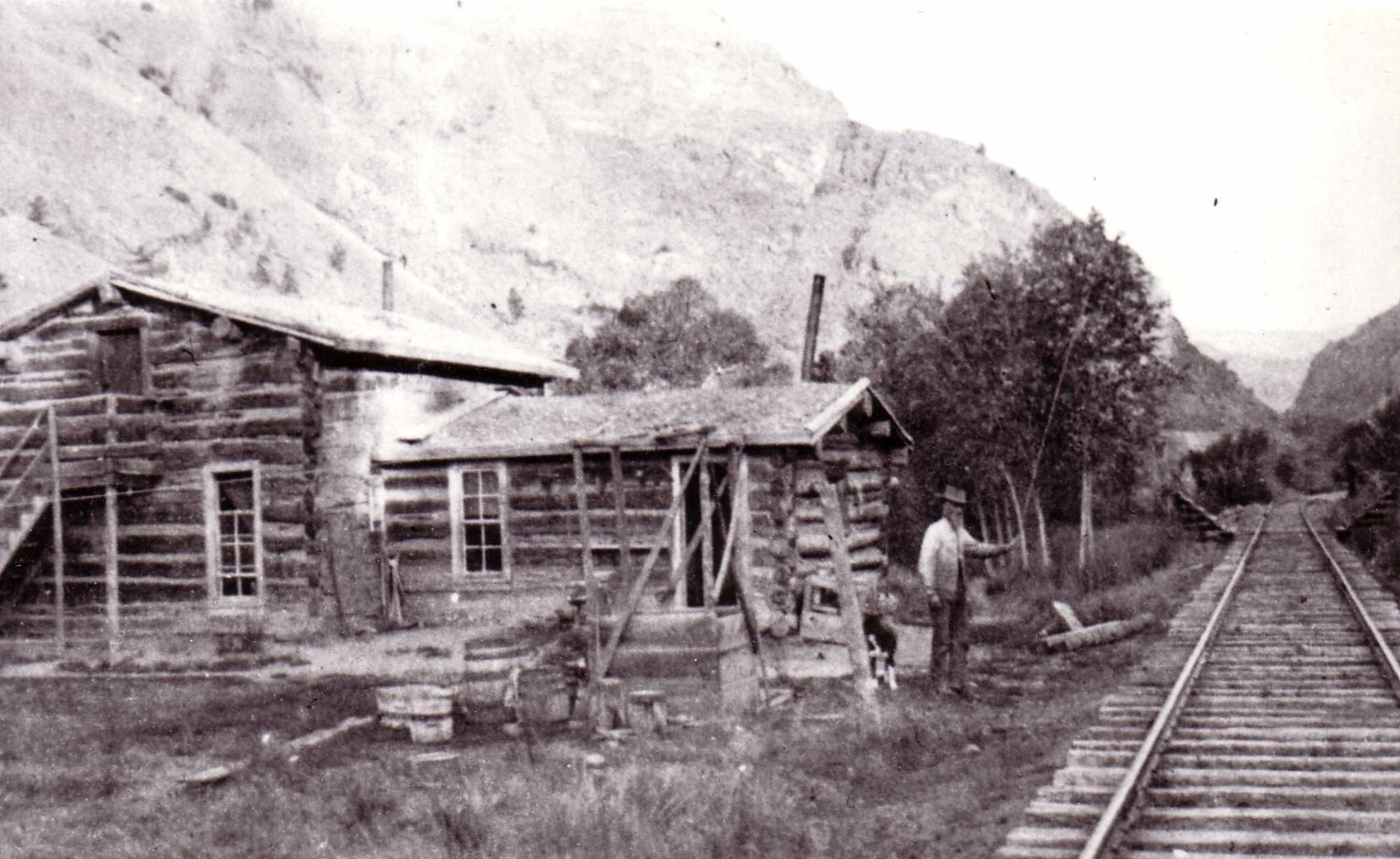
    Yankee Jim George between his cabin and the Northern Pacific track.

    In 1889 when British author Rudyard Kipling visited Yellowstone, a spur of the Northern Pacific carried passengers from Livingston, Montana, to the edge of the Park. But Kipling heeded advice from a fellow passenger and stopped to visit Yankee Jim George, the legendary operator of a toll road than ran through the canyon that still bears his name.

    Yankee Jim was a garrulous man who must have met thousands of tourists after he began collecting tolls in 1873. In 1883 the railroad took over Yankee Jim’s road bed, although they did build a bypass for him. Even after the county took over the road 1887, travelers continued to stop by Yankee Jim’s.

    Dozens of travelers’ diaries describe a stop at his cabin, note his courtly treatment of ladies and recount his tall tales. Kipling was no exception. Here’s his story.

    ∞§∞

    From Livingston the National Park train follows the Yellowstone River through the gate of the mountains and over arid volcanic country. A stranger in the cars saw me look at the ideal trout-stream below the windows and murmured softly: “Lie off at Yankee Jim’s if you want good fishing.”

    They halted the train at the head of a narrow valley, and I leaped literally into the arms of Yankee Jim, sole owner of a log hut, an indefinite amount of hay-ground, and constructor of twenty-seven miles of wagon-road over which he held toll right. There was the hut—the river fifty yards away, and the polished line of metals that disappeared round a bluff. That was all. The railway added the finishing touch to the already complete loneliness of the place.

    Yankee Jim was a picturesque old man with a talent for yarns that Ananias might have envied. It seemed to me, presumptuous in my ignorance, that I might hold my own with the old-timer if I judiciously painted up a few lies gathered in the course of my wanderings. Yankee Jim saw every one of my tales and went fifty better on the spot.

    He dealt in bears and Indians—never less than twenty of each; had known the Yellowstone country for years, and bore upon his body marks of Indian arrows; and his eyes had seen a squaw of the Crow Indians burned alive at the stake. He said she screamed considerable.

    In one point did he speak the truth—as regarded the merits of that particular reach of the Yellowstone. He said it was alive with trout. It was. I fished it from noon till twilight, and the fish bit at the brown hook as though never a fat trout-fly had fallen on the water. From pebbly beaches, quivering in the heat-haze where the foot caught on stumps cut foursquare by the chisel-tooth of the beaver; past the fringe of the water-willow crowded with the breeding trout-fly and alive with toads and water-snakes; over the drifted timber to the grateful shadow of big trees that darkened the holes where the fattest fish lay, I worked for seven hours.

    The mountain flanks on either side of the valley gave back the heat as the desert gives it, and the dry sand by the railway track, where I found a rattlesnake, was hot-iron to the touch. But the trout did not care for the heat. They breasted the boiling river for my fly and they got it. I simply dare not give my bag. At the fortieth trout I gave up counting, and I had reached the fortieth in less than two hours. They were small fish—not one over two pounds—but they fought like small tigers, and I lost three flies before I could understand their methods of escape. Ye gods! That was fishing.

    ∞§∞

    — Excerpt from  From Sea to Sea: Letters of Travel, Volume Two, Rudyard Kipling, 1899. (Page 203−205).

    — Photo, Pioneer Museum of Bozeman.

    — For related stories, click on “Fishing” under the “Categories” button to the left.

  • A Tale: A Near Tragedy on Uncle Tom’s Trail

    When Louis Downing visited Yellowstone National Park in 1911, good roads, comfortable hotels and camps, and tour guides left little room for adventure. But, as Downing found out, travelers could still get a thrill by taking “Uncle Tom’s Trail” to the base of the Lower Yellowstone Fall.

    Downing, a druggist from Hamilton, Montana, toured the park “The Wylie Way,” with a group of people he called “the family,” because they had become such fine friends on the trip. Here’s his description of what happened to members of the family when they decided to descend “Uncle Tom’s Trail.”

    ∞§∞

    After sending a few cards, Grace D., Mr. Jewell, Jane D., Sis, Lee and Doc followed a pretty trail through the forest to Uncle Tom’s Trail. A big sign marked “Dangerous” hung at the top.

    At the bottom of the trail, we could see a guide helping two women down—almost lifting them from rock to rock. Jane D. promptly decided that long skirts and high heels were not safe on that trail and refused to start. The boys agreed with her, but Grace, who wore flat heels, had started.

    Sis wanted to go but agreed to remain at the top with Jane D. Doc went down like a squirrel. Mr. Jewell and Lee remained near Grace. Almost half way down Brother Lee’s Kodak fell to the bottom and broke into a dozen pieces. When they reached the river, they sat on a large rock and drank some of the water. They were directly under the falls, and the view in either direction was magnificent.

    A light rain caused them to fear that the slippery rocks would make ascent dangerous so they started up the trail though they could have spent hours in the canyon. They reached the top in twenty-two minutes.

    Following the roadway, they came to a flight of stairs leading to a platform built close to the fall. The green water and white foam plunging over the rocks was simply magnificent.

    Grace D. says the climb up those steps was the hardest she had ever taken; yet, the view was worth the effort. Doc took a picture of the Falls from this point.

    In the meantime, the girls sat at the top of the trail—the mosquitoes swarming about them. They had almost made up their minds to start down when Sis slipped and fell a little to the left of the trail. She slid several feet before she could get hold of a rock that would hold her. Even then she realized that it would soon loosen, so while Jane D. frantically shouted for help Sis managed to pull herself up to the roots of a tree while the mosquitoes settled on her arms making it almost impossible to hold on.

    Jane D. tried to signal they boys, but they were too far away to realize what she meant and merely waved their hands. She knew that Sis could not hold on much longer, so she ran toward the road and finally attracted the attention of several tourists. Mr. L.F. Huesselmann of Osage, Iowa, reached the scene first, but Sis, knowing that he could not pull her up alone, held on until Mr. W.F. Schroeder of Oakland, California, reached the trail. They succeeded in getting her up and several feet from the trail before she weakened and sat down. Jane D. was pale and nervous and Mrs. Schroeder was badly frightened. She said her knees had just given way when she saw Sis hanging above the trail.

    Sis herself was over the fright in a few minutes, and laughed hysterically, but poor Jane D. couldn’t see anything to laugh at and said so.

    ∞§∞

    —   Louis E. Downing Diary. K. Ross Toole Archives, University of Montana Library, Missoula.

    — Colorized Photo, Yellowstone Digital Slide File.

    — You might also enjoy F. Dumont Smith’s story of a trip to the base of the Lower Fall of the Yellowstone.