Category: Dunraven

  • Introducing Free Reads

    I’ve used this blog to post stories I’ve found about early travel to Yellowstone Park and occasionally other stories. Also, I like to let people know about my other a ctivities: writing, speaking and occasional personal notes. Of course, I’ll keep doing those things, but with some new twists.

    Yellowstone travel stories are getting harder to find. I’ll keep an eye out and post stories when I see them, but I’l going to add what call “Free Reads.” That is, book, articles and reports that are available on the internet at no cost. I’ll provide links so you can read them whenever you want to learn more about Yellowstone Park Adventures

    I’ll begin with the Earl of Dunraven’s book, The Great Divide, which chronicles his trip to Yellowstone Park in 1874. The Earl was a wealthy Irish lord who loved adventure, hunting and fishing. He had been a newspaper correspondent and was a skilled writer. He could describe his adventures in bone-chilling detail or with wit and humor. His book is the source of many posts on this blog that you can see by selecting the “Dunraven” button at the left of this page.

    You can find complete copies The Great Divide online in several locations. I like seeing page-image versions like the one available at the Internet Archive.  Seeing what the book looked like gives a feel of authenticity and the illustrations can be great. They are in this book. Google Books is another internet site where you can get a copy of The Great Divide.

    So grab yourself a free copy of The Great Divide or read it on line. If you find anecdotes or stories in it that would make good additions to this blog, please let me know. Remember you can check to see if I’ve already published them by checking for “Dunraven” under the Categories Button to the left of this page. 

    I’ve added “Free Reads” under the Category Button and plan to add items there regularly. You should watch for them.

  • A Tale: The Antelope That Got Away — Dunraven, 1874

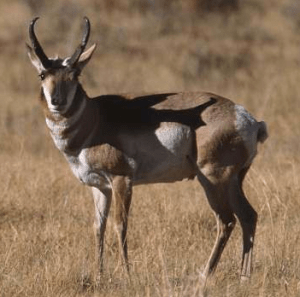
    While returning from Yellowstone Park in 1874, the Earl of Dunraven discovered he was running out of “grub.” Hunting for food in the Park was legal then, so he decided to replenish the larder by bagging an antelope. He went hunting with pioneer rancher and Yellowstone guide, Fred Bottler, and a helper named Wynn.

    While the trio was pursuing a large buck, a ferocious hail storm forced them to take cover under a pine tree. When the storm abated, Dunraven spotted the buck, tried a long shot and missed. Here’s his story of what happened after that.

    ∞§∞

    It was blowing so hard, and there was such a noise of storm, that there was no danger of the shot having disturbed anything, and so, as the country looked very gamey, we walked on, leading the horses. Presently we came upon a little band containing six antelopes.

    We were by this time near the summit of a long sloping mountain. The ground fell away rapidly on either side, and in a long but narrow glade the antelopes were lying. While we were peering at them, two does—nasty inquisitive females—got up, walked forward a few steps and stared too. We remained still as statues, and after a while they appeared satisfied and began to crop the grass. We then left our ponies, and signing to Wynne, who just then hove in sight, that there was something ahead, and that he was to catch them, hastened up under cover of some brush.

    By the time we reached the tree nearest to them we found the does had all got up and fled to some distance, but a splendid buck with a very large pair of horns was still lying down. At him I fired, and nailed him. He gave one spring straight into the air from his bed, fell back into the same spot, kicked once or twice convulsively, and lay still. I fired the second barrel at a doe and struck her, for she “pecked” almost on to her head, but she recovered and went on.

    Out we rushed: “Never mind the dead one,” shouts Bottler, his face all aglow; “let’s get the other; she’s twice as good, and can’t go far. You take one side of that clump and I will take the other.” So off we set, best pace, bursting up the hill after the wounded doe. We followed her for half an hour, running our level best, and got each a long shot, but missed; and, as she was evidently quite strong, we gave up the chase and walked back.

    We found Wynne driving up the ponies; and as he appeared to have some little trouble with the poor beasts, rendered sulky and ill-tempered by the wet and cold. I said to Bottler, “You go down and help him, and I will butcher the buck.”

    I had scarcely got the words “butcher the buck” out of my mouth, when the darned thing, apparently not appreciating my intentions, came to life, bounded to his feet, sprang into the air, coming down all four feet together, and, with his legs widely extended, gave a phwit—a sort of half whistle, half snort of surprise, I suppose at his own resurrection—stared a second, and made off.

    “Shoot, Bottler,” I cried, “shoot. In Heaven’s name, man, can’t you see the buck?” and I threw up my own rifle and missed him of course. “By George,” says Bottler, wheeling round, “look at the  ___;” and he let go at him with the same result.

    Wynne yelled and dropped the lariats; Bottler ejaculated terrible things; and I also, I fear, made use of very cursory remarks. But neither for swearing, shouting, nor shooting would he stop. He ran about fifty yards, fell on his head and rolled over and over, jumped up again, ran one hundred yards, pitched head over heels the second time, got up, and went down the hill as if he had never felt better in his life.

    We followed of course, and wasted an hour in searching for him in vain. Never again will I pass a beast, however dead he may appear to be, without cutting his throat by way of making sure.

    ∞§∞

    — Excerpt from Hunting on the Yellowstone by the Earl of Dunraven.

    — Image from the Coppermine Photo Gallery.

    — For more stories about The Earl of Dunraven, click on “Dunraven” under the “Categories” button to the right.

    — You can read more of Dunraven’s stories in my book, Adventures in Yellowstone: Early Travelers Tell Their Tales.

  • A Tale: A Dark and Stormy Night in Yellowstone Park — Dunraven, 1874

    Late October is a time for scary stories so I decided to check my collection of tales from Yellowstone Park for one to share here. I didn’t find anything about geyser ghosts and goblins, but I did locate a chilling tale by the Earl of Dunraven.

    Dunraven was hunting in Yellowstone in 1874. (It was legal then.) When a storm came up, the Earl and his guides, Fred Bottler and Texas Jack Omohondro, decided to return to camp, but their companion, Dr. George Kingsley, decided to keep hunting a little longer. The storm grew worse as darkness fell. Here’s the Earl’s story about what happened next.

    ∞§∞

    When Jack and I got in we found camp in a sorry plight, everything soaked through—tents, bedding, and all, and our prospects for the night looked anything but cheerful; but by extending the hide of the wapiti stag between four trees, and hauling it out taut with ropes, we managed to make a tolerable shelter; and, taking from out of our cache some dry birch bark and splinters of fat pine, we lit a huge fire, and sat down to make some tea for supper.

    About dusk, we heard a shot, and visions of fresh venison steaks floated before our eyes. About half an hour passed, but no venison and no Kingsley appeared, and then we heard another shot, and two or three minutes afterwards yet another.

    By this time, it was getting quite dark, and we were puzzled to know what Kingsley could be firing at—unless, indeed, he was treed by a bear. After a short interval we heard the sound of his rifle again, evidently further off, and then it suddenly occurred to us that he was lost and making signals. We fired our rifles, and whooped, and yelled, and shouted, but all to no purpose. The sound of his rifle became fainter and fainter; —he was going in the wrong direction.

    To be left out on such a night might cost a man his life, for it would have been hard for even an old experienced mountain man to have found material dry enough to make a fire; so Jack and Bottler started out into the blackness of the night and the thick fog to look for him, leaving me behind to heap logs on the fire, and occasionally emit a dismal yell to keep them acquainted with the whereabouts of camp.

    For some time I could hear the responsive shouts of the searchers, but after awhile they ceased, and nothing broke the horrid silence except the noises of the night and of the storm.

    The heavy raindrops pattered incessantly on the elk hide; the water trickled and splashed, and gurgled down the hillside in a thousand muddy rills and miniature cascades. The night was very dark, but not so black but that I could dimly see white ghost-like shreds of vapor and great indistinct rolling masses of fog driving up the valley in the gale. The wind rumbled in the caverns of the cliffs, shrieked and whistled shrilly among the dead pine trees, and fiercely shook the frail shelter overhead, dashing the raindrops in my face.

    Every now and then the fire would burn up bright, casting a fitful gleam out into the damp darkness, and lighting up the bare jaws and white skulls of the two elk-heads, which seemed to grin derisively at me out of the gloom; and then, quenched by the hissing rain, it would sink down into a dull red glow.

    My dog moved uneasily about, now pressing close up against me, shivering with cold and fear, nestling up to me for protection, and looking into my face for that comfort, which I had not in me to give him—now starting to his feet, whimpering, and scared when some great gust smote the pine tree overhead, angrily seized and rattled the elk-hide, and scooping up the firebrands tossed them in the air.

    The tall firs bowed like bulrushes before the storm, swaying to and fro, bending their lofty heads like bows and flinging them up again erect, smiting their great boughs together in agony, groaning and complaining, yet fiercely fighting with the tempest.

    At intervals, when the gale paused for a moment as it were to gather strength, its shrill shrieking subdued to a dismal groan, there was occasionally heard with startling distinctness, through the continuous distant din and clamor of the night, a long, painfully-rending cr-r-r-rash, followed by a dull heavy thud, notifying the fall of some monarch of the woods, and making my heart quake within me as I uneasily glanced at the two tall hemlocks overhead that wrathfully ground their trunks together, and whose creaking limbs were wrestling manfully with the storm.

    Strange and indistinct noises would come up from the vale: rocks became detached, and thundered down the far-off crags. A sudden burst of wind would bear upon me the roar of the torrent below with such clearness that it sounded as though it were close at hand. It was an awful night, in the strictest sense of the word. The Demon of the Tempest was abroad in his anger, yelling down the valley, dashing out the water-floods with his hands, laying waste the forest, and filling with dread the hearts of man and beast and every living thing.

    There was not a star or a gleam of moonlight. It was very gruesome sitting there all alone, and I began to feel, like David, “horribly afraid.” I do not know how long I was alone; probably it was only for a short time—a couple of hours or so, at most— but the minutes were as hours to me.

    Most dismal was my condition; and I could not even resort to the Dutch expedient for importing courage, to supply my natural allowance of that quality which had quickly oozed out of my cold fingertips. I had poured into a tin pannikin the last drain of whisky from the keg, and had placed it carefully to settle.

    I knew that Kingsley would really want it, so I could not seek consolation in that way. I could not find even a piece of dry tobacco wherewith to comfort myself; I began to feel very wretched indeed; and it was truly a great relief when I heard the shouts of the returning party.

    They brought in the lost man pretty well exhausted, for he had been out a long time exposed to the weather, had walked a great distance, and had fallen about terribly in the darkness. He had tried in vain to make a fire, and was wandering about without an idea of the direction in which camp lay.

    He was indeed in real need of a stimulant, and when, in answer to his inquiring glance at the keg, I said that there was half a pannikin full, his face beamed with a cheerful smile. But alas! A catastrophe had occurred. A gust of wind or a falling branch had over-thrown all my arrangements, and when I arose to give him the pannikin, behold, it was bottom upwards and dry!

    ∞§∞

    —   From the Earl of Dunraven, Hunting in the Yellowstone, New York: Outing Publishing Company, 1917. (Pages 174-177.)

    —   C.D. Loughrey Photo, c. 1888, Pioneer Museum of Bozeman.

    — To see more stories by by the Earl, click on “Dunraven” under the Categories button on the left side of this page.

  • A Tale: Dunraven Says Mountain Men Led a “Delicious Life” — 1874

    Beginning in 1807 when John Colter first passed through the area that became Yellowstone National Park through the 1830s, Mountain Men flourished in the Rocky Mountain West. Then a combination of over trapping and a shift in men’s fashions to silk hats ended the lucrative beaver trade. The last big Mountain Man rendezvous occurred  in 1840.

    Although a trapper couldn’t earn a fortune after that, a few hardy souls remained in the area making a subsistence living. Yellowstone tourists encountered such men until the 1880s. Here’s a description of  an encounter with two Mountain Men and their entourage written by the Earl of Dunraven, a wealthy Irish nobleman who visited the Park in the 1874.

    ∞§∞

    In the afternoon we passed quite a patriarchal camp, composed of two men with their Indian wives and several children; half a dozen powerful savage-looking dogs and about fifty horses completed the party.

    They had been grazing their stock, hunting and trapping—leading a nomad, vagabond, and delicious life—a sort of mixed existence, half hunter, half herdsman, and had collected a great pile of deer-hides and beaver-skins. They were then on their way to settlements to dispose of their peltry, and to get stores and provisions; for they were proceeding to look for comfortable winter quarters, down the river or up the canyon.

    We soon discovered that the strangers were white, and, moreover, that there were only two men in camp; and without more ado we rode in and made friends. What a lot of mutually interesting information was given and received! We were outward bound and had the news, and the latitude and the longitude. They were homeward bound, had been wandering for months, cut off from all means of communication with the outside world, and had but the vaguest notion of their position on the globe.

    But, though ignorant of external matters and what was going on in settlements, they had not lost all desire for information. An American, although he lives with an Indian woman in the forests or on the plains, never quite loses his interest in politics and parties; and these two squaw-men were very anxious to hear all about electioneering matters

    These men looked very happy and comfortable. Unquestionably the proper way for a man to travel with ease and luxury in these deserts is for him to take unto himself a helpmate chosen from the native population. With an Indian wife to look after his bodily comforts, a man may devote himself to hunting, fishing, or trapping without a thought or care. He may make his mind quite easy about all household matters. His camp will be well arranged, the tent pegs driven securely home, the stock watered, picketed, and properly cared for, a good supper cooked, his bed spread out, and everything made comfortable; his clothes and hunting-gear looked after, the buttons sewn on his shirt (if he has got any shirt—or any buttons) and all the little trivial incidents of life, which, if neglected, wear out one’s existence, he will find carefully attended to by a willing and affectionate slave.

    They had a lot to tell us also about their travels and adventures, about the wood and water supply, and the abundance or deficiency of game. So we sat down on bales of beaver-skins and retailed all the civilized intelligence we could think of. The women came and brought us embers for our pipes, and spread out robes for us and made us at home. And the little, fat, chubby children, wild and shy as young wolves, peered at us from behind the tent out of their round, black, beady eyes.

    ∞§∞

    — Text from The Great Divide by the Earl of Dunraven, 1875.

    — You might also enjoy:

    — To see more stories by this author, click on “Dunraven” under the “Categories” button to the left.