Category: Events

  • An Event: Getting Ready to Present “The Montana Gin Marriage Law of 1935” — to Smart Women

    Brubakers 1935
    Ivy and Albert Brubaker, 1935

    I’ve been getting ready to reprise my presentation “The Montana Gin Marriage Law of 1935” to Smart Women on Wednesday, October 9, at 3 p..m. at Aspen Point in Bozeman. I talked about the controversial law on September 28 last year at the Pioneer Museum of Bozeman and I’ve been revising my notes. The law, which went into effect on July 1, 1935, required couples to get a health certificate signed by a doctor, and wait three days to get a marriage license. When doctors refused to sign the certificates, Montanans discovered it was nearly impossible to get a marriage license.

    When I made my presentation last year, I speculated that my parents may have had the only August wedding in Montana in 1935. Since then Myrna Rytl of Bozeman told me her parents, Albert Sidney Brubaker and Ivy Marjory Fluss, were married on Aug. 11, 1935, at the family ranch in Prairie County, Montana, about 18 south of Terry. Myrna says her parents found a doctor who was willing to sign the required health certificate.They’re the only people I know of who complied with the letter of the Gin Marriage Law.

    My parents got around the law by buying their marriage license in June and holding onto it until the August wedding date that they had been planning for several months. That was perfectly legal. Many couple had July weddings with licenses they bought in June, but few waited until August.

    In the 1920s and 30s, many states passed Gin Marriage Laws, which got their name because they were designed to keep drunken couples from marrying after gin parties during prohibition. But Montana’s law was far more rigid than most and set off a complicated chain of events including couples traveling out of state to get married, a petition drive and a referendum election to get the law repealed.

    You can read about it here. Better still, come to my presentation.

    ∞§∞

    — Photo courtesy of Myrna Rytl.
  • An Event: Signing Books Again This Weekend at Old Faithful Inn

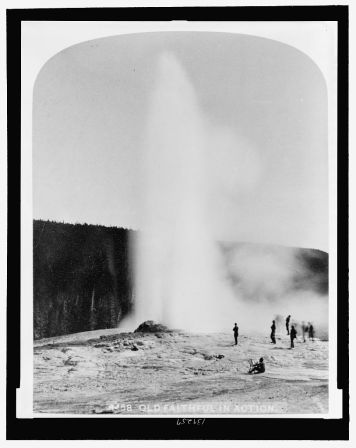
    FJHanes1883OldFaither LCI’ll return to Old Faithful Inn this weekend to sign copies of my book, Adventures in Yellowstone: Early Travelers Tell Their Tales. I’ll be in the lobby of the Inn Saturday and Sunday (Aug. 17-18) from 11 a.m. to 2 p.m. and and 3 to 5 p.m. If you’re in the area, stop by my table for a chat. I’d love to sigh a copy for you.

    I also hope I’ll get a chance to watch Old Faithful Geyser play again. I never get tired of that. I always remember the first time I saw it as a little boy when you could stand much closer than you can today. And I wonder what it was like in the 1800s when you could walk right up to the geyser like these people in an 1883 photo by the famous Yellowstone photographer, F. Jay Haynes.

    ∞§∞

    — Library of Congress Photo.

  • An Event: I’ll Be Signing Books on Two Weekends in August

    FJHaynes postcard wikipedia

    I’ll be signing copies of my book, Adventures in Yellowstone: Early Travelers Tell Their Tales, at the Old Faithful Inn on two weekends in August. I’ll be in the lobby of the world famous hotel on Aug. 10-11 and Aug. 17-18 from 11 a.m to 2 p.m. and 3 to 5 p.m.

    This will be the fourth summer I’ve signed books at the world famous hotel, and I’ve blogged about the experience several times.

    Adventures in Yellowstone contains a dozen first-person accounts of early travel to the park. Several of the stories are about adventures the Yellowstone guides and road signs still talk about. Here’s a list of examples with links to excerpts:

    Other stories are less well known, but equally interesting:

    I got the idea for my next book, Shorter Stories of Greater Yellowstone, while talking to people at my earlier book signings. People told me they want a collection that contains short stories they can finish around the campfire at night or while driving between sights. When I heard that, I decided to compile such a book.

    Shorter Stories will contain about sixty stories of 400 to 2,000 words.  The first-person accounts will be organized in twelve parts with titles like “Mountain Men,” “Hunting,” and “Bear Stories.”  The entire book will be about 60,000 words including introductions for each part and story.  I expect to be signing copies of it at Old Faithful Inn in the Summer of 2014.

    I hope to see you soon in Yellowstone Park!

    ∞§∞

    — F.J. Haynes Postcard, Wikipedia Commons.

  • An Event: Getting Ready To Present “The Nez Perce in Yellowstone” at The Pioneer Museum

    The big event on my schedule this week is my presentation, “The Nez Perce in Yellowstone,” at The Pioneer Museum of Bozeman on Saturday at 9:30 a.m. The talk, which is part of the Gallatin Historical Society’s Fall Lecture Series, will focus the dramatic stories told by tourists who survived run-ins with the Indians in the Summer of 1877.

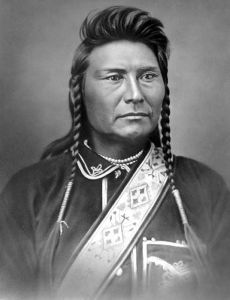
    Chief Joseph

    I’ll begin with an overview of the flight of the Nez Perce who generally had lived peacefully with whites for most of the 1800’s. After gold was discovered on Nez Perce land in 1853, settlers began moving onto their land. In 1877 the Indians were ordered onto a tiny reservation, but they decided instead to flee to the buffalo country on the plains. Most accounts of the flight of the Nez Perce emphasize things that happened outside of Yellowstone Park like broken treaties and battles, but I’ll reverse that pattern and focus in the human drama of the Indians’ encounters with tourists.

    I’ll read from my collection of first-person accounts of travel through Yellowstone Park in the 1800s. I like to present stories in the words of people who lived the adventures because that lets emotions and personalities shine through.

    The first tourist the Nez Perce found in the park was John Shively, a prospector who was familiar with the area. The Indians forced Shively to guide them all the way through the park. He was with them for thirteen days, so his story provides a good overview.

    The next tourists the Nez Perce found were the “Radersburg Party,” which included Emma Cowan and her thirteen-year-old sister, Ida. Emma and Ida were the only women to tangle with the Nez Perce inside the park. I’ll read Emma’s chilling description of the Indians shooting her husband in the head and taking her and her sister captive.

    To slow things down, I’ll talk about “Skedaddlers,” tourists who visited the park in the summer of 1877, but left before the Indians arrived. These include: the famous Civil War General William Tecumseh Sherman; Bozeman Businessman Nelson Story; English nobleman and park popularizer, The Earl of Dunraven and his companions, Buffalo Bill’s sometime partner, Texas Jack Omohundro, and Dunraven’s friend, George Henry Kingsley, a physician who patched up the Nez Perce’ victims at Mammoth Hot Springs.

    Next, I’ll talk about the Helena Party’s trip and contrast that all-male group that entered the park from the north with the co-ed Radersburg Party that entered from the west. Then I’ll read Andrew Weikert’s description of his blazing gun battle with the Nez Perce.

    I’ll describe how survivors of encounters with the Nez Perce were either rescued by soldiers looking for the Indians or made their way to Mammoth Hot Springs. I’ll explain that after Emma Cowan, her sister, and several wounded men left Mammoth for civilization, three men stayed there to see if their missing companions would appear. Then I’ll read Ben Stone’s description of the Indian attack at Mammoth that left another man dead.

    I’ll end with my synthesis of accounts of Emma Cowan’s overnight ride from Helena to Bottler’s Ranch in the Paradise Valley to join her husband who had survived three gunshot wounds and was rescued by the army. That will give me an opportunity to talk about Encounters in Yellowstone, a book I’m writing now.

    ∞§∞

    — The presentation will be at Pioneer Museum of Bozeman,  315 E. Main. It is free and open to the public.  Please tell your friends.

    — The photo of Chief Joseph is in the public domain.

  • An Event: Returning to Old Faithful Inn to Sign Books

    I’m looking forward to returning to Old Faithful In on August 25 and 26 to sign my book Adventures in Yellowstone: Early Travelers Tell Their TalesLook for me between 10 a.m. and 3 p.m. by the clock that tells the next time Old Faithful is expected to erupt.

    I enjoy talking with anyone about early travel to Yellowstone Park, but conversations with young people, like the fellow in the photo above, are the best.

    “Did you write this book?” he asks.

    “I did,” I confess. Then I add, “It’s a collection of adventure stories about early travel to Yellowstone.”

    “Are they true stories?” he asks.

    “Well,” I answer, “They’re stories in the words of the people who lived the adventures, but sometimes people exaggerate when they tell about themselves.”  I like to put it that way so people will know I didn’t make up the stories, and I can’t guarantee that every word is true.

    I sense that he’s losing interest, so I add, “It’s got great adventure stories like the time  a mountain man tangled with Blackfeet or when ‘Bird’ Calfee saved a man who fell into a geyser.

    The boy brightens and turns on his heel to walk away.  “I’ll be be back,” he says over his shoulder. In a few minutes he returns with his mother—and more important her credit card—in tow.

    I sign his book and add a note wishing him “Great adventures in Yellowstone.”  He leaves with a smile.

    I’d love to chat with you next Saturday and Sunday at Old Faithful Inn. But if you can’t make it, remember you can buy Adventures in Yellowstone: Early Travelers Tell Their Tales in gift shops all over the park. And it’s available at your favorite book store.  Amazon has both paperback and Kindle editions.

    ∞§∞

    — Photo by Tamara Miller.

  • An Event: Ready To Sign Adventures in Yellowstone at Old Faithful Inn

    Grand Geyser was erupting the last time I rode up to Old Faithful Inn for a book signing. I took the towering white plume of water and steam silhouetted against the pale blue sky as an auspicious sign. This will be a good day to sell books, I thought.

    I’ll be in the lobby of the famous inn again on Friday and Saturday (Aug. 10 and 11) from 10 a.m. to 3 p.m. to sign my book Adventures in Yellowstone. Look for me by the clock that tells the next time Old Faithful is expected to erupt. There’ll be an easel with a a description of my book, my biography and a photo of me.

    The last time I was there, I checked in at the gift shop where employees greeted me like an old friend and helped me set up. (It was the fourth time I’ve done book signings at the Inn.) Soon, I was seated behind a table smiling as passers-by and enticing them to buy my book.

    I adjusted to the rhythm of the place, which is governed by Old Faithful’s 90-minute cycle. The lobby is nearly empty when the geysers plays. Then it fills with a rush of people searching for the restrooms, awing over the magnificent lobby and milling around. When things thin out a bit is the best time to sell books.

    I noticed that during slack times—even while Old Faithful was playing—there were a few people who were eager to talk about the stories in my book. I began asking questions and discovered that many of them were tour bus drivers looking for stories to tell their clients during the rides between sights.

    I told them that my book has stories about many of the famous people and events in Yellowstone history. Emma Cowan’s story of being captured by Indians would be one to tell when driving by Nez Perce Creek. Truman Everts’ 37-day ordeal of being lost lost alone in the Yellowstone wilderness would a good one near Yellowstone Lake. And crossing Dunraven Pass, why, the Earl of Dunraven’s hilarious description of how to pack a mule or one of his exciting hunting stories.

    “if there aren’t enough stories in my book,” I said, “you should check out my blog. There are more than hundred tales there.”  When I gave examples, I mentioned William Henry Wright’s efforts to photograph grizzlies at night with flash powder.  ”That’s great,” the bus driver  said, “sometimes I have a whole busload of photographers.”

    When I asked about her current load, she sighed. “Children,” she said, “lots of children.”

    “They’d love Ernest Thompson Seton’s ‘Johnny Bear,’” I replied, and she headed back to her bus to read it.

    So if you’re at Old Faithful Inn on Aug. 10 or 11, I’d love to see you. I’d be glad to sigh a copy of Adventures in Yellowstone for you and talk about park history. And if you miss me then you’ll have another chance. I’ll be back for another book signing the weekend of Aug. 25-26.

    ∞§∞

    — Read about another book signing at Old Faithful Inn here.

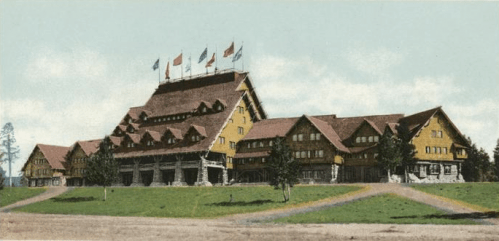
    — Image, Postcard of Old Faithful Inn, c, 1906. New York Public Library.

  • An Event: Ready To Present at the Jefferson County Museum.

    I love Montana’s many small museums because the do such a good job of preserving history and promoting community spirit. I’m looking forward to presenting “Sidesaddles and Geysers” Saturday, May 19, at the Jefferson County Museum in Clancy.  I’ve been there before and I plan to arrive early so I can see the wonderful exhibits.

    I’ll begin my presentation, which is supported by Humanities Montana, with stories my grandmother used to tell me about her trip to Yellowstone Park in 1909.  I built a “stone soup story” around that trip for my presentation at the Sheridan, MT, Public Library a couple of weeks ago.  You can read about that here.

    Then I’ll tell stories about the first women to visit Yellowstone Park. These brave ladies literally rode sidesaddle through the then roadless wilderness in the 1870’s. One of the most chilling stories is Emma Cowan’s tale of being captured by Indians in the Park.  Emma and her family went there in the summer of 1877, the year the Nez Perce fled the homeland in hopes of finding freedom in Canada.

    Emma wrote a gripping account of watching Indians shoot her husband, George, in the head, and, leaving him for dead, and then taking her and her sister and brother captive. After the Nez Perce release the trio, Emma made her way home where she awaited word of her husband’s fate. Word finally arrived that George was alive, but Emma didn’t know if the army would send him to Virginia City or Bozeman, so she waited near the telegraph office in Helena to find out. As soon Emma heard that George was being taken to Bozeman, she rented a wagon and set out to meet him.

    For my presentation in Clancy, I’ll read the account I wrote about Emma’s epic ride to be by George’s side for my upcoming book, Encounters in Yellowstone. Emma traveled 175 miles over rough roads in 31 hours, a trip that generally took four days.

    Then I’ll slow the pace with a different kind of adventure: Eleanor Corthell’s account of her 1903 trip to Yellowstone Park. By then roads were good and there was no danger from Indians, but Eleanor still had plenty to deal with while she watched her seven children frolic near geysers and drove bears from her camp.

    I’ll end the presentation with a bit of humor, Louise Elliott’s story of how a camp assistant for a tour company gets even with a supercilious guest who has been making her life miserable.

    ∞§∞

    — Photo from the Jefferson County Museum Web Site.

  • An Event: Ready To Tell “Smart Women” About The Nez Perce In Yellowstone

    The big event on my schedule this week is my presentation, “The Nez Perce in Yellowstone,” to Smart Women on Wednesday at 3 p.m. at Aspen Point, an assisted living facility in Bozeman. I’m still working on my slides and script, but it’s taking shape in my mind.

    Chief Joseph

    I’ll begin with an overview of the flight of the Nez Perce who generally lived peacefully with whites for most of the 1800’s. After gold was discovered on Nez Perce land in 1853, settlers began moving in and in 1877 the Indians were ordered onto a tiny reservation. Rather than comply with the order, they decided to flee to the buffalo country on the plains. Most accounts of the flight of the Nez Perce emphasize things that happened outside of Yellowstone Park like broken treaties and battles, but I’ll reverse that pattern and focus in the human drama of the Indians’ encounters with tourists.

    Then I’ll talk about what I call “The Joseph Myth,” the common belief that Chief Joseph was a great general whose genius allowed him to outmaneuver the U.S. Army for months. Joseph was the chief of one of the five bands that led the army on its merry chase, but he was never the principal chief. I’ll speculate on reasons the Joseph Myth was born and why it persistes: (1) Joseph was an important chief who had a conspicuous role in negotiations with whites before the Nez Perce decided to leave and he was the last remaining chief at the Battle of Beartooth so he negotiated the surrender. These things made him the apparent leader. (2) The Army Officers needed a genius opponent, otherwise they would look like fools for letting a band of Indians that included old men, women and children—and 1,600 hundred horses and cow—elude them for months, (3)After the conflict Indian sympathizers needed an Indian hero who sought peace to bolster their case, and (4) Joseph was indeed a noble man who devoted his life to obtaining justice for his people. All true, but he wasn’t a military genius.

    I’ll talk about the Radersburg Party’s trip to the park and read Emma Cowan’s description of her being taken captive by the Nez Perce, which ended with her watching an Indian shoot her husband in the head.

    To slow things down, I’ll talk about “Skedaddlers,” tourists who visited the park in the summer of 1877, but left before the Indians arrived. These include: the famous Civil War General William Tecumseh Sherman; Bozeman Businessman Nelson Story; English Nobleman and park popularizer, The Earl of Dunraven and his companions, Buffalo Bill’s sometime partner, Texas Jack Omohundro, and Dunraven’s friend, George Henry Kingsley, a physician who patched up the Nez Perce’ victims at Mammoth Hot Springs.

    I’ll talk about the Helena Party’s trip and contrast the all-male group that entered the park from the north with the co-ed Radersburg Party that entered from the west. Then I’ll read Andrew Weikert’s description of his gun battle with the Nez Perce.

    Then I’ll describe how survivors of encounters with the Nez Perce were either rescued by soldiers looking for the Indians or made their way to Mammoth Hot Springs. I’ll explain that after Emma Cowan, her sister, and several wounded men left Mammoth for civilization, three men stayed there to see if their missing companions would appear. Then I’ll read Ben Stone’s description of the Indian attack at Mammoth that left another man dead.

    I’ll end with my synthesis of accounts of Emma Cowan’s overnight ride from Helena to Bottler’s Ranch in the Paradise Valley to join her husband who had survived three gunshot wounds and was rescued by the army. That will give me an opportunity to talk about Encounters in Yellowstone, a book I’m writing now.

    ∞§∞

    — The presentation is free and open to the public.  Please tell your friends.

    — You can read about my 2011 presentation to Smart Women.

    — Public Domain Photo.

  • An Event: Northwest Montana Tour Was Great Fun

    The drive to northwest Montana last Tuesday was gorgeous. Fluffy white clouds sailed across a blue sky above snow capped mountains. Deep blue pine forests in the distance were covered with patches of snow that make them look like acid bleached denim. Rivers, full with spring rain and snow melt, ran aquamarine except where side streams poured in brown water.

    Eureka Historic Village store and church.

    After driving nearly 400 miles, I arrived in Troy in time to relax and have a sandwich before making my “Sidesaddles and Geysers” presentation to a small but lively audience for the public library. Then I drove 20 miles to Libby for the night.

    In the morning, I met Brian Sherry of WVRZ community radio and he took me to the community station’s makeshift studio where we chatted about early travel to Yellowstone Park and my work as an author. (I’ll see if I can post a link to the interview later.)

    Then I drove 70 miles through stunning mountain scenery to Eureka. In the afternoon, Scott Baney, a descendent of Tobacco Valley pioneers, guided me through the Eureka Historic Villiage—a collection of historic buildings including a store, chuch, school, and a hand-hewn cabin built by Scott’s ancestors. I had a great time reminiscing over the antique farm machinery with Scott.

    Eureka auther Darris Flanagan arrived and showed the inside of the buildings where the local historical society has created displays. My favorite was on logging, an activity that I don’t know well.

    In the evening, I presented “Sidesaddles and Geysers” to a lively audience at the Lincoln County High School Auditorium under the auspices of the Sunburst Foundation. Scott and Darris were in the audience.

    On Thursday, I decided to take the scenic route back to Bozeman. I traveled mostly on two-lane roads past Seeley and Swan Lakes.  I arrived home about 5 p.m. after driving nearly 900 miles in three days.  It was great fun.

    ∞§∞

  • An Event: Preparing a Stone Soup Story for Sheridan, Montana

    I’ve been assembling a stone soup story to present on April 29 in Sheridan, Montana. It will be my Humanities Montana talks entitled Sidesaddles and Geysers at the Sheridan Public Library beginning at 5:30 p.m.

    I’m building my presentation around stories my grandmother told me when I was a little boy about her trip to Yellowstone Park in 1909. I real don’t know much about that trip, so I’ve been checking my files for accounts of trips to the park at the dawn of the Twentieth Century and historic photos to illustrate those accounts. I’ll put together bits and pieces from those accounts to assemble a description of what Grandma’s trip must have been like. That’s what I mean by a “stone soup story.”

    Grandma went to the park with her Aunt Elvina Redfield, seven of Elivina’s eleven children, and two of her brothers whose last name was Mercer. The Redfield-Mercer party had a surrey for Elvina and the younger children, a wagon for supplies, and four saddle horses. They left the family ranch near the Point of Rocks west of Twin Bridges in early August and were gone for four weeks. That’s about all I know about the trip.

    I’ll model my reconstruction of the trip after Florence Strebb Fassler’s diary of her trip to Yellowstone Park in 1910, which probably was very like my grandmother’s a year earlier. Florence started in Melrose, a town west of Twin Bridges, on August 1. She provides good descriptions of the route she and her companions and the sights they saw.

    Florence’s first stop was Twin Bridges where she spent the first night and then toured the state orphans home the next morning. After that,  she headed down the Jefferson Valley traveling about twenty miles a day. She and her companions fished for food and stopped by farmhouses to buy bread, butter, milk and fresh vegetables.

    Florence was impressed by her stop in Bozeman where she saw streetcars and electric lights for the first time. She also took a tour of Nelson Story’s massive new flourmill—and got to meet Mr. Story himself.

    Two days later, Florence was at Yankee Jim Canyon where she met the famous toll road operator. Yankee Jim had stopped taking tolls by then, but he was still spinning tall tales for passing tourists and telling fortunes.

    The next day Florence entered the park and stopped at Mammoth Hot Springs for a couple of days. Then her group traveled to the lush meadows south of Mammoth to let their horses rest and graze for a couple of days.

    After describing travel to Yellowstone Park, I’ll turn to other traveler’s descriptions of adventures that they had about the time the Redfield-Mercer party went there:

    After reading the stories, I’ll tell about heading down the Madison River and exiting the park at West Yellowstone. Florence’s diary ends there. That should leave time for me to answer questions and sigh copies of my book, Adventures in Yellowstone.

    I think the presentation will give a good ideas of what it would have been like to tour Yellowstone Park a hundred years ago. I know I’ll enjoy being in Sheridan.

    ∞§∞