Category: Events

  • An Event: Getting Ready for My Northwest Montana Tour

    I’ve prepared a slide show and script for my presentations in northwest Montana next week. I’ll be at the Troy Public Library on Tuesday, April 24, at 6:30 p.m., and at the Lincoln County High School Auditorium in Eureka on Wednesday, April 25, at 7 p.m. I’ll be doing  my Humanities Montana program, “Sidesaddles and Geysers: Women’s Adventures in Early Yellowstone.”

    Troy and Eureka are 90 miles apart so I decided to prepare one slide show for both. Of course, my presentations are largely ad libbed so no two of them are the same.

    I always read a few stories from my collection of more than 300 first-person accounts of early trips to Yellowstone National Park. It’s always a challenge to choose a stories that work well together and illustrate the variety of adventures people had on the Yellowstone vacations, but that’s the fun of it. I truly enjoy reviewing the stories I’ve collected. It gives me a chance to examine new additions to my still growing collection and to see how they fit with the old friends.

    I’ll begin both nights by introducing myself and explaining how I became interested in early travel to Yellowstone Park. That gives me an excuse to recount the stories my grandmother told me when I was a little boy. Grandma went to the park in 1909 with her aunt, seven cousin and two brothers. Family lore says they took a milk cow to provide for the younger children. Grandma told stories about churning butter by tying a bucket of cream under the wagon axle, cooking fish still on the hook in a hot spring, and dying geysers pink by tossing red flannel underwear in them.

    Then, I’ll tell about the first women to visit the park in the 1870’s when it was a remote roadless wilderness. I’ll follow that with Emma Cowan’s chilling story of being taken captive by fleeing Nez Perce Indians in 1877. To lighten things up, I’ll read excerpts from Eleanor Corthell’s adventures taking her seven children to the park in 1903 and read the story of a women nearly falling in the Grand Canyon of the Yellowstone in 1911. I’ll end with the sad tale of a sedate group of tourists saying goodbye to new friends they made while traveling through the park in comfortable coaches and staying in world-class hotels.

    That should leave time for questions and comments from the audience, which I really enjoy. And, if the audience wants an encore story, I’ll have one ready.

    Of course, I’ll stay after the presentation to chat and sign copies of my book, Adventures in Yellowstone: Early Travelers Tell Their Tales.

    ∞§∞

    — To find the stories listed above, click “Women’s Stories” under the categories button to the left.  Explore this blog for all kinds of tales of early travel to Yellowstone Park.

  • An Event: Preparing a Stone Soup Story to Present in Ennis

    I’ve been getting ready to present my Humanities Montana program “Sidesaddles and Geysers” at the Madison Valley Library in Ennis. I’ll be at the library at 210 East Main beginning at 11 a.m. on Saturday, March 24

    William Ennis

    I always tailor my presentations to the local audience, so I’ve been looking for information about the trip the town’s founder, William Ennis, took to Yellowstone Park. Here’s everything I found: “In 1873, when Mr. Ennis and his family made a trip to the Yellowstone National Park, his were the first children who visited this ‘wonderland’.”

    With that paucity of information, I’ll have to do what I call a “stone soup story.” Like the folk tale about a man who was told all the cupboards were bare, I’ll get a piece from here and a bit from there, boil them all together to get a hearty soup.

    The assertion that the Ennis children were the first to visit Yellowstone Park is wrong. That provides me a segue to talk about Sidford Hamp’s amazement at seeing a baby at Mammoth Hot Springs in 1872 and Hyrum and Emma Stone’s taking their two sons through the park that same year. Then I can read Mabel Cross Osmond’s reminiscence about her tour of the park as a six-year-old in 1874.

    Since Ennis was talking his family, doubtless he would want to travel by team and wagon. The only road to the geysers in 1873 detoured around the Madison Canyon and went by Henry’s Lake, so I’ll describe that route and the sights there. One of the best descriptions of staying at Henry’s Lake is Emma Cowan’s so I’ll talk about her description of this place.

    Of course, I can’t talk about Emma Cowan without reading the story of her watching the Nez Perce shoot her husband in the head and then take her captive. After a few more comments and time for questions, I’ll have an hour presentation done.

    The audience will learn a lot about what William Ennis’s trip must have been like although I know almost nothing about it directly. Maybe my stone soup story will inspire an audience member to dig through family papers and find a description William Ennis’s trip. If someone does that, I hope they’ll share it with me.

    ∞§∞

    — Image and direct quotation from Progressive Men of the State of Montana. A.W, Bowen and Co.: Chicago.

    — For more information about my book signings and presentations, click on “Events” under the Categories Button to the left.

  • An Event: Getting Ready for Danforth Gallery in Livingston

    I’ve been getting ready to present my Humanities Montana program “Sidesaddles and Geysers” on Tuesday, March 6, at the Danforth Gallery in Livingston. I’ll be at the gallery at 106 North Main beginning at 6:30 p.m. under the sponsorship of the Park County Friends of the Arts.

    I always tailor my presentation to the local audience. That lets people see me more than once without a lot of repetition. It also motivates me to re-examine my collection of more than 300 first-person accounts of early travel to Yellowstone Park. I always find something new.

    I’ll open with Hester Henshall’s description of taking the train from Bozeman to Livingston in 1903. Hester does a nice job of describing the railroad depot and town. I’ll provide a bit of history of Livingston, which  was a point where early Yellowstone travelers switched from the Northern Pacific main line to the Park Branch.

    Then I’ll note that the first Yellowstone tourists went to the park by Trail Creek Pass and didn’t go to Livingston at all. That’ll let me segue into stories about Emma Stone, who in 1872, became the first woman to take a complete tour of Yellowstone Park, and Sarah Tracy, who wrote a charming diary of her trip there in 1874.

    From there, I’ll read a few other stories. Probably one will be a well-tested tale like Emma Cowan’s chilling story of watching Indians shoot her husband in 1877. And, I’ll include as story I’ve never read to an audience before, perhaps Mary Townsend’s description of fishing the Firehole River in 1897.

    I’ll be ready with a couple more stories if time allows: maybe Henry Merry’s hilarious story of trying to race his Winton car past park rangers in 1902 when automobiles were forbidden there, or Louise Elliott’s tale of a camp tender taking revenge on a supercilious guest by letting the air out of her mattress.

    I’ll finish by returning to Hester Henshall’s story. Hester and her husband befriended an elderly lady during the trip, and when they got back to Livingston, all the hotels in town were full. Hester’s husband found the lady some locals to stay with. That anecdote will bookend the presentation with Henshall stories and leave the audience with a warm feeling.

    Of course, I’ll hang around afterward to sign copies of my book, Adventures in Yellowstone: Early Travelers Tell Their Tales.

    ∞§∞

    — You might be interested in Hester Henshall’s story, “Cruising Laking Yellowstone.”

  • An Event: Meet Me Next Summer at Old Faithful Inn

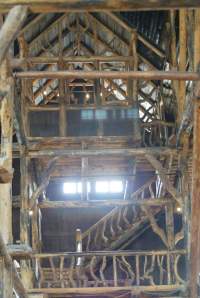
    Old Faithful Inn Crows Nest

    I’ll be returning to Yellowstone Park this summer to greet tourists and sign copies of my book, Adventures in Yellowstone: Early Travelers Tell Their Tales, in the lobby of the world famous Old Faithful Inn. Why don’t you join me there on the weekends August 11-12 and August 25-26? [The dates of July 21-22 posted here earlier have been changed.]

    You can read about my book signing at the Inn in July last year here, and in August here.  For a complete list of my activities, click on “My Events” above.  Check back often because things are poppin’.

    ∞§∞

    — Image from The Coppermine  Photo Gallery.

  • An Event: Getting Ready to Launch 2012 at Old Faithful Snow Lodge

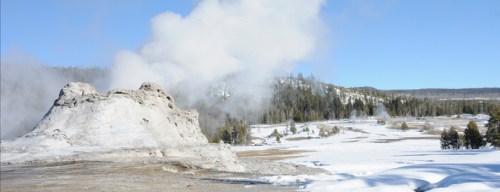
    Castle Geyser in Winter

    I spent the day preparing for my presentations on January 1 and 2 at the Old Faithful Inn Snow Lodge. I’ll be at the visitor center gift shop on both days from 7 to 9 p.m. to do readings and sign copies of my book, Adventures in Yellowstone: Early Travelers Tell Their Tales.

    I could have just marked a few selections in Adventures and been done with it, but I prefer to do a unique presentation every time I speak. That motivates me to re-examine my collection of stories about early travel to Yellowstone Park and lets people see my presentations more than once without a lot of repetition. That’s really important this time because I’m on for two nights in a row.

    I’ll begin both nights by introducing myself and explaining how I became interested in early travel to Yellowstone Park. That gives me an excuse to recount the stories my grandmother told me when I was a little boy. Grandma went to the park in 1909 with her aunt, seven cousins and two brothers. Family lore says they took a milk cow with them to provide for the younger children.

    Then I’ll tell stories that explore snow and cold weather in the Park. On Jan. 1, Sunday, I’ll read a story about pioneer photographer F. J. Haynes who was a member of the first winter expedition to the park in 1887. Haynes marveled at the fantastic forms created when ice formed on trees near hot springs and geyser and managed to take pictures in temperatures that reached 50 degrees below zero. On Jan. 2, Monday, I’ll tell how soldiers, who guarded Yellowstone at the dawn of the Twentieth Century, tracked down a notorious buffalo poacher in February.

    Of course, I’ll read from Adventures in Yellowstone. On Sunday, I’ll read an excerpt from Truman Everts’ story of being treed by a mountain lion. The incident occurred when Everts became separated from the famous Washburn Expedition of 1870. Everts’ tale of being lost and alone in the Yellowstone wilderness for 37 days is one of the park’s most famous.

    Another very famous Yellowstone story is Emma Cowan’s account of being captured by the Nez Perce in 1877. On Monday, I’ll read her chilling description of watching Indians shoot her husband in the head.

    Emma’s adventures will also appear in my Sunday presentation when I read a section from the book I’m working on now, Encounters in Yellowstone, which will tell what happened when several groups of tourists ran afoul of the Nez Perce. I’ll read a section from the new book that describes Emma driving her team and wagon 125 miles in 15 hours to be by her wounded husband’s side.

    On Monday, I’ll read a selection from Macon’s Perfect Shot, a mid-grades novel that I’m sending to a publisher next week. Perfect Shot tells about a 14-year-old boy who learns to shoot while visiting the Park in the 1870s. I’ll read an excerpt where he makes an impossible shot—and regrets it.

    If time allows, I’ll read a couple of my favorite stories. On Sunday, I’ll have Henry Merry’s tale of driving the first automobile into the park in 1904.  Merry tried to race his Winton past the guards, but they lassoed the car and dragged it to the superintendent’s office.  On Monday, I’ll be ready to read “Maud’s Revenge,” the story of how a camp cook gets even with a supercilious travel guest.

    I’ll like to end my presentation with a farewell story. On Sunday, I’ll read story from Osborne Russell’s famous Journal of a Trapper about a group of Mountain Men telling tall tales around a campfire in the 1830s. On Monday, I’ll end up with Stephan Dale’s 1904 story about people finishing a six-day tour by saying goodbye to new friendships and budding romances.

    ∞§∞

    — Photo courtesy of Xantera.

  • An Event: Getting Reacquainted With Jamie Ford

    I was delighted to renew my acquaintance with Jamie Ford last night at Friends of the MSU Libraries annual dinner. I first met Jamie a couple of years ago when his book, The Hotel at the Corner of Bitter and Sweet, was starting its ascension onto the New York Times best seller list where it has roosted ever since.

    I had just read Hotel and recommended it for the Montana Book Award. (Part of the fun of being a reader for MBA is getting to read brand new books.) When I heard that Jamie would be at Bozeman’s premier independent bookstore, The Country Bookshelf, I decided I had to meet him.

    I arrived at the bookstore early and found Jamie chatting with the owner. I introduced myself and told him how much I admire Hotel. Then I coyly told him I too am a writer. He politely asked about that and I found a copy of Adventures in Yellowstone on the store shelves. He politely admired my book and we chatted amiably about writing and life in Montana.

    A few months later, I met Jamie again at the presentation ceremonies for the Montana Book Award at the Bozeman Public Library. That when my wife, who is Dean of MSU Libraries, recruited him to speak at the Friends dinner.

    I was pleased last night when Jamie greeted me with a smile and recalled that we had met before. After all, his book has enjoyed a bit more success than mine has. Hotel has been translated into a couple dozen languages and is on sale in thirty countries. (I wonder what dialogue between Henry Lee, a 12-year-old Chinese boy, and Keiko Okabe, a 12-year-old Japanese girl, sounds like in Norwegian?)

    Adventures is available only in English, but you can buy it on the web anywhere in the world. (I wonder what Emma Cowan’s story of being captured by the Nez Perce in 1877 would sound like in Norwegian.)

    In his speech last night, Jamie talked about the importance of libraries in his life. He described himself as “a library rat” and said, “I write in the library.”

    He recalled attending a pre-marital counseling session where couples were asked how they met. He said several other people reported stories like: “I woke up one morning with a woman in my bed wearing my t-shirt. I thought I should introduce myself.”

    “I met my wife in the library,” Jamie said. “And a year later I proposed to her—in the library.”

    Throughout the evening, Jamie was friendly and gracious. He found ways to personalize the dedications he put on the books he signed. He answered audience questions candidly and completely. He offered advice to aspiring writers with a smile.

    As I once told my friend Craig Lancaster, the Billings-based author of the novels 600 Hours and Edward and The Summer Son, there’s only one thing I dislike about Jamie Ford. He’s so damn nice I can’t think of reason to dislike him and that makes me feel guilty about envying his success.

    ∞§∞

    You also might enjoy:

  • An Event: Signing Books and Making Plans at Old Faithful Inn

    Grand Geyser was erupting as I rode up to Old Faithful Inn on Saturday morning. I took the towering white plume of water and steam silhouetted against the clear pale blue sky as an auspicious sign. This will be a good day to sell books, I thought.

    When I went into the lobby, I found an easel with information about my book (Adventures in Yellowstone), my biography and a photo of me. That apparently accounted for the bulge of hits on those things on my blog last week.

    I checked in at the gift shop where employees greeted me like an old friend and helped me set up. (It was the third time I’ve done book signings at the Inn.) Soon, I was seated behind a table smiling as passers-by and enticing them to buy my book.

    I adjusted to the rhythm of the place, which is governed by Old Faithful’s 90-minute cycle. The lobby is nearly empty when the geysers plays. Then it fills with a rush of people searching for the restrooms, awing over the magnificent lobby and milling around. When things thin out a bit is the best time to sell books.

    I noticed that during slack times—even while Old Faithful was playing—there were a few people who were eager to talk about the stories in my book. I began asking questions and discovered that many of them were tour bus drivers looking for stories to tell their clients during the rides between sights.

    I told them that my book has stories about many of the famous people and events in Yellowstone history. Emma Cowan’s story of being captured by Indians would be one to tell when driving by Nez Perce Creek. Truman Everts’ 37-day ordeal of being lost lost alone in the Yellowstone wilderness would a good one near Yellowstone Lake. And crossing Dunraven Pass, why, the Earl of Dunraven’s hilarious description of how to pack a mule or one of his exciting hunting stories.

    “if there aren’t enough stories in my book,” I said, “you should check out my blog. There are another hundred more of them there.”  When I gave examples, I mentioned William Henry Wright’s efforts to photograph grizzlies at night with flash powder.  “That’s great,” she said, “sometimes I have a whole busload of photographers.”

    When I asked about her current load, she sighed. “Children,” she said, “lots of children.”

    “They’d love Ernest Thompson Seton’s ‘Johnny Bear,’” I replied, and she headed back to her bus to read it.

    In the afternoon, I talked to a guide who works for Xantera, the park concessionaire. She suggested that I talk to her boss about the possibility of setting up a program to help Yellowstone guides find stories to tell their clients and she gave me his phone number.

    On Sunday, I called the number and chatted with the boss. He stopped by my table later and we talked some more. We didn’t make any commitments, but it looks like there’s a real possibility that I could present a program on Yellowstone stories for tour guides at Old Faithful Inn next year. I think that would be great fun—and people telling the stories I collected surely would stimulate sales of my book.

    ∞§∞

    — Read about my last book signing at Old Faithful Inn here.

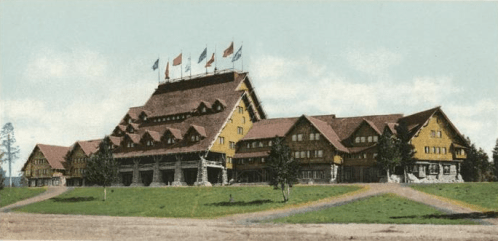
    — Image, Postcard of Old Faithful Inn, c, 1906. New York Public Library.

  • An Event: I Had Fun Signing Books at Old Faithful Inn

    “He seems to really enjoy being here.” I overheard that comment about myself last weekend from a hotel employee as I signed copies of my book, Adventures In Yellowstone, in the lobby of Old Faithful Inn. That never occurred to me before, but it’s true. I do enjoy meeting people and talking about early travel to Yellowstone Park. When I’m lucky, I also get to add a flamboyant signature to a newly purchased book.
    I sit at a table near the clock that indicates the next time the geyser will play so people see me when they come in to get that information. Most people just look at the predicted time and check their watches to see how long they’ll have to wait. If they have time, some people will stop to chat.

    “Are you the author?” is the most common question.

    At first I explained that the book is a collection of the writings by other people so actually I’m the editor or compiler. But that was too much information, so soon I began to just say, “Yes I am,” and smile. Sometimes I add, “I can prove it,” and hold up the book showing the page with a photo of me. People chuckle at that and agree it’s me.

    “It’s a collection of a dozen stories of early travel to Yellowstone Park in the words of the people who lived the adventures,” I add to guide attention back to the book.

    If people keep listening, I say, “It starts with fur trapper’s story about battling Blackfeet Indians in 1839 and ends in 1904 with a man telling about touring the park in a coach and staying in world-class hotels—like Old Faithful Inn.”

    When they ask about my favorite story, I tell them about Eleanor Corthell taking her seven children to the park from Laramie, Wyoming in 1902. That was a twelve-hundred-mile round trip, I add. The conversation might amble anywhere after that.

    The crowd pulses every 90 minutes in counterpoint to the eruptions of Old Faithful. Right after the geyser plays, the lobby fills with people marveling at the 500-ton stone fireplace and the eight-story tall log room. It’s hard to talk to people when the room is full, but the crowd soon disperses to the souvenir shop, restrooms, and parking lot, so there’s space around the table to talk. That’s prime book selling time.

    The crowd thins and soon the lobby is nearly empty. Then new people start arriving to check the time of the next eruption. While they wait, sometimes I can strike up a conversation. If a book sale results, that’s fine. But if it just gives me a chance to chat with people from all over the world, that’s fine too.

    I really do enjoy it. I’ll be back on August 20 and 21.

    ∞§∞

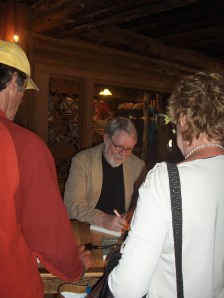
    — Photo by my author support system, Tamara Miller.

    — You might enjoy reading a description of Old Faithful Inn.

  • An Event: Off to a Book Signing at Old Faithful Inn

    I’ll be signing copies of my book, Adventures in Yellowstone: Early Travelers Tell Their Tales, in the lobby of the world famous Old Faithful Inn this Friday and Saturday reprising an event I had last summer. You shouldn’t visit Old Faithful without going inside the Inn, so if you’re there this weekend look for me.  I’d love to sign a book for you.  If you can’t make it, remember I’ll be back on August 20 and 21

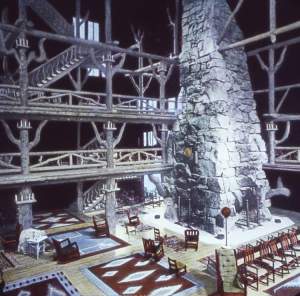
    It’s always a thrill to be in the setting that Wikipedia describes like this:  “With its spectacular log and limb lobby and massive (500-ton, 85-foot) stone fireplace, the inn is a prime example of the ‘Golden Age’ of rustic resort architecture.”

    The inn, which was built using local lumber and stone, is said to be the largest log structure in the world.  When Old Faithful Inn opened in 1904, it was a state-of-the-art facility with electric lights and steam heat.

    An earthquake in 1959 stalled the clock and damaged the fireplace so only two of its hearths work.  There has been some renovation are rearrangement of furniture, but the inn looks pretty much as it did in 1913 when Forest and Stream magazine published the description below.

    ∞§∞

     In this basin, besides … the numerous hot springs and wonderful geysers, is the Old Faithful Inn, one of the most costly and attractive log houses to be seen anywhere. The logs for the most part are rough as they appear in their natural state. Massive logs tapering on each ascending balcony appear as giant trees. The staircase leading to the lookout has split logs for steps. Windows of diamond-shaped glass and dainty French curtains are exquisitely beautiful against the setting of rough logs.” In the center the building rises eight stories high, and from this lofty eminence you have a most charming panoramic view of the Upper Geyser Basin. It was built at a cost of two hundred thousand dollars. The chimney of this immense structure has four large and four small fireplaces, and fastened to the chimney is a great iron clock that keeps Mountain Time.

    ∞§∞

     — Excerpt from “A Trip to Yellowstone Park” by G.S. Wyatt.  Forest and Stream, December 27, 1913.

    — Image, J.P. Clum lantern, Coppermine Photo Gallery.

    — You can read Thomas D. Murphy’s 1912 description of Old Faithful Inn here, and about my book signing last summer here.