Category: Falls

  • A Tale: To the Base of the Lower Fall of the Yellowstone

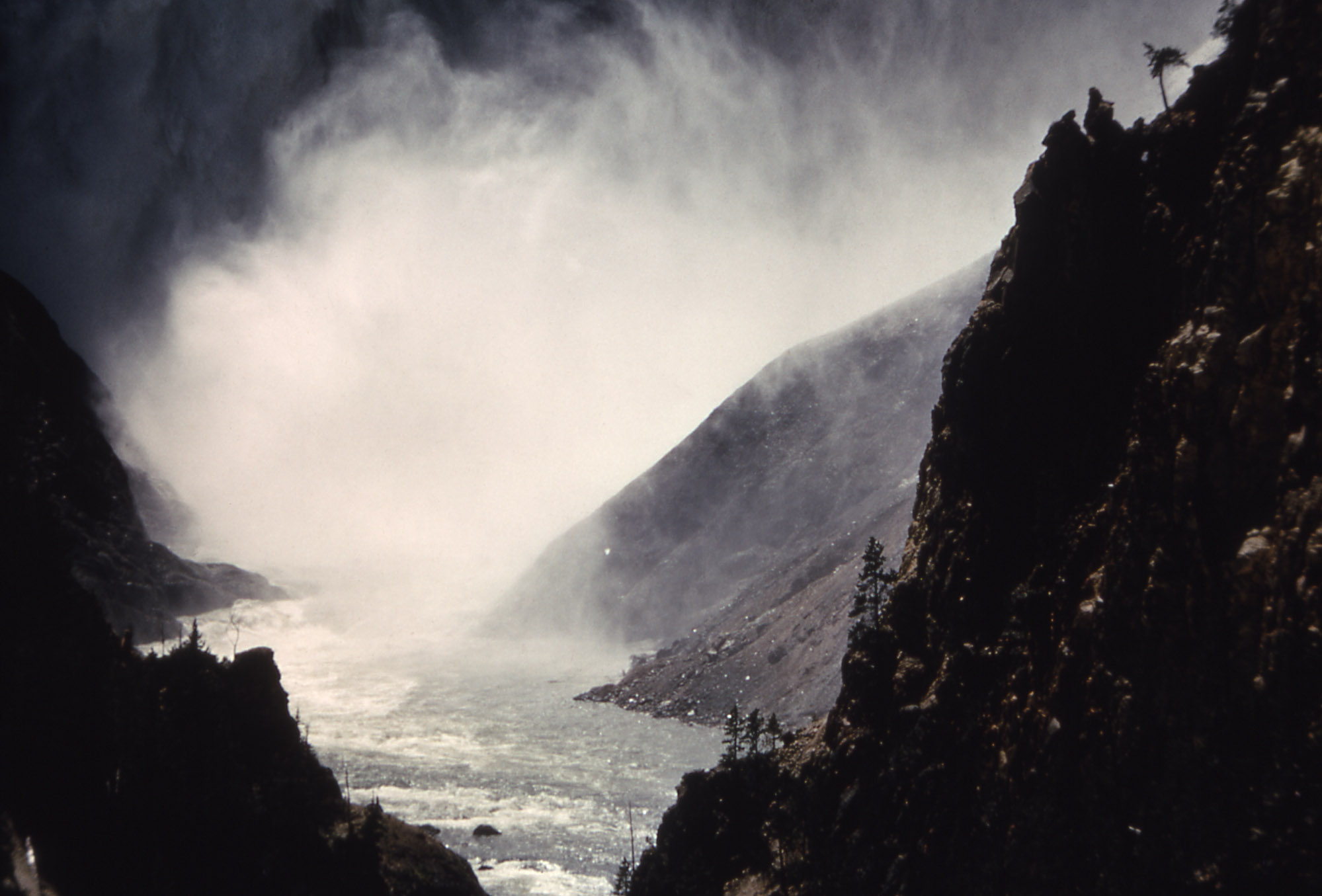
    Spray at the base of the Lower Fall

    In 1909 travel writer F. Dumont Smith published  this account of his hike to the base of the Lower Yellowstone Fall. Smith went down the canyon with two friends, Dudgeon and a man he called “the Banker.” Apparently, there were no stairs there at the time.

    ∞§∞

    We found the little path that descends to the bottom of the gorge, tied our horses, and started down. At the brink there was a sign that remarked, in the most casual way, “Danger.” Dudgeon and I had a discussion as to whether it meant bears or female tourists, Dudgeon holding to the latter view. In the meanwhile, the Banker had plunged down and we followed.

    If I had been in the lead, I should have abandoned the expedition right there; but Dudgeon and the Banker had gone and I was ashamed not to follow. At the bottom of the cleft there was a sheer descent.

    At the bottom, we found a long ridge, fifty feet above the water that envisaged the fall. For myself, I was content to rest there while Dudgeon and the Banker pursued a path of slippery granite to the bottom of the gorge, where the water ran blue and white, full of foam from its mad descent above. While it frothed and fumed and made much of itself, it was not alarming for the Yellowstone seems but a shallow brook there, between those vast walls, dwarfed by the fall and the great canyon.

    From the very bottom springs one great wonderful rainbow, a perfect arch, as steadfast as though it were of steel, one foot resting on the whirlpool and the other on the rock at the right. And two hundred feet above, where one little spurt of spray strikes a jut of stone, is a baby rainbow that comes and goes.

    Above me loomed that awful chasm that must be climbed. It hung over me—settled on my spirits. I tried to smile; to admire the falls; I tried to enjoy that wonderful gorge, with its coloring, its beauty, its charm. I watched an eagle leave his eyrie on the very edge of the canyon and soar above me, wings atilt, without movement, and I led my companions into a discussion of flying machines and the problem of aviation. I drew their attention to a place on the rocks opposite, where the continuous spray had mottled its somber brown with a living green of moss.

    I did everything that would hold their attention and postpone the hour when I must start back. At last, every subject exhausted, the Banker suddenly started upward. From our little cliff that overhung the maelstrom, the path led up a bare rock. When I looked at it in cold blood, I wondered how I ever descended it without wings. I knew in my heart that I could never get back, but the Banker started.

    It was a sheer cliff, with here and there a crack, a toe-hold, or finger-hold as far apart as one could reach. I saw him toilsomely reach from one to the other, spread-eagled against the rock face. At one place, a rock, that he grasped with his right hand, as he threw his weight on it, gave way, glanced over his arm, and just missed his head. He swung far outward and I shuddered. I thought he was gone, and his body a mangled mass on the rocks a hundred feet below. By a miracle, his left hand held, and he still pursued his way, inch by inch.

    I said to Dudgeon, “I never can make that, but you must stay below and catch me if I slip.” And Dudgeon smiled.

    Like most men, I am a coward when there is no one around. Here were no admiring crowds to see me risk my life. No one but Dudgeon. How I scaled that awful cliff, I shall never know. I think I was years doing it. I hung there, sometimes by two fingers of each hand, my toes inserted into some tiny crack, panting for breath, benumbed, speechless, sweating at every pore. Sometimes it seemed hours before I could move.

    I was safe enough as long as I stood still. My body in my anguish put out spores and tentacles that grasped the rock. I was for a time a limpet, one of those intermediate forms of life that cling and cling and never move.

    It was when I tried to progress that the strain became too great. The Banker had vanished. Dudgeon was somewhere far above me whistling “My Bonnie,” and there I clung, a mere gastropod. I doubt if, in those awful moments, I had any more intelligence than a vegetable. All I felt was fear—fear of those spear-like rocks down there below me.

    What a curious thing pride is! If I had been alone with Dudgeon I should have called for rope and tackle and a hoisting engine. But the Banker had passed before me, and so, however Dudgeon smiled, I could not quit.

    I knew that, at the very top, awaited me that terrible rocky slide, almost perpendicular and slimed with past ages of moisture. When I thought of that I was ready to die, but when I had attained it, there, hanging from the top of the path, was a rope.

    Somehow I grasped that rope. Somehow I scrambled up that rocky slide by its aid and sank half fainting at the top. There was not air enough in the universe to satisfy me. The wide scope of the heavens, of the starry skies, did not contain enough atmosphere to fill my starved and laboring lungs.

    Slowly and painfully the Banker and I climbed the rest of the hill. Slowly and painfully we got into our surrey. Meanwhile Dudgeon had danced and jigged his way up those slopes, whistling “My Bonnie,” and, when we finally seated ourselves in the surrey, he was as unbreathed as though he had just finished a two-step.

    If you go down the corridor of the Canyon Hotel, and turn to the right, at the second door you can find something in a glass with ice in it; and there once more Dudgeon smiled.

    ∞§∞

    —   Abridged from F. Dumont Smith, The Summit of the World: A Trip Through Yellowstone Park, 1909.

    —   Photo, Yellowstone Digital Slide File.

    You might enjoy Louis Downing’s story about going to the base of the Fall down Uncle Tom’s Trail.

  • A Tale: Two Pictures and 1300 Words — Walter Trumbull, 1870

    The Washburn Expedition of 1870 convinced the public that there really were wonders on the upper Yellowstone. Stories of towering waterfalls, mountains of glass, a crystal-clear inland sea, and fountains of boiling water could no longer dismissed as “tall tales.” Prominent government officials and businessmen whose word couldn’t be doubted said they were there.

    Just as important the as credibility of members of the Washburn Expedition was their writing skill. Several expedition members  wrote articles about the trip for the Helena Herald that were reprinted around the world.

    N.P. Langford and Truman Everts published articles in Scribner’s Monthly that also brought national attention. The illustrations that accompanied those articles where artists’ fanciful imaginings based on verbal descriptions. The images with Langford’s article were by Thomas Moran, whose later paintings of Yellowstone gave him world fame. Moran and photographer William Henry Jackson, whose work influenced the decision to make the area a national park, went to the upper Yellowstone with the Hayden expedition in 1871.

    Two members of the Washburn Expedition left pencil sketches of what they saw, Charles Moore, a private in the military escort, and Walter Trumbull, the son of U.S. Senator Lyman Trumbull of Illinois. Trumbull also published an account of his Yellowstone experience in the Overland Monthly. His written description and sketches of the Yellowstone Falls provide an interesting opportunity to test the adage, “A picture in worth a thousand words.”

    ∞§∞

    We reached the falls of the Yellowstone on the morning of August 30th. These falls, two in number, are less than half a mile apart. From the lake to the upper falls, a distance of about twenty miles, the river flows, with the exception of a short series of rapids having a moderate current, through an open, undulating country, gently sloping toward the stream..

    Here and there are small groves, and the timber is quite thick a mile away from the river. A quarter of a mile above the upper falls the river breaks into rapids, and foams in eddies about huge, granite boulders, some of which have trees and shrubs growing upon them.
    Above the rapids, the river is about 150 yards wide, but, as it approaches the falls, high, rocky bluffs crowd in on both sides, forcing the water into a narrow gorge, which, at the brink of the falls, is about thirty yards wide.

    The most convenient and desirable place from which to view the falls is from a ledge, easily reached, which juts into the river a considerable distance, just below the falls, and a few feet lower than their brink. It is so close that occasional drops dampen one’s face.  The height of the upper falls is 115 feet. The ledge is irregular, the water being much deeper on the west side than on the east. Great rocks project in the face of the fall, tearing and churning the waters into foam, with here and there a little strip of green, which contrasts beautifully with the surrounding silvery whiteness of the water.

    Between the two falls, the river flows quietly in a wide channel, between steep, timbered bluffs, four hundred feet high. Just above the lower falls the bluffs again converge; the one from the west stretching out as if to dam up the river, which has, however, forced its way through a break, forty yards wide. The rocky cliffs rise perpendicularly from the brink of the falls, to a height of several hundred feet. The rocky formation is of a shelly character, and slightly colored with flowers of sulphur. The plunge of the water is in the direct course of the stream, and at the brink of the falls, it appears to be of uniform depth. It clears its bed at a bound, and takes a fearful leap of 350 feet.

    The volume of water is about half as great as that which passes over the American Fall, at Niagara, and it falls more than twice the distance. The adjacent scenery is infinitely grander. Having passed over the precipice, the clear, unbroken, greenish mass is in an instant transformed by the jagged edges of the precipice into many streams, apparently separated, yet still united, and having the appearance of molten silver.

    These streams, or jets, are shaped like a comet, with nucleus and trailing coma, following in quick succession; or they look like foaming, crested tongues, constantly overlapping each other. The outer jets decrease in size as they descend, curl outward, and break into mist. In the sunlight, a rainbow constantly spans the chasm. The foot of the falls is enveloped in mist, which conceals the river for more than a hundred yards below.

    These falls are exactly the same in height as the Vernal Falls in the Yosemite Valley, but the volume of water is at least five times as great. I think I never saw a waterfall more beautiful than the Vernal, and its surroundings are sublime. Its Indian name is said to mean “Crown of Diamonds;” and it certainly deserves the name. I remember sitting on the rocky ledge just at the edge of the falls, and with an opera-glass watching the water as they plunged downward, breaking into myriads of drops; each drop, like a lens, gathering prismatic tints from the shining sun, and flashing like diamonds of the purest brilliancy.

    The lower fall of the Yellowstone reminds me of the Vernal Fall, on the Merced.  Though nothing, perhaps, can equal the sublime scenery of the Yosemite, yet that only excels the lower falls of the Yellowstone, and the grand canyon which extends for many miles below them.

    Below the falls, the hills gradually increase in height, while the river descends in a succession of rapids through the canyon. At the falls, the canyon is not more than twelve hundred feet deep, but a few miles lower down it is nearly eighteen hundred feet deep. Its average thick a mile away from the river. A quarter of a mile above the upper falls the river breaks into rapids, and foams in eddies about huge, granite boulders, some of which have trees and shrubs growing upon them.

    Above the rapids, the river is about 150 yards wide, but, as it approaches the falls, high, rocky bluffs crowd in on both sides, forcing the water into a narrow gorge, which, at the brink of the falls, is about thirty yards wide.

    The most convenient and desirable place from which to view the falls is from a ledge, easily reached, which juts into the river a considerable distance, just below the falls, and a few feet lower than their brink. It is so close that occasional drops dampen one’s face. The height of the upper falls is 115 feet. The ledge is irregular, the water being much deeper on the west side than on the east. Great rocks project in the face of the fall, tearing and churning the waters into foam, with here and there a little strip of green, which contrasts beautifully with the surrounding silvery whiteness of the water.

    Between the two falls, the river flows quietly, in a wide channel, between steep, timbered bluffs, four hundred feet high. Just above the lower falls the bluffs again converge; the one from the west stretching out as if to dam up the river, which has, however, forced its way through a break, forty yards wide. The rocky cliffs rise perpendicularly from the brink of the falls, to a height of several hundred feet. The rocky formation is of a shelly character, and slightly colored with flowers of sulphur.

    The plunge of the water is in the direct course of the stream, and at the brink of the falls, it appears to be of uniform depth. It clears its bed at a bound, and takes a fearful leap of 350 feet. The volume of water is about half as great as that which passes over the American Fall, at Niagara, and it falls more than twice the distance.

    The adjacent scenery is infinitely grander. Having passed over the precipice, the clear, unbroken, greenish mass is in an instant transformed by the jagged edges of the precipice into many streams, apparently separated, yet still united, and having the appearance of molten silver. These streams, or jets, are shaped like a comet, with nucleus and trailing coma, following in quick succession; or they look like foaming, crested tongues, constantly overlapping each other. The outer jets decrease in size as they descend, curl outward, and break into mist. In the sunlight, a rainbow constantly spans the chasm. The foot of the falls is enveloped in mist, which conceals the river for more than a hundred yards below.

    These falls are exactly the same in height as the Vernal Falls in the Yosemite Valley, but the volume of water is at least five times as great. I think I never saw a waterfall more beautiful than the Vernal, and its surroundings are sublime. Its Indian name is said to mean “Crown of Diamonds;” and it certainly deserves the name.

    I remember sitting on the rocky ledge just at the edge of the falls, and with an opera-glass watching the waters as they plunged downward, breaking into myriads of drops; each drop, like a lens, gathering prismatic tints from the shining sun, and flashing like diamonds of the purest brilliancy. The lower fall of the Yellowstone reminds me of the Vernal Fall, on the Merced. Though nothing, perhaps, can equal the sublime scenery of the Yosemite, yet that only excels the lower falls of the Yellowstone, and the grand canyon which extends for many miles below them.

    ∞§∞

    — Excerpt from “The Washburn Expedition”  by Walter Trumbull, Overland Monthly, May-June 1871.

    — Images from the Coppermine Photo Gallery.

    — For more stories about the Washburn Expedition, click on “Washburn” under the “Categories” button to the left.

  • A Tale: A Near Tragedy on Uncle Tom’s Trail

    When Louis Downing visited Yellowstone National Park in 1911, good roads, comfortable hotels and camps, and tour guides left little room for adventure. But, as Downing found out, travelers could still get a thrill by taking “Uncle Tom’s Trail” to the base of the Lower Yellowstone Fall.

    Downing, a druggist from Hamilton, Montana, toured the park “The Wylie Way,” with a group of people he called “the family,” because they had become such fine friends on the trip. Here’s his description of what happened to members of the family when they decided to descend “Uncle Tom’s Trail.”

    ∞§∞

    After sending a few cards, Grace D., Mr. Jewell, Jane D., Sis, Lee and Doc followed a pretty trail through the forest to Uncle Tom’s Trail. A big sign marked “Dangerous” hung at the top.

    At the bottom of the trail, we could see a guide helping two women down—almost lifting them from rock to rock. Jane D. promptly decided that long skirts and high heels were not safe on that trail and refused to start. The boys agreed with her, but Grace, who wore flat heels, had started.

    Sis wanted to go but agreed to remain at the top with Jane D. Doc went down like a squirrel. Mr. Jewell and Lee remained near Grace. Almost half way down Brother Lee’s Kodak fell to the bottom and broke into a dozen pieces. When they reached the river, they sat on a large rock and drank some of the water. They were directly under the falls, and the view in either direction was magnificent.

    A light rain caused them to fear that the slippery rocks would make ascent dangerous so they started up the trail though they could have spent hours in the canyon. They reached the top in twenty-two minutes.

    Following the roadway, they came to a flight of stairs leading to a platform built close to the fall. The green water and white foam plunging over the rocks was simply magnificent.

    Grace D. says the climb up those steps was the hardest she had ever taken; yet, the view was worth the effort. Doc took a picture of the Falls from this point.

    In the meantime, the girls sat at the top of the trail—the mosquitoes swarming about them. They had almost made up their minds to start down when Sis slipped and fell a little to the left of the trail. She slid several feet before she could get hold of a rock that would hold her. Even then she realized that it would soon loosen, so while Jane D. frantically shouted for help Sis managed to pull herself up to the roots of a tree while the mosquitoes settled on her arms making it almost impossible to hold on.

    Jane D. tried to signal they boys, but they were too far away to realize what she meant and merely waved their hands. She knew that Sis could not hold on much longer, so she ran toward the road and finally attracted the attention of several tourists. Mr. L.F. Huesselmann of Osage, Iowa, reached the scene first, but Sis, knowing that he could not pull her up alone, held on until Mr. W.F. Schroeder of Oakland, California, reached the trail. They succeeded in getting her up and several feet from the trail before she weakened and sat down. Jane D. was pale and nervous and Mrs. Schroeder was badly frightened. She said her knees had just given way when she saw Sis hanging above the trail.

    Sis herself was over the fright in a few minutes, and laughed hysterically, but poor Jane D. couldn’t see anything to laugh at and said so.

    ∞§∞

    —   Louis E. Downing Diary. K. Ross Toole Archives, University of Montana Library, Missoula.

    — Colorized Photo, Yellowstone Digital Slide File.

    — You might also enjoy F. Dumont Smith’s story of a trip to the base of the Lower Fall of the Yellowstone.

  • A Tale: Naming Tower Fall— Langford, 1870

    In 1870 the famous Washburn Expedition explored the remote area that became Yellowstone National Park. While the explorers always had be be alert for the dangers of Indians, wild animals, and strange geothermal features, they also found ways to have fun. Here’s Nathaniel P. Langford’s description of  one of the pranks they played on each other.

    ∞§∞

    At the outset of our journey we had agreed that we would not give to any object of interest that we might discover the name of any of our party nor of our friends. This rule was to be religiously observed.

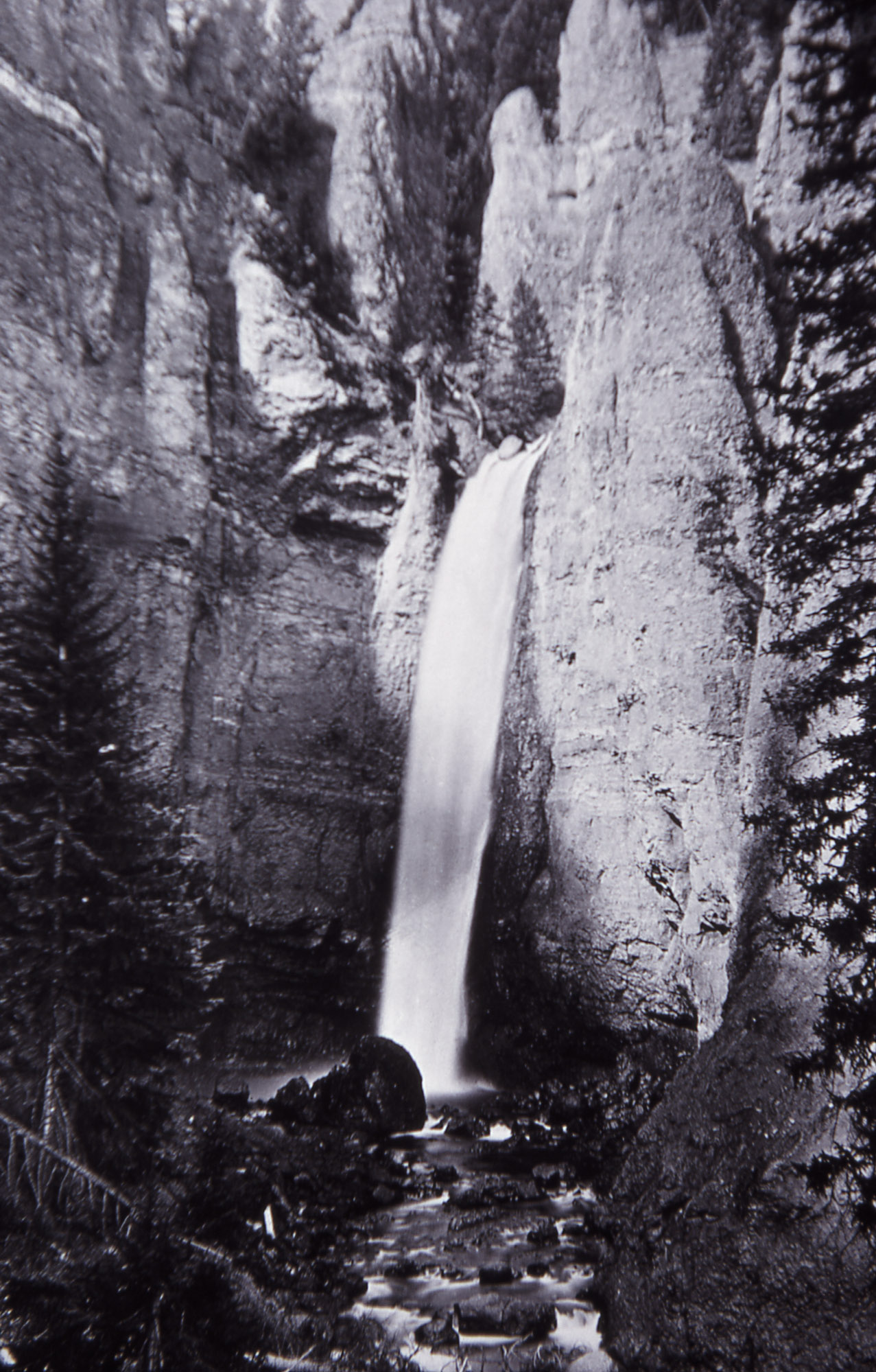
    While in camp on Sunday, August 28th, on the bank of this creek, it was suggested that we select a name for the creek and fail. Walter Trumbull suggested “Minaret Creek” and “Minaret Fall.” Mr. Hauser suggested “Tower Creek” and “Tower Fall.” After some discussion a vote was taken, and by a small majority, the name “Minaret” was decided upon.

    During the following evening Mr. Hauser stated with great seriousness that we had violated the agreement made relative to naming objects for our friends. He said that the well known Southern family—the Rhetts—lived in St. Louis, and that they had a most charming and accomplished daughter named “Minnie.” He said that this daughter was a sweetheart of Trumbull, who had proposed the name her name, “Minnie Rhett” — and that we had unwittingly given to the fall and creek the name of this sweetheart of Mr. Trumbull.

    Mr. Trumbull indignantly denied the truth of Hauser’s statement, and Hauser as determinedly insisted that it was the truth. The vote was therefore reconsidered, and by a substantial majority it was decided to substitute the name “Tower” for “Minaret.” Later, and when it was too late to recall or reverse the action of our party, it was surmised that Hauser himself had a sweetheart in St. Louis — a Miss Tower.

    ∞§∞

    —Excerpt from N. P. Langford, The Discovery of Yellowstone Park.

    —William Henry Jackson Photo, Yellowstone Digital Archive.

    — You can read a condensed version of Langford’s The Discovery of Yellowstone Park in my book, Adventures in Yellowstone.

    — To see more stories by this author, click on “Langford” under the “Categories” button to the left.

    — For more stories about the Washburn Expedition, click on “Washburn” under the “Categories” button to the left.