Early travelers to the area that became Yellowstone National Park depended on the abundant fish in the Yellowstone River watershed to supplement their larders, but they often they went hungry after discovering other streams and lakes were barren. At first, people thought the strange distribution of fish was caused by chemical laden hot springs, but that proved to be wrong. The article describes how scientists unraveled the mystery.
The article also tells about Cornelius Hedges discovery that anglers could catch fish in cold waters and cook them in hot springs without touching them, Lord Blackmore’s fabulous afternoon catching 254 fish, and General W.E. Strong’s thrill at landing his first fish in the park light tackle—a four-pound trout.
The article is accompanied by a slide show of historic images.
Early travelers to the area that became Yellowstone National Park found fish were abundant in the Yellowstone River and Lake and their tributaries, but many other lakes and streams were devoid of fish. At first, people thought heat and chemicals from geothermal features killed fish in some places. Then geologists offered another explanation.
The Yellowstone plateau, geologists said, was a huge sheet of volcanic rock left by a super volcano. Across eons, a giant glacier formed over the volcanic rock. When the ice age ended, the glacier melted washing away soft material but leaving hard volcanic rock. This formed a circle of waterfalls and cascades that fish couldn’t get over to populate the plateau.
The geologists’ theory explained the fishless waters, but it left a deeper mystery: How did fish get into upper Yellowstone and its tributaries? Certainly, they didn’t do it by climbing the 300-foot lower fall of the Yellowstone.
Then, people remembered Mountain Man Jim Bridger’s tale of the “Two Ocean Pass,” a place on the headwaters of the Yellowstone where creeks crossed the continental divide. Explorers had documented the existence of the pass, but it wasn’t until 1891 that the U.S. Fish Commission sent an ichthyologist to the area.
Here’s how Dr. Barton Warren Evermann described what he found at the Two-Ocean Pass.
∞§∞
We stood upon the bank of either fork of Atlantic Creek, just above the place of the ”parting of the waters,” and watched the stream pursue its rapid but dangerous and uncertain course along the very crest of the “Great Continental Divide.” A creek flowing along the ridgepole of a continent is unusual and strange, and well worth watching and experimenting with.
We waded to the middle of the North Fork, and, lying down upon the rocks in its bed. We drank the pure icy water that was hurrying to the Pacific, and, without rising, but by simply bending a little to the left, we took a draught from that portion of the stream which was just deciding to go east, via the Missouri-Mississippi route, to the Gulf of Mexico.
And then we tossed chips, two at a time, into the stream. Though they would strike the water within an inch or so of each other, not infrequently one would be carried by the current to the left, keeping in Atlantic Creek, while the other might be carried a little to the right and enter the branch running across the meadow to Pacific Creek; the one beginning a journey which will finally bring it to the Great Gulf, the other entering upon a long voyage in the opposite direction to Balboa’s ocean.
Pacific Creek is a stream of good size long before it enters the Pass, and its course through the meadow is in a definite channel; but not so with Atlantic Creek. The west bank of each fork is low, and the water is liable to break through anywhere, and thus send a part of its water across to Pacific Creek. It is probably true that one or two branches always connect the two creeks under ordinary conditions, and that, following heavy rains, or when the snows are melting, a much greater portion of the water of Atlantic Creek finds its way across the meadow to the other.
It is certain that there is, under ordinary circumstances, a continuous waterway through Two-Ocean Pass of such a character as to permit fishes to pass easily and readily from Snake River over to the Yellowstone, or in the opposite direction. Indeed, it is possible, barring certain falls in Snake River, for a fish so inclined to start at the mouth of the Columbia, travel up that great river to its principal tributary, the Snake, thence on through the long, tortuous course of that stream, and, under the shadows of the Grand Tetons, enter the cold waters of Pacific Creek, by which it could journey on up to the very crest of the Great Continental Divide to Two Ocean Pass; through this Pass it may have a choice of two routes to Atlantic Creek, in which the down-stream journey is begun. Soon it reaches the Yellowstone, down which it continues to Yellowstone Lake, then through the lower Yellowstone out into the turbid waters of the Missouri. For many hundred miles, it may continue down this mighty river before reaching the Father of Waters, which will finally carry it to the Gulf of Mexico—a wonderful journey of nearly six thousand miles, by far the longest possible fresh-water journey in the world.
We found trout in Pacific Creek at every point where we examined it. In Two-Ocean Pass, we obtained specimens from each of the streams, and in such positions as would have permitted them to pass easily from one side of the divide to the other. We also caught trout in Atlantic Creek below the Pass, and in the upper Yellowstone, where they were abundant.
Thus it is certain that there is no obstruction even in dry weather to prevent the passage of trout from the Snake River to Yellowstone Lake; it is quite evident that trout do pass over in this way; and it is almost absolutely certain that Yellowstone Lake was stocked with trout from the west, via Two-Ocean Pass.
Many early Yellowstone travelers describe places like the Fishing Cone where anglers could catch a fish in cool water and then cook it in a nearby hot spring without taking it off the hook. In fact, Philetus Norris, the park’s second superintendent, used to demonstrate the feat for the amusement of tourists.
The earliest written description of cooking live fish in a hot spring was written by Cornelius Hedges, a member of the famous Washburn expedition of 1870. Here’s Hedges’ description of how he accidentally discovered the trick.
∞§∞
My individual taste led me to fishing, and I venture that none of the party dared to complain they did not have all the fine trout that there several appetites and capacities could provide storage for. Indeed, I felt in gratitude bound to hear testimony that for fine fish, and solid, satisfying fun, there is no body of water under the sun more attractive to the ambitious fisherman than Yellowstone Lake.
While upon the subject of fishing, allow me to relate one or two instances of personal experience. One day, after the loss of one of our comrade, when rations were getting short, I was deputed to lay in a stock of fish to eke our scanty larder on our homeward journey.
Proud of this tribute to my piscatory skill, I endeavored under some difficulties, to justify the expectations of my companions, and in about two hours, while the waves were comparatively quiet, I strewed the beach with about 50 beauties, not one of which would weight less than 2 pounds, while the average weight was about 3 pounds.
Another incident, illustrative of the proximity of hot springs rather than of trouting: Near the southwest corner of the lake is a large basin of exceedingly hot springs. Some are in the very margin of the lake, while others rise under the lake and indicate their locations by steam and ebullition upon the lake’s surface when the waves are not too uneasy. One spring of large size, unfathomable depth, sending out a continuous stream of at least 50 inches of scalding water, is still separated from the cool water of the lake by a rocky partition not more than a foot thick in places.
I returned to the narrow rim of this partitian and catching sight of some expectant trout lying in easy reach, I solicited their attention to a transfixed grasshopper, and meeting an early and energetic response, I attempted to land my prize beyond the spring, but unfortunately for the fish, he escaped the hook to plunge into this boiling spring.
As soon as possible, I relieved the agonized creature by throwing him out with my pole, and although his contortions were not fully ended, his skin came off and he had all the appearance of being boiled through. The incident, though excusable as an incident, was too shocking to repeat.
∞§∞
— Cornelius Hedges, “Yellowstone Lake,” Helena Daily Herald, November 9, 1970.
— Illustration from William Cullen Bryant (ed.), Picturesque America. New York: Appleton, 1872. 1:302.
Most journals by early Yellowstone travelers provide descriptions of the sights: geysers, canyons, falls and wildlife, but only a few tell about ordinary activities like preparing food. Ernest Ingersoll, who explored the West in 1874 and 77 with Yellowstone surveyor F.V. Hayden, wrote about such things. In the late nineteenth century, Ingersoll became a famous naturalist, writer and lecturer. Here’s his account of an evening meal as it might have been prepared in the park in 1880.
∞§∞
The place for the camp having been indicated, the riding animals are hastily unsaddled, and then every one turns to help unpack and place the cargo in orderly array. The very first mule unloaded is the staid veteran distinguished by the honor of bearing the cuisine. The shovel and axe having been released from their lashings, the cook seizes them, and hurriedly digs a trench, in which he starts his fire. While it is kindling, he and anybody else whose hands are free cut or pluck up fuel.
We are so stiff sometimes from our eight or ten hours in the saddle that we can hardly move our legs; but it is no time to lie down. Hobbling round after wood and water limbers us up a little, and hastens the preparation of dinner, that blessed goal of all our present hopes.
If a stream that holds out any promise is near, the rod is brought into requisition at once; and, if all goes well, by the time the cook is ready for them, there are enough fish for the crowd. Flies, as a general thing, are rather a delusion to the angler than a snare for the fish. The accepted bait is the grasshopper, except when there are great numbers of this insect, in which case the fish are all so well fed that they will not bite.
We used to keep our eyes open all day, and pounce upon every grasshopper we could find, saving them for the evenings fishing. The usual catch was salmon trout—great two and three-pounders, gleaming, speckled, and inside golden pink, that sunset color called salmon. They were not gamy, though, and we were glad of it, since the object was not sport, but the despised pot. It really was more exciting to capture the lively bait than it was to hook the trout.
But all this happens while the cook gets his fire well a-going. That accomplished, and two square bars of three-quarters inch iron laid across the trench, affording a firm resting place for the kettles, the stove is complete. He sets a pail of water on to heat, jams his bake-oven well into the coals on one side, buries the cover of it in the other side of the fire, and gets out his long knife. Going to the cargo, he takes a side of bacon out of its gunny-bag, and cuts as many slices as he needs, saving the rind to grease his oven.
Then he is ready to make his bread. Flour is more portable than pilot biscuit; therefore warm, light bread, freshly made morning and night, has gratefully succeeded hardtack in all mining and mountain camps. Sometimes a large tin pan is carried, in which to mould the bread; but often a square half-yard of canvas kept for the purpose, and laid in a depression in the ground, forms a sufficiently good bowl, and takes up next to none of the precious room.
When a bread-pan is taken it is lashed bottom up on top of the kitchen-mules pack. If it breaks loose and slips down on his rump, or dangles against his hocks, there is likely to be some fun; and when a sudden squall sweeps down from the high mountains, and the hailstones beat a devils tattoo on that hollow pan, the mule under it goes utterly crazy. The canvas bread-pan is therefore preferred. Sometimes even this is dispensed with, and the bread is mixed up with water right in the top of the flour-bag, and is molded on the cover of a box or some other smooth surface. Baking powder, not yeast, is used, of course.
Sometimes the cook used the Dutch oven which every one knows, a shallow iron pot, with a close fitting iron cover upon which you can pile a great thickness of coals, or can build a miniature fire. Having greased the inside of the oven with a bacon rind, bread bakes quickly and safely.
A better article, however, results from another method. Mold your bread well, lay the round loaf in the skillet and hold it over the fire, turning the loaf occasionally, until it is somewhat stiff; then take it out, prop it upright before the coals with the help of a twig, and turn it frequently. It is soon done through and through, and on both sides alike
The table furniture, and a large portion of the small groceries, such as salt, pepper, mustard, etc., are carried in two red boxes, each two and a half feet long, one and a half feet broad, and a foot high. Each box is covered by a thin board, which sets in flush with the top of the box, and also by two others hinged together and to the edge of the box.
Having got his bread a-baking, the cook sets the two boxes a little way apart, unfolds the double covers backward until they rest against each other, letting the ends be supported on a couple of stakes driven into the ground, and over the whole spreads an enameled cloth. He thus has a table two and a half feet high, one and a half feet wide and six feet long.
Tin and iron ware chiefly constitute the table furniture, so that, as frequently happens, the mule may roll a hundred feet or so down the mountain and not break the dishes. His table set, John returns to his fire, and very soon salutes our happy ears with his stentorian voice in lieu of gong: Grub P-i-i-i-le!
∞§∞
— Excerpt abridged from Ernest Ingersoll, “Rocky Mountain Cookery,” Scribner’s Monthly 29(1)125-132 (May 1880).
— Illustration from Ingersoll’s book, Knocking Around the Rockies. Harpers: New York, 1882.
Early travelers assumed the reason that some lakes and streams in Yellowstone Park were barren of fish because of hot water and chemicals from springs and geysers, but systematic studies indicated that the problem was physical barriers like water falls. In 1889 officials initiated a program of stocking fish and proved the studies were right.
By the late 1890s, when Frank B. King and his friend hauled their fly rods and creels through the park, the once barren rivers and lakes were teeming with fish. King has been traveling through the park for several days before he arrived at the Firehole River and finally got an opportunity to test the famous fishing waters of Yellowstone Park. Here’s his story of what happened then.
∞§∞
When we reached the Park, every one told us we could catch fish anywhere and everywhere, but still those rods remained under the seat, and as the days passed by, we wished we could tell some of those people what we thought of them. When we looked into the hot springs, we saw no signs of fish, and in the geysers the finny tribe was missing.
Still we went bravely on, now and then casting a longing glance at the rods, and hoping, at least, that we might some day find some place where we could take them out of their cases and look at them, if nothing more.
As we turned our backs upon Old Faithful and his companions that afternoon, and drove down the Firehole River toward the Fountain House, the shadows were just commencing to lengthen. Through the pines, I could catch here and there tantalizing glimpses of the river as it ran along between its meadowy banks. Now and then, it formed rapids which ran into beautiful pools and then out again into long, open riffles. Here, there would be a log extending out into the water, at the end of which I could see a tempting eddy from which I was almost sure I could coax a “big one.” Next, there would be a long bend with a riffle above and below it. In those riffles, I could imagine I saw several “beauties” waiting for a fly to drop upon the water that they might jump at it.
Well, I stood all this just as long as I could. I was going to get out my rod and make a try, even if I failed. My companion was a little, in fact, very sleepy, and did not care whether there were fish or no fish; what he had his mind on was that long, quiet nap he was to have when he reached the hotel. By promising him that I would only make a few casts, and that he could sleep in the surrey while I tried my luck, he consented to wait just a minute or two.
I pulled on some overalls, a fishing-coat, a pair of “gums;” set up my pet rod; tried the reel to see if it still knew its song; ran the line through the guides; tied on a leader; picked a brown hackle, a royal coachman, and a black gnat, out of my book; and sallied down to the river. Before me was a beautiful pool, one of those long, deep ones with just enough current running through it to make the flies work well.
I crept up as close to the pool as I dared, took the rod in my right hand, and made a long, pretty cast out past the middle of the pool. The flies had no sooner straightened out than there was a break in the water and a streak of gold and black passed over the end hackle and into the water. He had missed it; but he was a beauty. I felt like letting out an Indian whoop—there was a fish in the river anyway, I had seen him. The next thing to do was to catch him.
I was all of a tremble, for if ever I wanted a fish in my life, I wanted that one, if for nothing more than to give me some cause for yelling to my sleepy companion to bring down the landing-net. Once more I drew back and made a long cast, but the flies struck a little too far up stream and had to travel with the current a little distance.
No sooner were they over the spot where I had had the first rise than, zip, something struck the end fly and started up stream, making the line hum through the water and the reel spin. I did not think, as some people tell, that I had a whale or an elephant, I knew what it was—it was a good big trout. There is only one thing that acts the way this something on the end of my line did, and that is a gamy trout.
He ran up stream until the current and strain of the rod was too much, and then he left the water. You can imagine the way he left the water. You know the way a big trout acts. Well, he acted as they all do. When he was back in the water, he started down stream, and when he reached the end of the pool, he broke again and then came toward me and then away from me.
By this time, the first rush was over and I let out a long, deep yell for my sleepy friend. As soon as he heard that yell, he knew just what was up, and he came down that hill with the landing-net in his hand just as fast as a man who was not a bit sleepy. His first words were:
“What have you got? How big is he?”
After a little sulking, a few dashes, and a break or two, came the fight around the landing net, and at last I had him kicking in the grass on the bank. He was a beauty! A Loch Leven that measured nearly twenty inches and weighed over two pounds and a half. As he lay there in the grass, his yellow stripe and red spots upon the black made a very pretty picture. He was a beauty, and he was ours.
Thoughts of a nap left the mind of my companion, and fishing was declared the order of the day. He soon had his “Leonard” set up, and before many minutes had a mate to mine bending it almost double. I never saw any one wake up so quickly in my life. He never had a thought of sleep the rest of the afternoon. The fact was, he did not have time for such thoughts, the fish kept him too busy.
From the time I hooked my first fish up to a little while before dark, we had the finest fishing I ever heard of. When I say it was the finest fishing I ever heard of, I mean it, and I have heard some very tall fish stories. We fished side by side all afternoon and one was working with fish all the time, and part of the time both of us had our hands full.
We lost the biggest one we had hooked, of course; one always does. When we left the stream, we had twenty-two fish that would average over two pounds apiece. Some were Rainbows; some were Loch Levens; some were Cutthroats, and they were all beauties, every one of them a work of art. I never hope to catch such a gamy, beautiful mess of trout again. Such fishing one only has once in a lifetime.
∞§∞
— Frank B. King, “In Nature’s Laboratory: Driving and Fishing in Yellowstone Park.” Overland Monthly, 29(174)594-603 (June 1897).
— Wikipedia photo.
— To see more stories about fishing in Yellowstone Park, choose “Fishing” under the categories button on the right side of this page.
Early explorers discovered many stretches of water in Yellowstone Park were devoid of fish. At first people thought the problem was caused by hot water and chemicals from geysers and hot springs, but soon they discovered that the problem was obstructions like waterfalls.
Efforts to stock the barren waters with exotic fish caused ecological problems that officials are still trying to fix, but they also resulted in an anglers’ paradise. Soon people from all over the world were coming Yellowstone Park to fish and reporting phenominal catches. Here’s one woman’s story about fishing a once barren stretch of the Firehole River.
∞§∞
In 1888 the United States Fish Commission stocked the Fire Hole with many varieties of trout. They are still uneducated, eager for the fly; a number six or eight gray professor or brown Montreal proved the most killing. The father of all the Pacific trout, the blackspotted or “cut-throat” (Salmo mykiss), with the scarlet splotch on his lower jaw, was most in evidence. With long, symmetrical body and graduated black spots on his burnished sides, he is a brave, dashing fighter, often leaping salmon-like many times from the water before he can be brought to creel. We found him feeding in the open riffs, or rising on the clear surface of some sunlit pool. “The pleasantest angling is to see the fish cut with her golden oars the silver stream.”
Our dainty Eastern trout, with brilliant red spots and short, thick-set body, had hardly become accustomed to the change from grass-edged streams and sheltered pools, to the fierce struggle for existence in this fire-bound river. The glint of his white-edged fins betrayed him swaying in the eddies at the foot of some big rock or hidden in the shade of an overhanging bank, thereby offering a direct contrast to his more aggressive Western cousin.
The California rainbow trout proved true to his reputation, as absolutely eccentric and uncertain, sometimes greedily taking a fly, and again refusing to be tempted by the most brilliant array of a carefully stocked book. During several days’ fishing we landed some small ones, none weighing over two pounds, although they are said to have outstripped the other varieties in rapidity of growth, and tales were told of four-pounders landed by more favored anglers.
A heavy splash, a ray of silvery light, and with lengthened line the fly was carefully dropped on the surface of a swirling pool, edged with water-plants and tangled grasses, where the current had gullied out deep holes around the big boulders; a rise, a strike—now for a fight.
Long dashes down stream taxed my unsteady footing; the sharp click and whirr of the reel resounded in desperate efforts to hold him somewhat in check; another headlong dash, then a vicious bulldog shake of the head as he sawed back and forth across the rocks. Every wile inherited from generations of wily ancestors was tried until, in a moment of exhaustion, the net was slipped under him. Wading ashore with my prize, I had barely time to notice his size—a good four-pounder, and unusual markings, large yellow spots encircled by black, with great brilliancy of iridescent color—when back he flopped into the water and was gone. However, I took afterward several of the same variety, known in the Park as the Von Baer trout, and which I have since found to be the Salmo fario, the veritable trout of Izaak Walton.
So, on down the stream, careful placing of the fly and changing of the feathers brought different varieties to the surface. One other fish proved a complete surprise. He was of silvery gray color, covered with small black crescents. Some of the Park fishermen called him a Norwegian trout; others, the Loch Leven. Any country might be proud to claim him, with his harmonious proportions, game fighting qualities and endurance.
As the river had worn a pathway around the formation much too deep for wading, I climbed around the edge, past its heated springs and over its mosaic paving, and was seldom disappointed in coaxing a rise where the hot sulphur-tainted streams dripped into the water of the Fire Hole.
When my creel became uncomfortably heavy, and square spotted tails began to overlap its edge, I waded ashore to look at my catch. Fortunately my boots were heavy, for the bank was honeycombed with miniature geysers and mud-pots, bubbling and sputtering in wicked imitation of their bigger sisters. My last captive being still on my line, I swung it from the river into a geyser cone. Unprepared for the temperature, my return cast brought out only a hook with skull and backbone attached; the flesh had instantlv boiled off.
Surfeited with success, I unjointed my much tried and highly prized Mitchell rod, a veritable Japanese jinjutsu, ” to conquer by yielding,” among fly-rods. It can never more be duplicated, now that the master who engrafted his love of stream, of woods, of trout, into the rod he fashioned, has passed from sight around the bend of life’s stream, beyond which we cannot follow him.
∞§∞
— Excerpt from Mary T. Townsend, ‘A Woman’s Trout Fishing In Yellowstone Park.’Outing: An Illustrated Magazine of Sport, Travel and Recreation 30:165-177 (1897)
— Image detail from the same source.
— For more stories about fishing in Yellowstone Park, click on “fishing” under the “Categories” button on the right.
In the 1870s a curious conflict developed over who got to kill wildlife in Yellowstone Park. After decimating the bison herds on the great plains, hide hunters converged on the park and slaughtering elk by the thousand leaving their carcasses to rot.
Sport hunters condemned commercial hunting, but reserved their own right to blast away at anything that moved. On the other hand, hide hunters said they were just trying to make a living and condemned killing “just for fun.”
The differing attitudes are illustrated in the story below. It comes from the reminiscence of Jack Bean, an Indian fighter and commercial hunter who hired on as a guide to the Hayden Expedition of 1872.
Lord William Blackmore, a wealthy Englishman who had helped fund the expedition, was Hayden’s guest and an avid fisherman. Here’s what Bean says happened when he went fishing with Lord Blackmore.
∞§∞
While the doctor was geologizing the country there, I went fishing with Sir William Blackmore in Lake Abundance.
You could see plenty of trout close to shore in the lake, but when he got to catching them he thought it would be wonderful if he caught one for each year he was old—fifty four. He soon caught the fifty four and tried for a hundred, and was not long catching this and made a try for fifty-four more and kept fishing for another hundred, and another fifty-four.
As we had gotten two thirds of the way around the lake by this time, I told him that I would quit as I had all the fish I could drag along on the grass, being two hundred and fifty-four. I dragged them into camp which was close along the lake and wanted to make a little show of these fish.
Sir Blackmore, whenever he would see any bones would always ask, “How come those bones there?” I would tell him they were left by skin hunters in the winter. He thought that all skin hunters should be put in jail for such vandalism and I told him he would do the same if he were in this country for the winter.
So when I had shook all these fish off from the strings they made such a sight that I called Dr. Hayden’s attention to what Sir Blackmore would do if he had a chance. He colored up considerable and excused himself by saying, “The fish were so plenty it was Godsend to catch some of them out.”
∞§∞
In 1886 the U.S. Army took over administration of the Park and ended the holocaust by forbidding hunting for any purpose and regulating fishing.
— For more stories about fishing in Yellowstone Park, click on “fishing” under the “Categories” button on the right.
— Excerpt from Jack Bean’s Reminiscence, Pioneer Museum of Bozeman.
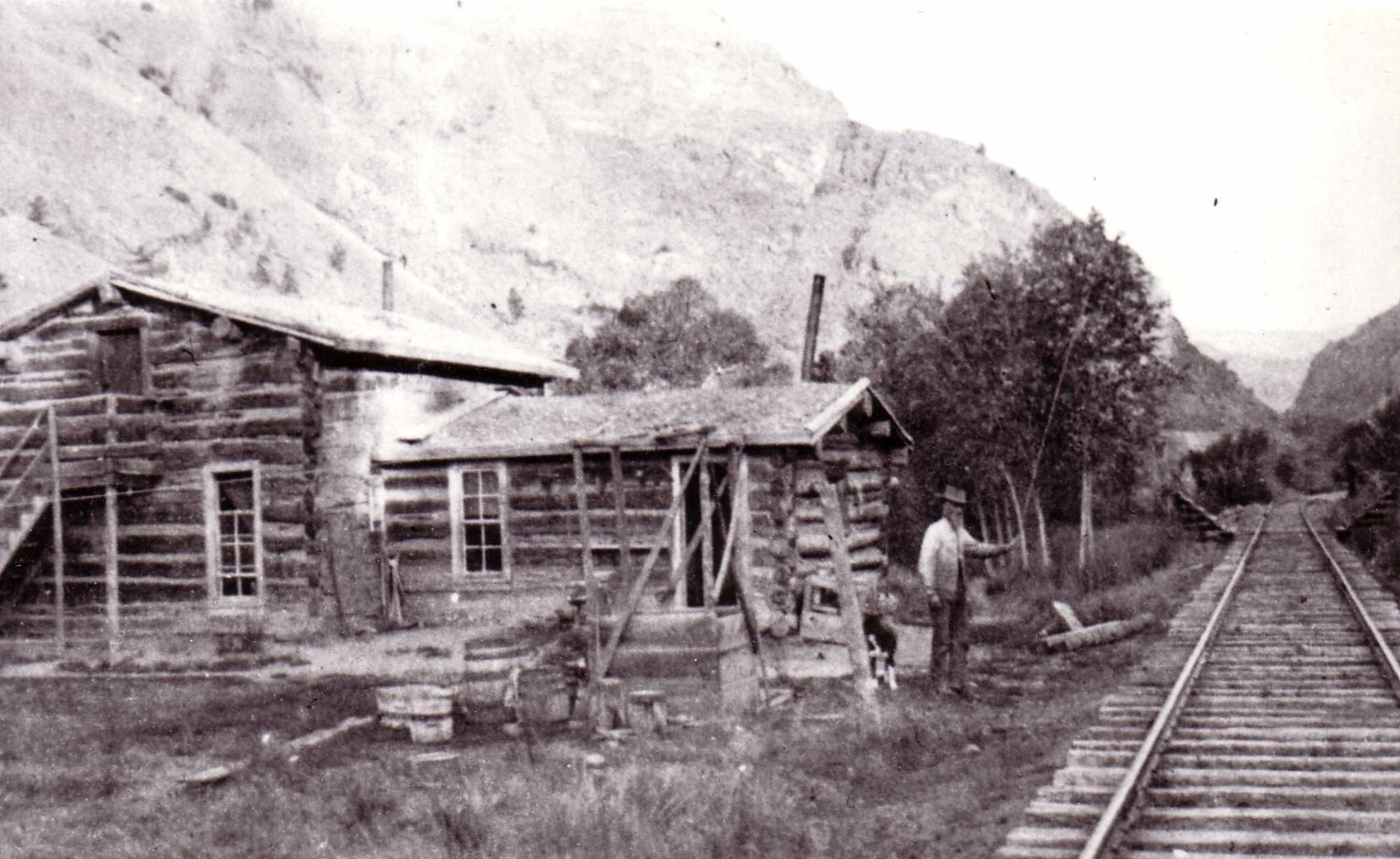
Yankee Jim George between his cabin and the Northern Pacific track.
In 1889 when British author Rudyard Kipling visited Yellowstone, a spur of the Northern Pacific carried passengers from Livingston, Montana, to the edge of the Park. But Kipling heeded advice from a fellow passenger and stopped to visit Yankee Jim George, the legendary operator of a toll road than ran through the canyon that still bears his name.
Yankee Jim was a garrulous man who must have met thousands of tourists after he began collecting tolls in 1873. In 1883 the railroad took over Yankee Jim’s road bed, although they did build a bypass for him. Even after the county took over the road 1887, travelers continued to stop by Yankee Jim’s.
Dozens of travelers’ diaries describe a stop at his cabin, note his courtly treatment of ladies and recount his tall tales. Kipling was no exception. Here’s his story.
∞§∞
From Livingston the National Park train follows the Yellowstone River through the gate of the mountains and over arid volcanic country. A stranger in the cars saw me look at the ideal trout-stream below the windows and murmured softly: “Lie off at Yankee Jim’s if you want good fishing.”
They halted the train at the head of a narrow valley, and I leaped literally into the arms of Yankee Jim, sole owner of a log hut, an indefinite amount of hay-ground, and constructor of twenty-seven miles of wagon-road over which he held toll right. There was the hut—the river fifty yards away, and the polished line of metals that disappeared round a bluff. That was all. The railway added the finishing touch to the already complete loneliness of the place.
Yankee Jim was a picturesque old man with a talent for yarns that Ananias might have envied. It seemed to me, presumptuous in my ignorance, that I might hold my own with the old-timer if I judiciously painted up a few lies gathered in the course of my wanderings. Yankee Jim saw every one of my tales and went fifty better on the spot.
He dealt in bears and Indians—never less than twenty of each; had known the Yellowstone country for years, and bore upon his body marks of Indian arrows; and his eyes had seen a squaw of the Crow Indians burned alive at the stake. He said she screamed considerable.
In one point did he speak the truth—as regarded the merits of that particular reach of the Yellowstone. He said it was alive with trout. It was. I fished it from noon till twilight, and the fish bit at the brown hook as though never a fat trout-fly had fallen on the water. From pebbly beaches, quivering in the heat-haze where the foot caught on stumps cut foursquare by the chisel-tooth of the beaver; past the fringe of the water-willow crowded with the breeding trout-fly and alive with toads and water-snakes; over the drifted timber to the grateful shadow of big trees that darkened the holes where the fattest fish lay, I worked for seven hours.
The mountain flanks on either side of the valley gave back the heat as the desert gives it, and the dry sand by the railway track, where I found a rattlesnake, was hot-iron to the touch. But the trout did not care for the heat. They breasted the boiling river for my fly and they got it. I simply dare not give my bag. At the fortieth trout I gave up counting, and I had reached the fortieth in less than two hours. They were small fish—not one over two pounds—but they fought like small tigers, and I lost three flies before I could understand their methods of escape. Ye gods! That was fishing.
∞§∞
— Excerpt from From Sea to Sea: Letters of Travel, Volume Two, Rudyard Kipling, 1899. (Page 203−205).
— Photo, Pioneer Museum of Bozeman.
— For related stories, click on “Fishing” under the “Categories” button to the left.
My friend, Paul Schullery, who Trout magazine calls America’s “preeminent angling historian,” was kind enough to offer a comment on my post of General W.E. Strong’s story, “The Rod Bent Nearly Double.” I thought it deserved to be featured as a guest article.
∞§∞
Strong’s accounts of the fishing that he and his companions enjoyed are interesting to historians for several reasons.
The tackle is of interest because fashionable and well-heeled anglers of the mid-1870s were experiencing a revolution in their choice of gear, as the traditional (and often very large) solid-wood rods that had dominated the sport of fly fishing for centuries were being replaced by far lighter but often stiffer split-bamboo rods. Bamboo rods of this sort were expensive but very effective for distance- and precision-casting. Strong may have had some of those in his rod case, as it sounds like he had several rods.
He was certainly in the majority in recognizing the importance of grasshoppers to the tastes of western trout. Though the British had been experimenting with some grasshopper imitations for centuries, the American grasshoppers were a considerably different and often much larger set of animals, and in the 1870s American anglers were just beginning to develop fly pattens that would work as well as the natural insects that Strong and his companions finally resorted to when their favorite artificial trout flies didn’t work. It would be several decades before American fly tiers developed floating grasshopper imitations that were consistent in catching fish when there were lots of natural grasshoppers competing for the trout’s attention.
But Strong’s most interesting details may be about the trout itself. No doubt his relatively light tackle, which included a silkworm gut leader that may not have been strong enough to horse a big fish in heavy water, had an effect on his handling of this fish. But by the mid-1900s, Yellowstone Cutthroat Trout would be widely regarded as the least sporting of the trout, in that they were typically thought of as the easiest to hook and the least strong as fighters. At least that was the prevailing stereotype; many of us have seen that same species of trout display great selectivity in feeding, and great strength in resisting capture once hooked. But for a Yellowstone Cutthroat Trout to jump clear of the water, repeatedly, would seem like an oddity to most modern anglers; at least I rarely have seen it or heard of it, and any number of respected authorities have said that they don’t jump. For whatever combination of evolutionary reasons, the species stereotypically does not feature jumping among its usual escape tactics. But there are exceptions to every rule; I’ve heard or read that brown trout don’t jump, either, but I’ve seen them do so many times. What Strong’s account gives us is lots to think about as far as how well we know these fish; he tells us to be careful about our generalizations.
∞§∞
— For more stories about fishing in Yellowstone Park, click on “fishing” under the “Categories” button on the right.
One of the most luxurious early trips to Yellowstone Park was led by President U.S. Grant’s Secretary of War, General William Belknap. In 1875, Belknap was joined by four other Generals including W.E. Strong, who provide an account of the trip.
The Generals crossed the country in a plush Pullman car smoking cigars, drinking whisky, and telling stories, on the new transcontinental railroad. Then they rode in a special stagecoach that traveled at breakneck speed from Utah to Montana.
Along the way they were feted with banquets, parties and parades. In Bozeman a Silver Coronet Band greeted them at the edge of town and escorted them through the city to Fort Ellis.
At Fort Ellis they were provided with an escort of active duty soldiers led by Gustavus Doane, who had commanded the escort of the Washburn Expedition in 1870.
Each General was assigned an orderly to take care of his every whim: packing his personal belongings, putting up his tent, rolling out his bed roll, digging his latrine, and cleaning any fish he caught. All at army expense, of course. A year later the U.S. Senate impeached General Belknap for taking bribes.
General Strong eloquently describes the wonders of Yellowstone—falls, hot springs and geysers, and describes the people he met—mountain men, stagecoach drivers, and towns people. Most of all, he revels in telling exciting tales of hunting elk, stampeding buffalo, and catching fish. Here’s his description of fishing.
∞§∞
Again I threw my hook in the swift water, and down the stream it went like lightning, tossing about like a feather in the rapid. My reel whirled and spun like a buzz saw, the line went out so fast.
I never touched the reel to check the running line till seventy-five feet, at least, was in the water. Then I pressed my thumb firmly upon it and drew gently back the rod. At the same instant something struck my hook that nearly carried me off my feet. I had to let go the reel to save the rod.
I had him securely hooked, but could I land him? That was the question. I gave him twenty-five or thirty feet more line—then checked again and tried to hold him—but it was no use, the rod bent nearly double, and I had to let him run.
My line was one hundred and fifty feet in length, and I knew when it was all out, if the fish kept in the rapids, I should lose him. No tackle like mine could stand for a moment against the strength of such a fish as I had struck in such swift water.
I therefore continued to give him the line—but no faster than I was forced to. No more than twelve or fifteen feet remained on the reel. Fortunately for me, he turned to the left and was carried into an eddy which swept him into more quiet water near the shore.
Twice in his straight run down the rapid current of the stream he leaped clear from the water. I saw he was immense—something double or triple the size of any trout I had ever caught. The excitement to me was greater than anything I had ever experienced.
No one but a trout fisherman can understand or appreciate the intense pleasure of a single run. I was crazy to kill and land him, and yet I knew the chances were against it. Again and Again I reeled him within twenty-five or thirty feet of the rock. But he was game to the last, and would dart off with the same strength as when he first struck. I had to let him go.
Finally, he showed signs of exhaustion. I managed to get him to top the water, and then worked him in close to the sore. Flynn was waiting to take the line and throw him out, as I had no landing net. Flynn did it very well. When the trout was very near the bank and quiet, he lifted him out.
He was a fine specimen, and would weigh four pounds if he weighed an ounce. This trout was three times the size I had ever caught. At 4:30 o’clock I stopped fishing having landed thirty-five trout which would have run from two and a half to four pounds in weight—none less than two and one half pounds.

 Early travelers to the area that became Yellowstone National Park depended on the abundant fish in the Yellowstone River watershed to supplement their larders, but they often they went hungry after discovering other streams and lakes were barren. At first, people thought the strange distribution of fish was caused by chemical laden hot springs, but that proved to be wrong. The article describes how scientists unraveled the mystery.

 lashings, the cook seizes them, and hurriedly digs a trench, in which he starts his fire. While it is kindling, he and anybody else whose hands are free cut or pluck up fuel.
 Soon people from all over the world were coming Yellowstone Park to fish and reporting phenominal catches. Here’s one woman’s story about fishing a once barren stretch of the Firehole River.


 M. Mark Miller, Author