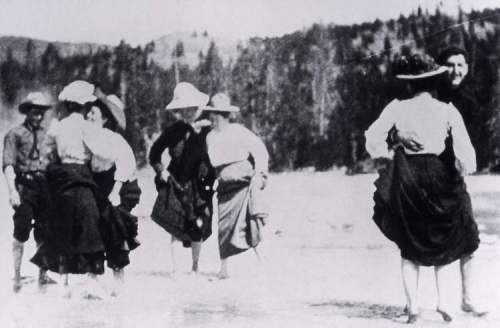
Eleanor Corthell’s husband “could only fizz and fume” when she announced in 1903 that she was taking their seven children to Yellowstone National Park by team and wagon. But he could think of no good reason to stop her.
By then the park had been transformed from a forbidding wilderness into a genteel resort where an unaccompanied woman could travel without fear of being attacked by Indians or bears. The Army Corps of Engineers had completed a network of roads in the park that were among the best in the United States, certainly good enough to be navigated by Mrs. Corthell’s sixteen-year-old son. There were stores where the Corthells could buy supplies and post offices where they could keep in contact with family and friends.
Although the park had several grand hotels, the Corthells camped out for their entire two-month adventure. This meant that Mrs. Corthell had to manage not only the logistics of the trip but also cooking and laundry—all out of doors. That might sound like an enormous challenge, but as Eleanor would have pointed out, she would have been in charge of all those duties had she stayed at home.
Despite the relative tranquility of Yellowstone Park at the time, the Corthells had plenty of adventures. Their travels across the ranch country of central Wyoming reminded them of Owen Wister’s novel The Virginian, which many consider to be the first Western. In the park they kept their eyes out for black bear cubs like Johnny Bear and grizzlies like Wahb, who were the subjects of famous stories by the hugely popular naturalist and writer Ernest Thompson Seton.
Eleanor’s husband, Nellis, joined his family in the park and promptly ran afoul of regulations that were enforced by the Army, which ran the park then. But Nellis (Eleanor called him “The New Camp Spirit”) was a prominent Wyoming attorney, and he managed to talk himself down to a two-dollar fine.
Eleanor’s story of her family trek was published in June 1905 in the magazine, Independent. Here’s an excerpt.
∞§∞
We camped across the road from Old Faithful and saw it play five times; but we shouldn’t have stopped there, we were taking chances. The park rules are very strict in regard to trespass on the formations, and thereby hangs a tale: But then, you would not expect such a large family to pass among a whole valley full of yawning gulfs and smiling springs and shooting geysers, absorbed until they forgot time and place and circumstance and not have something happen, would you? Since none of them fell into a hot spring, what could matter?
Well, “The New Camp Spirit” got arrested! And that mattered a good deal.
The horses found feed scarce in the very heavy timber so came into the open where the road lay. Just across, on forbidden territory, was a bunch of grass that poor Star wanted. Now he didn’t intend to swallow Old Faithful, or tramp on its flinty surroundings. We were busy spreading a good, hot dinner on the tablecloth, so failed to notice Star quite quick enough. Presently we saw, and sent a boy to drive him back, but a soldier on horseback got ahead of him, and swearing like a trooper at boy and horse, he came thundering up saying, “Consider yourself under arrest, sir, and come with me!”
In his very, very sweetest manner and most persuasive tone, Mr. Corthell asked, “May I finish my dinner first?” “Well, yes sir,” the soldier said, somewhat mollified. And he sullenly stood in the background.
But dinner had lost its savor. This is an experience we had nowhere reckoned on. What if it meant jail—forgotten pocketbooks, broken wagons, floods, nothing ever created such consternation as this. But we didn’t fall into a panic. The chief victim was so placid, so serene, even sweetly content, that the example set composed the rest of us. Before the walk to headquarters was over, sweetness won the day, so the fine was only two dollars when it might have been a hundred. From this point on the “New Camp Spirit” took no more chances and always put out his fires.
∞§∞
— Excerpts from “A Family Trip to the Yellowstone” by Mrs. N. E. Corthell, The Independent, 58:2952, 1460-67 (June 29, 1905).
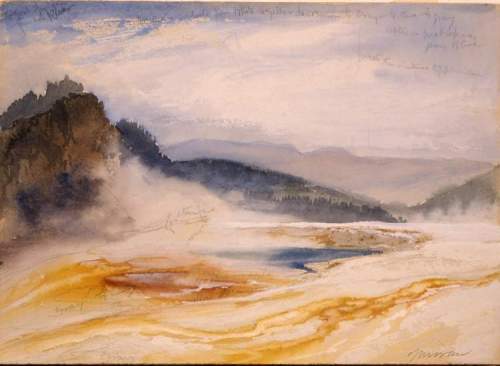
“Hot Springs of the Yellowstone,” Thomas Moran 1871
Mammoth Hot Springs was the first major feature Thomas Moran encountered when he toured Yellowstone Park in 1871 with the Hayden Expedition. Moron’s diary entries for the three days he spent at Mammoth contain not a word of description. Apparently he was content relying on his watercolor sketches.
Of course, many travelers did offer written descriptions of the springs. Here’s one by Edwin J. Stanley, a writer, historian, and Methodist minister, who visited Yellowstone Park in 1873.
∞§∞
I came suddenly out in full view of the far famed Hot Springs. Having read glowing descriptions of the place, and being rather despondent from the fatigue of travel, I felt somewhat disappointed, and feared my expectations would not be fully met; but all such impressions vanished at first view of the strangely-beautiful scene, and I felt that the half had not been told, though the sun was obscured by clouds, depriving me of much of the inspiration that the first view would otherwise have furnished.
The proprietors of the place, two young gentlemen from Bozeman, anticipating the value of these springs as a place of resort for pleasure-seekers and invalids, had taken possession of them before the passage of the bill including them in the National Park, and styled them the Mammoth Hot Springs. But Dr. Hayden, the United States Geologist, doubtless moved by the first impression made upon his mind on arriving here, gave them the title of White Mountain Hot Springs.
Both titles are quite appropriate, considering their mammoth proportions—surpassing anything of the kind yet discovered—and the vast mountain of white and yellowish deposit made from the mineral solutions contained in the immense volumes of water gurgling up from scores of boiling fountains. This immense calcareous formation, with its numberless and intricate phenomena, baffling all attempts at description, is the chief object of interest here.
The first impression on beholding it is that of a snowy mountain beautifully terraced, with projections extending out in various directions, resembling frozen cascades, as though the high, foam-crested waves, in their rapid descent over the steep and rugged declivity, were suddenly arrested and congealed on the spot in all their native beauty. There are fifty or sixty of these springs of greater and smaller dimensions, extending over an area of about a mile square; though there are remains of springs of the same kind for miles around, and mountains of the same deposit overgrown with pine-trees, perhaps hundreds of years old.
Most of the water is at boiling heat, and contains in solution a great amount of lime, sulphur, and magnesia, with some soda, alumina, and other substances, which are slowly deposited in every conceivable form and shape as the water flows along in its course down the mountain-side.
On each level, or terrace, there is a large central spring, which is usually surrounded by a basin of several feet in diameter, and the water, after leaving the main basin at different portions of the delicately-wrought rim, flows down the declivity, step by step, forming hundreds of basins and reservoirs of every size and depth, from a few inches to six or eight feet in diameter, and from one inch to several feet in depth, their margins beautifully scalloped with a finish resembling bead-work of exquisite beauty. The character of the formation depends upon the temperature and flow of the water, as well as upon the character of prevailing minerals at that particular place. Where the water flows slowly, and with but slight ebullition, the smaller basins and terraces are formed, one below the other, with their delicate partitions and beautifully-fringed borders; and where the volume and momentum are greater, the basins are larger and deeper, and the ornamentation proportionately coarser.
Where the water flows quite rapidly, the pools are filling up, leaving the deposit in wave-like forms, just like water congealed when flowing over a cascade. Underneath the sides of many of the basins are beautifully-arranged stalactites, formed by the dripping of the water; and, by digging beneath the surface at places where the springs are inactive, the most delicate and charming specimens of every character and form can be obtained—stalactites, stalagmites, grottoes, etc., all delicately arranged as the water filtrates through the crevices and perforations of the deposit. The larger pools, before the erection of bathing-houses, afforded a splendid opportunity to enjoy the luxury of bathing, as water of any temperature desirable could be secured. The sides of the mountain for hundreds of yards in extent are covered with this calcareous incrustation, formerly possessing all the ornamental attractions of the springs now in action. It is a scene sublime in itself to see the entire area with its numerous and terraced reservoirs, and millions of delicate little urns, sparkling with water transparent as glass, and tinged with many varieties of coloring, all glistening under the glare of a noonday sun. But the water is constantly changing its channel, and atmospheric agencies have disfigured much of the work, leaving a great portion of it only the resemblance of an old ruin.
Every active spring or cluster of springs has its succession of little urns and reservoirs extending in various directions. The largest spring now active, situated about half-way up the mountain on the outer edge of the main terrace, has a basin about twenty-five by forty feet in diameter, in the centre of which the water boils up several inches above the surface, and is so transparent that you can, by approaching the margin, look down into the heated depths many feet below the surface. The sides of the cavern are ornamented with a coral-like formation of almost every variety of shade, with a fine, silky substance, much like moss, of a bright vegetable green, spread over it thinly, which, with the slight ebullition of the water keeping it in constant motion, and the blue sky reflected in the transparent depths, gives it an enchanting beauty far beyond the skill of the finest artist. Here all the hues of the rainbow are seen and arranged.so gorgeously that, with other strange views by Which one is surrounded, you almost imagine yourself in some fairy region, the wonders of which baffle all attempts of pen or pencil to portray them.
Besides the elegant sculpturing of this deposit, imagine, if you can, the wonderful variety of delicate and artistically-arranged colors with which it is adorned. The mineral-charged fluid lays down pavements here and there of all the shades of red, from bright scarlet to rose-tint, beautiful layers of bright sulphur-yellow, interspersed with tints of green—all elaborately arranged in Nature’s own order. Viewed from the Tower Creek trail, which passes at the base, this section of the mountain has a very architectural appearance.
But descending the mountain from which we first beheld the springs, and where we left the reader, we come to the first level, or terrace, the base of the principal formation. There are several springs, the water of which is used by the scores of invalids already flocking here to be healed of their maladies. Here, also, are the small bath-houses erected by the proprietors, for the use of which a handsome sum is generally exacted. The medicinal properties of each fountain seem to be different, and the invalid can use that best adapted to his case. Just over there to our right, in the mouth of a little gorge, coming down from the mountain, by the side of the sparkling brook of snowwater, among the pine-trees, where the smoke is curling up from many fires, are the camps of the tourists and invabds who have come hither, and are abiding in rudely-constructed cabins, some in tents, enjoying all the luxuries of camp-life. Rather a motley, though quite a lively, group. Some remarkable cures have been effected here, mostly of diseases of the skin, and rheumatism. But I think that the invigorating mountain-air and the healthful influence of camp-life have much to do with many cures that are effected, as these are known to be wonderful remedies in themselves for many of the ills which flesh is heir to.
∞§∞
— From Edwin James Stanley, Rambles in Wonderland, Or Up The Yellowstone, New York: D. Appleton and Company, 1883. pages 54-58.
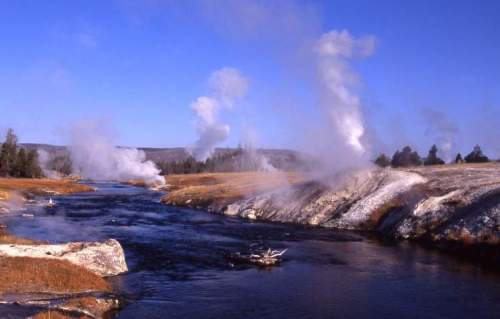
Great Springs of the Firehole River by Thomas Moran, 1871.
By the late 1860s enough prospectors’ reports of boiling fountains, deep canyons and glass mountains had accumulated to convince people that there really were things worth seeing on the upper Yellowstone. Several plans for expeditions to document the wonders of the area fizzled because organizers couldn’t recruit enough men to feel safe from Indians. But in 1869 David Folsom, Charles Cook and William Peterson decided that a small group could avoid the hostiles.
These intrepid explorers succeed in finding the canyons, falls, and geysers, but publishers were leery of their stories. Both the New York Tribune and Scriber’s magazine refused to publish an account of the expedition because “they had a reputations that could not risk such unreliable material.” A Chicago based magazine, the Western Monthly, finally published it in July 1870, nearly a year after the trip. The Monthly attributed the story to C.W. Cook.
The account didn’t get wide circulation until nearly 35 years later when it was published by the Montana Historical Society. N.P. Langford, who wrote a preface for the historical society version, attributed it to David E. Folsom. Here’s the Cook/Folsom description of geysers and hot springs.
∞§∞
We ascended to the head of the lake and remained in its vicinity for several days, resting ourselves and our horses and viewing the many objects of interest and wonder. Among these were springs differing from any we had previously seen. They were situated along the shore for a distance of two miles, extending back from it about five hundred yards and into the lake perhaps as many feet. The ground in many places gradually sloped down to the water’s edge, while in others the white chalky cliffs rose fifteen feet high,, the waves having worn the rock away at the base, leaving the upper portion projecting over in some places twenty feet.
There were several hundred springs here, varying in size from miniature fountains to pools or wells seventy-five feet in diameter and of great depth. The water had a pale violet tinge and was very clear, enabling us to discern small objects fifty or sixty feet below the surface. In some of these, vast openings led off at the side, and as the slanting rays of the sun lit up these deep caverns, we could see the rocks hanging from their roofs, their water-worn sides and rocky floors, almost as plainly as if we had been traversing their silent chambers.
These springs were intermittent, flowing or boiling at irregular intervals. The greater portion of them were perfectly quiet while we were there, although nearly all gave unmistakable evidence of frequent activity. Some of them would quietly settle for ten feet, while another would as quietly rise until it overflowed its banks, and send a torrent of hot water sweeping down to the lake. At the same time, one near at hand would send up a sparkling jet of water ten or twelve feet high, which would fall back into its basin, and then perhaps instantly stop boiling and quietly settle into the earth, or suddenly rise and discharge its waters in every direction over the rim; while another, as if wishing to attract our wondering gaze, would throw up a cone six feet in diameter and eight feet high, with a loud roar.
These changes, each one of which would possess some new feature, were constantly going on; sometimes they would occur within the space of a few minutes, and again hours would elapse before any change could be noted. At the water’s edge, along the lake shore, there were several mounds of solid stone, on the top of each of which was a small basin with a perforated bottom. These also overflowed at times, and the hot water trickled down on every side. Thus, by the slow process of precipitation, through the countless lapse of ages, these stone monuments have been formed. A small cluster of mud springs near by claimed our attention. They were like hollow truncated cones and oblong mounds, three or four feet in height. These were filled with mud, resembling thick paint of the finest quality, differing in color from pure white to the various shades of yellow, pink, red and violet. Some of these boiling pots were less than a foot in diameter. The mud in them would slowly rise and fall, as the bubbles of escaping steam, following one after the other, would burst upon the surface. During the afternoon they threw mud to the height of fifteen feet for a few minutes, and then settled back to their former quietude.
As we were about departing on our homeward trip, we ascended the summit of a neighboring hill and took a final look at Yellowstone Lake. Nestled among the, forest crowned hills which bounded our vision, lay this inland sea, its crystal waves dancing and sparkling in the sunlight as if laughing with joy for their wild freedom. It is a scene of transcendent beauty which has been viewed by but few white men, and we felt glad to have looked upon it before its primeval solitude should be broken by the crowds of pleasure seekers which at no distant day will throng its shores.
September 29th, we took up our march for home. Our plan was to cross the range in a northwesterly direction, find the Madison river, and follow it down to civilization. Twelve miles brought us to a small triangular-shaped lake, about eight miles long, deeply set among the hills. We kept on in a northwesterly direction as near as the rugged nature of the country would permit, and on the third day came to a, small irregularly shaped valley, some six miles across in the widest place, from every part of which great clouds of steam arose. From descriptions which we had had of this valley from persons who had previously visited it, we recognized it as the place known as “Burnt Hole” or “Death Valley.” The Madison river flows through it, and from the general contour of the country we knew that it headed in the lake: which we passed two days ago, only twelve miles from the Yellowstone. We descended into the valley and found that the springs had the same general characteristics as those I have already described, although some of them were much larger and discharged a vast amount of water. One of them, at a little distance, attracted our attention by the immense amount of steam it threw off, and upon approaching it we found it to be an intermittent geyser active operation. The hole through which the water was discharged was ten feet in diameter, and was situated in the center of a large circular shallow basin, into which the water fell. There was a stiff breeze blowing at the time, and by going to the windward side and carefully picking our way over convenient stones, we were enabled to reach the edge of the hole. At that moment the escaping steam was causing the water to boil up in a fountain five or six feet high. It stopped in an instant, and commenced settling down—twenty, thirty, forty feet-until we concluded that the bottom had fallen out, but the next instant, without any warning, it came rushing up and shot into the air at least eighty feet, causing us to stampede for higher ground. It continued to spout at intervals of a few minutes for some time, but finally subsided and was quiet during the remainder of the time we stayed in the vicinity.
We followed up the Madison five miles, and there found the most gigantic hot springs we had seen, They were situated along the river bank, and discharged so much hot water that the river was blood warm a quarter of a mile below. One of the springs was two hundred and fifty feet in diameter, and had every indication of spouting powerfully at times. The waters from the hot springs in this valley, if united, would form a large stream, and they increase the size of the river nearly one half. Although we experienced no bad effects from passing through the “Valley of Death,” yet we were not disposed to dispute the propriety of giving it that name. It seemed to be shunned by all animated nature. There were no fish in the river, no birds in the trees, no animals – not even a track – anywhere to be seen, although in one spring we saw the entire skeleton of a buffalo that had probably fallen in accidentally and been boiled down to soup.
Leaving this remarkable valley, we followed the course of the Madison, sometimes through level valleys, and sometimes through deep cuts in mountain ranges, and on the fourth of October emerged from a canyon, ten miles long with high and precipitous mountain sides, to find the broad valley of the Lower Madison spread out before us. Here we could recognize familiar landmarks in some of the mountain peaks around Virginia City. From this point we completed our journey by easy stages, and arrived at home on the evening of the eleventh. We had been absent thirty-six days – a much longer time than our friends had anticipated and we found that they were seriously contemplating organizing a party to go in search of us.
∞§∞
— Excerpt from C. W. Cook , “The Valley of the Upper Yellowstone,” The Western Monthly 4(19)60-67 (July 1870).
Only a few of the rugged mountain men who penetrated the area that became Yellowstone National Park could read and write. One who could was Warren Angus Ferris, a clerk for the American Fur Company. Ferris kept a journal that was published in serialized form in 1843-44 in the Western Literary Messenger and later as a book entitled Life in the Rocky Mountains. In these writings he offered one of the earliest written descriptions of the grand geysers in the Upper Geyser Basin.
∞§∞
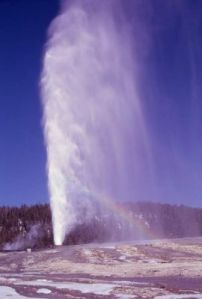
Beehive Geyser
I had heard in the summer of 1833, while at rendezvous, that remarkable boiling springs had been discovered, on the sources of the Madison, by a party of trappers in their spring hunt; of which the accounts they gave, were so very astonishing, that I determined to examine them myself, before recording their descriptions, though I had the united testimony of more than twenty men on the subject, who all declared they saw them, and that they really were, as extensive and remarkable as they had been described.
Having now an opportunity of paying them a visit, and as another or a better might not soon occur, I parted with the company after supper, and, taking with me two Pen-d’orielles, set out at a round pace, the night being clear and comfortable. We proceeded over the plain about twenty miles, and halted until daylight on a fine spring, flowing into Cammas Creek.
Refreshed by a few hours sleep, we started again after a hasty breakfast, and entered a very extensive forest called the Piny Woods, which we passed through, and reached the vicinity of the springs about dark, having seen several small lakes or ponds, on the sources of the Madison; and rode about forty miles; which was a hard day’s ride, taking into consideration the rough irregularity of the country through which we had travelled.
We regaled ourselves with a cup of coffee, and immediately after supper lay down to rest, sleepy, and much fatigued. The continual roaring of the springs, however, for some time prevented my going to sleep, and excited an impatient curiosity to examine them; which I was obliged to defer the gratification of, until morning; and filled my slumbers with visions of water spouts, cataracts, fountains, jets d’eau of immense dimensions, etc. etc.
When I arose in the morning, clouds of vapor seemed like a dense fog to overhang the springs, from which frequent reports or explosions of different loudness, constantly assailed our ears. I immediately proceeded to inspect them, and might have exclaimed with the Queen of Sheba, when their full reality of dimensions and novelty burst upon my view, “The half was not told me.”
From the surface of a rocky plain or table, burst forth columns of water, of various dimensions, projected high in the air, accompanied by loud explosions, and sulphurous vapors, which were highly disagreeable to the smell. The rock from which these springs burst forth, was calcareous, and probably extends some distance from them, beneath the soil. The largest of these wonderful fountains, projects a column of boiling water several feet in diameter, to the height of more than one hundred and fifty feet—in my opinion; but the party of Alvarez, who discovered it, persist in declaring that it could not be less than four times that distance in height accompanied with a tremendous noise.
These explosions and discharges occur at intervals of about two hours. After having witnessed three of them, I ventured near enough to put my hand into the water of its basin, but withdrew it instantly, for the heat of the water in this immense cauldron, was altogether too great for comfort, and the agitation of the water, the disagreeable effluvium continually exuding, and the hollow unearthly rumbling under the rock on which I stood, so ill accorded with my notions of personal safety, that I reheated back precipitately to a respectful distance.
The Indians who were with me, were quite appalled, and could not by any means be induced to approach them. They seemed astonished at my presumption in advancing up to the large one, and when I safely returned, congratulated me on my “narrow escape.” They believed them to be supernatural, and supposed them to be the production of the Evil Spirit. One of them remarked that hell, of which he had heard from the whites, must be in that vicinity.
The diameter of the basin into which the water of the largest jet principally falls, and from the centre of which, through a hole in the rock of about nine or ten feet in diameter, the water spouts up as above related, may be about thirty feet. There are many other smaller fountains, that did not throw their waters up so high, but occurred at shorter intervals. In some instances, the volumes were projected obliquely upwards, and fell into the neighboring fountains or on the rock or prairie. But their ascent was generally perpendicular, falling in and about their own basins or apertures.
These wonderful productions of nature, are situated near the centre of a small valley, surrounded by pine covered hills, through which a small fork of the Madison flows. Highly gratified with my visit to these formidable and magnificent fountains, jets, or springs, whichever the reader may please to call them, I set out after dinner to rejoin my companions.
∞§∞
— From Warren Angus Ferris, A Diary of Wanderings on the sources of the Rivers Missouri, Columbia, and Colorado from February, 1830, to November, 1835.
— Image from the Coppermine Photo Gallery.
— You might also enjoy these early descriptions of geysers:
Daniel Potts’ 1827 account, which is thought to be the first one written.
On the 3d of August we entered the Park. The first point we reached is what is called the Firehole, or the Lower Geyser Basin. It is a flat meadow, 7,000 feet above the sea, through which runs the Firehole river, and part of it is covered with beautiful grass, while part of it is the white sinter formation of the hot springs and geysers.
Setting Tin Lee to work at his stove preparing supper, we rode about a mile on the edge of the pine forest that skirted the weird, desolate plain of the geyser basin. It was one glare of white geyserite, with sulphur and iron and alum springs bubbling up all over it, and little steaming funnels everywhere, giving evidence of the internal fires beneath.
Standing or lying about this plain are trees killed by the hot, siliceous waters. Nothing in nature could be more spectral than these naked trunks of trees, stripped of bark and bare of branches, and bleached white as snow, looking like the ghosts of the groves and forests, which are undoubtedly buried beneath the constantly accumulating mass of deposit.
It was a scene of absolutely uncanny desolation, and as we looked at it we ceased to wonder at the names bestowed upon it by its first discoverers, such as “Devil’s Paint Pots,” “Hell’s Half-acre,” etc. One of our guides told us in graphic language of his first sight of this region.
“You see,” he said, “a party of us were out prospecting for mines, and we had traveled all day through pretty thick forests, and were pushing towards an opening we could dimly see through the trees, where, we hoped to make a comfortable camp for the night. We were very tired, and were hurrying to get into camp, when suddenly, just as we reached the edge of the forest without a moment’s warning, we heard a most awful rumbling, the ground shook under our feet, and there burst into the air a column of water and steam that looked as if it reached the skies.
“We just fairly lost our senses, and never stopped to take a second look, but wheeled about in an instant, put spurs to our horses, and crushed away through the underbrush and tree-trunks as if the Evil One himself were after us.
“And the fact is,” he added, “we did not know but that he was. For what else, we asked ourselves, could such goings-on mean, but that we were on the very edge of the lower regions? We never rested till we had put miles between us and that awful place, and for years we never spoke of it for fear the fellows should think we had really been to hell, and were sold to the old fellow who lives there.”
We could not wonder at the fright of men who had probably never heard of geysers or volcanoes, and who had no more expectation of coming across such phenomena in that quiet and lonely region than we in Philadelphia have of seeing them in our sober Fairmount Park.
This is considered to be the most wonderful geyser region in the whole world. The far-famed geysers of Iceland are tame fountains compared to some here. It is estimated by Professor Hayden that within an area of thirty-five or forty square miles there are at least 2,000 hot springs, steam-jets, geysers, and mud fountains; and in the whole Park there are supposed to be not less than 10,000.
Many of the geysers spout to the height of fifty or a hundred feet, some two or three hundred, and our guides even told us of one which has only been known to spout twice, but which, when it does perform, reaches, they declared, the stupendous height of seven hundred feet. But as we did not see this one we felt a little dubious.
The geysers seem to have all sorts of openings. Some of them have formed craters around their mouths twenty or thirty feet high, that have assumed curious fantastic shapes and are constantly sending out between their eruptions great puffs of steam, and little jets of scalding spray, while there is all the time a sound of fierce boiling water below. In others the hot water stands, a marvelously transparent pool, in saucer-shaped basins, from ten to one hundred feet across, at the bottom of which is the well or tube from which the eruption issues.
No language can adequately describe the gracefully curved and scalloped forms of the deposits which line the apparently bottomless sides of these openings, nor the countless vivid and delicate colors with which they are dyed, shading from a deep crimson, on the edge of the pool, to a glorious emerald green or sapphire blue in the centre. To look down into the pure depths of these wonderful basins, with their fantastic forms and exquisite colors, is like looking into fairyland. Then suddenly, without a moment’s warning, or any apparent cause, the quiet water will begin to heave, and boil, and spurt, and will dash into a marvelous cataract, apparently instinct with life; leaping towards the skies, just as a cataract leaps downward; breaking into rockets of milk-white spray, each of which sends out a burst of steam, and then falls to the white rocks below in showers of shining jewels, tinted with all the colors of the rainbow. A geyser eruption is not in the least like an artificial fountain, but more like an inverted cataract, filled with a mighty life, every instant changing its shape and its height, and is always enveloped and surmounted by vast clouds and pillars of steam that sway with the wind, the whole being crowned and tinged with rainbows.
These marvelous displays take place with one or two geysers at regular intervals, but most of them are very irregular in their times of action, varying from three or four hours to several days, or even two or three weeks. They seem sometimes to die out altogether, and new ones to break out in fresh places.
It would seem, therefore, that while the amount of geyser action continues about the same, its centers of activity are constantly changing . . .. We were now a party of eleven, three sober middle-aged grown-ups, and eight young people, full of life and energy, and ready for any fun or adventure that came in their way. Our campfires at night were scenes of great merriment. As soon as we would get into camp all but the lazy ones would go to work gathering sagebrush or wood for the fire. We would choose a spot with dry sand or grass, and piling up our fuel and lighting it, would all gather round it on our rugs and buffalo robes, and tell stories and sing songs until bedtime.
Tin Lee, our Chinese cook, was a great feature in these entertainments. He seemed such an innocent, guileless sort of creature, that one’s heart was quite attracted to him, although all of us believed it was only the innocence and guilelessness of deepest cunning. He would come up to the fire with a smile that was almost as childlike and bland as that of the immortal “Ah Sin,” and take his place among us as innocently as though he belonged to us, and had a right to share all our pleasures. Sometimes we would get him to sing us a Chinese song—he called it “songing a sing “—and a sadder, more pathetic tune I never heard anywhere. It was always the same, and had no variations, and it seemed to embody in its sad refrain all the grief of a hopeless helpless race. It almost brought tears to my eyes every time I heard it. But I fear that our young people felt none of this, for they had persuaded the unsuspecting Tin Lee that he had a very fine tenor voice, and they would go into uncontrollable fits of laughter over the high falsetto quavers produced.
These nightly campfires are the chief delight of the trip. The air is always cool enough to make the warmth agree able, and the deliciousness of lying stretched out on one’s buffalo robes under the open sky, around a high roaring fire, can only be understood by experience. It seems, too, as if every one’s wits were sharper than usual under such circumstances, and our young party had many a grand night of it, that gave the three quiet elders almost as much delight as themselves.
The only drawback would be the inevitable coming of ten o’clock, when the sound of my “Now, daughters, it is bedtime,” was almost as dreaded as the cry of the panther would have been. There was only one other sound that spread greater consternation, and that was the call of Tin Lee in the morning when breakfast was ready, and he would wake us up from our delicious naps by playing a tattoo on a tin pan, and calling out to us at the top of his funny squeaky voice, ” Hi there! Bleakfast! Flappee Jack! Flappee Jack! Him all done!”
∞§∞
— In Part 4, HWS describes the wonder of a glass mountain, the “grapples” of traveling in a wagon over crude roads and managing rambunctious young travelers.
— From H. W. S., “A Lady’s Visit To The Geysers Of The Yellowstone Park.” Friends Intelligencer May 19, 1883. Pages 218-221, and May 27, Pages 234-237.
— Photo from Coppermine Gallery
— For more on women’s adventures in Yellowstone Park click on “Women’s Stories” under the Categories button to the left.
Many early Yellowstone travelers describe places like the Fishing Cone where anglers could catch a fish in cool water and then cook it in a nearby hot spring without taking it off the hook. In fact, Philetus Norris, the park’s second superintendent, used to demonstrate the feat for the amusement of tourists.
The earliest written description of cooking live fish in a hot spring was written by Cornelius Hedges, a member of the famous Washburn expedition of 1870. Here’s Hedges’ description of how he accidentally discovered the trick.
∞§∞
My individual taste led me to fishing, and I venture that none of the party dared to complain they did not have all the fine trout that there several appetites and capacities could provide storage for. Indeed, I felt in gratitude bound to hear testimony that for fine fish, and solid, satisfying fun, there is no body of water under the sun more attractive to the ambitious fisherman than Yellowstone Lake.
While upon the subject of fishing, allow me to relate one or two instances of personal experience. One day, after the loss of one of our comrade, when rations were getting short, I was deputed to lay in a stock of fish to eke our scanty larder on our homeward journey.
Proud of this tribute to my piscatory skill, I endeavored under some difficulties, to justify the expectations of my companions, and in about two hours, while the waves were comparatively quiet, I strewed the beach with about 50 beauties, not one of which would weight less than 2 pounds, while the average weight was about 3 pounds.
Another incident, illustrative of the proximity of hot springs rather than of trouting: Near the southwest corner of the lake is a large basin of exceedingly hot springs. Some are in the very margin of the lake, while others rise under the lake and indicate their locations by steam and ebullition upon the lake’s surface when the waves are not too uneasy. One spring of large size, unfathomable depth, sending out a continuous stream of at least 50 inches of scalding water, is still separated from the cool water of the lake by a rocky partition not more than a foot thick in places.
I returned to the narrow rim of this partitian and catching sight of some expectant trout lying in easy reach, I solicited their attention to a transfixed grasshopper, and meeting an early and energetic response, I attempted to land my prize beyond the spring, but unfortunately for the fish, he escaped the hook to plunge into this boiling spring.
As soon as possible, I relieved the agonized creature by throwing him out with my pole, and although his contortions were not fully ended, his skin came off and he had all the appearance of being boiled through. The incident, though excusable as an incident, was too shocking to repeat.
∞§∞
— Cornelius Hedges, “Yellowstone Lake,” Helena Daily Herald, November 9, 1970.
— Illustration from William Cullen Bryant (ed.), Picturesque America. New York: Appleton, 1872. 1:302.
There had been rumors of wonders in the upper Yellowstone for more than 50 years, but the Washburn Expedition of 1870 made it official. The place really did contain towering waterfalls, a huge inland sea and—most stupendous—boilding fountains that threw water hundreds of feet into the air.
There were several reasons Washburn and his companions captured the public imagination. First, the expedition was composed of prominent government officials and businessmen whose word could not be doubted. Second, the expedition included several skilled writers who published reports immediately after they returned from the wilderness. Third, there was a well developed communication system that included several Montana territorial newspapers and the telegraph to spread the news across the nation. Finally, the Northern Pacific Railroad, which was making its way westward, promoted the area in hopes of making it a tourist destination.
General Washburn himself was one of the skilled writers whose work was caught up in this fortuitous combination. Here’s his description of the geysers of the Upper Yellowstone.
∞§∞
Grand Geyser
On the south end of the lake is a very beautiful collection of hot springs and wells. In many the water is so clear that you can see down fifty or a hundred feet.
The lake is 8,000 feet above the level of the sea, a beautiful sheet of water, with numerous islands and bays, and will in time be a great summer resort; for its various inlets, surrounded by the finest mountain scenery, cannot fail to be very popular to the seeker of pleasure, while its high elevation and numerous medicinal springs will attract the invalid. Its size is about twenty-two by fifteen miles.
Leaving the lake, we moved nearly west, over several high ranges, and camped in the snow amid the mountains. Next day, about noon we struck the Fire Hole River. and camped in Burnt Hole Valley.
This is the most remarkable valley we found. Hot springs are almost innumerable. Geysers were spouting in such size and number as to startle all, and are beyond description. Enormous columns of hot water and steam were thrown into the air with a velocity and noise truly amazing. We classified and named some of them according to size:
No. 1. The Giant, 7 by 10 feet, throwing a solid column of water from £0 to 120 feet high.
No. 2. The Giantess, 20 by 30. throwing a solid column and jets from 150 to 200 feet high.
No. 3. Old Faithful, 7 by 8, irregular in shape, a solid column each hour, 75 feet high.
No. 5. Fan Tail, irregular shape, throwing a double stream 60 feet high.
No. 6 is a beautiful arched spray, called by us the Grotto, with several apertures through which, when quiet, one can easily pass, but when in action each making so many vents for the water and steam.
Upon going into camp we observed a small hot spring that had apparently built itself up about three feet. The water was warm but resting very quietly, and we camped within 200 yards of it. While we were eating breakfast this spring, without any warning threw, as if it were the nozzle of an enormous steam-engine, a stream of water into the air 210 feet, and continued doing so for some time, thereby enabling us to measure it, and then as suddenly subsided.
Surrounded by these hot springs is a beautiful cold spring of tolerably fair water. Here we found a beautiful spring or well, raised around it was a border of pure white, carved as if by the hand of a master-workman, the water pure. Looking down into it, one can see the sides white and clear as alabaster, and carved in every conceivable, shape, down, down, until the eye tires in penetrating.
Standing and looking down into the steam and vapor of the crater of the Giantess. With the sun upon our back, the shadow is surrounded by a beautiful rainbow; and, by getting the proper angle, the rainbow, surrounding only the head, gives that halo so many painters have vainly tried to give in paintings of the Savior.
Standing near the fountain when in motion, and the sun shining, the scene is grandly magnificent; each of the broken atoms of water shining like so many brilliants, while myriads of rainbows are dancing attendance. No wonder, then, that our usually staid and sober companions threw up their hats and shouted with ecstasy at the sight.
We bid farewell to the geysers, little dreaming there were more beyond. Five miles below Burnt Hole we found the “Lake of Fire and Brimstone.” In the valley we found a lake measuring 450 yards in diameter, gently overflowing, that had built itself up by a deposit of white sub-strata at least 50 feet above the plain. This body of water was steaming hot.
Below this was a similar spring, but of smaller dimensions while between the two, and apparently having no connection with either, was a spring of enormous volume flowing into the Madison, and is undoubtedly the spring about which Bridger was laughed at so much when he reported that it heated the Madison for two miles below. For some distance down the river we found hot springs and evidences of volcanic action.
∞§∞
— From Henry Washburn, “The Yellowstone Expedition,” Helena Daily Herald, September 27 and 28, 1870.
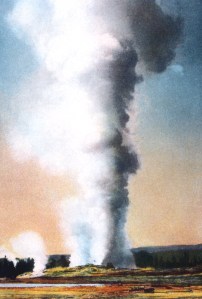
— Frank J. Haynes postcard, Yellowstone Digital Slide File.
Conventional wisdom is that people just didn’t believe trappers’ tales of fountains of boiling water, mountains of glass and the other wonders of the upper Yellowstone. But that’s not entirely true, at least in the case of the famous Mountain Man, Jim Bridger. The U.S. Army apparently found Bridger reliable; they frequently hired him as a scout, included his descriptions in their reports and called him “Major.”
Jim Bridger
One of the officers who believed Bridger was John W. Gunnison, a lieutenant in the Army Corps of Topographers. When a severe winter kept Gunnison from doing surveys of the Great Salt Lake Valley in 1849-50, he used the time to do research on the people who lived there. He published a book in 1852 that included this description of Bridger.
∞§∞
The builder of Fort Bridger is one of-the hardy race of mountain trappers who are now disappearing from the continent, being enclosed in the wave of civilisation. These trappers have made a thousand fortunes for eastern men, and by their improvidence have nothing for themselves.
Major Bridger, or “old Jim,” has been more wise of late, and laid aside a competence; but the mountain tastes fostered by twenty-eight years of exciting scenes, will probably keep him there for life. He has been very active, and traversed the region from the head-waters of the Missouri to the Del Norte—and along the Gila to the Gulf, and thence throughout Oregon and the interior of California.
His graphic sketches are delightful romances. With a buffalo skin and piece of charcoal, he will map out any portion of this immense region, and delineate mountains, streams, and-the circular valleys called “holes,” with wonderful accuracy; at least we may so speak of that portion we traversed after his descriptions were given.
He gives a picture, most romantic and enticing, of the head-waters of the Yellowstone. A lake sixty miles long, cold and pellucid, lies embosomed amid high precipitous mountains. On the west side is a sloping plain several miles wide, with clumps of trees and groves of pine.
The ground resounds to the tread of horses. Geysers spout up seventy feet high, with a terrific hissing noise, at regular intervals. Waterfalls are sparkling, leaping, and thundering down the precipices, and collect in the pool below. The river issues from this lake, and for fifteen miles roars through the perpendicular canyon at the outlet. In this section are the Great-Springs, so hot that meat is readily cooked in them, and as they descend on the successive terraces, afford at length delightful baths. On the other side is an acid spring, which gushes out in a river torrent; and below is a cave which supplies “vermilion” for the savages in abundance.
Bear, elk, deer, wolf, and fox, are among the sporting game, and the feathered tribe yields its share for variety, on the sportsman’s table of rock or turf.
∞§∞
— From Gunnison, J.W., A History of the Mormons. Philadelphia: Lippincott, Grambo & Co., 1852. p. 151
In the first decade after Yellowstone National Park was established in 1872, dozens of adventurous young men set out to see Wonderland. Usually the had meager supplies and planned to live off the land. That and problems of managing their horses always made such trips an adveture. Here’s a story of such a trip by Alva Josiah Noyes, who called himself “Ajax.”
∞§∞
A.J. Noyes
The summer and fall of ’80 was spent in the Elk Park ranch. I remember that I got out a whole lot of timber for fencing. After haying I sold my interest to my uncle. I was to take the money, go to the University of Iowa and enter the Law Department. My uncle was to give me $250 the first year, the same amount for the second.
Before going to Iowa I made up my mind to take a team and make the trip through the National Park. My object in so doing was to get data for a lecture, providing my cash should not hold out. I thought that I could deliver a lecture on the wonders of that place and probably make a few dollars, as it was then so little known.
I took a team, one of the horses belonged to my step-mother, and began my journey alone. On my arrival at Bozeman I met several of the Butte boys, ten of them in all. They had just been through the park and were on their way home. I could not get any of them to go back with me.
I got my dinner that day with George Wakefield, who was then running the Northern Pacific Hotel. Mrs. Wakefield was a schoolmate of mother’s. I met a kid, Link Coberly, who had been pretty near the Park but had not been in it. I proposed that he go with me. He said: “All the money I have is five dollars; that won’t take me very far toward the Park.” I informed him that he didn’t need any, I would put up. He consented to go.
We camped out on Bear Creek, 10 miles from Bozeman that night, and the next we were at Bottler Brothers, on the Yellowstone. We picketed our horses a short distance from camp. We were up early the next morning. Requesting Link to get the horses, I proceeded to get breakfast. He had been gone but a short time when he came hurrying back with the information that one of the horses was cast, and “his head was as big as a barrel!”
On making an examination I found that he had, in some way, gotten one of his hind feet in the rope which was around his neck, and in struggling to get up, had choked himself, more or less, also bruising his head. This was a nice state of affairs. A horse that could not be used; miles from home, and anxious to make the trip. What could I do? I went to Bottler and explained my condition.
He said: “I have a horse that you can have as soon as he comes back from the Park, which should be soon now.” I had to be contented and wait for “Old Bozeman,” as the horse was called, for several days.
At last he came and we made a new start. It did not require a long time to go, from this ranch, to Mammoth Springs. On arriving there I met Mrs. Carson (mother of Arthur of the North Butte), also Mrs. Ed Reimel of Walkerville, who invited me to have lunch with them, which was accepted with pleasure and much enjoyed.
When I got back to camp I found a young man, who desired to make one of our company, a George Allen of the Yellowstone. We left the wagon at the Springs and began our trip through the Park. We went via Tower Falls to the Grand Canyon, Great Fall, Sulphur Mountain, Mud Volcano, thence to Mary’s Lake, to the Lower Geyser Basin. We did not go to Yellowstone Lake.
We enjoyed the scenery very much. The weather was delightful. When we arrived at Midway, or “Hell’s Half Acre,” we crossed the Fire Hole river to investigate the Prismatic Spring and the Caldron, or what was afterward called “Sheridan Geyser.” This is a large body of boiling water, over 100 feet across, and when not in a state of eruption, is some ten to more feet below the surface. Steam arises all the time, as from a great kettle of boiling water.
Wishing to see more of this wonderful spring, I carefully walked toward it and stopped in awe at the fearful sight that met my gaze when a light breeze wafted the steam from me, as I was at the brink of that hellish hole. One more careless step and—the end.
When we arrived at the Upper Basin, we found ourselves pretty short of provisions. The boys were successful in getting a nice lot of fool hens, with sticks, but as we had no grease in which to fry them we began to rustle. Link found, in a tree, a can of bacon grease that had been left by the former camper. As this was nice and fresh, we made use of it.
We returned to the Springs via Norris Geyser Basin. At that place Colonel Norris had a party of men at work on the roads. Link got some brown sugar of them, which, under the circumstances, was the nicest ever.
The next day we arrived at the Springs, and got as good a meal as McCartney’s Hotel could set up. We purchased a few supplies, and started down the river. When on my way up to the Mammoth Springs I made arrangements with a party to catch some fish for me. When I returned to the place the man had a nice supply, which I hauled to Butte and sold them for 25 cents per pound.
When I got back to Bottler’s I found that my horse was in no condition to take me home. William Lee had a large number of horses, so I went to his ranch and bought a pony for $40.00, leaving my horse in his care. Link and I arrived in Butte in good season. Owing to the inroads on my cash, I did not have enough to carry me through the first year at Iowa City, so I did not study law. There must have been something of a Providencial nature in this, as we have too many poor lawyers now.
∞§∞
— Adapted from Alva Josiah Noyes, The Story of Ajax: Life in the Big Hole Basin. State Publishing Company:Helena, Montana: 1914. Pp. 43-45.
By the 1890s Yellowstone Park had been transformed from a roadless wilderness into a genteel resort with comfortable carriages and luxury hotels. That’s when Frank B. King got on a train in California and traveled to Gardiner, Montana, to take a coach tour of the Park. Although the high adventures of thirty years before we gone, there was still plenty to thrill a visitor like Frank. Here’s his description of waiting in the moonlight for a geyser.
∞§∞
Soon we arrived at the famous Great Fountain, which is one of the largest geysers in the Park. Its crater is about twenty feet in diameter, and one can see down into its clear, blue water at least fifteen feet, and watch the bubbles ascend and break upon the surface. Surrounding the main crater is a secondary, flat basin, and it is in the formation of this border that one sees the most beautiful tints that Nature can produce. The shapes and forms are of the most fantastic and artistic. The coloring is of the lighter and more delicate hues, being upon the pink and amber shades. The forms, colored as they are with the beautiful tints and seen through the clear, still water, which gives one the impression of looking through a pure crystal, make one think of fairyland, they are so beautiful and artistically ideal.
After viewing these more gentle elements, we became impatient for the grand. We had come to see an eruption—had almost been promised it at seven o’clock—and here it was nearly eight. We watched the indicators, but they gave no sign of sounding the alarm. We watched the bubbling water of the crater rise and fall, hoping that each rise would be the last grand spurt, and that each fall was the lull before the storm. We asked questions of the guide; talked among ourselves; carried wood, and built a fire. Time passed, the night grew colder, and still there was no eruption. About ten-thirty, it was the general opinion of the party that we had better give the moon and stars our proxies and let them watch the never-ceasing bubbling of the Fountain, and we returned to the hotel, a cold, tired, and disgusted lot.
The next day, as we were returning from our visit to the Upper Basin, we saw a vast column of steam ascend toward heaven from the vicinity of the Fountain, which was a sign that there had been an eruption, and we had just missed it.
The third evening that we were at the Fountain hotel, we were again told that there was to be an eruption of the Great Fountain. We thought perhaps there might be luck in odd numbers, having missed two eruptions. We piled into the bus to make a try for the third. Again we viewed the beauties of the border; again we watched the fluctuation of the water of the crater, and again we became impatient. The hours passed slowly because we expected every minute to be the last. Nine o’clock came and no eruption. Ten o’clock came and no eruption. The moon rose and cast its mellow light upon the water of the crater and the outer basin. The stars blinked and twinkled and watched over us and the geyser. It was a beautiful sight, with the great geyser before us slowly and deliberately preparing for a mighty effort, the pines back of us sighing and whispering to one another, and that little knot of impatient watchers moving to and fro in the firelight. The question was raised, “Shall we go or shall we stay?” and it was decided we should stay with it until the “bitter end.” There was more wood piled upon the fire, and we settled down to wait in earnest. We had gotten to that “don’t care” state, when those who were standing at the edge of the crater rushed back with a cry of, ” Here she comes!”
Slowly and deliberately the water in the crater overflowed into and filled the outer basin. This was an unfailing indication that an eruption was coming. More wood was piled upon the fire, and the flames leaped with joy and reflected themselves in the moving water. The moderate bubbling increased to violent convulsions. There was a low, sullen rumbling; a bulging of that great mass of water, and with a rush and a roar, the whole mass shot into the air one hundred and fifty feet. It was a sight worth the many hours of waiting to see that great volume of water, twenty feet in diameter and one hundred and fifty feet high, rise and then fall and rise again and continue to play. As it rose toward the spangled blue and the reflected glow of the fire fell upon the water and steam, it seemed like a most beautiful and grand electric fountain; then the steam would drift to one side and the moonlight would play upon it. It was a grand and overpowering sight!
The geyser continued to play for nearly an hour, but the first twenty minutes it was at its best and showed its greatest power, making grand spurts which would be followed by the little lull that came before a renewal of vigor. Then, little by little, the spurts became more feeble; the water subsided, the fire smoldered and went out, and the eruption of the Great Fountain was over.
∞§∞
— Frank B. King, “In Nature’s Laboratory: Driving and Fishing in Yellowstone Park.” Overland Monthly, June 1897.
 Eleanor Corthell’s husband “could only fizz and fume” when she announced in 1903 that she was taking their seven children to Yellowstone National Park by team and wagon. But he could think of no good reason to stop her.



 M. Mark Miller, Author