Category: geysers

  • A Tale: Building Fires To Light Up Grotto Geyser — 1880

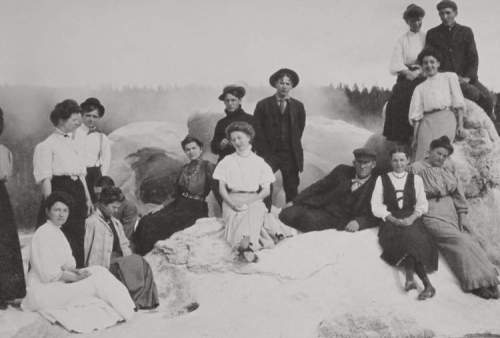
    Visitors on Groto Geyser Cone

    When the U.S. Congress established Yellowstone Park in 1872, they didn’t provide a budget for rangers to enforce regulations. That left people free to do whatever they wanted—and often they did things people today would never imagine.

    Early travelers’ accounts include descriptions of such things as dumping rubble in Old Faithful to see what would happen, shooting bald eagles for sport and doing dishes in hot springs. The Army took over administration of the park in 1886 and guarded it until the Park Service was established in 1916.

    Robert Strahorn, who visited the park in 1880 to write a description for the Union Pacific Railroad, built fires beside Grotto Geyser so he could see it play by firelight. Here’s what he said about that.

    ∞§∞

    Groto Geyser Closeup

    The Grotto is the most singular piece of mechanism among all the geysers. Its dome is some 30 feet long and half as wide, and 20 feet high. It is a miniature temple of almost alabaster whiteness, with arches leading to some interior Holy of Holies, whose sacred places may never be profaned by eye or foot. The hard, calcareous formation about it is smooth and bright as a clean swept pavement.

    Several columns, resembling masses of pearls, rise to a height of eight or ten feet, supporting a roof that covers the entire vent, forming fantastic arches and entrances, out of which the water is ejected, during an eruption, 50 or 60 feet.

    The entire surface is composed of the most delicate bead-work imaginable, massive but elaborately elegant, and so peerlessly beautiful that the hand of desecration has not been laid upon it, and it stands without flaw or break in all its primal beauty—a grotto of pearls.

    Darkness coming on, we built large fires on one side of the Grotto, and from the opposite side were afforded a sight, whose wonderful weirdness we can never forget. The volumes of water then resembled sheets of flame or molten metal and the drenched and dripping arches, through which the flickering blaze was plainly seen, seemed more like a fiery furnace than a real, live geyser.

    We camped by the side of the Grotto during the night, and with the confused noises of hundreds of geysers, steam vents and boiling springs in our ears, and reflection, which would not “down,” upon the almost supernatural experiences of the day, there was more wakefulness than tired bodies warranted.

    ∞§∞

    — Excerpt from Robert E. Strahorn’s book, Montana and Yellowstone Park, 1881.

    — Images from Coppermine Photo Gallery.

    — You also might enjoy this story by Robert Strahorn’s wife, Carrie: An October Snowstorm at Yellowstone Canyon, or John L. Stoddard’s description of Fountain Geyser as a Cloudburst of Jewels.

  • A Tale: Angering Old Faithful — 1877

    Today most Yellowstone tourists believe that nature is fragile. They wouldn’t collect a leaf or pick a flower for fear of causing irreparable damage. But early tourists shattered geological features to gather specimens, slaughtered animals for fun, and experimented with geysers.

    Explorers Near Old Faithful, August 1871

    They reported these things without the slightest embarrassment.

    On a Sunday in the summer of 1877, Frank Carpenter was lolling around Old Faithful with his companions: Dingee, Arnold and Mr. Huston—and Frank’s sisters, Ida and Emma. They soon tired of quietly observing the Sabbath and decided to experiment with Old Faithful. Here’s Frank’s story.

    ∞§∞

    We conclude that we will do our washing, since such an opportunity for “boiling clothes” will not be presented again soon.

    Emma and Ida put their clothes in a pillowcase. Dingee took off his blouse and tied a large stone in it and I finished tying it with my handkerchief. Arnold also removed his jacket—and we repaired to the laundry—Old Faithful.

    We hear the preparatory rumbling and the waters rise a few feet above the surface. Mr. Houston now gives the command to throw our garments into the water. The water goes down and remains low so long that we begin to feel uneasy. Dingee begins to lament his loss and to curse the man who “put us up to the job up.”

    Mr. Huston remarks that it will be all right, and the next instant, with a rush and a roar she “goes off.” The clothes, mixed in every conceivable shape, shoot up to a distance of a hundred feet and fall with a splash in the basins below.

    The water subsides, and we fish out the clothing, which, we find as nice and clean as a Chinaman could wash it with a week’s scrubbing. Dingee rejoices.

    Wishing to experiment further, we collect an immense quantity of rubbish and drop it into the crater. We fill it to the top with at least a thousand pounds of stones, trees, and stumps. Now we sit down to await further developments.

    At the exact time advertised, sixty-five minutes from the time of the last eruption, the earth begins to tremble. We hear the rush again. “Off she goes,” and away go rocks, trees and rubbish—to a height of seventy-five or eighty feet.

    Old Faithful seems to have been angered by the unwarrantable procedure on our parts—or he wishes to show us that our attempts to check his power are futile. And he furnishes entertainment of unusual magnitude and duration.

    ∞§∞

    — From The Wonders in Geyserland by Frank D. Carpenter.

    — Photo byWilliam Henry Jackson 1872. Yellowstone Digital Slide.

    — You may also enjoy Colonel John W. Barlow’s tale of bathing in Mammoth Hot Spring.