 Grand Geyser was erupting the last time I rode up to Old Faithful Inn for a book signing. I took the towering white plume of water and steam silhouetted against the pale blue sky as an auspicious sign. This will be a good day to sell books, I thought.
I’ll be in the lobby of the famous inn again on Friday and Saturday (Aug. 10 and 11) from 10 a.m. to 3 p.m. to sign my book Adventures in Yellowstone. Look for me by the clock that tells the next time Old Faithful is expected to erupt. There’ll be an easel with a a description of my book, my biography and a photo of me.
The last time I was there, I checked in at the gift shop where employees greeted me like an old friend and helped me set up. (It was the fourth time I’ve done book signings at the Inn.) Soon, I was seated behind a table smiling as passers-by and enticing them to buy my book.
I adjusted to the rhythm of the place, which is governed by Old Faithful’s 90-minute cycle. The lobby is nearly empty when the geysers plays. Then it fills with a rush of people searching for the restrooms, awing over the magnificent lobby and milling around. When things thin out a bit is the best time to sell books.
I noticed that during slack times—even while Old Faithful was playing—there were a few people who were eager to talk about the stories in my book. I began asking questions and discovered that many of them were tour bus drivers looking for stories to tell their clients during the rides between sights.
I told them that my book has stories about many of the famous people and events in Yellowstone history. Emma Cowan’s story of being captured by Indians would be one to tell when driving by Nez Perce Creek. Truman Everts’ 37-day ordeal of being lost lost alone in the Yellowstone wilderness would a good one near Yellowstone Lake. And crossing Dunraven Pass, why, the Earl of Dunraven’s hilarious description of how to pack a mule or one of his exciting hunting stories.
“if there aren’t enough stories in my book,” I said, “you should check out my blog. There are more than hundred tales there.” When I gave examples, I mentioned William Henry Wright’s efforts to photograph grizzlies at night with flash powder. ”That’s great,” the bus driver said, “sometimes I have a whole busload of photographers.”
When I asked about her current load, she sighed. “Children,” she said, “lots of children.”
“They’d love Ernest Thompson Seton’s ‘Johnny Bear,’” I replied, and she headed back to her bus to read it.
So if you’re at Old Faithful Inn on Aug. 10 or 11, I’d love to see you. I’d be glad to sigh a copy of Adventures in Yellowstone for you and talk about park history. And if you miss me then you’ll have another chance. I’ll be back for another book signing the weekend of Aug. 25-26.
∞§∞
— Read about another book signing at Old Faithful Inn here.
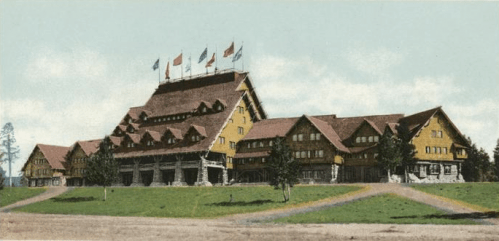
— Image, Postcard of Old Faithful Inn, c, 1906. New York Public Library.

 M. Mark Miller, Author