Category: Humor

  • A Tale: Nights of Romance in Yellowstone Park — 1919

    Not all stories about Yellowstone Park are high adventures like battling Indians, or tumbling down canyons, or falling in geysers. Some are just sweet little tales about young people falling in love. Here’s an example.

    ∞§∞
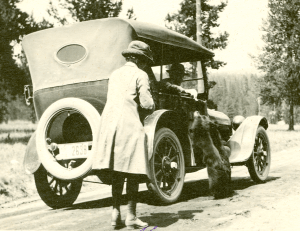
    Yellowstone Bear on the Running Board.

    The giant Speedex hummed out of Bozeman with its load of khaki-clad, riding-trousered women and men in old army uniforms. The running-board was piled high with the dunnage which accompanies an automobile tour, and in back, two burly, grey, spare tires rode majestic. The giant Speedex was bound for the Yellowstone Park.

    Not two minutes behind roared Winsted Tripp’s fiery roadster. The girl was in the big machine ahead. In the hotel the night before, Win had noted the entrance of the party; had heard the clerk describing the route they must take to get to the Park and had observed the girl. So it was that he had arisen early, and was now sailing along with the top down and windshield up, the breeze blowing over his thick hair and over the iron-grey ambrosial locks of old Pop Slocum, who was accompanying him on his trip through the Park.

    All morning long the roadster sped down the Yellowstone Trail on its way to the Gardiner gateway. Win kept a lookout for the Speedex, and twice sighted the big spare tires down the dustless road ahead. He aimed to travel a short distance behind the other party, and if necessary assist Fate in decreeing that they should stop at the same hotel that night.

    They made Mammoth Hot Springs about half-past four and secured a room. Then the young man with his old comrade went for a tour of the great hot springs formation. It was the cool of the afternoon, and the white limestone dust on the formation looked like snow. Old maids, college professors, geologists, guides, bored tourists, were everywhere, giving the multitudinous colored pools, spiderweb limestone deposits, and other wonders the great American “once-over.”

    Win thought once that he glimpsed the girl, but he couldn’t be sure.

    Those nights at Mammoth Hotel! The stars sparkling in the dry air of that high altitude; the arc lights flaring like giant diamonds around the grounds; the dance-floor in the hotel swimming in color as the couples sway to the orchestra’s jangling tunes; the scent of balsam firs that pervades everything in the Park . . . Nights of romance!

    “Go in and dance,” urged Pop Slocum. “You may not know yon gay damsels, but tell ’em you’re a gentleman and are taking as much risk as they are anyhow, and I’ll bet no one will object.”
    Ballroom Scene.

    But Win preferred to sit on the sidelines and watch the dancers. He had been a male wallflower since the first dance he had ever attended. He couldn’t talk to girls, that was the trouble; he always felt called on to say something humorous or brilliant, and always managed to stammer out some peculiarly stupid remark.

    And so, melancholy came upon Win, and he began to be afraid of his interest in the girl. She was too far above him, he concluded; she’d never understand. Finally, he went upstairs to bed.

    The travellers went on early the next morning. They were getting into the heart of the great reserve, and the roads were becoming ever more tortuous and steep, though their ribbon-smooth surfacing continued.

    Pop Slocum was surprised by Win’s gloomy silence in the seat beside him. The old man had turned and stared for perhaps thirty seconds, while Win tried to look unconscious of it but felt the hot blood climbing to his ears.

    “My God!” finally boomed the old man. “I might have known as much!”

    “Known what?” asked Win.

    “You’re in love, my boy, in love! That’s my diagnosis!”

    Win grinned like a twelve-year-old boy.

    “Correct you are, Pop,” he admitted.

    ###

    The Norris Geyser Basin rushed upon them around a curve, and Win drove his car off to the side of the road and stopped with a squall of brake linings. Below them was spread the basin, like the roof of hell’s kitchen, smoking and steaming and hissing in a thousand vents.

    The two men set out for the basin They had walked hardly a dozen steps when the old man grasped Win’s arm.

    “There she is, lad!” he whispered, pointing towards the party out on the walk.

    And there indeed she was, clad in an abbreviated yellow coat, khaki breeches, puttees, and battered old army hat. Win quickened his pace, and the old man giggled excitedly.

    “Now, leave it to me, Bud,” he instructed. “Just follow my lead, and keep wide awake.”

    They approached the party with all decent speed; the others had paused to examine a steam vent, and in no time, Win was able to get a satisfactory glance at the group. Pop Slocum was not idle. He had a way with him which never gave offense, yet admitted him to any company on terms of friendly and jovial intimacy. He had introduced himself and Win all around within three minutes.

    And the girl? She smiled at Win frankly, as if she were meeting a friend again. She was about to say something, when Pop suddenly slipped and nearly tumbled into the hot water that lay on the thin crust of the basin. He grasped frantically and in so doing kicked the girl’s foot so as to shove her towards Win.

    She lost her balance, and fell into Win’s arms. Perhaps he held her longer than was really necessary; at any rate he saw that she was thoroughly steady and in no danger of falling before letting her go. Pop had recovered, and the incident passed off. But Dorothy Brown’s cheeks were bright with color; and Winsted Tripp was reduced to embarrassed silence.

    ###

    It was evening at the Grand Canyon Hotel. In the lobby the jazz band was putting “pep” into the couples weaving in and out on the polished floor. On the porch the older men smoked and talked of war and bolshevism and stockmarkets and automobiles, while the women gathered in those familiar gossip-circles which they can never forego, although they have the vote, and sit in Congress.

    A steep winding trail leads down from the Canyon hotel to a platform overlooking the lower falls of the Yellowstone.  Here Win had come, to sit in the moonlight and bid farewell to the romance he had possessed

    The night was bright with a full moon, and the canyon of the Yellowstone stretched away before him into infinity, a grey giant, dreaming under the stars. The roar of the river had become nearly soundless to Win’s ears, its steady noise turning his nerves to its own pitch.

    He was aroused from his reflections by the presence of someone else on the platform. He looked again, and rubbed his eyes.

    “Oh, so it’s you back again,” he said confusedly.

    “Yes,” said Dorothy Brown, “It’s I, back again.”

    Her tone had a little gladness that Win could not mistake. In that moment he knew his heart had found its objective

    ∞§∞

    — Condensed from R. Maury, “A Yellowstone Rencontrem,” The University of Virginia Magazine, October 1919, pp. 221-232.

    — “Bear on the Running Board,”  Pioneer Museum of Bozeman Photo.

    — “Ballroom Scene,” detail from Library of Congress Photo.
  • A Tale: Skiing with Theodore Roosevelt in Yellowstone Park — 1903

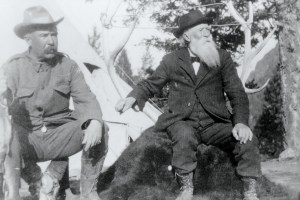
    In 1903 President Theodore Roosevelt invited John Burroughs to join him on a two-week trip to Yellowstone National Park. At the time, Burroughs was a very popular writer whose nature essays were compared to those of Henry David Thoreau.

    Theodore Roosevelt and John Burroughs

    Roosevelt and Burroughs had built a long-term friendship on their mutual respect and love of the nature. They corresponded regularly, mostly about natural history. For some reason the president called Burroughs “Oom John.”

    The pair crossed the country in Roosevelt’s private Pullman car stopping at cities and towns where the president met local dignitaries and gave speeches. Between cities the president reminisced about his life as a rancher and sportsman.

    When they reached the entrance of the park at Gardiner, the Roosevelt left reporters and his secret service guards behind and went through the park accompanied only by Burroughs, Park Superintendent John Pitcher and a small entourage. 

    The 65-year-old Burroughs was afraid he wouldn’t be able the keep up with the 44-year-old president who had a larger-than-life reputation for physical stamina. Here’s Burroughs’ description of what happened when the pair went skiing.

    ∞§∞

    At the Canyon Hotel the snow was very deep, and had become so soft from the warmth of the earth beneath, as well as from the sun above, that we could only reach the brink of the Canyon on skis. The President and Major Pitcher had used skis before, but I had not, and, starting out without the customary pole, I soon came to grief. The snow gave way beneath me, and I was soon in an awkward predicament. The more I struggled, the lower my head and shoulders went, till only my heels, strapped to those long timbers, protruded above the snow. To reverse my position was impossible till some one came, and reached me the end of a pole, and pulled me upright. But I very soon got the hang of the things, and the President and I quickly left the superintendent behind. I think I could have passed the President, but my manners forbade. He was heavier than I was, and broke in more. When one of his feet would go down half a yard or more, I noted with admiration the skilled diplomacy he displayed in extricating it. The tendency of my skis was all the time to diverge, and each to go off at an acute angle to my main course, and I had constantly to be on the alert to check this tendency.

    Paths had been shoveled for us along the brink of the Canyon, so that we got the usual views from the different points. The Canyon was nearly free from snow, and was a grand spectacle, by far the grandest to be seen in the Park. The President told us that once, when pressed for meat, while returning through here from one of his hunting trips, he had made his way down to the river that we saw rushing along beneath us, and had caught some trout for dinner. Necessity alone could induce him to fish.

    Across the head of the Falls there was a bridge of snow and ice, upon which we were told that the coyotes passed. As the season progressed, there would come a day when the bridge would not be safe. It would be interesting to know if the coyotes knew when this time arrived.

    The only live thing we saw in the Canyon was an osprey perched upon a rock opposite us.

    Near the falls of the Yellowstone, as at other places we had visited, a squad of soldiers had their winter quarters. The President always called on them, looked over the books they had to read, examined their housekeeping arrangements, and conversed freely with them.

    In front of the hotel were some low hills separated by gentle valleys. At the President’s suggestion, he and I raced on our skis down those inclines. We had only to stand up straight, and let gravity do the rest. As we were going swiftly down the side of one of the hills, I saw out of the corner of my eye the President taking a header into the snow. The snow had given way beneath him, and nothing could save him from taking the plunge. I don’t know whether I called out, or only thought, something about the downfall of the administration. At any rate, the administration was down, and pretty well buried, but it was quickly on its feet again, shaking off the snow with a boy’s laughter. I kept straight on, and very soon the laugh was on me, for the treacherous snow sank beneath me, and I took a header, too.

    “Who is laughing now, Oom John?” called out the President.

    The spirit of the boy was in the air that day about the Canyon of the Yellowstone, and the biggest boy of us all was President Roosevelt.

    ∞§∞

    — You also might enjoy “The Army Protects Theodore Roosevelt from Snooping Reporter in Yellowstone Park.”

    — Excerpt from “Camping with the President” by John Burroughs,” Saturday Evening Post, May, 1906.

    — Yellowstone Digital Slide File Photo.

  • A Tale: A Mother Takes Her Seven Children to Yellowstone Park — 1903

    In 1903, Eleanor Corthell bought a team of horses and a spring wagon to take her seven children to Yellowstone Park. She told the seller to send his bill to her husband, Nellis Corthell, a prominent Laramie lawyer. Nellis tried to talk Eleanor out of the trip, but in the end, she said, all he could do was “fizz and fume and furnish the wherewithal.”

    Here are some excerpts from Mrs. Corthell’s account of her family’s adventures.

    ∞§∞

    Nearly half a lifetime I have lived in Laramie, with all the while a great longing to see the wonders of the Yellowstone, in season, out of season, when the house was full of babies—even when it was full of measles. As the older children outgrew marbles and dolls, I conceived the bold idea of stowing them all in a prairie schooner and sailing away over the Rocky Mountains, deserts, forests and fords to the enchanted land five hundred miles away.

    My husband offered strenuous objection, of course, to the crazy project, but could only fizz and fume and furnish the wherewithal—for the reasons advanced he found irresistible, such an ideal vacation for the children. A chance for their botany, geography, zoology, to be naturalized. To be drivers and cooks would throw them on their own resources somewhat, a valuable education in itself. So economical, too! Such a fine opportunity for stretching of legs and lungs, with the Park at the end! Reasons to turn a man’s head, you see, so when the boys wrote along the wagon top ” Park or Bust,” that settled it, and we started July 4th, 1903.

    After traveling several days, Mrs. Corthell wrote:

    Everybody is growing handy, even expert, in camp work. The boys can skin a cottontail or dress a sage hen equal to Kit Carson himself, while daughter can prepare a savory dinner or pack a mess box good enough for an army general. The children are eagerly interested in everything they see, hear or can catch. Tad announces that we have seen nine horned toads, caught six, mailed three and have two packed in little tablet boxes with which to surprise the chum at home. Query: Where is the medicine that was in the boxes?

    At the Paint Pots near West Thumb on Lake Yellowstone, Eleanor was vigilant.

    I was kept busy counting the children. Every time one of them moved I was certain he would stumble into one of the boiling, walloping vats of mud. That the mud was delicate rose, emerald green, or heavenly blue did not reassure me in the least. But the children simply laughed. Even the youngest pertly informed me he had not come all the way to Yellowstone Park to fall into a mud hole. Still the horrid smells and the horrible groans and growls, and the gaping mouths clear to Hades aroused such emotions of terror in me that in sheer desperation I hurried over to the lake.

    Eleanor summarized the trip this way:

    Like everybody else, we loved Old Faithful and the Morning Glory, we feared Excelsior, we admired the Giant, Bee Hive, Punch Bowl and a hundred other yawning chasms and smiling springs and spouting geysers. But the horrible rumbling—as if an earthquake were imminent—and the smell of brimstone made me eager to get my brood into the valley of safety beyond the Yellowstone.

    Altogether we traveled twelve hundred miles, stood the journey well, and never, never had such a wonderful, delightful summer. The children will have lifelong memories of the grandest scenes the world can produce.

    ∞§∞

    — Excerpts from “A Family Trip to the Yellowstone” by Mrs. N. E. Corthell, The Independent, June 29, 1905.

    — Photo from the Pioneer Museum of Bozeman.

    — You can read Eleanor Corthell’s complete story about her family trip in my book, Adventures in Yellowstone.

    — You also might enjoy Mrs. Corthell’s story about chasing a bear away from her bean pot.

  • A Tale: Stampeded by an Umbrella — Wingate, 1885

    General George W. Wingate, a wealthy New Yorker, took his wife and 17-year-old daughter to Yellowstone Park in 1885. Although there were roads by then, the Wingates decided to travel on horseback and the women rode sidesaddle. Here’s General Wingate’s description of an incident that occurred while the ladies were riding through the Paradise Valley north of Yellowstone Park.
     ∞§∞

    Hemmed in on every side by high mountains every breath of air was excluded, while the sun beat into it like a furnace; consequently the ride was very hot and tiresome. The heat was so great that the ladies got out their umbrellas from the wagon and raised them, but slowly with great care, for fear of stampeding the ponies who were not familiar with those refinements. The horses, however, were tired and languid from the heat and paid no attention to them so the rode forward in comfort.

    As we reached the end of the valley, where the Park branch of the Northern Pacific terminates, a dashing young ranchman rode out from behind some buildings. He had a spirited horse and rode well—and he knew it. Ladies were scarce in the valley, and the opportunity to display his horsemanship and personal graces to two at once was not to be thrown away. So he swung his horse around and rode towards us, making his steed curvet and prance, while he swayed to the motion as easily and gracefully as if in an armchair.

    While we were admiring him, a sudden gust of wind came whirling out of a canyon. It caught my daughter’s umbrella and instantly turned it inside out, with a loud “crack.” At the unwonted sight and sound, our horses roused from their lethargy, simultaneously reared, snorted and bolted in different directions, and at their top speed.

    The steed of our gallant ranchman was even more frightened that ours. It ran half a mile with him, and as we last saw him he had all he could do to keep it from dashing into a barbed wire fence. The change from his jaunty air to that of anxiety to keep the horse out of the fence was sudden and ludicrous. I fear his pride had a sad fall.

    We could do nothing with the horses until May threw away her unbrella, and even then none of our steeds would approach it.  As [our guide] Fisher said, “umbrellas and cayuses don’t agree.”

    ∞§∞

    — Text adapted from Through Yellowstone on Horsback by George W. Wingate, 1886

    — Detail from illustration in Wingate’s book.

    — You also might enjoy “Little Invulnerable,” N.P. Langford’s description of the antics of an undersized horse.

  • A Tale: Crashing Through Yankee Jim Canyon in a Wooden Boat — c. 1902

    Today it’s easy to hire a boat with a guide to run the rapids through Yankee Jim Canyon north of Yellowstone Park. But that wasn’t always the case, as Lewis Ransome Freeman discovered more than a hundred years ago.

    After graduating from Stanford University in 1898, Freeman decided to become an adventurer and traveled America, Asia, Africa and the Pacific Islands. About 1902, after snowshoeing through Yellowstone Park, he decided to float to the Gulf of Mexico down the Yellowstone, Missouri, and Mississippi Rivers. His first obstacle was to get through Yankee Jim Canyon, a rugged streatch of the Yellowstone River just north of the Park.

    Freeman solicited help from Yankee Jim George, a colorful character who had lived for 30 years  in the canyon that bears his name. The government had taken over Jim’s toll road by then, but he still provided accommodations in his rustic cabin. And, he knew where Freeman could get a boat.

    Freeman covered the Russo-Japanese War beginning in 1905 and continued to work as a war correspondent through World War I. It wasn’t until 1922 that he published this description of running the rapids of Yankee Jim Canyon.

    ∞§∞

    The boat I secured about ten miles down river from the Park boundary. The famous “Yankee Jim” gave it to me. This may sound generous on Jim’s part, but seeing the boat didn’t belong to him it wasn’t especially so. Nor was the craft really a boat.

    We found the craft where it had been abandoned at the edge of an eddy. It was high and dry on the rocks. Plain as it was that neither boat-builder nor even carpenter had had a hand in its construction, there was still no possible doubt of its tremendous strength arid capacity to withstand punishment.

    Jim said that a homesick miner had built this fearful and wonderful craft with the idea of using it to return to his family in Hickman, Kentucky. He had bade defiance to the rapids of the Yellowstone with the slogan “HICKMAN OR BUST.” Kentucky Mule he had called it.

    Our plan of operation was something like this: Bill and Herb, the neighboring ranchers, were to go up and help me push off, while Jim went down to the first fall at the head of the Canyon to be on hand to pilot me through. If I made the first riffle all right, I was to try to hold up the boat in an eddy until Jim could amble down to the second fall and stand-by to signal me my course into that one in turn. And so on down through.

    I was to take nothing with me save my camera. My bags were to remain in Jim’s cabin until he had seen me pass from sight below the Canyon. Then he was to send the stuff on to me at Livingston

    As I swung round the bend above the head of the Canyon, I espied old Jim awaiting my coming on a rocky vantage above the fall. A girl in a gingham gown had dismounted from a calico pony and was climbing up to join us. With fore-blown hair and skirt, she cut an entrancing silhouette against the sun-shot morning sky.

    I think the presence of that girl had a deal to do with the impending disaster, for I would never have thought of showing off if none but Jim had been there. But something told me that the exquisite creature could not but admire the sang froid of a youth who would let his boat drift while he stood up and took a picture of the thundering cataract over which it was about to plunge.

    And so I did it—just that. Then, waving my camera above my head to attract Jim’s attention to the act, I tossed it ashore. That was about the only sensible thing I did in my run through the Canyon.

    As I resumed my steering oar, I saw that Jim was gesticulating wildly in an apparent endeavor to attract my attention to a comparatively rock-free chute down the left bank. Possibly if I had not wasted valuable time displaying my sang froid I might have worried the Mule over in that direction, and headed right for a clean run through.

    As it was, the contrary brute simply took the bit in her teeth and went waltzing straight for the reef of barely submerged rock at the head of the steeply cascading pitch of white water. Broadside on she sunk into the hollow of a refluent wave, struck crashingly fore and aft, and hung trembling while the full force of the current of the Yellowstone surged against her up-stream gunwale.

    Looking back up-stream as the reeling Mule swung in the current, I saw Jim, with the Gingham Girl in his wake, ambling down the bank at a broken-kneed trot in an apparent endeavor to head me to the next fall as per schedule.

    Poor old chap! He was never a hundred-to-one shot in that race now that the Mule had regained her head and was running away down mid-channel regardless of obstacles. He stumbled and went down even as I watched him with the tail of my eye. The Gingham Girl pulled him to his feet and he seemed to be leaning heavily against her fine shoulder as the Mule whisked me out of sight around the next bend.

    With the steering oar permanently unshipped there was more difficulty than ever in exercising any control over the balkiness of the stubborn Mule. After a few ineffectual attempts, I gave up trying to do anything with the oar and confined my navigation to fending off with a cottonwood pike-pole.

    This really helped no more than the oar, so it was rather by good luck than anything else that the Mule hit the next pitch head on and galloped down it with considerable smartness. When she reeled through another rapid beam-on without shipping more than a bucket or two of green water I concluded she was quite able to take care of herself, and so sat down to enjoy the scenery.

    I was still lounging at ease when we came to a sharp right-angling notch of a bend where the full force of the current was exerted to push a sheer wall of red-brown cliff out of the way. Not unnaturally, the Mule tried to do the same thing. That was where I discovered I had over-rated her strength of construction.

    I have said that she impressed me at first sight as being quite capable of nosing the Rock of Gibraltar out of her way. This optimistic estimate was not borne out. That little patch of cliff was not high enough to make a respectable footstool for the guardian of the Mediterranean, but it must have been quite as firmly socketed in the earth. So far as I could see it budged never the breadth of a hair when the Mule, driving at all of fifteen miles an hour, crashed into it with the shattering force of a battering ram. Indeed, everything considered, it speaks a lot for her construction that she simply telescoped instead of resolving into cosmic stardust. Even the telescoping was not quite complete.

    The Mule had ceased to be a boat and become a raft, but not a raft constructed on scientific principles. The one most desirable characteristic of a properly built raft of logs is its stability. It is almost impossible to upset. The remains of the Mule had about as much stability as a toe dancer, and all of the capriciousness.

    She kept more or less right side up on to the head of the next riffle and then laid down and negotiated the undulating waves by rolling. I myself, after she had spilled me out at the head of the riffle, rode through on one of her planks, but it was a railroad tie, with a big spike in it, that rasped me over the ear in the whirlpool at the foot.

    And so I went on through to the foot of “Yankee Jim’s Canyon.” In the smoother water, I clung to a tie, plank or the thinning remnants of the Mule herself. At the riffles, to avoid another clout on the head from the spike-fanged flotsam, I found it best to swim ahead and flounder through on my own. I was not in serious trouble at any time, for much the worst of the rapids had been those at the head of the Canyon. Had I been really hard put for it, there were a dozen places at which I could have crawled out. As that would have made overtaking the Mule again somewhat problematical, I was reluctant to do it. Also, no doubt, I was influenced by the fear that Jim and the Gingham Girl might call me a quitter.

    Beaching what I must still call the Mule on a bar where the river fanned out in the open valley at the foot of the Canyon, I dragged her around into an eddy and finally moored her mangled remains to a friendly cottonwood on the left bank. Taking stock of damages, I found that my own scratches and bruises, like Beauty, were hardly more than skin deep. As the day was bright and warm and the water not especially cold, I decided to make way while the sun shone—to push on toward Livingston.

    The rest of that day’s run was more a matter of chills than thrills, especially after the evening shadows began to lengthen and the northerly wind to strengthen. The Mule repeated her roll-and-reduce tactics every time she came to a stretch of white water.

    There were only three planks left when I abandoned her at dusk, something over twenty miles from the foot of the Canyon, and each of these was sprinkled as thickly with spike-points as a Hindu fakir’s bed of nails. One plank, by a curious coincidence, was the strake that had originally borne the defiant slogan, “HICKMAN OR BUST.” Prying it loose from its cumbering mates, I shoved it gently out into the current.

    Spending the night with a hospitable rancher, I walked into Livingston in the morning. There I found my bags and camera, which good old “Yankee Jim” had punctually forwarded by the train .

    ∞§∞

    —   Condensed from Down the Yellowstone, Lewis Ransom Freeman, 1902.

    —   National Park Service Photo.

    — You might also enjoy “Rudyard Kipling Goes Fishing with Yankee Jim.”

  • A Tale: Grandma Told Me Abuse Killed the Handkerchief Pool

    When I was a little boy, my grandmother used to tell me about The Handkerchief Pool, which was one of the most popular geothermal features in Yellowstone Park when she went there in 1909. I was fascinated by the story, but Grandma explained that I would never see it because tourists threw so much junk into it that it didn’t work any more.

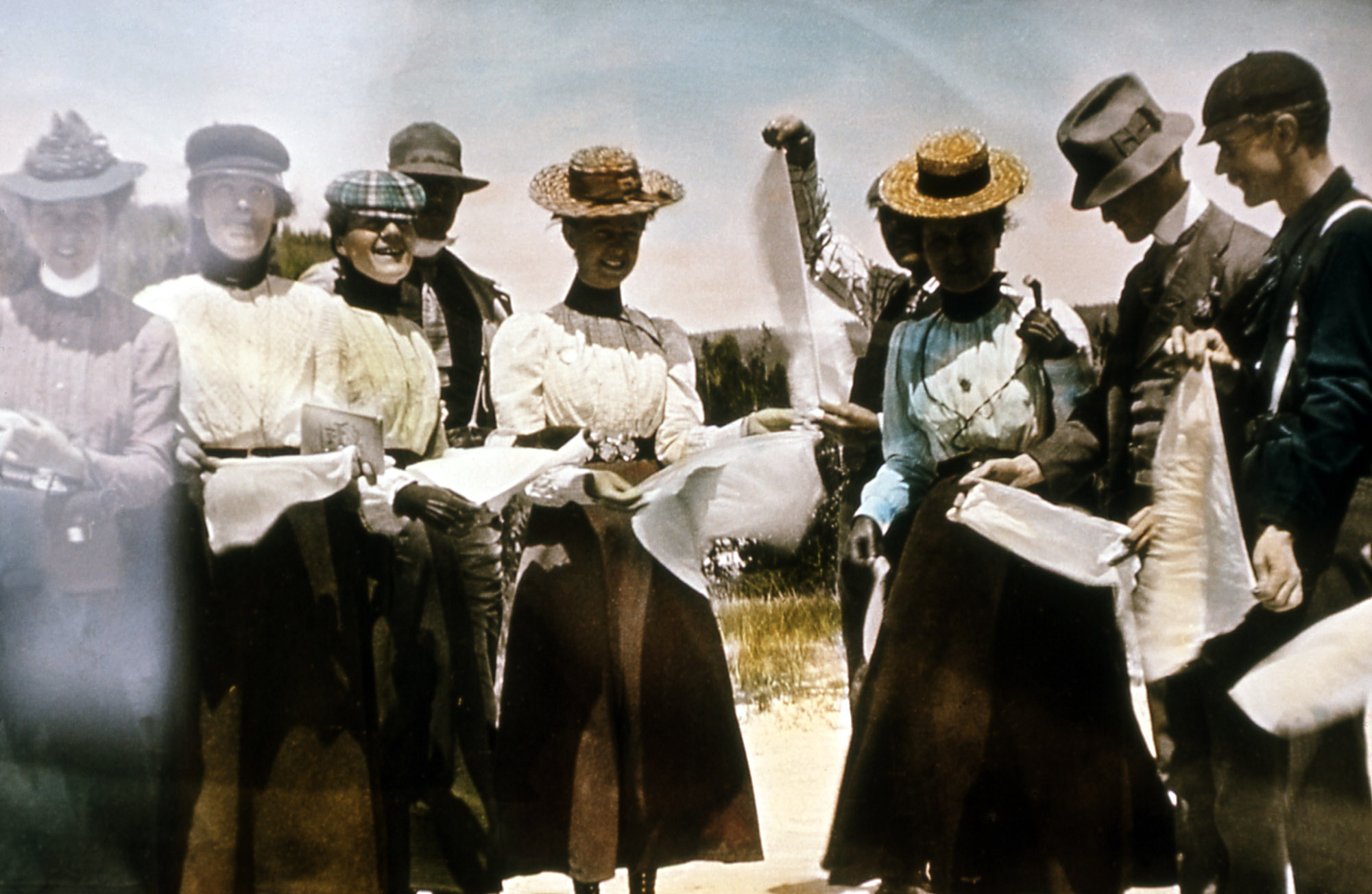
    In 1903 Hester Henshall visited the park with her husband, angling writer and fish biologist Dr. James Henshall. In the Henshal’s tour group was Lillian Elhert, an intrepid young woman who was always thrusting herself into the middle of things. Here’s Hester’s description of Miss Lillian’s antics at the Handkerchief Pool.

    ∞§∞

    The Handkerchief Pool reminded one of a great pot of boiling water, seething, roaring and bubbling, and issuing clouds of steam with a washday odor. Miss Lillian Ehlert must put her handkerchief in the pool, of course. We gathered round to watch it. It floated awhile, circling the pool, then suddenly disappeared down a sucking eddy, out of sight.

    We watched and waited, some of us thinking it had gone forever, but at last it popped up in another part of the pool and floated once more to the surface. It was then taken out with a stick, to be gazed upon by all of the party with something akin to awe. We wondered where it had been when lost to sight—what it had seen underground, and what tale it could tell if gifted with speech.

    Miss Ehlert simply said: “No checky no washee, but I got it all the same.”

    ∞§∞

    — From the journal of Hester Ferguson Henshall, Trip Through Yellowstone National Park 1903. Montana Historical Society Archives.

    — You might also enjoy Hester Henshall’s description of Miss Lilian’s antics in Cruising Lake Yellowstone.

    — Frank J. Haynes postcard, Yellowstone Digital Slide File.

  • A Tale: Rudyard Kipling Goes Fishing With Yankee Jim — 1889

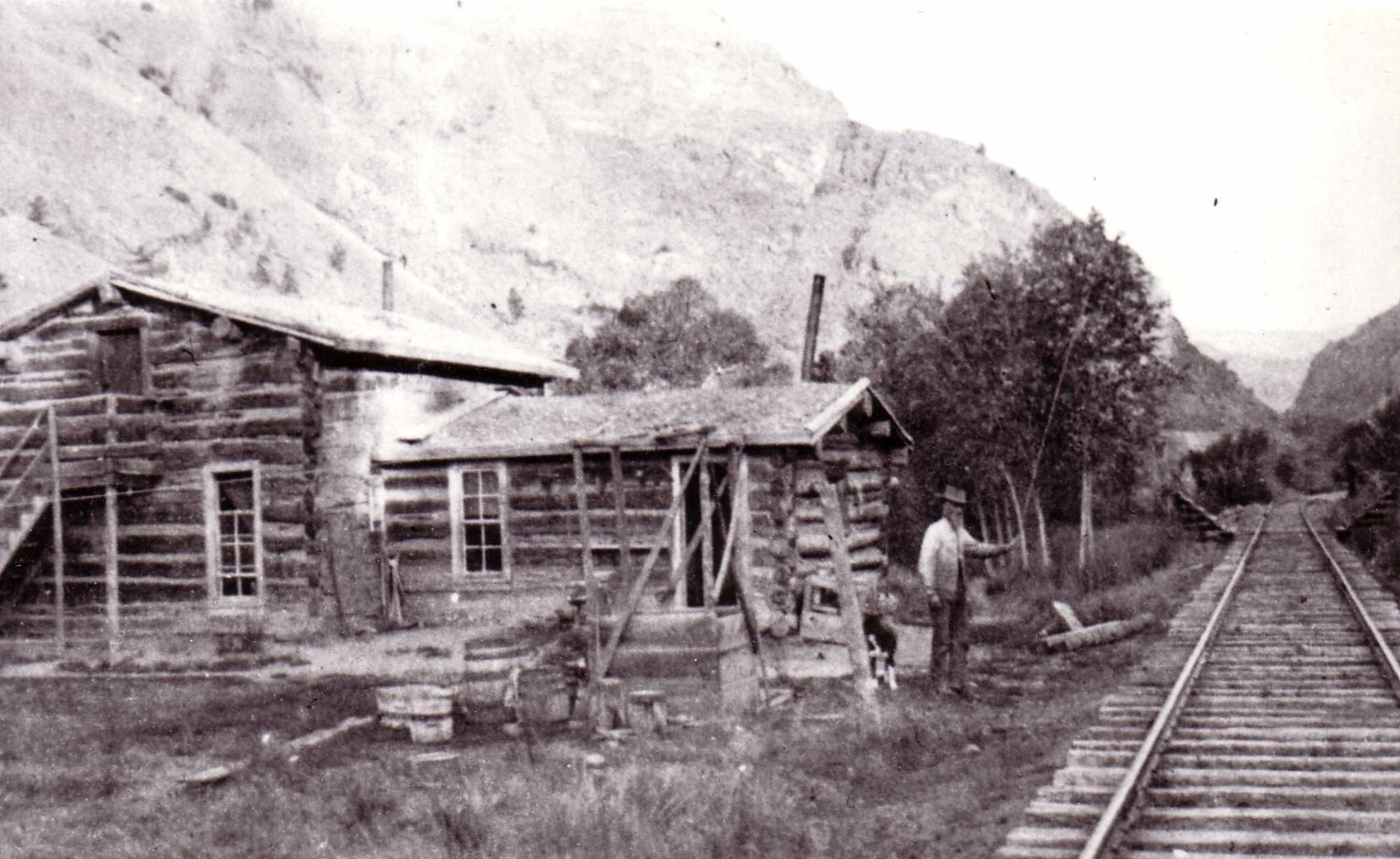
    Yankee Jim George between his cabin and the Northern Pacific track.

    In 1889 when British author Rudyard Kipling visited Yellowstone, a spur of the Northern Pacific carried passengers from Livingston, Montana, to the edge of the Park. But Kipling heeded advice from a fellow passenger and stopped to visit Yankee Jim George, the legendary operator of a toll road than ran through the canyon that still bears his name.

    Yankee Jim was a garrulous man who must have met thousands of tourists after he began collecting tolls in 1873. In 1883 the railroad took over Yankee Jim’s road bed, although they did build a bypass for him. Even after the county took over the road 1887, travelers continued to stop by Yankee Jim’s.

    Dozens of travelers’ diaries describe a stop at his cabin, note his courtly treatment of ladies and recount his tall tales. Kipling was no exception. Here’s his story.

    ∞§∞

    From Livingston the National Park train follows the Yellowstone River through the gate of the mountains and over arid volcanic country. A stranger in the cars saw me look at the ideal trout-stream below the windows and murmured softly: “Lie off at Yankee Jim’s if you want good fishing.”

    They halted the train at the head of a narrow valley, and I leaped literally into the arms of Yankee Jim, sole owner of a log hut, an indefinite amount of hay-ground, and constructor of twenty-seven miles of wagon-road over which he held toll right. There was the hut—the river fifty yards away, and the polished line of metals that disappeared round a bluff. That was all. The railway added the finishing touch to the already complete loneliness of the place.

    Yankee Jim was a picturesque old man with a talent for yarns that Ananias might have envied. It seemed to me, presumptuous in my ignorance, that I might hold my own with the old-timer if I judiciously painted up a few lies gathered in the course of my wanderings. Yankee Jim saw every one of my tales and went fifty better on the spot.

    He dealt in bears and Indians—never less than twenty of each; had known the Yellowstone country for years, and bore upon his body marks of Indian arrows; and his eyes had seen a squaw of the Crow Indians burned alive at the stake. He said she screamed considerable.

    In one point did he speak the truth—as regarded the merits of that particular reach of the Yellowstone. He said it was alive with trout. It was. I fished it from noon till twilight, and the fish bit at the brown hook as though never a fat trout-fly had fallen on the water. From pebbly beaches, quivering in the heat-haze where the foot caught on stumps cut foursquare by the chisel-tooth of the beaver; past the fringe of the water-willow crowded with the breeding trout-fly and alive with toads and water-snakes; over the drifted timber to the grateful shadow of big trees that darkened the holes where the fattest fish lay, I worked for seven hours.

    The mountain flanks on either side of the valley gave back the heat as the desert gives it, and the dry sand by the railway track, where I found a rattlesnake, was hot-iron to the touch. But the trout did not care for the heat. They breasted the boiling river for my fly and they got it. I simply dare not give my bag. At the fortieth trout I gave up counting, and I had reached the fortieth in less than two hours. They were small fish—not one over two pounds—but they fought like small tigers, and I lost three flies before I could understand their methods of escape. Ye gods! That was fishing.

    ∞§∞

    — Excerpt from  From Sea to Sea: Letters of Travel, Volume Two, Rudyard Kipling, 1899. (Page 203−205).

    — Photo, Pioneer Museum of Bozeman.

    — For related stories, click on “Fishing” under the “Categories” button to the left.

  • A Tale: An Optimistic Prospector — 1863

    Walter Washington DeLacy

    After gold was discovered near Bannack, Montana, in 1862, prospectors scoured every gully and creek searching for the next bonanza. In 1863, Walter Washington DeLacy led a 40-man expedition that explored the Snake River to its source. The party didn’t find enough “color” for a paying proposition, but they did bring back a wealth of information about the Yellowstone Plateau. DeLacy included that information in his famous 1865 map of the Montana territory. DeLacy was a civil engineer and his account of the Snake River expedition is one of few prospector accounts by an educated man. At time when a man could make a fortune from a few gold pans of dirt, prospectors were ever hopeful of striking it rich. In the virtually lawless territories prospecting parties made their own rules to assure that everybody has a fair chance. Here’s DeLacy’s description of an effort to draft some “miner’s laws.”

    ∞§∞

    I halted the men at the creek as they came up, and when all had arrived I suggested to them that we should go on to the next water, pick out a good camp, and remain some days and prospect the different streams, which were in sight. This was agreed to, and we went forward about three miles to the next creek, near the outlet of Lake Jackson and established ourselves where wood, water, and grass were abundant.

    After unpacking and staking the animals out, another meeting was called in order to decide upon our future action. It was decided to build a “corral,” to put the horses in at night that should be left in camp, and that four parties should be formed: one to remain in camp as a guard, and three others to prospect the streams in sight.

    The men were then detailed for the different expeditions, and it was suggested, that as there was a strong probability of finding good “diggings,” we should adopt some mining laws for them.

    We therefore organized ourselves into a “miners’ meeting,” and, after appointing a chairman, etc., one of the members moved, and another seconded the motion, that the following regulations should be adopted:

    1. That every person present should be regarded as a discovered in each and every gulch found by any party or member of a party.

    2. That each member, as discoverer, should be entitled to five claims of two hundred feet each along the gulch, viz., a discovery claim, and a pre-emption claim in the main gulch, a bar claim, a hill claim, and a patch claim. (I never knew exactly what a patch claim was, but I think that it meant all that you could grab, after you got the other four claims.)

    These liberal and disinterested regulations were voted in the affirmative with gratifying unanimity, and the chairman was just about to put the question to the meeting whether there was any more business before it, when a big, burly Scotchman named Brown, who had apparently been turning the subject over in his mind, jumped up, and inquired with great earnestness, “But, Mr. Chairman, what shall we do with the rest of it.”

    ∞§∞

    — Adapted from “A Trip up the South Snake River in 1863.” Walter W. DeLacy, Contributions to the Historical Society of Montana, Vol. 2, 1896.

    — Photo, Yellowstone Digital Slide File

    — For more funny stories click on “Humor” under the “Categories” button on the left side of this page.

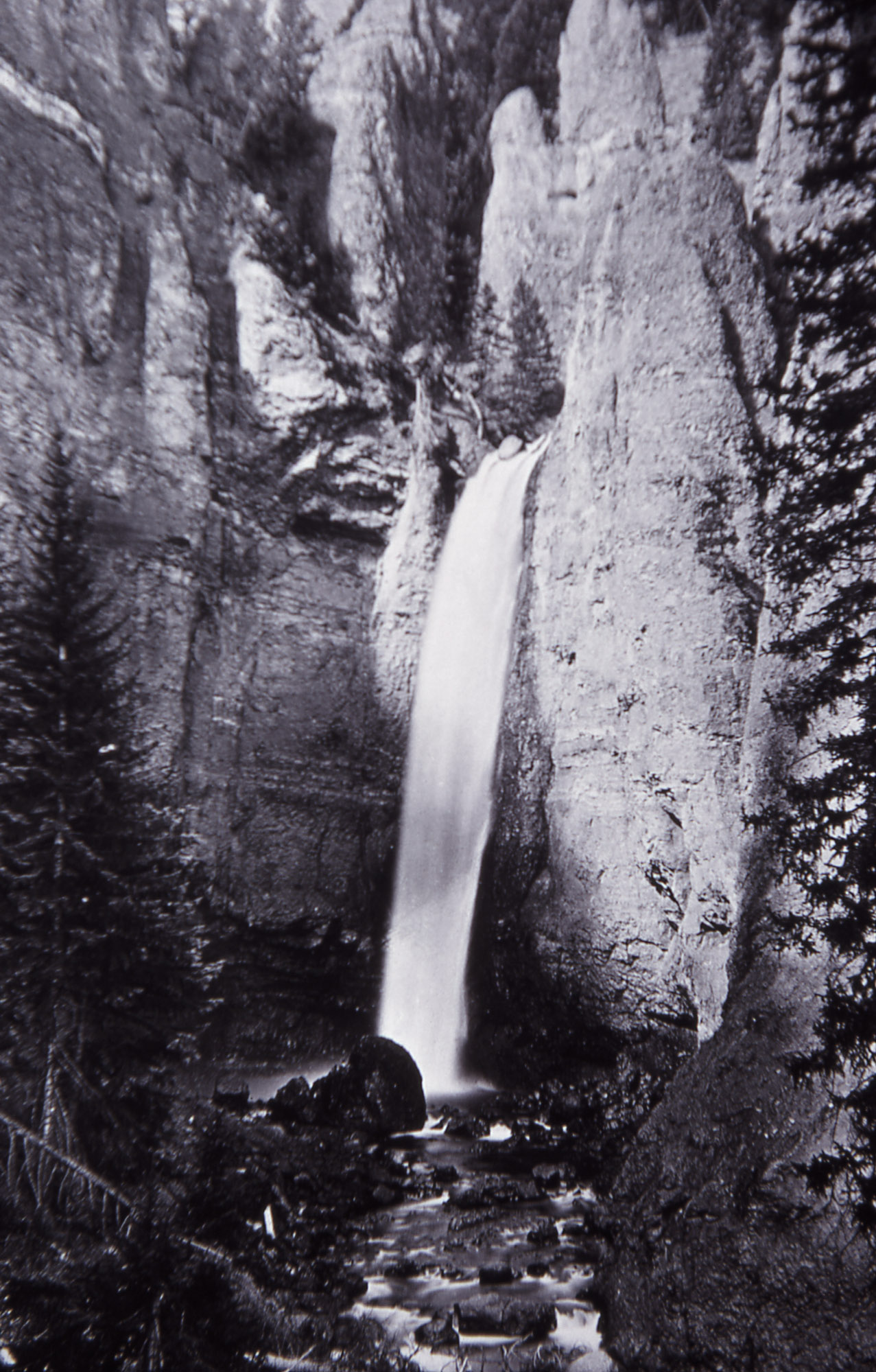
  • A Tale: Naming Tower Fall— Langford, 1870

    In 1870 the famous Washburn Expedition explored the remote area that became Yellowstone National Park. While the explorers always had be be alert for the dangers of Indians, wild animals, and strange geothermal features, they also found ways to have fun. Here’s Nathaniel P. Langford’s description of  one of the pranks they played on each other.

    ∞§∞

    At the outset of our journey we had agreed that we would not give to any object of interest that we might discover the name of any of our party nor of our friends. This rule was to be religiously observed.

    While in camp on Sunday, August 28th, on the bank of this creek, it was suggested that we select a name for the creek and fail. Walter Trumbull suggested “Minaret Creek” and “Minaret Fall.” Mr. Hauser suggested “Tower Creek” and “Tower Fall.” After some discussion a vote was taken, and by a small majority, the name “Minaret” was decided upon.

    During the following evening Mr. Hauser stated with great seriousness that we had violated the agreement made relative to naming objects for our friends. He said that the well known Southern family—the Rhetts—lived in St. Louis, and that they had a most charming and accomplished daughter named “Minnie.” He said that this daughter was a sweetheart of Trumbull, who had proposed the name her name, “Minnie Rhett” — and that we had unwittingly given to the fall and creek the name of this sweetheart of Mr. Trumbull.

    Mr. Trumbull indignantly denied the truth of Hauser’s statement, and Hauser as determinedly insisted that it was the truth. The vote was therefore reconsidered, and by a substantial majority it was decided to substitute the name “Tower” for “Minaret.” Later, and when it was too late to recall or reverse the action of our party, it was surmised that Hauser himself had a sweetheart in St. Louis — a Miss Tower.

    ∞§∞

    —Excerpt from N. P. Langford, The Discovery of Yellowstone Park.

    —William Henry Jackson Photo, Yellowstone Digital Archive.

    — You can read a condensed version of Langford’s The Discovery of Yellowstone Park in my book, Adventures in Yellowstone.

    — To see more stories by this author, click on “Langford” under the “Categories” button to the left.

    — For more stories about the Washburn Expedition, click on “Washburn” under the “Categories” button to the left.

  • A Tale: A Million Billion Barrels of Hot Water — 1871

    A group of professionals and businessmen visited the geysers in 1871—long before the era of hot water heaters. The trip was chronicled by Harry Norton, who published the first Yellowstone travel guide in Virginia City in 1873. Norton called one of his companions, who owned telegraph lines between Deer Lodge and Bozeman, “Prince Telegraph.” Here’s Norton’s description of the Prince’s experiments in geyserland.

    ∞§∞

    Just for the oddity of the idea, some of the party proposed that we should try a cup of geyser tea. Happy thought! A million billion barrels of hot water within easy reach, and nothing to do but put the tea a-drawing! Notwithstanding all that has been said by former tourists, the tea was excellent—and produced no disagreeable effects.

    We afterwards utilized several of the geysers by boiling meat, dirty clothes, beans, coffee, etc., each experiment being attended with satisfaction. For boiled beans, two quarts of “navies” were put in a flour sack, and with a rope, lowered into the steaming crater. In thirty minutes they were perfectly soft and palatable. This is not a first-rate method to make allopathic bean soup, but for a homeopathic dose. it can’t be beat. In this connection, a little incident:

    Prince Telegraph’s wardrobe, like our saddle-seat, was constantly getting out of repair—and as he had failed in trying to sew on a patch with a needle-gun he was obliged to procure assistance. He finally compromised affairs by a change of duties: Woodall, an expert, was to sew on the patch while Prince Telegraph washed the dishes—his first attempt probably in a lifetime. Hesitating a moment, a brilliant idea struck him. Fifty or sixty feet distant was a very noisy little geyser. Its aperture was in the centre of a noisy shallow, well-rimmed basin of about two and a half by four feet. The water scarcely ever covered the flat bottom at a greater depth than two inches.

    Pitching the soiled tin ware, knives, forks, towels, etc., into a champagne basket, and with an “0h, ho! I guess I can’t wash dishes!” the Prince approaching his improvised dishpan, unceremoniously dumped them in to soak while he placidly enjoyed his meerschaum. Suddenly, and as if resenting the insult to its dignity, the little spouter spit the basin full to overflowing in a second. Setting the contents in a perfect whirl, and the next instant, drawing in its breath, the geyser commenced sucking everything toward the aperture.

    We at the camp heard an agonizing cry for help, and looking out, beheld the Prince—with hat off and eyes peeled—dancing around his dishpan in a frantic attempt to save the last culinary outfit. It was comical in the extreme. There would be a plunge of the hand in the boiling water, a yell of pain, and out would come a spoon—another plunge and yell, and a tin plate—an” Oh! ah! o-o-o, e-e-e” and a fork. As we arrived, the towel and one tin plate were just going out of sight; while the Prince, gazing at his parboiled hands, was profanely discussing the idea of being “sucked in” by a geyser!

    ∞§∞

    — From  Harry J. Norton, Wonderland Illustrated or, Horseback Rides Through the Yellowstone National Park, 1873.

    — Postcard from the Yellowstone Digital Slide File.

    — You may also enjoy Colonel William J. Barlow’s tale of bathing in Mammoth Hot Spring.

    — For more funny stories click on “Humor” under the “Categories” button on the left side of this page.