Category: Hunting

  • A Tale: In a Country Swarming With Grizzly Bears — 1874

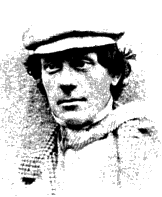
    Dr. George Henry Kingsley

    While doing research for my next book, Encounters in Yellowstone , I’ve kept a list of  everbody who was in the park when the Nez Perce passed through there in 1877. I’ve discovered some interesting people who skedaddled before the Indians arrived.

    Among them was an intrepid trio that was reprising a trip they had made to Yellowstone Park in 1874.  They were “Texas Jack” Omohundro, a frontiersman and sometimes partner of Buffalo Bill Cody and his Wild West Show; The Earl of Dunraven, whose book The Great Divide popularized Yellowstone Park in England, and George Henry Kingsley, an English physician and adventurer.

    After Dr. Kingsley’s death, his daughter, Mary Henrietta Kingsley, compiled his papers into a book entitled Notes on Sport and Travel.  Here’s Dr. Kingley’s account of hunting grizzlies in Yellowstone Park in 1874 from that book.

    ∞§∞

    We have had very poor sport, for though we have been in a country swarming with grizzly bears we have only killed one. I was mousing around by myself the other day with the little Ballard—(a little, single-barreled rifle)—and hearing something smashing about in the willow beds, and thinking that it might be a deer, I proceeded quietly to investigate, when out there lounged the great-grandfather of all the grizzlies.

    He looked at me for a moment, and then turned and trotted off, and I trotted after him, when he, being suddenly struck with the idea that valor was the better part of discretion, faced round and walked straight at me, stopping about thirty yards off.

    As I only had the Ballard, and was quite out in the open, away from any decently sized trees, I hardly knew what to do. We stood facing each other thus for a few moments, and I could plainly see his pink tongue licking his lips, and his bright little eyes twinkling with rage.

    I put up the rifle, but could not cover any part of him where a ball would have been mortal, and if I had only wounded him, he would have been at me in a brace of shakes. After interviewing one another thus, he said “hough” and decided to advance, and I decided to retreat, which I did with considerable decision up the thickest sapling in the neighborhood, hoping, however, that he would follow me at least to the foot of it.

    I was in no small state of exultation at the prospect of killing my bear single-handed, but before I was settled, he swerved and went crashing away through the willows, and I saw him no more. He looked as big as an ox.

    Texas Jack quizzed me tremendously about this on my return, but the very next day he came back to camp with a far-away look in his eye and requested whisky. He too had come across a grizzly. He found him in a patch of trees, covering up the carcass of an elk—they are wonderfully cunning, these bears, and will plaster mud and moss over carcasses they don’t want at once, will even plaster over their wounds when they have been shot.

    Jack fired. Hit him. The bear gave one tremendous yell—looked round a moment—then tore up the ground like mad and flew at the trees, sending the bark flying in all directions. Jack lay as flat as a flounder behind a tree, and when, at length, the bear made off, came home a wiser man.

    After hearing his account I was rather glad, on the whole, that my friend had not followed to the foot of my sapling, for had I not killed him first shot, he would certainly have made it a very shaky perch to reload on.

    ∞§∞

    — Frmm Notes on Sport and Travel by George Henry Kingsley, 1900.

    — Illustration from Notes on Sport and Travel.

    — For more stories about The Earl of Dunraven, click on “Dunraven” under the “Categories” button to the right.
  • News: Climate Change—Not Just Wolves—May Cause Fewer Yellowstone Elk

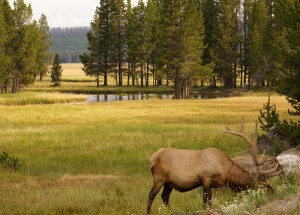
    Hunters have been blaming the introduction of Wolves for the recent decline in the number of elk in Yellowstone National Park, but new research indicates that climate change may be to blame. New West has provided a nice summary of the evidence.

    The news reminded me that several of the accounts of early travel to Yellowstone Park talk about summer snow storms bigger than anything we see now. Of course, the storytellers may have been exaggerating, but perhaps I should see if travel accounts provide evidence of climate change.

    Also, early travelers who went to the Park in August (apparently to avoid bad weather) often couldn’t find game. Before the Army outlawed hunting in 1886, many groups counted on living off the land, so when game was scarce they went hungry. Several stories tell about the great joy of returning to the ranches near the park and getting “civilized grub.”

    The Earl of Dunraven, who visited the Park in 1874, commented explicitly about how weather affects the migration of elk and other game.

    ∞§∞

    The herds of game move according to the seasons. In Estes Park, for instance, near Denver, you might go out in winter or in early spring, when the snow is deep upon the ranges and shoot blacktail deer till you were sick of slaughter. I daresay you might—if you knew where to go—sit down, and, without moving, get ten, fifteen, or even as many as twenty shots in the day.

    At other seasons you might walk the flesh off your bones without seeing a beast of any kind. Yet the deer are somewhere all the time; and, if you can only find out to what deep recesses of the forest, or to what high mountain pastures they have betaken themselves in their search for cool shelter, or in their retreat from mosquitoes and other insect pests, you would be amply rewarded for your trouble.

    It is the same with wapiti. Sometimes the park will be full of them; you may find herds feeding right down on the plains among the cattle; and in a fortnight there will be none left. All will have disappeared; in what is more, it is almost impossible to follow them up and find them, for they are much shyer than the deer.

    Where do they go? Not across the snowy range, certainly. Where then? Up to the bare fells, just under the perpetual snow, where they crop the short sweet grass that springs amid the debris fallen from the highest peaks; to the deep black recesses of primeval forest; to the valleys, basins, little parks and plains, hidden among the folds of the mountains, where even the wandering miner has never disturbed the solitude.

    ∞§∞

    — Excerpt from The Great Divide by the Earl of Dunraven.

    — New West Photo.

    — You can read a condensed version of the Earl’s 1874 trip to Yellowstone Park in my book, Adventures in Yellowstone.

  • A Tale: Lord Blackmore Riles His Guide by Catching 254 Fish in One Day — 1872

    In the 1870s a curious conflict developed  over who got to kill wildlife in Yellowstone Park. After decimating the bison herds on the great plains, hide hunters converged on the park and  slaughtering elk by the thousand leaving their carcasses to rot.

    Sport hunters condemned commercial hunting, but reserved their own right to blast away at anything that moved. On the other hand, hide hunters said they were just trying to make a living and condemned killing “just for fun.”

    The differing attitudes are illustrated  in the story below. It comes from the reminiscence of Jack Bean, an Indian fighter and commercial hunter who hired on as a guide to the Hayden Expedition of 1872.

    Lord William Blackmore, a wealthy Englishman who had helped fund the expedition, was Hayden’s guest and an avid fisherman. Here’s what Bean says happened when he went fishing with Lord Blackmore.

    ∞§∞

    While the doctor was geologizing the country there, I went fishing with Sir William Blackmore in Lake Abundance.

    You could see plenty of trout close to shore in the lake, but when he got to catching them he thought it would be wonderful if he caught one for each year he was old—fifty four. He soon caught the fifty four and tried for a hundred, and was not long catching this and made a try for fifty-four more and kept fishing for another hundred, and another fifty-four.

    As we had gotten two thirds of the way around the lake by this time, I told him that I would quit as I had all the fish I could drag along on the grass, being two hundred and fifty-four. I dragged them into camp which was close along the lake and wanted to make a little show of these fish.

    Sir Blackmore, whenever he would see any bones would always ask, “How come those bones there?” I would tell him they were left by skin hunters in the winter.  He thought that all skin hunters should be put in jail for such vandalism and I told him he would do the same if he were in this country for the winter.

    So when I had shook all these fish off from the strings they made such a sight that I called Dr. Hayden’s attention to what Sir Blackmore would do if he had a chance. He colored up considerable and excused himself by saying, “The fish were so plenty it was Godsend to catch some of them out.”

    ∞§∞

    In 1886 the U.S. Army took over administration of the Park and ended the holocaust by forbidding hunting for any purpose and regulating fishing.

    — For more stories about fishing in Yellowstone Park, click on “fishing” under the “Categories” button on the right.

    — Excerpt from Jack Bean’s Reminiscence, Pioneer Museum of Bozeman.

    — NPS llustration, Yellowstone Digital Slide.

    — You might enjoy Jack Bean’s sarcastic description of guiding a greenhorn in Colonel Pickett Gets His Bear.  It fun to compare Bean’s story with Colonel Pickett’s version.

    — You can read more of Bean’s delightful reminiscence in my book, Adventures in Yellowstone.

  • A Tale: Wapiti Are The Stupidest Brutes — 1874

    Most early Yellowstone tourists came from the adjacent territories because getting to the park was too expensive for other people. But a few wealthy adventurers from distant places found the time and money to make the long trip. Hunting, which was perfectly legal until the Army took over administration of Yellowstone Park in 1886, was a prime attraction.

    One such traveler was Windham Thomas Wyndam-Quin, the fourth Earl of Dunraven. A fabulously wealthy Irish nobleman, Lord Dunraven hired several men to accompany him. One of them was Fredrick Bottler, a rancher who settled in the Paradise Valley on the Yellowstone River in 1868. Bottler was familiar with Yellowstone’s wonders and served as an outfitter, guide and hunter for several early expeditions.

    Dunraven, who had been a war correspondent for British newspapers, was an astute observer with a droll wit. In addition to his stories about watching geysers and hunting big game, he offers humorous advice on how to pack a mule, and tells about roasting fresh elk meat over a campfire.

    He wrote several books about his travel adventures. Here’s his description of Elk Hunting from The Great Divide, one of his most popular.

    ∞§∞

    We wound our way towards the head of the valley, half asleep, for the day was very hot. Before long I jerked my horse on to his haunches and slid quietly off. The others followed my example without a word, for they too had caught a glimpse of the dark brown forms of some wapiti feeding quietly in the wood. Bottler, in his enthusiasm, seized me violently by the arm and hurried into the timber, ejaculating at every glimpse of the forms moving through the trees.

    “There they go! There they go! Shoot! Now then! There’s a chance.” At the time he was dragging me along, and I could no more shoot than fly. At last I shook myself clear of him, and, getting a fair easy shot at a large fat doe, fired and killed her.

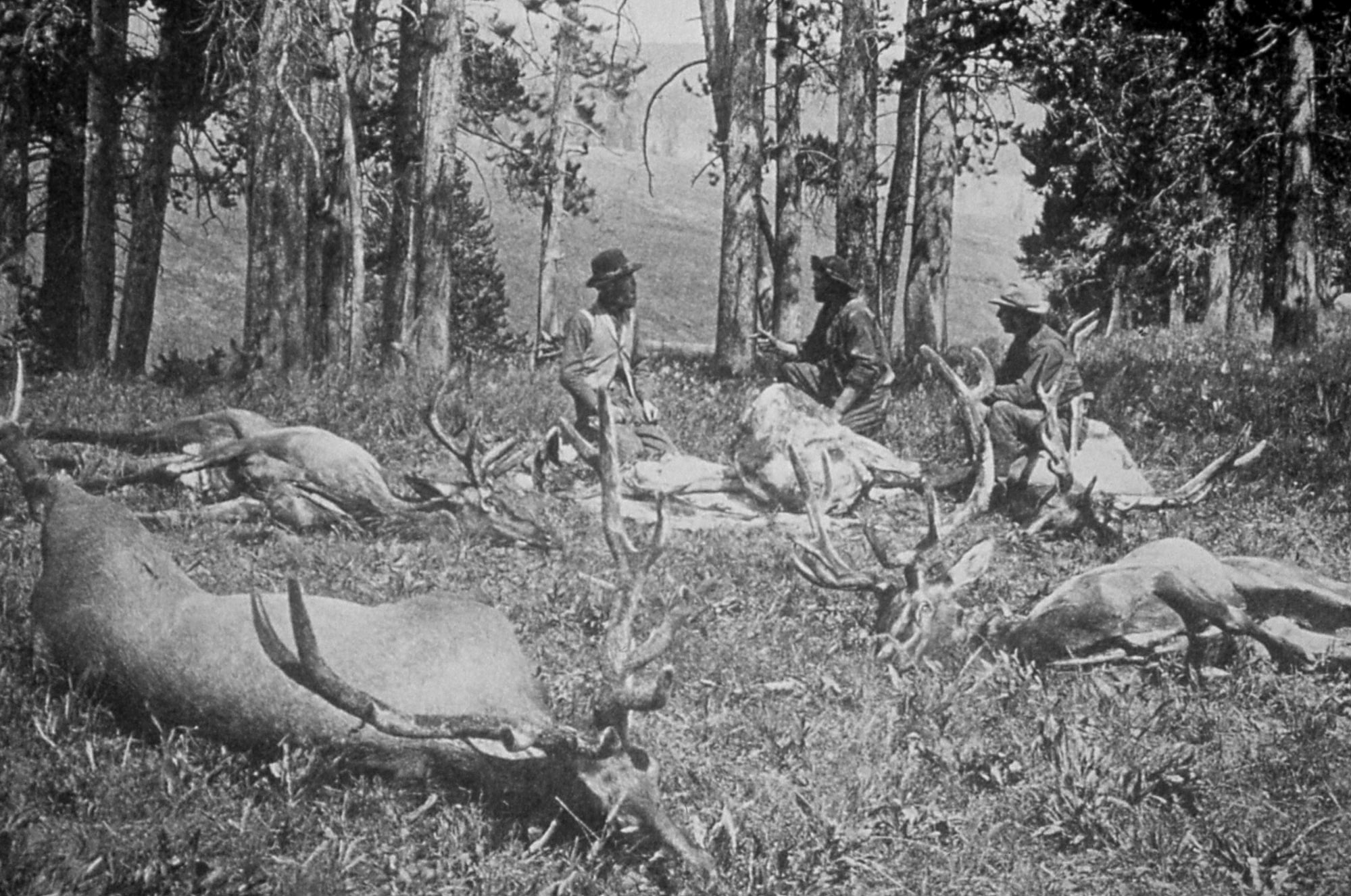
    Wapiti are the stupidest brutes in creation; and, instead of making off at once, the others all bunched up and stared about them, so that we got two more before they made up their minds to clear out. There was a fine stag in the herd, but, as is usually the case, he managed to get himself well among the hinds out of harm’s way, and none of us could get a chance at him.

    Bottler and I followed his tracks for an hour, but could not come up with him; and, finding that he had taken clear up the mountain, we returned to the scene of action. There we found the rest of the party busily engaged in cutting up the huge deer. One of them was a hind, in first-rate condition and as fat as butter. We were very glad of fresh meat, and, as the ground was very suitable, determined to camp right there, and send some of the flesh down to the main camp in the morning. We pitched our Lilliputian tents at the foot of one of a hundred huge hemlocks, set a fire, and proceeded to make ourselves comfortable for the night.

    We were all smoking round the fire—a most attentive audience, watching with much interest the culinary feats which Bottler was performing—when we were startled by a most unearthly sound.

    Bottler knew it well, but none of us strangers had ever heard a wapiti stag roaring before, and it is no wonder we were astonished at the noise. The wapiti bellows forth one great roar, commencing with a hollow, harsh, unnatural sound, and ending in a shrill screech like the whistle of a locomotive.

    In about ten minutes this fellow called again, a good deal nearer, and the third time he was evidently close to camp, so we started out. Advancing cautiously, we presently, through a bush, distinguished in the gloom the I saw body and antlered head of a real monarch of the forest as he stalked out into an open glade and stared with astonishment at our fire.

    He looked perfectly magnificent. He was a splendid beast, and his huge bulk, looming large in the uncertain twilight, appeared gigantic. He stood without betraying the slightest sign of fear or hesitation; but, as if searching with proud disdain for the intruder that had dared to invade his solitude, he slowly swept round the branching spread of his antlers, his neck extended and his head a little thrown back, and snuffed the air.

    I could not see the fore sight of the little muzzle-loader, but luck attended the aim, for the bullet struck high up the shoulder; and, shot through the spine, the largest wapiti stag that I had ever killed fell stone-dead in his tracks.

    It was early in the season, and his hide was in first rate condition, a rich glossy brown on the sides and jet black along the back and on the legs; so we turned to, cut off his head and skinned him; and, by the time we had done that and had packed the head and hide into camp, it was pitch dark, when we were ready for supper and blankets.

    ∞§∞

    —From Dunraven, The Great Divide, 1875.

    —William Henry Jackson Photo, Yellowstone Digital Slide File.

    — To see more stories by this author, click on “Dunraven” under the “Categories” button to the left.

  • A Tale: Yellowstone’s First Tourists Seek “First Blood”

    When the Washburn expedition returned from exploring the upper Yellowstone in 1870, they confirmed the rumors of the wonders there. Interest in the area surged when people learned it really did contain a grand canyon, a giant lake, geysers and petrified forests.

    Washburn and his companions returned to civilization in late summer—too late to mount another expedition to the Yellowstone plateau where blizzards could trap traveler in September. But in 1871—a year before the national park was created—a small group of men set off “to see Wonderland.”

    The group, considered by many to be Yellowstone’s first tourists, was led by Professor Rossiter Raymond. Their principal chronicler was Calvin C. Clawson who wrote about the trip in a series of 17 articles for The New Northwest, a Deer Lodge newspaper.

    Clawson not only describes the sights the party encountered, he speculates on such things as using of the finely ground minerals found in the geyser basins for lady’s cosmetics, and embalming bodies in the calcium-laden waters. Clawson also describes the antics men out for an enjoyable adventure. Like groups everywhere, they sometimes entertained themselves with strange contests—like seeing who could get “First Blood.”

    ∞§∞

    The morning of the eleventh was very pleasant, and a calm air was highly appreciated after a boisterous night. While we made preparations to start, a large eagle sailed over and alighted in a tree half a mile down the creek. Prof. Raymond and Eiler immediately mounted their horses and gave chase.

    As yet we had taken no game—not even a chicken killed or a fish caught—and there was a strife among us to see who would get the first blood.

    I knew that when we got to Bear Creek, among the berries, with my dog Nig’s assistance, I could get a bear—for he was celebrated for hunting that kind of game.

    Bear Creek is well named. Its underbrush furnishes bears with ample and secure hiding places. Here berries grow in abundance, and the industrious ant rears her ingenious palace. Bruin is fond of both.

    After the horses were unsaddled and secured, in company with the dog and my gun, I took a stroll up the creek to see if we couldn’t bag a Bruin before the eagle hunters came up. As we advanced, the “signs” became more and more numerous—until I was satisfied we would soon be rewarded with a bear fight.

    All of a sudden I was brought to my senses by a terrible noise in the bushes ahead of me, as of the rushing and snorting of wild animals. Of course it was a bear out berrying, and he was coming directly towards me. Nearer and nearer he came. I could see the tops of the high berry bushes bending before him.

    Now it occurred to me there might be two—two bears are a good many. I would have whistled for Nig, but to attract attention would prove ruinous, for the bear was coming plenty fast already. If the gun should fail, there would be no alternative but to trust to my knife, and that would bring me face to face with the enemy.

    Old hunters say a bear can be successfully handled (in an emergency) by waiting till he rises on his hind feet, and then smiting him under the fifth rib till he dies. They never tell how the bear amuses himself in the meantime—whether he “throws up his hand” or goes for his foe “tooth and toe nail.”

    These things have to be considered—and I considered them. I recollected that I had never seen but one man who stabbed a bear. We had to take two horses to get him (not the bear) to camp—he was too much scattered to carry on one. The best surgical assistance never could make anything else out of him but a torn up man—although he lived.

    Closer and closer come the bears—I thought I got a glimpse of them through the bushes.   There was a drove of them—two abreast, rushing on me—another minute and the fight would begin. There was no tree in reach. I held a council of war—a change of base was considered in order. I immediately stepped behind a point of rocks half a mile down the creek. After waiting a reasonable time for the enemy to appear, I walked into camp—demoralized, but not damaged. The dog soon followed, panting as though he too had a race for life.

    In a short time the eagle hunters made their appearance—with their hats bedecked with trophies in the shape of eagle feathers, and an eagle hanging to the horn of each saddle—while the wings dragged the ground.

    The old one had showed fight when she saw the hunters approaching, and settled down by the nest to protect her young. After several shots from a rifle, she was disabled—and Mr. Raymond climbed the tree as far as possible, threw a rope over the limb, and shook the two young out—then brought them to camp. They were monsters for their age, and after admiring them a while, we turned them loose to shift for themselves.

    The first blood was unanimously accorded to the Professor by the balance of the party, but if the other parent bird had been at home they might have “got away” with the invaders.

    ∞§∞

    — You can read Clawson’s complete account of the 1871 trip to the upper Yellowstone in A Ride to the Infernal Regions edited by Eugene Lee Silliman.

    —Photo from the Yellowstone Digital Slide File.