
As the above image shows, rugged mountains surround the wonders of Yellowstone National Park. As Captain William F. Raynolds discovered, that fact made it extremely difficult to visit the area.
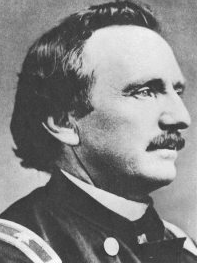
In 1859 the army ordered Raynolds to explore areas of Montana and Wyoming along the headwaters of the Yellowstone and Missouri Rivers. He was also to look for a route over the Absaroka Mountains via the Wind River. The hope was to find a convenient crossing from the Yellowstone drainage to the headwaters of the Missouri.
In May of 1860, Raynolds went up Wind River, but couldn’t find a pass. He admitted later that his guide, the famous mountain man Jim Bridger, had told him that the effort was futile. After Raynolds decided to turn back, Bridger said, “I told you you could not go through. A bird could not fly over that without taking a supply of grub.”
Raynolds then headed south and made his way over the mountains via Union Pass and struggled through drifted snow to the Gros Ventre River. He again tried to get to the Missouri drainage by traveling up the Gros Ventre, but deep snow forced him to turn back.
Raynolds then went over the Teton Pass and up the Henrys Fork of the Snake River to the low pass that bears his name. On the way two of his men headed east to explore the Targee pass and found the summit just five miles away. From there they could have descended to the Madison River and easily made their way to the grand geysers. But Raynolds was under strict orders to make a rendezvous at the Three Forks by May 30 so he rushed down the Madison.
Although Raynolds failed to enter the area that became Yellowstone Park, in his official reports he described the wonders there based on conversations with Bridger. Unfortunately, because of the Civil War the report wasn’t published until 1868.
Here’s what Raynolds said about Bridger’s descriptions of Yellowstone’s wonders..
∞§∞
We were compelled to content ourselves with listening to marvellous tales of burning plains, immense lakes, and boiling springs, without being able to verify these wonders.
I know of but two white men who claim to have ever visited this part of the Yellowstone valley—James Bridger and Robert Meldrum. The narratives of both these men are very remarkable, and Bridger, in one of his recitals, described an immense boiling spring that is a perfect counterpart of the Geysers of Iceland.
As he is uneducated, and had probably never heard of the existence of such natural marvels elsewhere, I have little doubt that he spoke of that which he had actually seen. The burning plains described by these men may be volcanic, or more probably burning beds of lignite, similar to those on Powder river, which are known to be in a state of ignition.
Bridger also insisted that immediately west of the point at which we made our final effort to penetrate this singular valley, there is a stream of considerable size, which divides and flows down either side of the water-shed, thus discharging its waters into both the Atlantic and Pacific oceans. Having seen this phenomenon on a small scale in the highlands of Maine, where a rivulet discharges a portion of its waters into the Atlantic and the remainder into the St. Lawrence, I am prepared to concede that Bridger’s” Two Ocean river” may be a verity.
Had our attempt to enter this district been made a month later in the season, the snow would have mainly disappeared, and there would have been no insurmountable obstacles to overcome. I cannot doubt, therefore, that at no very distant day the mysteries of this region will be fully revealed, and though small in extent, I regard the valley of the upper Yellowstone as the most interesting unexplored district in our widely expanded country.
∞§∞
- Report of Brevet Colonel W.F. Raynolds, U.S.A., Corps of Engineers, “On the Explorastons of the Yellowstone and Missouri Rivers in 1859-’60.” U.S. Government Printing Office, 1868.
- Relief map from the Yellowstone Digital Slide File.
- Raynold’s portrait is a National Park Service Photo.
You might also enjoy:
- Barton Warren Evermann’s description of the Two-Ocean Pass.
- James Gemmell’s description of his trip to geyser land in 1846.
∞§∞
 M. Mark Miller, Author