Category: Mountain Men

  • A Tale: Seeing the ‘spouting springs’ with Jim Bridger — James Gemmell, 1846

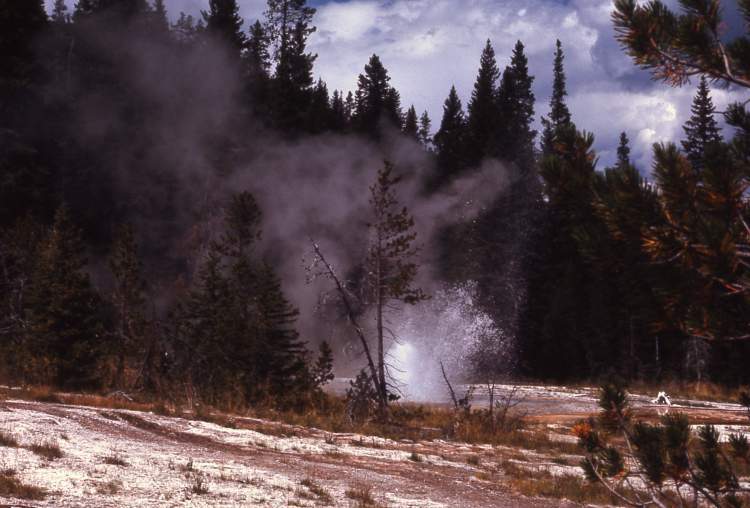
    Castle Geyser, Upper Geyser Basin
    Castle Gesyer, Upper Geyser Basin

    Conventional Yellowstone Park history holds that people didn’t start visiting the area just for fun until the area was explored in the 1870s. But this tale proves the sights attracted people long before that.

    James Gemmell toured the area that became Yellowstone Park in 1846 with the best guide of all, Jim Bridger. Gemmell and his companion left Fort Bridger on the Green River in Utah, followed the Snake River to “Wonderland,” and spent several weeks seeing the sights on their way to trade with Indians in Montana. Here’s his story.

    ∞§∞

    In 1846 I started from Fort Bridger in company with old Jim Bridger on a trading expedition to the Crows and Sioux. We left in August with a large and complete outfit, went up Green River and camped for a time near the Three Tetons, and then followed the trail over the divide between Snake River and the streams which flow north into Yellowstone Lake.

    We camped for a time near the west arm of the lake and here Bridger proposed to show me the wonderful spouting springs at the head of the Madison. Leaving our main camp, with a small and select party we took the trail by Snake Lake (now called Shoshonne Lake) and visited what have of late years become so famous as the Upper and Lower Geyser Basins. There we spent a week and then returned to our camp, whence we resumed our journey, skirted the Yellowstone Lake along its west side, visited the Upper and Lower Falls, and the Mammoth Hot Springs, which appeared as wonderful to us as had the geysers.

    Here we camped several days to enjoy the baths and to recuperate our animals, for we had had hard work in getting around the lake and down the river, because of so much fallen timber which had to be removed. We then worked our way down the Yellowstone and camped again for a few days’ rest on what is now the reservation, opposite to where Benson’s Landing now is.

    From here we crossed the present Crow Reservation and made our winter camp at the mouth of the Big Horn, where we had a big trade with the Crow and Sioux Indians, who at that time were friendly towards each other. The next spring we returned with our furs and robes, passing up the Big Horn River and over the mountains to Independence Kock and thence home.

    ∞§∞

    — Gemmell’s story is quoted in William F. Wheeler, “The Late James Gemmell,” Contributions to the Historical Society of Montana 2 (Helena, Mont.: State Publishing Co., 1896), pages 331-332.

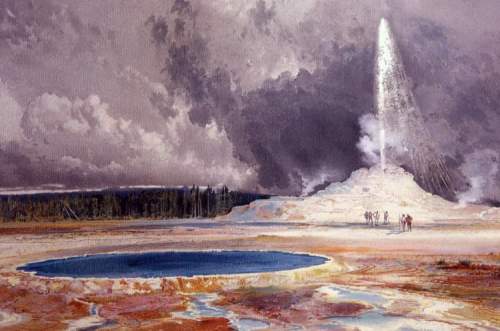
    — The Thomas Moran painting of Castle Geyser is from the Copper Mine Photo Gallery.

    — You might enjoy fur trader Warren Angus Ferris’s story of visiting geysers in 1834.  

    — For similar stories click on “Mountain Men” under the Categories button above.

  • A Tale: Trappers Encounter Peaceful Indians on the Yellowstone Plateau — Osborne Russell, 1834

    When I was a boy my father told me that Indians never went into the Yellowstone Park area because they were afraid of the geothermal features. But that’s not true. Archeological evidence shows that Indians traveled through the area and hunted there for at least 11,000 years. The erroneous assertion appears to have been started by officials to assure early tourists they could travel safely to the park.

    Alfred_Jacob_Miller_-_Ma-wo-ma_-_Walters_37194035
    Ma-wo-ma, a 19th-century Snake leader

    At least one band of Shoshone Indians, the Sheep Eaters, were permanent residents of the area. The mountain man Osborne Russell told about meeting a group of them in 1834 in his famous Journal of a Trapper. (He referred to them by the more generic term “Snake Indians,” which was what early travellers called several tribes that lived around the Snake River.)

    Russell found the Sheep Eaters (so-called because bighorn sheep made up a large portion of their diet) when he traveled up the Snake River to the Yellowstone Plateau in 1834. Here’s his description.

    ∞§∞

    We crossed the mountain in a westerly direction through the thick pines and fallen timber, about twelve miles, and , encamped in a small prairie about a mile in circumference. Through this valley ran a small stream in a northerly direction, which all agreed in believing to be a branch of the Yellowstone.

    We descended the stream about fifteen miles through the dense forest and at length came to a beautiful valley about eight miles long and three or four wide, surrounded by dark and lofty mountains. The stream, after running through the center in a northwesterly direction, rushed down a tremendous canyon of basaltic rock apparently just wide enough to admit its waters. The banks of the stream in the valley were low and skirted in many places with beautiful cottonwood groves.

    Here we found a few Snake Indians comprising six men, seven women and eight or ten children, who were the only inhabitants of the lonely and secluded spot. They were all neatly clothed in dressed deer and sheep skins of the best quality and seemed to be perfectly contented and happy.

    They were rather surprised at our approach and retreated to the heights, where they might have a view of us without apprehending any danger, but having persuaded them of our pacific intentions we succeeded in getting them to encamp with us. Their personal property consisted of one old butcher knife nearly worn to the back, two old, shattered fusees which had long since become useless for want of ammunition, a small stone pot and about thirty dogs on which they carried their skins, clothing, provisions, etc., on their hunting excursions.

    They were well armed with bows and arrows pointed with obsidian. The bows were beautifully wrought from sheep, buffalo and elk horns, secured with deer and elk sinews, and ornamented with porcupine quills, and generally about three feet long. We obtained a large number of deer, elk and sheep skins from them of the finest quality, and three large, neatly dressed panther skins, in return for awls and axes, kettles, tobacco, ammunition, etc.

    They would throw the skins at our feet and say, “Give us whatever you please for them and we are satisfied; we can get plenty of skins but we do not often see the Tibuboes” (or “People of the Sun”). They said there had been a great many beavers on the branches of this stream, but they had killed nearly all of them, and, being ignorant of the value of fur had singed it off with fire in order to drip the meat more conveniently. They had seen some whites some years previous who had passed through the valley and left a horse behind, but he had died during the first winter.

    They are never at a loss for fire, which they produce by the friction of two pieces of wood which are rubbed together with a quick and steady motion.

    One of them drew a map of the country around us on a white elk skin with a piece of charcoal, after which he explained the direction of the different passes, streams, etc. From these we discovered that it was about one day’s travel in a southwesterly direction to the outlet or northern extremity of the Yellowstone Lake, but the route, from his description being difficult, and beaver comparatively scarce, our leader gave up the idea of going to it this season, as our horses were much jaded and their feet badly worn.

    Our geographer also told us that this stream united with the Yellowstone after leaving this valley half a day’s travel in a westerly direction. The river then ran a long distance through a tremendous cut in the mountain in the same direction and emerged into a large plain, the extent of which was beyond his geographical knowledge or conception.

    ∞§∞

    —   Excerpt from “In the Yellowstone Country—A Garden of Eden Inhabited by a Small Party of Snake Indians.” Pages 31-34 in Osborne Russell and Lem A York, Journal of a Trapper 1834-1843. Boise, Idaho: Syms-York Co. 1921.

    — Painting by Alfred Jacob Miller, Wikipedia Commons.

    — You might enjoy other tales by Osborne Russell.  To find them just insert his name in the Search box above.

  • A Tale: Joe Meek Flees Blackfeet and Finds Wonderland — c. 1829

    About 1829 a nineteen-year-old trapper named Joe Meek camped along the Gallatin River in southwest Montana with a brigade of mountain men led by William Sublette of the Rocky Mountain Fur Company. When a group of Blackfeet attacked, the trappers scattered. Young Meek fled across the mountains and found geothermal features in what later became Yellowstone National Park. 

    Joe Meek

    When the fur trade collapsed, Meek moved to Oregon where he helped organize the territorial government and became its federal marshal. In the 1860s, the historian Frances Fuller Victor interviewed him several times. She later published a book about Meek’s adventures. Here’s how Victor described Meek’s first look at geothermal features in Wonderland.  Interestingly, there’s no mention of boiling fountains or geysers.

    ∞§∞

    In November the camp left Missouri Lake on the east side of the mountains, and crossed over, still northeasterly, on to the Gallatin fork of the Missouri River, passing over a very rough and broken country. They were, in fact, still in the midst of mountains, being spurs of the great Rocky range, and equally high and rugged. A particularly high mountain lay between them and the main Yellowstone River. This they had just crossed, with great fatigue and difficulty, and were resting the camp and horses for a few days on the river’s bank, when the Blackfeet once more attacked them in considerable numbers. Two men were killed in this fight, and the camp thrown into confusion by the suddenness of the alarm. Capt. Sublette, however, got off, with most of his men, still pursued by the Indians.

    Not so our Joe, who this time was not in luck, but was cut off from camp, alone, and had to flee to the high mountains overlooking the Yellowstone. Here was a situation for a nineteen-year-old raw recruit! Knowing that the Blackfeet were on the trail of the camp, it was death to proceed in that direction. Some other route must be taken to come up with them; the country was entirely unknown to him; the cold severe; his mule, blanket, and gun, his only earthly possessions. On the latter he depended for food, but game was scarce; and besides, he thought the sound of his gun would frighten himself, so alone in the wilderness, swarming with stealthy foes.

    Hiding his mule in a thicket, he ascended to the mountaintop to take a view of the country, and decide upon his course. And what a scene was that for the miserable boy, whose chance of meeting with his comrades again was small indeed! At his feet rolled the Yellowstone River, coursing away through the great plain to the eastward. To the north, his eye follows the windings of the Missouri, as upon a map, but playing at hide-and-seek in amongst the mountains. Looking back, he saw the River Snake stretching its serpentine length through lava plains, far away, to its junction with the Columbia. To the north, and to the south, one white mountain rose above another as far as the eye could reach. What a mighty and magnificent world it seemed, to be alone in! Poor Joe succumbed to the influence of the thought, and wept.

    Having indulged in this sole remaining luxury of life, Joe picked up his resolution, and decided upon his course. To the southeast lay the Crow country, a land of plenty—as the mountain-man regards plenty—and there he could at least live; provided the Crows permitted him to do so. Besides, he had some hopes of falling in with one of the camps, by taking that course.

    Descending the mountain to the hiding-place of his mule, by which time it was dark night, hungry and freezing, Joe still could not light a fire, for fear of revealing his whereabouts to the Indians; nor could he remain to perish with cold. Travel he must, and travel he did, going he scarcely knew whither. Looking back upon the terrors and discomforts of that night, the veteran mountaineer yet regards it as about the most miserable one of his life. When day at length broke, he had made, as well as he could estimate the distance, about thirty miles. Traveling on toward the southeast, he had crossed the Yellowstone River, and still among the mountains, was obliged to abandon his mule and accoutrements, retaining only one blanket and his gun. Neither the mule nor himself had broken fast in the last two days. Keeping a southerly course for twenty miles more, over a rough and elevated country, he came, on the evening of the third day, upon a band of mountain sheep. With what eagerness did he hasten to kill, cook, and eat! Three days of fasting was, for a novice, quite sufficient to provide him with an appetite.

    Having eaten voraciously, and being quite overcome with fatigue, Joe fell asleep in his blanket, and slumbered quite deeply until morning. With the morning came biting blasts from the north, that made motion necessary if not pleasant. Refreshed by sleep and food, our traveler hastened on upon his solitary way, taking with him what sheep-meat he could carry, traversing the same rough and mountainous country as before. No incidents nor alarms varied the horrible and monotonous solitude of the wilderness. The very absence of anything to alarm was awful; for the bravest man is wretchedly nervous in the solitary presence of sublime Nature. Even the veteran hunter of the mountains can never entirely divest himself of this feeling of awe, when his single soul comes face to face with God’s wonderful and beautiful handiwork.

    At the close of the fourth day, Joe made his lonely camp in a deep defile of the mountains, where a little fire and some roasted mutton again comforted his inner and outer man, and another night’s sleep still farther refreshed his wearied frame. On the following morning, a very bleak and windy one, having breakfasted on his remaining piece of mutton, being desirous to learn something of the progress he had made, he ascended a low mountain in the neighborhood of his camp—and behold! The whole country beyond was smoking with the vapor from boiling springs, and burning with gasses, issuing from small craters, each of which was emitting a sharp whistling sound.

    When the first surprise of this astonishing scene had passed, Joe began to admire its effect in an artistic point of view. The morning being clear, with a sharp frost, he thought himself reminded of the city of Pittsburg, as he had beheld it on a winter morning, a couple of years before. This, however, related only to the rising smoke and vapor; for the extent of the volcanic region was immense, reaching far out of sight. The general face of the country was smooth and rolling, being a level plain, dotted with cone-shaped mounds. On the summits of these mounds were small craters from four to eight feet in diameter. Interspersed among these, on the level plain, were larger craters, some of them from four to six miles across. Out of these craters issued blue flames and molten brimstone.

    For some minutes, Joe gazed and wondered. Curious thoughts came into his head, about hell and the day of doom. With that natural tendency to reckless gayety and humorous absurdities, which some temperaments are sensible of in times of great excitement, he began to soliloquize. Said he, to himself, “I have been told the sun would be blown out, and the earth burnt up. If this infernal wind keeps up, I shouldn’t be surprised if the sun war blown out. If the earth is not burning up over thar, then it is that place the old Methodist preacher used to threaten me with. Any way it suits me to go and see what it’s like.”

    On descending to the plain described, the earth was found to have a hollow sound, and seemed threatening to break through. But Joe found the warmth of the place most delightful, after the freezing cold of the mountains, and remarked to himself again, that “if it war hell, it war a more agreeable climate than he had been in for some time.”

    He had thought the country entirely desolate, as not a living creature had been seen in the vicinity; but while he stood gazing about him in curious amazement, he was startled by the report of two guns, followed by the Indian yell. While making rapid preparations for defense and flight, if either or both should be necessary, a familiar voice greeted him with the exclamation, “It is old Joe!” When the adjective “old” is applied to one of Meek’s age at that time, it is generally understood to be a term of endearment. “My feelings you may imagine,” says the “old Uncle Joe” of the present time, in recalling the adventure.

    ∞§∞

    — Text from Frances Fuller Victor, Eleven Years in the Rocky Mountains and Life on the Frontier. Harford Connecticut: R.W. Bliss and Company 1881. Pages 73-77.

    — Image from the Wikipedia Commons.

    — You might also enjoy:

  • A Tale: Another Version of Colter’s Run

    If there’s a story that deserves retelling, it is John Colter’s tale of his escape from a band of Blackfeet Indians. Colter mustered out of Lewis and Clark’s Corps of Discovery in 1806 and began his career as a trapper and Indian trader. In 1807, while searching for Indians to trade with, Colter passed through the area that is now Yellowstone National Park. In 1808 he made his famous run from the Blackfeet.
    Colter apparently was illiterate, but there are at least two versions of his tale that were written by men who heard him tell it. The one below is from Thomas James’ book, Three Years Among the Indians and Mexicans.  It generally agrees with John Bradbury’s version, but differs in some details. It’s interesting to compare these two versions of Colter’s Run.

    ∞§∞

    Colter had gone with a companion named Potts to the Jefferson River, which is the most western of the three Forks, and runs near the base of the mountains. They were both proceeding up the river in search of beaver, each in his own canoe, when a war party of about eight hundred Black-Feet Indians suddenly appeared on the east bank of the river.

    The Chiefs ordered them to come ashore, and apprehending robbery only, and knowing the utter hopelessness of flight, and having dropped his traps over the side of the canoe from the Indians, into the water, which was here quite shallow, he hastened to obey their mandate.

    On reaching the shore, he was seized, disarmed and stripped entirely naked. Potts was still in his canoe in the middle of the stream, where he remained stationary, watching the result. Colter requested him to come ashore, which he refused to do, saying he might as well lose his life at once, as be stripped and robbed in the manner Colter had been. An Indian immediately fired and shot him about the hip; he dropped down in the canoe, but instantly rose with his rifle in his hands.

    “Are you hurt,” said Colter.

    “Yes, said he, too much hurt to escape; if you can get away do so. I will kill at least one of them.”

    He leveled his rifle and shot an Indian dead. In an instant, at least a hundred bullets pierced his body and as many savages rushed into the stream and pulled the canoe, containing his riddled corpse, ashore. They dragged the body up onto the bank, and with their hatchets and knives cut and hacked it all to pieces, and limb from limb. The entrails, heart, lungs &c, they threw into Colter’s face.

    The relations of the killed Indian were furious with rage and struggled, with tomahawk in hand, to reach Colter, while others held them back. He was every moment expecting the death blow or the fatal shot that should lay him beside his companion.

    A council was hastily held over him and his fate quickly determined upon. He expected to die by tomahawk, slow, lingering and horrible. But they had magnanimously determined to give him a chance, though a slight one, for his life.

    After the council, a Chief pointed to the prairie and motioned him away with his hand, saying in the Crow language, “go—go away.” He supposed they intended to shoot him as soon as he was out of the crowd and presented a fair mark to their guns. He started in a walk, and an old Indian with impatient signs and exclamations, told him to go faster, and as he still kept a walk, the same Indian manifested his wishes by still more violent gestures and adjurations.

    When he had gone a distance of eighty or a hundred yards from the army of his enemies, he saw the younger Indians throwing off their blankets, leggings, and other encumbrances, as if for a race. Now he knew their object. He was to run a race, of which the prize was to be his own life and scalp.

    Off he started with the speed of the wind. The war-whoop and yell immediately arose behind him; and looking back, he saw a large company of young warriors, with spears, in rapid pursuit. He ran with all the strength that nature, excited to the utmost, could give; fear and hope lent a supernatural vigor to his limbs and the rapidity of his flight astonished himself.

    The Madison Fork lay directly before him, five miles from his starting place. He had run half the distance when his strength began to fail and the blood to gush from his nostrils. At every leap, the red stream spurted before him, and his limbs were growing rapidly weaker and weaker. He stopped and looked back; he had far outstripped all his pursuers and could get off if strength would only hold out.

    One solitary Indian, far ahead of the others, was rapidly approaching, with a spear in his right hand, and a blanket streaming behind from his left hand and shoulder. Despairing of escape, Colter awaited his pursuer and called to him in the Crow language, to save his life.

    The savage did not seem to hear him, but letting go his blanket, and seizing his spear with both hands, he rushed at Colter, naked and defenseless as he stood before him and made a desperate lunge to transfix him.

    Colter seized the spear, near the head, with his right hand, and exerting his whole strength, aided by the weight of the falling Indian, who had lost his balance in the fury of the onset, he broke off the iron head or blade which remained in his hand, while the savage fell to the ground and lay prostrate and disarmed before him.

    Now was his turn to beg for his life, which he did in the Crow language, and held up his hands imploringly, but Colter was not in a mood to remember the golden rule, and pinned his adversary through the body to the earth by one stab with the spearhead. He quickly drew the weapon from the body of the now dying Indian, and seizing his blanket as lawful spoil, he again set out with renewed strength, feeling, he said to me, as if he had not run a mile.

    A shout and yell arose from the pursuing army in his rear as from a legion of devils, and he saw the prairie behind him covered with Indians in full and rapid chase. Before him, if anywhere, was life and safety; behind him certain death; and running as never man before sped the foot, except, perhaps, at the Olympic Games, he reached his goal, the Madison river and the end of his five mile heat.

    Dashing through the willows on the bank he plunged into the stream and saw close beside him a beaver house, standing like a coal-pit about ten feet above the surface of the water, which was here of about the same depth. This presented to him a refuge from his ferocious enemies of which he immediately availed himself.

    Diving under the water he arose into the beaver house, where he found a dry and comfortable resting place on the upper floor or story of this singular structure. The Indians soon came up, and in their search for him, they stood upon the roof of his house of refuge, which he expected every moment to hear them breaking open. He also feared that they would set it on fire.

    After a diligent search on that side of the river, they crossed over, and in about two hours returned again to his temporary habitation in which he was enjoying bodily rest, though with much anxious foreboding. The beaver houses are divided into two stories and will generally accommodate several men in a dry and comfortable lodging.

    In this asylum, Colter kept fast till night. The cries of his terrible enemies had gradually died away, and all was still around him, when he ventured out of his hiding place . . .

    He traveled day and night, stopping only for necessary repose, and eating roots and the bark of trees, for eleven days. He reached the Fort, nearly exhausted by hunger, fatigue and excitement. His only clothing was the Indian’s blanket, whom he had killed in the race, and his only weapon, the same Indian’s spear which he brought to the Fort as a trophy. His beard was long, his face and whole body were thin and emaciated by hunger, and his limbs and feet swollen and sore. The company at the Fort did not recognize him in this dismal plight until he made himself known

    ∞§∞

    — Adapted from Thomas James, Three Years Among the Indians and Mexicans.  Saint Louis, Missouri Historical Society, 1916. [Edited with notes and biographical sketches by Walter B. Douglas] Pages 57-64.

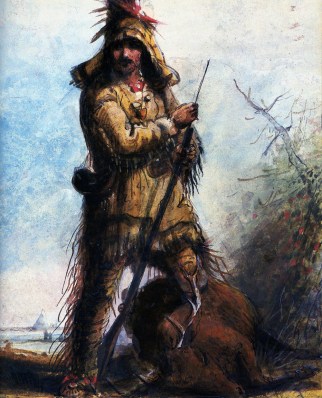
    — Image, “Old Bill Williams.” Wikipedia Commons.

    — You might also enjoy John Bradbury’s version of Colter’s Run.
  • A Tale: Jim Bridger’s Descriptions of Yellowstone Wonders — Gunnison, 1852

    Conventional wisdom is that people just didn’t believe trappers’ tales of fountains of boiling water, mountains of glass and the other wonders of the upper Yellowstone. But that’s not entirely true, at least in the case of the famous Mountain Man, Jim Bridger. The U.S. Army apparently found Bridger reliable; they frequently hired him as a scout, included his descriptions in their reports and called him “Major.”

    Jim Bridger

    One of the officers who believed Bridger was John W. Gunnison, a lieutenant in the Army Corps of Topographers. When a severe winter kept Gunnison from doing surveys of the Great Salt Lake Valley in 1849-50, he used the time to do research on the people who lived there. He published a book in 1852 that included this description of Bridger.

    ∞§∞

    The builder of Fort Bridger is one of-the hardy race of mountain trappers who are now disappearing from the continent, being enclosed in the wave of civilisation. These trappers have made a thousand fortunes for eastern men, and by their improvidence have nothing for themselves.

    Major Bridger, or “old Jim,” has been more wise of late, and laid aside a competence; but the mountain tastes fostered by twenty-eight years of exciting scenes, will probably keep him there for life. He has been very active, and traversed the region from the head-waters of the Missouri to the Del Norte—and along the Gila to the Gulf, and thence throughout Oregon and the interior of California.

    His graphic sketches are delightful romances. With a buffalo skin and piece of charcoal, he will map out any portion of this immense region, and delineate mountains, streams, and-the circular valleys called “holes,” with wonderful accuracy; at least we may so speak of that portion we traversed after his descriptions were given.

    He gives a picture, most romantic and enticing, of the head-waters of the Yellowstone. A lake sixty miles long, cold and pellucid, lies embosomed amid high precipitous mountains. On the west side is a sloping plain several miles wide, with clumps of trees and groves of pine.

    The ground resounds to the tread of horses. Geysers spout up seventy feet high, with a terrific hissing noise, at regular intervals. Waterfalls are sparkling, leaping, and thundering down the precipices, and collect in the pool below. The river issues from this lake, and for fifteen miles roars through the perpendicular canyon at the outlet. In this section are the Great-Springs, so hot that meat is readily cooked in them, and as they descend on the successive terraces, afford at length delightful baths. On the other side is an acid spring, which gushes out in a river torrent; and below is a cave which supplies “vermilion” for the savages in abundance.

    Bear, elk, deer, wolf, and fox, are among the sporting game, and the feathered tribe yields its share for variety, on the sportsman’s table of rock or turf.

    ∞§∞

    — From Gunnison, J.W.,  A History of the Mormons. Philadelphia: Lippincott, Grambo  & Co., 1852.   p. 151

    — Photo, Wikipedia Commons.

    — You might also enjoy:

  • A Tale: Osborne Russell Tangles With Blackfeet — 1839

    Few of the Mountain Men who scoured the Rocky Mountains looking for beaver had the skill or inclination to write about their experiences. A conspicuous exception is Osborne Russell who trapped in Yellowstone Park in the late 1830’s.

    He also described some thrilling adventures. Here’s one of them.

    ∞§∞

    The Trapper’s Last Shot

    We encamped on the Yellowstone in the big plain below the lake. The next day we went to the lake and set our traps on a branch running into it near the outlet on the northeast side. After setting my traps I returned to the Camp.

    The day being very warm, I took a bath in the lake for probably half an hour and returned to camp about 4 o’clock After eating a few minutes, I arose and kindled a fire, filled my tobacco pipe and sat down to smoke. My comrade whose name was White was still sleeping. Presently I cast my eyes towards the horses, which were feeding in the Valley and discovered the heads of some Indians gliding round within 30 steps of me.

    I jumped to my rifle and aroused White while looking towards my powder horn and bullet pouch. They were already in the hands of an Indian and we were completely surrounded. We cocked our rifles and started through their ranks into the woods, which seemed to be completely filled with Blackfeet who rent the air with their horrid yells.

    On presenting our rifles they opened a space about 20 feet wide through which we plunged. About the fourth jump an arrow struck White on the right hip joint. I hastily told him to pull it out. As I spoke another arrow struck me in the same place, but the arrows did not retard our progress. At length another arrow striking through my right leg above the knee benumbed the flesh so that I fell with my breast across a log. The Indian who shot me was within eight feet and made a spring towards me with his uplifted battle-axe. I made a leap and avoided the blow and kept hopping from log to log through a shower of arrows that flew around us like hail.

    After we had passed them about ten paces we wheeled about and took aim at them. They then began to dodge behind the trees and shoot their guns. We then ran and hopped about fifty yards further in the logs and bushes and made a stand.

    I was very faint from the loss of blood and we set down among the logs determined to kill the two foremost when they came up and then die like men. We rested our rifles across a log—White aiming at the foremost and myself at the second. I whispered to him that when they turned their eyes toward us to pull trigger.

    About twenty of them passed by us within fifteen feet without casting a glance towards us another file came round on the opposite side within twenty or thirty paces closing with the first a few rods beyond us and all turning to the right. The next minute they were out of our sight among the bushes. They were all well armed with fusees, bows and battle-axes.

    We sat still until the rustling among the bushes had died away then arose after looking carefully around us. White asked in a whisper how far it was to the lake. I replied by pointing to the southeast about a quarter of a mile. I was nearly fainting from the loss of blood and the want of water.

    We hobbled along forty or fifty rods and I was obliged to sit down for a few minutes, then go a little further, and then rest again. We managed in this way until we reached the bank of the lake. Our next object was to obtain some of the water as the bank was very steep and high. White had been perfectly calm and deliberate, but now his conversation became wild hurried.  Despairing, he observed, “I cannot go down to that water for I am wounded all over—I shall die.” I told him to sit down while I crawled down and brought some in my hat. This I effected with a great deal of difficulty.

    We then hobbled along the border of the Lake for a mile and a half when it grew dark and we stopped. We could still hear the shouting of the savages over their booty. We stopped under a large pine near the lake and I told White I could go no further

    “Oh” said he, “let us go up into the pines and find a spring,” I replied there was no spring within a mile of us, which I knew to be a fact.

    “Well,” said he, “if you stop here I shall make a fire.”

    “ Make as much as you please,” I replied angrily; “this is a poor time now to undertake to frighten me into measures.” I then started to the water crawling on my hands and one knee and returned in about an hour with some in my hat.

    While I was at this he had kindled a small fire and taking a draught of water from the hat he exclaimed, “Oh dear we shall die here, we shall never get out of these mountains.”

    “Well,” said I, “if you persist in thinking so you will die but I can crawl from this place upon my hands and one knee and kill two or three elk and make a shelter of the skins, dry the meat until we get able to travel.” In this manner I persuaded him that we were not in half so bad a situation as we might be although he was not in half so bad a situation as I expected.

    On examining I found only a slight wound from an arrow on his hip bone, but he was not so much to blame as he was a young man who had been brought up in Missouri, the pet of the family and had never done or learned much of anything but horseracing and gambling whilst under the care of his parents (if care it can be called).

    I pulled off an old piece of a coat made of blanket (as he was entirely without clothing except his hat and shirt)—set myself in a leaning position against a tree ever and anon gathering such leaves and rubbish as I could reach without altering the position of my body to keep up a little fire in this manner miserably spent the night.

    It was now ninety miles to Fort Hall and we expected to see little or no game on the route, but we determined to travel it in three days. We lay down and shivered with the cold till daylight then arose and again pursued our journey towards the fork of Snake river where we arrived sun about an hour high forded the river which was nearly swimming and encamped. The weather being very cold and fording the river so late at night caused me much suffering during the night. September 4th we were on our way at daybreak and traveled all day through the high Sage and sand down Snake River. We stopped at dark nearly worn out with fatigue hunger and want of sleep as we had now traveled sixty-five in two days without eating. We sat and hovered over a small fire until another day appeared then set out as usual and traveled to within about 10 of the Fort when I was seized with a cramp in my wounded leg which compelled me to stop and sit down every thirty or forty rods. At length we discovered a half breed encamped in the valley who furnished us with horses and went with us to the fort where we arrived about sun an hour high being naked hungry wounded sleepy and fatigued. Here again I entered a trading post after being defeated by the Indians but the treatment was quite different from that which I had received at Laramie’s fork in 1837 when I had been defeated by the Crows.

    The Fort was in charge of Mr. Courtney M. Walker who had been lately employed by the Hudsons Bay Company for that purpose He invited us into a room and ordered supper to be prepared immediately. Likewise such articles of clothing and Blankets as we called for.

    After dressing ourselves and giving a brief history of our defeat and sufferings supper was brought in consisting of tea, cakes, buttermilk, dried meat, etc. I ate very sparingly as I had been three days fasting but drank so much strong tea that it kept me awake till after midnight. I continued to bathe my leg in warm salt water and applied a salve, which healed it in a very short time so that in ten days I was again setting traps for Beaver.

     ∞§∞

    — Adapted from Journal of a Trapper [1834-1843] by Osborne Russell.

    — Detail from a Library of Congress Image.

    — You can read more by Osborn Russell in my book, Adventures in Yellowstone.

    — You might also enjoy these tales by Mountain Men:

  • A Tale: Hour Spring, A Geyser by Another Name — c. 1834

    Rustic Geyser, Heart Lake Geyser Basin

    In the decade between 1834 and 1843, a trapper named Osborne Russell kept a journal describing his adventures in the frontier northwest. Russell’s journal provides one of the earliest written accounts of travel to the upper Yellowstone. Here’s his description of hot springs and geysers in a now extinct geothermal area.

    ∞§∞

    The next day we traveled along the border of the lake till we came to the northwest extremity, where we found about 50 springs of boiling hot water. We stopped here some hours as one of my comrades had visited this spot the year previous he wished to show us some curiosities.

    The first spring we visited was about ten feet in diameter, which threw up mud with a noise similar to boiling soap. Close about this were numerous similar to it throwing up the hot mud and water five or six feet high. About thirty or forty paces from these along the side of a small ridge the hot steam rushed forth from holes in the ground with a hissing noise which could be heard a mile distant.

    On a near approach we could hear the water bubbling under ground some distance from the surface. The sound of our footsteps over this place was like thumping over a hollow vessel of immense size. In many places were peaks from two to six feet high formed of limestone, deposited by the boiling water, which appeared of snowy whiteness. The water when cold is perfectly sweet except having a fresh limestone taste.

    After surveying these natural wonders for sometime, my comrade conducted me to what he called the “Hour Spring.” At this spring the first thing that attracts the attention is a hole about 15 inches in diameter in which the water is boiling slowly about 4 inches below the surface. At length it begins to boil and bubble violently and the water commences raising and shooting upwards until the column arises to the height of sixty feet. It falls to the ground in drops on a circle of about 30 feet in diameter being perfectly cold when it strikes the ground.

    It continues shooting up in this manner five or six minutes and then sinks back to its former state of slowly boiling for an hour — and then shoots forth as before. My comrade said he had watched the motions of this spring for one whole day and part of the night the year previous and found no irregularity whatever in its movements.

    ∞§∞

    — Photo, Coppermine Photo Galley

    — From Osborn Russell, Journal of a Trapper, Syms-York Company, Boise, Idaho, 1921. Pages 99-100.

    — You might also enjoy:

  • A Tale: The First Written Description of Yellowstone Geysers — Daniel T. Potts, 1827


    By the early 1800’s trappers were scouring the Rocky Mountains  for beaver. Evidence of  their travel is sketchy, but we know that trapper brigades reached the Yellowstone Plateau by 1826.

    In 1947, two elderly ladies offered to sell the National Park Service three letters that were then 120 years old. A fur trapper named Daniel T. Potts had sent one of them to his brother in 1827. It is thought to be the first written description of the thermal features of the Upper Yellowstone by someone who actually saw them. Here’s the famous “Letter from Sweet Lake.”

    ∞§∞

    Sweet Lake
    July 8th 1827

    Respected Brother,

    Shortly after writing to you last year I took my departure for the Blackfoot Country. We took a northerly direction about fifty miles where we cross Snake River or the South fork of Columbia—which heads on the top of the great chain of Rocky Mountains that separate the water of the Atlantic from that of the Pacific. Near this place Yellowstone South fork of Missouri and the Henrys fork head at an angular point. The head of the Yellowstone has a large fresh water lake on the very top of the mountain—which is about one hundred by forty miles in diameter and as clear as crystal.

    On the south borders of this lake is a number of hot and boiling springs—some of water and others of most beautiful fine clay. The springs throw particles to the immense height of from twenty to thirty feet in height. The clay is white and of a pink. The water appears fathomless; it appears to be entirely hollow underneath.

    There is also a number of places where the pure sulphur is sent forth in abundance. One of our men visited one of those whilst taking his recreation. There at an instant the earth began a tremendous trembling. With difficulty he made his escape when an explosion took place resembling that of thunder. During our stay in that quarter, I heard it every day.

    From this place by a circuitous rout to the northwest, we returned. Two others and myself pushed on in the advance for the purpose of accumulating a few more Beaver. In the act of passing through a narrow confine in the Mountain, we where met plumb in face by a large party of Blackfeet Indians. Not knowing our number, they fled into the mountain in confusion—and we to a small grove of willows. Here we made every preparation for battle. After finding our enemy as much alarmed as ourselves we mounted our Horses which where heavily loaded we took the back retreat.

    The Indian raised a tremendous yell and showered down from the mountaintop. They had almost cut off our retreat when put whip to our horses. They pursued us in close quarters until we reached the plains where we left them behind.

    Tomorrow I depart for the west. We are all in good health and hope that this letter will find you in the same situation. I wish you to remember my best respects to all enquiring friends particularly your wife.

    Remain yours most affectionately.

    Daniel T. Potts

    ∞§∞

    — Original manuscript, Yellowstone National Park Research Library.

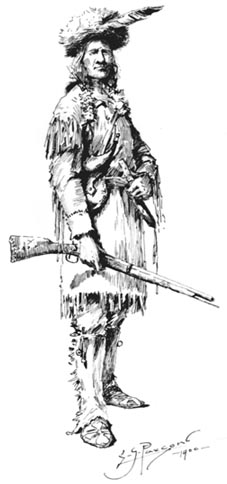
    — Sketch by E.S. Paxson, Montana Historical Society

    — You might also enjoy:

  • A Tale: Colter’s Run — 1807

    People have told and retold John Colter’s adventures with embellishments that turn him into a legendary figure like Pecos Bill and Paul Bunyon. But Colter really did cross the plains naked after outrunning hundreds of Blackfeet warriors who were screaming for his scalp. He really was the first white man to visit what is now Yellowstone Park. And his reports of a stinking place where springs spout steam and boiling water were greeted as fantasy and labeled “Colter’s Hell.”

    Colter was a member of the famous Lewis and Clark Expedition that first explored the American West beginning in 1803. He came within a hundred miles of what is now the park in 1806 when he accompanied William Clark on the return trip down the Yellowstone River.

    Later, Colter sought permission to muster out of the Corps of Discovery so he could return upriver with a pair of trappers. After extracting a promise from the rest of the men that they wouldn’t seek similar treatment, the Captains acceded to his request.

    Colter’s partnership soon broke up and he joined  Manuel Lisa’s Missouri Fur Company. In 1807, Lisa sent Colter up the Yellowstone River to make friends with the Crow Indians and bring them back to his trading post. While he was on this mission, Colter passed through parts of what is now Yellowstone National Park.

    Apparently illiterate, Colter left no written accounts of his travels. But on a visit to Saint Louis, Colter told his adventures to the English writer and naturalists William Bradbury. In a footnote in his 1819 book, Travels in the Interior of America, Bradbury reported the famous story of Colter’s Run.

    ∞§∞

    Colter came to St. Louis in May, 1810, in a small canoe, from the headwaters of the Missouri, a distance of three thousand miles. I saw him on his arrival, and received from him an account of his adventures. One of these, from its singularity, I shall relate.

    He trapped in company with a hunter named Potts. Aware of the hostility of the Blackfeet Indians, they set their traps at night, and took them up early in the morning, remaining concealed during the day.

    They were examining their traps early one morning, in a creek about six miles from that branch of the Missouri called Jefferson’s Fork, and were ascending in a canoe. Suddenly they heard a great noise, resembling the trampling of animals. But they could not ascertain the cause, as the high, perpendicular banks on each side of the river impeded their view.

    Colter immediately pronounced it to be occasioned by Indians, and advised an instant retreat. Potts accused him of cowardice and insisted that the noise was caused by buffaloes. In a few minutes their doubts were removed by a party of Indians making their appearance on both sides of the creek—five or six hundred—who beckoned them to come ashore.

    As retreat was now impossible Colter turned the head of the canoe to the shore. At the moment of its touching, an Indian seized the rifle belonging to Potts. But Colter, who is a remarkably strong man, immediately retook it. He handed it to Potts, who remained in the canoe, and on receiving it pushed off into the river.

    He had scarcely quitted the shore when an arrow was shot at him, and he cried out, “Colter, I am wounded.” Colter remonstrated with him on the folly of attempting to escape, and urged him to come ashore.

    Instead of complying, he instantly leveled his rifle at an Indian, and shot him dead on the spot. This conduct may appear to have been an act of madness, but it was doubtless the effect of sudden and sound reasoning. For if taken alive, Potts must have expected to be tortured to death, according to their custom. He was instantly pierced with arrows so numerous that, to use the language of Colter, “be was made a riddle of.”

    They now seized Colter, stripped him entirely naked, and began to consult on the manner in which he should be put to death. They were first inclined to set him up as a mark to shoot at. But the chief interfered, and seizing him by the shoulder, asked him if he could run fast.

    Colter, who had been some time amongst the Crow Indians, had in a considerable degree acquired the Blackfoot language. He was also well acquainted with Indian customs. He knew that he had now to run for his life, with the dreadful odds of five or six hundred against him. Therefore he cunningly replied that he was a very bad runner—although he was considered by the hunters as remarkably swift.

    The chief now commanded the party to remain stationary, and led Colter out on the prairie three or four hundred yards—and released him, bidding him to save himself if he could.

    At that instant the horrid war whoop sounded in the ears of poor Colter. Urged with the hope of preserving life, he ran with a speed at which he was himself surprised.

    He proceeded towards the Jefferson Fork, having to traverse a plain six miles in breadth, abounding with prickly pear, on which he was every instant treading with his naked feet. He ran nearly halfway across the plain before he ventured to look over his shoulder.

    He perceived that the Indians were very much scattered—and that he had gained ground to a considerable distance from the main body. But one Indian, who carried a spear, was much before all the rest, and not more than a hundred yards from him.

    A faint gleam of hope now cheered the heart of Colter. He derived confidence from the belief that escape was within the bounds of possibility. But that confidence was nearly fatal to him. He had exerted himself to such a degree that the blood gushed from his nostrils—and almost covered the forepart of his body.

    He had now arrived within a mile of the river, when he distinctly heard the appalling sound of footsteps behind him, and every instant expected to feel the spear of his pursuer. Again he turned his head, and saw the savage not twenty yards from him.

    Determined if possible to avoid the expected blow, he suddenly stopped, turned round, and spread out his arms. The Indian, surprised by the suddenness of the action, and perhaps of the bloody appearance of Colter, also attempted to stop. But exhausted with running, he fell whilst endeavoring to throw his spear, which stuck in the ground and broke in his hand.

    Colter instantly snatched up the pointed part, with which he pinned him to the earth, and then continued his flight. The foremost of the Indians, on arriving at the place, stopped till others came up to join them, when they set up a hideous yell. Every moment of this time was improved by Colter, who, although fainting and exhausted, succeeded in gaining the skirting of the cottonwood trees, on the borders of the fork, through which he ran and plunged into the river.

    Fortunately for him, a little below this place there was an island, against the upper point of which a raft of drift timber, had lodged. He dived under the raft, and after several efforts, got his head above the water amongst the trunks of trees, covered over with smaller wood to the depth of several feet. Scarcely had he secured himself when the Indians arrived on the river, screeching and yelling, as Colter expressed it, “like so many devils.” They were frequently on the raft during the day, and were seen through the chinks by Colter, who was congratulating himself on his escape, until the idea arose that they might set the raft on fire.

    In horrible suspense he remained until night, when hearing no more of the Indians, he dived under the raft, and swam silently down the river to a considerable distance. He landed and traveled all night. Although happy in having escaped from the Indians, his situation was still dreadful. He was completely naked, under a burning sun—the soles of his feet were entirely filled with the thorns of the prickly pear—he was hungry. He had no means of killing game—although he saw abundance around him. He was at least seven days’ journey from the nearest Fort.

    These were circumstances under which almost any man but an American hunter would have despaired. He arrived at the fort in seven days, having subsisted on a root much esteemed by the Indians.

    ∞§∞

    — Story adapted from pages 17-21 (footnote) in John Bradbury, Travels in the Interior of America in the Years 1809, 1810, and 1911 (London: Sherwood, Neely, and Jones, 1817).

    — Illustration, “Old Bill Williams,” Wikipedia Commons.

    — You might also enjoy “Jim Bridger’s Descriptions of Yellowstone.”

    — Here’s another version of Colter’s Run.