Category: Nez Perce

  • A Tale: A Narrow Escape from the Nez Perce — Andrew Weikert, 1877

    mccartneys-at-mammoth
    McCartney’s “Hotel” at Mammoth Hot Springs

    In the summer of 1877, several bands of Nez Perce abandoned their homeland in Idaho and eastern Oregon in hopes of making a new life in the buffalo country of Montana. Pursued by the Army, they fled through Yellowstone Park.

    Although the Nez Perce chiefs wanted to avoid contact with whites, a group of young men separated from the main Indian body and attacked several groups of tourists. On August 26, the Indians attacked a group from Helena, Montana, killing one of them and forcing others flee. Most of the survivors made their way to the incipient resort at Mammoth Hot Springs.

    After waiting for two days for stragglers to come in, the leader of the Helena tourists, Andrew Weikert, got the owner of the resort, James McCartney, to return with him to the scene of the attack. They planned to look for two men who hadn’t returned and bury one they knew had been killed. Here’s Weikert’s story of their adventure.

    ∞§∞

    While McCartney and I were on our way from the Springs to the old camp, this same band of Indians passed us somewhere, but we did not see them at that time. We went within two miles of the old camp and unpacked and stayed all night, for it was too late to go farther.

    We started early the next morning and got into the old camp, then began our search. We soon found Kenck’s body and buried it the best we could. We found his watch in his pocket and ring on his finger, which the Indians had missed. We spent the remainder of the day searching for the other two missing boys, but not finding them, concluded that they had made their escape.

    We packed up what little was left in the camp and started back, camping at night where we did the night before; had our supper then made down our bed, then went to picket our horses so they could not go too far away.

    Mack said, “Andy, something tells me we had better go on.” I told him all right, so we saddled up and started. I looked back through an opening in the timber and saw an Indian ride across, so we “lit out” pretty lively for a little ways. I presume he wanted to find out how we were fixed, but we slipped them that time and traveled on until 3 o’clock in the morning, then crossed the Yellowstone and camped until morning.

    It was about 9 o’clock when we found our horses, for we had to turn them loose so that they could get something to eat. Had almost come to the conclusion that the Indians had stolen them. We, at this time, were about eighteen miles from the Springs. We saddled and packed our horses then started to the Springs.

    We met a party of Indians on the trail; got within two hundred yards of them before we saw them. There were eighteen of them, so we thought there was not much chance for us. So we struck out for the nearest brush.

    We had a lively race for a mile, for the Indians were firing at us all the time and trying to head us off from the brush. Eighteen guns kept up quite a racket and they got some of the balls in pretty close. We could hear the balls whistle through the air and see them pick up the dust.

    We returned fire as best we could and think we made some good Indians. We rode together for some time, then Mack started right straight up the hill for the brush. I kept out on the hillside more so as to give my horse a better chance.

    The Indians got off their horses and kept right behind a reef of rocks, so we had rather a poor chance to return fire, but they kept pouring the lead into the hill close around me all the time, for they were not over two hundred yards from me. But they soon put a ball into my horse and he stopped as quick as a person could snap his finger. I knew that something was wrong, so I got off quick and in an instant saw the blood running out of his side.

    So I said, “Goodbye Toby, I have not time to stay, but must make the rest of the way afoot.” I made all speed possible for the brush, for I could not see enough of the Indians behind the rocks to shoot at and had no cartridges to waste. We had fired several shots apiece.

    About this time, Mack’s horse commenced bucking (the saddle had got back on his rump,) and bucked him off, then ran out to where I was, and followed up after me with the saddle under him. I took my knife after me, from my belt and was going to try and catch him, if he would come close enough, then cut the saddle loose and jump on him, but he tramped on the saddle and away he went.

    The Indians never let up shooting, but kept picking up the dust all around me. I think they must have fired fifty shots at me, but only cut a piece out of my boot leg and killed my horse. He had keeled over before Mack and I got together.

    Mack wanted to get down behind a big log that was lying close by, but I looked up and saw the reds almost over our heads, I then told him that I was going for the brush. He asked me to wait until he would take off his spurs, then he would go with me. He put his hand on my shoulder and yanked off his spurs, throwing them down towards the log saying they might lie there until some time later he might call for them.

    While he was taking off his spurs the reds fired three shots at us. I don’t think either of them was over ten feet from us. I made the remark that they were coming pretty thick; Mack says “Just so.”

    We soon got to the brush, but there was no reds to be seen anywhere. They were terrible brave so long is they had the advantage, but just as soon as the tables were turned, they made themselves scarce behind the hills, as they will not follow a man into the brush.

    We camped there for about an hour, then ventured out to see if the walking was good, or probably they had missed one of our horses. We did not find any except the dead, and from even this they had taken my saddle and bridle. We saw the Indians about four miles off so concluded to make it on foot to the Springs.

    ∞§∞

    Weikert later returned to retrieve the dead man’s body and take it to Helena for a proper burial. Soldiers pursuing the Nez Perce rescued the two missing men.

    I’m working on a book titled Encounters in Yellowstone 1877 that will chronicle more stories of Yellowstone tourists who ran afoul of the Indians.

    ∞§∞

    Adapted from Weikert’s Journal published in Contributions to the Montana Historical Society, 1900.

    — NPS photo from the Yellowstone Digital Slide File.

    — You might enjoy:

    For other related stories, click “Nez Perce” under the categories button.
  • An Event: Getting Ready To Present “The Nez Perce in Yellowstone” at The Pioneer Museum

    The big event on my schedule this week is my presentation, “The Nez Perce in Yellowstone,” at The Pioneer Museum of Bozeman on Saturday at 9:30 a.m. The talk, which is part of the Gallatin Historical Society’s Fall Lecture Series, will focus the dramatic stories told by tourists who survived run-ins with the Indians in the Summer of 1877.

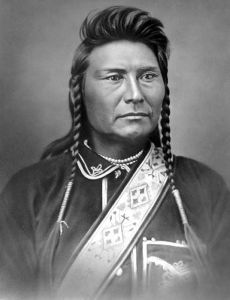
    Chief Joseph

    I’ll begin with an overview of the flight of the Nez Perce who generally had lived peacefully with whites for most of the 1800’s. After gold was discovered on Nez Perce land in 1853, settlers began moving onto their land. In 1877 the Indians were ordered onto a tiny reservation, but they decided instead to flee to the buffalo country on the plains. Most accounts of the flight of the Nez Perce emphasize things that happened outside of Yellowstone Park like broken treaties and battles, but I’ll reverse that pattern and focus in the human drama of the Indians’ encounters with tourists.

    I’ll read from my collection of first-person accounts of travel through Yellowstone Park in the 1800s. I like to present stories in the words of people who lived the adventures because that lets emotions and personalities shine through.

    The first tourist the Nez Perce found in the park was John Shively, a prospector who was familiar with the area. The Indians forced Shively to guide them all the way through the park. He was with them for thirteen days, so his story provides a good overview.

    The next tourists the Nez Perce found were the “Radersburg Party,” which included Emma Cowan and her thirteen-year-old sister, Ida. Emma and Ida were the only women to tangle with the Nez Perce inside the park. I’ll read Emma’s chilling description of the Indians shooting her husband in the head and taking her and her sister captive.

    To slow things down, I’ll talk about “Skedaddlers,” tourists who visited the park in the summer of 1877, but left before the Indians arrived. These include: the famous Civil War General William Tecumseh Sherman; Bozeman Businessman Nelson Story; English nobleman and park popularizer, The Earl of Dunraven and his companions, Buffalo Bill’s sometime partner, Texas Jack Omohundro, and Dunraven’s friend, George Henry Kingsley, a physician who patched up the Nez Perce’ victims at Mammoth Hot Springs.

    Next, I’ll talk about the Helena Party’s trip and contrast that all-male group that entered the park from the north with the co-ed Radersburg Party that entered from the west. Then I’ll read Andrew Weikert’s description of his blazing gun battle with the Nez Perce.

    I’ll describe how survivors of encounters with the Nez Perce were either rescued by soldiers looking for the Indians or made their way to Mammoth Hot Springs. I’ll explain that after Emma Cowan, her sister, and several wounded men left Mammoth for civilization, three men stayed there to see if their missing companions would appear. Then I’ll read Ben Stone’s description of the Indian attack at Mammoth that left another man dead.

    I’ll end with my synthesis of accounts of Emma Cowan’s overnight ride from Helena to Bottler’s Ranch in the Paradise Valley to join her husband who had survived three gunshot wounds and was rescued by the army. That will give me an opportunity to talk about Encounters in Yellowstone, a book I’m writing now.

    ∞§∞

    — The presentation will be at Pioneer Museum of Bozeman,  315 E. Main. It is free and open to the public.  Please tell your friends.

    — The photo of Chief Joseph is in the public domain.

  • A Tale: Gunshot Man Crawls to Safety — George Cowan, 1877

    George Cowan was a 35-year-old attorney from Radersburg, Montana, when he toured Yellowstone Park in August 1877 with his family and friends. That year the Nez Perce passed through the park after fleeing their homeland to make a new life in the buffalo country.

    The Radersburg party was getting ready to go home when a band of Nez Perce captured them. After the Nez Perce shot George Cowan and left him for dead, he regained consciousness only to find himself alone in the wilderness. Despite George’s grievous wounds, his first thought was for the safety of his wife. Here’s his tale of crawling a dozen miles to find help.

    ∞§∞

    George F. Cowan

    In about two hours, I began to come back to life, and as I did so my head felt benumbed. The feeling as near as I can express it was a buzzing, dizziness, and the sensation increased as it grew lighter and lighter. I began to feel soon and then my reason came back to me. My head felt very large, seemingly as large as a mountain, and I mechanically raised my hand and began feeling my face and head. I found my face covered with blood and my hair clotted with blood that had cooled there. I then realized the incidents of the day and remembered the shooting.

    I could not at first discover where I was wounded, but after getting the blood out of my eyes and pulling my hat off with hair and skin sticking to the clotted blood, I discovered that I was shot in the face and head. Running my had over my head, I found great gashes in the scalp, and I then thought the ball had passed entirely through my head some way. Feeling my leg, I found it completely benumbed, but there were no bones broken.

    I again felt the intolerable pangs of thirst, raised myself on my elbow, and looked about me. I then found that I was some ten or twelve feet from the place of shooting. This, I thought, accounted for the wounds in the back of my head. As far as I could see, the Indians were all gone and I could hear nothing but the moaning of the wind in the trees.

    Standing near me was a little pine tree the boughs of which I could just reach, and grasping one, I pulled myself to my feet. My wounds were painful now. As I raised up I saw an Indian close by me sitting on his pony watching me. As I was hobbling away, I glanced backward and saw him on one knee aiming his gun at me. Then followed a twinging sensation in my left side, and the report of the gun and I dropped forward on my face. The ball had struck me on the side above the hip and came out in front of the abdomen.

    I thought that this had “fixed me” beyond hope of recovery and I lay perfectly motionless expecting the Indian to finish the job with the hatchet.

    I must have lain here fully twenty minutes expecting to die every moment, and during the time, I think my mind must have dwelt on every incident of our trip. I supposed my wife had been killed. I knew the fate she and Ida would be subjected, and my whole nature was aroused as I thought of it.

    Directly I heard Indians talking. The were coming up the trail and I could hear them driving numbers of loose horses. They passed within forty feet of me, but I was unnoticed and they were soon out of hearing. I waited for a few moments, then turned over and took a look around me.

    I now took another inventory of my wounds, and in trying to rise found that I could not use either of my lower limbs. They were both paralyzed. I then turned up my face and began crawling by pulling myself with my elbows. I thus managed to get into some willows where I found water which I drank eagerly, and felt greatly refreshed and strengthened. I now began crawling as before, pulling myself on my breast with my elbows. In this way, I crawled to a little stream of warm water, and raised up on my hands and entered the water. I immediately sank to my shoulders in the mud, and the water came up to my chin.

    This would not do, so extricating my hands, I again began crawling as before, and found that I could thus cross it. Having crossed it, I entered the willows on the bank, and began crawling down stream and followed it until I struck the East Fork about a half mile below where I started from. It was now about one or two o’clock in the morning and being completely exhausted I lay down and rested until daybreak.

    At dawn, I again started and crawled until noon, when I again stopped to rest. I had been here but a few moments when I again heard Indians approaching, coming down the trail. They passed within ten feet of me and were soon out of hearing.

    I lay here for an hour or so and again resumed my wearisome journey. By nightfall, I had made four or five miles, and I kept on during the night, resting at short intervals.

    I kept on down the trail, or rather by the side of it, and Indians kept passing by me every little while, driving ponies as they went. I could hear them approaching and then I would lie down and wait till the passed.

    I kept this up until Monday morning, have crossed the East Fork Sunday night, and reached the wagons we had abandoned on Friday. I had crawled about nine miles in sixty hours.

    As I reached the wagon, I found my faithful dog, Dido, laying beneath it. I called to her, and see came bounding to me, and covered my face and wounds with caresses. The pleasure of the meeting was mutual.

    The buggy was laying upon the ground, all of the spokes having been taken from two of the wheels, and I could search it without rising. I found some rags, a portion of a man’s underclothing, which were very acceptable, but I could find nothing to eat.

    It occurred to me that I had spilled some coffee when in camp, on Thursday in the Lower Geyser Basin, and calling my dog we started for it, I crawling as before, and the dog walking by my side. The coffee was four miles distant, but I thought not of that. The only idea was to possess the coffee. I was starving.

    While crawling along close to the trail, my dog stopped suddenly and began to growl. I grasped her by the neck, and placed my hand over her nose to keep her from making noise. Peering through the brush, I saw two Indians sitting beneath a tree but a few feet from me. I began moving back cautiously and made a circuit around them, keeping the dog close by me. I thus avoided them, and reached the Lower Geyser Basin on Tuesday night.

    Here, as I anticipated, I found some coffee, and a few matches. I found about a handful of coffee, and placing it in an empty can that I had found, I pounded it up fine. I then got some water in another empty can that, that had contained molasses, and building a fire, I soon had some excellent hot coffee that refreshed me greatly. This was my first refreshment that I had taken in five days and nights.

    I now began calculating my chances for being picked up. I would not starve, as I could, as a last resort, kill my dog and eat it. I shudder now, as I think of sacrificing my noble, faithful dog, one that money cannot purchase now, but circumstances were such that I did not view it then as I do now. The natural desire for life will force one to any necessity.

    I remained where I was Tuesday night. No one can imagine my thoughts during that time. I supposed that I was the only one of the party left, unless it be my wife, and the speculations upon her fate almost set me mad. It was horrible. All night long I lay there suffering instead of resting, and I hailed with pleasure the break of day.

    I made some more coffee, and drank it, which seemed to give me renewed strength, but as my strength returned I felt more keenly the horrors of my position. I thought now I would crawl to where the East Fork empties into the Fire Hole River, so calling my dog I began my journey.

    I found that I was gradually growing weaker, as I could now crawl but a little ways when I would be compelled to stop and rest. At about a mile and a half distant I came to the place of our first night’s camp on entering the basin. Here again, I had to cross the river, but as the water was not deep, I made it without mishap. Here I rested for a few moments, before starting for the timber, which was about a fourth of a mile distant. I got there about two o’clock in the afternoon, and laid down under a tree and some brush close to the road. I was now exhausted and could go no farther. It was an expiring effort, and having accomplished it I gave myself up for dead.

    In about two hours, I hear the sound of horses coming, but so completely tired out was it that I did not care whether they were Indians or not. My dog began to growl, but I did not try to stop her. The horses drew nearer, and approached and stopped. The riders had seen me. I looked up and saw that they were white men. They alighted and came to me, and one of them asked: “Who are you?”

    I replied that my name was Cowan, and asked them if any news had been received of my wife. They replied that there had not been, and I then cared for nothing further. I turned from them and would have been glad to have died.

    One of them kept talking to me, and asking questions that I cared not to answer, while the other built a fire and made some coffee for me. The told me that they were scouts from Howard’s command, and that the troops would reach me some time during the next day. They left me some “hard tack” and a blanket, and went on to the scene of the massacre to find the bodies of the party. After they were gone and I had eaten, my desire for life returned, and it seems the spirit of revenge took complete possession of me. I knew that I would live and I took a solemn vow that I would devote the rest of my life to killing Indians, especially Nez Perce.

    I laid here until Thursday afternoon, when I heard the sound of approaching cavalry, and shortly afterwards General Howard and some of his officers rode up to me. In a few minutes, I saw Arnold coming. He came up, recognized me, and knelt beside me. We grasped hands, but neither spoke for some minutes. I could only gasp: “My wife!”

    “No news yet, George,” he replied.

    ∞§∞

    The Army took George with them as they pursued the Nez Perce across the roadless wilderness of Yellowstone Park.  He survived the ordeal and was reunited with wife three weeks after he was found.

    — Condensed from George F. Cowan’s account in Frank D. Carpenter, The Wonders of Geyserland, Black Earth, WI: Burnett and Son, 1878, pages  143-148.

    — Image from Progressive Men of the State of Montana.

    — For more stories about tourists’ encounters with the Nez Perce in Yellowstone Park, click “Nez Perce” under the “Categories” button to the left.

    — I’m working on a book about the Nez Perce and tourists, Encounters In Yellowstone.

  • A Tale: A Narrow Escape from the Nez Perce — Ben Stone, 1877

    McCartney’s “Hotel” at Mammoth Hot Springs

    Ben Stone was an African American hired to cook for a group of men from Helena who toured Yellowstone in August 1877, the year the Nez Perce passed through there. The Helena Party fought a couple of gun battles with Nez Perce scouts. Leaving the body of one of their companions behind, several members party made their way to Mammoth Hot Springs where there was an incipient resort.

    When two young men failed to show up at Mammoth, two others went to search for them, leaving Stone, a music teacher named Dietrich, and a wounded man named Stewart to wait for a ride. Here’s how Stone described what happened then.

    ∞§∞

    No more of our party, having shown up in the three days after arriving at the Springs, we were alarmed about them, and Andy Weikert concluded to go and see if he could find anything of them. James McCartney, proprietor of the Mammoth Hot Springs, kindly volunteered to go with him.

    The next day after they left an ambulance arrived to take Stewart, Dietrich, and myself to Bozeman. The boys with the ambulance begged Dietrich to go with them, but he said, with tears in his eyes, “My God! What will Mrs. Roberts say if I go and leave Joe?” Through my inducement he came. “What shall I say when I meet his mother, when she asks me where Joe is?”

    Dietrich and I concluded to remain until we heard from Weikert and McCartney. If Joe or any of the rest of the party were brought in, we wished to be there to care for them, in case they were wounded. One of the party, with the ambulance (Jake Stoner), remained with us.

    Dietrich and Stoner went down to Gardiner’s River fishing, not returning until three in the afternoon, leaving me to keep house alone at the Springs. After they returned, I cooked dinner and, after eating, Dietrich and I concluded to go up and take a bath. Stoner said he would go along to look at the Springs, and took his gun with him, as he said, “To knock over a grouse, as grub was getting scarce.”

    After taking our bath and drinking some of the water out of the Hot Springs, we went back to the house.

    Dietrich said: “I’ll go down and water and stake the mare for the night.

    “All right,” I answered, “and while you’re gone, I’ll keep house.

    Taking a seat in the doorway, I felt uneasy. On glancing towards the Springs, I saw Jake Stoner running to the house. I smilingly asked him if he had caught any grouse.

    He said: “No, but I’ve caught something else.”

    I inquired of him what he had caught, when he said that, while up on top of the Springs, he had caught sight of a large party coming this way.

    I replied: “You did! That must be white men. How many did you see?”

    “I saw two parties, with about ten persons in each nearly forty yards apart, and traveling very slowly.”

    I said: “They must be white men. Andy and McCartney have found the boys, and are bringing them in. Of course, they are wounded, and have to travel slowly. I’ll go in the house, make a fire, and have grub ready for the boys by the time they get here.

    “No,” said Jake: “don’t do that. We had better cache ourselves in the timber until we know whether they are white men or not.”

    I replied: “That’s a good idea—we’ll do that.”

    He then asked for Dietrich, saying, “I’ll warn him, so he can take to timber too.”

    I told him where Dietrich was, and he went down the flat towards him. I started up the gulch to cache myself. After advancing twenty-five or thirty yards, I took to the timber on my right, and went up in it to a point of rocks overlooking the house, and where I could see both trails approaching the house. After waiting there fifteen or twenty minutes, and the parties not coming, I began to think the boys were a long time coming. Looked out, but could not see anything.

    Sat down and waited ten minutes—nothing in sight. I exposed myself in trying to find out if the parties were coming. When I got to where I could see, I descried an object in the distance, in what appeared to be a long white blanket. He dodged around out of sight, as if intending to go behind the Springs. Another appeared closer to me, in what also appeared to be a blanket. He dodged around in the same manner as the former one.

    Another soon appeared. I had no doubt that he was an Indian, and I said to myself: “Mr. Stone, it’s about time you were traveling!” I “lit out” for timber about one hundred yards up the gulch. While I was waiting to see who were coming, the Indians had worked around and got into the gulch I had to go up, and get to the timber. I had to go within five or six yards of them through the brush. Moving as fast and cautiously as I could, I accidentally stepped on a piece of dead brush, which broke with a loud crash. Some of the Indians heard and one made for me. I then moved very fast, for I knew I had to work for my life, if I did not get to timber soon, I was a dead man.

    In a few moments, I found that the Indian would cut me off, as from the crash of breaking twigs I knew he was close to me. I thought I was a dead man, sure, and said: “My God! What shall I do!” Just then, I chanced to run under a tree, with low branches. I took hold of the branches and hoisted myself in, without any expectation of saving my life. I had no more than got into the tree, before an Indian on horseback dashed under it, gazing in every direction for me, and seeming surprised at not seeing the object that made the noise.

    After going about ten yards, he stopped his horse, raised his gun up on his arm, and listened for an instant. He then went through an opening out of sight.

    I now considered myself perfectly safe, but remained in the tree about two hours.

    While in the tree I heard several shots at the house, and saw they had made fires there. Suppose they had burned the buildings.

    ∞§∞

    After the Indians left, Stone decided to make for a ranch north of the Park.  On the way, he met a group of soldiers who were pursuing the Indians. Later he learned that the Indians had killed Dietrich and other members of the party were safe.

    ∞§∞

    —  Abridged from “Two Narrow Escapes from the Clutches of the Red Devils in 1877: His Own Story Told by Benjamin Stone.” The Avant Courier, Bozeman, September 6, 1877.

    — Photo from the Yellowstone Digital Slide File.

  • An Event: Ready To Tell “Smart Women” About The Nez Perce In Yellowstone

    The big event on my schedule this week is my presentation, “The Nez Perce in Yellowstone,” to Smart Women on Wednesday at 3 p.m. at Aspen Point, an assisted living facility in Bozeman. I’m still working on my slides and script, but it’s taking shape in my mind.

    Chief Joseph

    I’ll begin with an overview of the flight of the Nez Perce who generally lived peacefully with whites for most of the 1800’s. After gold was discovered on Nez Perce land in 1853, settlers began moving in and in 1877 the Indians were ordered onto a tiny reservation. Rather than comply with the order, they decided to flee to the buffalo country on the plains. Most accounts of the flight of the Nez Perce emphasize things that happened outside of Yellowstone Park like broken treaties and battles, but I’ll reverse that pattern and focus in the human drama of the Indians’ encounters with tourists.

    Then I’ll talk about what I call “The Joseph Myth,” the common belief that Chief Joseph was a great general whose genius allowed him to outmaneuver the U.S. Army for months. Joseph was the chief of one of the five bands that led the army on its merry chase, but he was never the principal chief. I’ll speculate on reasons the Joseph Myth was born and why it persistes: (1) Joseph was an important chief who had a conspicuous role in negotiations with whites before the Nez Perce decided to leave and he was the last remaining chief at the Battle of Beartooth so he negotiated the surrender. These things made him the apparent leader. (2) The Army Officers needed a genius opponent, otherwise they would look like fools for letting a band of Indians that included old men, women and children—and 1,600 hundred horses and cow—elude them for months, (3)After the conflict Indian sympathizers needed an Indian hero who sought peace to bolster their case, and (4) Joseph was indeed a noble man who devoted his life to obtaining justice for his people. All true, but he wasn’t a military genius.

    I’ll talk about the Radersburg Party’s trip to the park and read Emma Cowan’s description of her being taken captive by the Nez Perce, which ended with her watching an Indian shoot her husband in the head.

    To slow things down, I’ll talk about “Skedaddlers,” tourists who visited the park in the summer of 1877, but left before the Indians arrived. These include: the famous Civil War General William Tecumseh Sherman; Bozeman Businessman Nelson Story; English Nobleman and park popularizer, The Earl of Dunraven and his companions, Buffalo Bill’s sometime partner, Texas Jack Omohundro, and Dunraven’s friend, George Henry Kingsley, a physician who patched up the Nez Perce’ victims at Mammoth Hot Springs.

    I’ll talk about the Helena Party’s trip and contrast the all-male group that entered the park from the north with the co-ed Radersburg Party that entered from the west. Then I’ll read Andrew Weikert’s description of his gun battle with the Nez Perce.

    Then I’ll describe how survivors of encounters with the Nez Perce were either rescued by soldiers looking for the Indians or made their way to Mammoth Hot Springs. I’ll explain that after Emma Cowan, her sister, and several wounded men left Mammoth for civilization, three men stayed there to see if their missing companions would appear. Then I’ll read Ben Stone’s description of the Indian attack at Mammoth that left another man dead.

    I’ll end with my synthesis of accounts of Emma Cowan’s overnight ride from Helena to Bottler’s Ranch in the Paradise Valley to join her husband who had survived three gunshot wounds and was rescued by the army. That will give me an opportunity to talk about Encounters in Yellowstone, a book I’m writing now.

    ∞§∞

    — The presentation is free and open to the public.  Please tell your friends.

    — You can read about my 2011 presentation to Smart Women.

    — Public Domain Photo.

  • A Tale: Guiding the Nez Perce Through Yellowstone Park — 1877

    After the bloody Big Hole Battle on August 9, 1877, the Nez Perce fled through Yellowstone Park to avoid the settled areas of Montana. Pursued by Army units under General O.O. Howard, they needed a guide because the route was unfamiliar to them. On August 23, they found one.

    John Shively, who had prospected for gold in the area, was camped near the Lower Geyser Basin when the Indians captured him. Shively had planned to leave the park with a party of tourists from Radersburg, Montana, that he had met earlier.

    The next day, the Nez Perce accosted the Radersburg group, shot two men and took two women captive. The women were treated well and later release.

    Shively traveled with the Nez Perce for thirteen days, then made his escape. (The Indians said they let him go after they reached country they knew.) Several territorial newspapers reported Shively’s adventures and Edwin J. Stanley synthesized them into a single narrative several years later. Here’s Stanley’s version.

    ∞§∞

    On the evening of the second day, after leaving the Radersburg party, I was camped in the Lower Geyser Basin. I was eating my supper, and, on hearing a slight noise, looked up, and, to my astonishment, four Indians, in war-paint, were standing within ten feet of me, and twenty or thirty more had surrounded me not more than forty feet off.

    I sprang for my gun, but was rudely pushed back. I then asked them what Indians they were, and they answered “Sioux.” I said, “No.” Then one of them said, “Nez-Perces.” They then commenced to gesticulate wildly, and a loud conversation was kept up between them.

    I thought the exhibition of a little bravery might help me, so I folded my arms and told them to shoot, that I was not afraid to die. A brother of Looking-Glass then came up, placed his hand on my heart, and held it there a minute or two, and exclaimed, “Hyas, skookum-tum-tum!” meaning ‘strong heart’ in Chinook. He then said in English, “Come with me,” walked a few steps, told me to get on a pony that he pointed out, jumped up behind me, and all started for the main camp, a short distance below.

    While this was taking place, the other Indians had taken my gun, blankets, horses—in fact, everything I had. Arriving at the main camp, a council of the chiefs was formed, and I was told to take a seat inside the circle.

    They asked me who I was, and what I was doing there. I told them. They asked me if I would show them the best trail leading out of the park to Wind River, where they were going. I told them I would, as I knew all about the country. This seemed to be satisfactory, and the council broke up, and the camp moved up a mile or two, where an encampment for the night was formed.

    A robe was given me, and an Indian named Joe was detailed to sleep with me. He spoke very good English; said that I must not attempt to escape; that he would be my friend; that they had come that way to get away from Howard; that the trail by that route to Wind River was not known to them, but other Indians had told them about it, and that if I told them the truth they would not harm me.

    As I could not help myself, I promised all they asked, and kept my promise. All the time I was with them, I always showed a willingness to get on or off a horse when they told me; and, if an Indian rode behind me on the horse, I offered no objections, and to this fact I am probably indebted for kind treatment.

    After breaking camp the next morning, I was ordered to mount. An Indian mounted behind, and I was started ahead with mounted and armed Indians on each side and behind me. While camped the next day, about noon, the Radersburg party were brought into camp.

    Shortly afterward, a march was made toward Yellowstone Lake, I still being kept some distance in the advance. After traveling about a mile, I heard seven distinct shots fired, and supposed all the persons had been killed, but that evening Joe told me that only two men had been shot, and the next morning I saw Mrs. Cowan and Miss Carpenter, and was allowed to speak to them, and we traveled near together all that day.

    Through this terrible ordeal, the sisters behaved nobly and with the utmost fortitude, although Mrs. Cowan’s mental agony at thought of her husband wounded, and perhaps dead, and they three in the hands of savages, was enough to have driven her distracted. With all their savagery and ferocity, let it be said and remembered to the credit of the Nez-Perces, that these ladies were treated with all respect, and protected from all harm, while their prisoners. The next day, Frank Carpenter and his sisters were permitted to go, and the Indians moved to the Yellowstone, and from there moved over to the head-waters, or rather a tributary, of Clark’s fork.

    The first night of our arrival being quite dark, I slipped out of camp and started for the Mammoth Hot Springs, which I reached after traveling two whole nights and one day. Here I found no one, but did find some potatoes already cooked, which greatly revived me after my long fast—having had nothing to eat from the time of leaving the Indian camp.

    I then started for Henderson’s ranch, which I found destroyed, but plenty of provisions lying around. I got some eggs, and, while cooking them, Mr. J. W. Schuler of Butte City, who was returning from the Clark’s Fork mines, rode up. He kindly gave me his horse to ride, he going on foot. That night, early, we reached Dailey’s ranch, where we received the kindest treatment, and Mr. Dailey loaned me a horse on which to ride to Bozeman.

    I was with the Indians thirteen days, and was treated very well all the time. They traveled very leisurely, not averaging, for the whole time, more than five miles a day. Joe said they were not afraid of Howard. He also said that they did not intend to return to Idaho, as the agent there, John Hall, was a bad man, and would not give them what was due them; that they would remain somewhere in the Big Horn country, and, if the soldiers came, they would join in with the Sioux and Crows and whip them.

    ∞§∞

    — Excerpt from Edwin J. Stanley, Rambles in Wonderland. Southern Methodist Publishing House: Nashville, 1885.

    — You also might like:

    — You can read Emma Cowan’s complete story in my book, Adventures in Yellowstone.

    — My next book, Encounters in Yellowstone 1877, will tell the story of the Nez Perce and the people who tangled with them in the park.