Category: photography

  • A Tale: Part 6: A Lady’s Visit To The Geysers Of The Yellowstone Park — HWS 1880.

    The final installment of HWS’s chronicle of her Yellowstone adventure begins at the edge of the Grand Canyon of the Yellowstone. Then a photographer takes her picture on Foxey and she visits Yellowstone Lake and the Upper Geyser Basin. Then she starts home.

    Begin with Part 1

    ∞§∞

    The lads of our party found great delight in starting enormous fallen trees down the awful incline, and watching them crash their way with a fearful swiftness to the river’s brink. Any mother will know how that made me feel, especially when I add that no doctor could be procured in that region under seven days at the very least, and that we had neither houses nor beds, nor anything considered necessary in sickness. I confess I was thankful every minute that our family did not possess a country seat on the banks of the Yellowstone Canyon!

    Near us was camped a photographer, and of course we were taken, guides, pack train, colts, dogs and all. They put me, mounted on Foxey, in the very forefront of the picture, and beside me an old blind pack-horse with our store on his back, choosing this position for us, no doubt, because we were the two queerest looking objects in the whole train. We have since heard that this picture is to be put in a panorama amongst other objects of interest in the Park, and that we shall be magnified to the size of fifteen feet and perfectly recognizable!

    One of our chief difficulties arose from the impurity of the water and its impregnation with mineral substances, yet the whole of our party went through the trip without suffering any bad effects, and even grew stronger and better, though not a drop of any stimulant was touched by any of us.

    The Yellowstone Lake lies 7,780 feet above the sea, almost on the top of the Rocky Mountains, and covers 300 square miles, being the fourth in size, which lies entirely within the limits of the United States. Its pure, cold waters, in some places 300 feet deep, are the rich blue color of the open sea, and swarm with trout, while it is the summer home of white swan, pelicans, geese, snipe, ducks, cranes, etc., and its shores furnish feeding grounds for elk, antelope, black and white tailed deer, bears, and mountain sheep.

    Scattered along its shores are many clusters of hot springs and small geysers. It is surrounded on every side but one with snowy mountains, and was long considered to be entirely mountain-locked and inaccessible. The guides told us that it was literally true that a man could stand at one point on the shore of the lake and catch fish on one side of him, which he could swing over and cook in a boiling spring on the other side!

    Leaving these high elevations, we went to see the Upper and Lower Geyser Basins. We had dismounted and unloaded our horses and buggy, and were looking for the best sites for our tents, when the cry was heard, “There goes a geyser!” and we dropped everything and ran. The sight was truly a glorious one. At the far end of the basin, Old Faithful was playing his wonderful fountain, and we saw what looked to us a river of water shooting up into the sky.

    Our guides told us it was only 150 or 200 feet high, but to us it seemed to reach the clouds, and on one side of it was a lovely soft rainbow that came and went with the blowing spray. It spouted for five or ten minutes and then subsided. Old Faithful is the only geyser whose performances can be depended upon. He spouts regularly every sixty-seven minutes, and has done so ever since the discovery of the Park.

    The crater looks like a great mound of coral or petrified sponge, surrounded by terraced basins at all shapes and sizes, and of the most lovely colors. The whole mound is convoluted in the most beautiful fashion, and every one of the little basins around it is rimmed with exquisite scalloping and fluting. The Grand Geyser, the Giant, the Grotto, the Splendid, the Riverside, and the Fan, complete the list of large geysers in this basin, and each one has a marvelous and distinct beauty.

    As we were quietly sitting in camp the day after our arrival, I noticed a great steam in the direction of the Grand Geyser, and called out to one of our guides, “George, is old Grand doing anything?” He looked a moment, and then, dropping everything, began to run, shouting out at the top of his voice, “Old Grand is spouting! Old Grand is spouting!”

    In a second of time our camp was deserted, every thing was left in wild confusion, and we were all running at the top of our speed to see the display. It was perfectly glorious! As it sent up its grand water rockets 250 feet into the air, shooting out on every side, we all involuntarily shouted and clapped our hands, and Sam took off his hat and swung it over his head in a perfect enthusiasm of delight!

    It was like a grand oration, and a wonderful poem, and a beautiful picture, and a marvelous statue, and a splendid display of fireworks, and everything else grand and lovely combined in one. Then all would subside, and the pool would be quiet for a moment or two; then again, it would heave and swell, and the glorious fountain would suddenly burst up again into the blue sky! Seven times this took place, and then all the water was sucked down, down, down into the abyss, and we climbed part way into the steaming crater, and picked up specimens from the very spot where just before had been this mighty fountain.

    The Giant, too, gave us a grand performance while we were in the Basin. We thought it the grandest and most beautiful of all. It shoots up a column of water at least seven feet thick to the height of 250 feet, the steam rising far higher. It played for nearly an hour, and flooded the whole basin around with boiling water, doubling the volume o water in the river.

    The internal rumblings and roarings meanwhile were perfectly deafening. I could not help feeling as I gazed on these wonders that there was a lesson in it all. Nothing but heat could bring forth such beauty as we see here at every step, and I thought that thus also did the refining fire of God bring forth in our characters forms and colors as beautiful after their fashion as these.

    On the 19th, we broke camp and started for our homeward journey. And so, in due time, our trip was over, and the “Mystic Wonderland” lay behind us; but we all felt that we had stored up while there a treasure of fascinating memories of which no time nor distance could rob us. Some of us felt also that we had learned to know our God and His greatness as we had not known Him before, while living amid such displays of His creating and sustaining power, and realized that never again could we doubt His love and care.

    ∞§∞

    — From H. W. S., “A Lady’s Visit To The Geysers Of The Yellowstone Park.” Friends Intelligencer May 19, 1883. Pages 218-221, and May 27, Pages 234-237.

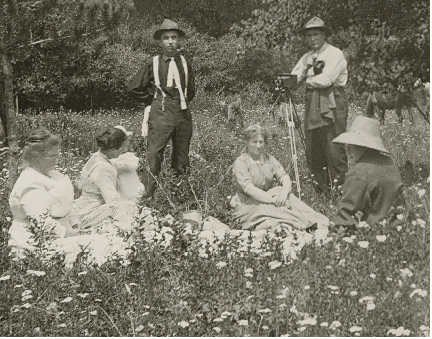
    — Detail from a photo in the collection of the Pioneer Museum of Bozeman.

  • A Tale: Pioneer Photographer Documents Hunting Expedition Near Yellowstone Park — 1889

    Jack Bean (left) and a client near Jackson Hole, Wyoming, 1889.

    When I received my copy of the fall issue of the Pioneer Museum Quarterly last week, I was delighted to see an article about Charles D. Loughrey, a Bozeman pioneer photographerI had examined the museum’s collection of Loughrey’s photographs but didn’t know much about him.  

    Jacob Rubow of the museum staff dug through Loughrey’s diary and a reminiscence by his brother-in-law, Jack Bean, to glean stories from their lives. One of those stories was about a hunting trip where Bean guided two Englishmen through the park. Hunting inside the park was illegal then, so Bean took his clients to places nearby so they could bag their trophies. And Loughrey was on hand to document the magnificent specimens.

    I asked Jacob if I could post the hunting story on my blog. I’m delighted that he obliged.

    ∞§∞

    In August, 1889, two Englishmen, Messrs. Lennard and Beach, hired Jack Bean, a resident of Bozeman, Montana, to lead them on a hunting trip through Yellowstone National Park and points beyond. Bean, who then earned a living as a guide for hunters and the cavalry out of Fort Ellis, enlisted his friend and brother-in-law, Charles D. Loughrey, as cook and photographer for the expedition. Loughrey had once owned a photography studio in Bozeman, and although the venture was short lived, his photographs, combined with his dutifully-kept journals, have left behind a rarity among historical sources: an illustrated account of the Gallatin Valley and greater Yellowstone region as he saw it in the late nineteenth century. As a frequent companion on Jack Bean’s hunting trips, Loughrey captured striking views of remote corners of the Gallatin Valley, Yellowstone, and the Snake River and Tetons. His diary entries, which chronicle the daily pace of life in the late nineteenth century as well as his and Bean’s adventures in Yellowstone, run from concise to sparse, but, as the saying goes, his pictures are worth a thousand words.

    On August 8, Loughrey and Bean rode into Bozeman through a haze of late-summer smoke blown before a hard east wind. There, they purchased food and had their horses freshly shod. Loughrey spent the next two days busily repairing and fitting his camera with a new lens, packing supplies, and accompanying his wife Ida and family to town “to see a street dog show given by some medicine men.” Then, on the morning of August 11, Loughrey took a bath and set off through the clearing smoke to meet Bean and his assistant guides. The men camped that night amidst heavy thundershowers in the Gallatin Mountains, and spent the following night cussing the building smoke along the Yellowstone River. On the thirteenth, the party camped above the Yankee Jim Tollgate, and on the fourteenth Loughrey wrote a letter to Ida from their camp above Gardiner. While Bean and the other guides spent the next three days waiting in town for the Englishmen, Loughrey explored Mammoth Hot Springs and claimed the hunting party’s first victim, a rattlesnake.

    On Sunday, August 18, with Englishmen in tow, the expedition crossed into the park, camping first at Tower Falls, then spending a “very wet and disagreeable” night in a snowstorm downstream from the Lower Falls of the Yellowstone. A spell of clear, cold weather followed the snowstorm, and the group traveled quickly past the Grand Canyon and Falls, camped at Yellowstone Lake, and then paused at the Upper Geyser Basin on the 23rd. Loughrey lagged behind to take a view of Lewis Falls before exiting the park on the 25th, and rejoined the party later that afternoon at a camp near the Snake River. The enthusiastic hunters spent their first evening beyond the park boundary searching for elk, but returned to camp empty handed. Loughrey stayed in camp on the 27th, washing clothing and photographing the horses grazing beside a stream in a small park. The hunters went out, and Jack Bean “killed a cow elk, which caused great rejoicing in camp.”

    The men spent the next few weeks crisscrossing the area around the Tetons and Snake River, fishing with great success, but hunting with mixed results. They quickly settled into a routine, with the hunters and guides fishing and hunting in pairs most evenings, and Loughrey tending to the camp, cooking, washing clothing, and diligently maintaining his photographic equipment. The hunters pursued elk, deer, and pronghorn “with blood in their eyes,” and when they met with success Loughrey dutifully marched out to capture views of the hunters posing with their trophies, and to collect the antlers. In addition to these portraits of victorious hunters, Loughrey captured candid views of the men in camp, striking images of the Tetons rising above Jackson Lake, and scenic glimpses of the horses and pack animals grazing in mountain parks. On September 20, returning northward, the party passed through Rexburg, Idaho, where Bean purchased sugar and dried fruit. The next day, they reached Market Lake, and in a flurry of activity, Bean packed the Englishmen’s things while Loughrey made portraits of the group and sent a letter to Ida on the five o’clock train. The men ate dinner that night with Captain Head, with whom they “[drank] liquor and [ate] fruit till half past nine.” The Englishmen left on the three o’clock train the next morning. Loughrey, Bean, and company packed up “with the wind howling and all hands cursing,” and started for home, taking care not to “let any grass grow under the horses [sic] feet.”

    Despite a snowstorm and Loughrey’s brief bout with a bug that prevented his eating breakfast on the 24th, the party continued their rapid pace homeward. They camped at Henry’s Lake, then at a creek near the Upper Madison Basin. From there the men crossed over to the Gallatin River, and set off down the Canyon. The group made a final camp at Sheep Rock on September 29, reaching the Bean and Loughrey farms on Rocky Creek, east of Bozeman, at half-past-two the next afternoon. Bean and Loughrey arrived at Bean’s house to find their wives gone to town. The two ate dinner, and then went out to check the garden. Loughrey ran into the ladies on his way home, and returned with them to Bean’s house where they stayed all night. The following evening, the Beans and Loughreys took dinner in town with their in-laws, the Rowlands. On Wednesday, October 22, 1889, a clear day, Loughrey “pitch forked some potatoes before dinner,” “cleaned the chicken house out and pulled the beans.” It was good to be home.

    ∞§∞

    This piece is a portion of a larger work from the Pioneer Museum Quarterly and draws upon: Jack Bean’s Reminiscences: Real Hunting Trails, and Charles D. Loughrey’s journals both of which are in the collections of the Pioneer Museum of Bozeman.

    — Photo from the Bean Collection, Pioneer Museum of Bozeman.

    — You also might enjoy Jack Bean’s story, Colonel Pickett Gets His Bear.

    — You can read more about Jack Bean in my book Adventures in Yellowstone.

  • A Tale: An Arctic Explorer Braves Yellowstone Park in Winter — 1887

    F. J. Haynes, Hayden Valley, 1887

    Today tourists can enjoy the winter wonders of Yellowstone National Park in snow coaches and stay overnight in cozy warm lodges. But in the Nineteenth Century, the very idea of winter travel in the park was so forbodding that the first winter trip there was led by an arctic explorer.

    Lieutenant Frederick Schwatka, who earned his fame exploring the frozen reaches of Alaska and Canada in 1878-80, led a group of a dozen men from Mammoth to Norris Geyser Basin in two days beginning on January 5, 1877.  Schwatka fell ill at Norris, but Yellowstone photographer F. Jay Haynes and three others continued on to the upper geyser basin and Yellowstone Falls. On their return trip, they were stranded on Mount Washburn in a blinding snowstorm for 72 hours.

    Here’s how F. Jay Haynes’ son, Jack Ellis Haynes, told the story in 1920.

    ∞§∞

    In January, 1887, the first successful winter exploration of the Yellowstone region was made. Lieutenant Frederick Schwatka of Arctic fame headed the party consisting of several eastern men, F. Jay Haynes, photographer, and a corps of guides, packers and assistants. Their outfit consisted of astronomical instruments, photographic equipment, sleeping bags and provisions which were drawn on toboggans; the party used Norwegian skis and Canadian web snowshoes, but the snow was so light that they sank readily and the toboggans were exceedingly difficult to draw. It took three days to cover the twenty miles from Mammoth Springs to Norris Basin; and the temperature the first night at Indian Creek was 37° below zero.

    Unfortunately Lieutenant Schwatka fell ill at Norris and was unable to proceed. Mr. Haynes, desirous of obtaining a collection of winter photographs of the Park, employed two of the sturdiest men of the Schwatka party, and with Edward Wilson, a government scout, resumed the journey.

    The toboggans were abandoned and this party packed their equipment and provisions on their backs—each man carrying about forty-five pounds.

    Norris Basin was a gorgeous sight. Craters heretofore unnoticed by these men familiar with the Park in summer, steamed conspicuously. The foliage was heavily laden with ice near the steam vents and geysers, producing all the fantastic forms possible to imagine; while the entire basin resembled a vast manufacturing centre.

    Tall trees buried in the snow appeared like bushes, and the general aspect of the country was completely changed; the average depth of the snow being about eight feet. The steam rising fully two thousand feet from the geysers at Upper Basin could be seen from the Lower Basin.

    The beautifully colored walls of the Grand Canyon were masses of pure white. The north half of the Great Fall hung in immense icicles 200 feet in length. An ice bridge fully 100 feet high was formed at the base of the fall, coming up to the spray line (about one-third the height of the fall.) The brink was frozen over and was hidden in an arch of ice a dozen feet thick.

    Thousands of elk were seen on the exposed ridges of Mount Washburn. The trip over Mount Washburn was one of most unusual hardship and privation; a blinding snowstorm which lasted four days overtook the party of four. During this entire time they wandered day and night without shelter, provisions or fire before reaching Yancey’s ranch, an experience that nearly cost them their lives.

    The circuit covered was about 200 miles, and the thermometer ranged from 10° to 50° below zero during the twenty-nine days of the trip.

    ∞§∞

    — From Jack Ellis Haynes, “Winter Exploration in 1887,”  Haynes New Guide and mortorists’ complete road log of Yellowstone National Park. J. E. Haynes: Saint Paul, 1920.  Pp. 134-137.

    — You also might be interested in:

    ∞§∞

  • A Tale: Photographer Tangles with an Elk — Seton, 1913

    When the Army took over administration of Yellowstone Park in 1886, they stopped all hunting and began sealing guns at the border. Soon Nimrods began fulfilling their hunting urges by stalking big game with cameras. 

    The famous naturalist-writer, Ernest Thompson Seton, told this story about his friend, John Fossum, who was once a soldier in Yellowstone Park. Seton described it as an adventure on a “heroic scale.”

    ∞§∞

    A friend of mine, John Fossum, while out on a camera hunt in early winter, descried afar a large bull Elk lying asleep in an open valley. At once Fossum made a plan. He saw that he could crawl up to the bull, snap him where he lay, then later secure a second picture as the creature ran for the timber.

    The first part of the program was carried out admirably. Fossum got within fifty feet and still the Elk lay sleeping. Then the camera was opened out. But alas! that little pesky “click,” that does so much mischief, awoke the bull, who at once sprang to his feet and ran—not for the woods—but for the man.

    Fossum with the most amazing nerve stood there quietly focussing his camera, till the bull was within ten feet, then pressed the button, threw the camera into the soft snow and ran for his life with the bull at his coat-tails.

    It would have been a short run but for the fact that they reached a deep snowdrift that would carry the man, and would not carry the Elk. Here Fossum escaped, while the bull snorted around, telling just what he meant to do to the man when he caught him; but he was not to be caught, and at last the bull went off grumbling and squealing.

    The hunter came back, recovered his camera, and when the plate was developed it bore the picture.

    It shows plainly the fighting light in the bull’s eye, the back laid ears, the twisting of the nose, and the rate at which he is coming is evidenced in the stamping feet and the wind-blown whiskers, and yet in spite of the peril of the moment, and the fact that this was a hand camera, there is no sign of shake on landscape or on Elk, and the picture is actually over-exposed.

    ∞§∞

    — Ernest Thompson Seton, Wild Animals at Home, Grosset and Dunlap: New York, 1913.  Pp. 71-72.

    — Photo by John Fossum from Seton’s book.

  • A Tale: Photographing Grizzlies With Flash Powder — 1906

    At the dawn of the Twentieth Century, a self-described hunter-naturalist named William Henry Wright decided to start carrying a camera on his various expeditions. He soon began taking excursions just to photograph animals. After a while, he decided to take on the challenges of photographing grizzlies.

    Because the grizzlies are shy and tend to be nocturnal, Wright said, chances of taking a daylight photo were slim, so he began experimenting with ways to use batteries and tripwires to ignite flash powder. By 1906 he had perfected his techniques enough to go to Yellowstone Park to try them out.

    It took several attempts before Wright succeeded in getting a decent photograph. Here’s his description of his first try.

    ∞§∞

    I followed some of the more travelled trails for several miles and found that nearly all of the grizzlies had their headquarters in the range of mountains around Mt. Washburn. I then selected their largest highway, and after setting up my camera, concealed myself one evening about a hundred feet from the trail and to leeward of it, and watched for the coming of the grizzlies. Across the trail I had stretched a number forty sewing thread, one end attached to the electric switch and the other to a small stake driven into the ground beyond the trail. Just below where I had located, there was an open park in which the bears had been feeding, as was shown by the grass that had been nipped and the holes that had been dug for roots.

    For some hours I waited in the bushes and fought gnats and mosquitoes. I saw several black bears pass along the hillside, but not a grizzly showed his nose until after the sun had set and the little marsh in the park was covered with a mantle of fog. Suddenly then, far up the trail, appeared what at first looked like a shadow, so slowly and silently did it move. But I knew at once, by the motion of the head and the long stride, that a grizzly was coming to the bottom for a few roots and a feed of grass.

    I was, of course, very anxious to see what he would do when he came to the thread across the trail, and I had not long to wait, for he came on steadily but slowly and, when within ten feet of the thread, he stopped, poked out his nose and sniffed two or three times, raised up on his hind feet, took a few more sniffs, and then bolted up the trail in the direction from which he had come.

    A few minutes after he had gone, three more appeared. These were evidently of one litter and appeared to be between two and three years old. They came on with the same cautious movements, and when they were close upon the thread, they also stopped and went through a similar performance. The one in front pushed out his nose and sniffed gingerly at the suspicious object. Those in the rear also stopped, but being curious to learn what was causing the blockade, the second one placed his forefeet on the rump of the one in front, in order to see ahead, while the third one straightened up on his hind legs and looked over the other two.

    They made a beautiful group, and just as they had poised themselves, the one in front must have touched the string a little harder than he had intended to, for there was a sudden flash that lit up the surroundings, and I expected to see the bears go tearing off through the timber, but, to my utter surprise, nothing of the kind happened.

    They all three stood up on their hind legs, and looked at each other as much as to say, “Now, what do you think of that?” and then they took up their investigation where it had been interrupted, followed the thread to where it was fastened to the stick, clawed up the spool, which I had buried in the ground, sniffed at it, and then went back to the trail, where they had first found the thread. Here they again stood up, and then, having either satisfied their curiosity or becoming suspicious, they turned around and trailed away through the timber.

    As far as I could see them they went cautiously, and stopped at frequent intervals to stand up and look behind them to see if there were any more flashes or if anything was following them. Unfortunately this picture was utterly worthless. I had failed to use enough flash powder, and when I came to develop the plate, it showed only the dimmest outline of the animals.

    ∞§∞

    — From William Henry Wright, The Grizzly Bear: The Narrative of a Hunter Naturalist,  Scribner’s Sons: New York, 1909.

    — Photo from the book.