Category: Uncategorized

  • News: Holiday Spirit Lives in Small Town America

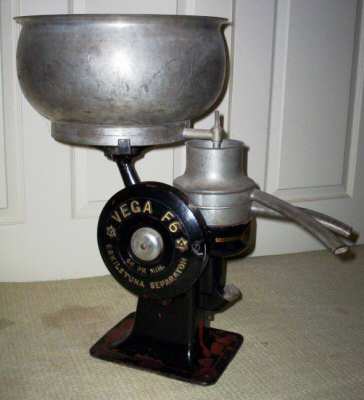
    A Cream Separator

    The highlight of my book signing last night occurred when carolers stopped at the Manhattan Museum to regale us with song. It seemed like everybody who lives in this town of 2000 was milling around downtown, greeting each other with cheerful smiles, and popping in and out of decorated stores to check out offerings and buy Christmas gifts. There was no piped in music to drown out the authentic sounds of holiday greetings, carolers, and the clip-clop of the horses that pulled a hay-ride wagon.

    I arrived early and had time to tour the new museum, which is housed in the old buidling that used to be a combination fire station and city jail. When I looked into a jail cell filled with dairy equipment—milk cans, strainers, and a cream separator—I was reminded of the times my brothers and I rushed to finish the evening milking so we could open our presents on Christmas Eve. (My parents had the wisdom to know it’s better to reward children who work in a dairy barn with early opening of presents than to make them wait until after morning milking.)

    I love these small town museums that have sprung up across Montana. They do such a good job of letting us peek into the past. I could almost smell my mother’s cooking when I looked at the collection of kitchen appliances from the time when electricity was new in rural America. I could almost see my father working in his shop when I looked at the collection of antique tools—a saw for cutting loose hay, tongs for hauling blocks of ice, and wrenches for keeping your Model T running.

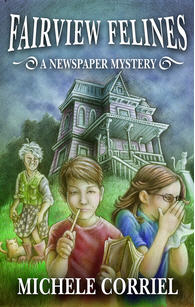
    I enjoyed chatting with fellow author, Michele Corriel, and bought a copy of her mid-grade book, Fairview Felines: A Newspaper Mystery. She reciprocated by buying two copies of Adventures in Yellowstone: Early Travelers Tell Their Tales.

    Like most authors I crave fans so it was great to hear people praise my articles from The Big Sky Journal like the one on early Yellowstone Entrepreneurs, and from The Pioneer Museum Quarterly like “Tales of the Belgrade Bull.”

    I had a good time—and sold a few books.

    ∞§∞
  • News: Adventures In Yellowstone Book Signing

    I’ll be signing copies of my book, Adventures In Yellowstone: Early Travelers Tell Their Tales, on Thursday, December 9, at the Museum in Manhattan, Montana. I’ll be appearing with fellow author Michele Corriel, the author of Fairview Felines. I’m looking forward to meeting her.

    Festivities include a chili feed at the Senior Center, horse-drawn hayrides, Christmas carolers, and activities for the kids. Shops open their doors and invite folks in for refreshment and conversation.

    Come by if you want a dose of small town holiday cheer. And don’t forget to stop by the museum for signed books.  They make great Christmas gifts.

    ∞§∞

  • A Tale: The First Written Description of Yellowstone Geysers — Daniel T. Potts, 1827


    By the early 1800’s trappers were scouring the Rocky Mountains  for beaver. Evidence of  their travel is sketchy, but we know that trapper brigades reached the Yellowstone Plateau by 1826.

    In 1947, two elderly ladies offered to sell the National Park Service three letters that were then 120 years old. A fur trapper named Daniel T. Potts had sent one of them to his brother in 1827. It is thought to be the first written description of the thermal features of the Upper Yellowstone by someone who actually saw them. Here’s the famous “Letter from Sweet Lake.”

    ∞§∞

    Sweet Lake
    July 8th 1827

    Respected Brother,

    Shortly after writing to you last year I took my departure for the Blackfoot Country. We took a northerly direction about fifty miles where we cross Snake River or the South fork of Columbia—which heads on the top of the great chain of Rocky Mountains that separate the water of the Atlantic from that of the Pacific. Near this place Yellowstone South fork of Missouri and the Henrys fork head at an angular point. The head of the Yellowstone has a large fresh water lake on the very top of the mountain—which is about one hundred by forty miles in diameter and as clear as crystal.

    On the south borders of this lake is a number of hot and boiling springs—some of water and others of most beautiful fine clay. The springs throw particles to the immense height of from twenty to thirty feet in height. The clay is white and of a pink. The water appears fathomless; it appears to be entirely hollow underneath.

    There is also a number of places where the pure sulphur is sent forth in abundance. One of our men visited one of those whilst taking his recreation. There at an instant the earth began a tremendous trembling. With difficulty he made his escape when an explosion took place resembling that of thunder. During our stay in that quarter, I heard it every day.

    From this place by a circuitous rout to the northwest, we returned. Two others and myself pushed on in the advance for the purpose of accumulating a few more Beaver. In the act of passing through a narrow confine in the Mountain, we where met plumb in face by a large party of Blackfeet Indians. Not knowing our number, they fled into the mountain in confusion—and we to a small grove of willows. Here we made every preparation for battle. After finding our enemy as much alarmed as ourselves we mounted our Horses which where heavily loaded we took the back retreat.

    The Indian raised a tremendous yell and showered down from the mountaintop. They had almost cut off our retreat when put whip to our horses. They pursued us in close quarters until we reached the plains where we left them behind.

    Tomorrow I depart for the west. We are all in good health and hope that this letter will find you in the same situation. I wish you to remember my best respects to all enquiring friends particularly your wife.

    Remain yours most affectionately.

    Daniel T. Potts

    ∞§∞

    — Original manuscript, Yellowstone National Park Research Library.

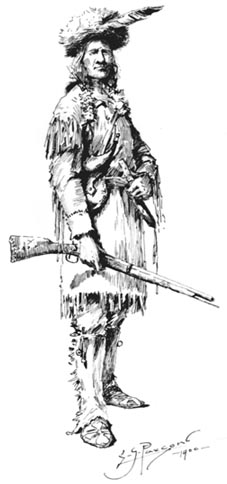
    — Sketch by E.S. Paxson, Montana Historical Society

    — You might also enjoy:

  • News and Views: Three Recent Books Describe Early Yellowstone Travel

    I was delighted this morning to find a brand new, autographed copy of Paul Schullery’s book, Old Yellowstone Days, on my breakfast table. Now I can retire the 1977 edition that I refer to often. It’s falling apart.

    The re-issue of Paul’s book means that three collections of first-person accounts of early travel to Yellowstone National Park have been published in the last two years. Old Yellowstone Days joins Ho! For Wonderland: Travelers Accounts of Yellowstone, 1872-1914 by Lee H. Whittlesey and Elizabeth A. Watry and my book, Adventures In Yellowstone: Early Travelers Tell Their Tales.

    At a superficial level, a single blurb could describe all three books: “A collection of interesting stories about nineteenth century travel to the world’s first national park by the people who lived the adventures.” But, the books really are quite different. In fact, only two of the forty stories contained in the three books appear more than once.

    Schullery focuses on celebrities. His book includes Rudyard Kipling’s description of Yellowstone as “a howling wilderness . . . full of the freaks of nature,” and his condescending description of a Fourth of July Celebration as “wild advertisement, gas, bunkum, blow, anything you please beyond the bounds of common sense,” and Theodore Roosevelt’s lament that hunters were wiping out all of America’s big game—bison, elk and moose, as well as Frederick Remington’s description of his adventures helping soldiers capture poachers.

    Whittlesey and Watry provide a wide sample of “ordinary” Yellowstone experiences. They begin with Montana Pioneer Granville Stuart’s detailed descriptions of everything he saw when the park was just a year old in 1873. They end with Elbert and Alice Hubbard’s precious accounts of what they saw in 1914. Whittlesey and Watry approach their task in a scholarly manner liberally sprinkling their book with footnotes to explain unclear references.

    I take the opposite approach focusing on extraordinary tales filled with adventure, like Emma Cowan’s story of watching Indians shoot her husband in the head, or with humor, like the Earl of Dunraven’s hilarious explanation of how to pack a mule. I don’t use a single footnote and edit extensively for easy reading by today’s readers.

    The books are testament to the enormous diversity of the Yellowstone experience. Fans of Yellowstone Park would enjoy all of them. So would fans of history. And fans of well told stories.

    ∞§∞

  • A Tale: A Cloud-Burst of the Rarest Jewels


    Most Yellowstone tourist who kept journals struggled to describe geysers. Some relied on quantitative descriptions of such things as how high water was hurled snd how much time separated eruptions. Other’s chose adjectives—”stupendous,” “astounding”—and left their readers to imagine what they meant.  And many simply used phrases like “words cannot describe ….”

    John L. Stoddard was a professional writer who revealed his emotions and used figures of speech to describe what he saw. Stoddard was a world traveler who turned his experiences into popular lectures that he delivered across American. He published them is a series of books entitled Stoddard’s Lectures. Here’s his description of Fountain Geyser.

    ∞§∞

    “Show me a geyser!” I at last exclaimed impatiently, “I want to see a genuine geyser.” Accordingly our guide conducted us to what he announced as “The Fountain.” I look around me with surprise. I saw no fountain, but merely a pool of boiling water, from which the light breeze bore away a thin transparent cloud of steam. It is true, around this was a pavement as delicately fashioned as any piece of coral ever taken from the sea. Nevertheless, while I admired that, I could not understand why this comparatively tranquil pool was called a geyser, and frankly said I was disappointed. But even as I spoke, I saw to my astonishment the boiling water in this reservoir sink and disappear from view.

    “Where has it gone?” I eagerly inquired.

    “Stand back!” Shouted the guide, “she’s coming.”

    I ran back a few steps, then turned a caught my breath; for at that very instant, up from the pool which I had just beheld so beautiful and tranquil, there rose on great outburst of sublimity, such a stupendous mass of water as I had never imagined possible in vertical form. I knew that it was boiling and that a deluge of those scalding drops would probably mean death, but I was powerless to move. Amazement and delight enchained me spellbound. Talk of a fountain! This was a cloud-burst of the rarest jewels which, till that moment had been held in solution in a subterranean cavern, but which had suddenly crystallized into a million radiant forms on thus emerging into light and air. The sun was shining though the glittering mass; and myriads of diamonds, moonstones, pearls, and opals mingled in splendid rivalry two hundred feet about our head.

    ∞§∞

    — From Stoddard’s Lectures, Volume 10, 1905.

    — F. J. Haynes Postcard, Yellowstone Digital Slide File.

  • News and Views: A Truly Great Conversation in Helena


    I had a really good time with seven scintillating dinner companions at Great Conversation in Helena on Wednesday.  I was impressed with the Helena Education Foundation, who sponsored the event and recognized ten great teachers from Helena schools.  What a wonderful show of community support for schools, teachers and — most important — students.

    I  truly enjoyed my dinner companions.  They laughed when I told them about Eleanor Corthell who announced to her husband that he should expect a bill  because she had bought a team and wagon and was taking their seven children to Yellowstone Park for the summer in 1904.  My companions were full of questions about Truman Everts and how he survived thirthy seven days alone in Yellowstone in 1870.  And, they were eager to share their own experiences from the time when bears would stall traffic to beg from cars.

    I was an overnight houseguest of Denny DeRozier and his wife, Nikki.  Denny is a friend from my childhood in Silver Star.  After we had a drink at Helena’s Silver Star Steak House, we spent a few minutes reminiscing in front of a historic photo of the Silver Star School.

    Great Fun!

    ∞§∞

    — Photo from the Yellowstone Digital Slide File

  • News and Views: Off to Helena for “Great Conversations”

    On Wednesday I’ll travel to Helena to host a table for “Great Conversations,” a fundraiser sponsored by the Helena Education Foundation.  My job will be to lead a dinner conversation (scintillating, I hope) with seven people who want to talk about early travel to Yellowstone Park.  I’ll get a free dinner, an opportunity to talk about a topic I love, and the satisfaction of supporting Helena schools.

    There’ll be twenty-eight tables at the event this year providing discussions for every taste and whim. Topics include “Raising Self-Reliant Children,” “The Neuroscience of Choice,” and “Is There a Plan of Attack for Peace?”  You can see the full list of topics.

    My topic is “Nineteenth Century Adventures in Yellowstone Park” and I’ve promised to tell exciting, funny and interesting stories.  My collection includes hundreds of tales and I’m wondering which to choose.  Can you help? Please look around through the posts on this blog and decide which ones would make for the best dinner conversation. Then tell me about your thoughts in the Comments section below.

    Just to get you started, here are links to some of my favorites:

    Why I’m Interested in Yellowstone Stories.

    Or offer a little high adventure:

    “Treed by a Lion” by Truman Everts.

    “Captured by Indians” by Emma Cowan.

    Or a touch of humor:

    “Maude Gets Her Revenge” by Louise Elliott.

    “Yellowstone’s First Car” by Henry Merry

    Or may just describe the sights:

    “Crusing Lake Yellowstone” by Hester Hensall.

    I really would like to know which stories you enjoy most. Thanks for your help.

    ∞§∞

  • A Tale: Naming Tower Fall— Langford, 1870

    In 1870 the famous Washburn Expedition explored the remote area that became Yellowstone National Park. While the explorers always had be be alert for the dangers of Indians, wild animals, and strange geothermal features, they also found ways to have fun. Here’s Nathaniel P. Langford’s description of  one of the pranks they played on each other.

    ∞§∞

    At the outset of our journey we had agreed that we would not give to any object of interest that we might discover the name of any of our party nor of our friends. This rule was to be religiously observed.

    While in camp on Sunday, August 28th, on the bank of this creek, it was suggested that we select a name for the creek and fail. Walter Trumbull suggested “Minaret Creek” and “Minaret Fall.” Mr. Hauser suggested “Tower Creek” and “Tower Fall.” After some discussion a vote was taken, and by a small majority, the name “Minaret” was decided upon.

    During the following evening Mr. Hauser stated with great seriousness that we had violated the agreement made relative to naming objects for our friends. He said that the well known Southern family—the Rhetts—lived in St. Louis, and that they had a most charming and accomplished daughter named “Minnie.” He said that this daughter was a sweetheart of Trumbull, who had proposed the name her name, “Minnie Rhett” — and that we had unwittingly given to the fall and creek the name of this sweetheart of Mr. Trumbull.

    Mr. Trumbull indignantly denied the truth of Hauser’s statement, and Hauser as determinedly insisted that it was the truth. The vote was therefore reconsidered, and by a substantial majority it was decided to substitute the name “Tower” for “Minaret.” Later, and when it was too late to recall or reverse the action of our party, it was surmised that Hauser himself had a sweetheart in St. Louis — a Miss Tower.

    ∞§∞

    —Excerpt from N. P. Langford, The Discovery of Yellowstone Park.

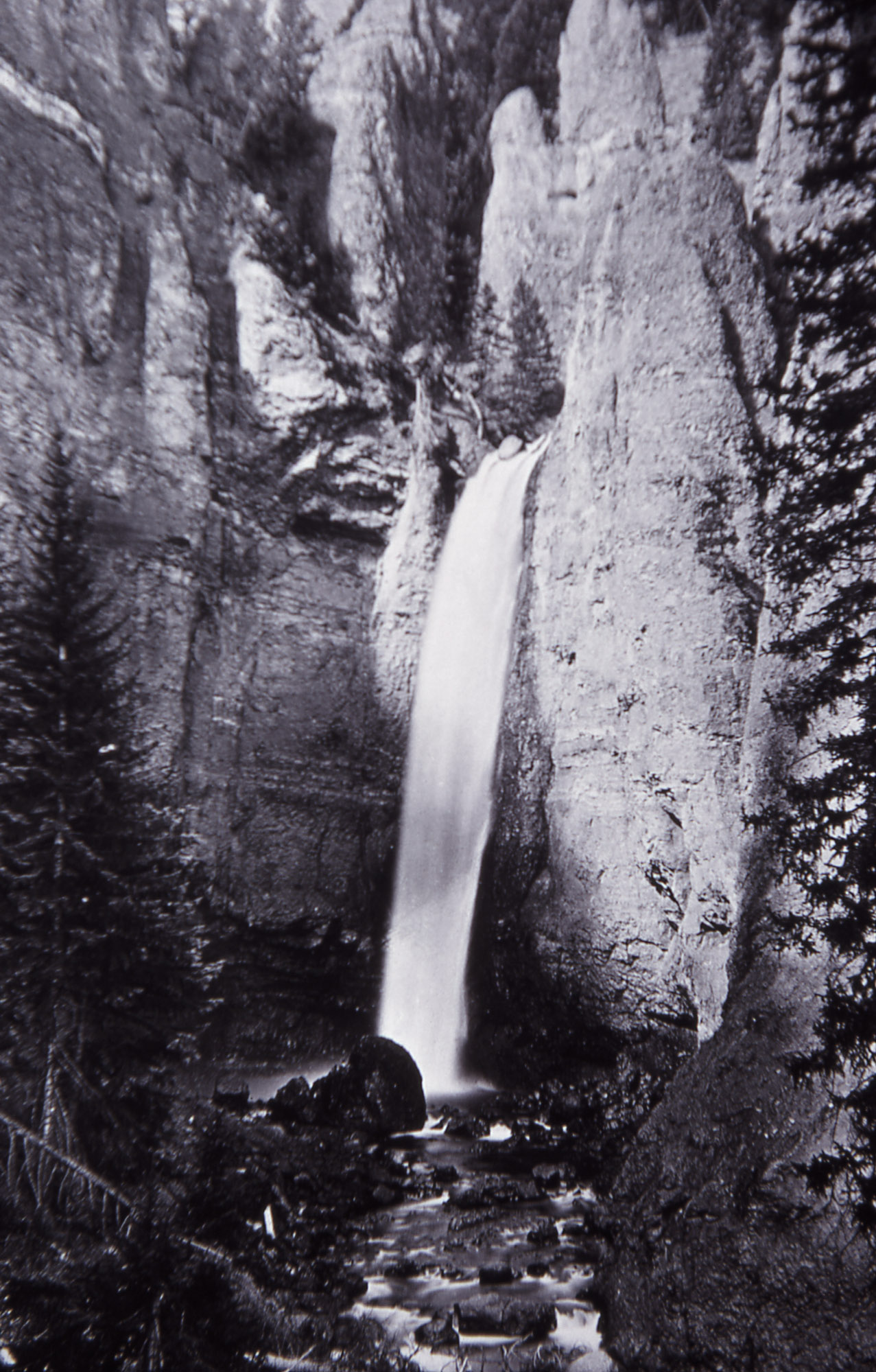
    —William Henry Jackson Photo, Yellowstone Digital Archive.

    — You can read a condensed version of Langford’s The Discovery of Yellowstone Park in my book, Adventures in Yellowstone.

    — To see more stories by this author, click on “Langford” under the “Categories” button to the left.

    — For more stories about the Washburn Expedition, click on “Washburn” under the “Categories” button to the left.

  • The Belgrade Bull 5: The Jake Ross Controversy

    Tales of Corbett, the Belgrade Bull, are the stuff of a legend that has lasted more than a hundred years. There are still old timers around who can tell “the true story” just the way their grandfathers told it to them. Of course, “the true story” varies depending on such things as whether grandpa lived in Belgrade or Townsend, or whether his last name was “Teeples” or “Ross.” But community pride and family stories are probably what keep the legend alive.

    To read the story beginning with Part 1, click here.


    The Belgrade Bull, Part 5, finale.

    ∞§∞

    In 1949—more then 50 years after Corbett retired to be a herd sire in Indiana—the Townsend Star printed obituary that claimed the old cowboy named Jake Ross had ridden the Belgrade Bull. The Belgrade Journal reprinted the obituary setting off flurry of letters to the editor. Most of them described a midnight ride Ross made in Belgrade. Nobody explained the motives behind the ride, but probably it was for the same reason others had purloined Corbett—to try him out before placing a bet.

    Jake and a friend found the bull in Belgrade and took him to a flat near a gravel pit. They saddled him and Jake climbed aboard hanging on to a small rope tied around the bull’s horns. The bull jerked his head down pulling Jake’s head and shoulders forward, and then reared up. Jake fell 10 feet away hitting his head in the gravel. Reports vary as to whether he saw “three or four moons” or “a lot of stars.” Ross’s staunchest advocates don’t say he successfully rode Corbett in Belgrade, but they claim the experience helped him make a successful ride in Helena.

    In his reminiscence, Ross said he had a medal that proved he was the only man that “ever rode the Belgrade Bull according to the rules.” An article from the Townsend Star, the editor said he had seen the medal, but it had been stolen.

    Pres Johnston said of the medal, “Where he got it, I don’t know. Neither my brother nor I ever signed it for him or anything like it for anyone.’

    Frank Collins was more blunt: “I don’t know who Jake got to make that medal, but it was a phony. Jake fooled the people with that medal until I think he got to believe it himself.”

    Still, Ross had supporters. An article in the Belgrade Journal quoted a Butte man saying, “I saw Jake Ross ride the Belgrade Bull to a finish in Helena” and another man claiming to be an eyewitness who said Ross managed to ride the bull by jumping aboard after the bull made his first jump

    It is difficult to make sense of the jumble of claims. Maybe Jake Ross did get a medal for riding an animal called “The Belgrade Bull,” but not the one owed by the Johnston brothers. A Brahma bull called “Sharkey, The Belgrade Bull” appears in rodeo histories and there may have been others,

    But if Ross rode another Belgrade Bull, why didn’t he say so? Surely he could tell the difference between a Brahma and a Holstein. Also, Pres Johnston said Jake’s medal bore the Johnston brothers names. Perhaps Pres was mis-remembering events from decades past.

    Information about Corbett is buried in decaying newspaper archives across Montana. There is probably more to be discovered in diaries, reminiscences, and letters. Someday someone may find a document that answers the question: Did anyone ever ride Belgrade Bull with a clean saddle?

    ∞§∞

    — To see all of the stories about Corbett, The Belgrade Bull, click on “Belgrade Bull” under “Categories” in the column to the right.

    —Illustration from the Saturday Evening Post, September 10, 1910.

  • A Tale: Photos—A Grizzly Chases a Yellowstone Bison

    Generally, I focus my interest in Yellowstone Park stories on things that happened before 1915, but I couldn’t resist  joining the thousands of others who shared this remarkable photo.