Category: Uncategorized

  • News: A Peak Experience — A Whole Day With Book Lovers and Great Books

    I spent the whole day on Saturday closeted with half a dozen book lovers from all over Montana. We got together at Chico Hot Springs to pick the 2010 Montana Book Award Winners. The process works like this:

    Publishers submit books for consideration. About all that’s required is that a book be about a Montana setting or by an author who lives in Montana. Except for technicalities defining the details of publication and residence, that’s it. Past winners have included fiction (The Hotel on the Corner of Bitter and Sweet by Jamie Ford), non-fiction (Full Court Quest by Linda Peavy and Ursula Smith), and young adult (Hattie Big Sky by Kirby Larson.)

    After a book is submitted, it is distributed to readers who vote via email. As soon as two of them endorse the book, it is fully nominated so everyone reads it. If two people reject the book then it’s set aside. This means each judge reads about 25 book a year—about a dozen or so that get fully nominated and another dozen that get rejected.

    Because about half the submissions arrive in the last quarter of the year, readers have to scramble to get everything read. (My eyeballs literally ache sometimes.) But by the time the meeting at Chico rolls around, everybody has read all the nominated books. That makes for a marvelous experience—a full day of discussing a wide range of good books with avid readers who have thought about them carefully.

    The meetings start with one judge introducing a book. After a brief group discussion, another judge introduces a book for discussion, and the process proceeds until all the nominated books have been discussed. Finding one “best book” in a diverse set  may seem like an impossible task, but by the time all the nominees have been discussed, four or five books emerge as leaders.

    Then committee members cast secret ballots indicating their top four choices in rank order. We weight the votes (4 points for a first rank, 3 for second, etc) and tally them. The committee discusses the tally, eliminates the low scorers, and votes again. The process repeats until one book has five first-place rankings—and it’s the winner.

    The committee then uses similar procedures to decide if there should be Honor Books and if so how many. For the last couple of years, entries have been so strong that number of honor books has been set at four—the maximum allowed. The one regret: many good books don’t get awards.

    After the judging, there’s time left in the afternoon for a soak in hot springs waters and drinks in Chico’s cowboy bar.

    And in the evening—dinner in the wine cellar of Chico’s five-star restaurant. Great food and great conversation with avid readers who love books. It just doesn’t get any better!

    The Friends of the Missoula Public Library sponsor The Montana Book Award. Book lovers everywhere owe them a vote of thanks.

    I can’t announce the winners until they’ve been notified officially. When that happens, I’ll provide reviews on this blog. I look forward to telling you about some really great books.

    ∞§∞

    — The Montana Book Award Logo is a woodcut by Claire Emory.

    — To find out more about my work with the Montana Book Award look under the “Categories Button” on the right.
  • An Event: Seeing My Name in Lights

    As I walked up the sidewalk last night carrying my laptop and a box of books, I saw it: My Name In Lights.  There in front of MSU’s Music Building was a sign beckoning to passersby in flashing red electric letters:

    Tonight at Reynolds Recital Hall

    Author Mark Miller

    “Bozeman to Wonderland: Early Trips to Yellowstone”

    I guess that makes it official.  I’m an author.

    I went into the recital hall where a technician helped me set up my computer and rigged me with a microphone.  Then I headed to the lobby for the reception.  I was able greet friends and introduce myself to new people, but mostly I just paced about and fretted about my presentation.

    After people filed into the auditorium, the Dean of the College of Art and Architecture introduced me.  Then magic happened.  I had an opportunity to talk about a topic I love — and an attentive audience.

    They chuckled when I said my family took a cow with them to Yellowstone in 1909 so they could have fresh milk for the children.

    They squirmed in their seats when I read them William Bradbury’s account of Colter’s Run when the blood soaked mountain man dived under a raft of driftwood to hide from dozens of murderous Blackfoot warriors who were chasing him.

    They listened intently when I read a brand new chapter from my next book that describes Emma Cowan’s heroic ride by team and wagon for 175 miles in 31 hours to be at the side of her wounded husband. And they sighed when I read the description of Emma’s reunion with him as “Joy too sacred for public perusal.”

    All too soon my time was up.  I basked in the warmth of polite applause. I answered insightful questions.  Then I signed copies of  Adventures in Yellowstone.

    ∞§∞

    You might also enjoy these posts:


  • An Event: Final Touches for My Fine Arts Presentation

    I’ve been working hard to put the final touches on my presentation Thursday to the President’s Fine Arts Series of the Montana State University.  My title is “Bozeman to Wonderland: Early Trips to Yellowstone Park.”

    I think of myself more as a collector and teller of stories than as a historian. With that in mind, I’ve picked stories with a Bozeman connection that exemplify different Yellowstone experiences.  I’ll put them in context and read excerpts — either from first-person accounts that I’ve collected, or from my own writing.

    My outline looks like this:

    An introduction explaining my interest in early travel to Yellowstone Park with stories my grandmother used to tell about her trip there in 1909 and her grandfather’s trip in 1882.

    The Mountain Man Era with an excerpt from William Bradbury’s account of Colter’s Run in 1807, when Indians stripped a trapper naked and ordered him to run for his life.

    The Prospectors Era when treasure hunters rushed past Yellowstone’s wonders to scour every gully and gulch for gold.

    The Era of Exploration when prominent citizens set out to confirm fantastic reports of the wonders of the upper Yellowstone with excerpts from Truman Everts chilling story of being alone in the Yellowstone wilderness for 37 days.

    First Tourists when Montana pioneers set out to see the wonders for themselves with stories about Emma Stone, a Bozeman matron who was the first woman to take a complete tour of the park in 1872, and Sarah Tracy (Bozeman’s Tracy Avenue is named for her husband), who left a marvelous reminiscence of her trip to the park in 1874.

    War in Wonderland 1877 when the Nez Perce Indians left their homelands in Idaho and Washington and fled through Yellowstone Park.  I’ll read a chapter from my next book telling about Emma Cowan’s 31-hour ride with a team and wagon to join her husband when she learned he had survived after an Indian shot him point blank in the head.

    Conclusion and Time for Questions.

    The presentation will be at the Reynolds Recital Hall on the MSU Campus.  It begin with a pre-event reception at 6:30.

    It is free to the public.

  • A Tale: Hour Spring, A Geyser by Another Name — c. 1834

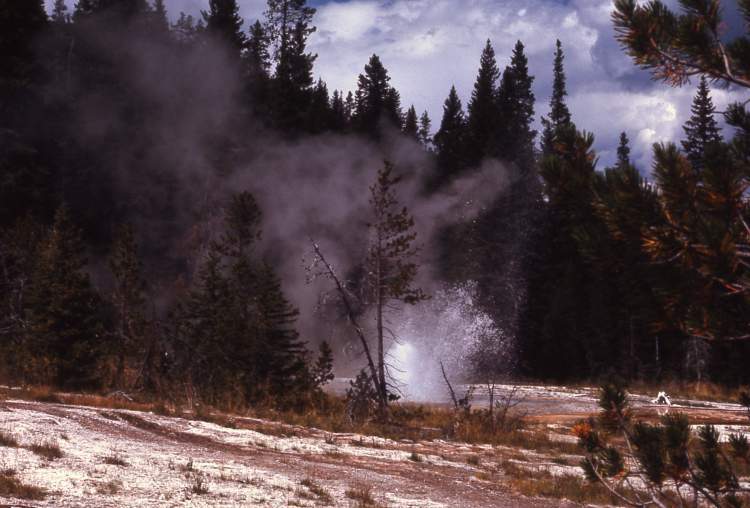
    Rustic Geyser, Heart Lake Geyser Basin

    In the decade between 1834 and 1843, a trapper named Osborne Russell kept a journal describing his adventures in the frontier northwest. Russell’s journal provides one of the earliest written accounts of travel to the upper Yellowstone. Here’s his description of hot springs and geysers in a now extinct geothermal area.

    ∞§∞

    The next day we traveled along the border of the lake till we came to the northwest extremity, where we found about 50 springs of boiling hot water. We stopped here some hours as one of my comrades had visited this spot the year previous he wished to show us some curiosities.

    The first spring we visited was about ten feet in diameter, which threw up mud with a noise similar to boiling soap. Close about this were numerous similar to it throwing up the hot mud and water five or six feet high. About thirty or forty paces from these along the side of a small ridge the hot steam rushed forth from holes in the ground with a hissing noise which could be heard a mile distant.

    On a near approach we could hear the water bubbling under ground some distance from the surface. The sound of our footsteps over this place was like thumping over a hollow vessel of immense size. In many places were peaks from two to six feet high formed of limestone, deposited by the boiling water, which appeared of snowy whiteness. The water when cold is perfectly sweet except having a fresh limestone taste.

    After surveying these natural wonders for sometime, my comrade conducted me to what he called the “Hour Spring.” At this spring the first thing that attracts the attention is a hole about 15 inches in diameter in which the water is boiling slowly about 4 inches below the surface. At length it begins to boil and bubble violently and the water commences raising and shooting upwards until the column arises to the height of sixty feet. It falls to the ground in drops on a circle of about 30 feet in diameter being perfectly cold when it strikes the ground.

    It continues shooting up in this manner five or six minutes and then sinks back to its former state of slowly boiling for an hour — and then shoots forth as before. My comrade said he had watched the motions of this spring for one whole day and part of the night the year previous and found no irregularity whatever in its movements.

    ∞§∞

    — Photo, Coppermine Photo Galley

    — From Osborn Russell, Journal of a Trapper, Syms-York Company, Boise, Idaho, 1921. Pages 99-100.

    — You might also enjoy:

  • Paul Schullery Comments on the General’s Fishing Tackle

    My friend, Paul Schullery, who Trout magazine calls America’s “preeminent angling historian,”  was kind enough to offer a comment on my post of General W.E. Strong’s story, “The Rod Bent Nearly Double.” I thought it deserved to be featured as a guest article.

    ∞§∞

    Strong’s accounts of the fishing that he and his companions enjoyed are interesting to historians for several reasons.

    The tackle is of interest because fashionable and well-heeled anglers of the mid-1870s were experiencing a revolution in their choice of gear, as the traditional (and often very large) solid-wood rods that had dominated the sport of fly fishing for centuries were being replaced by far lighter but often stiffer split-bamboo rods. Bamboo rods of this sort were expensive but very effective for distance- and precision-casting. Strong may have had some of those in his rod case, as it sounds like he had several rods.

    He was certainly in the majority in recognizing the importance of grasshoppers to the tastes of western trout. Though the British had been experimenting with some grasshopper imitations for centuries, the American grasshoppers were a considerably different and often much larger set of animals, and in the 1870s American anglers were just beginning to develop fly pattens that would work as well as the natural insects that Strong and his companions finally resorted to when their favorite artificial trout flies didn’t work. It would be several decades before American fly tiers developed floating grasshopper imitations that were consistent in catching fish when there were lots of natural grasshoppers competing for the trout’s attention.

    But Strong’s most interesting details may be about the trout itself.  No doubt his relatively light tackle, which included a silkworm gut leader that may not have been strong enough to horse a big fish in heavy water, had an effect on his handling of this fish. But by the mid-1900s, Yellowstone Cutthroat Trout would be widely regarded as the least sporting of the trout, in that they were typically thought of as the easiest to hook and the least strong as fighters. At least that was the prevailing stereotype; many of us have seen that same species of trout display great selectivity in feeding, and great strength in resisting capture once hooked. But for a Yellowstone Cutthroat Trout to jump clear of the water, repeatedly, would seem like an oddity to most modern anglers; at least I rarely have seen it or heard of it, and any number of respected authorities have said that they don’t jump. For whatever combination of evolutionary reasons, the species stereotypically does not feature jumping among its usual escape  tactics. But there are exceptions to every rule; I’ve heard or read that brown trout don’t jump, either, but I’ve seen them do so many times. What Strong’s account gives us is lots to think about as far as how well we know these fish; he tells us to be careful about our generalizations.

    ∞§∞

    — For more stories about fishing in Yellowstone Park, click on “fishing” under the “Categories” button on the right.

  • News: Meet Me Next Summer in Geyserland

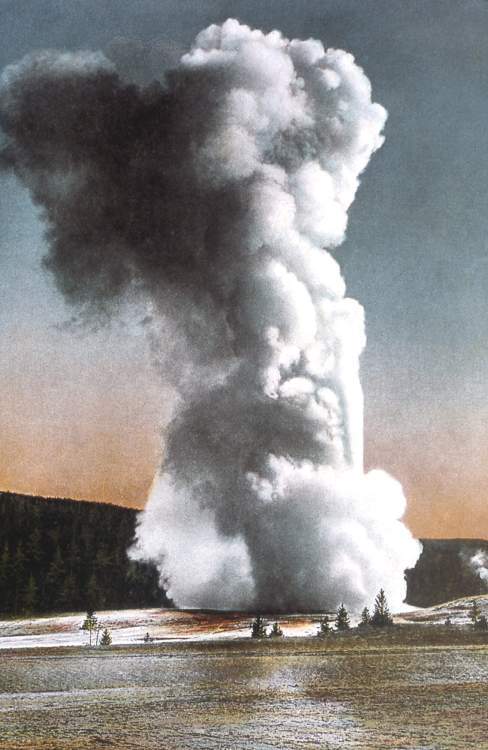
    Old Faithful Geyser, 1920

    I just arranged two events to promote my book, Adventures in Yellowstone: Early Travelers Tell Their Tales, in the lobby of Old Faithful Inn.

    I’ll be doing book signings there on July 23-24, and Aug. 20-21 between 10 a.m. and 3 p.m.  Also, I’m trying to arrange readings on those dates in smaller rooms off the lobby.  That would be great fun.

    So if you’re going to visit Yellowstone National Park this summer, plan to stop by historic Old Faithful Inn.  I’d love to sign a book for you.

    You can read about my book signing at the Inn in 2010 here and here.

    ∞§∞

    — F. J. Haynes postcard, Yellowstone Digital Slide File.

  • What’s a story? It helps to know what you’re looking for:

    Helena Daily Herald, Sept. 30, 1870

    Last week, I promised I would explain how I find the stories I post on this blog. The first step is defining what I look for.

    Most of the stories I post come from the collection of first-person accounts of travel to Yellowstone Park that I assembled for my presentations under the auspices of the Humanities Montana Speakers Bureau.

    In my promotional materials, I promised to bring travelers’ experiences to life using their own words. I soon figured out I could read four or five excerpts of three hundred to a thousand words in an hour presentation. That meant I had to be very selective as I went through my files.

    At first I “just followed my nose,” that is, I read and noted things I found fun or exciting, then excerpted and edited selections for presentation.

    My collection grew into dozens. There was just too much good stuff. How could I choose just four or five tales? My solution was to tailor each presentation to its audience. When I presented to women’s groups, I focused on stories by women. When I presented in Billings, I included stories by people who lived there. But, an account written by a person who lives in Billings, isn’t necessarily interesting to a Billings resident. It needs to be a story.

    So, what is a story?  I found an answer in Jon Franklin’s wonderful book, Writing for Story: Craft Secrets of Dramatic Nonfiction.

    Franklin, a Pulitzer Prize winning writer and teacher, emphasizes the “complication-resolution” structure of stories.  He says a story is a description of what happens when a person encounters a situation that demands a response.

    That situation can be the high adventure of life-threatening danger as in “Colter’s Run”.

    Or the need for quick thinking to protect another person as in “Colonel Picket Gets His Bear”.

    Or the humor evoked by the need to get even with a supercilious twit as in “Maud Gets Her Revenge”.

    With the complication-resolution definition of a story, it’s not hard to recognize one when you see it. But that doesn’t mean finding stories is easy. In fact, most accounts of Yellowstone travel in my collection contain nothing but banal descriptions of one sight after another. But I slog through them anyway. You never can tell where you’re going to find a nugget.

    I found one of my favorite stories, “A Million Billion Barrels of Hot Water” after slogging through more than 40 boring pages.

    ∞§∞

    — Next topic: “Sometimes the best stories are the worst history: Differences between journals, articles and reminiscences.”

    — Clipping adapted from the Yellowstone Digital Slide File.

  • What’s a story? It helps to know what you’re looking for:

    Helena Daily Herald, Sept. 30, 1870

    Last week, I promised I would explain how I find the stories I post on this blog. The first step is defining what I look for.

    Most of the stories I post come from the collection of first-person accounts of travel to Yellowstone Park that I assembled for my presentations under the auspices of the Humanities Montana Speakers Bureau.

    In my promotional materials, I promised to bring travelers’ experiences to life using their own words. I soon figured out I could read four or five excerpts of three hundred to a thousand words in an hour presentation. That meant I had to be very selective as I went through my files.

    At first I “just followed my nose,” that is, I read and noted things I found fun or exciting, then excerpted and edited selections for presentation.

    My collection grew into dozens. There was just too much good stuff. How could I choose just four or five tales? My solution was to tailor each presentation to its audience. When I presented to women’s groups, I focused on stories by women. When I presented in Billings, I included stories by people who lived there. But, an account written by a person who lives in Billings, isn’t necessarily interesting to a Billings resident. It needs to be a story.

    So, what is a story?  I found an answer in Jon Franklin’s wonderful book, Writing for Story: Craft Secrets of Dramatic Nonfiction.

    Franklin, a Pulitzer Prize winning writer and teacher, emphasizes the “complication-resolution” structure of stories.  He says a story is a description of what happens when a person encounters a situation that demands a response.

    That situation can be the high adventure of life-threatening danger as in “Colter’s Run”.

    Or the need for quick thinking to protect another person as in “Colonel Picket Gets His Bear”.

    Or the humor evoked by the need to get even with a supercilious twit as in “Maud Gets Her Revenge”.

    With the complication-resolution definition of a story, it’s not hard to recognize one when you see it. But that doesn’t mean finding stories is easy. In fact, most accounts of Yellowstone travel in my collection contain nothing but banal descriptions of one sight after another. But I slog through them anyway. You never can tell where you’re going to find a nugget.

    I found one of my favorite stories, “A Million Billion Barrels of Hot Water” after slogging through more than 40 boring pages.

    ∞§∞

    — Next topic: “Sometimes the best stories are the worst history: Differences between journals, articles and reminiscences.”

    — Clipping adapted from the Yellowstone Digital Slide File.

  • Views: Where Do You Find All Those Stories

    Relaxing in a Wylie Way Tent in Yellowstone Park

    People often ask me where I find the stories I post on this blog. That’s a good question and I plan to answer it. But I’ve discovered there’s no short simple answer.

    I’ve been looking for first-person accounts of early travel to Yellowstone Park for almost a decade and have more than 300 of them in my collection. But I know there are thousands more out there. It’s still a thrill to find a good one.

    I compare my efforts to those of nineteenth century prospectors searching for gold. Sometimes they saw huge nuggets lying on the surface, so they could just bend over and pick them up. Sometimes they had to shift through tons of sand and gravel to gather  a few ounces of gold dust. And sometimes they had to blast their way through solid rock just to locate a small vein.

    It will take several posts to explain that metaphor so  for now I’ll list a few of the topics I’m thinking about discussing.  I’d like you to tell me which ones you find interesting and what you’d like to know.

    • It helps to know what you’re looking for: What’s a story?
    • Sometimes the best stories are the worst history: Differences between journals, articles and reminiscences.
    • Just pull them off the shelf: There are great stories at your local library.
    • Let other people do the hard work:  Working at special collections, museums and archives
    • Download it for free: Project Gutenberg, Google Books, and The Making of America Collection.
    • Looking for pictures to bring a story to life.  The Yellowstone Digital Slide File and other repositories of photos and illustrations.

    That’s enough to get us started.  I’ll look forward to hearing from you.

    ∞§∞

    — Image adapted from an F.J. Haynes postcard, Yellowstone Digital Slide File.

  • A Tale: Mabel Cross Osmond: Dolly Saved My Life — 1874

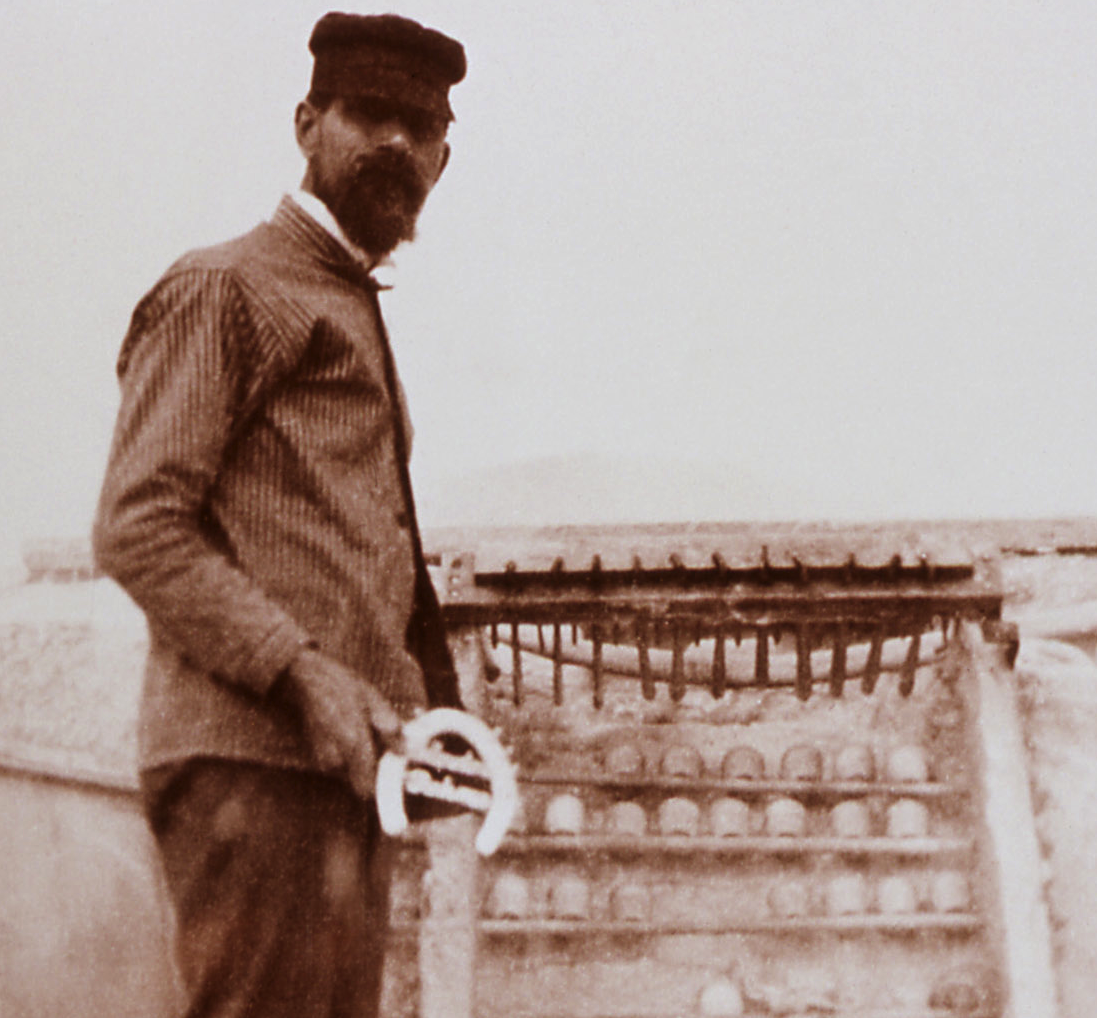
    Coating souvenirs at Mammoth Hot Springs

    Mabel Cross Osmond was just six and half years old when she first went to Yellowstone Park with her parents in 1874. Mabel’s father Captain Robert Cross was a Civil War veteran who came to Montana to be the post trader at Crow Agency, which was then located nine miles east of the present Livingston, Montana.

    Mabel wrote her memoir more that fifty years after her trip, but she still had vivid memories of it including such details as the saddle she rode. “The blacksmith,” she said, “taking a man’s saddle, fastened a covered iron rod from the pommel around on the right side to the back. This rod and the seat were well padded with blankets.  A covered stirrup, wide enough for my two feet was hung on the left side and across this open side from the pommel to the rod in back was attached a buckled leather strap so that, when mounted, I sat as a child in a high chair.”

    Mabel of rode an Indian pony she called “Dolly” that she said saved her life “by instantly stopping when, while descending a steep trail my saddle turned, leaving me hanging head downward, helplessly strapped in until the others could reach me.”

    The Crosses had an army escort to see them though Indian country until they reached the Bottler ranch.  Mabel recalled the stop clearly.

    “We enjoyed one of Grandma Bottler’s good dinners. I remember the cute little roast Pig with an ear of corn in its mouth, and also being awakened during the night by hearing her shrilly shouting — “Fredereek, Fredereek, the skunk is after the chickuns.” Though eighty years old, she kept her ‘store teeth’ put away —‘fearing to wear them out’ — she told us.”

    At Mammoth Hot Springs, Mabel’s father made a basket out of her mother’s corset stays and laid it in one of the pools.   The running waters encrusted the item with white mineral deposits making a souvenir that Mabel still had when she wrote her memoir.

    The Crosses traveled along Indian trails and through timber so thick that it hid the sky and pack mules had difficulty carrying their wide loads between the trees.  They camped at the geyser basins for several days, plenty of time to see most of the geysers play.

    When the Crosses got the Yellowstone Lake, Mabel took a ride on the boat that Sarah Tracy had named  “The Sally” just weeks earlier.  Mabel sailed to a small island where she feasted on gooseberries and ripe red raspberries, but she attributed the seasickness she got on the return trip to rough waters.  She said her hosts named an Island for her, but it didn’t stick.

    ∞§∞

    — Adapted from Mabel Cross Osmond, Memories of a Trip Through Yellowstone National Park in 1874. Typescript, Pioneer Museum of Bozeman.

    — Photo, Yellowstone Digital Slide.