Category: Women’s Stories

  • A Tale: A Lady’s Visit To The Geysers Of The Yellowstone Park (Part 3) — HWS 1880.

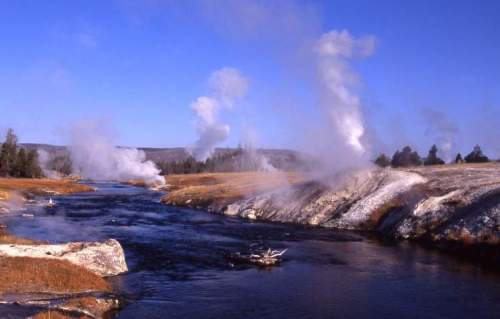
    Firehole River at the Upper Geyser Basin

    In Part 3, HWS describes the wonders of geyserland and the joys of evenings around the campfire.

    Begin with Part 1

    ∞§∞

    On the 3d of August we entered the Park. The first point we reached is what is called the Firehole, or the Lower Geyser Basin. It is a flat meadow, 7,000 feet above the sea, through which runs the Firehole river, and part of it is covered with beautiful grass, while part of it is the white sinter formation of the hot springs and geysers.

    Setting Tin Lee to work at his stove preparing supper, we rode about a mile on the edge of the pine forest that skirted the weird, desolate plain of the geyser basin. It was one glare of white geyserite, with sulphur and iron and alum springs bubbling up all over it, and little steaming funnels everywhere, giving evidence of the internal fires beneath.

    Standing or lying about this plain are trees killed by the hot, siliceous waters. Nothing in nature could be more spectral than these naked trunks of trees, stripped of bark and bare of branches, and bleached white as snow, looking like the ghosts of the groves and forests, which are undoubtedly buried beneath the constantly accumulating mass of deposit.

    It was a scene of absolutely uncanny desolation, and as we looked at it we ceased to wonder at the names bestowed upon it by its first discoverers, such as “Devil’s Paint Pots,” “Hell’s Half-acre,” etc. One of our guides told us in graphic language of his first sight of this region.

    “You see,” he said, “a party of us were out prospecting for mines, and we had traveled all day through pretty thick forests, and were pushing towards an opening we could dimly see through the trees, where, we hoped to make a comfortable camp for the night. We were very tired, and were hurrying to get into camp, when suddenly, just as we reached the edge of the forest without a moment’s warning, we heard a most awful rumbling, the ground shook under our feet, and there burst into the air a column of water and steam that looked as if it reached the skies.

    “We just fairly lost our senses, and never stopped to take a second look, but wheeled about in an instant, put spurs to our horses, and crushed away through the underbrush and tree-trunks as if the Evil One himself were after us.

    “And the fact is,” he added, “we did not know but that he was. For what else, we asked ourselves, could such goings-on mean, but that we were on the very edge of the lower regions? We never rested till we had put miles between us and that awful place, and for years we never spoke of it for fear the fellows should think we had really been to hell, and were sold to the old fellow who lives there.”

    We could not wonder at the fright of men who had probably never heard of geysers or volcanoes, and who had no more expectation of coming across such phenomena in that quiet and lonely region than we in Philadelphia have of seeing them in our sober Fairmount Park.

    This is considered to be the most wonderful geyser region in the whole world. The far-famed geysers of Iceland are tame fountains compared to some here. It is estimated by Professor Hayden that within an area of thirty-five or forty square miles there are at least 2,000 hot springs, steam-jets, geysers, and mud fountains; and in the whole Park there are supposed to be not less than 10,000.

    Many of the geysers spout to the height of fifty or a hundred feet, some two or three hundred, and our guides even told us of one which has only been known to spout twice, but which, when it does perform, reaches, they declared, the stupendous height of seven hundred feet. But as we did not see this one we felt a little dubious.

    The geysers seem to have all sorts of openings. Some of them have formed craters around their mouths twenty or thirty feet high, that have assumed curious fantastic shapes and are constantly sending out between their eruptions great puffs of steam, and little jets of scalding spray, while there is all the time a sound of fierce boiling water below. In others the hot water stands, a marvelously transparent pool, in saucer-shaped basins, from ten to one hundred feet across, at the bottom of which is the well or tube from which the eruption issues.

    No language can adequately describe the gracefully curved and scalloped forms of the deposits which line the apparently bottomless sides of these openings, nor the countless vivid and delicate colors with which they are dyed, shading from a deep crimson, on the edge of the pool, to a glorious emerald green or sapphire blue in the centre. To look down into the pure depths of these wonderful basins, with their fantastic forms and exquisite colors, is like looking into fairyland. Then suddenly, without a moment’s warning, or any apparent cause, the quiet water will begin to heave, and boil, and spurt, and will dash into a marvelous cataract, apparently instinct with life; leaping towards the skies, just as a cataract leaps downward; breaking into rockets of milk-white spray, each of which sends out a burst of steam, and then falls to the white rocks below in showers of shining jewels, tinted with all the colors of the rainbow. A geyser eruption is not in the least like an artificial fountain, but more like an inverted cataract, filled with a mighty life, every instant changing its shape and its height, and is always enveloped and surmounted by vast clouds and pillars of steam that sway with the wind, the whole being crowned and tinged with rainbows.

    These marvelous displays take place with one or two geysers at regular intervals, but most of them are very irregular in their times of action, varying from three or four hours to several days, or even two or three weeks. They seem sometimes to die out altogether, and new ones to break out in fresh places.

    It would seem, therefore, that while the amount of geyser action continues about the same, its centers of activity are constantly changing . . .. We were now a party of eleven, three sober middle-aged grown-ups, and eight young people, full of life and energy, and ready for any fun or adventure that came in their way. Our campfires at night were scenes of great merriment. As soon as we would get into camp all but the lazy ones would go to work gathering sagebrush or wood for the fire. We would choose a spot with dry sand or grass, and piling up our fuel and lighting it, would all gather round it on our rugs and buffalo robes, and tell stories and sing songs until bedtime.

    Tin Lee, our Chinese cook, was a great feature in these entertainments. He seemed such an innocent, guileless sort of creature, that one’s heart was quite attracted to him, although all of us believed it was only the innocence and guilelessness of deepest cunning. He would come up to the fire with a smile that was almost as childlike and bland as that of the immortal “Ah Sin,” and take his place among us as innocently as though he belonged to us, and had a right to share all our pleasures. Sometimes we would get him to sing us a Chinese song—he called it “songing a sing “—and a sadder, more pathetic tune I never heard anywhere. It was always the same, and had no variations, and it seemed to embody in its sad refrain all the grief of a hopeless helpless race. It almost brought tears to my eyes every time I heard it. But I fear that our young people felt none of this, for they had persuaded the unsuspecting Tin Lee that he had a very fine tenor voice, and they would go into uncontrollable fits of laughter over the high falsetto quavers produced.

    These nightly campfires are the chief delight of the trip. The air is always cool enough to make the warmth agree able, and the deliciousness of lying stretched out on one’s buffalo robes under the open sky, around a high roaring fire, can only be understood by experience. It seems, too, as if every one’s wits were sharper than usual under such circumstances, and our young party had many a grand night of it, that gave the three quiet elders almost as much delight as themselves.

    The only drawback would be the inevitable coming of ten o’clock, when the sound of my “Now, daughters, it is bedtime,” was almost as dreaded as the cry of the panther would have been. There was only one other sound that spread greater consternation, and that was the call of Tin Lee in the morning when breakfast was ready, and he would wake us up from our delicious naps by playing a tattoo on a tin pan, and calling out to us at the top of his funny squeaky voice, ” Hi there! Bleakfast! Flappee Jack! Flappee Jack! Him all done!”

    ∞§∞

    — In Part 4HWS describes the wonder of a glass mountain, the “grapples” of traveling in a wagon over crude roads and managing rambunctious young travelers.

    — From H. W. S., “A Lady’s Visit To The Geysers Of The Yellowstone Park.” Friends Intelligencer May 19, 1883. Pages 218-221, and May 27, Pages 234-237.

    — Photo from Coppermine Gallery

    — For more on women’s adventures in Yellowstone Park click on “Women’s Stories” under the Categories button to the left.

  • A Tale: A Lady’s Visit To The Geysers Of The Yellowstone Park (Part 2) — HWS 1880

    After reaching the end of the railroad line, HWS travels with a pack train through scorching days and freezing nights across Idaho to the edge of Yellowstone National Park.

    Begin with Part 1

    ∞§∞

    We were met on the little railroad platform at Camas by our guides, three fine looking mountaineers, who informed us that they had a train of twenty-six horses and mules ready for our trip. We had also engaged a Chinese cook at Ogden, named Tin Lee, a very obliging fellow, and excellent in his profession.
    So far things looked promising, but it was perfectly hot, and the wind blew almost a hurricane all the time, and the sand was whirled in through every crack in such quantities as absolutely to necessitate closed doors and windows, and all day long it was simply unmitigated discomfort. They told us it had only rained twice there in four years, and we could almost believe it, though we could not but suspect that this was one of the stories told to “tenderfeet,” as all new comers in the West are called.

    We wore through the day, somehow, however, and at night were repaid for all our troubles. The storekeeper allowed us to spread our bedding in his hay-yard the air cooled off rapidly with the going down of the sun, and with the sweet, soft hay beneath us, and the glorious clear sky above us, we felt we had beds that a monarch might envy. No physical sensation in the world appears to me to be more delightful than that of sleeping in the open air on a clear, cool night, with plenty of blankets and buffalo robes around and underneath one.

    To have all the wide universe to breathe into, and the infinite sky to gaze upon, seems to lift one out of this ordinary everyday world into a region of glorious possibilities and undreamed of triumphs. Next morning the guides brought the riding horses up to the store, and we all went out and tried them, in order to find out those, which would best suit our individual likings.

    This was fun to the young people, but I am free to confess it was misery to me, for I had not been on the back of a horse for years, and had long ago decided that, being in my fiftieth year, and rather stout, my time for horseback riding was over. I tried several, but found them all so slippery that I experienced a great tendency to fall off their backs the moment they undertook to go out of a walk, especially as we had to use Spanish saddles, with only a high peak in front. The prospect began to look very dreary to me, as the guides said we should have five or six hundred miles to travel in this way.

    I began to ask myself if even the “Mystic Wonderland” would pay for such a journey. But of course, the party could not be stopped by any whim of mine, so I made up my mind to say nothing, and just “grin and bear it.” However, at last we found a light two-seated wagon in the town, which we bought with the hope of selling it again on our return, and two of our pack-mules were found to pull it, so that this difficulty was surmounted for the time, though our guides seemed to think it very doubtful whether a wagon would be able to travel over the rough trails into the Park.

    We made an imposing appearance as we started off with our long train of three guides, ten packhorses, nine horseback riders, the wagon with its occupants, two dogs, and three little colts, who were accompanying their mothers on the trip. The next morning, however, we were greeted with the intelligence that our horses and mules had strayed away during the night and were lost! The search for them occupied several hours, and after we had resumed our journey, the wagon made our route much more perplexing on account of the difficulty of fording the streams.

    The sun seemed to scorch like a fire, and the wind, which might have been a comfort had it been moderate, seemed to take away our breath by its fierceness. We wondered if there was any comfort possible in a country that is both hot and windy at once. No one can have an idea of these winds who has not felt them. They seem to blow you back in your life somehow, and you have to use all your energies to catch up again. Our night experiences were peculiar. We had to go to bed and get up in the midst of a vast airy space, with no shelter for anything. Of course no one thought of undressing much, but the little we did need to do for comfort’s sake was an affair of highest art, as may readily be imagined.

    Though the days were so sultry, the nights were bitterly cold, and it was quite a common thing for us to find ice half an inch or an inch thick in our basins or buckets when we woke in the morning; and this in August! This extreme change of temperature is caused by the excessively dry air, which does not retain heat like a moist atmosphere; in consequence of which it cools off the moment the sun’s rays leave it. The lower layers of atmosphere, rarefied with the day’s heat, all rise, and the cold winds from the mountains rush in to fill their place. For two days, we had not seen a single human being, and not even a dog, or horse or cow. On the third day, however, to our delight, we met a man and his wife, traveling with all their household goods from Montana to Ogden, and they gave us some information about the route.

    We camped that night in a beautiful green meadow, and though we tried to toast our poor cold feet at our fire before going to bed, we arose in the morning shivering with cold,

    Mr. S having dreamed that he was asleep in an icehouse, and all the rest of us having had equally delightful sensations. Our slumbers were also disturbed by a stampede of our horses, which were frightened by a flock of wild swans, and came tearing and racing almost over our very beds, but were fortunately turned off in another direction by two of our young men jumping out at them, and they were finally quieted by our guides.

    ∞§∞

    — From H. W. S., “A Lady’s Visit To The Geysers Of The Yellowstone Park.” Friends Intelligencer May 19, 1883. Pages 218-221, and May 27, Pages 234-237.

    — Library of Congress Photo.

    In Part 3,  HWS describes the wonders of geyserland and the joys of evenings around the campfire.


  • A Tale: A Lady’s Visit To The Geysers Of The Yellowstone Park — HWS 1880 (Part 1)

    When I find long pieces on early travel to Yellowstone Park, I usually look for a excerpt or two to post on my blog. But when I examined “A Lady’s Visits To The Geysers of Yellowstone Park,” I couldn’t find short piece that stood out.

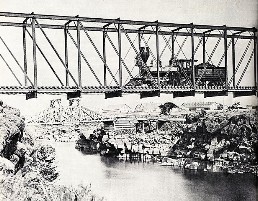
    Utah and Northern Bridge, Idaho Falls, 1880.

    In fact, the whole thing struck me as a charming account that deserved wide circulation. Also, since it’s getting harder to find items, I decided to post it in sections.

    The magazine that published the article identifies its author only as HWS, and she reveals few details about herself, just that she was a stout lady in her 50s who had two daughters.

    We know that HWS was adventurous because she took her trip at a time when getting to Yellowstone Park required a long horseback or stagecoach ride. Also, road building was just beginning in Yellowstone Park so HWS knew she would have to ride a horse when she was there.

    In part 1 or her story, HWS describes preparations for her Yellowstone adventure and the trip from Ogden, Utah, to Camas, Idaho, on the Utah and Northern Railroad. By 1883, thousands would take the train to Yellowstone Park and cross it in comfortable coaches. But in 1881, when HWS went there, it was still a remote wilderness with only a few primitive roads.

    ∞§∞

    In the summer of 1880, while traveling in California, we conceived the idea of taking a trip the following year to the National Yellowstone Park. Our party consisted of myself and three children, two young collegians, two gentlemen from Philadelphia, and a young cousin. As we had learned that our journey would have to be largely made on horseback, we condensed our baggage as much as possible, and packed it in some admirable canvas saddlebags we found in an outlying store at Salt Lake. Our “proud clothes” we left in Ogden to be picked up on our return.

    During our previous camping-out trip in Colorado, we had discovered that an oval hole dug for the hips relieved the strain on the body, and made even the hard earth quite bearable. And if to this was added a small pillow to place under the back or side, it became luxurious! We therefore purchased pillows at Salt Lake, and I supplied myself with a private trowel to carry in my own knapsack for these digging purposes. The three ladies of the party (myself and my two daughters) wore short flannel suits, with Turkish trousers. The gentlemen wore flannel shirts, and winter coats and pants, with brown duck overalls for protection from rents and holes. These latter garments were bought at my especial request, as I strongly objected to the risk of spending all my spare time in mending.

    On July 27th we started for Camas on the little narrow gauge railroad, our road lying through the dreariest of all dreary alkali plains. As far as the eye could reach, there was nothing to be seen but the burning sand and the sad gray sagebrush, which is the only thing that will grow upon it. Prairie the people called it, but desert it is, and desert it used to be called, I am sure, in the geographies of my childhood. I remember well how I used to be interested and excited in those far off days with the vague | descriptions given us of this mysterious I “Great American Desert,” and how I used to long to penetrate its dreary wastes, but never hoped to have such good fortune bestowed upon me.

    And now here I found myself, feeling as natural and almost as much at home as on a New Jersey sand-flat, and could hardly wonder how it came about. I believe it is the tin cans that have done it—tin cans and Yankee push and grit, but chiefly tin cans, for without them I do not see how these deserts could have been traversed or settled. The altitudes are so high, and the nights so cold, and the water so scarce, that nothing fit to eat grows naturally, and very little can be raised artificially, and therefore if it had not been for the ease of carrying food in these cans, civilization would, it seems to me, have met with an impassible barrier in these desert plains.

    ∞§∞

    — From H. W. S., “A Lady’s Visit To The Geysers Of The Yellowstone Park.” Friends Intelligencer May 19, 1883. Pages 218-221, and May 27, Pages 234-237.

    — Image from Widipedia Commons.

    In Part 2HWS describes the trials and tribulations of traveling across Idaho to the edge of Yellowstone National Park with a pack train.

  • A Tale: Big Boots to Fill — Carrie Strahorn, 1880

    In October 1880, Carrie Strahorn and her husband, Robert (she called him “Pard”) were the only passengers on the first run of George Marshall’s stage between Virginia City, Montana, and the Lower Geyser Basin. The Strahorns spent their first night in a cabin in the Madison River valley that belonged to Gilman Sawtell, Yellowstone Park’s first commercial guide and builder of the first road to the Lower Geyser Basin.

    Carrie Strahorn

    On their second day of travel, the Strahorns crossed the Continental Divide over Raynolds Pass and went to Henrys Lake where Sawtell had built a two-story building he planed to use as a hotel for Yellowstone tourists. Sawtell wasn’t there because, as Carrie put it, “during the late Indian troubles, he had abandoned this house and cached the doors and windows for fear the house would be burned.” The Strahorns made themselves at home anyway and Marshall fixed them a dinner of canned beans. Carrie told this story about what happened next.

    ∞§∞

    Pard and I gathered our blankets to go back to the stage to fix a place to sleep, but Mr. Marshall insisted there was a nice lot of hay upstairs where we could be more comfortable, and handing us a candle, directed us to the stairway. It was a rickety passage, with the wind howling through every aperture and holding high carnival with every loose board in the house.

    Once upstairs, the room to which we were sent seemed about forty feet square. The glimmering candle would light only a corner of the great black space, and a gust of wind would blow out the glim at intervals until the place seemed full of spooks and goblins. Pard and I gazed at each other when we could, and when we couldn’t, well, maybe I cried—I don’t quite remember.

    He had persuaded me to buy a very heavy pair of shoes in Virginia City, because he had been told the ground was so hot in some sections of the park that thin soles were not at all safe to wear, and would soon be burned through. Then he had proceeded to hold them up to ridicule all day, and I had finally wagered five dollars with him that in spite of their looks I could get both of my feet into one of his shoes. So there in the dim candle light, with any number of sashless and paneless windows, with the pallet of hay down in a dark corner, partly covered with canvas, with the wind shrieking requiems for the dead and threats for the living,  and with the rafters full of bats, I called to him to bring me his shoe, and let me win my wager.

    I put on his number seven and declared my foot was lost and lonesome in it, and he cried out, “Well, then, now put in the other one! Put in the other one!” I began at once taking it off to put it on the other foot, when he cried out, “Oh, no, not that way, but both at once.” But I revolted and said, “No, that was not in the bargain; I had not agreed to put both in at the same time.” In deep chagrin, he threw a five-dollar gold piece at me, which was lost for half an hour in the hay before I could find it, while he gave a grunt or two that will be better not translated. And so we went on with our merrymaking, trying to forget our surroundings, and dispel thoughts of our discomfort, but it was a glad hour that saw us started again on our way with a new sun.

    ∞§∞

    —   Excerpt from “Early Days In Yellowstone,” pages 254-286 in Carrie Adell Strahorn, Fifteen Thousand Miles by Stage, New York: Putnam’s Sons, 1911.

    —   Photo detail from Strahorn’s book.

    You also might enjoy:

    — You can read Carrie Strahorn’s account of her 1880 trip to Yellowstone Park in my book, Adventures in Yellowstone.  

  • A Tale: Watching a Giant Grizzly — Grace Gallatin Seton, 1896

    In 1915 a giant grizzly that roamed between the Meeteesee region of Wyoming and Yellowstone Park was so well known that The New York Times published the news that he had been shot to death. He was Wahb, a bear made famous by the naturalist and writer Ernest Thompson Seton. Seton, who was instrumental in founding the Boy Scouts of America, described Wahb in his popular book, Biography of a Grizzly, and in his story “Johnny Bear.”

    Seton’s wife, Grace Gallatin Seton, also wrote about Wahb. In her version, Grace called her husband “Nimrod,” after the mighty hunter of the Bible. She called A. A. Anderson, the owner of the ranch where she first saw Wahb’s tracks, “The Host.” Here’s Grace’s story.

    ∞§∞

    A fourteen-inch track is big, even for a grizzly. That was the size of Wahb’s. The first time I saw it, the hole looked big enough for a baby’s bathtub. The Host said there was only one bear in that region that could make a track like that; in spite of the fact that this was beyond his range, it must be Meeteetsee Wahb. He got off his horse and measured the track Yes, the hind foot tracked fourteen inches. What a hole in the ground it looked!

    The Host said the maker of it was probably far away, as he judged the track to be several weeks old. I had heard so many tales of this monster that when I gazed upon his track I felt as though I were looking at the autograph of a hero.

    It was not till the next year that I really saw Wahb. It was at his summer haunt, the Fountain Hotel in the Yellowstone National Park. If you were to ask Nimrod to describe the Fountain Geyser or Hell Hole, or any of the other tourist sights thereabouts, I am sure he would shake his head and tell you there was nothing but bears around the hotel. For this was the occasion when Nimrod spent the entire day in the garbage heap watching the bears, while I did the conventional thing and saw the sights.

    About sunset, I got back to the hotel. Much to my surprise, I could not find Nimrod; and neither had he been seen since morning, when he had started in the direction of the garbage heap in the woods some quarter of a mile back from the hotel. Anxiously I hurried there, but could see no Nimrod. Instead, I saw the outline of a Grizzly feeding quietly on the hillside. It was very lonely and gruesome.

    Under other circumstances, I certainly would have departed quickly the way I came, but now I must find Nimrod. It was growing dark, and the bear looked a shocking size, as big as a whale. Dear me, perhaps Nimrod was inside—Jonah style. Just then, I heard a sepulchral whisper from the earth.

    “Keep quiet, don’t move, it’s the Big Grizzly.”

    I looked about for the owner of the whisper and discovered Nimrod not far away in a nest he had made for himself in a pile of rubbish. I edged nearer.

    “See, over there in the woods are two black bears. You scared them away. Isn’t he a monster?indicating Wahb.

    I responded with appropriate enthusiasm. Then after a respectful silence, I ventured to say:

    “How long have you been here?”

    “All day—and such a day—thirteen bears at one time. It is worth all your geysers rolled into one.

    “H’m—Have you had anything to eat?”

    “No.” Another silence, then I began again.

    “Aren’t you hungry? Don’t you want to come to dinner?”

    He nodded yes. Then I sneaked away and came back as soon as possible with a change of clothes. The scene was as I had left it, but duskier. I stood waiting for the next move. The Grizzly made it. He evidently had finished his meal for the night, and now moved majestically off up the hill towards the pine woods. At the edge of these he stood for a moment, Wahb’s last appearance, so far as I am concerned, for, as he posed, the fading light dropped its curtain of darkness between us, and I was able to get Nimrod away.

    ∞§∞

    — Condensed from Grace Gallatin Seton, “What I Know About Wahb of the Big Horn Basin,” A Woman Tenderfoot. Doubleday, Page and Co.: New York, 1900.

    — Illustration from Grace Gallatin Seton, “A Woman Tenderfoot and a Grizzly.” The Puritan: A Journal for Gentlewomen. October 1900. Pp. 109-117.

    You also might enjoy:

  • A Tale: A Woman’s Trout Fishing In Yellowstone Park — 1897

    Early explorers discovered many stretches of water in Yellowstone Park were devoid of fish. At first people thought the problem was caused by hot water and chemicals from geysers and hot springs, but soon they discovered that the problem was obstructions like waterfalls.

    Efforts to stock the barren waters with exotic fish caused ecological problems that officials are still trying to fix, but they also resulted in an anglers’ paradise. Soon people from all over the world were coming Yellowstone Park to fish and reporting phenominal catches. Here’s one woman’s story about fishing a once barren stretch of the Firehole River.

    ∞§∞

    In 1888 the United States Fish Commission stocked the Fire Hole with many varieties of trout. They are still uneducated, eager for the fly; a number six or eight gray professor or brown Montreal proved the most killing. The father of all the Pacific trout, the blackspotted or “cut-throat” (Salmo mykiss), with the scarlet splotch on his lower jaw, was most in evidence. With long, symmetrical body and graduated black spots on his burnished sides, he is a brave, dashing fighter, often leaping salmon-like many times from the water before he can be brought to creel. We found him feeding in the open riffs, or rising on the clear surface of some sunlit pool. “The pleasantest angling is to see the fish cut with her golden oars the silver stream.”

    Our dainty Eastern trout, with brilliant red spots and short, thick-set body, had hardly become accustomed to the change from grass-edged streams and sheltered pools, to the fierce struggle for existence in this fire-bound river. The glint of his white-edged fins betrayed him swaying in the eddies at the foot of some big rock or hidden in the shade of an overhanging bank, thereby offering a direct contrast to his more aggressive Western cousin.

    The California rainbow trout proved true to his reputation, as absolutely eccentric and uncertain, sometimes greedily taking a fly, and again refusing to be tempted by the most brilliant array of a carefully stocked book. During several days’ fishing we landed some small ones, none weighing over two pounds, although they are said to have outstripped the other varieties in rapidity of growth, and tales were told of four-pounders landed by more favored anglers.

    A heavy splash, a ray of silvery light, and with lengthened line the fly was carefully dropped on the surface of a swirling pool, edged with water-plants and tangled grasses, where the current had gullied out deep holes around the big boulders; a rise, a strike—now for a fight.

    Long dashes down stream taxed my unsteady footing; the sharp click and whirr of the reel resounded in desperate efforts to hold him somewhat in check; another headlong dash, then a vicious bulldog shake of the head as he sawed back and forth across the rocks. Every wile inherited from generations of wily ancestors was tried until, in a moment of exhaustion, the net was slipped under him. Wading ashore with my prize, I had barely time to notice his size—a good four-pounder, and unusual markings, large yellow spots encircled by black, with great brilliancy of iridescent color—when back he flopped into the water and was gone. However, I took afterward several of the same variety, known in the Park as the Von Baer trout, and which I have since found to be the Salmo fario, the veritable trout of Izaak Walton.

    So, on down the stream, careful placing of the fly and changing of the feathers brought different varieties to the surface. One other fish proved a complete surprise. He was of silvery gray color, covered with small black crescents. Some of the Park fishermen called him a Norwegian trout; others, the Loch Leven. Any country might be proud to claim him, with his harmonious proportions, game fighting qualities and endurance.

    As the river had worn a pathway around the formation much too deep for wading, I climbed around the edge, past its heated springs and over its mosaic paving, and was seldom disappointed in coaxing a rise where the hot sulphur-tainted streams dripped into the water of the Fire Hole.

    When my creel became uncomfortably heavy, and square spotted tails began to overlap its edge, I waded ashore to look at my catch. Fortunately my boots were heavy, for the bank was honeycombed with miniature geysers and mud-pots, bubbling and sputtering in wicked imitation of their bigger sisters. My last captive being still on my line, I swung it from the river into a geyser cone. Unprepared for the temperature, my return cast brought out only a hook with skull and backbone attached; the flesh had instantlv boiled off.

    Surfeited with success, I unjointed my much tried and highly prized Mitchell rod, a veritable Japanese jinjutsu, ” to conquer by yielding,” among fly-rods. It can never more be duplicated, now that the master who engrafted his love of stream, of woods, of trout, into the rod he fashioned, has passed from sight around the bend of life’s stream, beyond which we cannot follow him.

    ∞§∞

    — Excerpt from Mary T. Townsend, ‘A Woman’s Trout Fishing In Yellowstone Park.’Outing: An Illustrated Magazine of Sport, Travel and Recreation 30:165-177  (1897)

    — Image detail from the same source.

    — For more stories about fishing in Yellowstone Park, click on “fishing” under the “Categories” button on the right.

  • A Tale: A Mother Takes Her Seven Children to Yellowstone Park — 1903

    In 1903, Eleanor Corthell bought a team of horses and a spring wagon to take her seven children to Yellowstone Park. She told the seller to send his bill to her husband, Nellis Corthell, a prominent Laramie lawyer. Nellis tried to talk Eleanor out of the trip, but in the end, she said, all he could do was “fizz and fume and furnish the wherewithal.”

    Here are some excerpts from Mrs. Corthell’s account of her family’s adventures.

    ∞§∞

    Nearly half a lifetime I have lived in Laramie, with all the while a great longing to see the wonders of the Yellowstone, in season, out of season, when the house was full of babies—even when it was full of measles. As the older children outgrew marbles and dolls, I conceived the bold idea of stowing them all in a prairie schooner and sailing away over the Rocky Mountains, deserts, forests and fords to the enchanted land five hundred miles away.

    My husband offered strenuous objection, of course, to the crazy project, but could only fizz and fume and furnish the wherewithal—for the reasons advanced he found irresistible, such an ideal vacation for the children. A chance for their botany, geography, zoology, to be naturalized. To be drivers and cooks would throw them on their own resources somewhat, a valuable education in itself. So economical, too! Such a fine opportunity for stretching of legs and lungs, with the Park at the end! Reasons to turn a man’s head, you see, so when the boys wrote along the wagon top ” Park or Bust,” that settled it, and we started July 4th, 1903.

    After traveling several days, Mrs. Corthell wrote:

    Everybody is growing handy, even expert, in camp work. The boys can skin a cottontail or dress a sage hen equal to Kit Carson himself, while daughter can prepare a savory dinner or pack a mess box good enough for an army general. The children are eagerly interested in everything they see, hear or can catch. Tad announces that we have seen nine horned toads, caught six, mailed three and have two packed in little tablet boxes with which to surprise the chum at home. Query: Where is the medicine that was in the boxes?

    At the Paint Pots near West Thumb on Lake Yellowstone, Eleanor was vigilant.

    I was kept busy counting the children. Every time one of them moved I was certain he would stumble into one of the boiling, walloping vats of mud. That the mud was delicate rose, emerald green, or heavenly blue did not reassure me in the least. But the children simply laughed. Even the youngest pertly informed me he had not come all the way to Yellowstone Park to fall into a mud hole. Still the horrid smells and the horrible groans and growls, and the gaping mouths clear to Hades aroused such emotions of terror in me that in sheer desperation I hurried over to the lake.

    Eleanor summarized the trip this way:

    Like everybody else, we loved Old Faithful and the Morning Glory, we feared Excelsior, we admired the Giant, Bee Hive, Punch Bowl and a hundred other yawning chasms and smiling springs and spouting geysers. But the horrible rumbling—as if an earthquake were imminent—and the smell of brimstone made me eager to get my brood into the valley of safety beyond the Yellowstone.

    Altogether we traveled twelve hundred miles, stood the journey well, and never, never had such a wonderful, delightful summer. The children will have lifelong memories of the grandest scenes the world can produce.

    ∞§∞

    — Excerpts from “A Family Trip to the Yellowstone” by Mrs. N. E. Corthell, The Independent, June 29, 1905.

    — Photo from the Pioneer Museum of Bozeman.

    — You can read Eleanor Corthell’s complete story about her family trip in my book, Adventures in Yellowstone.

    — You also might enjoy Mrs. Corthell’s story about chasing a bear away from her bean pot.

  • A Tale: Stampeded by an Umbrella — Wingate, 1885

    General George W. Wingate, a wealthy New Yorker, took his wife and 17-year-old daughter to Yellowstone Park in 1885. Although there were roads by then, the Wingates decided to travel on horseback and the women rode sidesaddle. Here’s General Wingate’s description of an incident that occurred while the ladies were riding through the Paradise Valley north of Yellowstone Park.
     ∞§∞

    Hemmed in on every side by high mountains every breath of air was excluded, while the sun beat into it like a furnace; consequently the ride was very hot and tiresome. The heat was so great that the ladies got out their umbrellas from the wagon and raised them, but slowly with great care, for fear of stampeding the ponies who were not familiar with those refinements. The horses, however, were tired and languid from the heat and paid no attention to them so the rode forward in comfort.

    As we reached the end of the valley, where the Park branch of the Northern Pacific terminates, a dashing young ranchman rode out from behind some buildings. He had a spirited horse and rode well—and he knew it. Ladies were scarce in the valley, and the opportunity to display his horsemanship and personal graces to two at once was not to be thrown away. So he swung his horse around and rode towards us, making his steed curvet and prance, while he swayed to the motion as easily and gracefully as if in an armchair.

    While we were admiring him, a sudden gust of wind came whirling out of a canyon. It caught my daughter’s umbrella and instantly turned it inside out, with a loud “crack.” At the unwonted sight and sound, our horses roused from their lethargy, simultaneously reared, snorted and bolted in different directions, and at their top speed.

    The steed of our gallant ranchman was even more frightened that ours. It ran half a mile with him, and as we last saw him he had all he could do to keep it from dashing into a barbed wire fence. The change from his jaunty air to that of anxiety to keep the horse out of the fence was sudden and ludicrous. I fear his pride had a sad fall.

    We could do nothing with the horses until May threw away her unbrella, and even then none of our steeds would approach it.  As [our guide] Fisher said, “umbrellas and cayuses don’t agree.”

    ∞§∞

    — Text adapted from Through Yellowstone on Horsback by George W. Wingate, 1886

    — Detail from illustration in Wingate’s book.

    — You also might enjoy “Little Invulnerable,” N.P. Langford’s description of the antics of an undersized horse.

  • A Tale: Grandma Told Me Abuse Killed the Handkerchief Pool

    When I was a little boy, my grandmother used to tell me about The Handkerchief Pool, which was one of the most popular geothermal features in Yellowstone Park when she went there in 1909. I was fascinated by the story, but Grandma explained that I would never see it because tourists threw so much junk into it that it didn’t work any more.

    In 1903 Hester Henshall visited the park with her husband, angling writer and fish biologist Dr. James Henshall. In the Henshal’s tour group was Lillian Elhert, an intrepid young woman who was always thrusting herself into the middle of things. Here’s Hester’s description of Miss Lillian’s antics at the Handkerchief Pool.

    ∞§∞

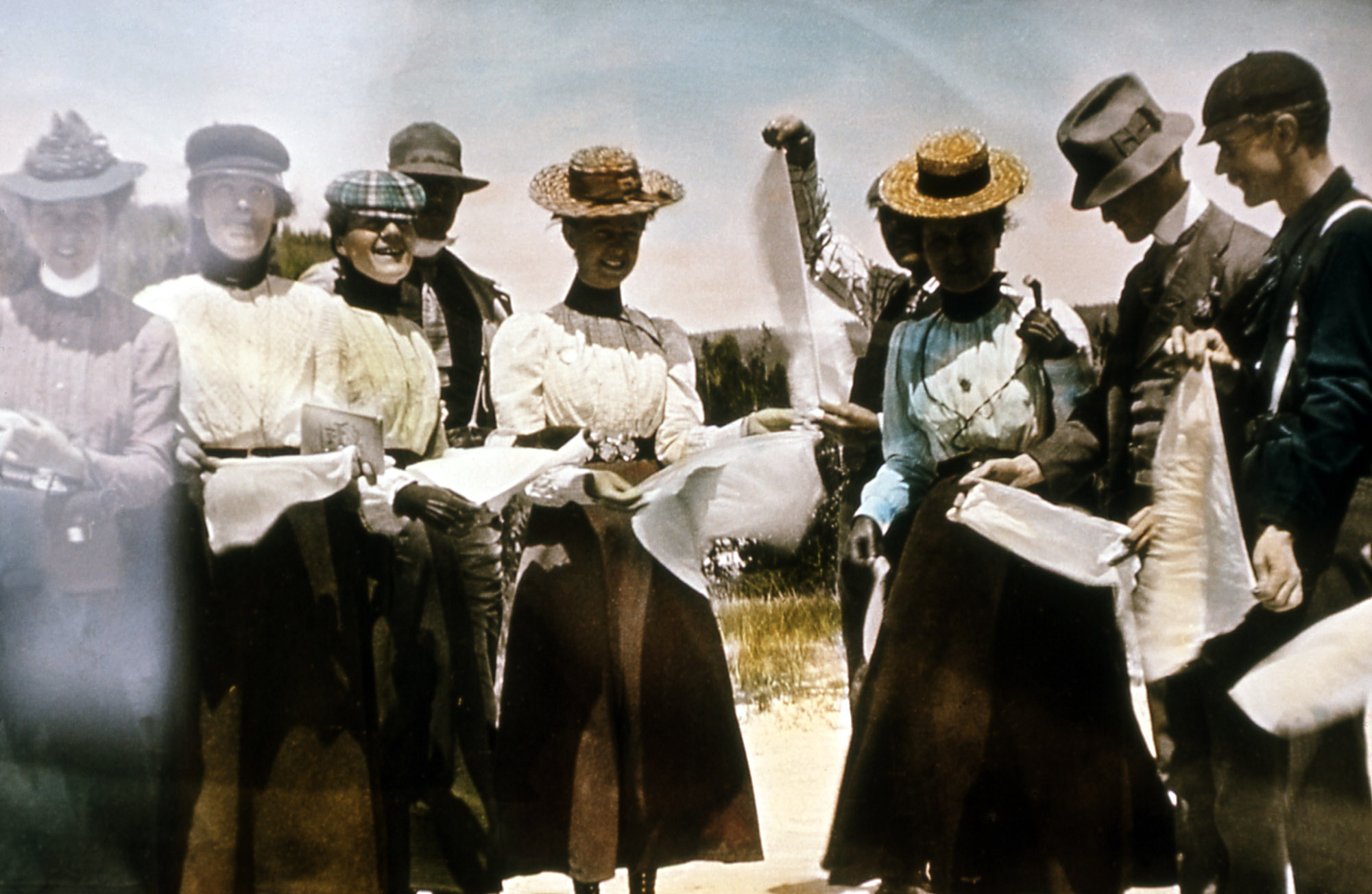
    The Handkerchief Pool reminded one of a great pot of boiling water, seething, roaring and bubbling, and issuing clouds of steam with a washday odor. Miss Lillian Ehlert must put her handkerchief in the pool, of course. We gathered round to watch it. It floated awhile, circling the pool, then suddenly disappeared down a sucking eddy, out of sight.

    We watched and waited, some of us thinking it had gone forever, but at last it popped up in another part of the pool and floated once more to the surface. It was then taken out with a stick, to be gazed upon by all of the party with something akin to awe. We wondered where it had been when lost to sight—what it had seen underground, and what tale it could tell if gifted with speech.

    Miss Ehlert simply said: “No checky no washee, but I got it all the same.”

    ∞§∞

    — From the journal of Hester Ferguson Henshall, Trip Through Yellowstone National Park 1903. Montana Historical Society Archives.

    — You might also enjoy Hester Henshall’s description of Miss Lilian’s antics in Cruising Lake Yellowstone.

    — Frank J. Haynes postcard, Yellowstone Digital Slide File.

  • First Women: Mary Wylie Crosses Yellowstone Park in a Covered Wagon — 1880

    In 1880, Mary Wylie crossed Yellowstone Park as a member of the first tourist party to use a wheeled conveyance for this trip. She went from Mammoth Hot Springs to the Lower Geyser Basin in a covered wagon.

    Mary came to Montana from Iowa in 1879 with her children. Her husband, William Wallace Wylie, had arrived in Montana the year before to become Bozeman’s first school superintendent.

    Mr. Wylie came west in 1878 on the Union Pacific transcontinental railroad to Corinne, Utah, and then took a stagecoach 400 miles north. When Mary and the children took the same trip a year later, they came north on the Utah and Northern Railroad to the Montana border and traveled about 200 miles by stage from there to Bozeman.

    Mr. Wylie left his mark on Yellowstone Park history as a lecturer, interpreter, and inventor of “permanent camps.” After he did a lecture tour across the nation, school teachers began asking him to guide them into the park. He said this “accidentally” launched him into the tourist business.

    In 1893, he founded the Wylie Permanent Camping Company, which specialized in tours of the park where guests stayed in tents left up for a full season. His moderately priced tours provided competition to the more expensive hotel tours and opened the park to middle class tourists.

    Wylie first visited the park in the spring of 1880. When he learned that Park Superintendent P. W. Norris was building the first road across the park and was going to have it finished by August, Wylie resolved to show his wife the wonders of Yellowstone Park.

    He returned to Bozeman, bought a lumber wagon and rigged it with an emigrant cover. He then assembled a nine-person party that included Mary and two of their children, a woman friend of Mary’s, and three men.

    The party met a couple with a spring wagon at Mammoth who went with them on their tour. This proved to be a good arrangement because the travelers often had to hitch both of their teams to a single wagon to get up steep hills and through rough country.

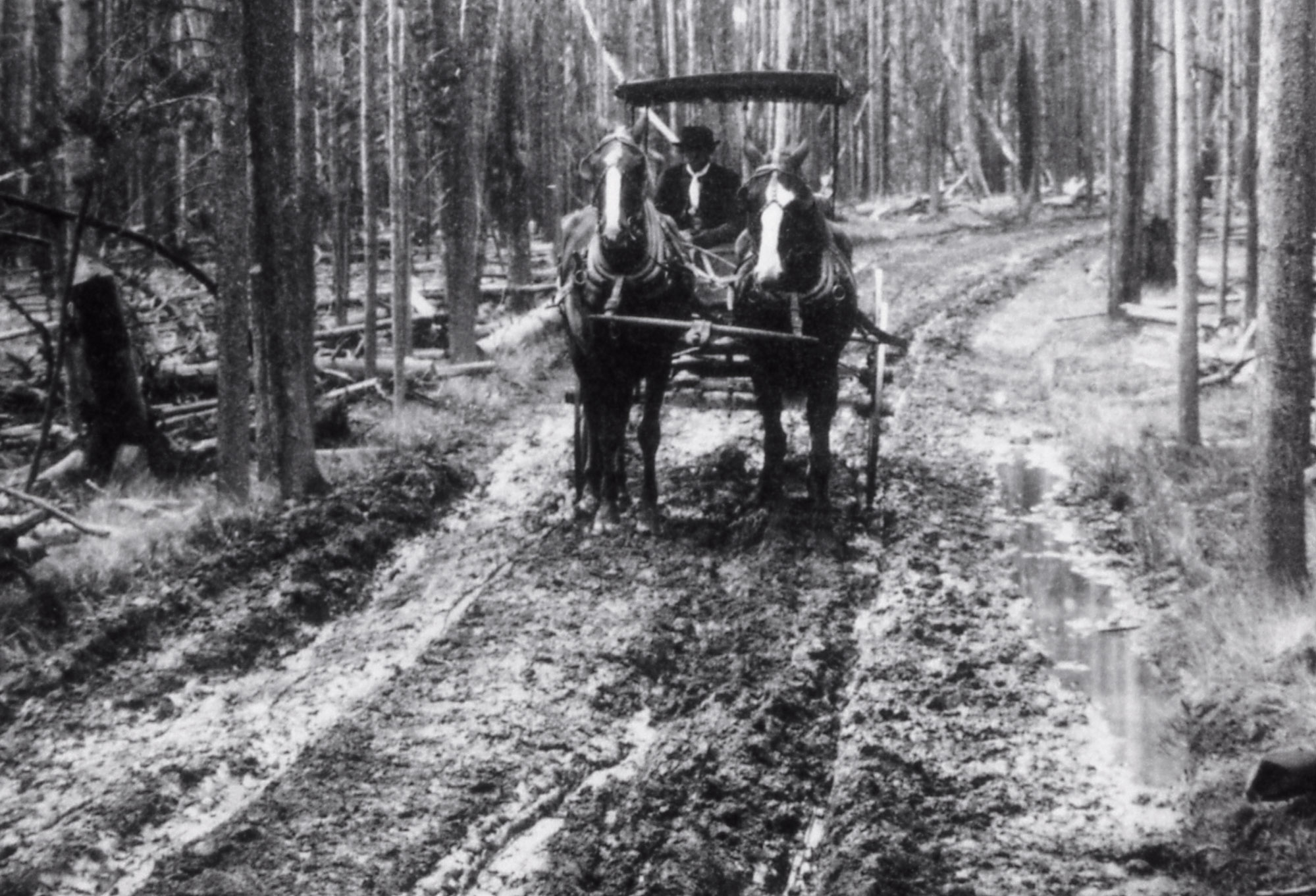
    Superintendent Norris’s new road was extremely rough. Sometimes tree stumps were too tall to let the wagons pass. When the wagons got stuck, the party had to hitch a team to the back of the wagon and pull it back so they could cut the stump lower. This made travel extremely slow. It took more than a week to travel from Mammoth to the Lower Geyser Basin.

    It was the first time tourists made the trip in wheeled conveyances. Wylie said this fact helped him get licenses to set up his tourists business in the park.

    A few weeks after Mary Wylie crossed the park beginning at Mammoth Hot Springs, Carrie Strahorn and her husband traversed Norris’s new road starting at the other end.  But after starting from the Lower Geyser Basin in a wagon, the Strahorns decided the road was too rough, and continued on horseback.

    Mary’s trip by covered wagon must have been quite an adventure. It’s too bad she didn’t leave a written account of it.

    ∞§∞

    — Photo from Yellowstone Digital Slide File.

    You also might enjoy Carrie Strahorn’s story about traveling Norris’s new road in 1880 and encountering a winter storm.

    — For related stories, look at “First Women in Yellowstone” under the Categories button to the upper left of this page.