Category: yellowstone

  • A Tale: First Report of Cooking Live Fish in a Hot Spring — Hedges, 1870.

    Many early Yellowstone travelers describe places like the Fishing Cone where anglers could catch a fish in cool water and then cook it in a nearby hot spring without taking it off the hook. In fact, Philetus Norris, the park’s second superintendent, used to demonstrate the feat for the amusement of tourists.

    The earliest written description of cooking live fish in a hot spring was written by Cornelius Hedges, a member of the famous Washburn expedition of 1870. Here’s Hedges’ description of how he accidentally discovered the trick.

    ∞§∞

    My individual taste led me to fishing, and I venture that none of the party dared to complain they did not have all the fine trout that there several appetites and capacities could provide storage for. Indeed, I felt in gratitude bound to hear testimony that for fine fish, and solid, satisfying fun, there is no body of water under the sun more attractive to the ambitious fisherman than Yellowstone Lake.

    While upon the subject of fishing, allow me to relate one or two instances of personal experience. One day, after the loss of one of our comrade, when rations were getting short, I was deputed to lay in a stock of fish to eke our scanty larder on our homeward journey.

    Proud of this tribute to my piscatory skill, I endeavored under some difficulties, to justify the expectations of my companions, and in about two hours, while the waves were comparatively quiet, I strewed the beach with about 50 beauties, not one of which would weight less than 2 pounds, while the average weight was about 3 pounds.

    Another incident, illustrative of the proximity of hot springs rather than of trouting: Near the southwest corner of the lake is a large basin of exceedingly hot springs. Some are in the very margin of the lake, while others rise under the lake and indicate their locations by steam and ebullition upon the lake’s surface when the waves are not too uneasy. One spring of large size, unfathomable depth, sending out a continuous stream of at least 50 inches of scalding water, is still separated from the cool water of the lake by a rocky partition not more than a foot thick in places.

    I returned to the narrow rim of this partitian and catching sight of some expectant trout lying in easy reach, I solicited their attention to a transfixed grasshopper, and meeting an early and energetic response, I attempted to land my prize beyond the spring, but unfortunately for the fish, he escaped the hook to plunge into this boiling spring.

    As soon as possible, I relieved the agonized creature by throwing him out with my pole, and although his contortions were not fully ended, his skin came off and he had all the appearance of being boiled through. The incident, though excusable as an incident, was too shocking to repeat.

    ∞§∞

    — Cornelius Hedges, “Yellowstone Lake,” Helena Daily Herald, November 9, 1970.

    — Illustration from William Cullen Bryant (ed.), Picturesque America. New York: Appleton, 1872. 1:302.

    — You also might enjoy Henry J. Winser’s story about “Cooking Fish on the Hook in a Hot Spring.”

    — For more stories about fishing, click “Fishing” under the Categories button to the left.

  • A Tale: The Army Protects Theodore Roosevelt From Snooping Reporter — 1903

    Guard Mount at Fort Yellowstone

    When the U.S. congress established Yellowstone National Park in 1872, they put a civilian staff  in charge, but failed to appropriate enough money for the job of protecting it. Poachers decimated wildlife; collectors vandalized natural features and monopolists gouged travelers. Things became so bad by 1886 that the U.S. Army was asked to step in. It ran the park until 1918 when the National Park Service took over.

    By all accounts, the Army was diligent and left its mark in ways ranging from the shape of rangers’ hats to Grand Loop pattern of roadways. Here’s a story that describes how effective they were when they were asked to protect President Theodore Roosevelt when he visited Yellowstone in 1903.

    ∞§∞

    An incident that occurred during President Roosevelt’s recent visit proves the exceedingly careful manner in which the Park is guarded. When Mr. Roosevelt made it known that his object in entering the Yellowstone Park was to secure several days of complete privacy, and that he did not want any one aside from Major Pitcher and the picked escort to accompany him, a certain correspondent representing a New York daily, who had been ordered to be on hand in case of any accident to the President or other emergency of National importance, resolved to ignore the President’s request and to follow him at all hazards.

    With this object in view, he attempted to bribe some of the native population, but without success. Not disheartened by his failure to secure a friendly companion and guide, the correspondent hired a horse and persuaded a stray dog to accompany him. This was on the afternoon of the President’s arrival at Fort Yellowstone. The Fort is ten miles from Gardiner, where the rest of the correspondents and the President’s party had stopped.

    The recreant correspondent set forth in high glee at the possibility of working a “beat” on his fellow-craftsmen. As he rode along through the leafy lanes and past the towering cliffs, which in part line the road to the Springs, he felt very well satisfied with himself, and chuckled at the ease with which he had evaded the guards stationed near Gardiner. Suddenly, as he was entering a particularly dark part of a forest, he heard a voice from the brush on the right.

    “Theodore Jones,” it said slowly and in unmistakable authoritative tones. “Theodore Jones!”

    The correspondent reined up his horse in amazement. Who was it calling his name? Had he been followed from Gardiner? If so, why did the voice come from the bushes and evidently some distance from the road?

    “Hello !” he shouted, in reply.

    There was no answer. He called again and again, but without result. Then he put spurs to his horse and rode on. Half a mile further down the road, just as he was passing through another bit of woodland, a deep voice called out seemingly at his very elbow:

    “Theodore Jones ! Theodore Jones-s-s ! Better go back.”

    For one moment, the newspaperman hesitated, then he rode resolutely forward. He felt that he was being tricked, but he intended to see the game out. He was a bit nervous because he realized that his course of action was not entirely honorable, and it was with something very like relief that he espied at a turn in the road a United States trooper sitting with horse blocking the path and a rifle slung carelessly across the pommel of his saddle.

    “Haiti” called out the soldier. “Mr. Jones, you are wanted at Headquarters.”

    “How do you know my name is Jones?” demanded the correspondent.

    The trooper smiled as if the question was a joke. Placing one hand upon the correspondent’s bridle, he led him without further words to Fort Yellowstone. A technical charge of unlawfully bringing a dog into the reservation was entered against Mr. Jones, but he was released on his promise not to enter the Park again until the President’s return. The incident had its value in showing the extreme care taken by the Park’s guardians in keeping out unwelcome visitors. The correspondent’s errand was known at Headquarters before he had crossed the line.

    ∞§∞

    — From Henry Harrison Lewis, “Managing a National Park.” The Outlook 74(18)1036-40. (Aug. 29, 1903).

    — You also might enjoy

    — Detail from Coppermine Gallery Photo.

  • A Scene: The Geysers of Yellowstone — Washburn, 1870

    There had been rumors of wonders in the upper Yellowstone for more than 50 years, but the Washburn Expedition of 1870 made it official. The place really did contain towering waterfalls, a huge inland sea and—most stupendous—boilding fountains that threw water hundreds of feet into the air. 

    There were several reasons Washburn and his companions captured the public imagination. First, the expedition was composed of prominent government officials and businessmen whose word could not be doubted. Second, the expedition included several skilled writers who published reports immediately after they returned from the wilderness. Third, there was a well developed communication system that included several Montana territorial newspapers and the telegraph to spread the news across the nation. Finally, the Northern Pacific Railroad, which was making its way westward, promoted the area in hopes of  making it a tourist destination.

    General Washburn himself was one of the skilled writers whose work was caught up in this fortuitous combination. Here’s his description of the geysers of the Upper Yellowstone.

    ∞§∞

    Grand Geyser

    On the south end of the lake is a very beautiful collection of hot springs and wells. In many the water is so clear that you can see down fifty or a hundred feet.

    The lake is 8,000 feet above the level of the sea, a beautiful sheet of water, with numerous islands and bays, and will in time be a great summer resort; for its various inlets, surrounded by the finest mountain scenery, cannot fail to be very popular to the seeker of pleasure, while its high elevation and numerous medicinal springs will attract the invalid. Its size is about twenty-two by fifteen miles.

    Leaving the lake, we moved nearly west, over several high ranges, and camped in the snow amid the mountains. Next day, about noon we struck the Fire Hole River. and camped in Burnt Hole Valley.

    This is the most remarkable valley we found. Hot springs are almost innumerable. Geysers were spouting in such size and number as to startle all, and are beyond description. Enormous columns of hot water and steam were thrown into the air with a velocity and noise truly amazing. We classified and named some of them according to size:

    No. 1. The Giant, 7 by 10 feet, throwing a solid column of water from £0 to 120 feet high.

    No. 2. The Giantess, 20 by 30. throwing a solid column and jets from 150 to 200 feet high.

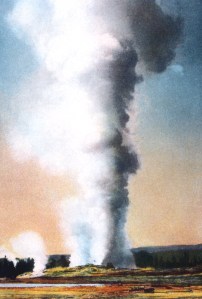
    No. 3. Old Faithful, 7 by 8, irregular in shape, a solid column each hour, 75 feet high.

    No. 4. Bee Hive, 24 by 15 inches, stream measured 219 feet.

    No. 5. Fan Tail, irregular shape, throwing a double stream 60 feet high.

    No. 6 is a beautiful arched spray, called by us the Grotto, with several apertures through which, when quiet, one can easily pass, but when in action each making so many vents for the water and steam.

    Upon going into camp we observed a small hot spring that had apparently built itself up about three feet. The water was warm but resting very quietly, and we camped within 200 yards of it. While we were eating breakfast this spring, without any warning threw, as if it were the nozzle of an enormous steam-engine, a stream of water into the air 210 feet, and continued doing so for some time, thereby enabling us to measure it, and then as suddenly subsided.

    Surrounded by these hot springs is a beautiful cold spring of tolerably fair water. Here we found a beautiful spring or well, raised around it was a border of pure white, carved as if by the hand of a master-workman, the water pure. Looking down into it, one can see the sides white and clear as alabaster, and carved in every conceivable, shape, down, down, until the eye tires in penetrating.

    Standing and looking down into the steam and vapor of the crater of the Giantess. With the sun upon our back, the shadow is surrounded by a beautiful rainbow; and, by getting the proper angle, the rainbow, surrounding only the head, gives that halo so many painters have vainly tried to give in paintings of the Savior.

    Standing near the fountain when in motion, and the sun shining, the scene is grandly magnificent; each of the broken atoms of water shining like so many brilliants, while myriads of rainbows are dancing attendance. No wonder, then, that our usually staid and sober companions threw up their hats and shouted with ecstasy at the sight.

    We bid farewell to the geysers, little dreaming there were more beyond. Five miles below Burnt Hole we found the “Lake of Fire and Brimstone.” In the valley we found a lake measuring 450 yards in diameter, gently overflowing, that had built itself up by a deposit of white sub-strata at least 50 feet above the plain. This body of water was steaming hot.

    Below this was a similar spring, but of smaller dimensions while between the two, and apparently having no connection with either, was a spring of enormous volume flowing into the Madison, and is undoubtedly the spring about which Bridger was laughed at so much when he reported that it heated the Madison for two miles below. For some distance down the river we found hot springs and evidences of volcanic action.

    ∞§∞

    — From Henry Washburn, “The Yellowstone Expedition,” Helena Daily Herald, September 27 and 28, 1870.

    — Frank J. Haynes postcard, Yellowstone Digital Slide File.

    — You might also enjoy General Washburn’s description of Yellowstone Falls.

    — For more stories from the Washburn Expedition, click “Washburn” under the “Categories” button to the left.

  • A Tale: The Antelope That Got Away — Dunraven, 1874

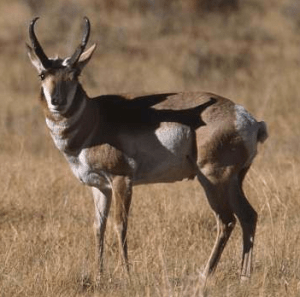
    While returning from Yellowstone Park in 1874, the Earl of Dunraven discovered he was running out of “grub.” Hunting for food in the Park was legal then, so he decided to replenish the larder by bagging an antelope. He went hunting with pioneer rancher and Yellowstone guide, Fred Bottler, and a helper named Wynn.

    While the trio was pursuing a large buck, a ferocious hail storm forced them to take cover under a pine tree. When the storm abated, Dunraven spotted the buck, tried a long shot and missed. Here’s his story of what happened after that.

    ∞§∞

    It was blowing so hard, and there was such a noise of storm, that there was no danger of the shot having disturbed anything, and so, as the country looked very gamey, we walked on, leading the horses. Presently we came upon a little band containing six antelopes.

    We were by this time near the summit of a long sloping mountain. The ground fell away rapidly on either side, and in a long but narrow glade the antelopes were lying. While we were peering at them, two does—nasty inquisitive females—got up, walked forward a few steps and stared too. We remained still as statues, and after a while they appeared satisfied and began to crop the grass. We then left our ponies, and signing to Wynne, who just then hove in sight, that there was something ahead, and that he was to catch them, hastened up under cover of some brush.

    By the time we reached the tree nearest to them we found the does had all got up and fled to some distance, but a splendid buck with a very large pair of horns was still lying down. At him I fired, and nailed him. He gave one spring straight into the air from his bed, fell back into the same spot, kicked once or twice convulsively, and lay still. I fired the second barrel at a doe and struck her, for she “pecked” almost on to her head, but she recovered and went on.

    Out we rushed: “Never mind the dead one,” shouts Bottler, his face all aglow; “let’s get the other; she’s twice as good, and can’t go far. You take one side of that clump and I will take the other.” So off we set, best pace, bursting up the hill after the wounded doe. We followed her for half an hour, running our level best, and got each a long shot, but missed; and, as she was evidently quite strong, we gave up the chase and walked back.

    We found Wynne driving up the ponies; and as he appeared to have some little trouble with the poor beasts, rendered sulky and ill-tempered by the wet and cold. I said to Bottler, “You go down and help him, and I will butcher the buck.”

    I had scarcely got the words “butcher the buck” out of my mouth, when the darned thing, apparently not appreciating my intentions, came to life, bounded to his feet, sprang into the air, coming down all four feet together, and, with his legs widely extended, gave a phwit—a sort of half whistle, half snort of surprise, I suppose at his own resurrection—stared a second, and made off.

    “Shoot, Bottler,” I cried, “shoot. In Heaven’s name, man, can’t you see the buck?” and I threw up my own rifle and missed him of course. “By George,” says Bottler, wheeling round, “look at the  ___;” and he let go at him with the same result.

    Wynne yelled and dropped the lariats; Bottler ejaculated terrible things; and I also, I fear, made use of very cursory remarks. But neither for swearing, shouting, nor shooting would he stop. He ran about fifty yards, fell on his head and rolled over and over, jumped up again, ran one hundred yards, pitched head over heels the second time, got up, and went down the hill as if he had never felt better in his life.

    We followed of course, and wasted an hour in searching for him in vain. Never again will I pass a beast, however dead he may appear to be, without cutting his throat by way of making sure.

    ∞§∞

    — Excerpt from Hunting on the Yellowstone by the Earl of Dunraven.

    — Image from the Coppermine Photo Gallery.

    — For more stories about The Earl of Dunraven, click on “Dunraven” under the “Categories” button to the right.

    — You can read more of Dunraven’s stories in my book, Adventures in Yellowstone: Early Travelers Tell Their Tales.

  • A Sight: Rudyard Kipling Watches Beaver Swimming Silently — 1889

    A Beaver Lodge

    With colorful canyons, mountains of glass and boiling geysers to hold their attention, few Yellowstone Park visitors spend time watching that lowly rodent, the beaver. But the famous British author Rudyard Kipling thought they were worth writing about after his visit there in 1889. Here’s his description.

    ∞§∞

    The sun began to sink, and there was a taste of frost about, and we went swiftly from the forest into the open, dashed across a branch of the Firehole River and found a wood shanty, even rougher than the last, at which, after a forty-mile drive, we were to dine and sleep.

    In the cool, crisp quiet of the evening I sought that river, and found a pile of newly gnawed sticks and twigs. The beaver works with the cold chisel, and a few clean strokes suffice to level a four-inch bole. Across the water on the far bank glimmered, with the ghastly white of peeled dead timber, the beaver-lodge—a mass of disheveled branches. The inhabitants had dammed the stream lower down and spread it into a nice little lake. The question was, would they come out for their walk before it got too dark to see.and there were rumors of bears and other cheerful monsters in the woods on the hill at the back of the building.

    They came—blessings on their blunt muzzles, they came—as shadows come, drifting down the stream, stirring neither foot nor tail. There were three of them. One went down to investigate the state of the dam; the other two began to look for supper.

    There is only one thing more startling than the noiselessness of a tiger in the jungle, and that is the noiselessness of a beaver in the water. The straining ear could catch no sound whatever till they began to eat the thick green river-scudge that they call beaver-grass.

    I, bowed among the logs, held my breath and stared with all my eyes. They were not ten yards from me, and they would have eaten their dinner in peace so long as I had kept absolutely still.

    ∞§∞

    — Excerpt from Rudyard Kipling, “The Yellowstone Park.” The Kipling Reader for the Upper Grades. D. Appleton and Company: New York, 1905. Pp. 141-148.

    — Photo, Coppermine Photo Gallery.

    — You also might enjoy “Rudyard Kipling Goes Fishing With Yankee Jim.”

  • A Tale: Sidford’s Fall on Grand Teton Mountain — Langford, 1872

    Sidford Hamp was just 17 in 1872 when his uncle William Blackmore, fulfilled his dreams by landing him a job on the second Hayden Expedition to Yellowstone Park. Lord Blackmore was wealthy and well connected so he was able to arrange for Sidford to dine with dignitaries in Washington D.C., meet the famous Sioux Chief Red Cloud, visit Niagara Falls, and travel across America on the new transcontinental railroad.

    Perhaps Sidford’s biggest adventure occurred on July 29 when he accompanied Hayden’s second in command, Captain James Stevenson, and Yellowstone first superintendent, N.P. Langford, as they mounted an effort to climb the 13,775-foot Grand Teton Peak in Wyoming. Some say Langford’s and Stevenson surmounted a side peak, not pinnacle of Grand Teton, but it was a grand adventure in any case. Here’s Langford’s description of what happen to Sidford that day.

    ∞§∞

    Very soon after we commenced the ascent, we found ourselves clambering around projecting ledges of perpendicular rocks, inserting our fingers into crevices so far beyond us that we reached them with difficulty, and poising our weight upon shelves not exceeding two inches in width, jutting from the precipitous walls of gorges from fifty to three hundred feet in depth. This toilsome process, which severely tested our nerves, was occasionally interrupted by large banks of snow, which had lodged upon some of the projections or in the concavities of the mountain side—in passing over the yielding surface of which we obtained tolerable foothold, unless, as was often the case, there was a groundwork of ice beneath.

    When this occurred, we found the climbing difficult and hazardous. In many places, the water from the melting snow had trickled through it, and congealed the lower surface. This, melting in turn, had worn long openings between the ice and the mountainside, from two to four feet in width, down which we could look two hundred feet or more. Great care was necessary to avoid slipping into these crevices. An occasional spur of rock or ice, connecting the ice-wall with the mountain, was all that held these patches of snow in their places. In Europe, they would have been called glaciers.

    Distrustful as we all were of their permanency, we were taught, before our toil was ended, to wish there had been more of them. As a general thing, they were more easily surmounted than the bare rock precipices, though on one occasion they came near proving fatal to one of our party.

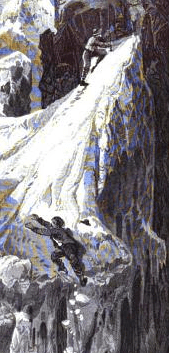
    Mr. Hamp, fresh from his home in England, knew little of the properties of snow and ice, and at one of the critical points in our ascent, trusting too much to their support, slipped and fell. For a moment, his destruction seemed inevitable, but with admirable dexterity, he threw himself astride the icy ridge projecting from the mountain.

    Impelled by this movement, with one leg dangling in the crevice next the mountain side, and the other sweeping the snow outside the glacier, he slid with fearful rapidity, at an angle of forty-five degrees, for the distance of fifty feet, falling headlong into a huge pile of soft snow, which prevented his descent of a thousand feet or more down the precipitous side of the mountain.

    I saw him fall, and supposed he would be dashed to pieces. A moment afterwards, he crawled from the friendly snow heap and rejoined us unharmed, and we all united in a round of laughter, as thankful as it was hearty.

    ∞§∞

    — Excerpt from N. P. Langford, “The Ascent of Mount Hayden,” Scribners Monthly (June 1873) 6(3):129-157.

    — Illustration from the the Scribner’s article.

    — You also might enjoy:

    — To see more stories by this author, click on “Langford” under the “Categories” button to the left.

    — You can read a  condensed version of N. P. Langford’s book, The Discovery of Yellowstone Park, in my book. Adventures in Yellowstone.

  • A Tale: Guiding the Nez Perce Through Yellowstone Park — 1877

    After the bloody Big Hole Battle on August 9, 1877, the Nez Perce fled through Yellowstone Park to avoid the settled areas of Montana. Pursued by Army units under General O.O. Howard, they needed a guide because the route was unfamiliar to them. On August 23, they found one.

    John Shively, who had prospected for gold in the area, was camped near the Lower Geyser Basin when the Indians captured him. Shively had planned to leave the park with a party of tourists from Radersburg, Montana, that he had met earlier.

    The next day, the Nez Perce accosted the Radersburg group, shot two men and took two women captive. The women were treated well and later release.

    Shively traveled with the Nez Perce for thirteen days, then made his escape. (The Indians said they let him go after they reached country they knew.) Several territorial newspapers reported Shively’s adventures and Edwin J. Stanley synthesized them into a single narrative several years later. Here’s Stanley’s version.

    ∞§∞

    On the evening of the second day, after leaving the Radersburg party, I was camped in the Lower Geyser Basin. I was eating my supper, and, on hearing a slight noise, looked up, and, to my astonishment, four Indians, in war-paint, were standing within ten feet of me, and twenty or thirty more had surrounded me not more than forty feet off.

    I sprang for my gun, but was rudely pushed back. I then asked them what Indians they were, and they answered “Sioux.” I said, “No.” Then one of them said, “Nez-Perces.” They then commenced to gesticulate wildly, and a loud conversation was kept up between them.

    I thought the exhibition of a little bravery might help me, so I folded my arms and told them to shoot, that I was not afraid to die. A brother of Looking-Glass then came up, placed his hand on my heart, and held it there a minute or two, and exclaimed, “Hyas, skookum-tum-tum!” meaning ‘strong heart’ in Chinook. He then said in English, “Come with me,” walked a few steps, told me to get on a pony that he pointed out, jumped up behind me, and all started for the main camp, a short distance below.

    While this was taking place, the other Indians had taken my gun, blankets, horses—in fact, everything I had. Arriving at the main camp, a council of the chiefs was formed, and I was told to take a seat inside the circle.

    They asked me who I was, and what I was doing there. I told them. They asked me if I would show them the best trail leading out of the park to Wind River, where they were going. I told them I would, as I knew all about the country. This seemed to be satisfactory, and the council broke up, and the camp moved up a mile or two, where an encampment for the night was formed.

    A robe was given me, and an Indian named Joe was detailed to sleep with me. He spoke very good English; said that I must not attempt to escape; that he would be my friend; that they had come that way to get away from Howard; that the trail by that route to Wind River was not known to them, but other Indians had told them about it, and that if I told them the truth they would not harm me.

    As I could not help myself, I promised all they asked, and kept my promise. All the time I was with them, I always showed a willingness to get on or off a horse when they told me; and, if an Indian rode behind me on the horse, I offered no objections, and to this fact I am probably indebted for kind treatment.

    After breaking camp the next morning, I was ordered to mount. An Indian mounted behind, and I was started ahead with mounted and armed Indians on each side and behind me. While camped the next day, about noon, the Radersburg party were brought into camp.

    Shortly afterward, a march was made toward Yellowstone Lake, I still being kept some distance in the advance. After traveling about a mile, I heard seven distinct shots fired, and supposed all the persons had been killed, but that evening Joe told me that only two men had been shot, and the next morning I saw Mrs. Cowan and Miss Carpenter, and was allowed to speak to them, and we traveled near together all that day.

    Through this terrible ordeal, the sisters behaved nobly and with the utmost fortitude, although Mrs. Cowan’s mental agony at thought of her husband wounded, and perhaps dead, and they three in the hands of savages, was enough to have driven her distracted. With all their savagery and ferocity, let it be said and remembered to the credit of the Nez-Perces, that these ladies were treated with all respect, and protected from all harm, while their prisoners. The next day, Frank Carpenter and his sisters were permitted to go, and the Indians moved to the Yellowstone, and from there moved over to the head-waters, or rather a tributary, of Clark’s fork.

    The first night of our arrival being quite dark, I slipped out of camp and started for the Mammoth Hot Springs, which I reached after traveling two whole nights and one day. Here I found no one, but did find some potatoes already cooked, which greatly revived me after my long fast—having had nothing to eat from the time of leaving the Indian camp.

    I then started for Henderson’s ranch, which I found destroyed, but plenty of provisions lying around. I got some eggs, and, while cooking them, Mr. J. W. Schuler of Butte City, who was returning from the Clark’s Fork mines, rode up. He kindly gave me his horse to ride, he going on foot. That night, early, we reached Dailey’s ranch, where we received the kindest treatment, and Mr. Dailey loaned me a horse on which to ride to Bozeman.

    I was with the Indians thirteen days, and was treated very well all the time. They traveled very leisurely, not averaging, for the whole time, more than five miles a day. Joe said they were not afraid of Howard. He also said that they did not intend to return to Idaho, as the agent there, John Hall, was a bad man, and would not give them what was due them; that they would remain somewhere in the Big Horn country, and, if the soldiers came, they would join in with the Sioux and Crows and whip them.

    ∞§∞

    — Excerpt from Edwin J. Stanley, Rambles in Wonderland. Southern Methodist Publishing House: Nashville, 1885.

    — You also might like:

    — You can read Emma Cowan’s complete story in my book, Adventures in Yellowstone.

    — My next book, Encounters in Yellowstone 1877, will tell the story of the Nez Perce and the people who tangled with them in the park.

  • A Tale: Ajax Takes a Trip to Yellowstone Park —1880

    In the first decade after Yellowstone National Park was established in 1872, dozens of adventurous young men set out to see Wonderland. Usually the had meager supplies and planned to live off the land. That and problems of managing their horses always made such trips an adveture. Here’s a story of such a trip by Alva Josiah Noyes, who called himself “Ajax.”  

    ∞§∞

    A.J. Noyes

    The summer and fall of ’80 was spent in the Elk Park ranch. I remember that I got out a whole lot of timber for fencing. After haying I sold my interest to my uncle. I was to take the money, go to the University of Iowa and enter the Law Department. My uncle was to give me $250 the first year, the same amount for the second.

    Before going to Iowa I made up my mind to take a team and make the trip through the National Park. My object in so doing was to get data for a lecture, providing my cash should not hold out. I thought that I could deliver a lecture on the wonders of that place and probably make a few dollars, as it was then so little known.

    I took a team, one of the horses belonged to my step-mother, and began my journey alone. On my arrival at Bozeman I met several of the Butte boys, ten of them in all. They had just been through the park and were on their way home. I could not get any of them to go back with me.

    I got my dinner that day with George Wakefield, who was then running the Northern Pacific Hotel. Mrs. Wakefield was a schoolmate of mother’s. I met a kid, Link Coberly, who had been pretty near the Park but had not been in it. I proposed that he go with me. He said: “All the money I have is five dollars; that won’t take me very far toward the Park.” I informed him that he didn’t need any, I would put up. He consented to go.

    We camped out on Bear Creek, 10 miles from Bozeman that night, and the next we were at Bottler Brothers, on the Yellowstone. We picketed our horses a short distance from camp. We were up early the next morning. Requesting Link to get the horses, I proceeded to get breakfast. He had been gone but a short time when he came hurrying back with the information that one of the horses was cast, and “his head was as big as a barrel!”

    On making an examination I found that he had, in some way, gotten one of his hind feet in the rope which was around his neck, and in struggling to get up, had choked himself, more or less, also bruising his head. This was a nice state of affairs. A horse that could not be used; miles from home, and anxious to make the trip. What could I do? I went to Bottler and explained my condition.

    He said: “I have a horse that you can have as soon as he comes back from the Park, which should be soon now.” I had to be contented and wait for “Old Bozeman,” as the horse was called, for several days.

    At last he came and we made a new start. It did not require a long time to go, from this ranch, to Mammoth Springs. On arriving there I met Mrs. Carson (mother of Arthur of the North Butte), also Mrs. Ed Reimel of Walkerville, who invited me to have lunch with them, which was accepted with pleasure and much enjoyed.

    When I got back to camp I found a young man, who desired to make one of our company, a George Allen of the Yellowstone. We left the wagon at the Springs and began our trip through the Park. We went via Tower Falls to the Grand Canyon, Great Fall, Sulphur Mountain, Mud Volcano, thence to Mary’s Lake, to the Lower Geyser Basin. We did not go to Yellowstone Lake.

    We enjoyed the scenery very much. The weather was delightful. When we arrived at Midway, or “Hell’s Half Acre,” we crossed the Fire Hole river to investigate the Prismatic Spring and the Caldron, or what was afterward called “Sheridan Geyser.” This is a large body of boiling water, over 100 feet across, and when not in a state of eruption, is some ten to more feet below the surface. Steam arises all the time, as from a great kettle of boiling water.

    Wishing to see more of this wonderful spring, I carefully walked toward it and stopped in awe at the fearful sight that met my gaze when a light breeze wafted the steam from me, as I was at the brink of that hellish hole. One more careless step and—the end.

    When we arrived at the Upper Basin, we found ourselves pretty short of provisions. The boys were successful in getting a nice lot of fool hens, with sticks, but as we had no grease in which to fry them we began to rustle. Link found, in a tree, a can of bacon grease that had been left by the former camper. As this was nice and fresh, we made use of it.

    We returned to the Springs via Norris Geyser Basin. At that place Colonel Norris had a party of men at work on the roads. Link got some brown sugar of them, which, under the circumstances, was the nicest ever.

    The next day we arrived at the Springs, and got as good a meal as McCartney’s Hotel could set up. We purchased a few supplies, and started down the river. When on my way up to the Mammoth Springs I made arrangements with a party to catch some fish for me. When I returned to the place the man had a nice supply, which I hauled to Butte and sold them for 25 cents per pound.

    When I got back to Bottler’s I found that my horse was in no condition to take me home. William Lee had a large number of horses, so I went to his ranch and bought a pony for $40.00, leaving my horse in his care. Link and I arrived in Butte in good season. Owing to the inroads on my cash, I did not have enough to carry me through the first year at Iowa City, so I did not study law. There must have been something of a Providencial nature in this, as we have too many poor lawyers now.

    ∞§∞

    — Adapted from Alva Josiah Noyes, The Story of Ajax: Life in the Big Hole Basin. State Publishing Company:Helena, Montana: 1914.  Pp.  43-45.

    — Photo from the book.

  • A Tale: Grub Pile, Preparing a Camp Supper — Ingersoll, 1880

    Most journals by early Yellowstone travelers provide descriptions of the sights: geysers, canyons, falls and wildlife, but only a few tell about ordinary activities like preparing food. Ernest Ingersoll, who explored the West in 1874 and 77 with Yellowstone surveyor F.V. Hayden, wrote about such things. In the late nineteenth century, Ingersoll became a famous naturalist, writer and lecturer. Here’s his account of an evening meal as it might have been prepared in the park in 1880.

    ∞§∞

    The place for the camp having been indicated, the riding animals are hastily unsaddled, and then every one turns to help unpack and place the cargo in orderly array. The very first mule unloaded is the staid veteran distinguished by the honor of bearing the cuisine. The shovel and axe having been released from their lashings, the cook seizes them, and hurriedly digs a trench, in which he starts his fire. While it is kindling, he and anybody else whose hands are free cut or pluck up fuel.

    We are so stiff sometimes from our eight or ten hours in the saddle that we can hardly move our legs; but it is no time to lie down. Hobbling round after wood and water limbers us up a little, and hastens the preparation of dinner, that blessed goal of all our present hopes.

    If a stream that holds out any promise is near, the rod is brought into requisition at once; and, if all goes well, by the time the cook is ready for them, there are enough fish for the crowd. Flies, as a general thing, are rather a delusion to the angler than a snare for the fish. The accepted bait is the grasshopper, except when there are great numbers of this insect, in which case the fish are all so well fed that they will not bite.

    We used to keep our eyes open all day, and pounce upon every grasshopper we could find, saving them for the evenings fishing. The usual catch was salmon trout—great two and three-pounders, gleaming, speckled, and inside golden pink, that sunset color called salmon. They were not gamy, though, and we were glad of it, since the object was not sport, but the despised pot. It really was more exciting to capture the lively bait than it was to hook the trout.

    But all this happens while the cook gets his fire well a-going. That accomplished, and two square bars of three-quarters inch iron laid across the trench, affording a firm resting place for the kettles, the stove is complete. He sets a pail of water on to heat, jams his bake-oven well into the coals on one side, buries the cover of it in the other side of the fire, and gets out his long knife. Going to the cargo, he takes a side of bacon out of its gunny-bag, and cuts as many slices as he needs, saving the rind to grease his oven.

    Then he is ready to make his bread. Flour is more portable than pilot biscuit; therefore warm, light bread, freshly made morning and night, has gratefully succeeded hardtack in all mining and mountain camps. Sometimes a large tin pan is carried, in which to mould the bread; but often a square half-yard of canvas kept for the purpose, and laid in a depression in the ground, forms a sufficiently good bowl, and takes up next to none of the precious room.

    When a bread-pan is taken it is lashed bottom up on top of the kitchen-mules pack. If it breaks loose and slips down on his rump, or dangles against his hocks, there is likely to be some fun; and when a sudden squall sweeps down from the high mountains, and the hailstones beat a devils tattoo on that hollow pan, the mule under it goes utterly crazy. The canvas bread-pan is therefore preferred. Sometimes even this is dispensed with, and the bread is mixed up with water right in the top of the flour-bag, and is molded on the cover of a box or some other smooth surface. Baking powder, not yeast, is used, of course.

    Sometimes the cook used the Dutch oven which every one knows, a shallow iron pot, with a close fitting iron cover upon which you can pile a great thickness of coals, or can build a miniature fire. Having greased the inside of the oven with a bacon rind, bread bakes quickly and safely.

    A better article, however, results from another method. Mold your bread well, lay the round loaf in the skillet and hold it over the fire, turning the loaf occasionally, until it is somewhat stiff; then take it out, prop it upright before the coals with the help of a twig, and turn it frequently. It is soon done through and through, and on both sides alike

    The table furniture, and a large portion of the small groceries, such as salt, pepper, mustard, etc., are carried in two red boxes, each two and a half feet long, one and a half feet broad, and a foot high. Each box is covered by a thin board, which sets in flush with the top of the box, and also by two others hinged together and to the edge of the box.

    Having got his bread a-baking, the cook sets the two boxes a little way apart, unfolds the double covers backward until they rest against each other, letting the ends be supported on a couple of stakes driven into the ground, and over the whole spreads an enameled cloth. He thus has a table two and a half feet high, one and a half feet wide and six feet long.

    Tin and iron ware chiefly constitute the table furniture, so that, as frequently happens, the mule may roll a hundred feet or so down the mountain and not break the dishes. His table set, John returns to his fire, and very soon salutes our happy ears with his stentorian voice in lieu of gong: Grub P-i-i-i-le!

    ∞§∞

    — Excerpt abridged from Ernest Ingersoll, “Rocky Mountain Cookery,” Scribner’s Monthly 29(1)125-132 (May 1880).

    — Illustration from Ingersoll’s book, Knocking Around the Rockies. Harpers: New York, 1882.

  • An Event & A Tale: A Book Signing at Old Faithful Inn and a 1912 Ballgame

    I’ll return to the lobby of Old Faithful Inn on Saturday and Sunday (August 20 and 21) to sign copies of my book Adventures in Yellowstone: Early Travelers Tell Their Tales. It’s a great venue and I always have fun there.

    The Inn probably is the most impressive man-made feature in Yellowtone Park and has been a favorite of visitors since it was finished in 1904, even those who were staying in other accommodations. Below is a description of the Inn by a man who was touring “The Wylie Way,” that is, spending his nights in tents put up for the season. Wylie Way tents weren’t as plush as the park hotels, but they had wooden floors and wood stoves to keep them warm.

    Employees of the park concessioners called both hotel guests and Wylie Way tourists “Dudes.” That distinguished them from “Sagebrushers,” people who had their own transportation and horses. Here the story of a baseball game between hotel and Wylie Way Dudes.

    ∞§∞

    We can’t sit and watch Old Faithful forever, so we step over to Old Faithful Inn and inspect that property. This is indeed a wonderful building, rustic throughout, with a chimney that must be at least fifteen feet square at the base. It runs up through the building and out the roof and has an enormous old-fashioned fireplace on each of the four sides. When we see the log fire sending out its cheerful warmth and glow, and the mammoth pans of hot popcorn passing around, and which we sample generously, it suddenly occurs to us that this is a “pretty happy world” after all.

    Right here I am reminded of the ball game that occurred directly in front of Old Faithful Inn the next afternoon. One team was made up from the “dudes” stopping at the Inn and the other from the “dudes” that were going the “Wylie Way.” Both teams played good ball in spite of the stiff wind that was blowing, but the Inn “dudes” were a little better than their opponents, the score being somewhere in the neighborhood of 8 to 5. The feature of the game proved to be the first-class, all round rooting of the Wylie drivers who, forty strong, were massed back of third base and cheered every good play made by their men, and kicked at every decision that went against them.

    ∞§∞

    — Excerpt from Fred W. Ellsworth, “Though Yellowstone Park with the American Institute of Banking.” Moody’s Magazine: The National Investors Monthly, November 1912, 14(5)369-375.

    — Photo, Coppermine Photo Gallery.

    — You can read other descriptions of Old Faithful Inn and my book signings there here, here, and here.