Category: Yellowstone Stories

  • A Tale: Grandma Told Me Abuse Killed the Handkerchief Pool

    When I was a little boy, my grandmother used to tell me about The Handkerchief Pool, which was one of the most popular geothermal features in Yellowstone Park when she went there in 1909. I was fascinated by the story, but Grandma explained that I would never see it because tourists threw so much junk into it that it didn’t work any more.

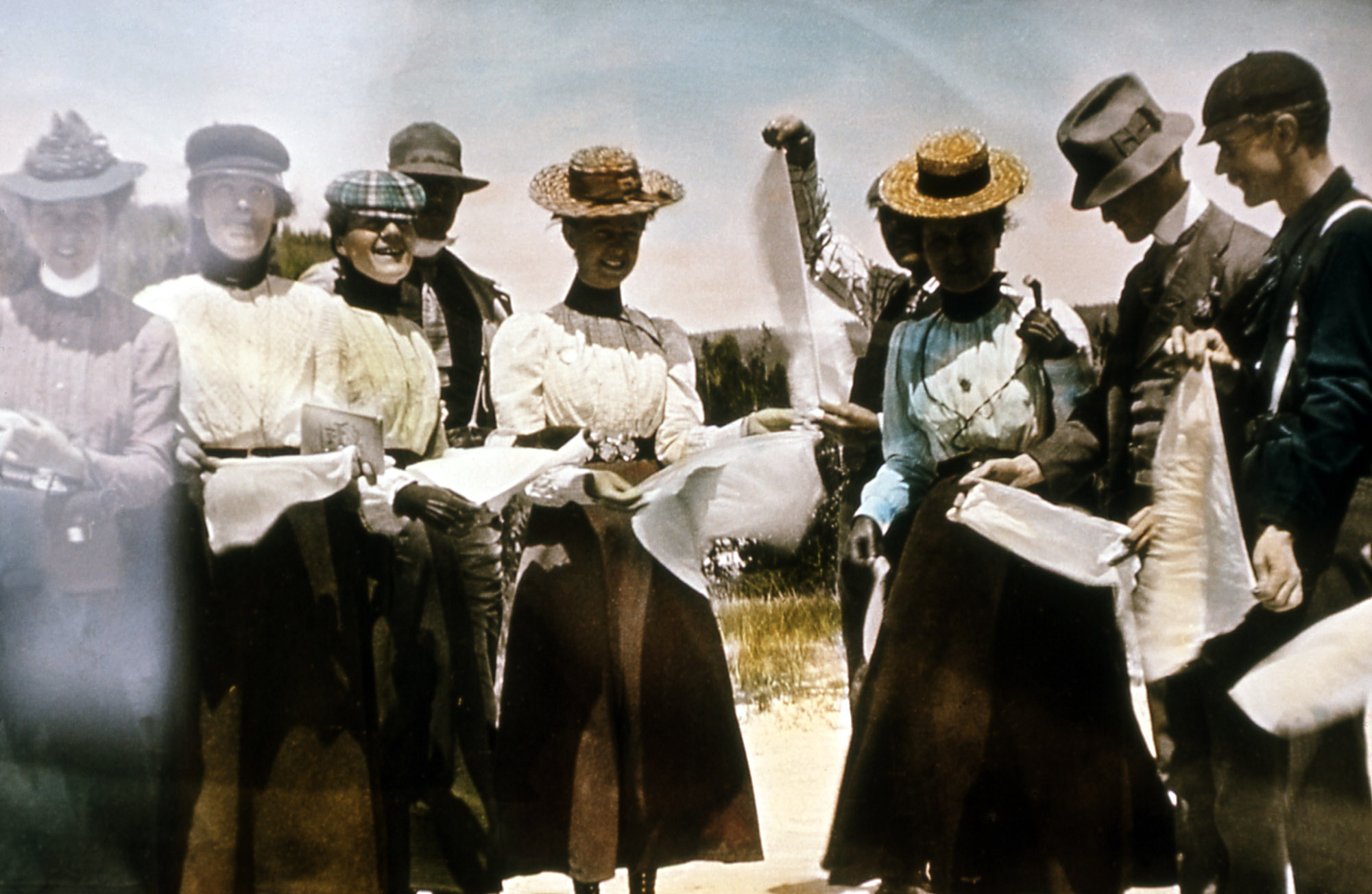
    In 1903 Hester Henshall visited the park with her husband, angling writer and fish biologist Dr. James Henshall. In the Henshal’s tour group was Lillian Elhert, an intrepid young woman who was always thrusting herself into the middle of things. Here’s Hester’s description of Miss Lillian’s antics at the Handkerchief Pool.

    ∞§∞

    The Handkerchief Pool reminded one of a great pot of boiling water, seething, roaring and bubbling, and issuing clouds of steam with a washday odor. Miss Lillian Ehlert must put her handkerchief in the pool, of course. We gathered round to watch it. It floated awhile, circling the pool, then suddenly disappeared down a sucking eddy, out of sight.

    We watched and waited, some of us thinking it had gone forever, but at last it popped up in another part of the pool and floated once more to the surface. It was then taken out with a stick, to be gazed upon by all of the party with something akin to awe. We wondered where it had been when lost to sight—what it had seen underground, and what tale it could tell if gifted with speech.

    Miss Ehlert simply said: “No checky no washee, but I got it all the same.”

    ∞§∞

    — From the journal of Hester Ferguson Henshall, Trip Through Yellowstone National Park 1903. Montana Historical Society Archives.

    — You might also enjoy Hester Henshall’s description of Miss Lilian’s antics in Cruising Lake Yellowstone.

    — Frank J. Haynes postcard, Yellowstone Digital Slide File.

  • A Tale: In a Country Swarming With Grizzly Bears — 1874

    Dr. George Henry Kingsley

    While doing research for my next book, Encounters in Yellowstone , I’ve kept a list of  everbody who was in the park when the Nez Perce passed through there in 1877. I’ve discovered some interesting people who skedaddled before the Indians arrived.

    Among them was an intrepid trio that was reprising a trip they had made to Yellowstone Park in 1874.  They were “Texas Jack” Omohundro, a frontiersman and sometimes partner of Buffalo Bill Cody and his Wild West Show; The Earl of Dunraven, whose book The Great Divide popularized Yellowstone Park in England, and George Henry Kingsley, an English physician and adventurer.

    After Dr. Kingsley’s death, his daughter, Mary Henrietta Kingsley, compiled his papers into a book entitled Notes on Sport and Travel.  Here’s Dr. Kingley’s account of hunting grizzlies in Yellowstone Park in 1874 from that book.

    ∞§∞

    We have had very poor sport, for though we have been in a country swarming with grizzly bears we have only killed one. I was mousing around by myself the other day with the little Ballard—(a little, single-barreled rifle)—and hearing something smashing about in the willow beds, and thinking that it might be a deer, I proceeded quietly to investigate, when out there lounged the great-grandfather of all the grizzlies.

    He looked at me for a moment, and then turned and trotted off, and I trotted after him, when he, being suddenly struck with the idea that valor was the better part of discretion, faced round and walked straight at me, stopping about thirty yards off.

    As I only had the Ballard, and was quite out in the open, away from any decently sized trees, I hardly knew what to do. We stood facing each other thus for a few moments, and I could plainly see his pink tongue licking his lips, and his bright little eyes twinkling with rage.

    I put up the rifle, but could not cover any part of him where a ball would have been mortal, and if I had only wounded him, he would have been at me in a brace of shakes. After interviewing one another thus, he said “hough” and decided to advance, and I decided to retreat, which I did with considerable decision up the thickest sapling in the neighborhood, hoping, however, that he would follow me at least to the foot of it.

    I was in no small state of exultation at the prospect of killing my bear single-handed, but before I was settled, he swerved and went crashing away through the willows, and I saw him no more. He looked as big as an ox.

    Texas Jack quizzed me tremendously about this on my return, but the very next day he came back to camp with a far-away look in his eye and requested whisky. He too had come across a grizzly. He found him in a patch of trees, covering up the carcass of an elk—they are wonderfully cunning, these bears, and will plaster mud and moss over carcasses they don’t want at once, will even plaster over their wounds when they have been shot.

    Jack fired. Hit him. The bear gave one tremendous yell—looked round a moment—then tore up the ground like mad and flew at the trees, sending the bark flying in all directions. Jack lay as flat as a flounder behind a tree, and when, at length, the bear made off, came home a wiser man.

    After hearing his account I was rather glad, on the whole, that my friend had not followed to the foot of my sapling, for had I not killed him first shot, he would certainly have made it a very shaky perch to reload on.

    ∞§∞

    — Frmm Notes on Sport and Travel by George Henry Kingsley, 1900.

    — Illustration from Notes on Sport and Travel.

    — For more stories about The Earl of Dunraven, click on “Dunraven” under the “Categories” button to the right.

  • News: Climate Change—Not Just Wolves—May Cause Fewer Yellowstone Elk

    Hunters have been blaming the introduction of Wolves for the recent decline in the number of elk in Yellowstone National Park, but new research indicates that climate change may be to blame. New West has provided a nice summary of the evidence.

    The news reminded me that several of the accounts of early travel to Yellowstone Park talk about summer snow storms bigger than anything we see now. Of course, the storytellers may have been exaggerating, but perhaps I should see if travel accounts provide evidence of climate change.

    Also, early travelers who went to the Park in August (apparently to avoid bad weather) often couldn’t find game. Before the Army outlawed hunting in 1886, many groups counted on living off the land, so when game was scarce they went hungry. Several stories tell about the great joy of returning to the ranches near the park and getting “civilized grub.”

    The Earl of Dunraven, who visited the Park in 1874, commented explicitly about how weather affects the migration of elk and other game.

    ∞§∞

    The herds of game move according to the seasons. In Estes Park, for instance, near Denver, you might go out in winter or in early spring, when the snow is deep upon the ranges and shoot blacktail deer till you were sick of slaughter. I daresay you might—if you knew where to go—sit down, and, without moving, get ten, fifteen, or even as many as twenty shots in the day.

    At other seasons you might walk the flesh off your bones without seeing a beast of any kind. Yet the deer are somewhere all the time; and, if you can only find out to what deep recesses of the forest, or to what high mountain pastures they have betaken themselves in their search for cool shelter, or in their retreat from mosquitoes and other insect pests, you would be amply rewarded for your trouble.

    It is the same with wapiti. Sometimes the park will be full of them; you may find herds feeding right down on the plains among the cattle; and in a fortnight there will be none left. All will have disappeared; in what is more, it is almost impossible to follow them up and find them, for they are much shyer than the deer.

    Where do they go? Not across the snowy range, certainly. Where then? Up to the bare fells, just under the perpetual snow, where they crop the short sweet grass that springs amid the debris fallen from the highest peaks; to the deep black recesses of primeval forest; to the valleys, basins, little parks and plains, hidden among the folds of the mountains, where even the wandering miner has never disturbed the solitude.

    ∞§∞

    — Excerpt from The Great Divide by the Earl of Dunraven.

    — New West Photo.

    — You can read a condensed version of the Earl’s 1874 trip to Yellowstone Park in my book, Adventures in Yellowstone.

  • A Tale: Lord Blackmore Riles His Guide by Catching 254 Fish in One Day — 1872

    In the 1870s a curious conflict developed  over who got to kill wildlife in Yellowstone Park. After decimating the bison herds on the great plains, hide hunters converged on the park and  slaughtering elk by the thousand leaving their carcasses to rot.

    Sport hunters condemned commercial hunting, but reserved their own right to blast away at anything that moved. On the other hand, hide hunters said they were just trying to make a living and condemned killing “just for fun.”

    The differing attitudes are illustrated  in the story below. It comes from the reminiscence of Jack Bean, an Indian fighter and commercial hunter who hired on as a guide to the Hayden Expedition of 1872.

    Lord William Blackmore, a wealthy Englishman who had helped fund the expedition, was Hayden’s guest and an avid fisherman. Here’s what Bean says happened when he went fishing with Lord Blackmore.

    ∞§∞

    While the doctor was geologizing the country there, I went fishing with Sir William Blackmore in Lake Abundance.

    You could see plenty of trout close to shore in the lake, but when he got to catching them he thought it would be wonderful if he caught one for each year he was old—fifty four. He soon caught the fifty four and tried for a hundred, and was not long catching this and made a try for fifty-four more and kept fishing for another hundred, and another fifty-four.

    As we had gotten two thirds of the way around the lake by this time, I told him that I would quit as I had all the fish I could drag along on the grass, being two hundred and fifty-four. I dragged them into camp which was close along the lake and wanted to make a little show of these fish.

    Sir Blackmore, whenever he would see any bones would always ask, “How come those bones there?” I would tell him they were left by skin hunters in the winter.  He thought that all skin hunters should be put in jail for such vandalism and I told him he would do the same if he were in this country for the winter.

    So when I had shook all these fish off from the strings they made such a sight that I called Dr. Hayden’s attention to what Sir Blackmore would do if he had a chance. He colored up considerable and excused himself by saying, “The fish were so plenty it was Godsend to catch some of them out.”

    ∞§∞

    In 1886 the U.S. Army took over administration of the Park and ended the holocaust by forbidding hunting for any purpose and regulating fishing.

    — For more stories about fishing in Yellowstone Park, click on “fishing” under the “Categories” button on the right.

    — Excerpt from Jack Bean’s Reminiscence, Pioneer Museum of Bozeman.

    — NPS llustration, Yellowstone Digital Slide.

    — You might enjoy Jack Bean’s sarcastic description of guiding a greenhorn in Colonel Pickett Gets His Bear.  It fun to compare Bean’s story with Colonel Pickett’s version.

    — You can read more of Bean’s delightful reminiscence in my book, Adventures in Yellowstone.

  • A Tale: Two Pictures and 1300 Words — Walter Trumbull, 1870

    The Washburn Expedition of 1870 convinced the public that there really were wonders on the upper Yellowstone. Stories of towering waterfalls, mountains of glass, a crystal-clear inland sea, and fountains of boiling water could no longer dismissed as “tall tales.” Prominent government officials and businessmen whose word couldn’t be doubted said they were there.

    Just as important the as credibility of members of the Washburn Expedition was their writing skill. Several expedition members  wrote articles about the trip for the Helena Herald that were reprinted around the world.

    N.P. Langford and Truman Everts published articles in Scribner’s Monthly that also brought national attention. The illustrations that accompanied those articles where artists’ fanciful imaginings based on verbal descriptions. The images with Langford’s article were by Thomas Moran, whose later paintings of Yellowstone gave him world fame. Moran and photographer William Henry Jackson, whose work influenced the decision to make the area a national park, went to the upper Yellowstone with the Hayden expedition in 1871.

    Two members of the Washburn Expedition left pencil sketches of what they saw, Charles Moore, a private in the military escort, and Walter Trumbull, the son of U.S. Senator Lyman Trumbull of Illinois. Trumbull also published an account of his Yellowstone experience in the Overland Monthly. His written description and sketches of the Yellowstone Falls provide an interesting opportunity to test the adage, “A picture in worth a thousand words.”

    ∞§∞

    We reached the falls of the Yellowstone on the morning of August 30th. These falls, two in number, are less than half a mile apart. From the lake to the upper falls, a distance of about twenty miles, the river flows, with the exception of a short series of rapids having a moderate current, through an open, undulating country, gently sloping toward the stream..

    Here and there are small groves, and the timber is quite thick a mile away from the river. A quarter of a mile above the upper falls the river breaks into rapids, and foams in eddies about huge, granite boulders, some of which have trees and shrubs growing upon them.

    Above the rapids, the river is about 150 yards wide, but, as it approaches the falls, high, rocky bluffs crowd in on both sides, forcing the water into a narrow gorge, which, at the brink of the falls, is about thirty yards wide.

    The most convenient and desirable place from which to view the falls is from a ledge, easily reached, which juts into the river a considerable distance, just below the falls, and a few feet lower than their brink. It is so close that occasional drops dampen one’s face.  The height of the upper falls is 115 feet. The ledge is irregular, the water being much deeper on the west side than on the east. Great rocks project in the face of the fall, tearing and churning the waters into foam, with here and there a little strip of green, which contrasts beautifully with the surrounding silvery whiteness of the water.

    Between the two falls, the river flows quietly in a wide channel, between steep, timbered bluffs, four hundred feet high. Just above the lower falls the bluffs again converge; the one from the west stretching out as if to dam up the river, which has, however, forced its way through a break, forty yards wide. The rocky cliffs rise perpendicularly from the brink of the falls, to a height of several hundred feet. The rocky formation is of a shelly character, and slightly colored with flowers of sulphur. The plunge of the water is in the direct course of the stream, and at the brink of the falls, it appears to be of uniform depth. It clears its bed at a bound, and takes a fearful leap of 350 feet.

    The volume of water is about half as great as that which passes over the American Fall, at Niagara, and it falls more than twice the distance. The adjacent scenery is infinitely grander. Having passed over the precipice, the clear, unbroken, greenish mass is in an instant transformed by the jagged edges of the precipice into many streams, apparently separated, yet still united, and having the appearance of molten silver.

    These streams, or jets, are shaped like a comet, with nucleus and trailing coma, following in quick succession; or they look like foaming, crested tongues, constantly overlapping each other. The outer jets decrease in size as they descend, curl outward, and break into mist. In the sunlight, a rainbow constantly spans the chasm. The foot of the falls is enveloped in mist, which conceals the river for more than a hundred yards below.

    These falls are exactly the same in height as the Vernal Falls in the Yosemite Valley, but the volume of water is at least five times as great. I think I never saw a waterfall more beautiful than the Vernal, and its surroundings are sublime. Its Indian name is said to mean “Crown of Diamonds;” and it certainly deserves the name. I remember sitting on the rocky ledge just at the edge of the falls, and with an opera-glass watching the water as they plunged downward, breaking into myriads of drops; each drop, like a lens, gathering prismatic tints from the shining sun, and flashing like diamonds of the purest brilliancy.

    The lower fall of the Yellowstone reminds me of the Vernal Fall, on the Merced.  Though nothing, perhaps, can equal the sublime scenery of the Yosemite, yet that only excels the lower falls of the Yellowstone, and the grand canyon which extends for many miles below them.

    Below the falls, the hills gradually increase in height, while the river descends in a succession of rapids through the canyon. At the falls, the canyon is not more than twelve hundred feet deep, but a few miles lower down it is nearly eighteen hundred feet deep. Its average thick a mile away from the river. A quarter of a mile above the upper falls the river breaks into rapids, and foams in eddies about huge, granite boulders, some of which have trees and shrubs growing upon them.

    Above the rapids, the river is about 150 yards wide, but, as it approaches the falls, high, rocky bluffs crowd in on both sides, forcing the water into a narrow gorge, which, at the brink of the falls, is about thirty yards wide.

    The most convenient and desirable place from which to view the falls is from a ledge, easily reached, which juts into the river a considerable distance, just below the falls, and a few feet lower than their brink. It is so close that occasional drops dampen one’s face. The height of the upper falls is 115 feet. The ledge is irregular, the water being much deeper on the west side than on the east. Great rocks project in the face of the fall, tearing and churning the waters into foam, with here and there a little strip of green, which contrasts beautifully with the surrounding silvery whiteness of the water.

    Between the two falls, the river flows quietly, in a wide channel, between steep, timbered bluffs, four hundred feet high. Just above the lower falls the bluffs again converge; the one from the west stretching out as if to dam up the river, which has, however, forced its way through a break, forty yards wide. The rocky cliffs rise perpendicularly from the brink of the falls, to a height of several hundred feet. The rocky formation is of a shelly character, and slightly colored with flowers of sulphur.

    The plunge of the water is in the direct course of the stream, and at the brink of the falls, it appears to be of uniform depth. It clears its bed at a bound, and takes a fearful leap of 350 feet. The volume of water is about half as great as that which passes over the American Fall, at Niagara, and it falls more than twice the distance.

    The adjacent scenery is infinitely grander. Having passed over the precipice, the clear, unbroken, greenish mass is in an instant transformed by the jagged edges of the precipice into many streams, apparently separated, yet still united, and having the appearance of molten silver. These streams, or jets, are shaped like a comet, with nucleus and trailing coma, following in quick succession; or they look like foaming, crested tongues, constantly overlapping each other. The outer jets decrease in size as they descend, curl outward, and break into mist. In the sunlight, a rainbow constantly spans the chasm. The foot of the falls is enveloped in mist, which conceals the river for more than a hundred yards below.

    These falls are exactly the same in height as the Vernal Falls in the Yosemite Valley, but the volume of water is at least five times as great. I think I never saw a waterfall more beautiful than the Vernal, and its surroundings are sublime. Its Indian name is said to mean “Crown of Diamonds;” and it certainly deserves the name.

    I remember sitting on the rocky ledge just at the edge of the falls, and with an opera-glass watching the waters as they plunged downward, breaking into myriads of drops; each drop, like a lens, gathering prismatic tints from the shining sun, and flashing like diamonds of the purest brilliancy. The lower fall of the Yellowstone reminds me of the Vernal Fall, on the Merced. Though nothing, perhaps, can equal the sublime scenery of the Yosemite, yet that only excels the lower falls of the Yellowstone, and the grand canyon which extends for many miles below them.

    ∞§∞

    — Excerpt from “The Washburn Expedition”  by Walter Trumbull, Overland Monthly, May-June 1871.

    — Images from the Coppermine Photo Gallery.

    — For more stories about the Washburn Expedition, click on “Washburn” under the “Categories” button to the left.
  • A Tale: Rudyard Kipling Goes Fishing With Yankee Jim — 1889

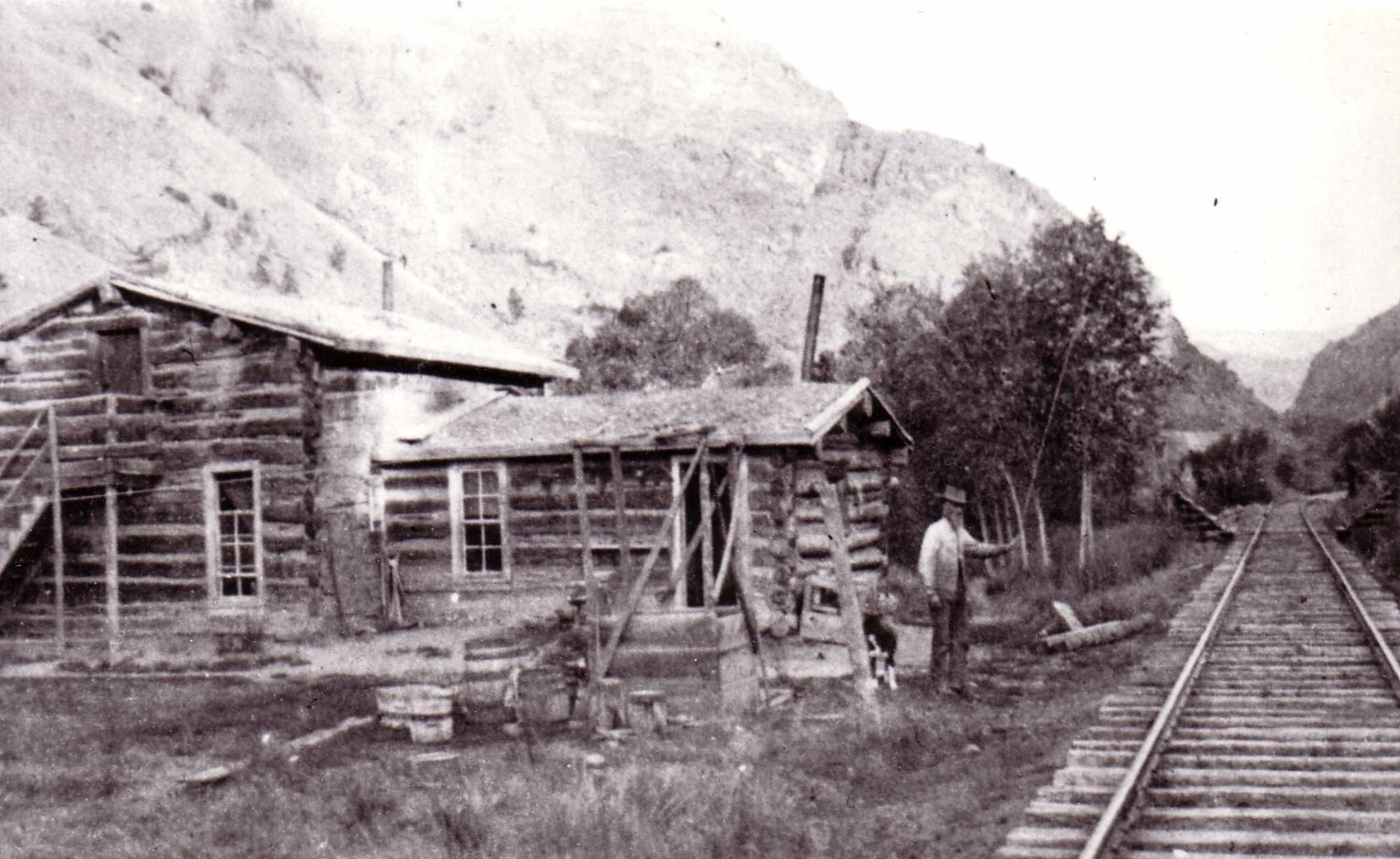
    Yankee Jim George between his cabin and the Northern Pacific track.

    In 1889 when British author Rudyard Kipling visited Yellowstone, a spur of the Northern Pacific carried passengers from Livingston, Montana, to the edge of the Park. But Kipling heeded advice from a fellow passenger and stopped to visit Yankee Jim George, the legendary operator of a toll road than ran through the canyon that still bears his name.

    Yankee Jim was a garrulous man who must have met thousands of tourists after he began collecting tolls in 1873. In 1883 the railroad took over Yankee Jim’s road bed, although they did build a bypass for him. Even after the county took over the road 1887, travelers continued to stop by Yankee Jim’s.

    Dozens of travelers’ diaries describe a stop at his cabin, note his courtly treatment of ladies and recount his tall tales. Kipling was no exception. Here’s his story.

    ∞§∞

    From Livingston the National Park train follows the Yellowstone River through the gate of the mountains and over arid volcanic country. A stranger in the cars saw me look at the ideal trout-stream below the windows and murmured softly: “Lie off at Yankee Jim’s if you want good fishing.”

    They halted the train at the head of a narrow valley, and I leaped literally into the arms of Yankee Jim, sole owner of a log hut, an indefinite amount of hay-ground, and constructor of twenty-seven miles of wagon-road over which he held toll right. There was the hut—the river fifty yards away, and the polished line of metals that disappeared round a bluff. That was all. The railway added the finishing touch to the already complete loneliness of the place.

    Yankee Jim was a picturesque old man with a talent for yarns that Ananias might have envied. It seemed to me, presumptuous in my ignorance, that I might hold my own with the old-timer if I judiciously painted up a few lies gathered in the course of my wanderings. Yankee Jim saw every one of my tales and went fifty better on the spot.

    He dealt in bears and Indians—never less than twenty of each; had known the Yellowstone country for years, and bore upon his body marks of Indian arrows; and his eyes had seen a squaw of the Crow Indians burned alive at the stake. He said she screamed considerable.

    In one point did he speak the truth—as regarded the merits of that particular reach of the Yellowstone. He said it was alive with trout. It was. I fished it from noon till twilight, and the fish bit at the brown hook as though never a fat trout-fly had fallen on the water. From pebbly beaches, quivering in the heat-haze where the foot caught on stumps cut foursquare by the chisel-tooth of the beaver; past the fringe of the water-willow crowded with the breeding trout-fly and alive with toads and water-snakes; over the drifted timber to the grateful shadow of big trees that darkened the holes where the fattest fish lay, I worked for seven hours.

    The mountain flanks on either side of the valley gave back the heat as the desert gives it, and the dry sand by the railway track, where I found a rattlesnake, was hot-iron to the touch. But the trout did not care for the heat. They breasted the boiling river for my fly and they got it. I simply dare not give my bag. At the fortieth trout I gave up counting, and I had reached the fortieth in less than two hours. They were small fish—not one over two pounds—but they fought like small tigers, and I lost three flies before I could understand their methods of escape. Ye gods! That was fishing.

    ∞§∞

    — Excerpt from  From Sea to Sea: Letters of Travel, Volume Two, Rudyard Kipling, 1899. (Page 203−205).

    — Photo, Pioneer Museum of Bozeman.

    — For related stories, click on “Fishing” under the “Categories” button to the left.
  • A Tale: Hour Spring, A Geyser by Another Name — c. 1834

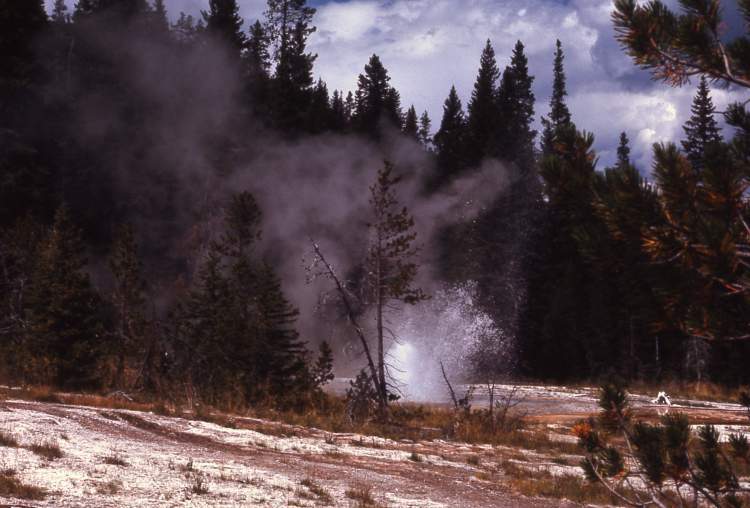
    Rustic Geyser, Heart Lake Geyser Basin

    In the decade between 1834 and 1843, a trapper named Osborne Russell kept a journal describing his adventures in the frontier northwest. Russell’s journal provides one of the earliest written accounts of travel to the upper Yellowstone. Here’s his description of hot springs and geysers in a now extinct geothermal area.

    ∞§∞

    The next day we traveled along the border of the lake till we came to the northwest extremity, where we found about 50 springs of boiling hot water. We stopped here some hours as one of my comrades had visited this spot the year previous he wished to show us some curiosities.

    The first spring we visited was about ten feet in diameter, which threw up mud with a noise similar to boiling soap. Close about this were numerous similar to it throwing up the hot mud and water five or six feet high. About thirty or forty paces from these along the side of a small ridge the hot steam rushed forth from holes in the ground with a hissing noise which could be heard a mile distant.

    On a near approach we could hear the water bubbling under ground some distance from the surface. The sound of our footsteps over this place was like thumping over a hollow vessel of immense size. In many places were peaks from two to six feet high formed of limestone, deposited by the boiling water, which appeared of snowy whiteness. The water when cold is perfectly sweet except having a fresh limestone taste.

    After surveying these natural wonders for sometime, my comrade conducted me to what he called the “Hour Spring.” At this spring the first thing that attracts the attention is a hole about 15 inches in diameter in which the water is boiling slowly about 4 inches below the surface. At length it begins to boil and bubble violently and the water commences raising and shooting upwards until the column arises to the height of sixty feet. It falls to the ground in drops on a circle of about 30 feet in diameter being perfectly cold when it strikes the ground.

    It continues shooting up in this manner five or six minutes and then sinks back to its former state of slowly boiling for an hour — and then shoots forth as before. My comrade said he had watched the motions of this spring for one whole day and part of the night the year previous and found no irregularity whatever in its movements.

    ∞§∞

    — Photo, Coppermine Photo Galley

    — From Osborn Russell, Journal of a Trapper, Syms-York Company, Boise, Idaho, 1921. Pages 99-100.

    — You might also enjoy:

  • Paul Schullery Comments on the General’s Fishing Tackle

    My friend, Paul Schullery, who Trout magazine calls America’s “preeminent angling historian,”  was kind enough to offer a comment on my post of General W.E. Strong’s story, “The Rod Bent Nearly Double.” I thought it deserved to be featured as a guest article.

    ∞§∞

    Strong’s accounts of the fishing that he and his companions enjoyed are interesting to historians for several reasons.

    The tackle is of interest because fashionable and well-heeled anglers of the mid-1870s were experiencing a revolution in their choice of gear, as the traditional (and often very large) solid-wood rods that had dominated the sport of fly fishing for centuries were being replaced by far lighter but often stiffer split-bamboo rods. Bamboo rods of this sort were expensive but very effective for distance- and precision-casting. Strong may have had some of those in his rod case, as it sounds like he had several rods.

    He was certainly in the majority in recognizing the importance of grasshoppers to the tastes of western trout. Though the British had been experimenting with some grasshopper imitations for centuries, the American grasshoppers were a considerably different and often much larger set of animals, and in the 1870s American anglers were just beginning to develop fly pattens that would work as well as the natural insects that Strong and his companions finally resorted to when their favorite artificial trout flies didn’t work. It would be several decades before American fly tiers developed floating grasshopper imitations that were consistent in catching fish when there were lots of natural grasshoppers competing for the trout’s attention.

    But Strong’s most interesting details may be about the trout itself.  No doubt his relatively light tackle, which included a silkworm gut leader that may not have been strong enough to horse a big fish in heavy water, had an effect on his handling of this fish. But by the mid-1900s, Yellowstone Cutthroat Trout would be widely regarded as the least sporting of the trout, in that they were typically thought of as the easiest to hook and the least strong as fighters. At least that was the prevailing stereotype; many of us have seen that same species of trout display great selectivity in feeding, and great strength in resisting capture once hooked. But for a Yellowstone Cutthroat Trout to jump clear of the water, repeatedly, would seem like an oddity to most modern anglers; at least I rarely have seen it or heard of it, and any number of respected authorities have said that they don’t jump. For whatever combination of evolutionary reasons, the species stereotypically does not feature jumping among its usual escape  tactics. But there are exceptions to every rule; I’ve heard or read that brown trout don’t jump, either, but I’ve seen them do so many times. What Strong’s account gives us is lots to think about as far as how well we know these fish; he tells us to be careful about our generalizations.

    ∞§∞

    — For more stories about fishing in Yellowstone Park, click on “fishing” under the “Categories” button on the right.

  • A Tale: “The Rod Bent Nearly Double,” General W. E. Strong — 1875

    One of the most luxurious early trips to Yellowstone Park was led by President U.S. Grant’s Secretary of War, General William Belknap. In 1875, Belknap was joined by four other Generals including W.E. Strong, who provide an account of the trip.

    The Generals crossed the country in a plush Pullman car smoking cigars, drinking whisky, and telling stories, on the new transcontinental railroad. Then they rode in a special stagecoach that traveled at breakneck speed from Utah to Montana.

    Along the way they were feted with banquets, parties and parades. In Bozeman a Silver Coronet Band greeted them at the edge of town and escorted them through the city to Fort Ellis.

    At Fort Ellis they were provided with an escort of active duty soldiers led by Gustavus Doane, who had commanded the escort of the Washburn Expedition in 1870.

    Each General was assigned an orderly to take care of his every whim: packing his personal belongings, putting up his tent, rolling out his bed roll, digging his latrine, and cleaning any fish he caught. All at army expense, of course. A year later the U.S. Senate impeached General Belknap for taking bribes.

    General Strong eloquently describes the wonders of Yellowstone—falls, hot springs and geysers, and describes the people he met—mountain men, stagecoach drivers, and towns people. Most of all, he revels in telling exciting tales of hunting elk, stampeding buffalo, and catching fish. Here’s his description of fishing.

    ∞§∞

    Again I threw my hook in the swift water, and down the stream it went like lightning, tossing about like a feather in the rapid. My reel whirled and spun like a buzz saw, the line went out so fast.

    I never touched the reel to check the running line till seventy-five feet, at least, was in the water. Then I pressed my thumb firmly upon it and drew gently back the rod. At the same instant something struck my hook that nearly carried me off my feet. I had to let go the reel to save the rod.

    I had him securely hooked, but could I land him? That was the question. I gave him twenty-five or thirty feet more line—then checked again and tried to hold him—but it was no use, the rod bent nearly double, and I had to let him run.

    My line was one hundred and fifty feet in length, and I knew when it was all out, if the fish kept in the rapids, I should lose him. No tackle like mine could stand for a moment against the strength of such a fish as I had struck in such swift water.

    I therefore continued to give him the line—but no faster than I was forced to.   No more than twelve or fifteen feet remained on the reel. Fortunately for me, he turned to the left and was carried into an eddy which swept him into more quiet water near the shore.

    Twice in his straight run down the rapid current of the stream he leaped clear from the water. I saw he was immense—something double or triple the size of any trout I had ever caught. The excitement to me was greater than anything I had ever experienced.

    No one but a trout fisherman can understand or appreciate the intense pleasure of a single run. I was crazy to kill and land him, and yet I knew the chances were against it. Again and Again I reeled him within twenty-five or thirty feet of the rock. But he was game to the last, and would dart off with the same strength as when he first struck. I had to let him go.

    Finally, he showed signs of exhaustion. I managed to get him to top the water, and then worked him in close to the sore. Flynn was waiting to take the line and throw him out, as I had no landing net. Flynn did it very well. When the trout was very near the bank and quiet, he lifted him out.

    He was a fine specimen, and would weigh four pounds if he weighed an ounce.   This trout was three times the size I had ever caught. At 4:30 o’clock I stopped fishing having landed thirty-five trout which would have run from two and a half to four pounds in weight—none less than two and one half pounds.

    ∞§∞

    See Paul Schulery’s comments on General Strong’s fishing tackle.

    — For more stories about fishing in Yellowstone Park, click on “fishing” under the “Categories” button on the right.

    — From W.E. Strong, A Trip to the Yellowstone National Park in July, August, and September, 1875.

    — Photo from Paul Schullery, Yellowstone Digital Slide File.

  • What’s a story? It helps to know what you’re looking for:

    Helena Daily Herald, Sept. 30, 1870

    Last week, I promised I would explain how I find the stories I post on this blog. The first step is defining what I look for.

    Most of the stories I post come from the collection of first-person accounts of travel to Yellowstone Park that I assembled for my presentations under the auspices of the Humanities Montana Speakers Bureau.

    In my promotional materials, I promised to bring travelers’ experiences to life using their own words. I soon figured out I could read four or five excerpts of three hundred to a thousand words in an hour presentation. That meant I had to be very selective as I went through my files.

    At first I “just followed my nose,” that is, I read and noted things I found fun or exciting, then excerpted and edited selections for presentation.

    My collection grew into dozens. There was just too much good stuff. How could I choose just four or five tales? My solution was to tailor each presentation to its audience. When I presented to women’s groups, I focused on stories by women. When I presented in Billings, I included stories by people who lived there. But, an account written by a person who lives in Billings, isn’t necessarily interesting to a Billings resident. It needs to be a story.

    So, what is a story?  I found an answer in Jon Franklin’s wonderful book, Writing for Story: Craft Secrets of Dramatic Nonfiction.

    Franklin, a Pulitzer Prize winning writer and teacher, emphasizes the “complication-resolution” structure of stories.  He says a story is a description of what happens when a person encounters a situation that demands a response.

    That situation can be the high adventure of life-threatening danger as in “Colter’s Run”.

    Or the need for quick thinking to protect another person as in “Colonel Picket Gets His Bear”.

    Or the humor evoked by the need to get even with a supercilious twit as in “Maud Gets Her Revenge”.

    With the complication-resolution definition of a story, it’s not hard to recognize one when you see it. But that doesn’t mean finding stories is easy. In fact, most accounts of Yellowstone travel in my collection contain nothing but banal descriptions of one sight after another. But I slog through them anyway. You never can tell where you’re going to find a nugget.

    I found one of my favorite stories, “A Million Billion Barrels of Hot Water” after slogging through more than 40 boring pages.

    ∞§∞

    — Next topic: “Sometimes the best stories are the worst history: Differences between journals, articles and reminiscences.”

    — Clipping adapted from the Yellowstone Digital Slide File.