Category: Yellowstone Stories

  • What’s a story? It helps to know what you’re looking for:

    Helena Daily Herald, Sept. 30, 1870

    Last week, I promised I would explain how I find the stories I post on this blog. The first step is defining what I look for.

    Most of the stories I post come from the collection of first-person accounts of travel to Yellowstone Park that I assembled for my presentations under the auspices of the Humanities Montana Speakers Bureau.

    In my promotional materials, I promised to bring travelers’ experiences to life using their own words. I soon figured out I could read four or five excerpts of three hundred to a thousand words in an hour presentation. That meant I had to be very selective as I went through my files.

    At first I “just followed my nose,” that is, I read and noted things I found fun or exciting, then excerpted and edited selections for presentation.

    My collection grew into dozens. There was just too much good stuff. How could I choose just four or five tales? My solution was to tailor each presentation to its audience. When I presented to women’s groups, I focused on stories by women. When I presented in Billings, I included stories by people who lived there. But, an account written by a person who lives in Billings, isn’t necessarily interesting to a Billings resident. It needs to be a story.

    So, what is a story?  I found an answer in Jon Franklin’s wonderful book, Writing for Story: Craft Secrets of Dramatic Nonfiction.

    Franklin, a Pulitzer Prize winning writer and teacher, emphasizes the “complication-resolution” structure of stories.  He says a story is a description of what happens when a person encounters a situation that demands a response.

    That situation can be the high adventure of life-threatening danger as in “Colter’s Run”.

    Or the need for quick thinking to protect another person as in “Colonel Picket Gets His Bear”.

    Or the humor evoked by the need to get even with a supercilious twit as in “Maud Gets Her Revenge”.

    With the complication-resolution definition of a story, it’s not hard to recognize one when you see it. But that doesn’t mean finding stories is easy. In fact, most accounts of Yellowstone travel in my collection contain nothing but banal descriptions of one sight after another. But I slog through them anyway. You never can tell where you’re going to find a nugget.

    I found one of my favorite stories, “A Million Billion Barrels of Hot Water” after slogging through more than 40 boring pages.

    ∞§∞

    — Next topic: “Sometimes the best stories are the worst history: Differences between journals, articles and reminiscences.”

    — Clipping adapted from the Yellowstone Digital Slide File.

  • A Tale: “Into the Scalding Morass,” Langford — 1870

    After the 1862 gold strike in Bannack, Montana, prospectors scoured every canyon and gully looking for pay dirt. That included the region that would become Yellowstone National Park.

    These men told about the wonders they had seen—mountains of glass, towering waterfalls, and fountains of boiling water, but, at first, people dismissed their reports as tall tales. Soon it became clear that there really were marvelous things in the area, so a group of government officials and businessmen decided to mount an expedition to document them. The result was the famous Washburn Expedition of 1870.

    Of course, documenting the wonders included gathering specimens—task that could be downright dangerous. Here’s a description of just how dangerous it could be, written by one of the expedition’s principle chroniclers, Nathaniel P. Langford.

    ∞§∞

    Washburn and I passed over a low divide, which, I think, must be the main range of the Rocky Mountains. Just beyond is another brimstone basin containing forty or fifty boiling sulphur and mud springs. A small creek runs through the basin—and the slopes of the mountains on either side showed unmistakable signs of volcanic action beneath the crust.

    A considerable portion of the slope of the mountain was covered with a hollow incrustation of sulphur, lime, or silica, from which issued in many places hot steam. We found many small craters from six to twelve inches in diameter —  from which issued the sound of the boiling sulphur or mud. In many instances we could see the mud or sulphur water.

    The water was too hot for us to bear the hand more than two or three seconds.  It had overflowed the green spaces between the incrustations, completely saturating the ground. In many places the grass had grown—forming a turf compact and solid enough to bear the weight of a man ordinarily. But when it gave way the underlying deposit was so thin that it afforded no support.

    While crossing one of these green places, my horse broke through—and sank to his body as if in a bed of quicksand.  I was off his back in an instant and succeeded in extricating the struggling animal.  The fore legs of my horse, however, had gone through the turf into the hot, thin mud beneath.

    General Washburn was a few yards behind me on an incrusted mound of lime and sulphur, which bore us in all cases. He had just before called to me to keep off the grassy place.  Now he inquired of me if the deposit beneath the turf was hot. Without making examination I answered that I thought it might be warm.

    Shortly afterwards the turf again gave way—and my horse plunged more violently than before, throwing me over his head. As I fell, my right arm was thrust violently through the treacherous surface into the scalding morass. It was with difficulty that I rescued my poor horse—and I found it necessary to instantly remove my glove to avoid blistering my hand.

    The frenzied floundering of my horse had in the first instance suggested to General Washburn the idea that the under stratum was hot enough to scald him. General Washburn was right in his conjecture. It is a fortunate circumstance that I today rode my light-weight pack horse. If I had ridden my heavy saddle horse, I think that the additional weight of his body would have broken the turf—and that he would have disappeared in the hot boiling mud—taking me with him.

    ∞§∞

    — Text and ilustration from Langford’s book, The Discovery of Yellowstone Park, 1870.

    — You can read a condensed version of Langford’s The Discovery of Yellowstone Park in my book, Adventures in Yellowstone.

    — To see more stories by this author, click on “Langford” under the “Categories” button to the left.

    — For more stories about the Washburn Expedition, click on “Washburn” under the “Categories” button to the left.

  • First Women: Mary Wylie Crosses Yellowstone Park in a Covered Wagon — 1880

    In 1880, Mary Wylie crossed Yellowstone Park as a member of the first tourist party to use a wheeled conveyance for this trip. She went from Mammoth Hot Springs to the Lower Geyser Basin in a covered wagon.

    Mary came to Montana from Iowa in 1879 with her children. Her husband, William Wallace Wylie, had arrived in Montana the year before to become Bozeman’s first school superintendent.

    Mr. Wylie came west in 1878 on the Union Pacific transcontinental railroad to Corinne, Utah, and then took a stagecoach 400 miles north. When Mary and the children took the same trip a year later, they came north on the Utah and Northern Railroad to the Montana border and traveled about 200 miles by stage from there to Bozeman.

    Mr. Wylie left his mark on Yellowstone Park history as a lecturer, interpreter, and inventor of “permanent camps.” After he did a lecture tour across the nation, school teachers began asking him to guide them into the park. He said this “accidentally” launched him into the tourist business.

    In 1893, he founded the Wylie Permanent Camping Company, which specialized in tours of the park where guests stayed in tents left up for a full season. His moderately priced tours provided competition to the more expensive hotel tours and opened the park to middle class tourists.

    Wylie first visited the park in the spring of 1880. When he learned that Park Superintendent P. W. Norris was building the first road across the park and was going to have it finished by August, Wylie resolved to show his wife the wonders of Yellowstone Park.

    He returned to Bozeman, bought a lumber wagon and rigged it with an emigrant cover. He then assembled a nine-person party that included Mary and two of their children, a woman friend of Mary’s, and three men.

    The party met a couple with a spring wagon at Mammoth who went with them on their tour. This proved to be a good arrangement because the travelers often had to hitch both of their teams to a single wagon to get up steep hills and through rough country.

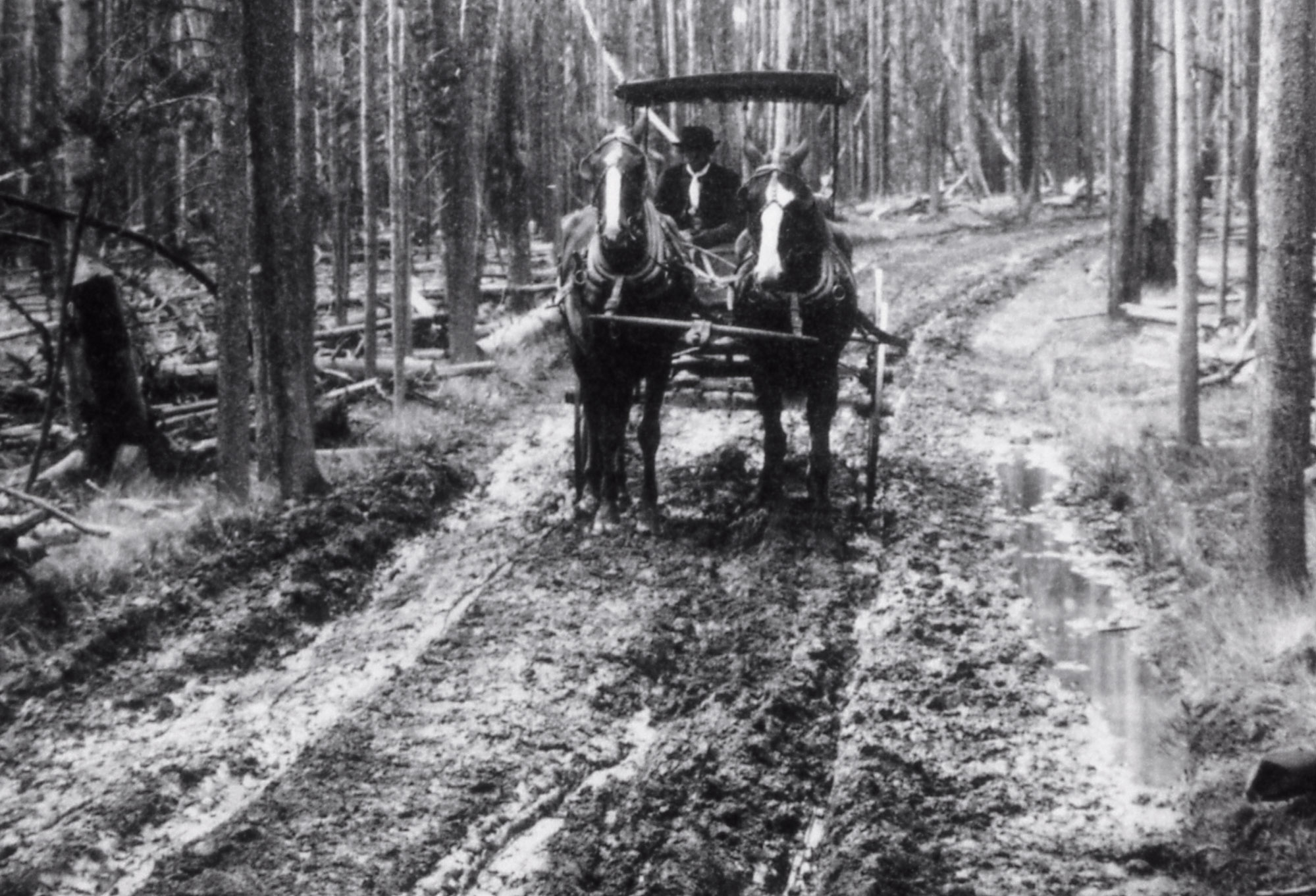
    Superintendent Norris’s new road was extremely rough. Sometimes tree stumps were too tall to let the wagons pass. When the wagons got stuck, the party had to hitch a team to the back of the wagon and pull it back so they could cut the stump lower. This made travel extremely slow. It took more than a week to travel from Mammoth to the Lower Geyser Basin.

    It was the first time tourists made the trip in wheeled conveyances. Wylie said this fact helped him get licenses to set up his tourists business in the park.

    A few weeks after Mary Wylie crossed the park beginning at Mammoth Hot Springs, Carrie Strahorn and her husband traversed Norris’s new road starting at the other end.  But after starting from the Lower Geyser Basin in a wagon, the Strahorns decided the road was too rough, and continued on horseback.

    Mary’s trip by covered wagon must have been quite an adventure. It’s too bad she didn’t leave a written account of it.

    ∞§∞

    — Photo from Yellowstone Digital Slide File.

    You also might enjoy Carrie Strahorn’s story about traveling Norris’s new road in 1880 and encountering a winter storm.

    — For related stories, look at “First Women in Yellowstone” under the Categories button to the upper left of this page.

  • A Tale: Mabel Cross Osmond: Dolly Saved My Life — 1874

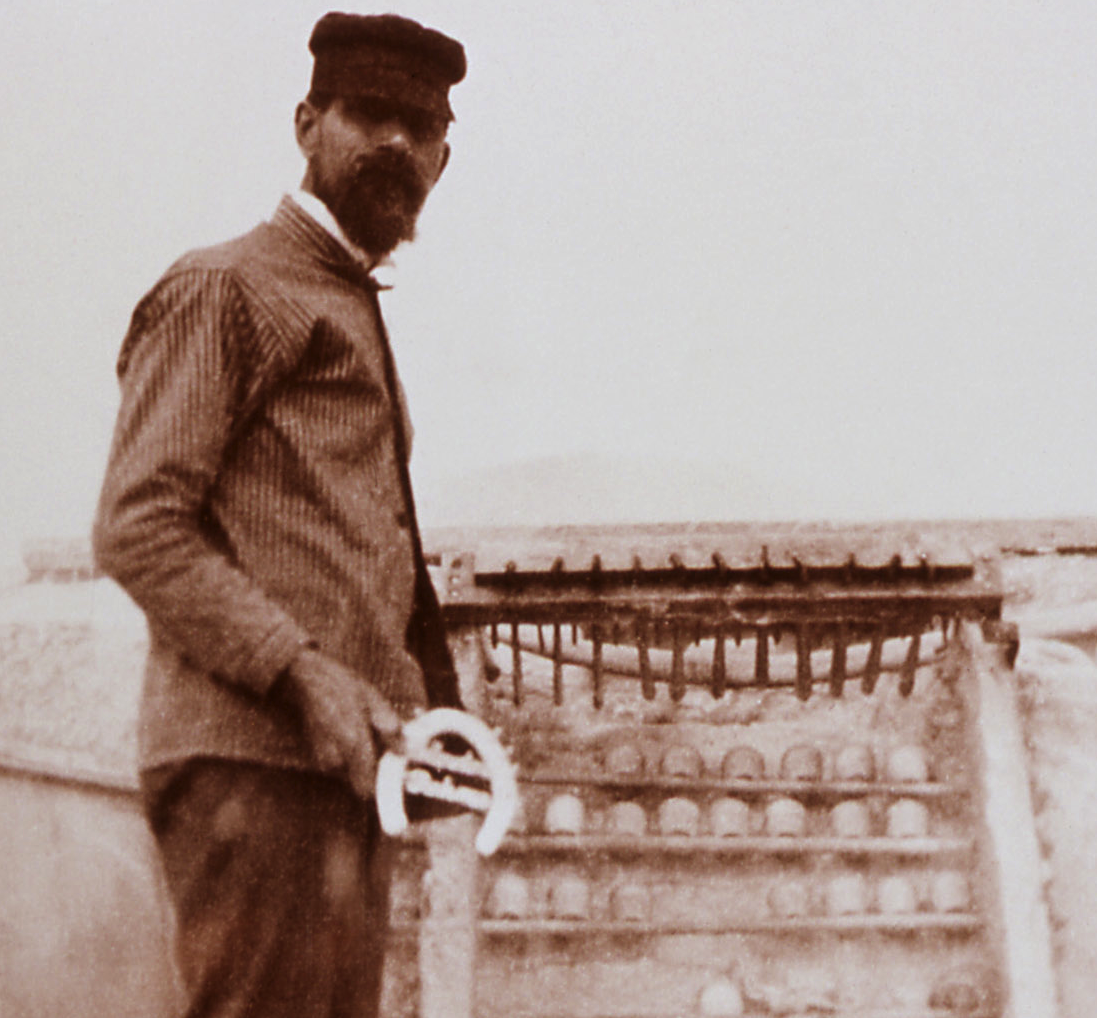
    Coating souvenirs at Mammoth Hot Springs

    Mabel Cross Osmond was just six and half years old when she first went to Yellowstone Park with her parents in 1874. Mabel’s father Captain Robert Cross was a Civil War veteran who came to Montana to be the post trader at Crow Agency, which was then located nine miles east of the present Livingston, Montana.

    Mabel wrote her memoir more that fifty years after her trip, but she still had vivid memories of it including such details as the saddle she rode. “The blacksmith,” she said, “taking a man’s saddle, fastened a covered iron rod from the pommel around on the right side to the back. This rod and the seat were well padded with blankets.  A covered stirrup, wide enough for my two feet was hung on the left side and across this open side from the pommel to the rod in back was attached a buckled leather strap so that, when mounted, I sat as a child in a high chair.”

    Mabel of rode an Indian pony she called “Dolly” that she said saved her life “by instantly stopping when, while descending a steep trail my saddle turned, leaving me hanging head downward, helplessly strapped in until the others could reach me.”

    The Crosses had an army escort to see them though Indian country until they reached the Bottler ranch.  Mabel recalled the stop clearly.

    “We enjoyed one of Grandma Bottler’s good dinners. I remember the cute little roast Pig with an ear of corn in its mouth, and also being awakened during the night by hearing her shrilly shouting — “Fredereek, Fredereek, the skunk is after the chickuns.” Though eighty years old, she kept her ‘store teeth’ put away —‘fearing to wear them out’ — she told us.”

    At Mammoth Hot Springs, Mabel’s father made a basket out of her mother’s corset stays and laid it in one of the pools.   The running waters encrusted the item with white mineral deposits making a souvenir that Mabel still had when she wrote her memoir.

    The Crosses traveled along Indian trails and through timber so thick that it hid the sky and pack mules had difficulty carrying their wide loads between the trees.  They camped at the geyser basins for several days, plenty of time to see most of the geysers play.

    When the Crosses got the Yellowstone Lake, Mabel took a ride on the boat that Sarah Tracy had named  “The Sally” just weeks earlier.  Mabel sailed to a small island where she feasted on gooseberries and ripe red raspberries, but she attributed the seasickness she got on the return trip to rough waters.  She said her hosts named an Island for her, but it didn’t stick.

    ∞§∞

    — Adapted from Mabel Cross Osmond, Memories of a Trip Through Yellowstone National Park in 1874. Typescript, Pioneer Museum of Bozeman.

    — Photo, Yellowstone Digital Slide.

  • News and Views: Presenting to “Smart Women” Was Great Fun

    The Library at Aspen Pointe

    There I was in the beautiful lobby of Aspen Pointe, an independent living facility run by Deaconess Hospital in Bozeman.  I looked out over a sea of women’s faces — and they were all looking back at me.  I thought I had died and gone to heaven.

    Indeed, the audience was filled with “Smart Women.”  They cringed when I told them about Emma Cowan’s chilling account of watching an Indian hold a pistol to her husband’s head and pull the trigger. And they laughed when I read Eleanor Corthell’s hilarious story about her husband getting arrested for letting their horse graze too close to Old Faithful and sweet talking his way into a $2 fine.

    I knew that Eleanor’s granddaughter, Phoebe Montagne, lives at Aspen Pointe, and I hoped she would be in the audience, but I wasn’t that lucky.  After signing copies of my book, I asked to be shown to Phoebe’s room.

    After my escort introduced us, I gave Phoebe a copy of my book and showed her the chapter containing Eleanor Corthell’s account of  her trip to Yellowstone Park in 1903.  While Eleanor’s husband stayed home in Laramie, she took their seven children clear across Wyoming in a horse-drawn wagon to see the wonders of the park.  Eleanor told wonderful stories about fording a flooded river, chasing a bear out of camp, and counting heads at a geyser basin to make sure none of her children had fallen in.

    When I asked Phoebe what she remembered about her grandmother, her eye twinkled and a smile slid across her face.

    “I remember Grandmother surrounded by us grandchildren sitting on the floor,” she said.  “She would read us books like David Copperfield.”

    I’m sure a smile slid across my face too while I listened to Phoebe reminisce.  As much as I enjoyed talking with 75 smart women, that was the highlight of the day.

    ∞§∞

    — You can read Eleanor Corthell’s story of her trip to Yellowstone Park in my book, Adventures in Yellowstone.

  • A Tale: Doughnuts in Bear Grease, Sarah Tracy — 1873

    Doing Laundry in a Hot Spring

    Indians stole a band of horses the day before Sarah Tracy left Bozeman for Yellowstone Park in June of 1873. But Mrs. Tracy was used to Indians. When she arrived in Bozeman in 1869 with her new husband, Bozeman Pioneer W.H. Tracy, Indians were encamped on the south side of town. She said, “They would peer in the windows if the doors were locked, or come flocking around the door begging for biscuits, soap, clothes, everything.”

    Such encounters left Mrs. Tracy with little fear of Indians, but the commander at Fort Ellis still didn’t want to let her party go to Yellowstone in the midst of “Indian troubles.” Finally, after some haggling, he agreed to provide an armed escort.

    “We were soon on our way with twelve mounted soldiers following us,” Mrs. Tracy said in a reminiscence she wrote about the trip. “With their guns and knapsacks on their shoulders, and their belts filled with cartridges, they looked very war like.” The soldiers escorted the stage across Trail Creek Pass to the Yellowstone River and then turned back after seeing no signs of Indians. The party then headed south to the Bottler brothers’ ranch. Diaries of early trips to Yellowstone often mention a stop at Bottlers.

    In 1868 Frederick and Phillip Bottler started the first permanent ranch in the Paradise Valley. The Bottlers’ ranch was a one-day ride from Bozeman and located halfway to Mammoth Hot Springs. That made it an ideal stopping point for travelers heading for the park. The Bottlers always made visitors welcome and eventually started a guesthouse.

    After a night at Bottlers, the stage headed to Mammoth Hot Springs over a new road through Yankee Jim Canyon. This road was so bad Mrs. Tracy said that it “fairly made one shudder to ride over it in a four-wheeled stage coach.” As the coach approached Mammoth passengers got a marvelous view from the top of a hill, but the descent down the mountain required chaining the stage’s rear wheels. This “rough locking” slowed the stage by making it skid and keeping it from crowding the horses.

    “We drove up to the hotel with a grand flourish of the four-horse whip, bringing the landlord and the guests to the door to meet us.” This description conjures pictures of an elegant building, but the “hotel” at Mammoth then was just an 25-by-35 foot log cabin with a sod roof. Crude as it was, the hotel had hot and cold running water; a stream of 40 degrees ran on one side and of 150 degrees on the other.

    Mrs. Tracy and her companion, Sarah Graham, waited for their husbands to join them for two days. They enjoyed fishing, climbing the terraces, two baths a day and three hearty meals. When the men arrived they all started on horseback for a tour of the Park.

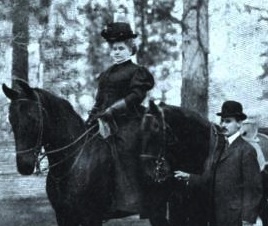
    “We rode side saddles,” Mrs. Tracy said, “and it was quite difficult for an amateur rider to keep seated.” Their train of a saddle horse for each traveler and eight packhorses made an impressive appearance strung out on the trail.  Their route frequently crossed the rushing, boulder-strewn Gardiner River, and Sarah said,

    I was in great fear of crossing, but as there was no alternative, I had to hold on as best I could. At first, I dismounted to walk over the bad places, but they were so frequent, I concluded to remain in my saddle. One old mountaineer remarked, “Wait until the mountains are so steep you must hold onto the horse’s ears going up, and tail going down.” And we certainly found some mountains where the saddle would slip over the back going up, and nearly over the head coming down. We made only one ride each day, as it was too much work to repack the horses.

    At Yellowstone Lake they found the man who had guided Emma Stone’s party, E.S. Topping, and his partner, Frank Williams. The men had recently built a sailboat. They said they would let the first woman to visit name the boat.  Since Mrs. Tracy and Mrs. Graham were both named Sarah, they decided to christen the boat “The Sallie.” Mrs. Tracy said after the name was painted on the boat, “We had a fine sail across the lake and our pictures taken on board,”

    At their camp, Topping and Williams rewarded the women by letting them make doughnuts fried in bear grease. In her reminiscence, Mrs. Tracy said of her twelve-day trip:

    “The balmy breezes and mountain sunshine had done our complexions to a turn. While our clothing was little worse for wear, yet we had seen the Yellowstone National Park in its primitive beauty. And bear’s grease doughnuts had certainly agreed with us.”

    ∞§∞

    — Sarah Tracy’s reminiscence is at the Museum of the Rockies in Bozeman.

    — You also might enjoy reading about Emma Stone, the first woman to make a complete tour of Yellowstone Park.

    — Photo, Yellowstone Digital Slide File

  • A Tale: Emma Cowan Visits Mammoth — 1873

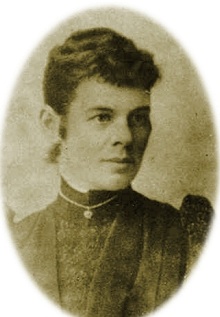
    Emma Cowan

    Most of the women who visited Yellowstone Park in the 1870s were Montana Pioneers. For them, camping out in the wilderness was no big deal. After all, they had already crossed the plains in a covered wagon, or come up the Missouri River on a crowded steamboat.

    Emma Cowan was such a pioneer. She was 10 years old when came to Montana in a covered wagon with her parents during the gold rush of 1864. Shortly after she arrived in Virginia City, Emma began hearing about the wonders of the upper Yellowstone. One day her father brought home a man who told marvelous stories.

    Emma said of the stories, “My fairy books could not equal such wonderful tales. Fountains of boiling water, crystal clear, thrown hundreds of feet into the air, only to fall back into pools of their own forming; pools of water in whose limpid depths tints of various rainbows were reflected; mounds and terraces of gaily colored sand.”

    Emma and her family thought the stories were just fantasies, but she said, “As I grew older and found truth in the statements, the desire to some day visit this land was ever present.”

    Emma’s first trip to Yellowstone Park was a visit to Mammoth Hot Springs in 1873 with her parents. She didn’t say a lot about it, but the normal starting point for such a trip would have been Bozeman, a thriving trade center and agriculture town about 75 miles from the park.

    After they left Bozeman, travelers usually would spend their first night at the Bottler brothers’ ranch—a one-day ride from Bozeman. Bottlers’ ranch was located halfway to Mammoth Hot Springs, which made it an ideal stopping point for early travelers heading to the park.

    After a night at Bottlers, Emma’s family would have gone to Mammoth Hot Springs over a new road through Yankee Jim Canyon. Emma said this road was scarcely more than a trail, but “by careful driving, unhitching the horses, and drawing the wagon by hand over the most dangerous places, we made it safely.”

    The road was so bad, Emma said, that just a few weeks before a man, who was taking his crippled wife to Mammoth to soak in mineral waters that he hoped would cure her, didn’t even try to travel by wagon. Instead, he carried her on an Indian-style travois.

    Although the park was only a year old in 1873 when Emma and her family visited there, Mammoth Hot Springs had already become a tourist destination. When her family arrived, Emma said, “We found an acquaintance or two, a number of strangers, a small hotel and a bath house.”

    At Mammoth, tourists could hire guides to take them into the roadless wilderness to see the Grand Canyon of the Yellowstone, the Falls, and, most important, the Grand Geysers. Here they could also buy supplies that included such luxuries as canned fruit, baked bread, fresh milk, and butter.

    Visitors could either camp nearby, or pay $20 a week to the hotel for room and board. In addition, they could pay five dollars for twice-daily baths in tin tubs that had been coated with a porcelain like finish by the mineral waters. Visitors often made their own souvenirs by leaving items in pools where mineral waters encrusted them.

    Emma and her family stayed at Mammoth for two weeks seeing nearby sights, soaking in hot baths, and making souvenirs. But they decided not to visit the geysers. That would have required an arduous seventy-five mile trip on horseback because there were no roads across the park.

    Several parties returned from the geysers during Emma’s stay, and their accounts intrigued her. People often told her that words couldn’t convey the wonders they had seen. “You must see them for yourself,” they told her.

    Emma’s interest was piqued. When she got home she learned everything she could about the geysers from magazines, newspapers, and friends’ accounts.

    In 1877 Emma’s wish to see the geysers came true. But the adventure was even more that she expected when Indians shot her husband and took her captive.

    Coming Soon: “Doughnuts Fried in Bear Grease, Sarah Tracy — 1874”

    — Related stories you might enjoy:

  • A Tale : Emma Stone Tours Yellowstone — 1872

    Carrie and Robert Strahorn

    While doing research for my post last week, “An October Snow Storm at Yellowstone Canyon,” I noticed that Carrie Strahorn claimed, “I was the first woman who made a complete detour of the park.” I knew that Carrie was wrong about that, but the statement wasn’t in the excerpt I used so I ignored it.

    Then I started thinking about the first women to visit Yellowstone Park. I checked my files and concluded that I had enough information to provide several posts on the topic. Here’s “First Women Yellowstone, Part 1: Emma Stone Tours Yellowstone — 1872.”

    ∞§∞

    Doubtless, the first women in what is now Yellowstone Park were Indians who had lived there for centuries before Euro-Americans explored it. As for white women, there are no official records of their early park visits. Fortunately, Yellowstone travelers have always thought their adventures were worth saving and sharing so they left a rich record of journals, diaries, reminiscences, and articles in newspapers and magazines. Examination of these documents reveals that white women penetrated the edges of the park by the early 1870s.

    One of the earliest recorded “sightings” of women in Yellowstone Park was by Sidford Hamp, a young Englishman whose rich uncle, Lord Blackmore, got him a job as a surveyor’s assistant on the second Hayden Expedition. Here’s what Hamp said about his arrival at Mammoth Hot Springs on August 27, 1872.

    “When we got about two miles from there we saw a haystack. You can’t imagine what a curiosity it was. We went on and saw a mule tied to a bush, and soon after that, came two men, more curiosities. Then we came upon a man holding in his arms the greatest curiosity of all, a baby! We went on a bit farther and saw a woman! And a house! which almost knocked us down with curiosity.”

    One of the women who visited Mammoth in 1872 was Emma Stone of Bozeman, Montana. She is credited with being the first woman to take a complete tour of the park.

    In 1872, Hiram and Emma Stone and their two sons were visiting Mammoth Hot Springs when two specimen collectors, Dwight Woodruff and E.S. Topping, returned from exploring the park and announced that they had discovered a new geyser basin (now called Norris Geyser Basin.) Such men often hung around the hotel at Mammoth looking for people to guide and the Stones hired them.

    Because there were no roads, people had to travel on horseback along Indian trails and through timber so tall, they could barely see the sky. Horses had to jump fallen logs that covered the ground. Sometimes trees were so close together that pack mules had to get on their knees to squeeze their wide loads under the lower branches.

    Travelers camped at major sights for days or even weeks. This not only provided an opportunity for such things as seeing many geysers play, but also gave spent horses time to graze and regain strength. Often the animals wandered off and many diaries record accounts of searching for them.

    The Stones visited all the geyser basins, Yellowstone Lake and Falls. Topping, in his 1888 book Chronicles of the Yellowstone, said, “It was a hard trip for the lady of the party, Mrs. Stone, but she now has the satisfaction of remembering that to her belongs the honor of being the first white woman to see the beauties of the National Park.”

    ∞§∞

    — Photo adapted from Carrie Adell Strahorn, Fifteen Thousand Miles by Stage, 1911.

    — Related stories you might enjoy:

  • A Tale: An Optimistic Prospector — 1863

    Walter Washington DeLacy

    After gold was discovered near Bannack, Montana, in 1862, prospectors scoured every gully and creek searching for the next bonanza. In 1863, Walter Washington DeLacy led a 40-man expedition that explored the Snake River to its source. The party didn’t find enough “color” for a paying proposition, but they did bring back a wealth of information about the Yellowstone Plateau. DeLacy included that information in his famous 1865 map of the Montana territory. DeLacy was a civil engineer and his account of the Snake River expedition is one of few prospector accounts by an educated man. At time when a man could make a fortune from a few gold pans of dirt, prospectors were ever hopeful of striking it rich. In the virtually lawless territories prospecting parties made their own rules to assure that everybody has a fair chance. Here’s DeLacy’s description of an effort to draft some “miner’s laws.”

    ∞§∞

    I halted the men at the creek as they came up, and when all had arrived I suggested to them that we should go on to the next water, pick out a good camp, and remain some days and prospect the different streams, which were in sight. This was agreed to, and we went forward about three miles to the next creek, near the outlet of Lake Jackson and established ourselves where wood, water, and grass were abundant.

    After unpacking and staking the animals out, another meeting was called in order to decide upon our future action. It was decided to build a “corral,” to put the horses in at night that should be left in camp, and that four parties should be formed: one to remain in camp as a guard, and three others to prospect the streams in sight.

    The men were then detailed for the different expeditions, and it was suggested, that as there was a strong probability of finding good “diggings,” we should adopt some mining laws for them.

    We therefore organized ourselves into a “miners’ meeting,” and, after appointing a chairman, etc., one of the members moved, and another seconded the motion, that the following regulations should be adopted:

    1. That every person present should be regarded as a discovered in each and every gulch found by any party or member of a party.

    2. That each member, as discoverer, should be entitled to five claims of two hundred feet each along the gulch, viz., a discovery claim, and a pre-emption claim in the main gulch, a bar claim, a hill claim, and a patch claim. (I never knew exactly what a patch claim was, but I think that it meant all that you could grab, after you got the other four claims.)

    These liberal and disinterested regulations were voted in the affirmative with gratifying unanimity, and the chairman was just about to put the question to the meeting whether there was any more business before it, when a big, burly Scotchman named Brown, who had apparently been turning the subject over in his mind, jumped up, and inquired with great earnestness, “But, Mr. Chairman, what shall we do with the rest of it.”

    ∞§∞

    — Adapted from “A Trip up the South Snake River in 1863.” Walter W. DeLacy, Contributions to the Historical Society of Montana, Vol. 2, 1896.

    — Photo, Yellowstone Digital Slide File

    — For more funny stories click on “Humor” under the “Categories” button on the left side of this page.

  • Views: Yellowstone Park Belongs in Montana

    After I urged my FaceBook Friends last week to buy my book as a Christmas gift, sales surged. In fact, Amazon.com ranked Adventures in Yellowstone Number One among books on Wyoming history for a while.

    Of course, I’m grateful for book buyers, and it’s always fun to be on top, but I think Wyoming history is the wrong category. Although most of Yellowstone Park’s land mass lies in Wyoming, most of its early history is in Montana. In fact, the Montana territorial legislature asked the U.S. Congress to attach the park to Montana twice, in 1872 and 1874. The territorial legislators offered two interrelated reasons for their request: the wonders of the Yellowstone Plateau were accessible only from Montana, and, Montana residents had explored the area and begun to develop it.

    As the accompanying relief map shows, extremely rugged mountains surround the Yellowstone Plateau. As the “Memorial” the territorial legislature drafted in 1872 put it:

    . . . this portion of Wyoming is only accessible from the side of Montana, contains the heads of streams whose courses lie wholly in Montana, while, through the enterprise of citizens of Montana, it has been thoroughly explored, and its innumerable and magnificent array of wonder in geysers, boiling springs, mud volcanoes, burning mountains, lakes, and waterfalls brought to the attention of the world. Your memorialists would, therefore, urge upon your honorable bodies that the said portion of Wyoming Territory be ceded to Montana . . . .

    The legislators had a point. While the trappers of the Mountain Man Era sometimes entered what is now Yellowstone Park over the rugged mountains to the east and south, by the time the Montana and Wyoming Territories were established in the 1860s, most explorers came from north and west. In 1863, Walter DeLacy led a group of prospectors from Bannack, Montana, up the Snake River into what is now Yellowstone Park. In 1869, David Folsom and his friends, Charles Cook and William Peterson, left Diamond City, Montana, and went up the Yellowstone River to the Yellowstone Plateau.

    A year later, an expedition led by General Henry Washburn, with an Army escort under Lt. Gustavus Doane, followed the same route as the Folsom-Cook-Peterson party. In 1871, U.S. Commissioner of Mines Rossiter Raymond led a party of men up the Madison River to see Yellowstone’s wonders.

    Also, in 1871, Montana entrepreneurs were racing to capture the tourist trade. Bozeman businessmen were building a road up the Yellowstone River through the canyon that would come to be named after toll taker, “Yankee Jim” George. At the same time, Virginia City businessmen were extending the road from Henry’s Lake to the Lower Geyser Basin. And, other adventurous Montana businessmen were building a hotel and bathhouses at Mammoth Hot Springs.

    And, what were Wyoming residents doing then to develop Yellowstone Park? Nothing!

    In 1874, the Montana territorial legislature renewed its request to the U.S. Congress that the part of Yellowstone Park that “now lies within the Territory of Wyoming be detached therefrom and attached to the territory of Montana.” Obviously, the Congress demurred. Even today, after more than a century of road building, nearly twice as many visitors enter Yellowstone Park from Montana entrances than from Wyoming entrances.

    I think Montana pioneers made a good case for making all of Yellowstone Park a part of Montana. And, it would make more sense for Amazon.com to categorize Adventures in Yellowstone with Montana books instead of Wyoming books. But I understand that geography trumps history.

    I’m just glad when my book sells—no matter what category it’s in. And remember, Adventures in Yellowstone makes a great gift for Valentines Day.

    ∞§∞

    — Relief map from the Yellowstone Digital Slide File.
    — Related Stories you might enjoy: