Category: Yellowstone Stories

  • A Tale: An October Snow Storm at Yellowstone Canyon — 1880

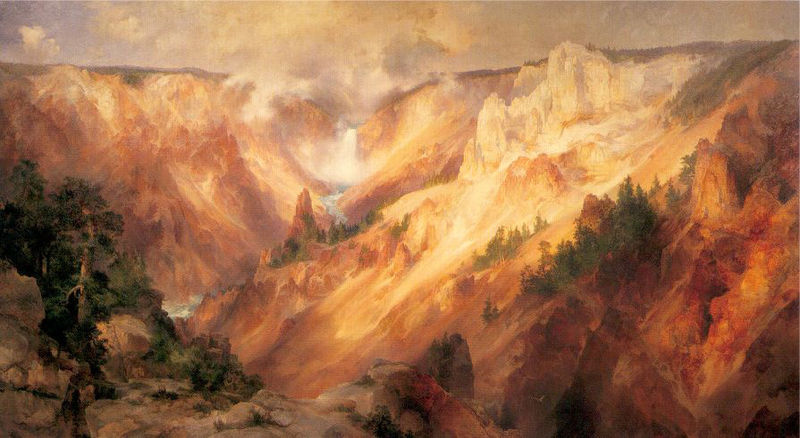
    Thomas Moran, The Grand Canyon of the Yellowstone


    Carrie Strahorn was an adventurous woman who insisted on traveling with her husband  Robert  (she called him “Pard”) as he traveled the country searching for destinations for the Union Pacific Railroad. Carrie wrote newspaper columns about her adventures and eventually collected them in a book,
    Fifteen Thousand Miles by Stage.

    Despite warnings about winter storms, the Strahorns decided to visit Yellowstone Park in October 1880. Their guide was George Marshall, who operated a stage line between Virginia City, Montana, and a hotel he built at the Lower Geyser Basin. Also, Park Superintendent Philetus Norris accompanied the Strahorns during  part of their trip.

    The weather was fine when the Strahorns began, but as they returned to Marshall’s hotel after visited the Mammoth Hot Springs, a snow storm caught them. Here’s Carrie’s story about that.

    ∞§∞

    The rain changed to snow, and through the storm we saw the disconsolate face of Mr. Marshall, as he stood near the smoldering campfire muttering to himself as if he had become demented. Upon inquiring the cause of his trouble, he said as soon as he saw the snow he went to look for the horses—and they were gone.

    “Gone!” we all exclaimed in unison and despair. The horses were gone and we were at the end of our rations with a big storm upon us. The many warnings not to go into the park so late went buzzing through our minds like bumblebees. The snow was several inches deep and falling faster every minute.

    As soon as daylight came the men started in search of the horses. I was left all alone in the camp for several hours waiting with my rifle in hand, until after a hard and hurried chase the horses were overtaken and brought back. We knew that we should hurry home as quickly as possible—but to be within five miles and not to see the falls was asking too much. With the return of the horses we resolved at once to go on.

    Superintendent Norris thought it was not best for me to go to the falls. The trip must be a hasty one, and the start home not to be delayed longer than possible for fear of continued storm. The snow ceased falling soon after daylight, but the sun did not appear and there was every indication of more snow. Pard was reluctant to leave me, and knew what disappointment lurked in my detention, but he was overruled. With Mr. Norris he started off leaving me with Mr. Marshall—who was to have everything ready for the return to Fire Hole Basin on their return.

    The more I meditated the more I felt that I could not give up seeing the canyon and falls. To be balked by a paltry five or ten miles was more than I could stand. I called to Mr. Marshall to saddle my horse at once for I was going to the falls.

    He laughingly said “all right,” but he went right on with his work and made no move toward the horse. I had to repeat the request the third time most emphatically and added that I would start out on foot if he did not get my horse without more delay.

    He said I could not follow them for I would not know the way, but I reminded him of the freshly fallen snow, and that I could easily follow the trail. He was vexed with my persistence as I was with his resistance, and he finally not only saddled my horse but his own, and rather sulkily remarked that if the bears carried off the whole outfit I would be to blame. When well on our way I persistently urged him to return to the camp and he finally did turn back, but waited watched me until I turned out of sight.

    Alone in the wild woods full of dangerous animals my blood began to cool, and I wondered what I should do if I met a big grizzly who would not give up the trail. The silence of that great forest was appalling and the newly fallen snow made cushions for the horse’s feet as I sped noiselessly on. It was a gruesome hour, and to cheer myself I began to sing, and the echoing voice coming back from the treetops was mighty good company.

    The five miles seemed to stretch out interminably. When about a mile from the falls other voices fell on my ear, and I drew rein to locate the sound, then gave a glad bound forward for it was Pard on his way back. Mr. Norris said anyone might think that Pard and I had been separated for a month, so glad were we to see each other.

    Pard could not restrain his joy that I had followed, and sending the superintendent on to the camp he at once wheeled about and went with me to the falls and canyon that I came so near missing. Up and down o’er hills and vales we dashed as fast as our horses would carry us until the upper falls were reached where we dismounted and went up to the edge of the canyon to get a better view.

    These falls are visible from many points along the canyon, and. the trail runs close to them and also by the river for several miles, the tourist many glimpses of grandeur. Above the upper falls the river is a series of sparkling cascades, when suddenly the stream narrows to thirty yards, and the booming cataract rushes over the steep ledge a hundred and twenty feet and rebounds in fleecy foam of great iridescence. The storm increased and the heavens grew darker every hour, but we pushed on.

    Moran has been chided for his high coloring of this canyon, but one glimpse of its rare, rich hues would convince the most skeptical that exaggeration is impossible. We longed to stay for days and weeks and hear this great anthem of nature and study its classical and noble accompaniment, but there was a stern decree that we must return, and that without delay.

    There was no hope for sightseeing as we kept on our way back to the Lower Geyser Basin. Without giving our horses or ourselves over half an hour to rest at noon, we rode on and on, up hill and down, through woods and plains, fording the Fire Hole River again and again, until at last the lights of Marshall camp were in sight. The storm had continued all day, turning again from snow to rain in the valley. How tired I was when we rode up to the door. Our forty-mile ride was ended at seven o’clock, but it took three men to get me off my horse.

    ∞§∞

    — Adapted from Carrie Adell Strahorn, Fifteen Thousand Miles by Stage, 1911.

    — Image, Yellowstone Digital Slide File.

    — You might also enjoy “Big Boots to Fill” by Carrie Strahorn.

    — Read more of Carrie’s story in my book,  Adventures in Yellowstone.

  • A Tale: A Near Tragedy on Uncle Tom’s Trail

    When Louis Downing visited Yellowstone National Park in 1911, good roads, comfortable hotels and camps, and tour guides left little room for adventure. But, as Downing found out, travelers could still get a thrill by taking “Uncle Tom’s Trail” to the base of the Lower Yellowstone Fall.

    Downing, a druggist from Hamilton, Montana, toured the park “The Wylie Way,” with a group of people he called “the family,” because they had become such fine friends on the trip. Here’s his description of what happened to members of the family when they decided to descend “Uncle Tom’s Trail.”

    ∞§∞

    After sending a few cards, Grace D., Mr. Jewell, Jane D., Sis, Lee and Doc followed a pretty trail through the forest to Uncle Tom’s Trail. A big sign marked “Dangerous” hung at the top.

    At the bottom of the trail, we could see a guide helping two women down—almost lifting them from rock to rock. Jane D. promptly decided that long skirts and high heels were not safe on that trail and refused to start. The boys agreed with her, but Grace, who wore flat heels, had started.

    Sis wanted to go but agreed to remain at the top with Jane D. Doc went down like a squirrel. Mr. Jewell and Lee remained near Grace. Almost half way down Brother Lee’s Kodak fell to the bottom and broke into a dozen pieces. When they reached the river, they sat on a large rock and drank some of the water. They were directly under the falls, and the view in either direction was magnificent.

    A light rain caused them to fear that the slippery rocks would make ascent dangerous so they started up the trail though they could have spent hours in the canyon. They reached the top in twenty-two minutes.

    Following the roadway, they came to a flight of stairs leading to a platform built close to the fall. The green water and white foam plunging over the rocks was simply magnificent.

    Grace D. says the climb up those steps was the hardest she had ever taken; yet, the view was worth the effort. Doc took a picture of the Falls from this point.

    In the meantime, the girls sat at the top of the trail—the mosquitoes swarming about them. They had almost made up their minds to start down when Sis slipped and fell a little to the left of the trail. She slid several feet before she could get hold of a rock that would hold her. Even then she realized that it would soon loosen, so while Jane D. frantically shouted for help Sis managed to pull herself up to the roots of a tree while the mosquitoes settled on her arms making it almost impossible to hold on.

    Jane D. tried to signal they boys, but they were too far away to realize what she meant and merely waved their hands. She knew that Sis could not hold on much longer, so she ran toward the road and finally attracted the attention of several tourists. Mr. L.F. Huesselmann of Osage, Iowa, reached the scene first, but Sis, knowing that he could not pull her up alone, held on until Mr. W.F. Schroeder of Oakland, California, reached the trail. They succeeded in getting her up and several feet from the trail before she weakened and sat down. Jane D. was pale and nervous and Mrs. Schroeder was badly frightened. She said her knees had just given way when she saw Sis hanging above the trail.

    Sis herself was over the fright in a few minutes, and laughed hysterically, but poor Jane D. couldn’t see anything to laugh at and said so.

    ∞§∞

    —   Louis E. Downing Diary. K. Ross Toole Archives, University of Montana Library, Missoula.

    — Colorized Photo, Yellowstone Digital Slide File.

    — You might also enjoy F. Dumont Smith’s story of a trip to the base of the Lower Fall of the Yellowstone.

  • News and Views: Three Recent Books Describe Early Yellowstone Travel

    I was delighted this morning to find a brand new, autographed copy of Paul Schullery’s book, Old Yellowstone Days, on my breakfast table. Now I can retire the 1977 edition that I refer to often. It’s falling apart.

    The re-issue of Paul’s book means that three collections of first-person accounts of early travel to Yellowstone National Park have been published in the last two years. Old Yellowstone Days joins Ho! For Wonderland: Travelers Accounts of Yellowstone, 1872-1914 by Lee H. Whittlesey and Elizabeth A. Watry and my book, Adventures In Yellowstone: Early Travelers Tell Their Tales.

    At a superficial level, a single blurb could describe all three books: “A collection of interesting stories about nineteenth century travel to the world’s first national park by the people who lived the adventures.” But, the books really are quite different. In fact, only two of the forty stories contained in the three books appear more than once.

    Schullery focuses on celebrities. His book includes Rudyard Kipling’s description of Yellowstone as “a howling wilderness . . . full of the freaks of nature,” and his condescending description of a Fourth of July Celebration as “wild advertisement, gas, bunkum, blow, anything you please beyond the bounds of common sense,” and Theodore Roosevelt’s lament that hunters were wiping out all of America’s big game—bison, elk and moose, as well as Frederick Remington’s description of his adventures helping soldiers capture poachers.

    Whittlesey and Watry provide a wide sample of “ordinary” Yellowstone experiences. They begin with Montana Pioneer Granville Stuart’s detailed descriptions of everything he saw when the park was just a year old in 1873. They end with Elbert and Alice Hubbard’s precious accounts of what they saw in 1914. Whittlesey and Watry approach their task in a scholarly manner liberally sprinkling their book with footnotes to explain unclear references.

    I take the opposite approach focusing on extraordinary tales filled with adventure, like Emma Cowan’s story of watching Indians shoot her husband in the head, or with humor, like the Earl of Dunraven’s hilarious explanation of how to pack a mule. I don’t use a single footnote and edit extensively for easy reading by today’s readers.

    The books are testament to the enormous diversity of the Yellowstone experience. Fans of Yellowstone Park would enjoy all of them. So would fans of history. And fans of well told stories.

    ∞§∞

  • A Tale: Wapiti Are The Stupidest Brutes — 1874

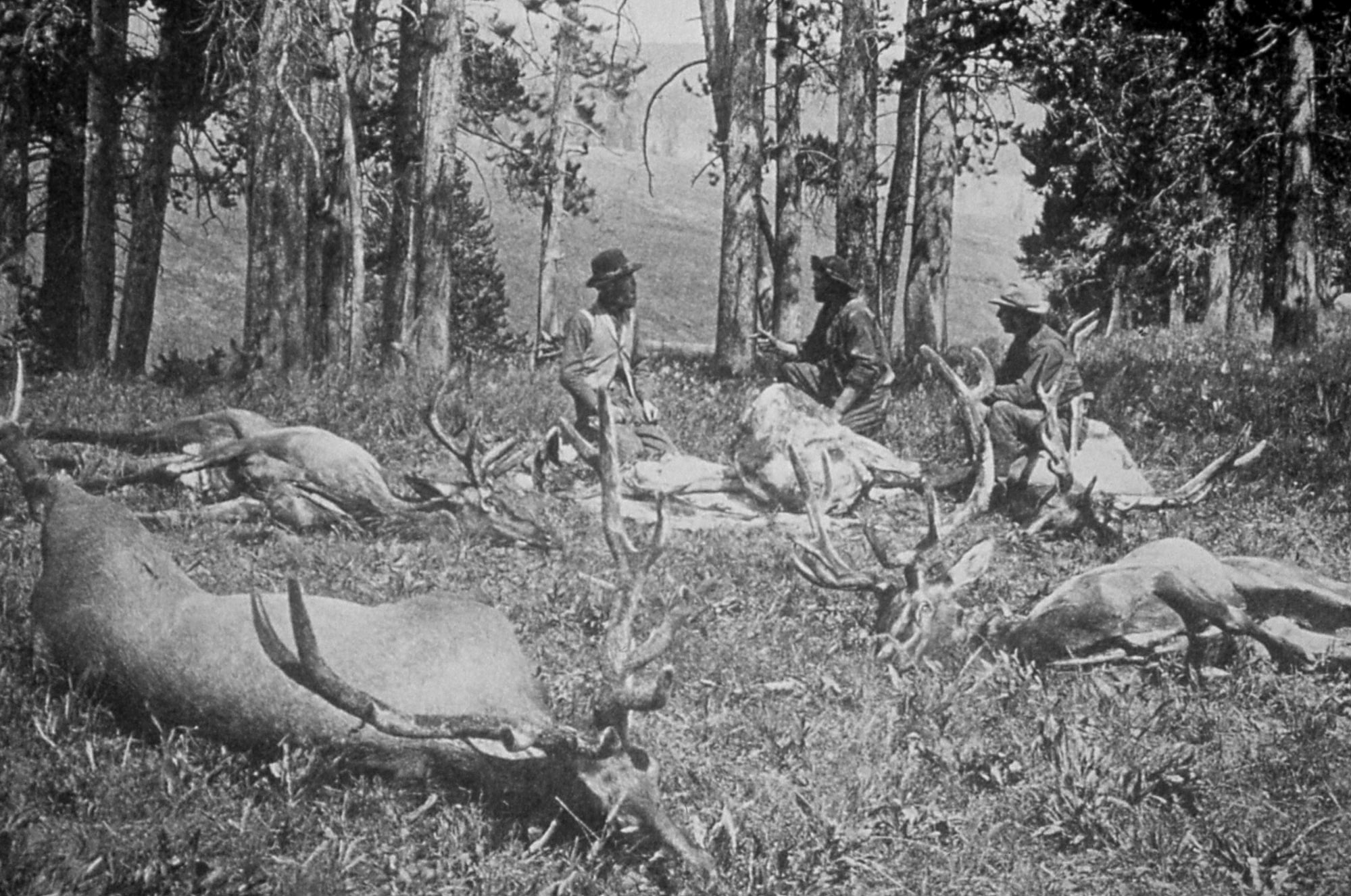
    Most early Yellowstone tourists came from the adjacent territories because getting to the park was too expensive for other people. But a few wealthy adventurers from distant places found the time and money to make the long trip. Hunting, which was perfectly legal until the Army took over administration of Yellowstone Park in 1886, was a prime attraction.

    One such traveler was Windham Thomas Wyndam-Quin, the fourth Earl of Dunraven. A fabulously wealthy Irish nobleman, Lord Dunraven hired several men to accompany him. One of them was Fredrick Bottler, a rancher who settled in the Paradise Valley on the Yellowstone River in 1868. Bottler was familiar with Yellowstone’s wonders and served as an outfitter, guide and hunter for several early expeditions.

    Dunraven, who had been a war correspondent for British newspapers, was an astute observer with a droll wit. In addition to his stories about watching geysers and hunting big game, he offers humorous advice on how to pack a mule, and tells about roasting fresh elk meat over a campfire.

    He wrote several books about his travel adventures. Here’s his description of Elk Hunting from The Great Divide, one of his most popular.

    ∞§∞

    We wound our way towards the head of the valley, half asleep, for the day was very hot. Before long I jerked my horse on to his haunches and slid quietly off. The others followed my example without a word, for they too had caught a glimpse of the dark brown forms of some wapiti feeding quietly in the wood. Bottler, in his enthusiasm, seized me violently by the arm and hurried into the timber, ejaculating at every glimpse of the forms moving through the trees.

    “There they go! There they go! Shoot! Now then! There’s a chance.” At the time he was dragging me along, and I could no more shoot than fly. At last I shook myself clear of him, and, getting a fair easy shot at a large fat doe, fired and killed her.

    Wapiti are the stupidest brutes in creation; and, instead of making off at once, the others all bunched up and stared about them, so that we got two more before they made up their minds to clear out. There was a fine stag in the herd, but, as is usually the case, he managed to get himself well among the hinds out of harm’s way, and none of us could get a chance at him.

    Bottler and I followed his tracks for an hour, but could not come up with him; and, finding that he had taken clear up the mountain, we returned to the scene of action. There we found the rest of the party busily engaged in cutting up the huge deer. One of them was a hind, in first-rate condition and as fat as butter. We were very glad of fresh meat, and, as the ground was very suitable, determined to camp right there, and send some of the flesh down to the main camp in the morning. We pitched our Lilliputian tents at the foot of one of a hundred huge hemlocks, set a fire, and proceeded to make ourselves comfortable for the night.

    We were all smoking round the fire—a most attentive audience, watching with much interest the culinary feats which Bottler was performing—when we were startled by a most unearthly sound.

    Bottler knew it well, but none of us strangers had ever heard a wapiti stag roaring before, and it is no wonder we were astonished at the noise. The wapiti bellows forth one great roar, commencing with a hollow, harsh, unnatural sound, and ending in a shrill screech like the whistle of a locomotive.

    In about ten minutes this fellow called again, a good deal nearer, and the third time he was evidently close to camp, so we started out. Advancing cautiously, we presently, through a bush, distinguished in the gloom the I saw body and antlered head of a real monarch of the forest as he stalked out into an open glade and stared with astonishment at our fire.

    He looked perfectly magnificent. He was a splendid beast, and his huge bulk, looming large in the uncertain twilight, appeared gigantic. He stood without betraying the slightest sign of fear or hesitation; but, as if searching with proud disdain for the intruder that had dared to invade his solitude, he slowly swept round the branching spread of his antlers, his neck extended and his head a little thrown back, and snuffed the air.

    I could not see the fore sight of the little muzzle-loader, but luck attended the aim, for the bullet struck high up the shoulder; and, shot through the spine, the largest wapiti stag that I had ever killed fell stone-dead in his tracks.

    It was early in the season, and his hide was in first rate condition, a rich glossy brown on the sides and jet black along the back and on the legs; so we turned to, cut off his head and skinned him; and, by the time we had done that and had packed the head and hide into camp, it was pitch dark, when we were ready for supper and blankets.

    ∞§∞

    —From Dunraven, The Great Divide, 1875.

    —William Henry Jackson Photo, Yellowstone Digital Slide File.

    — To see more stories by this author, click on “Dunraven” under the “Categories” button to the left.

  • A Tale: A Cloud-Burst of the Rarest Jewels


    Most Yellowstone tourist who kept journals struggled to describe geysers. Some relied on quantitative descriptions of such things as how high water was hurled snd how much time separated eruptions. Other’s chose adjectives—”stupendous,” “astounding”—and left their readers to imagine what they meant.  And many simply used phrases like “words cannot describe ….”

    John L. Stoddard was a professional writer who revealed his emotions and used figures of speech to describe what he saw. Stoddard was a world traveler who turned his experiences into popular lectures that he delivered across American. He published them is a series of books entitled Stoddard’s Lectures. Here’s his description of Fountain Geyser.

    ∞§∞

    “Show me a geyser!” I at last exclaimed impatiently, “I want to see a genuine geyser.” Accordingly our guide conducted us to what he announced as “The Fountain.” I look around me with surprise. I saw no fountain, but merely a pool of boiling water, from which the light breeze bore away a thin transparent cloud of steam. It is true, around this was a pavement as delicately fashioned as any piece of coral ever taken from the sea. Nevertheless, while I admired that, I could not understand why this comparatively tranquil pool was called a geyser, and frankly said I was disappointed. But even as I spoke, I saw to my astonishment the boiling water in this reservoir sink and disappear from view.

    “Where has it gone?” I eagerly inquired.

    “Stand back!” Shouted the guide, “she’s coming.”

    I ran back a few steps, then turned a caught my breath; for at that very instant, up from the pool which I had just beheld so beautiful and tranquil, there rose on great outburst of sublimity, such a stupendous mass of water as I had never imagined possible in vertical form. I knew that it was boiling and that a deluge of those scalding drops would probably mean death, but I was powerless to move. Amazement and delight enchained me spellbound. Talk of a fountain! This was a cloud-burst of the rarest jewels which, till that moment had been held in solution in a subterranean cavern, but which had suddenly crystallized into a million radiant forms on thus emerging into light and air. The sun was shining though the glittering mass; and myriads of diamonds, moonstones, pearls, and opals mingled in splendid rivalry two hundred feet about our head.

    ∞§∞

    — From Stoddard’s Lectures, Volume 10, 1905.

    — F. J. Haynes Postcard, Yellowstone Digital Slide File.

  • News and Views: Off to Helena for “Great Conversations”

    On Wednesday I’ll travel to Helena to host a table for “Great Conversations,” a fundraiser sponsored by the Helena Education Foundation.  My job will be to lead a dinner conversation (scintillating, I hope) with seven people who want to talk about early travel to Yellowstone Park.  I’ll get a free dinner, an opportunity to talk about a topic I love, and the satisfaction of supporting Helena schools.

    There’ll be twenty-eight tables at the event this year providing discussions for every taste and whim. Topics include “Raising Self-Reliant Children,” “The Neuroscience of Choice,” and “Is There a Plan of Attack for Peace?”  You can see the full list of topics.

    My topic is “Nineteenth Century Adventures in Yellowstone Park” and I’ve promised to tell exciting, funny and interesting stories.  My collection includes hundreds of tales and I’m wondering which to choose.  Can you help? Please look around through the posts on this blog and decide which ones would make for the best dinner conversation. Then tell me about your thoughts in the Comments section below.

    Just to get you started, here are links to some of my favorites:

    Why I’m Interested in Yellowstone Stories.

    Or offer a little high adventure:

    “Treed by a Lion” by Truman Everts.

    “Captured by Indians” by Emma Cowan.

    Or a touch of humor:

    “Maude Gets Her Revenge” by Louise Elliott.

    “Yellowstone’s First Car” by Henry Merry

    Or may just describe the sights:

    “Crusing Lake Yellowstone” by Hester Hensall.

    I really would like to know which stories you enjoy most. Thanks for your help.

    ∞§∞

  • A Tale: Photos—A Grizzly Chases a Yellowstone Bison

    Generally, I focus my interest in Yellowstone Park stories on things that happened before 1915, but I couldn’t resist  joining the thousands of others who shared this remarkable photo.

  • A Tale: “Get Out and Throw Up Your Hands”

    Before completion of the Nothern Pacific’s transcontinental railroad in 1883, many early Yellowstone visitors often came long distances by stagecoach—and that wasn’t always safe. In 1872 a young Englishman named Sidford Hamp, who had spent the summer working on the second Hayden expedition documenting Yellowstone Park, told about a stagecoach robbery in a letter to his mother.

    ∞§∞

    About 8 o’clock that evening on October 16, I was asleep when suddenly the coach stopped, which woke me up. I was going to look out (for the blinds were down) when I heard some one outside say, “Put in your head there! Put in your head!”

    In a little while the voice said again, “get out one at a time and throw up your hands.” I knew in an instant that the coach was stopped by highwaymen. One of the passengers got out—and then I did—and all the others followed and stood in a row with their hands over their heads.

    There were seven of us besides one on the box with the driver and a lady and child inside. When we were outside, I had time to look about and the first thing I saw was a man with a double barreled shotgun—full cocked pointed at the driver.  Another man behind the coach had two six barreled pistols in his hand.

    I took the end nearest the shotgun man, so that I could see what he was up to.  When we were all out the man with the pistols told the coachman to throw out the treasure boxes, which he did. He then took a small hatchet he had with him and split them open but there was nothing in them.

    Then he came to us and searched us. He began with me, he first took out my watch, but he only looked at it and put it back, and said he didn’t want it. Then be felt in my other pockets and found a leather case in which I had $8 and all my letters. I told him there was only $8 in it and he said if he thought so he would give it back.  I asked him to look inside but he wouldn’t. He asked me what I had been doing as I only had $8 so I told him I was traveling with another fellow. I had 2 pound 5 shilling notes in watch pocket, which he didn’t find.

    Then he searched the others and got from the first, $300, the second $2400, third $4000, fourth $150, fifth $0. From the man on the box they got $150. The man who lost none had handed his purse to the lady as he got out—and as she wasn’t searched, he saved it.

    They then took the candle out of the coach lamp and searched inside the coach. The man on the box had a bottle of whiskey, which the robbers took from him and handed round for the passengers to drink. I took some just for the joke of it and because I was cold with standing out with my hands up. Fancy such a thing as a highway robbers in England.

    ∞§∞

    — From Sidford Hamp’s Diary, published in Annals of Wyoming, 1942. .

    — Photo from the Yellowstone Digital Slide File.

    — You might also enjoys these.

  • A Tale: Cooking Fish on the Hook in a Hot Spring

    Many Yellowstone Park tourists describe places where an angler can catch a fish and cook it in a nearby hot spring without taking it off the hook, but few report actually doing it. Henry J. Winser described performing the feat in his 1883 guide for tourists.

    ∞§∞

    It has often been said that it possible to catch trout in the Yellowstone Lake and cook them in a boiling spring close behind the angler—without taking them off the hook. The assertion seems incredible and it is generally doubted. This extraordinary feat may certainly be accomplished, not only at the Yellowstone Lake, but also on the Gardiner River below the Mammoth Hot Springs. The writer performed it at the latter place, and in the presence of nine witnesses.

    Selecting a likely pool of the ice-cold stream with a boiling spring fifteen feet distant from the bank, he stood upon a projecting rock and made a cast. His flies soon tempted a trout to his doom. The fish was small enough to be lifted out of the water without the aid of a landing net, and it was quite easy to drop him into the bubbling hot spring behind. His life must have been extinguished instantly.

    This procedure was repeated several times, and each of the spectators who had purposely assembled to test the truth of the strange assertion, partook of the fish thus caught and boiled. It required from three to five minutes to thoroughly cook the victims of the experiment, and it was the general verdict that they only needed a little salt to make them quite palatable.

    This is a “fish story,” without doubt, but a perfectly true one. A feat so extraordinary could nowhere else be practiced.

    ∞§∞

    — For more stories about fishing in Yellowstone Park, click on “fishing” under the “Categories” button on the right.

    — Excerpt from Henry J. Winser,  The Yellowstone National Park: A Manual for tourists. New York: G.P. Putnam’s Sons, 1883. (Pages 39-40).

    —Frank J. Haynes Postcard, Yellowstone Slide File.

  • A Tale: Gilmann Sawtell, First Yellowstone Park Guide

    Inside Sawtell's Cabin, Sawtell far left.

    Most of the tales I post here come from my collection on early travel to Yellowstone Park that I assembled for my Humanities Montana presentations.  I focus on first-person accounts and let people tell about their adventures in their own words.  But often there very interesting people who never wrote their own story, so I write one for them.  Gilman Sawtell is such a person.

    ∞§∞

    Most of the earliest Park tourists came from Montana because that’s where the access rivers ran. The north entrance via the Yellowstone River was 60 miles from the farm town of Bozeman, and the west entrance via the Madison was 90 miles from the gold rush town of Virginia City. Both rivers flow through rugged canyons that made travel difficult. In fact, the Madison Canyon was so bad that early travelers chose to cross the continental divide twice to avoid it. But that was a small sacrifice. Passage over the Raynolds and Targhee Passes was relatively easy. Besides, traveling this route provided the reward of a stop at Henry’s Lake.

    Many travelers left glowing descriptions of Henry’s Lake. The four-mile long lake is surrounded by stately mountains and fed by snowmelt streams and cold springs. Travelers praised the spot as a paradise for game, waterfowl. It was a haven for birds, and filled with magnificent trout. Travelers usually spent several days there hunting and fishing and lolling in the sturdy log structures built by Gilman Sawtell.

    Sawtell was a blue-eyed blond who came west with his wife and son after serving as a Union soldier in the Civil War. He prospected for gold near for a while and in 1867 he began homesteading at Henry’s lake. Sawtell left his mark in many ways. His main business was harvesting and selling fish—as many as 40,000 pounds a year. To make his commercial fish business work, Sawtell had to keep his product fresh and haul it to distant markets.

    Sawtell sawed blocks of ice from the lake in winter and stored them packed in sawdust in an sturdy thick-walled icehouse he built of logs. He speared fish and stored them in the icehouse until he had enough to fill his wagon. In the 1860s Sawtell sold his fish for top prices in the gold rush town of Virginia City 90 miles away. He had to build his own road to get there. As late as 1896, Sawtell was still hauling fish to Monida where they were loaded into railroad cars for sale in Butte and Ogden.

    While launching his fish business, Sawtell built a veritable village. By 1871 he had six well-built log buildings: a residence, a blacksmith shop, a stable, a storage shed for skins and game, and his icehouse. In addition he farmed crops of hay, grain, and vegetables.

    It’s not known when Sawtell began visiting Yellowstone, but he was telling stories about geysers by the mid 1860s. In 1873 he contracted with Virginia businessmen to build a road from his ranch over Targhee Pass to the lower geyser basin. This was called “The Yellowstone Free Road” to distinguish it from the toll road Bozeman businessmen were building along the Yellowstone River to Mammoth Hot Springs. The race for tourist dollars was on.

    In 1871 Sawtell guided a group of businessmen from Deer Lodge and Virginia City on a tour that covered the geyser basins, Yellowstone Lake, and the Grand Canyon of the Yellowstone. This trip made Sawtell the first commercial guide to Yellowstone. Several of these travelers described the trip in newspapers articles. These articles appeared in Virginia City, Helena and Deer Lodge. They fueled Montanan’s interest in visiting the upper Yellowstone and encouraged the U.S. congress to establish the national park. The most extensive account of this trip was written by Calvin C. Clawson, a reporter for The New Northwest, a Deer Lodge newspaper.

    ∞§∞

    — For more information about my Humanities Montana Presentation, click the button at the top of the page.

    — Read a story by Calvin Clawson about the 1871 trip. “First Blood.”

    — William Henry Jackson photo from the Yellowstone Digital Archive.

    — For more stories about fishing in Yellowstone Park, click on “fishing” under the “Categories” button on the right.