Category: Yellowstone Stories

  • A Tale: Yellowstone’s First Tourists Seek “First Blood”

    When the Washburn expedition returned from exploring the upper Yellowstone in 1870, they confirmed the rumors of the wonders there. Interest in the area surged when people learned it really did contain a grand canyon, a giant lake, geysers and petrified forests.

    Washburn and his companions returned to civilization in late summer—too late to mount another expedition to the Yellowstone plateau where blizzards could trap traveler in September. But in 1871—a year before the national park was created—a small group of men set off “to see Wonderland.”

    The group, considered by many to be Yellowstone’s first tourists, was led by Professor Rossiter Raymond. Their principal chronicler was Calvin C. Clawson who wrote about the trip in a series of 17 articles for The New Northwest, a Deer Lodge newspaper.

    Clawson not only describes the sights the party encountered, he speculates on such things as using of the finely ground minerals found in the geyser basins for lady’s cosmetics, and embalming bodies in the calcium-laden waters. Clawson also describes the antics men out for an enjoyable adventure. Like groups everywhere, they sometimes entertained themselves with strange contests—like seeing who could get “First Blood.”

    ∞§∞

    The morning of the eleventh was very pleasant, and a calm air was highly appreciated after a boisterous night. While we made preparations to start, a large eagle sailed over and alighted in a tree half a mile down the creek. Prof. Raymond and Eiler immediately mounted their horses and gave chase.

    As yet we had taken no game—not even a chicken killed or a fish caught—and there was a strife among us to see who would get the first blood.

    I knew that when we got to Bear Creek, among the berries, with my dog Nig’s assistance, I could get a bear—for he was celebrated for hunting that kind of game.

    Bear Creek is well named. Its underbrush furnishes bears with ample and secure hiding places. Here berries grow in abundance, and the industrious ant rears her ingenious palace. Bruin is fond of both.

    After the horses were unsaddled and secured, in company with the dog and my gun, I took a stroll up the creek to see if we couldn’t bag a Bruin before the eagle hunters came up. As we advanced, the “signs” became more and more numerous—until I was satisfied we would soon be rewarded with a bear fight.

    All of a sudden I was brought to my senses by a terrible noise in the bushes ahead of me, as of the rushing and snorting of wild animals. Of course it was a bear out berrying, and he was coming directly towards me. Nearer and nearer he came. I could see the tops of the high berry bushes bending before him.

    Now it occurred to me there might be two—two bears are a good many. I would have whistled for Nig, but to attract attention would prove ruinous, for the bear was coming plenty fast already. If the gun should fail, there would be no alternative but to trust to my knife, and that would bring me face to face with the enemy.

    Old hunters say a bear can be successfully handled (in an emergency) by waiting till he rises on his hind feet, and then smiting him under the fifth rib till he dies. They never tell how the bear amuses himself in the meantime—whether he “throws up his hand” or goes for his foe “tooth and toe nail.”

    These things have to be considered—and I considered them. I recollected that I had never seen but one man who stabbed a bear. We had to take two horses to get him (not the bear) to camp—he was too much scattered to carry on one. The best surgical assistance never could make anything else out of him but a torn up man—although he lived.

    Closer and closer come the bears—I thought I got a glimpse of them through the bushes.   There was a drove of them—two abreast, rushing on me—another minute and the fight would begin. There was no tree in reach. I held a council of war—a change of base was considered in order. I immediately stepped behind a point of rocks half a mile down the creek. After waiting a reasonable time for the enemy to appear, I walked into camp—demoralized, but not damaged. The dog soon followed, panting as though he too had a race for life.

    In a short time the eagle hunters made their appearance—with their hats bedecked with trophies in the shape of eagle feathers, and an eagle hanging to the horn of each saddle—while the wings dragged the ground.

    The old one had showed fight when she saw the hunters approaching, and settled down by the nest to protect her young. After several shots from a rifle, she was disabled—and Mr. Raymond climbed the tree as far as possible, threw a rope over the limb, and shook the two young out—then brought them to camp. They were monsters for their age, and after admiring them a while, we turned them loose to shift for themselves.

    The first blood was unanimously accorded to the Professor by the balance of the party, but if the other parent bird had been at home they might have “got away” with the invaders.

    ∞§∞

    — You can read Clawson’s complete account of the 1871 trip to the upper Yellowstone in A Ride to the Infernal Regions edited by Eugene Lee Silliman.

    —Photo from the Yellowstone Digital Slide File.

  • A Tale: A Million Billion Barrels of Hot Water — 1871

    A group of professionals and businessmen visited the geysers in 1871—long before the era of hot water heaters. The trip was chronicled by Harry Norton, who published the first Yellowstone travel guide in Virginia City in 1873. Norton called one of his companions, who owned telegraph lines between Deer Lodge and Bozeman, “Prince Telegraph.” Here’s Norton’s description of the Prince’s experiments in geyserland.

    ∞§∞

    Just for the oddity of the idea, some of the party proposed that we should try a cup of geyser tea. Happy thought! A million billion barrels of hot water within easy reach, and nothing to do but put the tea a-drawing! Notwithstanding all that has been said by former tourists, the tea was excellent—and produced no disagreeable effects.

    We afterwards utilized several of the geysers by boiling meat, dirty clothes, beans, coffee, etc., each experiment being attended with satisfaction. For boiled beans, two quarts of “navies” were put in a flour sack, and with a rope, lowered into the steaming crater. In thirty minutes they were perfectly soft and palatable. This is not a first-rate method to make allopathic bean soup, but for a homeopathic dose. it can’t be beat. In this connection, a little incident:

    Prince Telegraph’s wardrobe, like our saddle-seat, was constantly getting out of repair—and as he had failed in trying to sew on a patch with a needle-gun he was obliged to procure assistance. He finally compromised affairs by a change of duties: Woodall, an expert, was to sew on the patch while Prince Telegraph washed the dishes—his first attempt probably in a lifetime. Hesitating a moment, a brilliant idea struck him. Fifty or sixty feet distant was a very noisy little geyser. Its aperture was in the centre of a noisy shallow, well-rimmed basin of about two and a half by four feet. The water scarcely ever covered the flat bottom at a greater depth than two inches.

    Pitching the soiled tin ware, knives, forks, towels, etc., into a champagne basket, and with an “0h, ho! I guess I can’t wash dishes!” the Prince approaching his improvised dishpan, unceremoniously dumped them in to soak while he placidly enjoyed his meerschaum. Suddenly, and as if resenting the insult to its dignity, the little spouter spit the basin full to overflowing in a second. Setting the contents in a perfect whirl, and the next instant, drawing in its breath, the geyser commenced sucking everything toward the aperture.

    We at the camp heard an agonizing cry for help, and looking out, beheld the Prince—with hat off and eyes peeled—dancing around his dishpan in a frantic attempt to save the last culinary outfit. It was comical in the extreme. There would be a plunge of the hand in the boiling water, a yell of pain, and out would come a spoon—another plunge and yell, and a tin plate—an” Oh! ah! o-o-o, e-e-e” and a fork. As we arrived, the towel and one tin plate were just going out of sight; while the Prince, gazing at his parboiled hands, was profanely discussing the idea of being “sucked in” by a geyser!

    ∞§∞

    — From  Harry J. Norton, Wonderland Illustrated or, Horseback Rides Through the Yellowstone National Park, 1873.

    — Postcard from the Yellowstone Digital Slide File.
    — You may also enjoy Colonel William J. Barlow’s tale of bathing in Mammoth Hot Spring.

    — For more funny stories click on “Humor” under the “Categories” button on the left side of this page.

  • Narrative History or Historical Fiction?

    Most of the time I think I’ll write my next book, Encounters in Yellowstone 1877, as narrative history, but when I hit a dead end in my research, I’m tempted to switch to historical fiction. That happened yesterday when I was trying to find out what the weather was like in Yellowstone Park on August 25, 1877.

    One of the main characters in my book, George Cowan, woke up that morning after lying unconscious under a tree in his blood-soaked clothing. George was suffering from three gunshot wounds so severe that he could barely crawl, let alone walk. He hoped to drag himself on his elbows for five miles that day to a campsite where he might find food.

    I’d like to write something like this: “An ominous gray sky greeted George . . ..” Or maybe: “The bright morning sun cast deep shadows that must have looked like canyons to George . . ..”

    I don’t want to just say: “George awoke the next morning . . ..” But I may have to if I can’t find out what the weather was like. It might be easier to give up narrative history and convert to historical fiction. Then I wouldn’t have to ground every detail in the facts; I could just make stuff up.

    That may sound like a no-brainer: don’t bother with the hard research; go with historical fiction, but it’s not that easy. When you tell your readers you’re writing fiction, you promise to provide compelling stories, fully formed characters, and gripping details that will bring your story to life. That can be as hard—maybe even harder—than sticking to the facts.

    I’ve got myself persuaded. I’m sticking with narrative history—at least for now. I know it’s possible to write true stories that have all the compelling virtues of fiction. Laura Hillenbrand did it with Seabiscuit; Erik Larson with Devil in the White City; Timothy Egan, The Big Burn; David Laskin, The Children’s Blizzard—and there are many more examples.

    If they can do it, maybe I can do it.

    What do you think?

    ∞§∞

    — To see related posts, click on “Narrative History” under the Categories Button on the right side of this page.

    Read more about History versus Fiction.


  • A Tale: Woman Fends Off Attacking Bear With Zucchini

    This morning newspapers across Montana greeted readers with this story:

    “A woman in the Huson area warded off a charging black bear with a garden fresh zucchini early Thursday after the 200-pound bruin attacked her dog and swiped at the woman’s leg.” [continue reading]

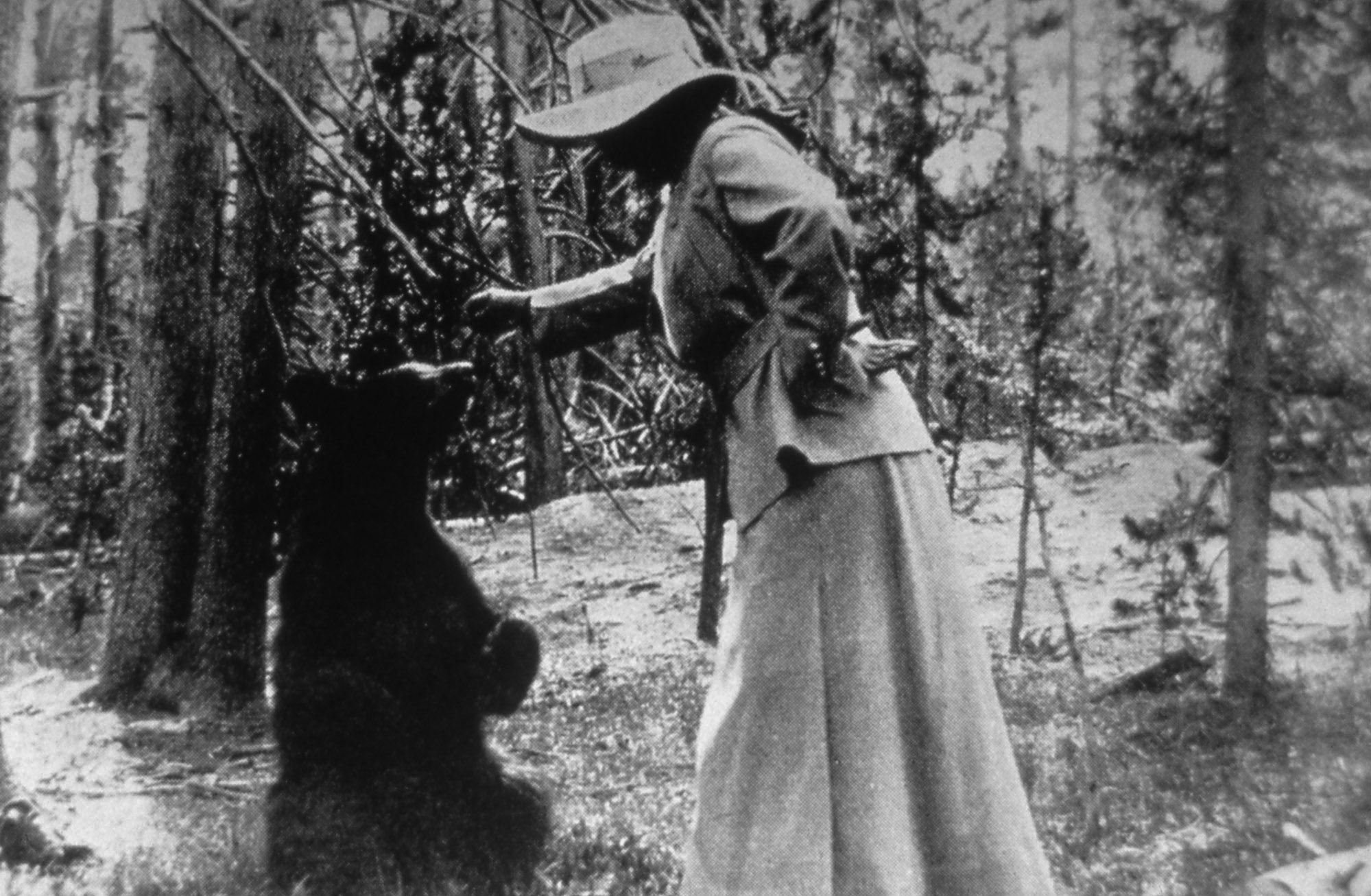
    The story probably amazed many readers, but for people in the know it’s not really surprising that the bear would flee when accosted by a zucchini. Certainly, bears can be dangerous, but early travelers to Yellowstone Park knew they could be persuaded to retreat. In fact, my collection of Yellowstone stories contains several accounts of people driving bears away by doing things like throwing rocks at them or banging together a pair of frying pans.

    An anecdote from Eleanor Corthell’s account of her trip to Yellowstone Park illustrates the point. Mrs. Corthell, who left her husband at home and took their seven children to the park in 1903, was camped near the Grand Canyon of the Yellowstone when she encountered a bear. Here’s her story.

    ∞§∞

    Of course, we remained here a day or two, sightseeing, cooking, resting, awaiting a telegram. It seemed sacrilegious to return to camp after that glorious gaze into nature’s proudest wonderland and go baking beans, yet we had to have a change from Van Camp’s. I wouldn’t speak of it now only that is how we came to have a visit from a bear.

    The beans were not done at bedtime, so I put in pine knots, thinking they would be just right for breakfast. It was so hot the stove was outside. About midnight there was a great clatter of falling stove. Sure enough, a bear had tipped it over trying to get my beans. He was trying so hard to work the combination of the oven door that he never noticed our excitement. Not until I threw things at him would he go away. On the whole, I presume, we would have been disappointed if one bear, at least, had not paid us a visit. We never thought of being afraid, but I used all my ingenuity in hiding bacon and sugar from prowling bears, every night.

    ∞§∞

    — Read more about Mrs. Corthell’s trip in my book, Adventures in Yellowstone.

    — Photo from the Pioneer Museum of Bozeman

  • A Tale: Angering Old Faithful — 1877

    Today most Yellowstone tourists believe that nature is fragile. They wouldn’t collect a leaf or pick a flower for fear of causing irreparable damage. But early tourists shattered geological features to gather specimens, slaughtered animals for fun, and experimented with geysers.

    Explorers Near Old Faithful, August 1871

    They reported these things without the slightest embarrassment.

    On a Sunday in the summer of 1877, Frank Carpenter was lolling around Old Faithful with his companions: Dingee, Arnold and Mr. Huston—and Frank’s sisters, Ida and Emma. They soon tired of quietly observing the Sabbath and decided to experiment with Old Faithful. Here’s Frank’s story.

    ∞§∞

    We conclude that we will do our washing, since such an opportunity for “boiling clothes” will not be presented again soon.

    Emma and Ida put their clothes in a pillowcase. Dingee took off his blouse and tied a large stone in it and I finished tying it with my handkerchief. Arnold also removed his jacket—and we repaired to the laundry—Old Faithful.

    We hear the preparatory rumbling and the waters rise a few feet above the surface. Mr. Houston now gives the command to throw our garments into the water. The water goes down and remains low so long that we begin to feel uneasy. Dingee begins to lament his loss and to curse the man who “put us up to the job up.”

    Mr. Huston remarks that it will be all right, and the next instant, with a rush and a roar she “goes off.” The clothes, mixed in every conceivable shape, shoot up to a distance of a hundred feet and fall with a splash in the basins below.

    The water subsides, and we fish out the clothing, which, we find as nice and clean as a Chinaman could wash it with a week’s scrubbing. Dingee rejoices.

    Wishing to experiment further, we collect an immense quantity of rubbish and drop it into the crater. We fill it to the top with at least a thousand pounds of stones, trees, and stumps. Now we sit down to await further developments.

    At the exact time advertised, sixty-five minutes from the time of the last eruption, the earth begins to tremble. We hear the rush again. “Off she goes,” and away go rocks, trees and rubbish—to a height of seventy-five or eighty feet.

    Old Faithful seems to have been angered by the unwarrantable procedure on our parts—or he wishes to show us that our attempts to check his power are futile. And he furnishes entertainment of unusual magnitude and duration.

    ∞§∞

    — From The Wonders in Geyserland by Frank D. Carpenter.

    — Photo byWilliam Henry Jackson 1872. Yellowstone Digital Slide.

    — You may also enjoy Colonel John W. Barlow’s tale of bathing in Mammoth Hot Spring.

  • Early Yellowstone Entrepreneurs

    Just in case you missed it, I decided to post a link to my article, Entrepreneurs on the Edges of Yellowstone, that was published in the summer 2008 issue of The Big Sky Journal.

    It describes the first intrepid entrepreneurs who tried to turn a dollar in Yellowstone Park. There’s Gilman Sawtell, a rancher and commercial fisherman who harvested thousands of fish from Henry’s Lake near the west entrance to the park. And Fred Bottler, who started ranching north of the park and hunted elk for their hides shipping them back east by thousands.  Sawtell and Bottler were also the first park guides.

    There are hotel and road builders and their first customers including women who rode sidesaddle through the roadless wilderness. Just click this link to read all about them.

    ∞§∞

  • Why I’m Interested in Yellowstone Stories

    Hot Springs Cone

    When I was a little boy, my grandmother used to tell me stories about her trip to Yellowstone National Park in 1909. Grandma went to the park with her aunt, seven cousins, and two brothers. Great Aunt Elvina was recently widowed and her youngest daughter was born after her husband died. Family lore says that the baby is the reason they took a milk cow with them. Grandma said she would hang a bucket of cream under the wagon axle in the morning where the rocking motion would turn it to butter by evening.

    At 20, Grandma was the eldest of the young people and she was responsible cooking and taking care of the camps. Aunt Elvina had her hands full with the baby and keeping track of the other small children.

    Grandma’s 15- and 17-year-old male cousins probably drove the teams, took care of the horses, and milked the cow. The party had a surrey for Elvina and the small children, a covered wagon for supplies and equipment, and four saddle horses.

    Grandma used to brag about making herself a split riding skirt and riding astride through the park. At that time proper young ladies rode side-saddle.

    She told about making bread in a hot spring. She put dough in a lard can, tied it to a rope, and dropped it into the boiling water. After an appropriate length of time, she pulled it and found a palatable loaf, although it lacked a pretty brown crust.

    Grandma also recounted stories her father told about working in the park in 1882. Grandma’s grandfather, Rodney Page, was a surveyor by profession and he got a contract to survey the northern border of Yellowstone. In fact, he apparently moved to Montana to take the job. He left his wife behind in Michigan to manage moving the family.

    On Rodney’s survey crew were two young men, Fred Mercer and Harry Redfield, who enjoyed playing practical jokes. Grandma said they stole each other’s red flannel underwear and pitched it into a geyser. The next time the geyser played, it was colored pink from the dye.

    Despite their pranks, Grandpa Rodney apparently approved of the two young men. After their work in the park, they returned home with him. Harry Redfiled married his daughter Elvina, and Fred Mercer, her sister, Evelyn. I descend from the Mercer line.

    In addition to stories about her family, Grandma told about experiences every early Yellowstone traveler knew about like catching a fish and turning to drop it in a hot spring to cook where and angler without removing it from the hook. Grandma commented that she preferred to clean her fish before cooking them. Actually, there are several places in the park where you could do this: along the Firehole and Gardiner Rivers and the shore of  Yellowstone Lakc. The Fishing Pot is probably the most well known.

    I also remember Grandma’s telling about the Handkerchief Pool, a now defunct geothermal feature in the Upper Geyser Basin. The Handkerchief Pool looked like a large pot of boiling water and gave off clouds of steam and a sulphur smell. When someone dropped a hankie in the pool, it would swirls around for awhile. Then the pool would suck it out of sight. About the time spectators had given the hankie up for lost, it would pop to the surface. Then the owner could fish the freshly laundered item out with a stick.

    As a small boy, I was fascinated by Grandma’s Yellowstone stories. As an adult, I wanted to know more, so I began researching early travel to Yellowstone. I now have a growing collection of about 300 first-person accounts of trips to the park.

    I’m sad to say that Grandma never wrote about her trip.

    ∞§∞

    — Postcard from the Pioneer Museum of Bozeman.

    — You also might enjoy these stories:

  • A Tale: Colter’s Run — 1807

    People have told and retold John Colter’s adventures with embellishments that turn him into a legendary figure like Pecos Bill and Paul Bunyon. But Colter really did cross the plains naked after outrunning hundreds of Blackfeet warriors who were screaming for his scalp. He really was the first white man to visit what is now Yellowstone Park. And his reports of a stinking place where springs spout steam and boiling water were greeted as fantasy and labeled “Colter’s Hell.”

    Colter was a member of the famous Lewis and Clark Expedition that first explored the American West beginning in 1803. He came within a hundred miles of what is now the park in 1806 when he accompanied William Clark on the return trip down the Yellowstone River.

    Later, Colter sought permission to muster out of the Corps of Discovery so he could return upriver with a pair of trappers. After extracting a promise from the rest of the men that they wouldn’t seek similar treatment, the Captains acceded to his request.

    Colter’s partnership soon broke up and he joined  Manuel Lisa’s Missouri Fur Company. In 1807, Lisa sent Colter up the Yellowstone River to make friends with the Crow Indians and bring them back to his trading post. While he was on this mission, Colter passed through parts of what is now Yellowstone National Park.

    Apparently illiterate, Colter left no written accounts of his travels. But on a visit to Saint Louis, Colter told his adventures to the English writer and naturalists William Bradbury. In a footnote in his 1819 book, Travels in the Interior of America, Bradbury reported the famous story of Colter’s Run.

    ∞§∞

    Colter came to St. Louis in May, 1810, in a small canoe, from the headwaters of the Missouri, a distance of three thousand miles. I saw him on his arrival, and received from him an account of his adventures. One of these, from its singularity, I shall relate.

    He trapped in company with a hunter named Potts. Aware of the hostility of the Blackfeet Indians, they set their traps at night, and took them up early in the morning, remaining concealed during the day.

    They were examining their traps early one morning, in a creek about six miles from that branch of the Missouri called Jefferson’s Fork, and were ascending in a canoe. Suddenly they heard a great noise, resembling the trampling of animals. But they could not ascertain the cause, as the high, perpendicular banks on each side of the river impeded their view.

    Colter immediately pronounced it to be occasioned by Indians, and advised an instant retreat. Potts accused him of cowardice and insisted that the noise was caused by buffaloes. In a few minutes their doubts were removed by a party of Indians making their appearance on both sides of the creek—five or six hundred—who beckoned them to come ashore.

    As retreat was now impossible Colter turned the head of the canoe to the shore. At the moment of its touching, an Indian seized the rifle belonging to Potts. But Colter, who is a remarkably strong man, immediately retook it. He handed it to Potts, who remained in the canoe, and on receiving it pushed off into the river.

    He had scarcely quitted the shore when an arrow was shot at him, and he cried out, “Colter, I am wounded.” Colter remonstrated with him on the folly of attempting to escape, and urged him to come ashore.

    Instead of complying, he instantly leveled his rifle at an Indian, and shot him dead on the spot. This conduct may appear to have been an act of madness, but it was doubtless the effect of sudden and sound reasoning. For if taken alive, Potts must have expected to be tortured to death, according to their custom. He was instantly pierced with arrows so numerous that, to use the language of Colter, “be was made a riddle of.”

    They now seized Colter, stripped him entirely naked, and began to consult on the manner in which he should be put to death. They were first inclined to set him up as a mark to shoot at. But the chief interfered, and seizing him by the shoulder, asked him if he could run fast.

    Colter, who had been some time amongst the Crow Indians, had in a considerable degree acquired the Blackfoot language. He was also well acquainted with Indian customs. He knew that he had now to run for his life, with the dreadful odds of five or six hundred against him. Therefore he cunningly replied that he was a very bad runner—although he was considered by the hunters as remarkably swift.

    The chief now commanded the party to remain stationary, and led Colter out on the prairie three or four hundred yards—and released him, bidding him to save himself if he could.

    At that instant the horrid war whoop sounded in the ears of poor Colter. Urged with the hope of preserving life, he ran with a speed at which he was himself surprised.

    He proceeded towards the Jefferson Fork, having to traverse a plain six miles in breadth, abounding with prickly pear, on which he was every instant treading with his naked feet. He ran nearly halfway across the plain before he ventured to look over his shoulder.

    He perceived that the Indians were very much scattered—and that he had gained ground to a considerable distance from the main body. But one Indian, who carried a spear, was much before all the rest, and not more than a hundred yards from him.

    A faint gleam of hope now cheered the heart of Colter. He derived confidence from the belief that escape was within the bounds of possibility. But that confidence was nearly fatal to him. He had exerted himself to such a degree that the blood gushed from his nostrils—and almost covered the forepart of his body.

    He had now arrived within a mile of the river, when he distinctly heard the appalling sound of footsteps behind him, and every instant expected to feel the spear of his pursuer. Again he turned his head, and saw the savage not twenty yards from him.

    Determined if possible to avoid the expected blow, he suddenly stopped, turned round, and spread out his arms. The Indian, surprised by the suddenness of the action, and perhaps of the bloody appearance of Colter, also attempted to stop. But exhausted with running, he fell whilst endeavoring to throw his spear, which stuck in the ground and broke in his hand.

    Colter instantly snatched up the pointed part, with which he pinned him to the earth, and then continued his flight. The foremost of the Indians, on arriving at the place, stopped till others came up to join them, when they set up a hideous yell. Every moment of this time was improved by Colter, who, although fainting and exhausted, succeeded in gaining the skirting of the cottonwood trees, on the borders of the fork, through which he ran and plunged into the river.

    Fortunately for him, a little below this place there was an island, against the upper point of which a raft of drift timber, had lodged. He dived under the raft, and after several efforts, got his head above the water amongst the trunks of trees, covered over with smaller wood to the depth of several feet. Scarcely had he secured himself when the Indians arrived on the river, screeching and yelling, as Colter expressed it, “like so many devils.” They were frequently on the raft during the day, and were seen through the chinks by Colter, who was congratulating himself on his escape, until the idea arose that they might set the raft on fire.

    In horrible suspense he remained until night, when hearing no more of the Indians, he dived under the raft, and swam silently down the river to a considerable distance. He landed and traveled all night. Although happy in having escaped from the Indians, his situation was still dreadful. He was completely naked, under a burning sun—the soles of his feet were entirely filled with the thorns of the prickly pear—he was hungry. He had no means of killing game—although he saw abundance around him. He was at least seven days’ journey from the nearest Fort.

    These were circumstances under which almost any man but an American hunter would have despaired. He arrived at the fort in seven days, having subsisted on a root much esteemed by the Indians.

    ∞§∞

    — Story adapted from pages 17-21 (footnote) in John Bradbury, Travels in the Interior of America in the Years 1809, 1810, and 1911 (London: Sherwood, Neely, and Jones, 1817).

    — Illustration, “Old Bill Williams,” Wikipedia Commons.

    — You might also enjoy “Jim Bridger’s Descriptions of Yellowstone.”

    — Here’s another version of Colter’s Run.

  • A Tale: Watching Bears Fight at a Dump — 1896

    Tourists watching bears.Bears are remarkably adaptive animals that adjust their behavior to the activities of people they encounter. When people began visiting the Park in the 1870s, bears were fearless and easy to find. But they soon figured out that rifle shots are deadly. By the 1880s bear sightings were rare.

    In 1883 the Army forbade firearms in the Park and soon developers built grand hotels. The hotels began dumping their kitchen scraps in the woods and bears took that as an invitation to dinner. Watching bears at the dump soon became a popular pastime and it continued until the Park Service began locking garbage away in the 1960s.

    When cars were admitted to the Park in 1915, bears discovered they could approach them because there were no horses to scare. Bear jams blocked traffic and became a nuisance until the Park clamped down on feeding bears in the 1960s.

    While visiting Yellowstone Park in 1896, author and naturalist Ernest Thompson Seton decided to study bears. So he spent a day in the garbage dump hiding among the carrot tops, rotting potato peels and tomato cans with his notebook and sketchpad. The bears obliged him by trooping into the dump to eat scraps and lick jam jars. A large female and her three-legged, pot-bellied son caught Seton’s attention. The sickly little bear became the inspiration of Seton’s famous story, “Johnny Bear.”

    Despite his infirmities, Johnny Bear’s mother, Grumpy, loved him dearly. Like all momma bears, Grumpy was fearless when it came to protecting her son. She drove the other bears away from Johnny and left him alone to lick syrup cans.

    When Johnny got his head stuck in a can, he yowled, and complained, and struggled until he was able to pull it off. Then he punished the offending container by smashing it flat with his little paws.

    Suddenly, a huge grizzly ambled into the dump between Johnny and Grumpy. To protect her son, Grumpy charged the much larger animal and thumped him on the head. The grizzly responded with a terrible blow that sent her sprawling. The two bears clinched and rolled around in a battle that left Seaton nothing to watch but clouds of dirt and flailing legs. Johnny climbed to the top on a tree and whined as the battle raged. The grizzly easily defeated Grumpy so she dashed up the tree to join her son.

    While the grizzly ambled though the dump grazing, Seton decided he need photographs the combatants. So he began snapping pictures of Grumpy and Johnny. He then pointed his camera at the grizzly and it began moving toward him. When the giant got within five yards, Seton thought he had met his end. But the bear turned away and began licking tomato cans.

    Seton returned to the hotel after his day of bear watching, but the hotel staff refused to let the stinking naturalist in. They made him take off his clothes in the woods behind the hotel. Then they brought a fresh change from his hotel room. But Seton wasn’t humiliated. He considered the day a great success. After all, he had the material for his most famous story.

    ∞§∞

    —Read a condensed version Ernest Thompson Seton’s “Johnny Bear” in my book, Adventures in Yellowstone.

    — F.J. Haynes Postcard, Copperplate Photo Gallery.

    — To find more stories about bears, click on “Bears” under the “Categories” button to the left.

  • Researching Attitudes Toward Indians

    What would it feel like to wake up in a wilderness with a lead slug embedded in your skull and remember watching your wife being dragged away by hostile Indians? That happened to George Cowan when the Nez Perce fled through Yellowstone Park  a hundred and thirty-three years ago.

    I’m writing about George’s ordeal for my next book, Encounters in Yellowstone 1877, so I need to know how he felt. Actually, it’s not hard to empathize with George. We all know that his head hurt from the bullet lodged there. And of course, George felt anger  — maybe even rage — at his attackers, and fear — maybe even terror — at what they might do to his wife.

    George’s story is compelling because it’s easy to identify with him, but can we assume he reacted in the same way we would? Wouldn’t events like the Battle of the Little Big Horn that happen just a year before George’s ordeal have colored his reactions?

    Last week, I did some research to answer questions like those. I started by searching the index of Montana the Magazine of Western History. I scanned subject headings until I saw “Indians, attitudes toward.” Under that heading I found an article published in 1957 by Robert W. Mardock entitled “Strange Concepts of the American Indian Since the Civil War.” Mardock says in the 1870s Americans called Indians everything from “noble savages” to “red devils.”

    New England writers like Cooper and Longfellow promoted the “noble savage” view, but Mardock says things were different on the frontier. He quoted a Virginia City, Montana, newspaper: “It is high time that sickly sentimentalism about humane treatment and conciliatory measures should be consigned to novel writers, and if the Indians continue their barbarity, wipe them out.’”

    According to Mardock, “The apprehensions and viewpoints of our frontier areas were strongly reflected in the Eastern newspapers. Exaggerated dispatches from the West, incredibly wild and inaccurate when reporting Indian ‘massacres’ and depredations, were commonly printed without ever questioning their accuracy. The frontier ‘red devil’ concept dominated the national press with few exceptions.”

    George Cowan was an attorney so he probably read both territorial and national newspapers. Visions of “red devils” must have danced through his mind when he came to that morning.

    And what was George’s wife, Emma, thinking when the Indians hauled her away? I found a 1984 article by Glenda Riley entitled “Frontierswomen’s Changing View of Indians in the Trans-Mississippi West,” that provides some insight.

    Riley says, “Journalists and novelists fed the anti-Indian prejudices of their reading publics with fictionalized accounts of brutal and primitive savages who preyed especially on women. When women’s accounts were published they were usually ‘penny dreadfuls’ or narratives of captivity that further inflamed hatred of Indians.”

    In their accounts, George and Emma Cowan don’t dwell on their feelings toward Indians, but they were creatures of their times so the insights Mardock and Riley provide must apply to them. I’ll use those insights as I scrutinize the Cowans’ accounts and write about their adventures. Encounters in Yellowstone will be a better book because I took the time to dig into these things.  Of course, I will do more research.