Category: Yellowstone Stories

  • A Tale: Little Invulnerable —Langford, 1870

    Private Moore's drawing.

    The remote area that became Yellowstone National Park was a roadless wilderness when the famous Washburn Expedition explored there in 1870. That meant they had to carry supplies on packhorses. Vital as these animals were to survival, the explorers rarely mentioned them. But, one horse’s antics earned him a place in several journals and a nickname. Here’s Nathaniel P. Langford’s description of “Little Invulnerable.”

    ∞§∞

    One of our packhorses is at once a source of anxiety and amusement to us all. He is a remarkable animal owned by Judge Hedges, who makes no pretentious to being a good judge of horses.

    Mr. Hedges says that the man from whom he purchased the animal, in descanting upon his many excellent qualities, said: “He is that kind of an animal that drives the whole herd before him.” The man spoke truly, but Mr. Hedges did not realize that the seller meant to declare that the animal, from sheer exhaustion, would always be lagging behind the others of the herd.

    From the start, and especially during our journey through the forest, this pony, by his acrobatic performances and mishaps, has furnished much amusement for us all.

    Progress today could only be accomplished by leaping our animals over the fallen trunks of trees. Our little bronco, with all the spirit necessary, lacks oftentimes the power to scale the tree trunks.

    As a consequence, he is frequently found resting upon his midriff with his fore and hind feet suspended over the opposite sides of some huge log. “The spirit indeed is willing, but the flesh is weak.” He has an ambitious spirit, which is exceeded only by his patience. He has had many mishaps, any one of which would have permanently disabled a larger animal, and we have dubbed him “Little Invulnerable.” One of the soldiers of our escort, Private Moore, has made a sketch of him as he appeared today lying across a log, of which I am to have a copy.

    ∞§∞

    —You can read a condensed version Langford’s book, The Discovery of Yellowstone Park, in my book, Adventures in Yellowstone: Early Travelers Tell Their Tales.

    —Illustration from Langford’s book.

    — You can read a condensed version of Langford’s The Discovery of Yellowstone Park in my book, Adventures in Yellowstone.

    — To see more stories by this author, click on “Langford” under the “Categories” button to the left.

    — For more stories about the Washburn Expedition, click on “Washburn” under the “Categories” button to the left.

  • A Tale: Colonel Pickett Gets His Bear — 1877


    Jack Bean with trophy bear.

    After word spread about the magnificent big game in Yellowstone Park, hunters from the eastern United States and Europe began coming to bag a trophy. Even if they were skilled hunters where they came from, they needed someone to guide them in the rugged West. Jack Bean had the perfect credentials for the job. Before hiring out as a guide, Bean had been a trapper, hunter, and Indian fighter.

    In the summer of 1877, the army hired Bean to look for Chief Joseph and his band of Nez Perce Indians along the Madison River and in Yellowstone Park. He returned to Bozeman after locating the Indians and telling the Army they were headed into Yellowstone Park, to discover that a Colonel Pickett wanted to hire him as a hunting guide. In his memoir, Bean tells this tale about the intrepid Colonel.

    ∞§∞

    The Colonel was very anxious to kill a bear and had only seen a bear entering the brush on his previous hunting trips.

    The next morning our trail led us over Mount Washburn where it commenced to snow. By the time we had reached our highest point in the trail the snow was about a foot deep. As the Colonel had only summer shoes, he had to walk to keep warm. So the Colonel stopped to dig the snow off his shoes and tie them a little tighter. I looked back behind me and saw a big bear crossing the trail. I spoke to the Colonel, “There goes a bear. ” But he kept tying his shoe. When he had finished he raised his head and with a southern accent answered me, “Whar?”

    I advised him that a bear didn’t wait for a man to tie his shoe. Our trail now left the ridge and descended down to the head of Tower Creek where we saw another big bear in the trail coming toward us. So I told the Colonel, “There comes a bear.”

    “Whar?” he answered so I showed him. He got off his horse and walked quietly up the trail. I watched Mr. Bear and saw him leave the trail and start up the grassy hillside.

    I was afraid that the Colonel would shoot him when the bear was right above him and it would come down and use him rather roughly. The Colonel saw him when he was on the hill side about 30 yards away, so I dismounted and slipped up behind the Colonel. When the Colonel shot the bear it made a big growl and came down the hill on the run and passed him within 30 feet. The Colonel didn’t know I was so close behind him until I spoke.

    I told him to hold his fire until the bear jumped the creek, but he wouldn’t do it. As the bear passed the Colonel shot and missed him. When the bear crossed the creek I opened fire with my Winchester. By the time the Colonel could load and was ready to shoot again I had put five Winchester balls into him. But the Colonel gave him his last shot through the breast while the bear was falling. It rolled into the creek dead.

    We found when we had examined the bear that the Colonel’s first shot just went under the skin in the bear’s neck, which caused him to come down the hill so rapidly.

    I knew that the Colonel would want to take this hide along. But we only had one packhorse between the two of us and it was too loaded to carry the wet and green hide. So I decided that I had better spoil it. So I gave my knife a lick on the steel and as we got to the bear stuck my knife between the ears and split the skin down the backbone clean to the tail.

    The Colonel gave me a slap on the back and says, “Bean, that’s my bear.”

    I told him, “All right.” It was no credit to me to kill a bear.

    “Well,” he says, “We’ll take this skin.”

    I said, “Why didn’t you say so before I split the skin—why I’ve spoiled it.”

    The Colonel was very much put out to lose the skin. He tramped the snow down for ten feet around and finally concluded he would take the front paw and hind foot and a good chunk of meat to eat. I only took meat enough for him, as I didn’t care for bear meat. And after dissecting the bear we journeyed on our way to the Yellowstone Falls and made camp.

    That night he wanted me to cook him plenty of bear meat, but I cooked bacon for myself. I noticed that after chewing the bear meat a little, he would throw it out of his mouth when he thought I wasn’t looking. I gave him bear meat for about two days and throwed the balance away, which was never inquired for.

    ∞§∞

    — Adapted from Jack Bean, Real Hunting Tales, typed manuscript, Pioneer Museum of Bozeman.  Pages 31-33.

    — You might enjoy Colonel Picket’s version of bagging his first grizzly.

    — Pioneer Museum Photo.

    — Read more about Jack Bean in my book Adventures in Yellowstone.

  • A Tale: How to Pack a Mule — 1874

    Early tourists had to brave a roadless wilderness to see the sights of the new Yellowstone National Park. That meant supplies had to be carried by pack animals—often cantankerous mules.  One such tourist was the Earl of Dunraven, an Irish noble who first visited the park in 1874. Dunraven was an astute observer and a droll wit.  Here’s his description of how to pack a mule.

    ∞§∞

    A man stands on each side of the mule to be operated upon; the saddle, a light wooden frame, is placed on his back and securely girthed. A long rope is looped into proper form and arranged on the saddle. The side packs are then lifted into position on each side of the saddle and tightly fastened. The middle bundle is placed between them—a few spare articles are flung on the top—a tent thrown over all—and the load ready to be secured.

    The rope is fixed so the fall is one side and the slack is on the other. Each man places one foot against the animal’s ribs. Throwing the whole weight of his body into the effort, each man hauls with all his strength upon the line.

    At each jerk, the wretched mule expel an agonized grunt—snaps at the men’s shoulders— and probably gives them a sharp pinch, which necessitates immediate retaliation.

    The men haul a while, squeezing the poor creature’s diaphragm most terrible. Smaller and more wasp like grows his waist—and last not another inch of line can be got in, and the rope is made fast.

    “Bueno,” cries the muleteer, giving the beast a spank on the behind which starts it off—teetering about on the tips of its toes like a ballet dancer. Having done with one animal, the packers proceed to the next, and so on through the lot.

    While you are busy with the others, Numbers One and Two have occupied themselves in tracing mystic circles in and out—among and round and round several short, stumpy, thickly branching firs—and, having diabolical ingenuity they have twisted, tied, and tangled their trail-ropes into inextricable confusion. They are standing there patiently in their knots.

    Number Three has been entrusted with the brittle and perishable articles because she is regarded as a steady and reliable animal of a serious turn of mind. She has acquired a stomach ache from the unusual constriction of that organ—and is rolling over and over—flourishing all four legs in the air at once.

    You may use language strong enough to split a rock—hot enough to fuse a diamond, without effect.  You may curse and swear your “level best”—but it does not do a bit of good. Go on they will, till they kick their packs off. And then they must be caught —the scattered articles gathered together—and the whole operation commenced afresh.

    ∞§∞

     You can read more about the Earl’s adventures in my book, Adventures In Yellowstone.

    —Text and ilustration from the Earl of Dunraven, The Great Divide: Travels in the Upper Yellowstone in the Summer of 1874, London: Chatto and Windus, Picadilly, 1876.  pages 139-141.

     You can read more about the Earl’s adventures in my book, Adventures In Yellowstone.

    — For more stories by this author, click on “Dunraven” under the “Categories” button to the left.

  • A Tale: Cruising Lake Yellowstone — 1903

    As soon as the Summer issue of the Pioneer Museum Quarterly arrived, I checked for my article on Hester Henshall’s 1903 trip to Yellowstone Park. I contribute regularly to the Quarterly, a publication of the Gallatin Historical Society. It’s always fun to see my stuff in print.

    Hester traveled by train from Bozeman to Yellowstone Park, with her husband, Dr. James Henshall, who was director of the Federal Fish Hatchery in Bozeman. Dr. Henshall was a physician, but he made his name as an angler and fish biologist. His Book of the Black Bass, published in 1881, is still in print

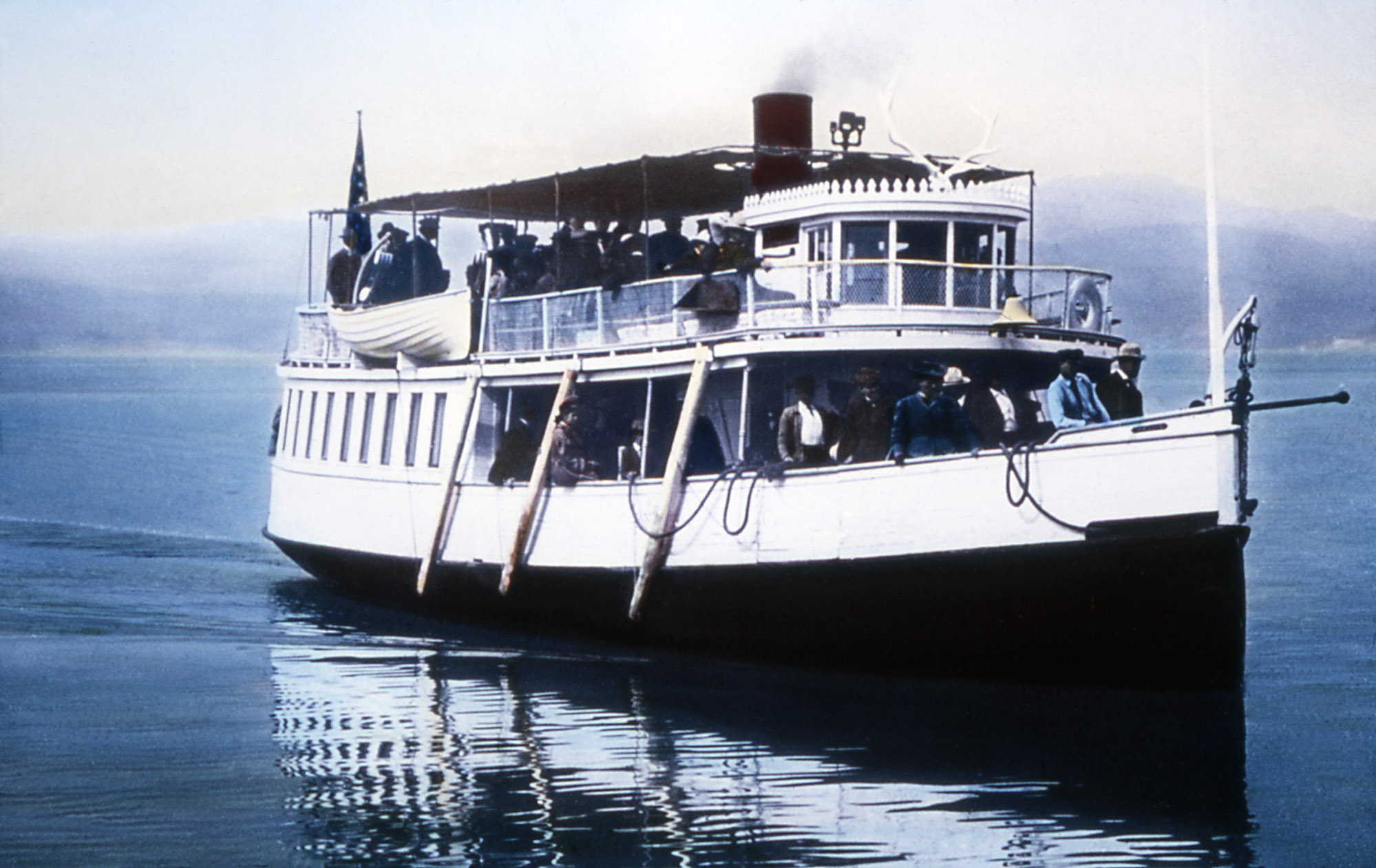
    The Henshalls toured Yellowstone “The Wylie Way.” That is, with Wylie Permanent Camping Company, which offered tourists a comprehensive package that included transportation, food and lodging in tents tour that were put up in the Spring and left up for the season. The tour included a steamboat cruise across Yellowstone Lake. Here’s Hester’s description of that.

    ∞§∞

    The shrill whistle of the little steamer called us aboard. She is a steel boat, with her name “Zillah” on a white flag floating at her masthead. We were soon steaming out into the lake. The Captain’s name was Waters, a good name for a steamboat captain. Miss Lillian Ehlert was soon at the wheel steering under the care of the pilot.

    Doctor Henshall and Doctor Donaldson and myself sat in the bow of the boat. The scene was beautiful and was all very fascinating to me. Upon the mountains was a vague blue efflorescent haze like the bloom upon a grape, that made the tint deeper, richer, softer, whether it were the deep blue of the farthest reach of vision, or the somber gray of the nearer mountains, or the densely verdant slopes of the foot-hills that dipped down into the dark shadowy waters of the lake.

    Along the western shore was the Absaroka Range of mountains; and in one place was seen the profile of a human face, formed by two peaks of the lofty range. The face is upturned toward the sky and is known as the Giant’s Face. It was several minutes before I recognized the resemblance, and then I wondered at my stupidity.

    We stopped at Dot Island, a tiny green isle in the middle of the lake, on which are a number of animals, buffalo, elk, deer and antelope. They were fed with hay from the steamboat while we were there. The Captain warned us not to go near, as the big bull buffalo was very fierce. He finally did make a terrific rush and butted the fence until I feared the structure would go down before his fierce onslaughts. He was the last animal fed, and the Doctor said that was the cause of his demonstration; that it was all for effect, and to get us aboard again as the Captain wanted to get the passengers to land at his curio store in season. The man brought another bale of hay and fed the big buffalo, who suddenly became very docile, and we left him quietly munching his hay. I guess the doctor was right.

    Soon we were again steaming over the lake. We three again took our places at the bow, and thought it queer that others did not want them. We were told that the “Zillah” was brought from Lake Minnetonka, Minnesota, in sections and put together at the lake, which seemed wonderful to me, as she had a steel hull. Too soon our journey was at an end.

    ∞§∞

    —From Hester Ferguson Henshall’s Journal, A Trip Through Yellowstone National Park [1903]. Montana Historical Society Archives.

    — Photo, Yellowstone Digital Slide File.

    — Read more about Hester Henshall’s trip in the Summer 2010 Issue of the Pioneer Museum Quarterly.

    — For more stories about fishing in Yellowstone Park, click on “fishing” under the “Categories” button on the right.

  • A Tale: Maud Gets Her Revenge — 1913

    In 1913 Louise Elliott publish a book about a young schoolteacher from Lander, Wyoming, who took a job as a camp assistant for a mobile camp tour. In her preface, Elliott confesses that she used several techniques that critics now might label “new journalism.” She created composite characters by combining traits of her camp companions, and made up a “little romance” for her protagonist.

    We can forgive Elliott because she provided an explicit disclaimer—and an entertaining portrait of  travel to Yellowstone Park in the early twentieth century. While her tales must be taken with the proverbial grain of salt, we probably can take her word that “the camp episodes and jokes, the weather and scenery, and the statistics” were all accurate descriptions copied from her diary.

    Elliott gives interesting details of her trip—a cook who makes biscuits “charred on the outside and doughy in the middle,”—a guide who carries “the scratchiest flannels” to be worn by anyone who didn’t heed his warning to bring warm clothing—and, snobbish hotel guests who refuse to return the greetings of lowly campers.

    At one point during the story, Elliott says her protagonist, Violet, and her friend, Maud, became irritated with one of their guests—a Boston lady that they called “The Spinster.” Here’s Louise’s story about that.

    ∞§∞

    Maud and I baked enough biscuits for supper and some cup cakes while the Spinster complained of all the discomforts of camp life as compared with her home conveniences. Neither did she forget to mention her lovely twenty-eight dollar and fifty-cent air mattress.

    “That settles it once for all,” whispered Maud. “Never again!”

    Well Maud had her revenge—and not once today has the Spinster boasted of her comfortable pneumatic mattress. I wondered last night why Maud was anxious to retire early as she is usually the last one to bed.

    The great pine fire was lighting our tent, and the Spinster was peacefully enjoying her first snore when I saw our Irish lassie get stealthily out of bed—and crawl over to the hated mattress. She certainly must have made a thorough study of the mechanism—she knew just where to find the valve screw. She gave a few turns—crept back into bed again—and began breathing hard and steady.

    Maud had not let me into her proposed vengeance because she feared I would not countenance it. But I suspected that the air was slowly leaking out of the mattress under the sleeping Bostonian. Soon that lady stopped her regular breathing and sat up in bed. She began fumbling under her and muttered, “Well, I never.” Finally she got up, punching the mattress, muttering something and reached into her bag.

    Pump, pump, pump—I tried so hard to keep from giggling that a snort escaped from my throat. Maud began to talk incoherently and to toss and throw her arms about to cover my tell-tale noises. “No sir, I told you before that I will not dance—no—no—.” Then her voice died away and she snored vociferously while the—pump, pump, pump—continued. At last the wonderful pneumatic was restored to its proper stage of plumpness and the weary Spinster was soon resuming her snores where she left off.

    She was more silent than usual this morning and did not allude in any way to her mattress. But while Maud and I were doing up the dishes, she went into the tent and gave her bed a thorough examination. She became more talkative after she had read the little pamphlet of directions, which had been attached to the mattress. After that she told the party how Maud had discussed her secrets and love affairs in her sleep.

    Maud asked innocently, “What did I talk about?”

    ∞§∞

    — From L. Louise Elliott, Six Weeks on Horseback Through Yellowstone Park, 1913.

    — Pioneer Museum of Bozeman Photo.

  • A Tale: Captured by Indians by Emma Cowan—1877

    Cowan Party
    The Cowans visiting the site of their capture in 1901.

    Emma Cowan and her family visited Yellowstone National Park in 1877—the year the U.S. Army pursued the Nez Perce Indians there. The Nez Perce generally had amicable relations with whites, but in what has become a familiar story, the peace was shattered when gold was discovered on their land. Some Nez Perce acquiesced to government demands that they move to a tiny reservation, but others decided to flee their homeland instead.

    The Army sent soldiers to subdue the defiant Nez Perce, but the Indians defeated them several times. In the most dramatic battle, the Army made a pre-dawn attack on a sleeping Nez Perce camp on the banks the Big Hole River in southwest Montana. The Indians rallied, drove back their attackers, then retreated leaving their equipment, teepees, and at least 89 dead—most of them women and children.

    After the battle, they fled though Yellowstone Park where they captured Emma’s party.  Here’s her account of what happened later.

    ∞§∞

    Every Indian carried a splendid gun, with belts full of cartridges. As the morning sunshine glinted on the polished surface of the gun barrels, a regiment of soldiers could have not looked more formidable. The Indians pretended all the while to be our very good friends, saying that if they should let us go, bad Indians, as they termed them, would kill us.

    Suddenly, without warning, shots rang out. Two Indians came dashing down the trail in front of us. My husband was getting off his horse. I wondered what the reason. I soon knew, for he fell as soon as he reached the ground—fell heading downhill. Shots followed and Indian yells, and all was confusion. In less time than it takes to tell it, I was off my horse and by my husband’s side….

    I heard my sister’s screams and called to her. She came and crouched by me, as I knelt by his side. I saw he was wounded in the leg above the knee, and by the way the blood spurted out I feared an artery had been severed. He asked for water. I dared not leave him to get it.

    I think we both glanced up the hill at the same moment, for he said, “Keep quiet. It won’t last long.” That thought had flashed through my mind also. Every gun in the whole party of Indians was leveled at us three. I shall never forget the picture, which left an impression that years cannot efface. The holes in those gun barrels looked as big as saucers.

    I gave it only a glance, for my attention was drawn to something near at hand. A pressure on my shoulder was drawing me away from my husband. Looking back over my shoulder, I saw an Indian with an immense navy pistol trying to get a shot at my husband’s head. Wrenching my arm from his grasp, I leaned over my husband, only to be roughly drawn aside. Another Indian stepped up, a pistol shot rang out, my husband’s head fell back, and a red stream trickled down his face from beneath his hat. The warm sunshine, the smell of blood, the horror of it all, a faint remembrance of seeing rocks thrown at his head, my sister’s screams, a faint sick feeling, and all was blank.

    ∞§∞

    Two days later the Indians released Emma, her sister, Ida, and her brother, Frank. They made their way to Mammoth Hot Springs where they found help. Emma’s husband, George, survived the shooting. He carried the slug that an Army surgeon dug out of his head as a watch fob for the rest of his life.

    While making their way through the Yellowstone wilderness, the Nez Perce discovered they were not welcome with their old friends, the Crow, who had made accommodations with the whites. The Nez Perce decided to head north to join Sitting Bull and his Sioux in Canada. In October the starving and exhausted remnants of the band surrendered to the Army just 40 miles from the Canadian border.

    ∞§∞

    You can read Emma’s complete story in my book, Adventures In Yellowstone.

    — You might also be interested in:

    — Photo, Pioneer Museum of Bozeman.

  • An Event & A Tale: Inside Old Faithful Inn — 1912

    Old Faithful Inn Lobby
    Old Faithful Inn Lobby

    On Friday and Saturday, I’ll be signing copies of my book, Adventures in Yellowstone, in the lobby of the world famous Old Faithful Inn.  When it was completed in 1903-04, the inn ranked as one of the finest hotels in the world. In 1912, a travel writer offered this description of park accomodations.

    ∞§∞

    The comfort and convenience of the hotels have been so carefully looked after that even the experienced traveler will be surprised at the excellence of the services.  These remote inns will compare very favorably with the best resort hotels of the East, and despite the disadvantages they suffer by bringing supplies so far by wagon, the bill-of-fare is excellent in quality and variety.  Almost every convenience is supplied and the more modern hotels have numerous rooms with bath in connection.  Everything is quite informal and comfortable.

    The Old Faithful Inn is quite as unique as the wilderness in which it stands.   Its design and construction are peculiarly appropriate to it location in the heart of the mountains and forests of the Park, from which it’s materials are drawn.

    Yet with all this rusticity, comfort, convenience and even elegance are everywhere. The polished hardwood floors are strewn with oriental rugs and the furniture is of the Mission pattern is dark weathered oak.  The windows are of heavy plate glass in leaded panes and the furnishings of bed and bathrooms are of the best.  Yet the rustic idea is carefully maintained; even in the private rooms the walls are of rough planks or ax-dressed slabs and everything is redolent with the fragrance of the mountain pine.  Verily, this inn is a pleasant place, set down as it is in a weird, enchanted land.

    ∞§∞

    — From Three Wonderlands of the American West by Thomas D. Murphy, 1912.

    — Photo by F. J. Haynes, Yellowstone Digital Slide File.

  • A Tale: Shooting Jake Smith’s Hat by N.P. Langford

    Jake Smith

    One of the members of the famous Washburn Expedition that explored  the uppper Yellowstone in 1870, a jocular man named Jake Smith, was always ready to gamble. Unfortunately, he lost all his money in a card game the night before the trip started. But Jake came up with a way to replenish his stake. N.P. Langford tells the story.

    ∞§∞

    Descending the range to the east, we reached Trail creek, a tributary of the Yellowstone about 3 o’clock in the afternoon, where we are now camped for the night. We are now fairly launched upon our expedition without the possibility of obtaining outside assistance in case we need it. Our safety will depend upon our vigilance. We are all well armed with long range repeating rifles and needle guns, though there are but few of our party who are experts at off-hand shooting with a revolver.

    In the course of our discussion Jake Smith expressed his doubt whether any member of our party is sufficiently skilled in the use of the revolver to hit an Indian at even a close range. He offered to put the matter to a test by setting up his hat at a distance of twenty yards for the boys to shoot at with their revolvers, without a rest, at twenty-five cents a shot.

    Several members of our party blazed away with indifferent success—with the result that Jake was adding to his exchequer without damage to his hat. I could not resist the inclination to quietly drop out of sight behind a clump of bushes. From my place of concealment I sent from my breech-loading Ballard repeating rifle four bullets in rapid succession, through the hat—badly riddling it.

    Jake inquired, “Whose revolver is it that makes that loud report?” He did not discover the true state of the case, but removed the target with the ready acknowledgment that there were members of our party whose aim with a revolver was more accurate than he had thought.

    ∞§∞

    — Excerpt Langford’s book, The Discovery of Yellowstone Park. in my book, Adventures in Yellowstone.

    — Photo, Yellowstone Digital Slide.

    — You can read a condensed version of Langford’s The Discovery of Yellowstone Park in my book, Adventures in Yellowstone.

    — To see more stories by this author, click on “Langford” under the “Categories” button to the left.

    — For more stories about the Washburn Expedition, click on “Washburn” under the “Categories” button to the left.
  • A Tale: Yellowstone’s First Car — 1902

    Henry G. Merry and his Winton

    Cars weren’t officially admitted to Yellowstone Park until 1915, but that doesn’t mean they weren’t there before that. One story says that Henry G. Merry drove his Winton to Mammoth Hot Springs in 1902 to a dance at the National Hotel. He was caught—the story goes—but was allowed to drive out under cover of darkness. Here’s a more colorful version told by his son.

    ∞§∞

    When the Winton car arrived it was the conversation piece of the time. The word reached the commandant at the fort, along with the information that the noise it made was terrifying to horses. Very wisely he issued an order prohibiting this machine and others like if from the confines of the Yellowstone Park. My father knew of this order, but thought he would pilot the car to the fort and talk things over with commandant. In the interim, two troopers had been stationed at the entrance to prevent any such violation of the commandant’s order.

    As related in father’s diary, on June 2nd, 1902, he and  my Mother took off. When the north entrance was reached, he opened up the speed to about 25 mph, and the troopers’ mounts acted up so that they could not block the passage. The machine was well on its way before they got their horses quieted down and started after the car—which was rapidly widening the distance between them.

    All went well as long as the road was level but that was not for long. As the grade became steeper—the speed was reduced—and soon the car came to a stop. The troopers arrived at a hard gallop.

    Fortunately, each one had a lariat and between the two horses they managed to pull the car to the commandant’s office and gave him a report of how things happened. He was quite pleasant and took time to explain to father, who already knew, that the noise of his conveyance posed a threat to the lives of all tourists who were visiting the park in horse-drawn vehicles. Then he became quite stern and reminded him that he was still under arrest and would have to pay a penalty to be released. When my father asked what the penalty would be, the officer very seriously replied, “You will have to take me for a ride in this contraption.” He got his ride and then assigned a detail to escort father to the gate.

    ∞§∞

    —Photo and text from The Pioneer Museum, Bozeman, Montana.

    — You might also enjoy “Touring Yellowstone Legally by Car — 1916.”

  • Treed by a Lion — Truman Everts, 1870

    Probably the best known story of early travel to Yellowstone Park is Truman Everts’ account of  being lost and alone there for 37 days. During the famous Washburn Expedition of 1870, Everts became separated from his companions as they made their way through heavy timber east of Lake Yellowstone. Everts was extremely nearsighted so he got off his horse to look for tracks. While he was scrutinizing a path, the horse ran away leaving him with little but the clothing on his back.

    Everts was a clever and tenacious man. He built a nest between two hot springs to survive a snow storm, made fire with the lens from an opera glass, and lived mostly on a diet of thistle roots.

    He told about his adventures in a magazine article that helped win support for creation of Yellowstone Park. Here’s one of them.

    ∞§∞

    I stretched myself under a tree, and fell asleep. How long I slept I know not; but suddenly I was roused by a loud, shrill scream, like that of a human being in distress. There was no mistaking that fearful voice. It was the screech of a mountain lion; so alarmingly near as to cause every nerve to thrill with terror.

    The work of the moment was to yell in return—seize with convulsive grasp the limbs of the friendly tree—and swing myself into it. Scrambling hurriedly from limb to limb, I was soon as near the top as safety would permit.

    The savage beast was snuffing and growling below—on the very spot I had just abandoned. I answered every growl with a responsive scream. Terrified at the delay and pawing of the beast, I increased my voice to its utmost volume. I then broke branches from the limbs and madly hurled them at the spot from whence the howlings preceded.

    I failed to alarm the animal that now began to make the circuit of the tree—as if to select a spot for springing into it. With my strength increased by terror, I shook the slender trunk until every limb rustled. All in vain. The terrible creature pursued his walk around the tree—lashing the ground with his tail, and prolonging his howling almost to a roar.

    It was too dark to see, but the movements of the lion kept me apprised of its position. Whenever I heard it on one side of the tree, I speedily changed to the opposite—an exercise that I could only have performed under the impulse of terror. I would alternately sweat and thrill with horror at the thought of being torn to pieces—and devoured by this formidable monster. All my attempts to frighten it seemed unavailing.

    Disheartened at its persistency, and expecting at every moment that it would take the deadly leap. I tried to collect my thoughts, and prepare for the fatal encounter. Just at this moment it occurred to me that I would try silence.  Clasping the trunk of the tree with both arms, I sat perfectly still.

    The lion ranged around, occasionally snuffing and pausing—all the while filling the forest with the echo of his howling. Suddenly it imitated my example and fell silent. This was more terrible than the clatter and crash of his movements through the brushwood. Now I did not know from what direction to expect this attack. Moments passed with me like hours. After a lapse of time, which I cannot estimate, the beast gave a spring into the thicket and ran screaming into the forest. My deliverance was effected.

    Had strength permitted, I should have retained my perch till daylight. But with the consciousness of escape from the jaws of the ferocious brute came a sense of overpowering weakness. That made my descent from the tree both difficult and dangerous. Incredible as it may seem, I lay down in my old bed, and was soon lost in a slumber so profound that I did not awake until after daylight.

    ∞§∞

    — Excerpt and illustration from Truman Everts’ “Thirty-Seven Days of Peril,”  Scribner’s Monthly, 3(1):1-17  (November 1871).

    — For more stories about the Washburn Expedition, click on “Washburn” under the “Categories” button to the left.

    — For more stories about the Washburn Expedition, click on “Washburn” under the “Categories” button to the left.