Category: Yellowstone Stories

  • A Tale: An Englishman Describes the Fourth of July at Mammoth Springs — Rudyard Kipling, 1889

    cottage hotel mammoth 1885 YDSF
    Cottage Hotel built at Mammoth Hot Springs in 1885.

    The British Empire was at its pinnacle when the famous author Rudyard Kipling visited Yellowstone Park in 1889. The 24-year-old Kipling often let his smug superiority show when he wrote about the people and places he saw while touring America that year. Here’s his description of a Fourth of July celebration at Mammoth Hot Springs.

    ∞§∞

    When we struck the Mammoth Hot Spring Hotel, a signboard informed us that the altitude was six thousand two hundred feet. The Park is just a howling wilderness of three thousand square miles, full of all imaginable freaks of a fiery nature. An hotel company, assisted by the Secretary of State for the Interior, appears to control it; there are hotels at all the points of interest, guide-books, stalls for the sale of minerals, and so forth, after the model of Swiss summer places.

    The tourists—may their master die an evil death at the hand of a mad locomotive!—poured into that place with a joyful whoop, and, scarce washing the dust from themselves, began to celebrate the Fourth of July. They called it “patriotic exercises,” elected a clergyman of their own faith as president, and, sitting on the landing of the first floor, began to make speeches and read the Declaration of Independence. The clergyman rose up and told them they were the greatest, freest, sublimest, most chivalrous, and richest people on the face of the earth, and they all said Amen. Another clergyman asserted in the words of the Declaration that all men were created equal, and equally entitled to Life, Liberty and the pursuit of Happiness.

    I should like to know whether the wild and woolly West recognizes this first right as freely as the grantors intended. The clergyman then bade the world note that the tourists included representatives of seven of the New England States; whereat I felt deeply sorry for the New England States in their latter days. He opined that this running to and fro upon the earth, under the auspices of the excellent Raiment, would draw America more closely together, especially when the Westerners remembered the perils that they of the East had surmounted by rail and river. At duly appointed intervals the congregation sang ‘My country, ’tis of thee,’ to the tune of’ God Save the Queen’ (here they did not stand up) and the’ Star-Spangled Banner’ (here they did), winding up the exercise with some doggerel of their own composition to the tune of ‘John Brown’s Body,’ movingly setting forth the perils before alluded to. They then adjourned to the verandahs and watched firecrackers of the feeblest, exploding one by one, for several hours.

    What amazed me was the calm with which these folks gathered together and commenced to belaud their noble selves, their country, and their ‘institootions’ and everything else that was theirs. The language was, to these bewildered ears, wild advertisement, gas, bunkum, blow, anything you please beyond the bounds of common sense. An archangel, selling town-lots on the Glassy Sea, would have blushed to the tips of his wings to describe his property in similar terms. Then they gathered round the pastor and told him his little sermon was ‘perfectly glorious,’ really grand, sublime, and so forth, and he bridled ecclesiastically. At the end a perfectly unknown man attacked me and asked me what I thought of American patriotism. I said there was nothing like it in the Old Country. By the way, always tell an American this. It soothes him.

    Then said he: ‘Are you going to get out your letters—your letters of naturalization?’

    ‘Why?’ I asked.

    ‘I presoom you do business in this country, and make money out of it—and it seems to me that it would be your dooty.’

    ‘Sir,’ said I sweetly, ‘there is a forgotten little island across the seas called England. It is not much bigger than the Yellowstone Park. In that island a man of your country could work, marry, make his fortune or twenty fortunes, and die. Throughout his career not one soul would ask him whether he were a British subject or a child of the Devil. Do you understand?’

    I think he did, because he said something about ‘Britishers’ which wasn’t complimentary.

    ∞§∞

    — Pages 70-72 in Rudyard Kipling, From Sea to Sea, Garden City, New York: Doubleday, Page and Co., 1914.

    — Photo from the Yellowstone Digital Slide File.

    — You also might enjoy:

  • A Tale: “Mr. Dooley, Her Story.” The Tragic Tale of a Captive Grizzly — Dan Beard, 1907

    Today most people know it’s not wise to capture young animals and try to tame them. Such “adoptions” may seem like acts of kindness, but they usually end in tragedy. Sometimes when people discover that baby animals are hard to care for, they return them to place where they found them, but the youngsters fail to re-connect with the mothers and die. 

    Mr. Dooley
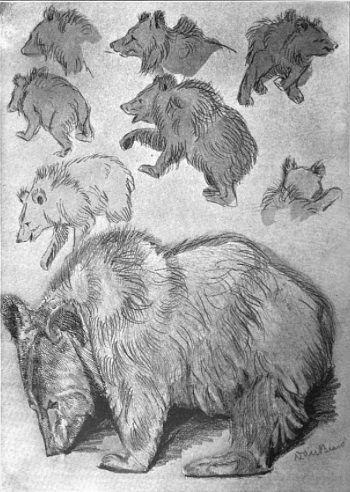
    Sketches of “Mr. Dooley” by Dan Beard.

    Even if the animals seem tame when they are young, when they grow up they can become dangerous. Often they run away, but because they’ve lost their fear of humans, they’re vulnerable to hunters.

    A century ago, people were far less sensitive to these problems as is demonstrated by this story published by Dan Beard in 1907. Beard was a famous author and illustrator, who founded the Sons of Daniel Boone in 1905 and merged the group with the Boy Scouts of America in 1910.

    Beard loved the animals he wrote about and illustrated. Here’s his story about the tragic life of Mr. Dooley, a grizzly captured in Yellowstone Park

    ∞§∞

    A few years ago, Mr. Walker, of the Yellowstone Park, while on horseback, ran down a silvertip cub, and when I sketched it the cub was fastened to a tree.

    The cub was named Mr. Dooley, but there was some mistake in this, as the young monster was not a mister, as it appears “he” was a she.

    I placed my sketching stool just out of reach of the cub, and, while I worked with my pencil, Mr. Dooley spent her time scraping the dirt with her paws, making long canals in the loose earth as she backed away, but all the time keeping her wicked little pig eyes fastened on me.

    Every once in a while she would make a sudden savage rush at me and end it with a half-strangled, gurgling growl.

    When the season was over, the commander of the post stated that he intended to send Mr. Dooley to the Washington Zoo. This grieved Mr. Walker, until the late Major Bach innocently asked if Dooley never escaped, and the next morning it was discovered that Dooley had escaped.

    In the following spring, when Mrs. Walker arrived with her husband at the canyon, to open the hotel, Dooley was waiting to greet them on the broad veranda.

    Time rolled on, and Dooley became a favorite visitor at the camps, and it was not an unusual sight to see a great, hulking, silver-tip bear wrestling with the guides and enjoying the fun as much as the astonished spectators.

    Dooley, although a very, very bad little cub, broadened both in mind and body as she grew older, and adopted the Golden Rule as her moral code; but this was a sad mistake on the bear’s part. There perhaps never was a more gentle, better-hearted bear than Mr. Dooley, the great grizzly of Yellowstone Park. Far better would it have been for the lady bear with a gentleman’s name if she had adhered closely to the traditions of her race and developed into a surly, gruff, dangerous old girl, in place of the gentle, sweet-tempered creature she really made of herself. True, she would not have been petted and fed with prunes and sweetmeats, but she would have been much happier than she now is, poor thing!

    The trouble with Mr. Dooley is that she made the mistake of applying the Golden Rule to human beings, and the human beings did not appreciate the generous nature of the bear.

    Human beings are all right when they preach and when they write, but their brothers in fur will do well not to trust to the sincerity of the two-legged creatures’ sentiments.

    Because the gentle grizzly of Yellowstone Park was guileless and unsuspicious, she (Mr. Dooley) was led into captivity, and is now imprisoned in a narrow iron-barred cell in the Washington Zoo.

    And when the readers visit Washington, and see a big grizzly with its tongue lolling out of its mouth, and a far-away look in its eyes, they may know that it is the lady bear, known as Mr. Dooley, of Yellowstone Park, and that the poor girl is dreaming of her free life in the mountains, or her real friends, the guides and cooks of the camps, and Mr. and Mrs. Walker of the Canyon Hotel.

    It is hoped that the visitors will take with them some little green thing—turnips, apples, or any vegetable, which will gladden the heart of the lady bear who trusted man to her sorrow.

    ∞§∞

    — Text and illustration from “Mr. Dooley: Her Story” Pages 269-273 in Daniel Carter Beard, Dan Beard’s Animal Book and Campfire Stories. New York, Moffat, Yard and Company, 1907.

    — For more stories like this, click on “bears” under the Categories button to the left.

  • A Tale: A Circuit Rider Describes the Upper Geyser Basin — Edwin J. Stanley, 1873

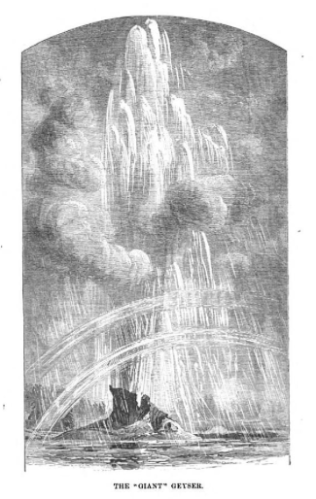
    As a Methodist circuit rider, Edwin J. Stanley traveled extensively throughout Montana in the late 1800s. Following a trip to Yellowstone Park Giant Geyser from Stanleyin 1873, Stanley published a series of letters about his experiences there in what he described as “a leading newspaper of the West.” In 1882, he published a compilation of those letters in his book, Rambles in Wonderland.

    Stanley supplemented his observations with extensive reading so his book provides a comprehensive summary of what people knew about the park then. Here’s a condensed version of his description of the Upper Geyser Basin.

    ∞§∞

    There are hundreds of springs in the basin, all differing more or less in some particular. There are about twenty regularly acting. On a calm, clear morning, at or just before sunrise, when all the springs are sending up their columns of steam of every magnitude, and all boiling and fussing and splashing away, as if trying each to attract the greatest share of attention, and while one or two of the larger geysers are piercing the heavens with their stupendous columns, the basin presents a lively and interesting spectacle.

    The eruptions as witnessed by moonlight are truly sublime, though deprived of much of their glory, as it is difficult to distinguish between water and steam. Some of the party built bonfires and watched the eruptions by firelight, which were very fine, giving the rising volumes the appearance of fiery liquid hurled forth from the crater of a volcano.

    It is not the most quiet and agreeable place for sleeping. One is frequently disturbed during the night by the alarming detonations and subterranean thunder, making an almost constantly rumbling noise as of heavy machinery in motion, the come and go of ponderous freight trains, the hiss and rush of escaping steam, and the loud plash of falling torrents, as the geysers, the ever vigilant sentinels on the outposts of old Pluto’s infernal regions, sound the alarm and spout forth in the darkness. This is more sensibly realized by sleeping on the ground, and, rest assured, the sensations are not always of the most desirable character.

    A Catholic priest was standing near a hot spring, when the crust gave way, and let him into the seething caldron. The accident would doubtless have proved fatal, but that a strong man who was at his side, and happened to be standing on solid ground, seized him by the collar and saved him from a horrible death. Though he escaped without any injury whatever, imagine his surprise at the appearance in an Eastern paper of a vivid account of his untimely death, together with an illustration showing a party of men dragging the lifeless body of a monk “all shaven and shorn,” and attired in priestly robes, from one of the geysers! He still asserts that it is a mistake, notwithstanding the statements of the newspapers to the contrary.

    Whenever railroads come within reach, or even passable wagon and stage roads are completed through the Park, this will become a favorite place of resort for people from every part of the world, though I prefer going in true pioneer style on horseback, with a pack-horse on which to carry provisions and baggage. A wagon-road is now completed from Virginia City up the Madison to the Lower Basin. But don’t go until you can make the grand rounds, for the geysers, in all their glory, are only part of the wonders of the National Park.

    While here we met with persons from various portions of the Territory, among them a number of friends; and quite a sociable time we had the two evenings spent in the basin. After the sight-seeing of the day was over, we gathered around our brilliant camp-fire, and passed the time relating incidents and anecdotes of a pleasant character; while Miss Clark, a young lady from Chicago, with vocal gifts that all admired, charmed us with some excellent music, presenting quite a contrast as the charming melodies floated out upon the nightwind, and mingled with the hissing reports of a hundred noisy, spouting springs, the wild, weird appearance of everything adding greatly to the novelty of the surroundings.

    ∞§∞

     — Exerpt condensed form Chapter 13 (pages 118-123) in Edwin J. Stanley, Rambles in Wonderland or Up the Yellowstone. New York: Appleton and Company, 1883.

    — Illustration from the book.

    — You might also enjoy:

    For more descriptions click “Geysers” under the Categories button above.

  • A Tale: A General Visits the Park During Indian Troubles — William Tecumseh. Sherman, 1877

    During the summer of 1877, William Tecumseh Sherman, who was then commanding general of the U.S. Army, decided to tour the forts along the proposed route of the Northern Pacific Railroad. That was just one year after a coalition of Sioux and Cheyenne decimated the Seventh Cavalary under George Armstrong Custer at the Battle of the Little Big Horn. In fact, the army was still patrolling the northern plains after the Sioux Chief Sitting Bull fled toi Canada. In addition, several bands of Nez Perce refused to move to a reservation in Washington and were headed to Montana.

    WAR AND CONFLICT BOOK ERA:  CIVIL WAR/LEADERS
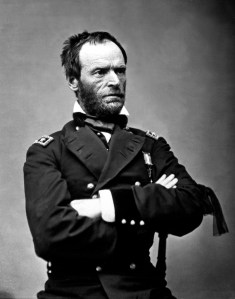
    General William Tecumseh Sherman

    Like many military officers, Sherman was fascinated with Yellowstone Park and had read several army and civilian reports about it. He knew about the Nez Perce troubles, but he decided to take a side trip to see the wonders of Yellowstone Park anyway. He was convinced that the Indians would not enter the park because they feared the geothermal features so he traveled with a small party of about a dozen men. After a 15-day tour, Sherman and his companions returned to Fort Ellis, near Bozeman, Montana, just a few days before the Nez Perce entered the park.

    Here’s an abridged version of Sherman’s report of his trip to Yellowstone Park.

    ∞§∞

    I suppose you want to hear something of the National Park, or “Wonderland,” as it is called here. As you know, I came from the Big Horn here with two light spring-wagons and one light wagon, with six saddle horses. Here we organized the party: Colonels Poe, Bacon, my son and self, three drivers, one packer, four soldiers, and five pack mules; making four officers, four soldiers, one citizen, and twenty-three animals. The packer was also guide.

    Our rate of travel was about 20 miles a day or less. Our first day’s travel took us southeast over the mountain range to the valley of the Yellowstone; the next two days up the valley of the Yellowstone to the mouth of Gardner’s River. Thus far we took our carriages, and along the valley found scattered ranchos, at a few of which were fields of potatoes, wheat, and oats, with cattle and horses.

    At the mouth of Gardner’s River begins the park, and up to that point the road is comparatively easy and good, but here begins the real labor; nothing but a narrow trail, with mountains and ravines so sharp and steep that every prudent horseman will lead instead of ride his horse, and the actual labor is hard.

    The next day is consumed in slowly toiling up Mount Washburn, the last thousand feet of ascent on foot. This is the summit so graphically described by Lord Dunraven in his most excellent book recently published under the title of the “Great Divide.” The view is simply sublime, worth the labor of reaching it once, but not twice. I do not propose to try it again.

    Descending Mount Washburn, by a trail through woods, one emerges into the meadows or springs out of which Cascade Creek takes its water; and following it to near its mouth you camp, and walk to the Great Falls and the head of the Yellowstone Canyon. In grandeur, majesty, coloring, &c., these probably equal any on earth. The painting by Moran in the Capitol is good, but painting and words are unequal to the subject. They must be seen to be appreciated and felt.

    The next day, eight miles up from the falls, we came to Sulphur Mountain, a bare, naked, repulsive hill, but of large extent, at the base of which were hot bubbling springs, with all the ground crisp with sulphur; and six miles farther up, or south, close to the Yellowstone, we reached and camped at Mud Springs.

    From the Mud Springs the trail leads due west, crosses the mountain range to the Lower Geyser Basin. It would require a volume to describe these geysers in detail. It must suffice now for me to say that the Lower Geyser Basin presents a series of hot springs or basins of water coming up from below, hot enough to scald your hand, boil a ham, egg, or anything else; clear as crystal, with basins of every conceivable shape, from the size of a quill to actual lakes a hundred. Yards across. In walking among and around them, one feels that in a moment he may break through and be lost in a species of hell.

    Six miles higher up the West Madison is the Upper Geyser Basin—the “spouting geysers,” the real object and aim of our visit. To describe these in detail would surpass my ability, or the compass of a letter. They have been described by Lieutenant Doane, Hayden, Strong, Lord Dunraven, and many others. The map by Major Ludlow, of the Engineers, locates the several geysers accurately. We reached the Upper Geyser Basin at twelve noon, one day, and remained there till 4 p.m. of the next. During that time we saw the ” Old Faithful” perform at intervals varying from 62 minutes to 80 minutes.

    Each eruption was similar, preceded by about live minutes of sputtering, and then would arise a column of hot water, steaming and smoking, to the height of 125 or 130 feet, the steam going a hundred or more feet higher, according to the state of the wind. It was difficult to say where the water ended and steam began; and this must be the reason why different observers have reported different results. The whole performance lasts about five minutes, when the column of water gradually sinks, and the spring resumes its normal state of rest.

    This is but one of some twenty of the active geysers of this basin. For the time we remained we were lucky, for we saw the Beehive twice in eruption, the Riverside and Fan each once. The Castle and Grotto were repeatedly in agitation, though their jets did not rise more than 20 feet. We did not see the “Giant” or the ” Grand ” in eruption, but they seemed busy enough in bubbling and boiling.

    In our return trip we again visited points of most interest and some new ones. The trip is a hard one and cannot be softened. The United States has reserved this park, but has spent not a dollar in its care or development. The paths are mere Indian trails, in some places as bad as bad can be. There is little game in the park now; we saw two bear, two elk, and about a dozen deer and antelope, but killed none. A few sage-chickens and abundance of fish completed all we got to supplement our bacon.

    We saw no signs of Indians, and felt at no moment more sense of danger than we do here. Some four or five years ago parties swarmed to the park from curiosity, but now the travel is very slack. Two small parties of citizens were in the park with us, and on our return we met several others going in, but all were small.

    ∞§∞

    — Abridged from Reports of the Inspection Made in the Summer of 1877 by Generals P.H. Sheridan and W.T. Sherman. Washington: U.S. Government Printing Office, 1878. (Pages 34-37)

    — Photo from Wikipedia Commons.

    — For related stories click “Nez Perce” under the Categories button.

  • A Tale: Early Travelers Confuse Geyser Basins — Rossiter Raymond, 1871

    In the summer of 1871, U.S. Commissioner of Mines Rossiter Raymond was in Virginia City, Montana, when he decided to organize a group to tour the area that would become Yellowstone National Park the next year. Of course, nobody had published any guidebooks by then, so Raymond and his companions decided to take copies of N.P. Langford’s descriptions of wonderland that Scribner’s Monthly published in its May and June 1871 issues.

    1116-7
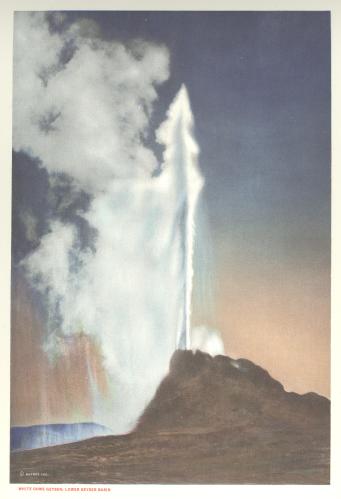
    White Dome Geyser, Lower Geyser Basin

    There were no signs in the roadless Yellowstone wilderness, so it was easy for travelers to become confused about the things they were seeing. When Augustus F. Thrasher, a photographer on the expedition, compared the Lower Geyser Basin to Langford’s descriptions of the Upper Basin, he became convinced that Langford’s description of geysers were exaggerations and decided to use his camera to prove it. 

    Raymond said, “Thrasher invests the profession of photography with all the romance and adventure . . ..  No perilous precipice daunts him, if it’s just the place for his camera.”  Given Thrasher’s passion, he must have taken some marvelous photographs, but, unfortunately, none of them are known to have survived.

     Here’s Raymond’s description of his expedition’s confusion over geysers.

    ∞§∞

    We approached the geyser basin with our expectation at the boiling-point, and ready to discharge; for we had among the baggage two copies of Scribner’s, containing Mr. Langford’s account of the wonders of the region, as seen by the Washburn exploring party. His article occupied two numbers, and we had two copies of each: so four persons could be accommodated with intellectual sustenance at one time. For the other two, it was, as one of them mournfully observed, “Testaments, or nothin’.”

    Mr. Langford’s articles were vivid and fascinating; and we found them, in the end, highly accurate. At the outset, however, we were inclined to believe them somewhat exaggerated; and Thrasher was divided between his desire to catch an instantaneous view of a spouting column two hundred and fifty-six feet high, and his ambition to prove, by the relentless demonstration of photography, that these vents of steam and hot water were not half as big as they had been cracked up to be.”

    We were not at first aware that there are two geyser basins on the Fire-Hole River; the upper one, ten miles above the other being the smaller, but containing the largest geysers. It was this one, which Washburn’s party, coming from Yellowstone Lake, first stumbled upon, and, after viewing its splendid display, naturally passed by the inferior basin with little notice. But we, emerging from the forest, and finding ourselves on the border of a great gray plain, with huge mounds in the distance, from which arose perpetually clouds of steam, supposed we had reached the great sensation, and prepared to be enthusiastic or cynical as circumstances might dictate.

    Rositer Raymond Wikipedia
    Rossister Raymond

    We rode for a mile across the barren plain picking our way to avoid the soft places. This is quite necessary in the neighborhood of the hot springs. Where they have deposited a white, hard crust, it is generally strong enough to bear horse and man; but, over large areas, the ground is like what we call, in the East, “spring-holes;” and the treacherous surface permits uncomfortable slumping through, haply into scalding water. It is not very deep; but a small depth under such circumstances is enough to make a fellow “suffer some,” like the lobster in the lobster pot. ”

    The plain contains a few scattered springs; and along the river, its western border, there are many in active ebullition. The principal group of geysers is at the upper or southern end extending for some distance up the valley of a small tributary from the east. With cautious daring, we rode up the side of the great white mound, winding among the numerous fissures, craters, and reservoirs that on every side of us hissed, gurgled, or quietly vapored, with now and then a slight explosion, and a spurt to the height of a dozen feet or more. Sawtell’s dog nosed suspiciously around several of the basins, until, finding that seemed not too hot for a bath, be plunged in, and emerged in a great hurry, with a yelp of disprobation.

    A couple of dead pines stood, lonesome enough, in the side of the hill, “whence all the rest had fled.” They had died at their posts, and to the said posts we made fast our horses, and ascended a few rods farther, until we stood by the borders of the summit springs. There were two or three large vents at the bottom of deep reservoirs or intricate caverns. It gives one an unpleasant thrill, at first, to bear the tumult of the imprisoned forces, and to feel their throes and struggles shaking the ground beneath one’s feet; but this soon passes away, and the philosopher is enabled to stand with equanimity on the rim of the boiling flood, or even to poke his inquisitive nose into some dark fissure, out of which, perhaps in a few moments more a mass of uproarious liquid and vapor will burst forth.

    We lingered much longer in this basin than my brief notice of it indicates; for, you see, we thought we had found the geysers; and oh the hours that we spent “identifying” the individual springs that Langford had described! Since, the largest eruptions we observed did not exceed forty-five feet in height, we set down his account as hugely overdrawn, and were deeply disgusted at the depravity of travelers. But Sawtell remarked, in his quiet way, that, “if it were not for that there article in that there magazine, these yer springs would be considered a big thing, after all, and perhaps it was just as well to let the magazine go to thunder, and enjoy the scenery.”

    This sensible advice we followed with much profit and pleasure; and we are all now ready to admit that our happening upon the wrong lot of geysers first was a most fortunate occurrence, since we should otherwise have been tempted to pass them by as insignificant. The truth is that in some of the elements of beauty and interest the lower basin is superior to its more thrilling rival. It is broader, and more easily surveyed as a whole; and its springs are more numerous though not so powerful. Nothing can be lovelier than the sight at sunrise, of the white steam-columns tinged with rosy morning ascending against the background of the dark pinewoods and the clear sky above. The variety in form and character of these springs is quite remarkable.

    ∞§∞

    — Excerpt from Rossiter Raymond, “Wonders of the Yellowstone.” Pages 153-207 in Camp and Cabin, New York: Fords, Hubbard & Howard, 1880.

    — Geyser postcard, Pioneer Museum of Bozeman; Raymond photo, Wikipedia Commons.

    — You might also enjoy Calvin Clawson’s tale about “First Blood” on the Raymond Expedition.

    — Find out more about Yellowstone’s first tourist guide, Gilman Sawtell.

    — For tales by N.P. Langford, click “Langford” under the Categories button above.

  • A Tale: Trappers Encounter Peaceful Indians on the Yellowstone Plateau — Osborne Russell, 1834

    When I was a boy my father told me that Indians never went into the Yellowstone Park area because they were afraid of the geothermal features. But that’s not true. Archeological evidence shows that Indians traveled through the area and hunted there for at least 11,000 years. The erroneous assertion appears to have been started by officials to assure early tourists they could travel safely to the park.

    Alfred_Jacob_Miller_-_Ma-wo-ma_-_Walters_37194035
    Ma-wo-ma, a 19th-century Snake leader

    At least one band of Shoshone Indians, the Sheep Eaters, were permanent residents of the area. The mountain man Osborne Russell told about meeting a group of them in 1834 in his famous Journal of a Trapper. (He referred to them by the more generic term “Snake Indians,” which was what early travellers called several tribes that lived around the Snake River.)

    Russell found the Sheep Eaters (so-called because bighorn sheep made up a large portion of their diet) when he traveled up the Snake River to the Yellowstone Plateau in 1834. Here’s his description.

    ∞§∞

    We crossed the mountain in a westerly direction through the thick pines and fallen timber, about twelve miles, and , encamped in a small prairie about a mile in circumference. Through this valley ran a small stream in a northerly direction, which all agreed in believing to be a branch of the Yellowstone.

    We descended the stream about fifteen miles through the dense forest and at length came to a beautiful valley about eight miles long and three or four wide, surrounded by dark and lofty mountains. The stream, after running through the center in a northwesterly direction, rushed down a tremendous canyon of basaltic rock apparently just wide enough to admit its waters. The banks of the stream in the valley were low and skirted in many places with beautiful cottonwood groves.

    Here we found a few Snake Indians comprising six men, seven women and eight or ten children, who were the only inhabitants of the lonely and secluded spot. They were all neatly clothed in dressed deer and sheep skins of the best quality and seemed to be perfectly contented and happy.

    They were rather surprised at our approach and retreated to the heights, where they might have a view of us without apprehending any danger, but having persuaded them of our pacific intentions we succeeded in getting them to encamp with us. Their personal property consisted of one old butcher knife nearly worn to the back, two old, shattered fusees which had long since become useless for want of ammunition, a small stone pot and about thirty dogs on which they carried their skins, clothing, provisions, etc., on their hunting excursions.

    They were well armed with bows and arrows pointed with obsidian. The bows were beautifully wrought from sheep, buffalo and elk horns, secured with deer and elk sinews, and ornamented with porcupine quills, and generally about three feet long. We obtained a large number of deer, elk and sheep skins from them of the finest quality, and three large, neatly dressed panther skins, in return for awls and axes, kettles, tobacco, ammunition, etc.

    They would throw the skins at our feet and say, “Give us whatever you please for them and we are satisfied; we can get plenty of skins but we do not often see the Tibuboes” (or “People of the Sun”). They said there had been a great many beavers on the branches of this stream, but they had killed nearly all of them, and, being ignorant of the value of fur had singed it off with fire in order to drip the meat more conveniently. They had seen some whites some years previous who had passed through the valley and left a horse behind, but he had died during the first winter.

    They are never at a loss for fire, which they produce by the friction of two pieces of wood which are rubbed together with a quick and steady motion.

    One of them drew a map of the country around us on a white elk skin with a piece of charcoal, after which he explained the direction of the different passes, streams, etc. From these we discovered that it was about one day’s travel in a southwesterly direction to the outlet or northern extremity of the Yellowstone Lake, but the route, from his description being difficult, and beaver comparatively scarce, our leader gave up the idea of going to it this season, as our horses were much jaded and their feet badly worn.

    Our geographer also told us that this stream united with the Yellowstone after leaving this valley half a day’s travel in a westerly direction. The river then ran a long distance through a tremendous cut in the mountain in the same direction and emerged into a large plain, the extent of which was beyond his geographical knowledge or conception.

    ∞§∞

    —   Excerpt from “In the Yellowstone Country—A Garden of Eden Inhabited by a Small Party of Snake Indians.” Pages 31-34 in Osborne Russell and Lem A York, Journal of a Trapper 1834-1843. Boise, Idaho: Syms-York Co. 1921.

    — Painting by Alfred Jacob Miller, Wikipedia Commons.

    — You might enjoy other tales by Osborne Russell.  To find them just insert his name in the Search box above.

  • A Tale: Tall Tales of Yellowstone Park — Reau Campbell, 1909

    Fanciful descriptions of places and events in Yellowstone Park apparently began in early in the 1800s when mountain men spun tall tales around their campfires to amuse each other. Bus drivers continue the tradition today as they drive their charges between sights. The tradition probably peaked at the dawn of the the 20th Century when carriage drivers tried to maximize their tips by telling tall tales. These tales were such an important part of the Yellowstone experience that travel writer Reau Campbell included a chapter on them in his 1909 travel guide.  Here it is.

    ∞§∞
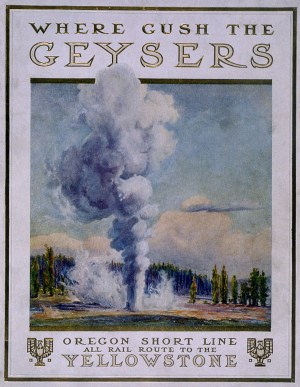
    Cover of the Oregon Short Line Brochure "Where Gush the Geysers"; Haynes; 1910I think the Yellowstone Park was so far west that it escaped any semblance of a legend, but nothing can ever be too far west to escape a joke. There are in the Park precipitous cliffs in plenty, but none from which forlorn Indian maidens have deliberately and with malice aforethought thrown their more or less tawny and symmetrical selves into the depths below, because their perverse papas insisted on the acceptance of some peculiarly painted chief as against the already, heretofore, selected young athlete of a Hiawatha, who had brought beads and feathers along with his pretty and unpronounceable love words whispered on the dark side of the tepee.

    Hence this chapter must be more of the joke than the legend, and as a matter of fact the Yellowstone Park was regarded as a joke in the first place. It was so considered from the time John Colter told his story till Jim Bridger related his yarns, and it was long afterwards found out that they were true stories after all.

    Jim Bridger had seen the hot springs and the geysers and he knew no one would believe even the truth, and, further, he knew that any story he might tell was not likely to be disproved, so he mixed his stories up, fact and fiction in equal parts with good grounds for both sides of the story.

    The story of catching a fish in the cold water of the lake and cooking it in a hot water pool alongside originated with Mr. Bridger, only the old man’s version was that he caught the fish in deep water that was hot near the surface and the fish was cooked on his way out. The truth is, any one may, at many places in the Park, catch a fish, and without moving, or taking the fish off the line, cook it in a nearby hot water pool. One place like this is in the Yellowstone Lake at the Thumb Lunch Station.

    Shakespeare says: “Travelers ne’er do lie, but folks at home condemn’ em —and Mr. Bridger was no exception to that rule, but his fault was mostly in exaggeration; he was not content to tell of the petrified trees, but must add petrified grass, petrified flowers and even petrified birds still singing petrified songs in the petrified trees, and his horses and mules had rather a hard feed on the brittle grass turned to stone. When Mr. Bridger came to show these things, behold! the petrified trees were there to prove that he had not prevaricated (“not to use a shorter and harsher word”).

    The story of the transparency or rather mirror-like composition of Obsidian Cliff was one of Mr. Bridger’s exaggerations. He told of this mountain of volcanic glass and illustrated it with a hunting incident of his own; he saw near the cliff what seemed to be an elk quietly feeding along its rugged sides; he just naturally fired at it, once, then again and again, but the elk never moved; he crept up cautiously without disturbing the animal, then he found out that he had been seeing right through a glass mountain and the elk was on the other side of it, and it was not only not plain everyday glass, but of telescopic quality, and the elk he shot at was twenty-five miles away.

    A latter day story of Obsidian Cliff that has more of the element of probability, is that the engineers on the Circuit Road found the composition so hard that it was impossible to drill into a part of the cliff jutting into the way of the road, and they could not blast it out, so they built fires against it, then threw cold water over the sides and the glass “broke away in great chunks,” so the narrator told me.

    A newcomer to the Park region once asked Mr. Bridger how long he had been there? “Why,” said the old man, “do you see that butte over there? Well, when I came here that butte was a hole in the ground.”

    All others came after, but their stories were as full of local color. Bridger started the alum creek “puckering yarns,” but E. C. Culver, the popular train agent and lecturer, put on a polish that made the old stories look like new. He, Mr. Culver, was going through the Livingston-Gardiner train one day delivering his usual lecture about in these words:

    We first pass through the Lower Canyon of the Yellowstone. Only a short ride, when we enter Paradise Valley, in which we ride for about twenty-five miles; the Absaroka range of mountains on our left are from eight to ten thousand feet high, the snow remaining frequently through the month of July.

    After leaving the beautiful valley we soon enter the middle of ‘Yankee Jim’ Canyon, so called because James George, better known as ‘Yankee Jim,’ came here in the early seventies and built the first wagon road to the Yellowstone Park. He is now an old man, still resides in the Canyon and is a famous storyteller. He tells of having a fine pair of field glasses and a good gun. In the cool of the evening he takes his glasses and looking up the mountainside he sees a bear, a deer, or an elk; taking his gun he shoots it, when it rolls down the mountainside to his feet. The distance is so long and the friction so great that in rolling down it tans the hide and cooks the meat; this is the way he lives.

    You smile with incredulity. Don’t you know you are entering Wonderland, where you must be sure to have your driver point out to you the most remarkable geyser in the world, for it throws up hot blocks of ice.

    On your fourth day’s coaching from Mammoth Hot Springs you will have a beautiful ride across Hayden Valley, crossing Alum Creek. You know alum will pucker and shrink anything, which comes in contact with it. A long time ago a man came along there driving four very large horses with a big wagon and he forded this creek; when he came out on the opposite side he found the alum water had shrunken his outfit to four Shetland ponies and a basket phaeton.

    A lady from Chicago heard of this wonderful water and immediately went there wearing number eight shoes, bathed her feet twice and went away wearing number ones.” In telling a party about it there happened to be a Chicago lady in the party who sarcastically advised the narrator to go and soak his head in that creek.

    Jim Bridger told of mountain streams having their source in the snow of the summit and ran down so fast that the water became hot from friction by the time it reached the foot of the mountain. As a matter of fact, the stones in the bed of the Yellowstone River below the Great Falls, where the cold water runs very rapidly, are hot, so hot that one can hardly bear the contact with the hand.

    “Slim,” a driver (I don’t know his other name, but he was a jolly good fellow), told me that when he came to the Park that Beaver Lake “was just crowded full of beavers, but they took so many of them to Washington that there wasn’t hardly any left now.”

    At the risk of being caught in some sort of joke, I just naturally inquired why they wanted to send beavers to Washington. “Oh,” Slim said, “they wanted ’em for the theological garden.” I had not thought of such a contingency, and at first I was inclined to be wroth at the idea of removing any animals from the Park, but Slim’s explanation tended to soothe my somewhat enraged feelings.

    Larry Matthews was the champion jokester of the Park for years at Norris and the Upper Basin.

    “Larry” was a constant source of wonderful stories, a well of information.

    Larry told me that the night Bob Ingersoll died, every geyser in the Park went into most violent eruption.

    I heard a grouchy old fellow complain to Larry one day about the turkey they had for lunch, and in accents wild asked Larry where they came from. Larry whispered as low as the “groucher” had talked loud, “They came over in the Mayflower and walked here.”

    Larry had amiability and wit combined. He could all in the same moment tell you a funny story and turn on a geyser.

    There are laughing waters, many, but not a hint of romantic story, not a Minnehaha anywhere.

    ∞§∞

    — Excerpt from Reau Campbell,  “Jokes and Legends.”  Pages 80-83 in Campbell’s New Complete Guide and Descriptive Book of the Yellowstone Park. H.E. Klamer, Upper Geyser Basin, Yellowstone Park, 1909.

    — Image of the Oregon Short Line brochure cover is from the Yellowstone Digital Slide File.

    — You might also enjoy:

  • A Tale: Encountering Irish Wit at a Lunch Station — John L. Stoddard, 1896

    Larry's Lunch Station
    Larry Mathews, center, holding court at Norris Lunch Station.

    The developers of Yellowstone Park located their grand hotels at major sights a day’s drive apart by horse and buggy. That necessitated construction of lunch stations about halfway between the hotels to provide mid-day meals.  

    The manager of the Norris Lunch Station, Larry Mathews, was a colorful character who found a place in many traveler’s journals. An Irish immigrant with a broad accent, Mathews was famous for his jocular manners and his ability to entertain customers as he rushed them through their sparse meals.

    The famous writer and lecturer, John L. Stoddard, met Larry at the Norris Lunch Station in 1896. Here’s how Stoddard described the encounter in Volume 10 of his famous set of travelogues, Stoddard’s Lectures.

    ∞§∞

    John L. Stoddard
    John L. Stoddard

    For half an hour we had been hearing, more and more distinctly, a dull, persistent roar, like the escape of steam from a transatlantic liner. At last we reached the cause. It is a mass of steam which rushes from an opening in the ground, summer and winter, year by year, in one unbroken volume. The rock around it is as black as jet; hence it is called the Black Growler. Think of the awful power confined beneath surface here, when this one angry voice can be distinctly heard four miles away. Choke up that aperture, and what a terrible convulsion would ensue, as the accumulated steam burst its prison walls! It is a sight which makes one long to lift the cover from this monstrous caldron, learn the cause of its stupendous heat, and trace the complicated and mysterious aqueducts through which the steam and water make their way.

    Returning from the Black Growler, we halted at a lunch station, the manager of which is Larry. All visitors to the Park remember Larry. He has a different welcome for each guest: “Good. day, Professor. Come in, my Lord. The top of the morning to you, Doctor.” These phrases flow as lightly from his tongue as water from a geyser. His station is a mere tent; but he will say, with most amusing seriousness: “Gintlemen, walk one flight up and turn to the right. Ladies, come his way and take the elevator. Now thin, luncheon is ready. Each guest take one seat, and as much food as he can get.”

    “Where did you come from, Larry?” I asked.

    “From Brooklyn, Sor,” was his reply, “but I’ll niver go back there, for all my friends have been killed by the trolley cars.”

    Larry is very democratic. The other day a guest, on sitting down to lunch, took too much room upon the bench.

    “Plaze move along, Sor,” said Larry. The stranger glared at him. “I am a Count,” he remarked at last.

    “Well, Sor,” said Larry, “here you only count wun!” “Hush!” exclaimed a member of the gentleman’s suite, “that is Count Schouvaloff.”

    “I’ll forgive him that,” said Larry, “if he won’t shuffle off this seat.” Pointing to my companion, Larry asked me: “What is that that gentleman’s business?”

    “He is a teacher of singing,” I answered.

    “Faith,” said Larry, “I’d like to have him try my voice. There is something very strange about my vocal chords. Whenever I sing, the Black Growler stops. One tourist told me it was a case of professional jealousy, and said the Black Growler was envious of my forte tones. ‘I have not forty tones,’ I said, ‘I’ve only one tone.’ ‘Well,’ says he, ‘make a note of it!’”

    Only once in his life has Larry been put to silence. Two years ago, a gentleman remarked to him: “Well, Larry, good. by; come and visit me next winter in the East. In my house you shall have a nice room, and, if you are ill, shall enjoy a doctor’s services free of all expense.”

    “Thank you,” said Larry, “plaze give me your card.”

    The tourist handed it to him; and Larry, with astonishment and horror, read beneath the gentleman’s name these words: “Superintendent of the Insane Asylum, Utica, New York.”

    ∞§∞

    — From “Yellowstone Park,” pages 207-304 in Volume 10 of Stoddard’s Lectures, Chicago: John L. Schuman & Co., 1898,

    — Lunch station photo from Stoddard’s Lectures. Stoddard photo from Wikipedia Commons.

    — You might also enjoy Stoddard’s description of Fountain Geyser.

  • A Tale: Finding a Goldilocks Pool at Mammoth Hot Springs — John W. Barlow, 1871

    Reports from the Washburn Expedition of 1870 stimulated so much interest in the Upper Yellowstone that the U.S. Government decided to send two expedition to explore the area systematically the next year. One was under the direction of Dr. Ferdinand V. Haden of the U.S. Geological Survey, and another was under Colonel John W. Barlow of the Army Corp of Engineers. The two expeditions worked in tandem to measure and map the wonders of the area. One of those wonders was “Soda Mountain,” what is now known as Mammoth Hot Springs.

    Bath Pools from Whylie by CalfeeIn an era when water for bathing often was heated in a teakettle, the copious amount of hot water flowing down the mountainside at Mammoth Hot Springs intrigued the explorers. Here’s how Colonel Barlow described it.
    ∞§∞

    A system of hot springs of great beauty, flowing from the top and sides of a large hill of calcareous deposit, and called Soda Mountain, is found five miles up the left bank of Gardners River. Here, at the foot of this curious white mountain, we encamped, and remained until the 24th [of July], examining the wonderful spring formation of this region, and the country around it.

    The central point of interest is the Soda Mountain, occupying an area of a hundred acres, and rising like the successive steps of a cascade, to the height of over 200 feet above the plateau at its base. The upper surface is a plain, composed of many hot springs, constantly sending up volumes of vapor slightly impregnated with sulphurous fumes.

    The sides of the hill down which the waters of these hot springs flow have become terraced into steps of various heights and widths, some twelve inches in dimension, while others are as many feet. In each terrace there is generally a pool of water, standing in a scalloped basin of gypsum, deposited at the edges by the water as it becomes cooler. These basins are often tinged with pink, gray, and yellow colors, giving to the whole a very beautiful effect.

    The rock in all directions has evidently been deposited in the same manner as the Soda Mountain is now being built up. When the formation ceases from a change in the course of the water, the rock becomes friable and disintegrates. After a time vegetation springs up and covers the surface. Many of the basins have the size and shape of bathtubs, and were used by members of the party for bathing purposes. The temperature varies in the different pools from fifty degrees all the way up to one hundred and eighty, so there is no difficulty in finding a bath of suitable temperature.

    [A few days later, Barlow left Mammoth Hot Springs to explore the area. When he returned in again enjoyed the hot water again.]

    Toward evening I enjoyed a bath among the natural basins of Soda Mountain. The temperature was delightful, and could be regulated at pleasure by simply stepping from one basin to another. They were even quite luxurious, being lined with spongy gypsum, soft and pleasant to the touch. I walked over a part of the hill by the faint light of the new moon, which gave to its deep-blue pools of steaming water a wild and ghostly appearance. The photographer has taken numerous views of these springs and the country in their vicinity, which will serve to convey a much more definite idea of their beautiful formation than can be given by any written description. A special survey was made of this locality, and careful observations of its latitude and longitude.

    ∞§∞

    —Excerpts from Colonel John W. Barlow, Report of a Reconnaissance of the Basin of the Upper Yellowstone in 1871, U.A. 42d Cong. 2d sess. Senate Ex Doc. 66, 1871, pp. 2-43.

    — Illustration from William Wallace Wylie, Yellowstone Park, or The Great American Wonderland. Kansas City, Missouri: Ramsey Millett & Hudson, 1882. Based on a Henry B. Calfee photograph.

    — You might enjoy:

  • A Tale: Prospectors Say They Have Seen the Fires of Hell — Montana Post, 1867

    Midway geyser basin YDSF
    Midway Geyser Basin

    The first indication of startling geothermal features on the Upper Yellowstone was a buffalo hide map that was sent to President Thomas Jefferson in 1805 by James Wilkinson, governor of the newly purchased Louisiana Territory. Governor Wilkinson said of the map, “a volcano is distinctly described in the Yellowstone River.” 

    About 1809 John Colter told his old boss, Captain William Clark of the Lewis and Clark Expedition, about the “Hot Spring Brimstone” he had seen along the shore of Lake Yellowstone, and Clark published a map containing that information information in 1814. 

     Eastern newspapers reported startling geothermal features in the area that became Yellowstone Park as early and early as 1827. Following that, there a steady stream of accounts in newspapers, government reports, journals and reminiscence. 

     But these reports did little to affect public awareness. In fact, William Wallace Wylie, in his guidebook published in1882, marveled that the area had been known for only a short time. Wylie, who invented the Wylie Way method of touring the park with stops permanent camps, searched Montana territorial newspapers and concluded this article published by The Montana Post in 1867 was the first one describing the area’s geothermal features. 

     ∞§∞

    It is indeed strange that this remarkable portion of country, now set apart by our Government as National pleasure-grounds, has been known to the world for so short a time. It may be authentically stated that the Park has been known to the general public for the short period of eleven years.

    Although trappers and prospectors had at different times passed through and seen some portions of the Park, and had tried to convince others of what they beheld, yet their stories were received as characteristic lies, and the general public lived on in ignorance of the fact that the greatest natural wonders of the world existed within the borders of our republic.

    The first published statement of these wonders, that the author could find, is that given below, taken from the Montana Post. The communication was dated Yellowstone City, Montana, August 18, 1867. Yellowstone City was a thriving mining village, nearer the boundary of the Park than any town at present is. The communication was written by Davis Willson, now of Bozeman, Montana. As will be seen, his information was obtained second-handed. The article is given entire for the purpose of showing how exaggerated were the ideas then obtained of what is now so well known: —

    A portion of the Bear Gulch stampeders has returned. They have been to the Lake at the head of Yellowstone, and report the greatest wonder of the age.  For eight days they traveled through a volcanic country emitting blue flames, living streams of molten brimstone, and almost every variety of minerals known to chemists. The appearance of the country was smooth and rolling, with long level plains intervening.

    On the summits of these rolling mounds, were craters from four to eight feet in diameter; and everywhere upon the level plains, dotting them like prairie-dog holes, were smaller ones, from four to six inches and upwards.

    The steam and blaze were constantly discharging from these subterranean channels, in regular evolutions or exhaustions, like the boilers of our steamboats, and gave the same roaring, whistling sound. As far as the eye could trace, this motion was observed.

    They were fearful to ascend to the craters, lest the thin crust should give way and swallow them. Mr. Hubbel (one of the party), who has visited this region before, ventured to approach one of the smaller ones. As he neared its mouth, his feet broke through, and the blue flame and smoke gushed forth, enveloping him. Dropping upon his body, he crawled to within a couple of feet of the crater, and saw that the crust around its edge was thin, like a wafer.

    Lighting a match, he extended it to the mouth and instantly it was on fire. The hollow ground resounded beneath their feet as they traveled on, and every moment it seemed liable to break through and bury them in its fiery vaults. The atmosphere was intensely suffocating, and they report that life could not long be sustained there.

    Not a living thing—bird or beast—was seen in the vicinity. The prospectors have given it the significant name—’Hell!’ They declare they have been to that ‘bad place,’ and even seen the ‘Devil’s horns;’ but through the interposition of Providence (not to speak profanely), their ‘souls have been delivered,’ and they emphatically aver, if a ‘straight and narrow’ course, during their sojourn on the Yellowstone, will save them, they will never go there again.

    This article was copied throughout the country by other papers, and doubtless served to awaken an interest concerning this unknown land; yet the general public were indebted for their first knowledge of the marvels of this region.

     ∞§∞

     — Text from “Earliest Publications Concerning Yellowstone Park,”  pages 74-77 in William Wallace Wylie, Yellowstone Park, or The Great American Wonderland. Kansas City, Missouri: Ramsey Millett & Hudson, 1882.

    — Photo from the Yellowstone Digital Slide File.

    — You might be interested in The New York Times story apparently based on this report.