Category: Yellowstone Stories

  • A Tale: “Bear That Killed Man Blown to Pieces” — 1917

    Values change. While searching for stories to post here, I frequently find reports of behavior that would outrage today’s sensibilities. Here’s an example published in Popular Mechanics in 1917.

    ∞§∞

    A bear that had severely mauled a government teamster in Yellowstone National Park was blown to pieces by dynamite recently, while the teamster died of his injuries in the hospital at Mammoth Hot Springs.Screen Shot 2013-04-07 at 8.02.58 AM The man was asleep under a supply wagon in the park when he was attacked by the bear. Two companions drove the animal away, after serious injuries had been inflicted on their mate, and when the latter had been removed to the hospital they prepared a warm reception for the bear, knowing it would return. Dynamite, connected with a small electric battery, was placed under a bait of army bacon a short distance from the camp. When the bear came back under cover of darkness and nosed the bait, the mine was sprung and the dynamite did its work most effectively. Bruin disappeared in sections, and the unlucky teamster was avenged.

    ∞§∞

    —  Text and illustration from “Bear That Killed Man Blown to Pieces,” Popular Mechanics, 27(4):561 (1917).

  • A Scene: Watching Deer in Yellowstone Canyon — Harrison Smith, 1914.

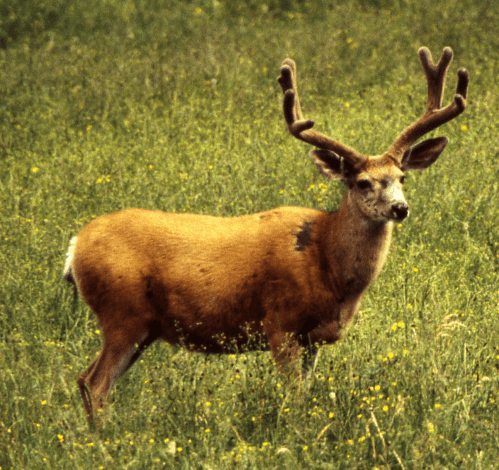
    Mule dee in velvet YDSF
    A mule deer in velvet.

    When Harrison Smith visited Yellowstone Park in the nineteen teens, he was most impressed the Grand Canyon of the Yellowstone. After marveling at the views from the rim, Smith hired a guide to take him to the canyon floor. There he got another thrill.  Here’s his story.

    ∞§∞

    The wonders of the Park are inexhaustible; there are underground caverns to explore, geysers of mud, boiling pools of colored clay, and hot springs, the basins of which are as delicately and beautifully colored as if they had been inlaid with precious stones. But the deep chasm into which the thundering flood of the Yellowstone River plunges, remains forever undimmed in the recollections of all who have seen it. It ranks with Nature’s great masterpieces.

    Before it reaches the Canon, this river flows through Yellowstone Lake, a magnificent sheet of water of one-hundred , and forty square miles lying almost eight thousand feet above the sea, dotted with forested islands and nearly surrounded by lofty snow-capped mountains. A few miles – below the lake, the river after a succession of cascades suddenly leaps over a cliff.

    This is the Upper Fall and half a mile lower down it thunders over the Lower Fall, which has a descent of three hundred and eight feet. Near this fall the river enters the Canon, which ranges in depth from six hundred to twelve hundred feet. Its depth is not tremendous compared with the Colorado Canon, but its precipitous and varied cliffs are so richly colored that it defies description.

    Imagine a great, wedge-shaped gash in the earth, with a foaming white river rushing along at the bottom, and at one end, a torrent pouring over the brink of a precipice. Then imagine that the volcanic rocks that make the walls of the Canon are painted every imaginable color, with orange, red and purple hues predominating. With the cloudless blue of the sky overhead, and the riot of colors below, accentuated by the fan-like spread of the white falls, and the foaming river, the whole scene might well be a fantastic dream.

    Crawling out on a projecting ledge that the gnarled roots of an ancient pine had kept from tumbling into the abyss, I leaned far over the edge. The only sound that marred the intense quiet came from the high and narrow gate-way from which the river leaped to freedom far below. Even that was soft and mellow and in keeping with Nature’s peaceful strength.

    In spite of the distance I could see the double rainbow that curved up from the base of the falls, while hovering over the center of the canon with wings wide-spread in the thin air, an eagle floated, the guardian spirit of the scene. I felt that I was merely a brief intruder, and that here was the true master and ruler of this splendid domain. For the moment I would willingly have given up my kinship with man, for the ability to soar down between those gleaming walls, and fly, winter and summer about the white mountain peaks that circled the horizon, and over the broad emerald lake to this paradise of color and beauty that the river had carved out for its treasure house.

    It is possible to scramble to the bottom of the canon by a winding trail and to walk through its entire length among the pines that border both sides of the river. But although the magic colors of the cliffs gain in splendor on a closer inspection, the feeling of spaciousness that you get in your first bird’s-eye glimpse over the top of the precipice is entirely lost.

    With a guide and three of the more adventurous of my fellow travelers, we tramped almost twenty miles along the river bank. It was difficult and dangerous work, climbing the great boulders and skirting steep precipices, that had been hurled down by the frost from some lofty crag. That night we camped beside a small river that branched into the Yellowstone.

    About a mile away from the camp, the guide discovered deer tracks on a shelving bank of the Yellowstone. Before the shadows of evening had turned into night we were posted on a ledge about one-hundred feet above the river, silently waiting.

    We had been there only a few minutes when the guide pointed excitedly down to the right of the spot we were watching. There, with their front legs sunk in the black water up to their knees, stood two fawns, eagerly drinking. Beside them their mother anxiously looked around, as if she suspected some hidden danger, and then, satisfied that they were safe, followed their example. They stole away as silently as they had come, and melted into the black shadows of the pines.

    An hour later we heard a slight crashing through the trees, and although it was almost too dark to make him out, watched an antlered stag daintily step to the brink of the river. He had been drinking only a moment, when in shifting my position, I dislodged a pebble; it sounded in the deathly stillness like a small avalanche. I caught one glimpse of the lordly up-lifted head of the stag; there was a crash of loose stones under his feet and he turned and fled into the friendly depths of the forest.

    We made our way back to camp; and soon fell asleep with the sound of rushing water in our ears and with the brilliant stars and the black night for our canopy.

    ∞§∞

    — Excerpt from Harrison Smith, “The Yellowstone National Park.”  Pages 144-153 in North America, New York: The Century Co., 1914.

    — Photo from the Yellowstone Digital Slide File.

  • A Tale: Adventurers Run Out of Grub at Old Faithful — Seth Bullock, 1872

    It was natural that Seth Bullock would want to visit Yellowstone. After all, he was the delegate to Montana Territorial Senate who in December 1871 wrote the “memorial” asking the federal government to establish the park. The next summer, he became one of the first tourists to visit there.

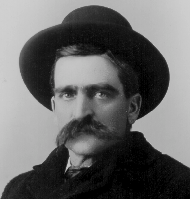
    Bullock2
    Seth Bullock

    Bullock was a colorful man whose real life biography inspired the tough sheriff character in the HBO series “Deadwood.” A newspaper once described him as “a man with a cold, grey eye, a nerve that never wavered, and a gun that never missed. “It has been said of him” the article continued, “he was a silent, cold man, and at times he seemed to have lost his power of speech. One writer referred to him as a ‘Man killer,’ and when this was called to his attention, Bullock broke his silence to remark: ‘They say I’ve killed forty-seven men. Son, I’ll tell you what. I’ve never killed but two, and I did not kill them soon enough.’”

    Teddy Roosevelt once called Bullock “the finest kind of frontiersman” and appointed him U.S. Marshall for South Dakota. Bullock began his career as a businessman and lawman in Helena, Montana. Later he moved to South Dakota where he died on his ranch in 1919.

    He was barely 22 when he was elected to the territorial legislature in 1871. Bullock said he never intended the journal of his Yellowstone for publication, but it’s a well written description of what was probably a typical trip at the time.

    Bullock left Helena for the park on horseback August 23, 1872, with three friends named A. J. Teller, Dick White, and Jack Langrishe.

    They led a packhorse that they named “Judge Clancy” after the man Bullock bought him from. The men counted on finding fish and game for food on their trip — a plan that didn’t always work.

    On the second night out, lightening spooked their horses, but they were able to catch a rope on Judge Clancy and stop the stampede. Lost horses were a common occurrence for Yellowstone travelers all through the period when they the primary means of transportation. Since the travelers carried little food for their horses, the animals needed to graze over and sometimes they wandered off. Often travel was delayed to search for horses which were sometimes found miles away.

    Here are some excerpts from Bullock’s journal.

    ∞§∞

    MONDAY, AUGUST 26th –  [The Gallatin Valley]

    Broke camp at 4 A. M. Teller grumbled a great deal at having to get up so early. For me, the day had a special interest. We were to travel through the Gallatin Valley.

    I anticipated a fine stretch of country, but was totally unprepared for the surprise that awaited me. Well has the Gallatin Valley been named the Garden-Spot of Montana. We were charmed and delighted. Stretching before us with mountains on each side was a magnificent plateau of fine rolling prairies, interwoven with two fine streams of silver whose beautiful shimmering sheen could be seen for very beautiful fields of ripe golden grain, greet the eye on every side. Substantial houses and good buildings are the rule and not the exception.

    Traveling through this beautiful valley — one of God’s dimples — as we did on this fine August day, it was impossible not to become a firm believer in the future and prosperity of this section of Montana.

    At 11 a.m. we arrived in Bozeman and camped on Bozeman Creek. A fine stream that skirts the town. After enjoying our Bedouin repast, we took a look at the town, which strikes one as a thrifty place. Evidence of future prosperity exists in the well-known agricultural resources of the valley and the pluck, business energy and shrewdness of the citizens. The town is nicely laid out with wide streets, looks very much like Deer Lodge. The people are all good boys.

    [five days later]

    SATURDAY, AUGUST 31st – [Mammoth Hot Springs]

    Here we are, at the famous springs, encamped in a little ravine, about 100 yards from the springs. Pen cannot describe, nor tongue tell, the wonders of this place. Large, white mountain and plains of icy whiteness cut into fantastic shapes meet the eye.

    Found quite a colony of invalids here. All speak of the medicinal qualities of the baths in terms of praise. Passed the afternoon in resting and listening to amusing stories told by the old mountaineer of the bug-hunters, as they facetiously termed the Hayden party. Intend leaving tomorrow for the geyser country.

    [eight days later]

    SUNDAY, SEPTEMBER 8th –  [Lower Geyser Basin]

    Left prairie at 6 A. M. After floundering around through mud for over three hours, we succeeded in finding solid foundation on hillside and struck out down creek for Lower Geyser Basin. Two pilgrims got stalled in the mud and had to be roped out. Passed numerous hot springs and infant geysers.

    As you approach the lower basin you can imagine that you are overlooking a wharf where a number of steamers are blowing off steam. Camped for noon in Lower Geyser Basin and examined curiosities. Reached Upper Fire Hole Basin about 4 o’clock. Went into camp and started out to examine the geysers. Did not have time to examine but one or two before night.

    While we were eating supper, Old Faithful started its evening entertainment. The display was grand, beyond our highest expectation, the water being thrown about 100 feet high, five feet in diameter at the base to a fine silver thread at the top. Judging from the noises we hear, there must be a great number of geysers in this vicinity.

    We are getting short on grub. Nothing left but flour and coffee. White prepared for supper a new dish, called Geyser sauce.

    [The next day]

    MONDAY, SEPTEMBER 9th – [Upper Geyser Basin]

    Arose at 3 A. M.  Before breakfast, [we] visited a number of geysers. One called “Grand” breaks through a small mound, evidently formed by the geyser. Around the sides of the mound are the most beautiful colorings imaginable.

    Left for home at 12 M. Course down Fire Hole River.  … Weather fine, but cold. No game in sight. No fish. Bread and water all we had today.

    [six days later]

    SUNDAY, SEPTEMBER 15th – [At Bottler’s Ranch north of the Park]

    Left Packer’s Camp at 5 A. M. Lunched at Bottler’s and examined his ranch. Fifty acres of wheat, very good. About the only ranch on the whole Yellowstone River

    Walked into Bottler’s eggs, cream, butter, and “sich” in a way that looked bad for his winter’s grub supply. First civilized grub that we had for twenty days.

    [the next day]

    MONDAY, SEPTEMBER 16th –

    At noon, we started on for Bozeman through Rocky Canyon. Arrived at Bozeman at 4 P. M. A. J. Davis of Helena visited our camp, dined with us on trout and Yellowstone stories. Spent evening in Bozeman.

    ∞§∞

    — Seth Bullock’s journal of his trip to Yellowstone Park is in the collection of the Montana Historical Society.

    — Photo from Wikipedia Commons.

  • A Tale: A Cayuse with One Blue Eye — Walter DeLacy, 1863

    After the discovery of gold at Bannack in 1862 brought thousands of men to Montana, prospectors fanned out over area looking for more riches. In 1863 Montana Pioneer Walter Delacy led a forty men to the headwaters of the Snake River looking for gold. Later DeLacy published a reminiscence of the trip that stands as one of very few accounts of prospecting in the area that became Yellowstone Park. DeLacy didn’t just describe the wonders he saw. Here’s his description of the antics of one of his horses.

     ∞§∞

    Panning_on_the_Mokelumne
    Panning for gold.

    I had a white, bob-tailed Cayuse (usually called “Muggins”) who had the peculiarity of having one eye black and the other of a very light blue. When you looked at him, on one side, he had a very obstinate and devilish look, as if he was up to any mischief (and so he was). Looking at him on the other, he seemed a very good-natured, steady, old horse, with a tendency toward religion.

    He had other peculiarities besides these, amongst which was that when you tried to lead him, he wouldn’t go anywhere if he could help it, and if you let him go loose, you could not catch him under an hour.

    This evening, as the wind was cold, and he had been good for a long time, he concluded that the time had come to distinguish himself. He was just before me, and looking round, he cocked his black eye at me, as much as to say, “Look out for squalls,” and gave two or three preliminary kicks, which threw off the pack, which he met with his heels, and sent the coffee pot, frying pan a piece of elk, a chunk of bread, and other miscellaneous articles into the air.

    He then galloped around, scattering the rest of the kit over the prairie, and when he ascertained that there was no more mischief to be done, he let himself be caught, and when I came up, turned his blue eye on me with such an expression of contrite humility and self reproach, that I had not the heart to give him the thrashing he richly deserved, and repacked him in silence, and went my way.

     ∞§∞

    — Except from “A Trip up the South Snake River in 1863” by  Walter W. DeLacy.  Pages 100-127 in Contributions to the Historical Society of Montana, Vol. 1, 1876

    — Image from the Wikipedia Commons.

    — You might also enjoy Walter DeLacy’s tale, “An Optimistic Prospector.”

  • A Tales: Fleeing a Prairie Fire — Henry Erskine Smith, 1893

    Elk Burn YDSF
    Elk graze in an area burned by the 1988 Yellowstone Fire.

    Wildfires are part of nature’s cycle of birth, death and regeneration, but that doesn’t mean they aren’t dangerous killers. Writer Henry Erskine Smith learned that in 1893 near Yellowstone Park’s west entrance when he and his companions were startled by three coyotes (he called them “prairie wolves”) that dashed by their carriage. Here’s how Smith described fleeing a prairie fire.

    ∞§∞

    About noon, as we were emerging from a dark, wild, narrow canyon in cutting our way through the mountains, we were confronted with three prairie wolves, who were just entering the canyon we were leaving. They were fleeing with desperate speed, and seeing us they stopped short, gazing about them with a petrified stare, uncertain as to which course to take, but they quickly dashed by us, within twenty feet, and soon disappeared. “A danger signal,” said Jim, as he took an extra grip on his reins and stretched his neck. “A big fire we’ve got about us.”

    True enough, for as we passed out into the open prairie we beheld a sight which sent a thrill of horror through us when we comprehended the situation.

    We had been traveling westward, while the fire had been traveling in an easterly direction, and had already passed to the left of us and apparently closed up our rear retreat. The horses sniffed the air excitedly, looking about them in a wild, uneasy manner, their ears moving to and fro, as they nervously neighed to each other.

    Away in the distance, where the prairie met the sky, a heated, quivering line arose, surmounted by a dark, wavering cloud. It was the prairie on fire! The wind was blowing almost a gale, directly towards us, and the long dead grass was as dry as tinder; the fire was plainly spreading rapidly, and, with a wild shout to the horses, Jim showed the stuff of which he was made.

    Off to the right we shot at a furious speed, leaving the road and taking to the pathless prairie; a band of antelope, with eyes like fire, came rushing past us, adding to the excitement and fury of our horses. A glance to the left showed that the fire was gaining on us, as, with a horrible crackling sound, we could see the bright flames, twenty feet high, shooting upwards, and tongues of fire leaping ten yards at a time before the gale.

    The fire was fast overhauling us. The dark rolling smoke soon overcast the sky above our heads, seeming to imprison us. Jim muttered something, and his face grew ashen, as the flecks of foam from our wild horses flew over his breast. It seemed as if our hour had come.

    On we went, the fire momentarily drawing nearer, the billows of smoke each instant growing denser and the heat more suffocating, at times seeming as though it would blister our faces. Should we throw out our guns and traps and lighten the wagon? Not a word from Jim, but his strong arm and steady eye were intent on saving us, as we thundered on at terrific speed.

    Shall we ever forget that moment when for an instant the smoke cleared, and we realized we were being literally encircled by the raging fire—caused by contrary and varying winds,—only about a quarter of a mile ahead, there was an opening of several hundred feet for our escape! Could we reach it before the gap closed?

    Again the smoke wreaths whirled around us; our eyes were smarting from the heat; the panting horses, mad with terror, blindly rushed through the darkness, as we yelled words of encouragement to them. Could they hold out? It was a race for life! A few moments and we dashed through the opening, then not one hundred feet wide, and were safe!

    ∞§∞

    — Excerpt from Henry Erskine Smith, On and Off The Saddle. New York: G.P. Putnam’s Sons, 1894.  Pages 14-18.

    — Image from the Yellowstone Digital Image File.

    — You might enjoy the National Park Service site, “The History of Wildland Fire in Yellowstone.”

  • A Tale: Soaping Beehive Geyser to Make It Play — Georgina Synge, 1892

    Apparently, the practice of soaping geysers to make them erupt began in the 1880s after a concessionaire decided that the naturally agitating Chinaman Spring would be the perfect place to do laundry. After tossing in clothing, the concessionaire added soap and the spring erupted spewing clothing over the landscape.

    Soon tourists began stripping soap off of store shelves and taking it from hotel bathrooms so they could eliminate the tedium of waiting for geysers to play. Of course, officials soon banned the practice, but it was hard to control. Here’s Georgina Synge’s description of a clandestine soaping of Beehive Geyser.

    ∞§∞

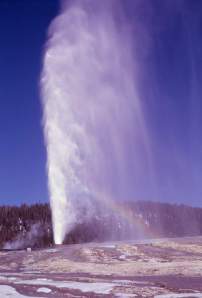
    The geyser we set our hearts on seeing was the “Beehive,” just opposite our camp, the other side of the basin. The cone, which really has all the appearance of a bee-hive
    Beehive Geyserin the distance, is about three feet in height and is beautifully coated with beaded silica. Its action is different to any other geyser, as the water is projected with such force from its comparatively small vent-hole, that it goes up in one perfectly straight pillar to over two hundred feet; and, instead of falling in floods on each side like the others, seems to evaporate into wreaths of steam and vapor.

    Now there is a sure and almost certain method for inducing a geyser to play out of its accustomed hours, and this is done by what is called “soaping” them! It may sound incredible, but it is a well known fact (which we attested on several occasions) that a bar or two of common yellow soap, cut up into pieces and slipped into a geyser cone, will have the desired effect in a very short interval. This is supposed to be partly caused by the soap creating a film on the water, which prevents the steam escaping. Smithson was as keen as we were tbat the “Beehive” should play. He assured us he had seen it soaped over and over again, with the most brilliant results.

    So that night we sallied forth after all the world had gone to bed, armed with two large bars of Brown Windsor tied up in a pocket-handkerchief. The moon was shining fitfully behind the clouds, and now and then gleamed forth upon us, as, having crossed the river, we climbed up the white sloping sides of the ” Beehive.”

    It was not due to play for several days, and as we peered down its dark funnel-like orifice, we could hear a soft peaceful gurgling, but nothing more; and even this quite ceased after we had slipped in the soap. We sat down then and watched. Presently it began to boil up—little by little—with a buzzing sort of noise as if it were hard at work. Every now and then it threw up a few squirts of water, and Smithson, who was getting very excited, laid his ” bottom dollar” it was going to play. But, alas, though it seemed to be trying with all its might, yet it never quite got off, and having watched for nearly an hour, we decided to send Smithson back to camp for some more soap.

    Perhaps we had not put in enough, we thought, though Smithson assured us two bars was all it had ever wanted before. Well, in went the second lot, but with just the same result. It showed all the premonitory symptoms, boiled over, made a few gasps, and sent up a few small jets, and then gave it up. We got quite desperate at last. It was nearly twelve o clock, and very cold, as a sharp frost had set in. We thought, however, we would have one more try.

    We hurried back to camp. There we found Elijah, stretched fast asleep before the smoldering embers of the fire. We cruelly awoke him, and made him produce the last piece of yellow bar, which we had hitherto thought necessary to leave for washing purposes. And to augment this, A. insisted on my bringing forth our few and treasured cakes of Pears. But no, even this last sacrifice was of no avail—that “Beehive” would not play! Smithson was furious, the first time it had ever refused for him; someone must have soaped it the day before, and if only we would wait it was sure to begin soon. But we decided we could not freeze there all night, even to see the “Beehive” display; and so dejectedly we made our way once more back to camp. Just as we were going off to sleep we heard a roar—something was “guising” at last, but we were too tired to stir even if it had been “Excelsior.” The next morning, however, just as we were dressed, we heard the roar again, like the sound of a sudden hurricane or of numberless distant guns. “She’s off —the ‘Beehive’s  guisin’,” shouted Smithson, and off we dashed, helter-skelter, arriving breathless, but in capital time to see a grand eruption.

    It was terrific. It seemed as if the whole hill-side must be blown out by the tremendous force with which it burst forth. Higher and higher it soared, in one great round perpendicular column of over two hundred feet, clouding the whole sky with masses of spray and steam. Presently a gust of wind blew up and carried the topmost wreaths in feathery masses over the valley, and we were able to stand quite close to lee of it without getting a drop upon us. It played for about twenty minutes, then wavered, trembled, and finally subsided with sundry gurgles and groans. As we came away, several people who had hurried out from their beds to see the sight, began making remarks on the curious fact of the “Beehive” playing before its proper time. “That’s been soaped,” said a man who belonged to the place, looking suspiciously round, at which we appeared innocently surprised.

    ∞§∞

    — Excerpt from “Geyser-Land,” pages 48-70 in Georgina M. Synge, A Ride Through Wonderland.  Sampson, Marston & Company. London, 1892.

    — Image from the Coppermine Photo Gallery.

    — You might also enjoy Georgina Synge’s tale, “A Nightime Visitor.”

    — For more stories about geysers, click “Geysers” under the Categories button to the left.

  • A Tale: Bears Entertain Yellowstone Campers — Dearling, 1900

    Table for Bears Yellowstone Slidefile Asahel Curtis postcard
    Setting the Table for Bears.

    By the 1890s, grand hotels had been built throughout Yellowstone Park and kitchen managers dumped their refuse in nearby woods. Bears soon began treating the arrival of garbage carts as invitations to dinner and watching them at the dump became a “must-do ” experience on par with viewing geysers, canyons and falls.

    In 1900, John Samuel Dearling visited Yellowstone Park “The Wylie Way,” that is, on a carriage tour operated by the Wylie Permanent Camping Company. Both black bears and grizzlies or “silvertips” frequented the Wylie camps just like they did the grand hotels. Here’s how Dearling described the bear antics he encountered in his book published in 1913

    ∞§∞

    Near a hotel, where the refuse was dumped from the kitchen, I saw thirteen bears at one sight. They came there every evening about six o’clock to get their dinner. They must have had watches or clocks of their own, for they did not wait for the hotel bell to ring; they were surely beauties, nearly all silvertips, and of good size—too big for me to play with.

    They watched us pretty closely while they ate their meals and once in a while one would get suspicious and walk off, but he would come back in a few minutes; he could not stand to see the other boys getting all the hash. They did not use very good manners at the festal-board, as they snarled and growled at each other a good deal. It reminded me of the scenes at some of our American breakfast tables.

    There was one poor fellow in the lot that I was sorry for. I would like to have been a Good Samaritan, but my nerve failed me. His lordship had by some means gotten a tin can mashed on his right fore foot; he must have been supping out of a can and some other bear stepped on the can and pressed it into the flesh; at any rate I was told that it had been on there for several weeks. This trouble all came about by his being a right-handed bear; if it had been mashed on his left hand, he could have pulled it off with his right hand.

    There was a family of bears near the Yellowstone Lake that gave the Wylie Company outfit considerable trouble, and some fun; the family consisted of old Betsey and her two boys. While the boys were under her control they behaved fairly well, but had no respect for their neighbors, and old Betsey like all other mothers, could not see the faults of her own children.

    The Wylie people had tents for their kitchens as well as for their sleeping apartments; now old Betsy’s boys thought it great fun to creep under the tents of the kitchen, like an American boy goes under the tent at a circus.

    One night about eight o’clock, Joe, the youngest one (the youngest is always the worst of the lot, that is what my brothers used to say) stole under the tent and proceeded to help himself to a pot of pork and beans; he did not look for a spoon, but in his haste rammed his hand to the bottom of the kettle.

    The beans were pretty hot at the bottom and Joe howled with pain. This attracted the white folks and they rushed into the kitchen and captured the free lunch find; he hallooed for his mamma, and Betsy was not slow in responding, but before she could arrive with reinforcements, the victors had their captive in jail, under a box.

    This so smothered his voice that Betsy could not say for sure that it was her boy that was in the toils of the law. So, after making some big bluffs and parading around the tent with her artillery cocked and pinned, she at last decided not to storm the fortress. Joe was kept for a week or two, then released under parole pending good behavior.

    ∞§∞

    —   From John Samuel Dearling, “Yellowstone National Park,” Pages 319-433 in A Drummer’s Experience, Colorado Spring, Colorado: Pikes Peak Publishing Company, 1913.

    —   Asahel Curtis Postcard from the Yellowstone Digital Slide File.

    —   For more stories about hunting, watching and photographing bears, click “Bears” under the categories button to the left.

  • A Tale: A Nighttime Visitor — Synge c. 1890

    By the time Georgina M. Synge visited Yellowstone Park in the 1890s, most tourists sped through the park on rigorously scheduled five-day coach tours.

    A Wolverine

    But Georgina and her companion, whom she simply called “A.” (probably A. was her husband), preferred the flexibility of traveling on horseback. Having their own horses and tents not only provided them with the flexibility to stay as long as they wanted at any given sight, it also allowed them to choose their  route. After visiting the Grand Geysers, they decided to detour into the back country in hopes of seeing some big game. Here’s how Georgina described what happened when a surprise visitor came to her tent.

    ∞§∞

    We pitched our tent on the Yellowstone banks, by a lovely bend that carried it through great rocks further down. Behind us were thick forests, and in front long blue lines of hills. It looked a splendid place for trout, with its deep pools and gravelly shallows, so, though it was getting dark, A. brought out his rods, and in a very few minutes had secured some fine big fellows, which were delicious, grilled for supper.

    The men had stupidly left the axe behind at our lunching place, and so it happened our tent was not very well pegged down that night. However, as it was clear still weather, we thought it did not matter, not dreaming of other alarms. I was rather tired and slept soundly, and it must have been about one o’clock when I was awakened by funny little squeaks near the tent, and I heard the men from the wagon, about ten yards off, calling out and trying to frighten something away. This ceased for a little. Then presently I heard something creeping round the tent, and some more squeals. The lamp was dimly burning, and I turned it on the entrance, which was the unpegged part. Something was squeezing itself under the canvas, something about the size of a badger, black and smooth, and with a sharp little nose.

    I turned the lamp full upon it, and we stared at each other, both much surprised. My stick was close at hand, so I whacked on the ground, upon which the little beast turned tail in a hurry, and scuttled out as fast as it could. A. by this time was awake, and professed to be much surprised that I, who was so fond of live creatures, should object to the poor little thing.

    “As if it would have hurt us,” he remarked, as he turned over and went to sleep again. However, dearly as I love the animal world, I prefer not to have unknown species thereof rambling about my sleeping apartment, and so I lay awake on the chance of having another visit. Before long I heard something walking about with heavy lumbering gait, some few yards off. Then it came nearer, walked slowly round the tent, sniffing along the bottom, and brushing up against the canvas as it passed. With some difficulty I awoke A.

    “There’s a wild beast outside!” I cried,” and it’s trying to get in—what shall we do!” A. replied that he would rather be eaten than wake up, and that it was most likely a poor little mink or inoffensive creature of that kind, and I had better go to sleep again. But at that moment it began to move once more, there was a shuffling at the entrance—a great big something bulging it out as it tried to poke its way through. Then, as we watched, horrified (having no guns in the tent), we saw a large brown head thrust through the insecurely fastened opening.

    “It’s a wolf!” I shrieked, “and it wants to eat us!” And we seized our sticks and made a terrific noise to frighten the monster. He certainly was surprised, for he quickly withdrew his nose, and we heard him sloping off. I was dying with curiosity to see what he was like, and at last summoned up courage to peep out. It was early morning, and a faint cold light made everything distinctly visible.

    There, squatting a few yards off, was our visitor, watching us, and trying to make up his mind whether to investigate further. I had no desire for a closer acquaintance with him, however, and beat on the sides of the tent with my stick, and yelled at him in a way that evidently struck terror into his savage breast, for he turned tail and trotted off, and I lost sight of him below the hill. After this we barricaded the entrance and made it as secure as we could, and A. promised to keep watch for the rest of the night. However, I had not the smallest inclination, to close an eye even, and as soon as it was light enough we got up and roused the men to prepare breakfast.

    We found they had had a lively night also, as they had had mink after the fish, and our big brown visitor also, which latter had been attracted by the elk steak. They declared it was a wolverine, which is a very cowardly sort of brute, and rarely shows fight or attacks mankind. But they confided in A. afterwards that it was really a cinnamon bear, but that they did not like to tell me for fear I should be too much alarmed to sleep in the tent again, whereas nobody minded wolverines. However, as I told them, one was quite as alarming to me as the other, though, now it was all over, I was not ill-pleased at having seen one of these interesting beasts so near; for many people go through the Yellowstone without seeing a vestige of a bear, especially if they keep on the trail.

    ∞§∞

    —From “Big Game” pp. 71-84 in Georgina M. Synge, A Ride Through Wonderland.  Sampson, Marston & Company. London, 1892.

    —Image from the Coppermine Photo Gallery.

  • A Tale: Joe Meek Flees Blackfeet and Finds Wonderland — c. 1829

    About 1829 a nineteen-year-old trapper named Joe Meek camped along the Gallatin River in southwest Montana with a brigade of mountain men led by William Sublette of the Rocky Mountain Fur Company. When a group of Blackfeet attacked, the trappers scattered. Young Meek fled across the mountains and found geothermal features in what later became Yellowstone National Park. 

    Joe Meek

    When the fur trade collapsed, Meek moved to Oregon where he helped organize the territorial government and became its federal marshal. In the 1860s, the historian Frances Fuller Victor interviewed him several times. She later published a book about Meek’s adventures. Here’s how Victor described Meek’s first look at geothermal features in Wonderland.  Interestingly, there’s no mention of boiling fountains or geysers.

    ∞§∞

    In November the camp left Missouri Lake on the east side of the mountains, and crossed over, still northeasterly, on to the Gallatin fork of the Missouri River, passing over a very rough and broken country. They were, in fact, still in the midst of mountains, being spurs of the great Rocky range, and equally high and rugged. A particularly high mountain lay between them and the main Yellowstone River. This they had just crossed, with great fatigue and difficulty, and were resting the camp and horses for a few days on the river’s bank, when the Blackfeet once more attacked them in considerable numbers. Two men were killed in this fight, and the camp thrown into confusion by the suddenness of the alarm. Capt. Sublette, however, got off, with most of his men, still pursued by the Indians.

    Not so our Joe, who this time was not in luck, but was cut off from camp, alone, and had to flee to the high mountains overlooking the Yellowstone. Here was a situation for a nineteen-year-old raw recruit! Knowing that the Blackfeet were on the trail of the camp, it was death to proceed in that direction. Some other route must be taken to come up with them; the country was entirely unknown to him; the cold severe; his mule, blanket, and gun, his only earthly possessions. On the latter he depended for food, but game was scarce; and besides, he thought the sound of his gun would frighten himself, so alone in the wilderness, swarming with stealthy foes.

    Hiding his mule in a thicket, he ascended to the mountaintop to take a view of the country, and decide upon his course. And what a scene was that for the miserable boy, whose chance of meeting with his comrades again was small indeed! At his feet rolled the Yellowstone River, coursing away through the great plain to the eastward. To the north, his eye follows the windings of the Missouri, as upon a map, but playing at hide-and-seek in amongst the mountains. Looking back, he saw the River Snake stretching its serpentine length through lava plains, far away, to its junction with the Columbia. To the north, and to the south, one white mountain rose above another as far as the eye could reach. What a mighty and magnificent world it seemed, to be alone in! Poor Joe succumbed to the influence of the thought, and wept.

    Having indulged in this sole remaining luxury of life, Joe picked up his resolution, and decided upon his course. To the southeast lay the Crow country, a land of plenty—as the mountain-man regards plenty—and there he could at least live; provided the Crows permitted him to do so. Besides, he had some hopes of falling in with one of the camps, by taking that course.

    Descending the mountain to the hiding-place of his mule, by which time it was dark night, hungry and freezing, Joe still could not light a fire, for fear of revealing his whereabouts to the Indians; nor could he remain to perish with cold. Travel he must, and travel he did, going he scarcely knew whither. Looking back upon the terrors and discomforts of that night, the veteran mountaineer yet regards it as about the most miserable one of his life. When day at length broke, he had made, as well as he could estimate the distance, about thirty miles. Traveling on toward the southeast, he had crossed the Yellowstone River, and still among the mountains, was obliged to abandon his mule and accoutrements, retaining only one blanket and his gun. Neither the mule nor himself had broken fast in the last two days. Keeping a southerly course for twenty miles more, over a rough and elevated country, he came, on the evening of the third day, upon a band of mountain sheep. With what eagerness did he hasten to kill, cook, and eat! Three days of fasting was, for a novice, quite sufficient to provide him with an appetite.

    Having eaten voraciously, and being quite overcome with fatigue, Joe fell asleep in his blanket, and slumbered quite deeply until morning. With the morning came biting blasts from the north, that made motion necessary if not pleasant. Refreshed by sleep and food, our traveler hastened on upon his solitary way, taking with him what sheep-meat he could carry, traversing the same rough and mountainous country as before. No incidents nor alarms varied the horrible and monotonous solitude of the wilderness. The very absence of anything to alarm was awful; for the bravest man is wretchedly nervous in the solitary presence of sublime Nature. Even the veteran hunter of the mountains can never entirely divest himself of this feeling of awe, when his single soul comes face to face with God’s wonderful and beautiful handiwork.

    At the close of the fourth day, Joe made his lonely camp in a deep defile of the mountains, where a little fire and some roasted mutton again comforted his inner and outer man, and another night’s sleep still farther refreshed his wearied frame. On the following morning, a very bleak and windy one, having breakfasted on his remaining piece of mutton, being desirous to learn something of the progress he had made, he ascended a low mountain in the neighborhood of his camp—and behold! The whole country beyond was smoking with the vapor from boiling springs, and burning with gasses, issuing from small craters, each of which was emitting a sharp whistling sound.

    When the first surprise of this astonishing scene had passed, Joe began to admire its effect in an artistic point of view. The morning being clear, with a sharp frost, he thought himself reminded of the city of Pittsburg, as he had beheld it on a winter morning, a couple of years before. This, however, related only to the rising smoke and vapor; for the extent of the volcanic region was immense, reaching far out of sight. The general face of the country was smooth and rolling, being a level plain, dotted with cone-shaped mounds. On the summits of these mounds were small craters from four to eight feet in diameter. Interspersed among these, on the level plain, were larger craters, some of them from four to six miles across. Out of these craters issued blue flames and molten brimstone.

    For some minutes, Joe gazed and wondered. Curious thoughts came into his head, about hell and the day of doom. With that natural tendency to reckless gayety and humorous absurdities, which some temperaments are sensible of in times of great excitement, he began to soliloquize. Said he, to himself, “I have been told the sun would be blown out, and the earth burnt up. If this infernal wind keeps up, I shouldn’t be surprised if the sun war blown out. If the earth is not burning up over thar, then it is that place the old Methodist preacher used to threaten me with. Any way it suits me to go and see what it’s like.”

    On descending to the plain described, the earth was found to have a hollow sound, and seemed threatening to break through. But Joe found the warmth of the place most delightful, after the freezing cold of the mountains, and remarked to himself again, that “if it war hell, it war a more agreeable climate than he had been in for some time.”

    He had thought the country entirely desolate, as not a living creature had been seen in the vicinity; but while he stood gazing about him in curious amazement, he was startled by the report of two guns, followed by the Indian yell. While making rapid preparations for defense and flight, if either or both should be necessary, a familiar voice greeted him with the exclamation, “It is old Joe!” When the adjective “old” is applied to one of Meek’s age at that time, it is generally understood to be a term of endearment. “My feelings you may imagine,” says the “old Uncle Joe” of the present time, in recalling the adventure.

    ∞§∞

    — Text from Frances Fuller Victor, Eleven Years in the Rocky Mountains and Life on the Frontier. Harford Connecticut: R.W. Bliss and Company 1881. Pages 73-77.

    — Image from the Wikipedia Commons.

    — You might also enjoy:

  • A Tale: Another Version of Colter’s Run

    If there’s a story that deserves retelling, it is John Colter’s tale of his escape from a band of Blackfeet Indians. Colter mustered out of Lewis and Clark’s Corps of Discovery in 1806 and began his career as a trapper and Indian trader. In 1807, while searching for Indians to trade with, Colter passed through the area that is now Yellowstone National Park. In 1808 he made his famous run from the Blackfeet.
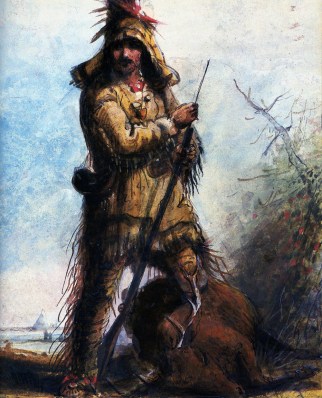
    Colter apparently was illiterate, but there are at least two versions of his tale that were written by men who heard him tell it. The one below is from Thomas James’ book, Three Years Among the Indians and Mexicans.  It generally agrees with John Bradbury’s version, but differs in some details. It’s interesting to compare these two versions of Colter’s Run.

    ∞§∞

    Colter had gone with a companion named Potts to the Jefferson River, which is the most western of the three Forks, and runs near the base of the mountains. They were both proceeding up the river in search of beaver, each in his own canoe, when a war party of about eight hundred Black-Feet Indians suddenly appeared on the east bank of the river.

    The Chiefs ordered them to come ashore, and apprehending robbery only, and knowing the utter hopelessness of flight, and having dropped his traps over the side of the canoe from the Indians, into the water, which was here quite shallow, he hastened to obey their mandate.

    On reaching the shore, he was seized, disarmed and stripped entirely naked. Potts was still in his canoe in the middle of the stream, where he remained stationary, watching the result. Colter requested him to come ashore, which he refused to do, saying he might as well lose his life at once, as be stripped and robbed in the manner Colter had been. An Indian immediately fired and shot him about the hip; he dropped down in the canoe, but instantly rose with his rifle in his hands.

    “Are you hurt,” said Colter.

    “Yes, said he, too much hurt to escape; if you can get away do so. I will kill at least one of them.”

    He leveled his rifle and shot an Indian dead. In an instant, at least a hundred bullets pierced his body and as many savages rushed into the stream and pulled the canoe, containing his riddled corpse, ashore. They dragged the body up onto the bank, and with their hatchets and knives cut and hacked it all to pieces, and limb from limb. The entrails, heart, lungs &c, they threw into Colter’s face.

    The relations of the killed Indian were furious with rage and struggled, with tomahawk in hand, to reach Colter, while others held them back. He was every moment expecting the death blow or the fatal shot that should lay him beside his companion.

    A council was hastily held over him and his fate quickly determined upon. He expected to die by tomahawk, slow, lingering and horrible. But they had magnanimously determined to give him a chance, though a slight one, for his life.

    After the council, a Chief pointed to the prairie and motioned him away with his hand, saying in the Crow language, “go—go away.” He supposed they intended to shoot him as soon as he was out of the crowd and presented a fair mark to their guns. He started in a walk, and an old Indian with impatient signs and exclamations, told him to go faster, and as he still kept a walk, the same Indian manifested his wishes by still more violent gestures and adjurations.

    When he had gone a distance of eighty or a hundred yards from the army of his enemies, he saw the younger Indians throwing off their blankets, leggings, and other encumbrances, as if for a race. Now he knew their object. He was to run a race, of which the prize was to be his own life and scalp.

    Off he started with the speed of the wind. The war-whoop and yell immediately arose behind him; and looking back, he saw a large company of young warriors, with spears, in rapid pursuit. He ran with all the strength that nature, excited to the utmost, could give; fear and hope lent a supernatural vigor to his limbs and the rapidity of his flight astonished himself.

    The Madison Fork lay directly before him, five miles from his starting place. He had run half the distance when his strength began to fail and the blood to gush from his nostrils. At every leap, the red stream spurted before him, and his limbs were growing rapidly weaker and weaker. He stopped and looked back; he had far outstripped all his pursuers and could get off if strength would only hold out.

    One solitary Indian, far ahead of the others, was rapidly approaching, with a spear in his right hand, and a blanket streaming behind from his left hand and shoulder. Despairing of escape, Colter awaited his pursuer and called to him in the Crow language, to save his life.

    The savage did not seem to hear him, but letting go his blanket, and seizing his spear with both hands, he rushed at Colter, naked and defenseless as he stood before him and made a desperate lunge to transfix him.

    Colter seized the spear, near the head, with his right hand, and exerting his whole strength, aided by the weight of the falling Indian, who had lost his balance in the fury of the onset, he broke off the iron head or blade which remained in his hand, while the savage fell to the ground and lay prostrate and disarmed before him.

    Now was his turn to beg for his life, which he did in the Crow language, and held up his hands imploringly, but Colter was not in a mood to remember the golden rule, and pinned his adversary through the body to the earth by one stab with the spearhead. He quickly drew the weapon from the body of the now dying Indian, and seizing his blanket as lawful spoil, he again set out with renewed strength, feeling, he said to me, as if he had not run a mile.

    A shout and yell arose from the pursuing army in his rear as from a legion of devils, and he saw the prairie behind him covered with Indians in full and rapid chase. Before him, if anywhere, was life and safety; behind him certain death; and running as never man before sped the foot, except, perhaps, at the Olympic Games, he reached his goal, the Madison river and the end of his five mile heat.

    Dashing through the willows on the bank he plunged into the stream and saw close beside him a beaver house, standing like a coal-pit about ten feet above the surface of the water, which was here of about the same depth. This presented to him a refuge from his ferocious enemies of which he immediately availed himself.

    Diving under the water he arose into the beaver house, where he found a dry and comfortable resting place on the upper floor or story of this singular structure. The Indians soon came up, and in their search for him, they stood upon the roof of his house of refuge, which he expected every moment to hear them breaking open. He also feared that they would set it on fire.

    After a diligent search on that side of the river, they crossed over, and in about two hours returned again to his temporary habitation in which he was enjoying bodily rest, though with much anxious foreboding. The beaver houses are divided into two stories and will generally accommodate several men in a dry and comfortable lodging.

    In this asylum, Colter kept fast till night. The cries of his terrible enemies had gradually died away, and all was still around him, when he ventured out of his hiding place . . .

    He traveled day and night, stopping only for necessary repose, and eating roots and the bark of trees, for eleven days. He reached the Fort, nearly exhausted by hunger, fatigue and excitement. His only clothing was the Indian’s blanket, whom he had killed in the race, and his only weapon, the same Indian’s spear which he brought to the Fort as a trophy. His beard was long, his face and whole body were thin and emaciated by hunger, and his limbs and feet swollen and sore. The company at the Fort did not recognize him in this dismal plight until he made himself known

    ∞§∞

    — Adapted from Thomas James, Three Years Among the Indians and Mexicans.  Saint Louis, Missouri Historical Society, 1916. [Edited with notes and biographical sketches by Walter B. Douglas] Pages 57-64.

    — Image, “Old Bill Williams.” Wikipedia Commons.

    — You might also enjoy John Bradbury’s version of Colter’s Run.