I’ll return to the lobby of Old Faithful Inn on Saturday and Sunday (August 20 and 21) to sign copies of my book Adventures in Yellowstone: Early Travelers Tell Their Tales. It’s a great venue and I always have fun there.
The Inn probably is the most impressive man-made feature in Yellowtone Park and has been a favorite of visitors since it was finished in 1904, even those who were staying in other accommodations. Below is a description of the Inn by a man who was touring “The Wylie Way,” that is, spending his nights in tents put up for the season. Wylie Way tents weren’t as plush as the park hotels, but they had wooden floors and wood stoves to keep them warm.
Employees of the park concessioners called both hotel guests and Wylie Way tourists “Dudes.” That distinguished them from “Sagebrushers,” people who had their own transportation and horses. Here the story of a baseball game between hotel and Wylie Way Dudes.
∞§∞
We can’t sit and watch Old Faithful forever, so we step over to Old Faithful Inn and inspect that property. This is indeed a wonderful building, rustic throughout, with a chimney that must be at least fifteen feet square at the base. It runs up through the building and out the roof and has an enormous old-fashioned fireplace on each of the four sides. When we see the log fire sending out its cheerful warmth and glow, and the mammoth pans of hot popcorn passing around, and which we sample generously, it suddenly occurs to us that this is a “pretty happy world” after all.
Right here I am reminded of the ball game that occurred directly in front of Old Faithful Inn the next afternoon. One team was made up from the “dudes” stopping at the Inn and the other from the “dudes” that were going the “Wylie Way.” Both teams played good ball in spite of the stiff wind that was blowing, but the Inn “dudes” were a little better than their opponents, the score being somewhere in the neighborhood of 8 to 5. The feature of the game proved to be the first-class, all round rooting of the Wylie drivers who, forty strong, were massed back of third base and cheered every good play made by their men, and kicked at every decision that went against them.
∞§∞
— Excerpt from Fred W. Ellsworth, “Though Yellowstone Park with the American Institute of Banking.” Moody’s Magazine: The National Investors Monthly, November 1912, 14(5)369-375.
— Photo, Coppermine Photo Gallery.
— You can read other descriptions of Old Faithful Inn and my book signings there here, here, and here.
When my Summer 2011 issue of Pioneer Museum Quarterly arrived, I immediately went through it to find my article, “Fred Bottler: Yellowstone Pioneer in Paradise.” It’s always thrill to see my stuff printed on slick paper in justified columns.
Philetus W. Norris
Fred Bottler started the first permanent ranch in the Paradise Valley in 1867 in a spot halfway between Bozeman and Mammoth Hot Springs, a day’s ride from each of them. That made Bottler’s a perfect overnight stop for early travelers on their way to Yellowstone Park. Also, Bottler hunted elk and prospected for gold in the park before he started ranching so he was the perfect guide.
Many early travelers mention Bottler in their journals and reminiscences and I began collecting information about him several years ago. When Pioneer Museum Director John Russell asked me to write an article for the Quarterly, I organized my Bottler file and went to work. The result is an account of Bottler’s life and a collection of stories about him. Here’s a sample.
∞§∞
In 1870, Philetus Norris, who became the second Yellowstone Park Superintendent, hired Bottler to guide him to the wonders of the region. Perhaps driven by the knowledge that others were planning a similar expedition later that summer, Norris and Bottler headed into the park in early June. Deep snow prevented them from getting to the grand geysers, so they decided to try to cross the mountains to Mammoth Hot Springs.
Norris described their trek this way: “Although the snow-capped cliffs and yawning chasms in the basaltic or ancient lava beds, fringed with snow-crushed, tangled timber and impetuous torrents of mingled hot-spring and snow-melt water made our progress—mainly on foot, leading our horses—slow, tedious and dangerous, we persevered until we came to a large river.”
It was the snowmelt-swollen Gardner River, a knee-deep stream 20 feet wide. When Bottler stepped into the rushing water, the torrent knocked him off his feet, swept him away and carried him downstream. Bottler grabbed an overhanging cottonwood branch and hung on. Norris rushed up barely in time to save him. Bottler had lost his rifle and ammunition belt in the icy water.
Norris summarized the situation like this: “With my only companion sadly bruised by the rocks, benumbed, the remnants of his dressed elk-skin garments saturated by snow water, without gun or pistol, in a snow-bound mountain defile in an Indian country, even a June night was far from pleasant for us.”
The next morning, Norris surveyed the area with his powerful field glasses and spotted steam rising from Mammoth Hot Springs eight miles away. The men decided they couldn’t make it to the springs over the mountain torrents swollen by melting snow. Besides, they had only one gun to provide meat and protection from wild animals and Indians. The river accident had banged Bottler up too much for him to climb back over the mountains, so they headed down the second canyon of the Yellowstone River, which later became known as Yankee Jim Canyon.
Bottler returned to his ranch to recuperate, and Norris went to Missoula to attend to business. From Missoula, Norris proceeded to the Pacific coast where he heard in August that a party headed by Montana Surveyor General Henry Washburn had returned from exploring the upper Yellowstone. Apparently, the news that others had beat him to documenting the wonders of the Yellowstone upset Norris greatly. “I was intensely mortified,” he said, “to learn that Messrs. Langford, Hauser and others had gone up the Yellowstone.”
∞§∞
— Excerpt from M. Mark Miller, “Fred Bottler: Yellowstone Pioneer in Paradise,” Pioneer Museum Quarterly, Summer 2011, pp. 13-18.
— You can read the rest of my stories about Fred Bottle by buying a copy of the Quarterly at the Pioneer Museum of Bozeman. Better still, join the Gallatin Historical Society and get a free subscription.
When I was a little boy my father told me the way to catch a bird was to put salt on its tail. If you do that, he assured me, you can reach right out and pick it up. I looked to my mother for confirmation, and she said something like, “I suppose that’s true.”
They armed me with a salt shaker and I spent the afternoon trying to get close enough to a bird to salt its tail. Not until my brothers came home from school and started laughing at me did I get the joke.
The tradition of playing tricks on the naive runs deep in the history of the northern Rockies. The famous Yellowstone explorer, N.P. Langford, told this story in his account of traveling with the second Hayden Expedition to Yellowstone Park in 1872.
∞§∞
Among our own hunters was a trapper named Shep Medary—a lively, roystering mountaineer, who liked nothing better than to get a joke upon any unfortunate “pilgrim” or ” tender foot ” who was verdant enough to confide in his stories of mountain life.
“What a night!” said Shep, as the moon rose broad and clear—”what a glorious night for drivin’ snipe!”
Here was something new. Two of our young men were eager to learn all about the mystery.
“Driving snipe! what’s that, Shep? Tell us about it.”
“Did ye never hear?” replied Shep, with a face expressive of wonder at their ignorance. “Why, it’s as old as the mountains, I guess; we always choose such weather as this for drivin’ snipe. The snipe are fat now, and they drive better, and they’re better eatin’ too. I tell you, a breakfast of snipe, broiled on the buffalo chips, is not bad to take, is it, Dick?”
Beaver Dick, who had just arrived in camp, thus appealed to, growled an assent to the proposition contained in Shep’s question; and the boys, more anxious than ever, pressed Shep for an explanation.
“Maybe,” said one of them, “maybe we can drive the snipe tonight and get a mess for breakfast: what have we got to do, Shep?”
“Oh well,” responded Shep, “if you’re so plaguey ignorant, I’m afeard you won’t do. Howsomever, you can try. You boys get a couple of them gunny-sacks and candles, and we’ll go out and start ’em up.”
Elated with the idea of having a mess of snipe for breakfast, the two young men, under Shep’s direction, each equipped with a gunnysack and candle, followed him out upon the plain, half a mile from camp, accompanied by some half-dozen members of our party. The spot was chosen because of its proximity to a marsh which was supposed to be filled with snipe. In reality it was the swarming place for mosquitoes.
“Now,” said Shep, stationing the boys about ten feet apart, “open your sacks, be sure and keep the mouths of ’em wide open, and after we leave you, light your candles and hold ’em well into the sack, so that the snipe can see, and the rest of us will drive ’em up. It may take a little spell to get ’em started, but if you wait patiently they’ll come.”
With this assurance the snipe-drivers left them and returned immediately to camp.
“I’ve got a couple of green ‘uns out there,” said Shep with a sly wink. “They’ll wait some time for the snipe to come up, I reckon.”
The boys followed directions—the sacks were held wide open, the candles kept in place. There they stood, the easy prey of the remorseless mosquitoes. An hour passed away, and yet from the ridge above the camp the light of the candles could be seen across the plain. Shep now stole quietly out of camp, and, making a long circuit, came up behind the victims and, raising a war-whoop, fired his pistol in the air.
The boys dropped their sacks and started on a two-forty pace for camp, coming in amid the laughter and shouts of their companions.
∞§∞
— Excerpt from N. P. Langford, “The Ascent of Mount Hayden,” Scribner’s Monthly (June 1873) 6(3)129-157.
— Illustration from the article.
— You can read a condensed version of Langford’s The Discovery of Yellowstone Park in my book, Adventures in Yellowstone.
— To see more stories by this author, click on “Langford” under the “Categories” button to the left.
At the dawn of the Twentieth Century, a self-described hunter-naturalist named William Henry Wright decided to start carrying a camera on his various expeditions. He soon began taking excursions just to photograph animals. After a while, he decided to take on the challenges of photographing grizzlies.
Because the grizzlies are shy and tend to be nocturnal, Wright said, chances of taking a daylight photo were slim, so he began experimenting with ways to use batteries and tripwires to ignite flash powder. By 1906 he had perfected his techniques enough to go to Yellowstone Park to try them out.
It took several attempts before Wright succeeded in getting a decent photograph. Here’s his description of his first try.
∞§∞
I followed some of the more travelled trails for several miles and found that nearly all of the grizzlies had their headquarters in the range of mountains around Mt. Washburn. I then selected their largest highway, and after setting up my camera, concealed myself one evening about a hundred feet from the trail and to leeward of it, and watched for the coming of the grizzlies. Across the trail I had stretched a number forty sewing thread, one end attached to the electric switch and the other to a small stake driven into the ground beyond the trail. Just below where I had located, there was an open park in which the bears had been feeding, as was shown by the grass that had been nipped and the holes that had been dug for roots.
For some hours I waited in the bushes and fought gnats and mosquitoes. I saw several black bears pass along the hillside, but not a grizzly showed his nose until after the sun had set and the little marsh in the park was covered with a mantle of fog. Suddenly then, far up the trail, appeared what at first looked like a shadow, so slowly and silently did it move. But I knew at once, by the motion of the head and the long stride, that a grizzly was coming to the bottom for a few roots and a feed of grass.
I was, of course, very anxious to see what he would do when he came to the thread across the trail, and I had not long to wait, for he came on steadily but slowly and, when within ten feet of the thread, he stopped, poked out his nose and sniffed two or three times, raised up on his hind feet, took a few more sniffs, and then bolted up the trail in the direction from which he had come.
A few minutes after he had gone, three more appeared. These were evidently of one litter and appeared to be between two and three years old. They came on with the same cautious movements, and when they were close upon the thread, they also stopped and went through a similar performance. The one in front pushed out his nose and sniffed gingerly at the suspicious object. Those in the rear also stopped, but being curious to learn what was causing the blockade, the second one placed his forefeet on the rump of the one in front, in order to see ahead, while the third one straightened up on his hind legs and looked over the other two.
They made a beautiful group, and just as they had poised themselves, the one in front must have touched the string a little harder than he had intended to, for there was a sudden flash that lit up the surroundings, and I expected to see the bears go tearing off through the timber, but, to my utter surprise, nothing of the kind happened.
They all three stood up on their hind legs, and looked at each other as much as to say, “Now, what do you think of that?” and then they took up their investigation where it had been interrupted, followed the thread to where it was fastened to the stick, clawed up the spool, which I had buried in the ground, sniffed at it, and then went back to the trail, where they had first found the thread. Here they again stood up, and then, having either satisfied their curiosity or becoming suspicious, they turned around and trailed away through the timber.
As far as I could see them they went cautiously, and stopped at frequent intervals to stand up and look behind them to see if there were any more flashes or if anything was following them. Unfortunately this picture was utterly worthless. I had failed to use enough flash powder, and when I came to develop the plate, it showed only the dimmest outline of the animals.
∞§∞
— From William Henry Wright, The Grizzly Bear: The Narrative of a Hunter Naturalist, Scribner’s Sons: New York, 1909.
Early travelers assumed the reason that some lakes and streams in Yellowstone Park were barren of fish because of hot water and chemicals from springs and geysers, but systematic studies indicated that the problem was physical barriers like water falls. In 1889 officials initiated a program of stocking fish and proved the studies were right.
By the late 1890s, when Frank B. King and his friend hauled their fly rods and creels through the park, the once barren rivers and lakes were teeming with fish. King has been traveling through the park for several days before he arrived at the Firehole River and finally got an opportunity to test the famous fishing waters of Yellowstone Park. Here’s his story of what happened then.
∞§∞
When we reached the Park, every one told us we could catch fish anywhere and everywhere, but still those rods remained under the seat, and as the days passed by, we wished we could tell some of those people what we thought of them. When we looked into the hot springs, we saw no signs of fish, and in the geysers the finny tribe was missing.
Still we went bravely on, now and then casting a longing glance at the rods, and hoping, at least, that we might some day find some place where we could take them out of their cases and look at them, if nothing more.
As we turned our backs upon Old Faithful and his companions that afternoon, and drove down the Firehole River toward the Fountain House, the shadows were just commencing to lengthen. Through the pines, I could catch here and there tantalizing glimpses of the river as it ran along between its meadowy banks. Now and then, it formed rapids which ran into beautiful pools and then out again into long, open riffles. Here, there would be a log extending out into the water, at the end of which I could see a tempting eddy from which I was almost sure I could coax a “big one.” Next, there would be a long bend with a riffle above and below it. In those riffles, I could imagine I saw several “beauties” waiting for a fly to drop upon the water that they might jump at it.
Well, I stood all this just as long as I could. I was going to get out my rod and make a try, even if I failed. My companion was a little, in fact, very sleepy, and did not care whether there were fish or no fish; what he had his mind on was that long, quiet nap he was to have when he reached the hotel. By promising him that I would only make a few casts, and that he could sleep in the surrey while I tried my luck, he consented to wait just a minute or two.
I pulled on some overalls, a fishing-coat, a pair of “gums;” set up my pet rod; tried the reel to see if it still knew its song; ran the line through the guides; tied on a leader; picked a brown hackle, a royal coachman, and a black gnat, out of my book; and sallied down to the river. Before me was a beautiful pool, one of those long, deep ones with just enough current running through it to make the flies work well.
I crept up as close to the pool as I dared, took the rod in my right hand, and made a long, pretty cast out past the middle of the pool. The flies had no sooner straightened out than there was a break in the water and a streak of gold and black passed over the end hackle and into the water. He had missed it; but he was a beauty. I felt like letting out an Indian whoop—there was a fish in the river anyway, I had seen him. The next thing to do was to catch him.
I was all of a tremble, for if ever I wanted a fish in my life, I wanted that one, if for nothing more than to give me some cause for yelling to my sleepy companion to bring down the landing-net. Once more I drew back and made a long cast, but the flies struck a little too far up stream and had to travel with the current a little distance.
No sooner were they over the spot where I had had the first rise than, zip, something struck the end fly and started up stream, making the line hum through the water and the reel spin. I did not think, as some people tell, that I had a whale or an elephant, I knew what it was—it was a good big trout. There is only one thing that acts the way this something on the end of my line did, and that is a gamy trout.
He ran up stream until the current and strain of the rod was too much, and then he left the water. You can imagine the way he left the water. You know the way a big trout acts. Well, he acted as they all do. When he was back in the water, he started down stream, and when he reached the end of the pool, he broke again and then came toward me and then away from me.
By this time, the first rush was over and I let out a long, deep yell for my sleepy friend. As soon as he heard that yell, he knew just what was up, and he came down that hill with the landing-net in his hand just as fast as a man who was not a bit sleepy. His first words were:
“What have you got? How big is he?”
After a little sulking, a few dashes, and a break or two, came the fight around the landing net, and at last I had him kicking in the grass on the bank. He was a beauty! A Loch Leven that measured nearly twenty inches and weighed over two pounds and a half. As he lay there in the grass, his yellow stripe and red spots upon the black made a very pretty picture. He was a beauty, and he was ours.
Thoughts of a nap left the mind of my companion, and fishing was declared the order of the day. He soon had his “Leonard” set up, and before many minutes had a mate to mine bending it almost double. I never saw any one wake up so quickly in my life. He never had a thought of sleep the rest of the afternoon. The fact was, he did not have time for such thoughts, the fish kept him too busy.
From the time I hooked my first fish up to a little while before dark, we had the finest fishing I ever heard of. When I say it was the finest fishing I ever heard of, I mean it, and I have heard some very tall fish stories. We fished side by side all afternoon and one was working with fish all the time, and part of the time both of us had our hands full.
We lost the biggest one we had hooked, of course; one always does. When we left the stream, we had twenty-two fish that would average over two pounds apiece. Some were Rainbows; some were Loch Levens; some were Cutthroats, and they were all beauties, every one of them a work of art. I never hope to catch such a gamy, beautiful mess of trout again. Such fishing one only has once in a lifetime.
∞§∞
— Frank B. King, “In Nature’s Laboratory: Driving and Fishing in Yellowstone Park.” Overland Monthly, 29(174)594-603 (June 1897).
— Wikipedia photo.
— To see more stories about fishing in Yellowstone Park, choose “Fishing” under the categories button on the right side of this page.
Late in the summer of 1870, men rushed into the area that was to become Yellowstone Park looking to find Truman Everts and claim the reward that was offered for his rescue.
McCartney's "Hotel"
Everts, who had become separated from the famous Washburn Expedition, had been alone in the wilderness for thirty-seven days when Jack Baronett found him. Everts refused to pay the reward on the grounds that he would have made it to safety on his own. Baronett said he found Everts nearly starved to death and raving mad.
The searchers also discovered Mammoth Hot Springs and immediately saw an opportunity to convert the area into a bath resort. The next summer, two entrepreneurs named James McCarntey and Harry Horr took out homestead claims near the springs and build the first hotel in Yellowstone Park—a 25-by 35-foot log cabin with a sod-covered slab roof. “Guests” at the cabin had to provide their own blankets and sleep on the floor.
Although the hotel had hot and cold running water (a 40-degree stream on one side and a 150-degree stream on the other), the Earl of Dunraven wasn’t impressed with the accommodations when he visited in 1874. Here’s his description.
∞§∞
The accommodation at the Mammoth Hot Springs Hotel was in an inverse ratio to the gorgeous description contained in the advertisements of the Helena and Virginia newspapers. No doubt the neighborhood of these springs will some day become a fashionable place. At present, being the last outpost of civilization—that is, the last place where whisky is sold—it is merely resorted to by a few invalids from Helena and Virginia City, and is principally known to fame as a rendezvous of hunters, trappers, and idlers, who take the opportunity to loiter about on the chance of getting a party to conduct to the geysers, hunting a little, and selling meat to a few visitors who frequent the place in summer; sending the good specimens of heads and skeletons of rare beasts to the natural history men in New York and the East; and occupying their spare time by making little basket-work ornaments and nicknacks, which, after placing them for some days in the water so that they become coated with white silicates, they sell to the travelers and invalids as memorials of their trip. They are a curious race, these mountain men, hunters, trappers, and guides—very good fellows as a rule, honest and open-handed, obliging and civil to strangers if treated with civility by them. They make what I should think must be rather a poor living out of travelers and pleasure parties, doing a little hunting, a little mining, and more prospecting during the summer. In the winter they hibernate like bears, for there is absolutely nothing for them to do. They seek out a sheltered canyon or warm valley with a southern aspect, and, building a little shanty, purchase some pork and flour, and lay up till spring opens the rivers and allows of gulch mining operations being recommenced. If you ask a man in the autumn where he is going and what he is going to do, ten to one he will tell you that it is getting pretty late in the season now, and that it won’t be long before we have some heavy snow, and he is going “down the river or up the canyon.”
∞§∞
— The Earl of Dunraven, Hunting in the Yellowstone, Outing Publishing Company, New York, 1917.
— Photo detail from the Yellowstone Digital Slide File.
— To see more stories by this author, click on “Dunraven” under the “Categories” button to the left.
— You might also enjoy Truman Everts’ chilling tale of being “Treed by a Lion.”
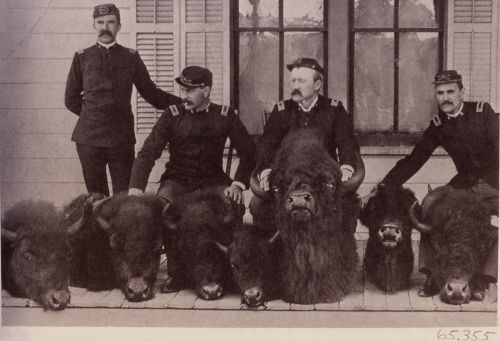
When the U.S. Army took over administration of Yellowstone Park in 1886, one of it’s primary missions was prevention of the poaching that was decimating the wildlife. The soldiers worked hard to stop illegal hunting, but they lacked authority to anything other than apprehend poachers, escort them out of the Park and order them never to come back. Persistent poachers ignored the orders.
Finally, in 1894, a poacher was so brazen that he generated public attention and forced Congress to act. Here’s the Park Superintendent’s account of how Ed Howell’s poaching career ended.
∞§∞
Sometime in February I sent a scouting party across the Yellowstone and into the Pelican Valley to look alter the herds of buffalo and elk that usually winter there. On the return of this party they reported to me that they had found an old snowshoe and toboggan trail, but that they were unable to follow it. It apparently headed in the direction of Cooke City.
While this party was still out, word came to me that Ed Howell, a notorious poacher of Cooke City, had passed the Soda Butte Station one stormy night and had gone on into Cooke for supplies, but that he had not carried any of his trophies with him. A few days after this the sergeant in charge of the Soda Butte Station reported the finding of a trail of this same party with his toboggan and followed it as far as the Park line.
I then determined on a plan which resulted in the capture of Howell. I waited until I thought it was about time for him to be back in the Pelican country, and then sent out a large search party, with Captain Scott in charge. This party arrived at the Lake Hotel on the evening of March 11. Next day Burgess and Sergeant Troike of the Sixth Cavalry went over into the country previously indicated by me, and made their camp.
On the morning of the 13th, very soon after starting, they came across some old snowshoe tracks which they could scarcely follow, but by continuing in the direction of them they soon came across a cache of six bison scalps suspended above the ground, in the limbs of a tree.
Securing these trophies, the party continued on down Astringent Creek to its mouth and then turned down the Pelican. They soon came across a newly-erected lodge, with evidences of occupation, and numerous snowshoe tracks in the vicinity.
Soon after this they were attracted by the sight of a man pursuing a herd of bison in the valley below them, followed by several shots from a rifle. After completing the killing, the culprit was seen to proceed with the removal of the scalps.
While thus occupied with the first one my scouting party ran upon him and made the capture. It turned out, as I had anticipated, to be Howell, who coolly remarked that if be had seen the party sooner they could never have captured him, meaning, of course, that he could have shot them before they were near enough to make effective the small pistol, which was the only weapon they carried. They brought him into this place as a prisoner, reaching here on the evening of the 16th of March.
I at once made full report of the affair and it was widely noted in the newspapers of the country. A suitable recognition, in the way ot a certificate, was made of the coolness and bravery of Burgess and Troike. The scalps, as far as they could be saved, were brought in and properly prepared by a competent taxidermist and placed at the disposal of the Department.
The feeling aroused in the minds of the public by this act of vandalism stirred Congress to prompt action, so that on May 7 an act for the protection of game in the Park received the President’s signature. In order that it may receive wider distribution, I inclose a copy to be printed with this report.
Howell denied having killed any bison but those found near him, but I feel sure that he did kill the six found in the cache, and it is quite probable that he killed others which we did not find. In one seuse it was the most fortunate thing that ever happened to the Park, for it was surely the means of securing a law so much needed aud so long striven for.
On April 25 Howell was released from confinement in the guardhouse by your order aud removed from the Park, and directed never again to return without proper permission. On the evening of July 28 I found him coolly sitting in the barber’s chair in the hotel at this point. I instantly arrested him and reconfined him in the guardhouse, had him reported to the U. S. attorney for this district, and on the evening of August 8 he received the first conviction under the law which he was instrumental in having passed. He was convicted before the ITS. commissioner of returning after expulsion, in violation of the tenth oi the Park regulations, and sentenced to confinement for one month and to a fine of 850.
With this conviction as a precedent and a strong determination to make other arrests under the new law whenever it is violated, I believe the days of poaching in the Park are nearly at an end.
∞§∞
— Captain George S. Anderson, Acting Superintendent of Yellowstone Park, Report of the Superintendent of Yellowstone National Park, 1895-1896.
When the U.S. Congress established Yellowstone Park in 1872, they didn’t provide a budget for rangers to enforce regulations. That left people free to do whatever they wanted—and often they did things people today would never imagine.
Robert Strahorn, who visited the park in 1880 to write a description for the Union Pacific Railroad, built fires beside Grotto Geyser so he could see it play by firelight. Here’s what he said about that.
∞§∞
Groto Geyser Closeup
The Grotto is the most singular piece of mechanism among all the geysers. Its dome is some 30 feet long and half as wide, and 20 feet high. It is a miniature temple of almost alabaster whiteness, with arches leading to some interior Holy of Holies, whose sacred places may never be profaned by eye or foot. The hard, calcareous formation about it is smooth and bright as a clean swept pavement.
Several columns, resembling masses of pearls, rise to a height of eight or ten feet, supporting a roof that covers the entire vent, forming fantastic arches and entrances, out of which the water is ejected, during an eruption, 50 or 60 feet.
The entire surface is composed of the most delicate bead-work imaginable, massive but elaborately elegant, and so peerlessly beautiful that the hand of desecration has not been laid upon it, and it stands without flaw or break in all its primal beauty—a grotto of pearls.
Darkness coming on, we built large fires on one side of the Grotto, and from the opposite side were afforded a sight, whose wonderful weirdness we can never forget. The volumes of water then resembled sheets of flame or molten metal and the drenched and dripping arches, through which the flickering blaze was plainly seen, seemed more like a fiery furnace than a real, live geyser.
We camped by the side of the Grotto during the night, and with the confused noises of hundreds of geysers, steam vents and boiling springs in our ears, and reflection, which would not “down,” upon the almost supernatural experiences of the day, there was more wakefulness than tired bodies warranted.
∞§∞
— Excerpt from Robert E. Strahorn’s book, Montana and Yellowstone Park, 1881.
When two people describe the same event, interesting differences often occur. That certainly happened when Colonel William D. Pickett’s and his guide, Jack Bean, described the Colonel’s first bear hunt.
Col. Pickett
The hunt happened shortly after the Nez Perce Indians fled through Yellowstone Park following the bloody Big Hole Battle on August 9, 1877. Although there was still a possibility of danger from Indians remaining in the Park, Pickett was eager to hunt for grizzly bears there so he hired Jack Bean, an old Indian fighter and frontiersman, as his guide.
Bean’s version of their trip presented the Colonel as a bit of a buffoon. Here’s how Colonel Pickett, who lated became a famous bear hunter, described his first kill.
∞§∞
It was learned the hostile Indians had passed through the National Park, followed by Howard’s forces. As there was still time to make a hasty trip through the Park before the severe winter set in, I determined to do so. I was urged not to make the attempt on account of the hostiles’ sick or wounded that might have been left behind, and of other Indians. I recognized the risk, but since as a youngster I had served during the Mexican war as a mounted volunteer on the northwest frontier of Texas against the Comanches, and all the bad Indians of the Indian Territory and of the Kansas Territory who infested that frontier, I had some knowledge of Indian ways. Added to this, was the experience of four years’ service in the War Between the States. These experiences qualified me to judge of the credence to be placed in war rumors. I was anxious to make the trip.
Only one man of suitable qualities could be found willing to make the trip—Jack Bean. He knew the routes through the Park; he was a good packer and mountain man, cautious, but resolute. We went light. I rode my hunting mare Kate; Jack his horse, and we packed my little red mule Dollie. I was armed with a .45-90-450 Sharpe long-range rifle, and Jack with a .44-40-200 repeater. In addition to a belt of cartridges, Bean carried around his neck a shot bag pretty full of cartridges, so that in case of being set afoot, they would be handy. When Dollie was packed there was not much visible except her ears and feet.
We left Bozeman September 11, and nooned in the second canyon of the Yellowstone on the 13th. While there, a portion of the cavalry that accompanied Colonel Gilbert on his trip around from the head of the Madison, passed down toward Fort Ellis, having with them Cowan and Albert Oldham, who had survived the hostile Indians near the Lower Geysers.
In the afternoon, we passed up the river, by the cabin of Henderson, burned by hostiles, turned up Gardiner’s River and camped within three miles of Mammoth Hot Springs. As this squad of cavalry passed down, we were conscious that we had to depend entirely on our own resources for the remainder of the trip, for there was probably not another white man in the Park. A note in my diary says: “International rifle match commences today.”
Early on the 14th, we went on to the Hot Springs, and spent two or three hours viewing their beauties and wonders. We passed by the cabin, in the door of which the Helena man had been killed a few days before, after having escaped the attack on the camp above the Grand Falls. During the day’s travel, there were splendid mountain views from the trail.
In the afternoon of September 15, the trail descended to the valley of the Yellowstone and passed within one mile of Baronett’s Bridge, across which Howard’s command passed on the 5th of September in pursuit of the Nez Perces. We soon dropped into the trail taken by that command and followed it back to Tower Falls.
September 16, we packed up and began the ascent of the Mt. Washburn range. For a few miles, the trail followed an open ridge, exposing us to a northeast blizzard, accompanied by snow. After descending into the gulch, up which the trail leads to the pass in the range, the snow became deeper, and toward the summit of the range, it was eighteen or twenty inches, knee-deep, which compelled us to dismount and lead the horses, as the ascent was very hard on them. In view of future possibilities, we made every effort to save their strength. It was one of the most laborious day’s work of my experience.
When near the summit, going through open pine timber, we discovered a large bear approaching us. He was moving along the side of the steep mountain to the left, about on a level, and would have passed out of safe range. I immediately dismounted and cut across as rapidly as the snow and the ascent admitted, to intercept him. He had not discovered us. When within about one hundred yards, watching my opportunity through the timber, I fired at his side. He was hit, but not mortally. As my later experience told me, those bears when hit always either roll down hill or go “on the jump.” On the jump this bear came, passing about twenty yards in our front. A cartridge was ready, and against Jack’s injunction “Don’t shoot,” I fired; yet, it failed to stop him, and Jack turned loose with his repeater, I shooting rapidly with my rifle. By the time the bear had reached the gulch he stopped, to go no further.
The excitement caused by this incident and my enthusiasm on killing my first grizzly—for I claimed the bear—dispelled at once all feelings of hardship and fatigue. The bear was a grizzly of about four hundred pounds weight, fat and with a fine pelt. We had not time to skin him, nor could the hide have been packed. After getting a few steaks, a piece of skin from over the shoulder and one of his forepaws, we continued our laborious ascent of the mountain. Still excited by this incident, the work was now in the nature of a labor of love.
∞§∞
— Abridged from William D. Pickett, Hunting at High Altitudes, (George Bird Grinnell, ed.) Harper & Brothers: New York, 1913. Pages 62-68.
—Photo from the book.
— Read more about Jack Bean in my book Adventures in Yellowstone.
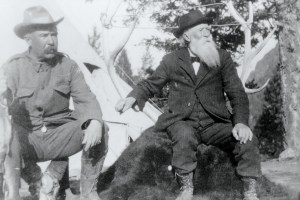
In 1903 President Theodore Roosevelt invited John Burroughs to join him on a two-week trip to Yellowstone National Park. At the time, Burroughs was a very popular writer whose nature essays were compared to those of Henry David Thoreau.
Theodore Roosevelt and John Burroughs
Roosevelt and Burroughs had built a long-term friendship on their mutual respect and love of the nature. They corresponded regularly, mostly about natural history. For some reason the president called Burroughs “Oom John.”
The pair crossed the country in Roosevelt’s private Pullman car stopping at cities and towns where the president met local dignitaries and gave speeches. Between cities the president reminisced about his life as a rancher and sportsman.
When they reached the entrance of the park at Gardiner, the Roosevelt left reporters and his secret service guards behind and went through the park accompanied only by Burroughs, Park Superintendent John Pitcher and a small entourage.
The 65-year-old Burroughs was afraid he wouldn’t be able the keep up with the 44-year-old president who had a larger-than-life reputation for physical stamina. Here’s Burroughs’ description of what happened when the pair went skiing.
∞§∞
At the Canyon Hotel the snow was very deep, and had become so soft from the warmth of the earth beneath, as well as from the sun above, that we could only reach the brink of the Canyon on skis. The President and Major Pitcher had used skis before, but I had not, and, starting out without the customary pole, I soon came to grief. The snow gave way beneath me, and I was soon in an awkward predicament. The more I struggled, the lower my head and shoulders went, till only my heels, strapped to those long timbers, protruded above the snow. To reverse my position was impossible till some one came, and reached me the end of a pole, and pulled me upright. But I very soon got the hang of the things, and the President and I quickly left the superintendent behind. I think I could have passed the President, but my manners forbade. He was heavier than I was, and broke in more. When one of his feet would go down half a yard or more, I noted with admiration the skilled diplomacy he displayed in extricating it. The tendency of my skis was all the time to diverge, and each to go off at an acute angle to my main course, and I had constantly to be on the alert to check this tendency.
Paths had been shoveled for us along the brink of the Canyon, so that we got the usual views from the different points. The Canyon was nearly free from snow, and was a grand spectacle, by far the grandest to be seen in the Park. The President told us that once, when pressed for meat, while returning through here from one of his hunting trips, he had made his way down to the river that we saw rushing along beneath us, and had caught some trout for dinner. Necessity alone could induce him to fish.
Across the head of the Falls there was a bridge of snow and ice, upon which we were told that the coyotes passed. As the season progressed, there would come a day when the bridge would not be safe. It would be interesting to know if the coyotes knew when this time arrived.
The only live thing we saw in the Canyon was an osprey perched upon a rock opposite us.
Near the falls of the Yellowstone, as at other places we had visited, a squad of soldiers had their winter quarters. The President always called on them, looked over the books they had to read, examined their housekeeping arrangements, and conversed freely with them.
In front of the hotel were some low hills separated by gentle valleys. At the President’s suggestion, he and I raced on our skis down those inclines. We had only to stand up straight, and let gravity do the rest. As we were going swiftly down the side of one of the hills, I saw out of the corner of my eye the President taking a header into the snow. The snow had given way beneath him, and nothing could save him from taking the plunge. I don’t know whether I called out, or only thought, something about the downfall of the administration. At any rate, the administration was down, and pretty well buried, but it was quickly on its feet again, shaking off the snow with a boy’s laughter. I kept straight on, and very soon the laugh was on me, for the treacherous snow sank beneath me, and I took a header, too.
“Who is laughing now, Oom John?” called out the President.
The spirit of the boy was in the air that day about the Canyon of the Yellowstone, and the biggest boy of us all was President Roosevelt.
 I’ll return to the lobby of Old Faithful Inn on Saturday and Sunday (August 20 and 21) to sign copies of my book Adventures in Yellowstone: Early Travelers Tell Their Tales. It’s a great venue and I always have fun there.
 They armed me with a salt shaker and I spent the afternoon trying to get close enough to a bird to salt its tail. Not until my brothers came home from school and started laughing at me did I get the joke.
 Because the grizzlies are shy and tend to be nocturnal, Wright said, chances of taking a daylight photo were slim, so he began experimenting with ways to use batteries and tripwires to ignite flash powder. By 1906 he had perfected his techniques enough to go to Yellowstone Park to try them out.



 M. Mark Miller, Author