Category: Yellowstone Stories

  • A Tale: Touring Yellowstone Legally by Car — 1916

    In 1902 when Henry G. Merry raced his 1897 Winton past the cavalry at the North Entrance to Yellowstone Park, the soldiers mounted their horses and chased him down. They took Merry to the Park Superintendent who chastised him and had him escorted out, but not until the Superintendent got a ride in the new fangled contraption. Cars were forbidden because people thought they would frighten wildlife and the horses used by other travelers.

    In 1915 when cars were officially allowed in the park, the action transformed the Yellowstone experience.  As the story below shows, fears of auto-induced mayhem proved to be unfounded.

    ∞§∞

    At the Park boundary is the soldier station. Fortunately the regulations are easily complied with, and in a few minutes the speedometer is again registering the speed limit. One season’s operation of the automobile regulations demonstrated to the powers that be that the average motorist is a saner and more reasonable being than was at first supposed; as a consequence, there has been a considerable downward revision of the rules governing his actions.

    Shortly after the entrance is passed the grade becomes noticeably steeper, and leaving the stream that has been so closely followed, a sharp rise carries the road over the divide through Sylvan Pass at an altitude of eight thousand four hundred feet. Gliding down the western slope through the cool, silent forests affords an indescribably keen enjoyment, and the motorist must have travelled far who has experienced roads as well built and maintained as this, more than a mile and a half above sea-level in the midst of rugged mountain summits.

    Eleanor and Sylvan Lakes are skirted in turn; the latter a dainty body of water set in the depth of an alpine forest and guarded by a grim peak at its head. The waving pines on the islets that dot its surface and the dense growth along its shores dispel any thought of the short distance to timber-line and eternal snow. As the road continues down a gently winding course all expectations are centred on Yellowstone Lake, till at last it flashes afar off through the pines—a great body of water scintillating under the turquoise brilliance of a Wyoming sky. In another instant it is gone and the road turns to hurry down to it in a flowing ribbon that stretches ahead as far as the eye can reach through the forest and across many a meadow of luxuriant grass.

    Half hidden in the long grass of these mountain parks scattered herds of elk and deer may be seen grazing within a few hundred feet of the road, and not even the rasping shriek of the electric horn seems to disturb the peaceful and contented existence of nature’s animals. Prior to the admittance of horseless vehicles to the Park, it was argued that the smell and the unnatural noise of the motors would drive the animal life away from the roads and would bring to an end one of the most fascinating features of this wonderland.

    When, however, the whir of the motor as it toils up the rugged heights of Mt. Washburn, and passes almost unnoticed within two hundred yards of a band of the most wary of wild animals, the Rocky Mountain sheep, and when at night the bears, having feasted on ”beefsteaks that have proved too tough for the tourists,” make bold actually to clamber into the motor-cars and despoil seat cushions in search of sweets unwittingly left in side pockets, it will be appreciated that the contention that the motor-car would frighten these animals was quite without foundation. The whole atmosphere of Yellowstone seems to exert a soothing effect on both man and beast, and it is said that “Even broncs won’t buck in the Park.”

     ∞§∞

    —   Excerpt and photo from Charles J. Beldon “The Motor in Yellowstone,” Scribners Magazine, 63:673-683 (1918).

    — You also might enjoy Henry G. Merry’s story about the first car in Yellowstone.

  • A Tale: A Mother Takes Her Seven Children to Yellowstone Park — 1903

    In 1903, Eleanor Corthell bought a team of horses and a spring wagon to take her seven children to Yellowstone Park. She told the seller to send his bill to her husband, Nellis Corthell, a prominent Laramie lawyer. Nellis tried to talk Eleanor out of the trip, but in the end, she said, all he could do was “fizz and fume and furnish the wherewithal.”

    Here are some excerpts from Mrs. Corthell’s account of her family’s adventures.

    ∞§∞

    Nearly half a lifetime I have lived in Laramie, with all the while a great longing to see the wonders of the Yellowstone, in season, out of season, when the house was full of babies—even when it was full of measles. As the older children outgrew marbles and dolls, I conceived the bold idea of stowing them all in a prairie schooner and sailing away over the Rocky Mountains, deserts, forests and fords to the enchanted land five hundred miles away.

    My husband offered strenuous objection, of course, to the crazy project, but could only fizz and fume and furnish the wherewithal—for the reasons advanced he found irresistible, such an ideal vacation for the children. A chance for their botany, geography, zoology, to be naturalized. To be drivers and cooks would throw them on their own resources somewhat, a valuable education in itself. So economical, too! Such a fine opportunity for stretching of legs and lungs, with the Park at the end! Reasons to turn a man’s head, you see, so when the boys wrote along the wagon top ” Park or Bust,” that settled it, and we started July 4th, 1903.

    After traveling several days, Mrs. Corthell wrote:

    Everybody is growing handy, even expert, in camp work. The boys can skin a cottontail or dress a sage hen equal to Kit Carson himself, while daughter can prepare a savory dinner or pack a mess box good enough for an army general. The children are eagerly interested in everything they see, hear or can catch. Tad announces that we have seen nine horned toads, caught six, mailed three and have two packed in little tablet boxes with which to surprise the chum at home. Query: Where is the medicine that was in the boxes?

    At the Paint Pots near West Thumb on Lake Yellowstone, Eleanor was vigilant.

    I was kept busy counting the children. Every time one of them moved I was certain he would stumble into one of the boiling, walloping vats of mud. That the mud was delicate rose, emerald green, or heavenly blue did not reassure me in the least. But the children simply laughed. Even the youngest pertly informed me he had not come all the way to Yellowstone Park to fall into a mud hole. Still the horrid smells and the horrible groans and growls, and the gaping mouths clear to Hades aroused such emotions of terror in me that in sheer desperation I hurried over to the lake.

    Eleanor summarized the trip this way:

    Like everybody else, we loved Old Faithful and the Morning Glory, we feared Excelsior, we admired the Giant, Bee Hive, Punch Bowl and a hundred other yawning chasms and smiling springs and spouting geysers. But the horrible rumbling—as if an earthquake were imminent—and the smell of brimstone made me eager to get my brood into the valley of safety beyond the Yellowstone.

    Altogether we traveled twelve hundred miles, stood the journey well, and never, never had such a wonderful, delightful summer. The children will have lifelong memories of the grandest scenes the world can produce.

    ∞§∞

    — Excerpts from “A Family Trip to the Yellowstone” by Mrs. N. E. Corthell, The Independent, June 29, 1905.

    — Photo from the Pioneer Museum of Bozeman.

    — You can read Eleanor Corthell’s complete story about her family trip in my book, Adventures in Yellowstone.

    — You also might enjoy Mrs. Corthell’s story about chasing a bear away from her bean pot.

  • A Tale: Stampeded by an Umbrella — Wingate, 1885

    General George W. Wingate, a wealthy New Yorker, took his wife and 17-year-old daughter to Yellowstone Park in 1885. Although there were roads by then, the Wingates decided to travel on horseback and the women rode sidesaddle. Here’s General Wingate’s description of an incident that occurred while the ladies were riding through the Paradise Valley north of Yellowstone Park.

     ∞§∞

    Hemmed in on every side by high mountains every breath of air was excluded, while the sun beat into it like a furnace; consequently the ride was very hot and tiresome. The heat was so great that the ladies got out their umbrellas from the wagon and raised them, but slowly with great care, for fear of stampeding the ponies who were not familiar with those refinements. The horses, however, were tired and languid from the heat and paid no attention to them so the rode forward in comfort.

    As we reached the end of the valley, where the Park branch of the Northern Pacific terminates, a dashing young ranchman rode out from behind some buildings. He had a spirited horse and rode well—and he knew it. Ladies were scarce in the valley, and the opportunity to display his horsemanship and personal graces to two at once was not to be thrown away. So he swung his horse around and rode towards us, making his steed curvet and prance, while he swayed to the motion as easily and gracefully as if in an armchair.

    While we were admiring him, a sudden gust of wind came whirling out of a canyon. It caught my daughter’s umbrella and instantly turned it inside out, with a loud “crack.” At the unwonted sight and sound, our horses roused from their lethargy, simultaneously reared, snorted and bolted in different directions, and at their top speed.

    The steed of our gallant ranchman was even more frightened that ours. It ran half a mile with him, and as we last saw him he had all he could do to keep it from dashing into a barbed wire fence. The change from his jaunty air to that of anxiety to keep the horse out of the fence was sudden and ludicrous. I fear his pride had a sad fall.

    We could do nothing with the horses until May threw away her unbrella, and even then none of our steeds would approach it.  As [our guide] Fisher said, “umbrellas and cayuses don’t agree.”

    ∞§∞

    — Text adapted from Through Yellowstone on Horsback by George W. Wingate, 1886

    — Detail from illustration in Wingate’s book.

    — You also might enjoy “Little Invulnerable,” N.P. Langford’s description of the antics of an undersized horse.

  • A Tale: Rumors of Wonders on the Upper Yellowstone — New York Times 1867

    Thumb Paint Pots

    After the Montana gold rush of 1863, groups of prospectors began scouring the area that became Yellowstone Park for gold. Occasionally their reports appeared in territorial newspapers. According to conventional wisdom, however, newspapers in the states (as opposed the the territories) were always skepical about reports of wonders on the upper Yellowstone until the famous of Washburn Expedition of 1870. This report from the September 14, 1867, issue of The New York Times proves that wasn’t always the case, although the reports of “blue flame” and “molten brimstone” don’t match any known features of the area today and show that some skepticism was in order.

    ∞§∞

    The Montana Post says that an exploring party, which has been to the headwaters of the Yellowstone River, has just returned and reports seeing one of the greatest wonders of the world. For eight days, the party traveled through a country emitting blue flame and a living stream of molten brimstone. The country was smooth and rolling, a long level plain intervening between roiling mounds. On the summits of the roiling mounds were craters for 4 to 6 inches in diameter, from which streamed a blaze and constant whistling sound. The hollow ground resounded beneath our feet as they traveled and every moment seemed to break through. Not a living thing was seen in the vicinity. The explorers gave it the significant appellation of hell.

    ∞§∞

    — New York Times, September 14, 1867, page 1.

    — Ashahel Curtis Postcard, Copperplate Photo Gallery

  • A Tale: To the Base of the Lower Fall of the Yellowstone

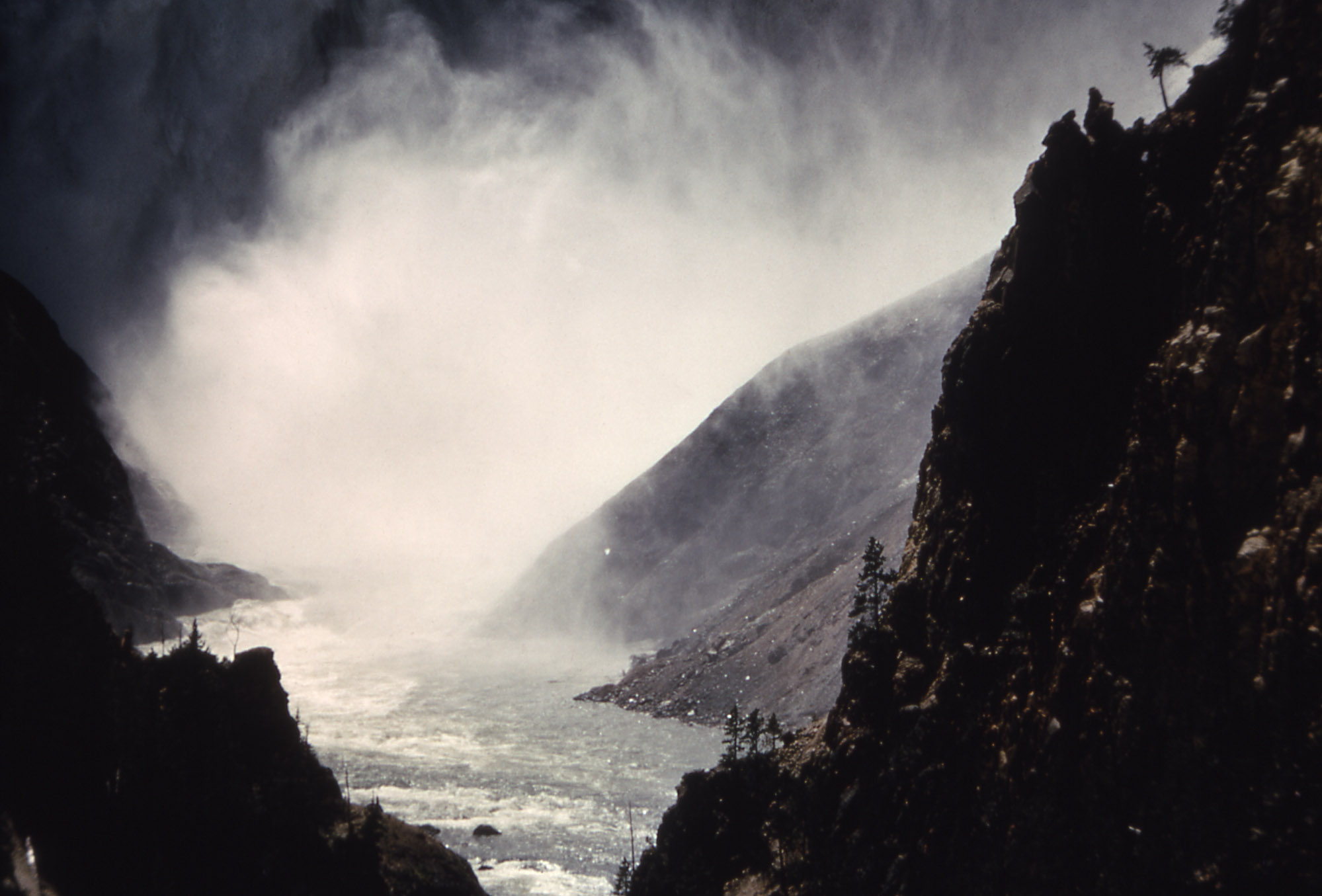
    Spray at the base of the Lower Fall

    In 1909 travel writer F. Dumont Smith published  this account of his hike to the base of the Lower Yellowstone Fall. Smith went down the canyon with two friends, Dudgeon and a man he called “the Banker.” Apparently, there were no stairs there at the time.

    ∞§∞

    We found the little path that descends to the bottom of the gorge, tied our horses, and started down. At the brink there was a sign that remarked, in the most casual way, “Danger.” Dudgeon and I had a discussion as to whether it meant bears or female tourists, Dudgeon holding to the latter view. In the meanwhile, the Banker had plunged down and we followed.

    If I had been in the lead, I should have abandoned the expedition right there; but Dudgeon and the Banker had gone and I was ashamed not to follow. At the bottom of the cleft there was a sheer descent.

    At the bottom, we found a long ridge, fifty feet above the water that envisaged the fall. For myself, I was content to rest there while Dudgeon and the Banker pursued a path of slippery granite to the bottom of the gorge, where the water ran blue and white, full of foam from its mad descent above. While it frothed and fumed and made much of itself, it was not alarming for the Yellowstone seems but a shallow brook there, between those vast walls, dwarfed by the fall and the great canyon.

    From the very bottom springs one great wonderful rainbow, a perfect arch, as steadfast as though it were of steel, one foot resting on the whirlpool and the other on the rock at the right. And two hundred feet above, where one little spurt of spray strikes a jut of stone, is a baby rainbow that comes and goes.

    Above me loomed that awful chasm that must be climbed. It hung over me—settled on my spirits. I tried to smile; to admire the falls; I tried to enjoy that wonderful gorge, with its coloring, its beauty, its charm. I watched an eagle leave his eyrie on the very edge of the canyon and soar above me, wings atilt, without movement, and I led my companions into a discussion of flying machines and the problem of aviation. I drew their attention to a place on the rocks opposite, where the continuous spray had mottled its somber brown with a living green of moss.

    I did everything that would hold their attention and postpone the hour when I must start back. At last, every subject exhausted, the Banker suddenly started upward. From our little cliff that overhung the maelstrom, the path led up a bare rock. When I looked at it in cold blood, I wondered how I ever descended it without wings. I knew in my heart that I could never get back, but the Banker started.

    It was a sheer cliff, with here and there a crack, a toe-hold, or finger-hold as far apart as one could reach. I saw him toilsomely reach from one to the other, spread-eagled against the rock face. At one place, a rock, that he grasped with his right hand, as he threw his weight on it, gave way, glanced over his arm, and just missed his head. He swung far outward and I shuddered. I thought he was gone, and his body a mangled mass on the rocks a hundred feet below. By a miracle, his left hand held, and he still pursued his way, inch by inch.

    I said to Dudgeon, “I never can make that, but you must stay below and catch me if I slip.” And Dudgeon smiled.

    Like most men, I am a coward when there is no one around. Here were no admiring crowds to see me risk my life. No one but Dudgeon. How I scaled that awful cliff, I shall never know. I think I was years doing it. I hung there, sometimes by two fingers of each hand, my toes inserted into some tiny crack, panting for breath, benumbed, speechless, sweating at every pore. Sometimes it seemed hours before I could move.

    I was safe enough as long as I stood still. My body in my anguish put out spores and tentacles that grasped the rock. I was for a time a limpet, one of those intermediate forms of life that cling and cling and never move.

    It was when I tried to progress that the strain became too great. The Banker had vanished. Dudgeon was somewhere far above me whistling “My Bonnie,” and there I clung, a mere gastropod. I doubt if, in those awful moments, I had any more intelligence than a vegetable. All I felt was fear—fear of those spear-like rocks down there below me.

    What a curious thing pride is! If I had been alone with Dudgeon I should have called for rope and tackle and a hoisting engine. But the Banker had passed before me, and so, however Dudgeon smiled, I could not quit.

    I knew that, at the very top, awaited me that terrible rocky slide, almost perpendicular and slimed with past ages of moisture. When I thought of that I was ready to die, but when I had attained it, there, hanging from the top of the path, was a rope.

    Somehow I grasped that rope. Somehow I scrambled up that rocky slide by its aid and sank half fainting at the top. There was not air enough in the universe to satisfy me. The wide scope of the heavens, of the starry skies, did not contain enough atmosphere to fill my starved and laboring lungs.

    Slowly and painfully the Banker and I climbed the rest of the hill. Slowly and painfully we got into our surrey. Meanwhile Dudgeon had danced and jigged his way up those slopes, whistling “My Bonnie,” and, when we finally seated ourselves in the surrey, he was as unbreathed as though he had just finished a two-step.

    If you go down the corridor of the Canyon Hotel, and turn to the right, at the second door you can find something in a glass with ice in it; and there once more Dudgeon smiled.

    ∞§∞

    —   Abridged from F. Dumont Smith, The Summit of the World: A Trip Through Yellowstone Park, 1909.

    —   Photo, Yellowstone Digital Slide File.

    You might enjoy Louis Downing’s story about going to the base of the Fall down Uncle Tom’s Trail.

  • A Tale: Army Bicyclists Visit Yellowstone Park — 1896

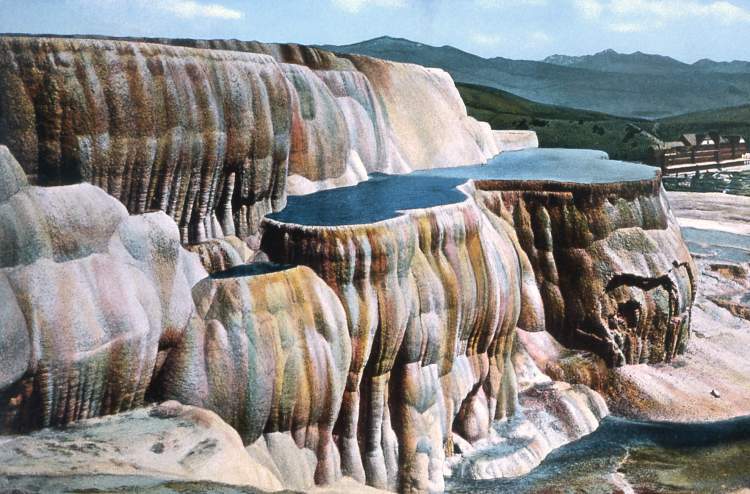
    One of the best-known photographs of Yellowstone Park shows eight uniformed men standing with their bicycles on Minerva Terrace at Mammoth Hot Springs in 1896. They were members the 25th Infantry, U.S. Army Bicycle Corps, a unit of African-American soldiers with white officers.

    The unit from Fort Missoula was on maneuvers to test the utility of bicycle soldiers. By the time they reached Mammoth, the soldiers had already set up relays to demonstrate they could move messages quickly, and sneaked up on an army camp to show they could spy silently. They had traversed primitive roads, forded streams, climbed fences and traveled up to 90 miles a day—with each man hauling more than 70 pounds of food and equipment.

    The Lieutenant in charge said the maneuvers demonstrated the “practicability of the bicycle for military purposes, even in a mountainous country. The matter was most thoroughly tested under all possible conditions—we made and broke camp in the rain; we traveled through mud, water, sand, dust, over rocks, ruts, etc.; for we crossed and recrossed mountain ranges, and forded streams, carrying our rations, rifles, ammunition, tents, blankets, extra underwear, medicines, tools, repairing material, cooking-utensils and extra bicycle parts.”

    ∞§∞

    — Information from “Recent Experiments in Infantry Bicycling Corps,” by Lieutenant James a Moss, Outing: An Illustrated Monthly Magazine, 1896-97.

    — Colorized photograph by F. Jay Haynes.

    Learn more about Army 25th Infantry Bicycle Corps.

  • A Tale: The Facts Are Tangled, But The Stagecoach Robbery Stories Are Fun

    When I got to the Pioneer Museum on Friday for my afternoon of volunteer work, Associate Director Ann Butterfield told me, “I found something that might interest you.” After a few minutes of her muttering “now where did I see that thing,” she pulled out a file folder entitled “QK Club.” QK stands for “quest for knowledge.” The club began in Bozeman in the 1920s and still meets monthly.

    At its meetings, members present learned papers and other members offer critiques on topics ranging from the death of Montana pioneer John Bozeman to the future of nuclear power. The paper Ann handed me contained a marvelous descriptions of stagecoach robberies in Yellowstone National Park.

    It was written by Jefferson Jones, long time publisher of The Bozeman Daily Chronicle, who was critiquing a paper entitled “Road Agents of Early Yellowstone National Park” by the famous Yellowstone photographer, Jack E. Haynes. In it, Jones quoted an interview with Lester Piersdorff, a Bozeman pioneer who claimed to be a witness to “the holdup of the park stages on October 14, 1897.” Piersdorff, who was in his 80s at the time of the interview, also said he knew about a stagecoach robbery in the 1880s, a that Haynes apparently hadn’t heard of.

    The first thing I did was dig through the collection of QK Club papers held at the Pioneer Museum to look for the Haynes paper. Supposedly, it was presented on October 21, 1952, and the Museum’s collection begins with 1956, so I decided to look for it later in the more extensive collection at Montana State University.

    The Museum has an index of QK Club papers that runs back to 1923, so I decided to look there. Not only did the index fail to list a paper by Jack E. Haynes, it didn’t even show a meeting on October 21, 1952.

    Next, I decided to check the Museum’s vertical files to see if there was a folder on Piersdorff, who sounded like a very colorful character. I went through the file drawers asking myself “was that ‘I’ before ‘E’ or ‘E’ before ‘I.’”I checked both spellings and was getting ready to give up when I saw a file labeled “Pierstorff,” with a “T.”  I pulled it out and there was a photo of “Lester Pierstorf” peering out from under a hat with a pipe protruding from his walrus mustache. It was a great picture, so I checked the Museum’s photo archive for it—no luck!

    Another clipping in the folder had a headline “Masked Bandits Loot 19 Stages; Lester Piersdorff Driver of One.” This time the spelling went back to “Piersdorff” with a “d,” but said he was a driver in robberies in 1897, but didn’t mention the robbery in the 1880s that he described to  Jones. Also, the clipping (from an unnamed source) had a different date for the robbery. Jones said it happened on August 14, but the clipping said August 7.

    Tired of the contradictory evidence, I decided to look up stagecoach robberies in Aubrey Haines definitive history of Yellowstone Park, The Yellowstone Story. (That’s Haines, the historian, not to be confused with Haynes, the photographer.) Sure enough, historian Haines reports the story that Jones attributes to Piersdorff, but he introduces it this way, “The holdup incident spawned a legend. Jefferson Jones told it this way.” Then Haines offers the story in the identical words that Jones attributed to Piersdorff.

    After repeating the story, Haines says: “It is a beautiful little story, but there is no truth in it.” In a footnote he says, “Told to J.E. Haynes during a discussion of his article “Yellowstone’s Stage Holdups,” [probably by Jones].

    So for what it’s worth, here’s Piersdorff’s account of stagecoach holdup in the 1880s.

    ∞§∞

    The circumstances of the holdup, as I recall them, were somewhat as follows:

    Major McDougle, paymaster of the army in the park, traveling in an ambulance with a bodyguard of six soldiers rounded a turn in the road at Eagles Nest on the Gardner River to find himself confronted by nine mounted road agents, dressed in military uniform, carrying army carbines and their horses bore regulation army saddles and saddle bags.

    Until the command “Hands Up” was issued, Major McDougle though he was looking at a cavalry patrol out on a morning maneuver. With the McDougle party covered by rifles, one road agent dismounted and searched the group for rifles and revolvers, which he took from the men and heaved into the nearby Gardner River.

    He then went to work breaking open the army chest containing $40,000 in gold, all sacked. As the road agent lifted out a sack, he would place it in the saddlebag of one of his confederates. When the robbery was completed, the men saluted the Major and rode down the road toward Gardiner.

    The robbery created much talk at the time, but the men were never apprehended nor the money recovered.

    [Piersdorff then continue with corrections to things Jack Haynes had reported about the 1897 robberies.]

    Jack is in error in stating that only six stagecoaches of the Yellowstone Park Transportation Company were involved in the August 14, 1897, holdup. There were 15 stages in all. [Various accounts put the number of coaches robbed at 6, 15 and 19.] Jack mentions loot taken in that robbery was $400. Not counting the jewelry taken there was approximately $8,000 cash split by the two road agents from that holdup, as I shall tell you about.

    Passengers in the last stagecoach were never robbed and only half of the passengers in Steele’s stage were robbed because at that moment the two road agents spied a Corporal and soldier riding on the old freight road near Spring Creek not far distant and the road agents evidently decided to pull out.

    As Jack states in his paper, I happened to eat opposite Gus Smitzer and George Heeb at the employees’ mess at Canyon the night before the holdup. It was then that I first noted Heeb had a bad scar on his right hand between the thumb and first finger. I little realized at the time how important that scar was to loom in just 14 hours.

    When the following morning the holdup occurred on the Canyon-Norris road, I turned to my passenger in my stage and said: “There’s a holdup going on here and if you have any valuables you better pass them to me.” Purses, billfolds, watches and the like, were all handed to me and I shoved them under the driver’s seat in a water bucket.

    Shortly afterwards when a road agent, who proved to be Heeb, stood opposite us on a bank and shouted, “This is a holdup. Give me your valuables,” only some $15 in loose cash from the pockets of my passengers was handed down. The valuables in the water bucket were never touched.

    The bandit, who had sewed together flour sacks over his head, that extended down to his waist, though which his arms protruded and which had holes for the eyes, pointed his revolver at me with his announcement, “This is a holdup.”

    Being in a higher position on the driver’s seat of the stage than he was, I looked down at the gun. As Jack in his account states, the men had covered their hands with charcoal. I noticed that the right hand of the road agent, which held the revolver, had a scar between the thumb and first finger to which the charcoal had not adhered. I noticed, too, as the road agent held his gun up toward me that the trigger guard had a peculiar “S” mark inscribed on it. When Heeb was captured later, he was carrying a gun with an “S” on the trigger guard. Testimony regarding the scar on Heeb’s right hand and his revolver with the “S” marking I gave in court at the Cheyenne trial was part of the evidence that convicted him.

    ∞§∞

    — Story from the Pioneer Museum of Bozeman.

    — Image, Coppermine Photo Gallery.

    — You might also enjoy

  • A Tale: A Battle With Fleeing Nez Perce — 1877

    My next book, Encounters in Yellowstone 1877, will tell the stories of the several groups of tourists who tangled with the Nez Perce while they fled through Yellowstone Park after the Big Hole Battle.

    Mammoth Hot Springs

    The Army’s pre-dawn attack on the sleeping Indian camp left dozens of women and children dead, which enraged many young Indians. Despite chiefs’ efforts to avoid whites, several groups were attacked in or near Yellowstone Park.

    The most famous encounter is Emma’s Cowan’s ordeal of being captured, but there are other chilling events. Andrew Weikert was touring with a group of young men when they spotted the Indians a few miles south of Mammoth Hot Springs. The group beat a hasty retreat to thick grove of trees and spent the night hiding. The next morning, Weikert and a companion named Wilkie decided to leave the others in camp and go see if the Nez Perce had moved on. Here’s how Weikert described what happened.

    ∞§∞

    We could see where the Indians and their horses had made a trail, so we thought the coast was clear. We started back for camp, but, we ran against an obstacle that made our hair raise and the blood rush to our faces.

    We had gotten into the timber not more than a quarter of a mile when we ran onto a lot of the redskins lying in wait for us. They were under the hill, behind a log, so we did not see them until we got within about seventy-five feet.

    I was riding ahead when I saw them raise up their heads from behind the log. I told Wilkie there were Indians ahead and wheeled my horse. At the same time I was getting my gun up ready to fire. Looking back I saw half a dozen guns leveled at me so I made myself small as I could, with my gun across my knees.

    Bang! bang! bang! then zip! zip! zip! went the balls, but none struck me that time. I was perfectly cool and self-possessed, but will own up that my hair was standing on end when I first saw them. My horse had made a few more jumps, when bang! they went again.

    This time they were a little more successful, for they cut a crease in my shoulder blade about four inches long; did not break a bone, but splintered my shoulder bone a little. And another ball took a piece out of my gunstock. I then began hugging my horse still closer, if such a thing was possible, when they gave us another volley.

    By this time, we were out of range, but the balls flew past thick and fast and we could hear them strike the trees. Now for a race!

    I supposed that they had their horses close at hand, but they did not mount them just then. Just at this time, my horse tripped his foot and fell and came near turning a somersault. I went sprawling on the ground directly in front of him.

    My shoulder was paining considerably, but I did not have long to remain there, for the ‘reds’ were running up again to get another shot at me. I up and let them have one from my repeater. You ought to have seen them dodge. I did this all in a few seconds, and my horse was on his feet again ready to start. I just put my hand on the horn of the saddle, made a bound into it, and was off.

    Wilkie had gotten considerably ahead of me by this time, but I soon made up for lost time. We got back on the prairie again on Alum Creek in the valley, then back in the timber again. The Indians did not follow us. We rode as far as we could, then took it afoot, for the under-brush was so thick that we could hardly get our horses through.

    After we got into the timber quite a ways, we halted to take breath and to see what damage was done. Wilkie asked me if I was hurt; I told him judging from the hole in my shirt on the right shoulder, and the way the blood was running in my boot, I thought that there must be a scratch at least.

    We examined it and bound it up the best we could. Wilkie, being a safe distance from the Indians, did not get hurt. We looked our horses over, and found them all sound, thank fortune. So we mounted and took our direction for camp, rode as lively as we could in hopes that the reds had not been there so we could warn the boys.

    ∞§∞

    —Adapted from Weikert’s Journal published in Contributions to the Montana Historical Society, 1900.

    — Frank J. Haynes postcard, Coppermine Photo Gallery.

    — You might also enjoy:

  • A Tale: Crashing Through Yankee Jim Canyon in a Wooden Boat — c. 1902

    Today it’s easy to hire a boat with a guide to run the rapids through Yankee Jim Canyon north of Yellowstone Park. But that wasn’t always the case, as Lewis Ransome Freeman discovered more than a hundred years ago.

    After graduating from Stanford University in 1898, Freeman decided to become an adventurer and traveled America, Asia, Africa and the Pacific Islands. About 1902, after snowshoeing through Yellowstone Park, he decided to float to the Gulf of Mexico down the Yellowstone, Missouri, and Mississippi Rivers. His first obstacle was to get through Yankee Jim Canyon, a rugged streatch of the Yellowstone River just north of the Park.

    Freeman solicited help from Yankee Jim George, a colorful character who had lived for 30 years  in the canyon that bears his name. The government had taken over Jim’s toll road by then, but he still provided accommodations in his rustic cabin. And, he knew where Freeman could get a boat.

    Freeman covered the Russo-Japanese War beginning in 1905 and continued to work as a war correspondent through World War I. It wasn’t until 1922 that he published this description of running the rapids of Yankee Jim Canyon.

    ∞§∞

    The boat I secured about ten miles down river from the Park boundary. The famous “Yankee Jim” gave it to me. This may sound generous on Jim’s part, but seeing the boat didn’t belong to him it wasn’t especially so. Nor was the craft really a boat.

    We found the craft where it had been abandoned at the edge of an eddy. It was high and dry on the rocks. Plain as it was that neither boat-builder nor even carpenter had had a hand in its construction, there was still no possible doubt of its tremendous strength arid capacity to withstand punishment.

    Jim said that a homesick miner had built this fearful and wonderful craft with the idea of using it to return to his family in Hickman, Kentucky. He had bade defiance to the rapids of the Yellowstone with the slogan “HICKMAN OR BUST.” Kentucky Mule he had called it.

    Our plan of operation was something like this: Bill and Herb, the neighboring ranchers, were to go up and help me push off, while Jim went down to the first fall at the head of the Canyon to be on hand to pilot me through. If I made the first riffle all right, I was to try to hold up the boat in an eddy until Jim could amble down to the second fall and stand-by to signal me my course into that one in turn. And so on down through.

    I was to take nothing with me save my camera. My bags were to remain in Jim’s cabin until he had seen me pass from sight below the Canyon. Then he was to send the stuff on to me at Livingston

    As I swung round the bend above the head of the Canyon, I espied old Jim awaiting my coming on a rocky vantage above the fall. A girl in a gingham gown had dismounted from a calico pony and was climbing up to join us. With fore-blown hair and skirt, she cut an entrancing silhouette against the sun-shot morning sky.

    I think the presence of that girl had a deal to do with the impending disaster, for I would never have thought of showing off if none but Jim had been there. But something told me that the exquisite creature could not but admire the sang froid of a youth who would let his boat drift while he stood up and took a picture of the thundering cataract over which it was about to plunge.

    And so I did it—just that. Then, waving my camera above my head to attract Jim’s attention to the act, I tossed it ashore. That was about the only sensible thing I did in my run through the Canyon.

    As I resumed my steering oar, I saw that Jim was gesticulating wildly in an apparent endeavor to attract my attention to a comparatively rock-free chute down the left bank. Possibly if I had not wasted valuable time displaying my sang froid I might have worried the Mule over in that direction, and headed right for a clean run through.

    As it was, the contrary brute simply took the bit in her teeth and went waltzing straight for the reef of barely submerged rock at the head of the steeply cascading pitch of white water. Broadside on she sunk into the hollow of a refluent wave, struck crashingly fore and aft, and hung trembling while the full force of the current of the Yellowstone surged against her up-stream gunwale.

    Looking back up-stream as the reeling Mule swung in the current, I saw Jim, with the Gingham Girl in his wake, ambling down the bank at a broken-kneed trot in an apparent endeavor to head me to the next fall as per schedule.

    Poor old chap! He was never a hundred-to-one shot in that race now that the Mule had regained her head and was running away down mid-channel regardless of obstacles. He stumbled and went down even as I watched him with the tail of my eye. The Gingham Girl pulled him to his feet and he seemed to be leaning heavily against her fine shoulder as the Mule whisked me out of sight around the next bend.

    With the steering oar permanently unshipped there was more difficulty than ever in exercising any control over the balkiness of the stubborn Mule. After a few ineffectual attempts, I gave up trying to do anything with the oar and confined my navigation to fending off with a cottonwood pike-pole.

    This really helped no more than the oar, so it was rather by good luck than anything else that the Mule hit the next pitch head on and galloped down it with considerable smartness. When she reeled through another rapid beam-on without shipping more than a bucket or two of green water I concluded she was quite able to take care of herself, and so sat down to enjoy the scenery.

    I was still lounging at ease when we came to a sharp right-angling notch of a bend where the full force of the current was exerted to push a sheer wall of red-brown cliff out of the way. Not unnaturally, the Mule tried to do the same thing. That was where I discovered I had over-rated her strength of construction.

    I have said that she impressed me at first sight as being quite capable of nosing the Rock of Gibraltar out of her way. This optimistic estimate was not borne out. That little patch of cliff was not high enough to make a respectable footstool for the guardian of the Mediterranean, but it must have been quite as firmly socketed in the earth. So far as I could see it budged never the breadth of a hair when the Mule, driving at all of fifteen miles an hour, crashed into it with the shattering force of a battering ram. Indeed, everything considered, it speaks a lot for her construction that she simply telescoped instead of resolving into cosmic stardust. Even the telescoping was not quite complete.

    The Mule had ceased to be a boat and become a raft, but not a raft constructed on scientific principles. The one most desirable characteristic of a properly built raft of logs is its stability. It is almost impossible to upset. The remains of the Mule had about as much stability as a toe dancer, and all of the capriciousness.

    She kept more or less right side up on to the head of the next riffle and then laid down and negotiated the undulating waves by rolling. I myself, after she had spilled me out at the head of the riffle, rode through on one of her planks, but it was a railroad tie, with a big spike in it, that rasped me over the ear in the whirlpool at the foot.

    And so I went on through to the foot of “Yankee Jim’s Canyon.” In the smoother water, I clung to a tie, plank or the thinning remnants of the Mule herself. At the riffles, to avoid another clout on the head from the spike-fanged flotsam, I found it best to swim ahead and flounder through on my own. I was not in serious trouble at any time, for much the worst of the rapids had been those at the head of the Canyon. Had I been really hard put for it, there were a dozen places at which I could have crawled out. As that would have made overtaking the Mule again somewhat problematical, I was reluctant to do it. Also, no doubt, I was influenced by the fear that Jim and the Gingham Girl might call me a quitter.

    Beaching what I must still call the Mule on a bar where the river fanned out in the open valley at the foot of the Canyon, I dragged her around into an eddy and finally moored her mangled remains to a friendly cottonwood on the left bank. Taking stock of damages, I found that my own scratches and bruises, like Beauty, were hardly more than skin deep. As the day was bright and warm and the water not especially cold, I decided to make way while the sun shone—to push on toward Livingston.

    The rest of that day’s run was more a matter of chills than thrills, especially after the evening shadows began to lengthen and the northerly wind to strengthen. The Mule repeated her roll-and-reduce tactics every time she came to a stretch of white water.

    There were only three planks left when I abandoned her at dusk, something over twenty miles from the foot of the Canyon, and each of these was sprinkled as thickly with spike-points as a Hindu fakir’s bed of nails. One plank, by a curious coincidence, was the strake that had originally borne the defiant slogan, “HICKMAN OR BUST.” Prying it loose from its cumbering mates, I shoved it gently out into the current.

    Spending the night with a hospitable rancher, I walked into Livingston in the morning. There I found my bags and camera, which good old “Yankee Jim” had punctually forwarded by the train .

    ∞§∞

    —   Condensed from Down the Yellowstone, Lewis Ransom Freeman, 1902.

    —   National Park Service Photo.

    — You might also enjoy “Rudyard Kipling Goes Fishing with Yankee Jim.”
  • A Tale: Ernest Thompson Seton Retells the Story of a Bear Fight

    Wahb, The Grizzly

    Some stories are just so good they deserve to be told twice. Ernest Thompson Seton, who was  an enomously popular writer, artist and naturalist at the dawn of the Twentieth Century, found one when he visited Yellowstone Park in 1898.

    At the time, watching bears at the garbage dumps near the park’s grand hotels was a spectacle not to be missed. One day Seton took his notebook, sketchpad and camera to the dump near the Fountain Hotel and hid out in the garbage to watch bears parade in and hold a banquet. That’s when he saw a mother black bear attack a huge grizzly to protect her sickly little cub.

    The incident not only provided material for Seton’s most famous short story, “Johnny Bear,” it also appeared in his book, The Biography of a Grizzly. The biography chronicles the life of Wahb, a grizzly who lived most of the year east of Yellowstone Park in an area called Meteetsee and was the scourge of ranchers there. But as Seton discovered, Wahb spent his summers dining in the dumps in Yellowstone Park. Here’s an excerpt from The Biography of a Grizzly.

    ∞§∞

    The Bears are especially numerous about the Fountain Hotel. In the woods, a quarter of a mile away, is a smooth open place where the steward of the hotel has all the broken and waste food put out daily for the Bears, and the man whose work it is has become the Steward of the Bears’ Banquet. Each day it is spread, and each year there are more Bears to partake of it. It is a common thing now to see a dozen Bears feasting there at one time. They are of all kinds—Black, Brown, Cinnamon, Grizzly, Silvertip, Roachbacks, big and small, families and rangers, from all parts of the vast surrounding country. All seem to realize that in the Park no violence is allowed, and the most ferocious of them have here put on a new behavior. Although scores of Bears roam about this choice resort, and sometimes quarrel among themselves, not one of them has ever yet harmed a man.

    Year after year they have come and gone. The passing travelers see them. The men of the hotel know many of them well. They know that they show up each summer during the short season when the hotel is in use, and that they disappear again, no man knowing whence they come or whither they go.

    One day the owner of the Palette Ranch came through the Park. During his stay at the Fountain Hotel, he went to the Bear banquet-hall at high meal-tide. There were several Blackbears feasting, but they made way for a huge Silvertip Grizzly that came about sundown.

    “That,” said the man who was acting as guide, “is the biggest Grizzly in the Park; but he is a peaceable sort, or Lud knows what ‘d happen.”

    “That!” said the ranchman, in astonishment, as the Grizzly came hulking nearer, and loomed up like a load of hay among the piney pillars of the Banquet Hall.” That! If that is not Meteetsee Wahb, I never saw a Bear in my life!  Why, that is the worst Grizzly that ever rolled a log in the Big Horn Basin.”

    ” It ain’t possible,” said the other, “for he ‘s here every summer, July and August, an’ I reckon he don’t live so far away.”

    “Well, that settles it,” said the ranchman; “July and August is just the time we miss him on the range; and you can see for yourself that he is a little lame behind and has lost a claw of his left front foot. Now I know where he puts in his summers; but I did not suppose that the old reprobate would know enough to behave himself away from home.”

    The big Grizzly became very well known during the successive hotel seasons. Once only did he really behave ill, and that was the first season he appeared, before he fully knew the ways of the Park.

    He wandered over to the hotel, one day, and in at the front door. In the hall he reared up his eight feet of stature as the guests fled in terror; then he went into the clerk’s office. The man said: “All right; if you need this office more than I do, you can have it,” and leaping over the counter, locked himself in the telegraph-office, to wire the superintendent of the Park: “Old Grizzly in the office now, seems to want to run hotel; may we shoot?”

    The reply came: “No shooting allowed in Park; use the hose.” Which they did, and, wholly taken by surprise, the Bear leaped over the counter too, and ambled out the back way, with a heavy thud thudding of his feet, and a rattling of his claws on the floor. He passed through the kitchen as he went, and, picking up a quarter of beef, took it along.

    This was the only time he was known to do ill, though on one occasion he was led into a breach of the peace by another Bear. This was a large she-Blackbear and a noted mischief-maker. She had a wretched, sickly cub that she was very proud of—so proud that she went out of her way to seek trouble on his behalf. And he, like all spoiled children, was the cause of much bad feeling. She was so big and fierce that she could bully all the other Blackbears, but when she tried to drive off old Wahb she received a pat from his paw that sent her tumbling like a football. He followed her up, and would have killed her, for she had broken the peace of the Park, but she escaped by climbing a tree, from the top of which her miserable little cub was apprehensively squealing at the pitch of his voice. So the affair was ended; in future the Blackbear kept out of Wahb’s way, and he won the reputation of being a peaceable, well-behaved Bear.

    ∞§∞

    — Excerpt from The Biography of a Grizzly, Ernest Thompson Seton, 1900.

    — The illustration is a detail from a drawing by Seton in the same source.

    — You might also enjoy:

    — Read Ernest Thompson Seton’s “Johnny Bear” in my book, Adventures in Yellowstone.

    — To find more stories about bears, click on “Bears” under the “Categories” button to the left.