Category: yellowstone

  • A Tale: Army Bicyclists Visit Yellowstone Park — 1896

    One of the best-known photographs of Yellowstone Park shows eight uniformed men standing with their bicycles on Minerva Terrace at Mammoth Hot Springs in 1896. They were members the 25th Infantry, U.S. Army Bicycle Corps, a unit of African-American soldiers with white officers.

    The unit from Fort Missoula was on maneuvers to test the utility of bicycle soldiers. By the time they reached Mammoth, the soldiers had already set up relays to demonstrate they could move messages quickly, and sneaked up on an army camp to show they could spy silently. They had traversed primitive roads, forded streams, climbed fences and traveled up to 90 miles a day—with each man hauling more than 70 pounds of food and equipment.

    The Lieutenant in charge said the maneuvers demonstrated the “practicability of the bicycle for military purposes, even in a mountainous country. The matter was most thoroughly tested under all possible conditions—we made and broke camp in the rain; we traveled through mud, water, sand, dust, over rocks, ruts, etc.; for we crossed and recrossed mountain ranges, and forded streams, carrying our rations, rifles, ammunition, tents, blankets, extra underwear, medicines, tools, repairing material, cooking-utensils and extra bicycle parts.”

    ∞§∞

    — Information from “Recent Experiments in Infantry Bicycling Corps,” by Lieutenant James a Moss, Outing: An Illustrated Monthly Magazine, 1896-97.

    — Colorized photograph by F. Jay Haynes.

    Learn more about Army 25th Infantry Bicycle Corps.

  • A Tale: The Facts Are Tangled, But The Stagecoach Robbery Stories Are Fun

    When I got to the Pioneer Museum on Friday for my afternoon of volunteer work, Associate Director Ann Butterfield told me, “I found something that might interest you.” After a few minutes of her muttering “now where did I see that thing,” she pulled out a file folder entitled “QK Club.” QK stands for “quest for knowledge.” The club began in Bozeman in the 1920s and still meets monthly.

    At its meetings, members present learned papers and other members offer critiques on topics ranging from the death of Montana pioneer John Bozeman to the future of nuclear power. The paper Ann handed me contained a marvelous descriptions of stagecoach robberies in Yellowstone National Park.

    It was written by Jefferson Jones, long time publisher of The Bozeman Daily Chronicle, who was critiquing a paper entitled “Road Agents of Early Yellowstone National Park” by the famous Yellowstone photographer, Jack E. Haynes. In it, Jones quoted an interview with Lester Piersdorff, a Bozeman pioneer who claimed to be a witness to “the holdup of the park stages on October 14, 1897.” Piersdorff, who was in his 80s at the time of the interview, also said he knew about a stagecoach robbery in the 1880s, a that Haynes apparently hadn’t heard of.

    The first thing I did was dig through the collection of QK Club papers held at the Pioneer Museum to look for the Haynes paper. Supposedly, it was presented on October 21, 1952, and the Museum’s collection begins with 1956, so I decided to look for it later in the more extensive collection at Montana State University.

    The Museum has an index of QK Club papers that runs back to 1923, so I decided to look there. Not only did the index fail to list a paper by Jack E. Haynes, it didn’t even show a meeting on October 21, 1952.

    Next, I decided to check the Museum’s vertical files to see if there was a folder on Piersdorff, who sounded like a very colorful character. I went through the file drawers asking myself “was that ‘I’ before ‘E’ or ‘E’ before ‘I.’”I checked both spellings and was getting ready to give up when I saw a file labeled “Pierstorff,” with a “T.”  I pulled it out and there was a photo of “Lester Pierstorf” peering out from under a hat with a pipe protruding from his walrus mustache. It was a great picture, so I checked the Museum’s photo archive for it—no luck!

    Another clipping in the folder had a headline “Masked Bandits Loot 19 Stages; Lester Piersdorff Driver of One.” This time the spelling went back to “Piersdorff” with a “d,” but said he was a driver in robberies in 1897, but didn’t mention the robbery in the 1880s that he described to  Jones. Also, the clipping (from an unnamed source) had a different date for the robbery. Jones said it happened on August 14, but the clipping said August 7.

    Tired of the contradictory evidence, I decided to look up stagecoach robberies in Aubrey Haines definitive history of Yellowstone Park, The Yellowstone Story. (That’s Haines, the historian, not to be confused with Haynes, the photographer.) Sure enough, historian Haines reports the story that Jones attributes to Piersdorff, but he introduces it this way, “The holdup incident spawned a legend. Jefferson Jones told it this way.” Then Haines offers the story in the identical words that Jones attributed to Piersdorff.

    After repeating the story, Haines says: “It is a beautiful little story, but there is no truth in it.” In a footnote he says, “Told to J.E. Haynes during a discussion of his article “Yellowstone’s Stage Holdups,” [probably by Jones].

    So for what it’s worth, here’s Piersdorff’s account of stagecoach holdup in the 1880s.

    ∞§∞

    The circumstances of the holdup, as I recall them, were somewhat as follows:

    Major McDougle, paymaster of the army in the park, traveling in an ambulance with a bodyguard of six soldiers rounded a turn in the road at Eagles Nest on the Gardner River to find himself confronted by nine mounted road agents, dressed in military uniform, carrying army carbines and their horses bore regulation army saddles and saddle bags.

    Until the command “Hands Up” was issued, Major McDougle though he was looking at a cavalry patrol out on a morning maneuver. With the McDougle party covered by rifles, one road agent dismounted and searched the group for rifles and revolvers, which he took from the men and heaved into the nearby Gardner River.

    He then went to work breaking open the army chest containing $40,000 in gold, all sacked. As the road agent lifted out a sack, he would place it in the saddlebag of one of his confederates. When the robbery was completed, the men saluted the Major and rode down the road toward Gardiner.

    The robbery created much talk at the time, but the men were never apprehended nor the money recovered.

    [Piersdorff then continue with corrections to things Jack Haynes had reported about the 1897 robberies.]

    Jack is in error in stating that only six stagecoaches of the Yellowstone Park Transportation Company were involved in the August 14, 1897, holdup. There were 15 stages in all. [Various accounts put the number of coaches robbed at 6, 15 and 19.] Jack mentions loot taken in that robbery was $400. Not counting the jewelry taken there was approximately $8,000 cash split by the two road agents from that holdup, as I shall tell you about.

    Passengers in the last stagecoach were never robbed and only half of the passengers in Steele’s stage were robbed because at that moment the two road agents spied a Corporal and soldier riding on the old freight road near Spring Creek not far distant and the road agents evidently decided to pull out.

    As Jack states in his paper, I happened to eat opposite Gus Smitzer and George Heeb at the employees’ mess at Canyon the night before the holdup. It was then that I first noted Heeb had a bad scar on his right hand between the thumb and first finger. I little realized at the time how important that scar was to loom in just 14 hours.

    When the following morning the holdup occurred on the Canyon-Norris road, I turned to my passenger in my stage and said: “There’s a holdup going on here and if you have any valuables you better pass them to me.” Purses, billfolds, watches and the like, were all handed to me and I shoved them under the driver’s seat in a water bucket.

    Shortly afterwards when a road agent, who proved to be Heeb, stood opposite us on a bank and shouted, “This is a holdup. Give me your valuables,” only some $15 in loose cash from the pockets of my passengers was handed down. The valuables in the water bucket were never touched.

    The bandit, who had sewed together flour sacks over his head, that extended down to his waist, though which his arms protruded and which had holes for the eyes, pointed his revolver at me with his announcement, “This is a holdup.”

    Being in a higher position on the driver’s seat of the stage than he was, I looked down at the gun. As Jack in his account states, the men had covered their hands with charcoal. I noticed that the right hand of the road agent, which held the revolver, had a scar between the thumb and first finger to which the charcoal had not adhered. I noticed, too, as the road agent held his gun up toward me that the trigger guard had a peculiar “S” mark inscribed on it. When Heeb was captured later, he was carrying a gun with an “S” on the trigger guard. Testimony regarding the scar on Heeb’s right hand and his revolver with the “S” marking I gave in court at the Cheyenne trial was part of the evidence that convicted him.

    ∞§∞

    — Story from the Pioneer Museum of Bozeman.

    — Image, Coppermine Photo Gallery.

    — You might also enjoy

  • A Tale: Crashing Through Yankee Jim Canyon in a Wooden Boat — c. 1902

    Today it’s easy to hire a boat with a guide to run the rapids through Yankee Jim Canyon north of Yellowstone Park. But that wasn’t always the case, as Lewis Ransome Freeman discovered more than a hundred years ago.

    After graduating from Stanford University in 1898, Freeman decided to become an adventurer and traveled America, Asia, Africa and the Pacific Islands. About 1902, after snowshoeing through Yellowstone Park, he decided to float to the Gulf of Mexico down the Yellowstone, Missouri, and Mississippi Rivers. His first obstacle was to get through Yankee Jim Canyon, a rugged streatch of the Yellowstone River just north of the Park.

    Freeman solicited help from Yankee Jim George, a colorful character who had lived for 30 years  in the canyon that bears his name. The government had taken over Jim’s toll road by then, but he still provided accommodations in his rustic cabin. And, he knew where Freeman could get a boat.

    Freeman covered the Russo-Japanese War beginning in 1905 and continued to work as a war correspondent through World War I. It wasn’t until 1922 that he published this description of running the rapids of Yankee Jim Canyon.

    ∞§∞

    The boat I secured about ten miles down river from the Park boundary. The famous “Yankee Jim” gave it to me. This may sound generous on Jim’s part, but seeing the boat didn’t belong to him it wasn’t especially so. Nor was the craft really a boat.

    We found the craft where it had been abandoned at the edge of an eddy. It was high and dry on the rocks. Plain as it was that neither boat-builder nor even carpenter had had a hand in its construction, there was still no possible doubt of its tremendous strength arid capacity to withstand punishment.

    Jim said that a homesick miner had built this fearful and wonderful craft with the idea of using it to return to his family in Hickman, Kentucky. He had bade defiance to the rapids of the Yellowstone with the slogan “HICKMAN OR BUST.” Kentucky Mule he had called it.

    Our plan of operation was something like this: Bill and Herb, the neighboring ranchers, were to go up and help me push off, while Jim went down to the first fall at the head of the Canyon to be on hand to pilot me through. If I made the first riffle all right, I was to try to hold up the boat in an eddy until Jim could amble down to the second fall and stand-by to signal me my course into that one in turn. And so on down through.

    I was to take nothing with me save my camera. My bags were to remain in Jim’s cabin until he had seen me pass from sight below the Canyon. Then he was to send the stuff on to me at Livingston

    As I swung round the bend above the head of the Canyon, I espied old Jim awaiting my coming on a rocky vantage above the fall. A girl in a gingham gown had dismounted from a calico pony and was climbing up to join us. With fore-blown hair and skirt, she cut an entrancing silhouette against the sun-shot morning sky.

    I think the presence of that girl had a deal to do with the impending disaster, for I would never have thought of showing off if none but Jim had been there. But something told me that the exquisite creature could not but admire the sang froid of a youth who would let his boat drift while he stood up and took a picture of the thundering cataract over which it was about to plunge.

    And so I did it—just that. Then, waving my camera above my head to attract Jim’s attention to the act, I tossed it ashore. That was about the only sensible thing I did in my run through the Canyon.

    As I resumed my steering oar, I saw that Jim was gesticulating wildly in an apparent endeavor to attract my attention to a comparatively rock-free chute down the left bank. Possibly if I had not wasted valuable time displaying my sang froid I might have worried the Mule over in that direction, and headed right for a clean run through.

    As it was, the contrary brute simply took the bit in her teeth and went waltzing straight for the reef of barely submerged rock at the head of the steeply cascading pitch of white water. Broadside on she sunk into the hollow of a refluent wave, struck crashingly fore and aft, and hung trembling while the full force of the current of the Yellowstone surged against her up-stream gunwale.

    Looking back up-stream as the reeling Mule swung in the current, I saw Jim, with the Gingham Girl in his wake, ambling down the bank at a broken-kneed trot in an apparent endeavor to head me to the next fall as per schedule.

    Poor old chap! He was never a hundred-to-one shot in that race now that the Mule had regained her head and was running away down mid-channel regardless of obstacles. He stumbled and went down even as I watched him with the tail of my eye. The Gingham Girl pulled him to his feet and he seemed to be leaning heavily against her fine shoulder as the Mule whisked me out of sight around the next bend.

    With the steering oar permanently unshipped there was more difficulty than ever in exercising any control over the balkiness of the stubborn Mule. After a few ineffectual attempts, I gave up trying to do anything with the oar and confined my navigation to fending off with a cottonwood pike-pole.

    This really helped no more than the oar, so it was rather by good luck than anything else that the Mule hit the next pitch head on and galloped down it with considerable smartness. When she reeled through another rapid beam-on without shipping more than a bucket or two of green water I concluded she was quite able to take care of herself, and so sat down to enjoy the scenery.

    I was still lounging at ease when we came to a sharp right-angling notch of a bend where the full force of the current was exerted to push a sheer wall of red-brown cliff out of the way. Not unnaturally, the Mule tried to do the same thing. That was where I discovered I had over-rated her strength of construction.

    I have said that she impressed me at first sight as being quite capable of nosing the Rock of Gibraltar out of her way. This optimistic estimate was not borne out. That little patch of cliff was not high enough to make a respectable footstool for the guardian of the Mediterranean, but it must have been quite as firmly socketed in the earth. So far as I could see it budged never the breadth of a hair when the Mule, driving at all of fifteen miles an hour, crashed into it with the shattering force of a battering ram. Indeed, everything considered, it speaks a lot for her construction that she simply telescoped instead of resolving into cosmic stardust. Even the telescoping was not quite complete.

    The Mule had ceased to be a boat and become a raft, but not a raft constructed on scientific principles. The one most desirable characteristic of a properly built raft of logs is its stability. It is almost impossible to upset. The remains of the Mule had about as much stability as a toe dancer, and all of the capriciousness.

    She kept more or less right side up on to the head of the next riffle and then laid down and negotiated the undulating waves by rolling. I myself, after she had spilled me out at the head of the riffle, rode through on one of her planks, but it was a railroad tie, with a big spike in it, that rasped me over the ear in the whirlpool at the foot.

    And so I went on through to the foot of “Yankee Jim’s Canyon.” In the smoother water, I clung to a tie, plank or the thinning remnants of the Mule herself. At the riffles, to avoid another clout on the head from the spike-fanged flotsam, I found it best to swim ahead and flounder through on my own. I was not in serious trouble at any time, for much the worst of the rapids had been those at the head of the Canyon. Had I been really hard put for it, there were a dozen places at which I could have crawled out. As that would have made overtaking the Mule again somewhat problematical, I was reluctant to do it. Also, no doubt, I was influenced by the fear that Jim and the Gingham Girl might call me a quitter.

    Beaching what I must still call the Mule on a bar where the river fanned out in the open valley at the foot of the Canyon, I dragged her around into an eddy and finally moored her mangled remains to a friendly cottonwood on the left bank. Taking stock of damages, I found that my own scratches and bruises, like Beauty, were hardly more than skin deep. As the day was bright and warm and the water not especially cold, I decided to make way while the sun shone—to push on toward Livingston.

    The rest of that day’s run was more a matter of chills than thrills, especially after the evening shadows began to lengthen and the northerly wind to strengthen. The Mule repeated her roll-and-reduce tactics every time she came to a stretch of white water.

    There were only three planks left when I abandoned her at dusk, something over twenty miles from the foot of the Canyon, and each of these was sprinkled as thickly with spike-points as a Hindu fakir’s bed of nails. One plank, by a curious coincidence, was the strake that had originally borne the defiant slogan, “HICKMAN OR BUST.” Prying it loose from its cumbering mates, I shoved it gently out into the current.

    Spending the night with a hospitable rancher, I walked into Livingston in the morning. There I found my bags and camera, which good old “Yankee Jim” had punctually forwarded by the train .

    ∞§∞

    —   Condensed from Down the Yellowstone, Lewis Ransom Freeman, 1902.

    —   National Park Service Photo.

    — You might also enjoy “Rudyard Kipling Goes Fishing with Yankee Jim.”

  • A Tale: Grandma Told Me Abuse Killed the Handkerchief Pool

    When I was a little boy, my grandmother used to tell me about The Handkerchief Pool, which was one of the most popular geothermal features in Yellowstone Park when she went there in 1909. I was fascinated by the story, but Grandma explained that I would never see it because tourists threw so much junk into it that it didn’t work any more.

    In 1903 Hester Henshall visited the park with her husband, angling writer and fish biologist Dr. James Henshall. In the Henshal’s tour group was Lillian Elhert, an intrepid young woman who was always thrusting herself into the middle of things. Here’s Hester’s description of Miss Lillian’s antics at the Handkerchief Pool.

    ∞§∞

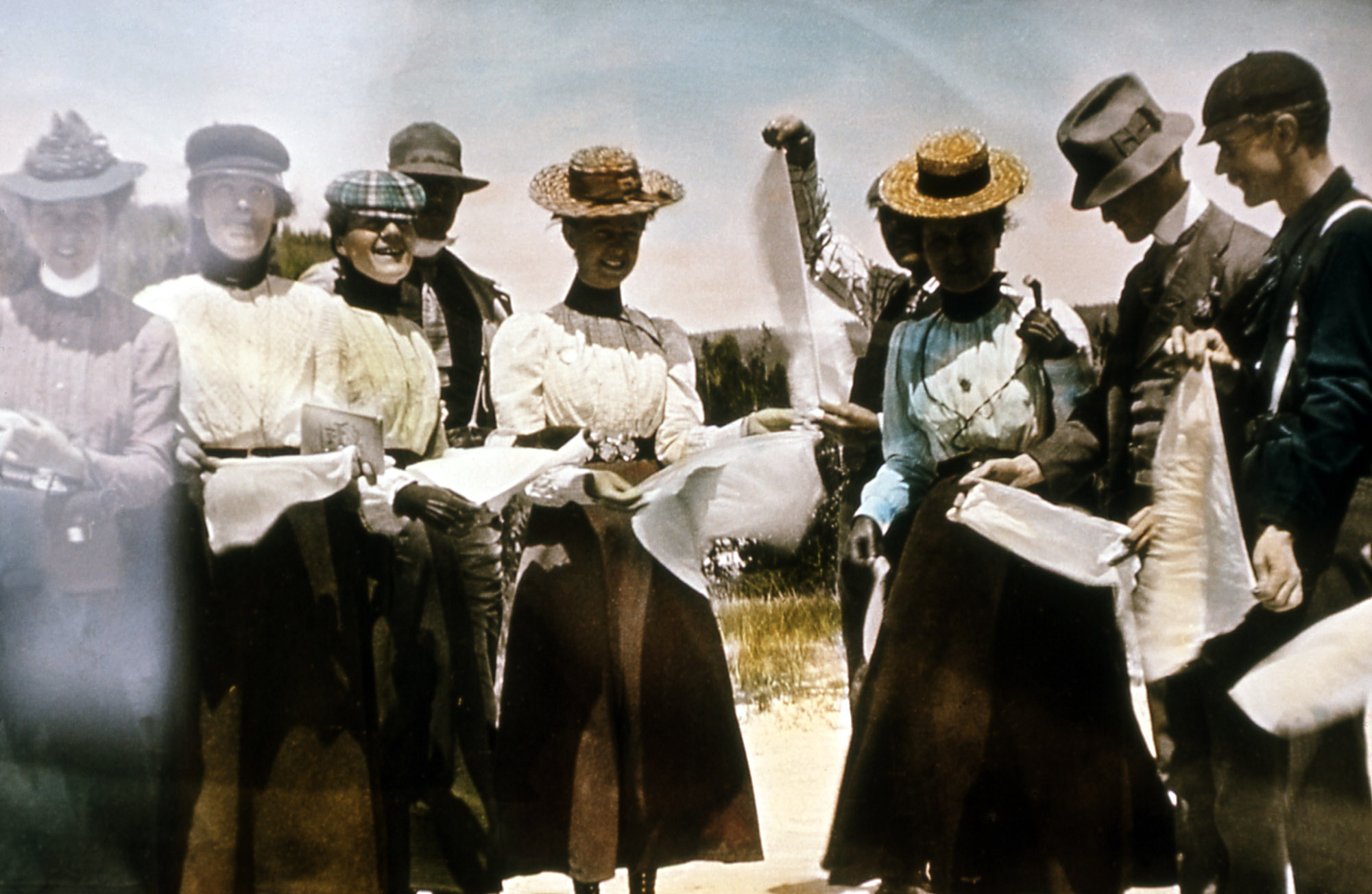
    The Handkerchief Pool reminded one of a great pot of boiling water, seething, roaring and bubbling, and issuing clouds of steam with a washday odor. Miss Lillian Ehlert must put her handkerchief in the pool, of course. We gathered round to watch it. It floated awhile, circling the pool, then suddenly disappeared down a sucking eddy, out of sight.

    We watched and waited, some of us thinking it had gone forever, but at last it popped up in another part of the pool and floated once more to the surface. It was then taken out with a stick, to be gazed upon by all of the party with something akin to awe. We wondered where it had been when lost to sight—what it had seen underground, and what tale it could tell if gifted with speech.

    Miss Ehlert simply said: “No checky no washee, but I got it all the same.”

    ∞§∞

    — From the journal of Hester Ferguson Henshall, Trip Through Yellowstone National Park 1903. Montana Historical Society Archives.

    — You might also enjoy Hester Henshall’s description of Miss Lilian’s antics in Cruising Lake Yellowstone.

    — Frank J. Haynes postcard, Yellowstone Digital Slide File.

  • A Tale: Dunraven Says Mountain Men Led a “Delicious Life” — 1874

    Beginning in 1807 when John Colter first passed through the area that became Yellowstone National Park through the 1830s, Mountain Men flourished in the Rocky Mountain West. Then a combination of over trapping and a shift in men’s fashions to silk hats ended the lucrative beaver trade. The last big Mountain Man rendezvous occurred  in 1840.

    Although a trapper couldn’t earn a fortune after that, a few hardy souls remained in the area making a subsistence living. Yellowstone tourists encountered such men until the 1880s. Here’s a description of  an encounter with two Mountain Men and their entourage written by the Earl of Dunraven, a wealthy Irish nobleman who visited the Park in the 1874.

    ∞§∞

    In the afternoon we passed quite a patriarchal camp, composed of two men with their Indian wives and several children; half a dozen powerful savage-looking dogs and about fifty horses completed the party.

    They had been grazing their stock, hunting and trapping—leading a nomad, vagabond, and delicious life—a sort of mixed existence, half hunter, half herdsman, and had collected a great pile of deer-hides and beaver-skins. They were then on their way to settlements to dispose of their peltry, and to get stores and provisions; for they were proceeding to look for comfortable winter quarters, down the river or up the canyon.

    We soon discovered that the strangers were white, and, moreover, that there were only two men in camp; and without more ado we rode in and made friends. What a lot of mutually interesting information was given and received! We were outward bound and had the news, and the latitude and the longitude. They were homeward bound, had been wandering for months, cut off from all means of communication with the outside world, and had but the vaguest notion of their position on the globe.

    But, though ignorant of external matters and what was going on in settlements, they had not lost all desire for information. An American, although he lives with an Indian woman in the forests or on the plains, never quite loses his interest in politics and parties; and these two squaw-men were very anxious to hear all about electioneering matters

    These men looked very happy and comfortable. Unquestionably the proper way for a man to travel with ease and luxury in these deserts is for him to take unto himself a helpmate chosen from the native population. With an Indian wife to look after his bodily comforts, a man may devote himself to hunting, fishing, or trapping without a thought or care. He may make his mind quite easy about all household matters. His camp will be well arranged, the tent pegs driven securely home, the stock watered, picketed, and properly cared for, a good supper cooked, his bed spread out, and everything made comfortable; his clothes and hunting-gear looked after, the buttons sewn on his shirt (if he has got any shirt—or any buttons) and all the little trivial incidents of life, which, if neglected, wear out one’s existence, he will find carefully attended to by a willing and affectionate slave.

    They had a lot to tell us also about their travels and adventures, about the wood and water supply, and the abundance or deficiency of game. So we sat down on bales of beaver-skins and retailed all the civilized intelligence we could think of. The women came and brought us embers for our pipes, and spread out robes for us and made us at home. And the little, fat, chubby children, wild and shy as young wolves, peered at us from behind the tent out of their round, black, beady eyes.

    ∞§∞

    — Text from The Great Divide by the Earl of Dunraven, 1875.

    — You might also enjoy:

    — To see more stories by this author, click on “Dunraven” under the “Categories” button to the left.

  • A Tale: Lord Blackmore Riles His Guide by Catching 254 Fish in One Day — 1872

    In the 1870s a curious conflict developed  over who got to kill wildlife in Yellowstone Park. After decimating the bison herds on the great plains, hide hunters converged on the park and  slaughtering elk by the thousand leaving their carcasses to rot.

    Sport hunters condemned commercial hunting, but reserved their own right to blast away at anything that moved. On the other hand, hide hunters said they were just trying to make a living and condemned killing “just for fun.”

    The differing attitudes are illustrated  in the story below. It comes from the reminiscence of Jack Bean, an Indian fighter and commercial hunter who hired on as a guide to the Hayden Expedition of 1872.

    Lord William Blackmore, a wealthy Englishman who had helped fund the expedition, was Hayden’s guest and an avid fisherman. Here’s what Bean says happened when he went fishing with Lord Blackmore.

    ∞§∞

    While the doctor was geologizing the country there, I went fishing with Sir William Blackmore in Lake Abundance.

    You could see plenty of trout close to shore in the lake, but when he got to catching them he thought it would be wonderful if he caught one for each year he was old—fifty four. He soon caught the fifty four and tried for a hundred, and was not long catching this and made a try for fifty-four more and kept fishing for another hundred, and another fifty-four.

    As we had gotten two thirds of the way around the lake by this time, I told him that I would quit as I had all the fish I could drag along on the grass, being two hundred and fifty-four. I dragged them into camp which was close along the lake and wanted to make a little show of these fish.

    Sir Blackmore, whenever he would see any bones would always ask, “How come those bones there?” I would tell him they were left by skin hunters in the winter.  He thought that all skin hunters should be put in jail for such vandalism and I told him he would do the same if he were in this country for the winter.

    So when I had shook all these fish off from the strings they made such a sight that I called Dr. Hayden’s attention to what Sir Blackmore would do if he had a chance. He colored up considerable and excused himself by saying, “The fish were so plenty it was Godsend to catch some of them out.”

    ∞§∞

    In 1886 the U.S. Army took over administration of the Park and ended the holocaust by forbidding hunting for any purpose and regulating fishing.

    — For more stories about fishing in Yellowstone Park, click on “fishing” under the “Categories” button on the right.

    — Excerpt from Jack Bean’s Reminiscence, Pioneer Museum of Bozeman.

    — NPS llustration, Yellowstone Digital Slide.

    — You might enjoy Jack Bean’s sarcastic description of guiding a greenhorn in Colonel Pickett Gets His Bear.  It fun to compare Bean’s story with Colonel Pickett’s version.

    — You can read more of Bean’s delightful reminiscence in my book, Adventures in Yellowstone.

  • Guest Blog: Reading Hemingway in Yellowstone by Craig Lancaster

    Craig Lancaster

    How does he do that? When you pick up one of Craig Lancaster’s books, he grabs you by the throat and drags you kicking and screaming into the story. You’ve got no choice.You just turn the pages until you get to the end. Then you say, “that was good.”

    Craig’s writing is invisible like a crystal clear mountain stream. You know it’s there not because you can see it, but because of what you can see in it. You never say “that guy sure know’s how to create characters.” You fall in love with the good guys (and hate the bad guys). You don’t say “he sure knows how to describe a scene.” You see a street in Billings or a mountain in Utah. You don’t tell yourself “his plots really work.” You just keep turning the pages.

    I should have figured it out when I read Craig’s first novel, 600 House of Edward, but I was having too much fun. Maybe I’ll see it when I read his new novel, Summer Son, but I doubt it. I’ll just  enjoy the book first. Then I’ll go back and look for things that make his writing work.

    Like me, Craig is an admirer of the invisible prose of Ernest Hemingway—as Craig puts it—”the spare, almost parched, approach to language, in which simple words built simple sentences that stacked up into simple paragraphs, the sum of which was not simple at all.”

    On his blog a while back Craig recalled a summer trip to Yellowstone Park. That’s perfect, I thought, I’ll ask him to write a guest blog about two of my favorite subjects, Yellowstone Park and Ernest Hemingway.

    He obliged me.

    ∞§∞

    Considering the summer of 1987 through the lens of nearly a quarter century, I wish now that I’d kept a journal or carried a camera to capture every little moment and object that demanded my interest. That summer, my parents packed up the Grand Marquis, tossed me, my sister Karen and my brother Cody into the back seat and pointed the car north, toward Yellowstone National Park, for a two-week vacation.

    To be perfectly frank, I’d have rather stayed home in suburban Fort Worth and continued putting the moves on Lisa Fravert (who, it turns out, was far less interested in me than I was in her), but my folks compelled me to go. I cordoned off my share of the back seat, threatened my much-younger siblings with imminent death if they crossed into my territory, and dropped myself into two things that I hoped would stave off boredom and family interaction (which, if you think about it, are the same thing to a teenage boy): my Sony Walkman and Ernest Hemingway’s For Whom the Bell Tolls.

    (Quick digression: Seriously, a Sony Walkman! Cassette-style, even. In my lifetime alone, a blink-of-the-eye 41 years, I’ve known music on eight-tracks, vinyl, cassettes, compact discs and, now, computer files so compressed that 400 songs can fit on a device half the length of my index finger. We cannot be far away from new music being piped directly into our cranial nodules, pre-selected by an algorithm that assesses every song we’ve ever heard and sends us new selections based on our biochemical responses of pleasure. It’s going to be great.)

    I’d discovered Hemingway the previous spring, when I was assigned to read A Farewell to Arms by my honors English teacher, Janelle Eklund. I hadn’t held out much hope for it. Hemingway struck me as hopelessly rooted in an era that had nothing to do with me or my life, a name on the spine of books in my parents’ house that I’d never seen cracked. It was only after I did the work of crawling inside the book that I saw and appreciated Hemingway’s genius—the spare, almost parched, approach to language, in which simple words built simple sentences that stacked up into simple paragraphs, the sum of which was not simple at all. To write in such a way requires supreme control, an unwillingness to expend a single unnecessary syllable. Long before I read Hemingway for the first time, I’d resolved to be a writer, and in my teens, I was still flailing around for my voice, often with poor results. On a given day, I could do bad imitations of Dave Barry, Stephen King and, God help me, Andy Rooney—sometimes all three of them in a single paragraph. In Hemingway, I found an approach to writing that I could understand and an ethic I could emulate. He had built his creative writing on a foundation of journalism, the career path I came to follow. It was, in so many ways, a perfect convergence of my developing sensibility and a tangible manifestation of where it could lead.

    In Casper, Wyoming, where we spent a few days with extended family, I ventured into a mall bookstore and bought a collection of Hemingway’s short stories, and this wrenched open a whole new realization of the man’s talent. I’m going to employ an out-of-left-field comparison here, one I’ve used before: Hemingway’s short stories remind me John McEnroe’s career in doubles tennis. Both derived their greatest fame for other things—Hemingway for his novels, McEnroe for his Grand Slam singles titles and obnoxious bearing on the court. And yet, in these sidelight endeavors, both are possibly the greatest who ever lived. It’s an incredible level of ability for one person to possess.

    Onward, we drove, hooking up with my mother’s sister and her family in Billings, where I live today. The merged families then made their way to Red Lodge, up the switchbacks on the Beartooth Highway, to Cooke City—where I met a woman who’d known Hemingway, a connection to him that knocked me out—and into the park. This is where the haze of memory fails me a bit; I cannot remember the order in which we took in the sights, or how many days we stayed, or even the finer details of the majesty we saw. I spent a lot of time on narrow trails leading to viewing platforms, my 4-year-old cousin Dani riding on my shoulders. The rest of the time, I spent with my nose in Hemingway’s prose and my ears under assault by Rush’s Moving Pictures.

    (Another quick digression: What’s it going to take to put Rush into the Rock ‘n’ Roll Hall of Fame? I’m serious. I can think of few pop-culture travesties that irritate me more.)

    I was 17 years old that summer, and now I am the age my mother was back then. The calendar turned over faster than I could have imagined, but even though time has erased the sharp edges of memory of that vacation, it will never leave me. I can glance to my left as I write this and see those two books—the very ones I manhandled that summer—sitting in my bookcase. I can walk out my door and into my city and state and know that I’m finally at home in the land I fell in love with as a teenager. I can pull up my current manuscript—backed up nightly on a Web-based server, a phrase I couldn’t have conceived of twenty-four years ago—and know that I’m working at the dream Ernest Hemingway helped nurture in me, the writer’s life.

    Simply put, I’m a lucky man.

    ∞§∞

    Craig Lancaster is the author of the novels 600 Hours of Edward (a Montana Honor Book and High Plains Book Award winner) and The Summer Son. Visit him at his website (www.craiglancaster.net) and/or his blog (http://craiglancaster.wordpress.com).

  • A Tale: Two Pictures and 1300 Words — Walter Trumbull, 1870

    The Washburn Expedition of 1870 convinced the public that there really were wonders on the upper Yellowstone. Stories of towering waterfalls, mountains of glass, a crystal-clear inland sea, and fountains of boiling water could no longer dismissed as “tall tales.” Prominent government officials and businessmen whose word couldn’t be doubted said they were there.

    Just as important the as credibility of members of the Washburn Expedition was their writing skill. Several expedition members  wrote articles about the trip for the Helena Herald that were reprinted around the world.

    N.P. Langford and Truman Everts published articles in Scribner’s Monthly that also brought national attention. The illustrations that accompanied those articles where artists’ fanciful imaginings based on verbal descriptions. The images with Langford’s article were by Thomas Moran, whose later paintings of Yellowstone gave him world fame. Moran and photographer William Henry Jackson, whose work influenced the decision to make the area a national park, went to the upper Yellowstone with the Hayden expedition in 1871.

    Two members of the Washburn Expedition left pencil sketches of what they saw, Charles Moore, a private in the military escort, and Walter Trumbull, the son of U.S. Senator Lyman Trumbull of Illinois. Trumbull also published an account of his Yellowstone experience in the Overland Monthly. His written description and sketches of the Yellowstone Falls provide an interesting opportunity to test the adage, “A picture in worth a thousand words.”

    ∞§∞

    We reached the falls of the Yellowstone on the morning of August 30th. These falls, two in number, are less than half a mile apart. From the lake to the upper falls, a distance of about twenty miles, the river flows, with the exception of a short series of rapids having a moderate current, through an open, undulating country, gently sloping toward the stream..

    Here and there are small groves, and the timber is quite thick a mile away from the river. A quarter of a mile above the upper falls the river breaks into rapids, and foams in eddies about huge, granite boulders, some of which have trees and shrubs growing upon them.

    Above the rapids, the river is about 150 yards wide, but, as it approaches the falls, high, rocky bluffs crowd in on both sides, forcing the water into a narrow gorge, which, at the brink of the falls, is about thirty yards wide.

    The most convenient and desirable place from which to view the falls is from a ledge, easily reached, which juts into the river a considerable distance, just below the falls, and a few feet lower than their brink. It is so close that occasional drops dampen one’s face.  The height of the upper falls is 115 feet. The ledge is irregular, the water being much deeper on the west side than on the east. Great rocks project in the face of the fall, tearing and churning the waters into foam, with here and there a little strip of green, which contrasts beautifully with the surrounding silvery whiteness of the water.

    Between the two falls, the river flows quietly in a wide channel, between steep, timbered bluffs, four hundred feet high. Just above the lower falls the bluffs again converge; the one from the west stretching out as if to dam up the river, which has, however, forced its way through a break, forty yards wide. The rocky cliffs rise perpendicularly from the brink of the falls, to a height of several hundred feet. The rocky formation is of a shelly character, and slightly colored with flowers of sulphur. The plunge of the water is in the direct course of the stream, and at the brink of the falls, it appears to be of uniform depth. It clears its bed at a bound, and takes a fearful leap of 350 feet.

    The volume of water is about half as great as that which passes over the American Fall, at Niagara, and it falls more than twice the distance. The adjacent scenery is infinitely grander. Having passed over the precipice, the clear, unbroken, greenish mass is in an instant transformed by the jagged edges of the precipice into many streams, apparently separated, yet still united, and having the appearance of molten silver.

    These streams, or jets, are shaped like a comet, with nucleus and trailing coma, following in quick succession; or they look like foaming, crested tongues, constantly overlapping each other. The outer jets decrease in size as they descend, curl outward, and break into mist. In the sunlight, a rainbow constantly spans the chasm. The foot of the falls is enveloped in mist, which conceals the river for more than a hundred yards below.

    These falls are exactly the same in height as the Vernal Falls in the Yosemite Valley, but the volume of water is at least five times as great. I think I never saw a waterfall more beautiful than the Vernal, and its surroundings are sublime. Its Indian name is said to mean “Crown of Diamonds;” and it certainly deserves the name. I remember sitting on the rocky ledge just at the edge of the falls, and with an opera-glass watching the water as they plunged downward, breaking into myriads of drops; each drop, like a lens, gathering prismatic tints from the shining sun, and flashing like diamonds of the purest brilliancy.

    The lower fall of the Yellowstone reminds me of the Vernal Fall, on the Merced.  Though nothing, perhaps, can equal the sublime scenery of the Yosemite, yet that only excels the lower falls of the Yellowstone, and the grand canyon which extends for many miles below them.

    Below the falls, the hills gradually increase in height, while the river descends in a succession of rapids through the canyon. At the falls, the canyon is not more than twelve hundred feet deep, but a few miles lower down it is nearly eighteen hundred feet deep. Its average thick a mile away from the river. A quarter of a mile above the upper falls the river breaks into rapids, and foams in eddies about huge, granite boulders, some of which have trees and shrubs growing upon them.

    Above the rapids, the river is about 150 yards wide, but, as it approaches the falls, high, rocky bluffs crowd in on both sides, forcing the water into a narrow gorge, which, at the brink of the falls, is about thirty yards wide.

    The most convenient and desirable place from which to view the falls is from a ledge, easily reached, which juts into the river a considerable distance, just below the falls, and a few feet lower than their brink. It is so close that occasional drops dampen one’s face. The height of the upper falls is 115 feet. The ledge is irregular, the water being much deeper on the west side than on the east. Great rocks project in the face of the fall, tearing and churning the waters into foam, with here and there a little strip of green, which contrasts beautifully with the surrounding silvery whiteness of the water.

    Between the two falls, the river flows quietly, in a wide channel, between steep, timbered bluffs, four hundred feet high. Just above the lower falls the bluffs again converge; the one from the west stretching out as if to dam up the river, which has, however, forced its way through a break, forty yards wide. The rocky cliffs rise perpendicularly from the brink of the falls, to a height of several hundred feet. The rocky formation is of a shelly character, and slightly colored with flowers of sulphur.

    The plunge of the water is in the direct course of the stream, and at the brink of the falls, it appears to be of uniform depth. It clears its bed at a bound, and takes a fearful leap of 350 feet. The volume of water is about half as great as that which passes over the American Fall, at Niagara, and it falls more than twice the distance.

    The adjacent scenery is infinitely grander. Having passed over the precipice, the clear, unbroken, greenish mass is in an instant transformed by the jagged edges of the precipice into many streams, apparently separated, yet still united, and having the appearance of molten silver. These streams, or jets, are shaped like a comet, with nucleus and trailing coma, following in quick succession; or they look like foaming, crested tongues, constantly overlapping each other. The outer jets decrease in size as they descend, curl outward, and break into mist. In the sunlight, a rainbow constantly spans the chasm. The foot of the falls is enveloped in mist, which conceals the river for more than a hundred yards below.

    These falls are exactly the same in height as the Vernal Falls in the Yosemite Valley, but the volume of water is at least five times as great. I think I never saw a waterfall more beautiful than the Vernal, and its surroundings are sublime. Its Indian name is said to mean “Crown of Diamonds;” and it certainly deserves the name.

    I remember sitting on the rocky ledge just at the edge of the falls, and with an opera-glass watching the waters as they plunged downward, breaking into myriads of drops; each drop, like a lens, gathering prismatic tints from the shining sun, and flashing like diamonds of the purest brilliancy. The lower fall of the Yellowstone reminds me of the Vernal Fall, on the Merced. Though nothing, perhaps, can equal the sublime scenery of the Yosemite, yet that only excels the lower falls of the Yellowstone, and the grand canyon which extends for many miles below them.

    ∞§∞

    — Excerpt from “The Washburn Expedition”  by Walter Trumbull, Overland Monthly, May-June 1871.

    — Images from the Coppermine Photo Gallery.

    — For more stories about the Washburn Expedition, click on “Washburn” under the “Categories” button to the left.

  • A Tale: Hour Spring, A Geyser by Another Name — c. 1834

    Rustic Geyser, Heart Lake Geyser Basin

    In the decade between 1834 and 1843, a trapper named Osborne Russell kept a journal describing his adventures in the frontier northwest. Russell’s journal provides one of the earliest written accounts of travel to the upper Yellowstone. Here’s his description of hot springs and geysers in a now extinct geothermal area.

    ∞§∞

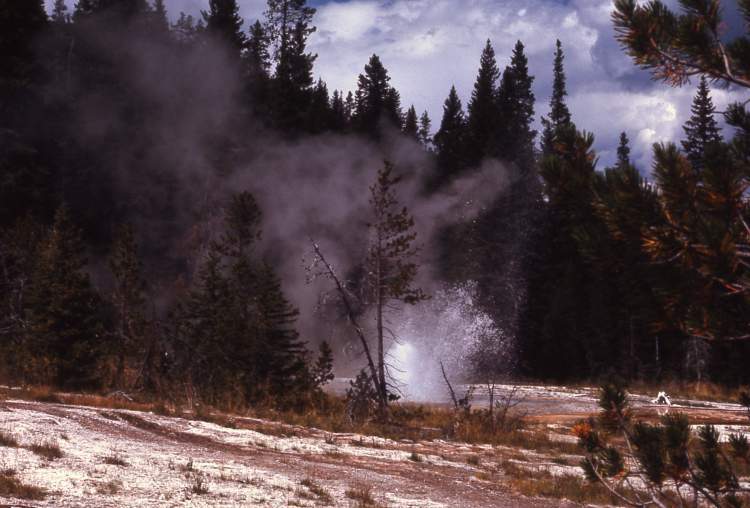
    The next day we traveled along the border of the lake till we came to the northwest extremity, where we found about 50 springs of boiling hot water. We stopped here some hours as one of my comrades had visited this spot the year previous he wished to show us some curiosities.

    The first spring we visited was about ten feet in diameter, which threw up mud with a noise similar to boiling soap. Close about this were numerous similar to it throwing up the hot mud and water five or six feet high. About thirty or forty paces from these along the side of a small ridge the hot steam rushed forth from holes in the ground with a hissing noise which could be heard a mile distant.

    On a near approach we could hear the water bubbling under ground some distance from the surface. The sound of our footsteps over this place was like thumping over a hollow vessel of immense size. In many places were peaks from two to six feet high formed of limestone, deposited by the boiling water, which appeared of snowy whiteness. The water when cold is perfectly sweet except having a fresh limestone taste.

    After surveying these natural wonders for sometime, my comrade conducted me to what he called the “Hour Spring.” At this spring the first thing that attracts the attention is a hole about 15 inches in diameter in which the water is boiling slowly about 4 inches below the surface. At length it begins to boil and bubble violently and the water commences raising and shooting upwards until the column arises to the height of sixty feet. It falls to the ground in drops on a circle of about 30 feet in diameter being perfectly cold when it strikes the ground.

    It continues shooting up in this manner five or six minutes and then sinks back to its former state of slowly boiling for an hour — and then shoots forth as before. My comrade said he had watched the motions of this spring for one whole day and part of the night the year previous and found no irregularity whatever in its movements.

    ∞§∞

    — Photo, Coppermine Photo Galley

    — From Osborn Russell, Journal of a Trapper, Syms-York Company, Boise, Idaho, 1921. Pages 99-100.

    — You might also enjoy:

  • Paul Schullery Comments on the General’s Fishing Tackle

    My friend, Paul Schullery, who Trout magazine calls America’s “preeminent angling historian,”  was kind enough to offer a comment on my post of General W.E. Strong’s story, “The Rod Bent Nearly Double.” I thought it deserved to be featured as a guest article.

    ∞§∞

    Strong’s accounts of the fishing that he and his companions enjoyed are interesting to historians for several reasons.

    The tackle is of interest because fashionable and well-heeled anglers of the mid-1870s were experiencing a revolution in their choice of gear, as the traditional (and often very large) solid-wood rods that had dominated the sport of fly fishing for centuries were being replaced by far lighter but often stiffer split-bamboo rods. Bamboo rods of this sort were expensive but very effective for distance- and precision-casting. Strong may have had some of those in his rod case, as it sounds like he had several rods.

    He was certainly in the majority in recognizing the importance of grasshoppers to the tastes of western trout. Though the British had been experimenting with some grasshopper imitations for centuries, the American grasshoppers were a considerably different and often much larger set of animals, and in the 1870s American anglers were just beginning to develop fly pattens that would work as well as the natural insects that Strong and his companions finally resorted to when their favorite artificial trout flies didn’t work. It would be several decades before American fly tiers developed floating grasshopper imitations that were consistent in catching fish when there were lots of natural grasshoppers competing for the trout’s attention.

    But Strong’s most interesting details may be about the trout itself.  No doubt his relatively light tackle, which included a silkworm gut leader that may not have been strong enough to horse a big fish in heavy water, had an effect on his handling of this fish. But by the mid-1900s, Yellowstone Cutthroat Trout would be widely regarded as the least sporting of the trout, in that they were typically thought of as the easiest to hook and the least strong as fighters. At least that was the prevailing stereotype; many of us have seen that same species of trout display great selectivity in feeding, and great strength in resisting capture once hooked. But for a Yellowstone Cutthroat Trout to jump clear of the water, repeatedly, would seem like an oddity to most modern anglers; at least I rarely have seen it or heard of it, and any number of respected authorities have said that they don’t jump. For whatever combination of evolutionary reasons, the species stereotypically does not feature jumping among its usual escape  tactics. But there are exceptions to every rule; I’ve heard or read that brown trout don’t jump, either, but I’ve seen them do so many times. What Strong’s account gives us is lots to think about as far as how well we know these fish; he tells us to be careful about our generalizations.

    ∞§∞

    — For more stories about fishing in Yellowstone Park, click on “fishing” under the “Categories” button on the right.