Tag: Andrew Weikert

  • A Tale: A Narrow Escape from the Nez Perce — Andrew Weikert, 1877

    mccartneys-at-mammoth
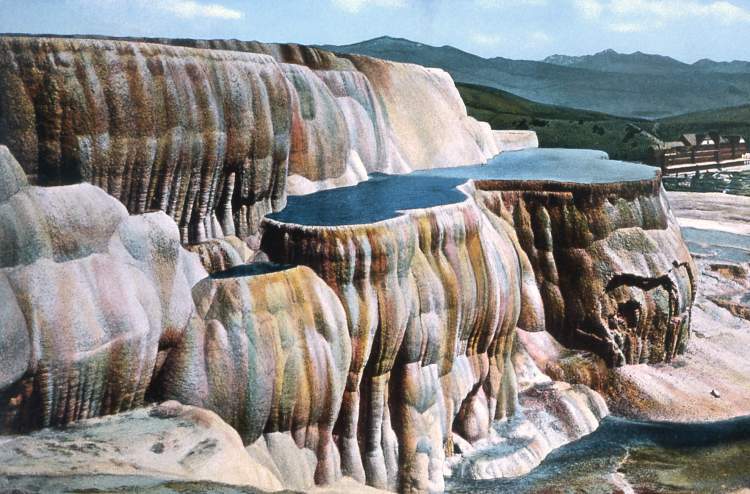
    McCartney’s “Hotel” at Mammoth Hot Springs

    In the summer of 1877, several bands of Nez Perce abandoned their homeland in Idaho and eastern Oregon in hopes of making a new life in the buffalo country of Montana. Pursued by the Army, they fled through Yellowstone Park.

    Although the Nez Perce chiefs wanted to avoid contact with whites, a group of young men separated from the main Indian body and attacked several groups of tourists. On August 26, the Indians attacked a group from Helena, Montana, killing one of them and forcing others flee. Most of the survivors made their way to the incipient resort at Mammoth Hot Springs.

    After waiting for two days for stragglers to come in, the leader of the Helena tourists, Andrew Weikert, got the owner of the resort, James McCartney, to return with him to the scene of the attack. They planned to look for two men who hadn’t returned and bury one they knew had been killed. Here’s Weikert’s story of their adventure.

    ∞§∞

    While McCartney and I were on our way from the Springs to the old camp, this same band of Indians passed us somewhere, but we did not see them at that time. We went within two miles of the old camp and unpacked and stayed all night, for it was too late to go farther.

    We started early the next morning and got into the old camp, then began our search. We soon found Kenck’s body and buried it the best we could. We found his watch in his pocket and ring on his finger, which the Indians had missed. We spent the remainder of the day searching for the other two missing boys, but not finding them, concluded that they had made their escape.

    We packed up what little was left in the camp and started back, camping at night where we did the night before; had our supper then made down our bed, then went to picket our horses so they could not go too far away.

    Mack said, “Andy, something tells me we had better go on.” I told him all right, so we saddled up and started. I looked back through an opening in the timber and saw an Indian ride across, so we “lit out” pretty lively for a little ways. I presume he wanted to find out how we were fixed, but we slipped them that time and traveled on until 3 o’clock in the morning, then crossed the Yellowstone and camped until morning.

    It was about 9 o’clock when we found our horses, for we had to turn them loose so that they could get something to eat. Had almost come to the conclusion that the Indians had stolen them. We, at this time, were about eighteen miles from the Springs. We saddled and packed our horses then started to the Springs.

    We met a party of Indians on the trail; got within two hundred yards of them before we saw them. There were eighteen of them, so we thought there was not much chance for us. So we struck out for the nearest brush.

    We had a lively race for a mile, for the Indians were firing at us all the time and trying to head us off from the brush. Eighteen guns kept up quite a racket and they got some of the balls in pretty close. We could hear the balls whistle through the air and see them pick up the dust.

    We returned fire as best we could and think we made some good Indians. We rode together for some time, then Mack started right straight up the hill for the brush. I kept out on the hillside more so as to give my horse a better chance.

    The Indians got off their horses and kept right behind a reef of rocks, so we had rather a poor chance to return fire, but they kept pouring the lead into the hill close around me all the time, for they were not over two hundred yards from me. But they soon put a ball into my horse and he stopped as quick as a person could snap his finger. I knew that something was wrong, so I got off quick and in an instant saw the blood running out of his side.

    So I said, “Goodbye Toby, I have not time to stay, but must make the rest of the way afoot.” I made all speed possible for the brush, for I could not see enough of the Indians behind the rocks to shoot at and had no cartridges to waste. We had fired several shots apiece.

    About this time, Mack’s horse commenced bucking (the saddle had got back on his rump,) and bucked him off, then ran out to where I was, and followed up after me with the saddle under him. I took my knife after me, from my belt and was going to try and catch him, if he would come close enough, then cut the saddle loose and jump on him, but he tramped on the saddle and away he went.

    The Indians never let up shooting, but kept picking up the dust all around me. I think they must have fired fifty shots at me, but only cut a piece out of my boot leg and killed my horse. He had keeled over before Mack and I got together.

    Mack wanted to get down behind a big log that was lying close by, but I looked up and saw the reds almost over our heads, I then told him that I was going for the brush. He asked me to wait until he would take off his spurs, then he would go with me. He put his hand on my shoulder and yanked off his spurs, throwing them down towards the log saying they might lie there until some time later he might call for them.

    While he was taking off his spurs the reds fired three shots at us. I don’t think either of them was over ten feet from us. I made the remark that they were coming pretty thick; Mack says “Just so.”

    We soon got to the brush, but there was no reds to be seen anywhere. They were terrible brave so long is they had the advantage, but just as soon as the tables were turned, they made themselves scarce behind the hills, as they will not follow a man into the brush.

    We camped there for about an hour, then ventured out to see if the walking was good, or probably they had missed one of our horses. We did not find any except the dead, and from even this they had taken my saddle and bridle. We saw the Indians about four miles off so concluded to make it on foot to the Springs.

    ∞§∞

    Weikert later returned to retrieve the dead man’s body and take it to Helena for a proper burial. Soldiers pursuing the Nez Perce rescued the two missing men.

    I’m working on a book titled Encounters in Yellowstone 1877 that will chronicle more stories of Yellowstone tourists who ran afoul of the Indians.

    ∞§∞

    Adapted from Weikert’s Journal published in Contributions to the Montana Historical Society, 1900.

    — NPS photo from the Yellowstone Digital Slide File.

    — You might enjoy:

    For other related stories, click “Nez Perce” under the categories button.
  • An Event: Ready To Tell “Smart Women” About The Nez Perce In Yellowstone

    The big event on my schedule this week is my presentation, “The Nez Perce in Yellowstone,” to Smart Women on Wednesday at 3 p.m. at Aspen Point, an assisted living facility in Bozeman. I’m still working on my slides and script, but it’s taking shape in my mind.

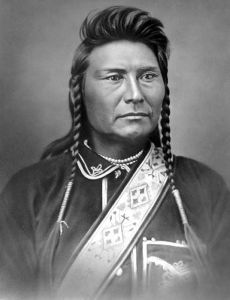
    Chief Joseph

    I’ll begin with an overview of the flight of the Nez Perce who generally lived peacefully with whites for most of the 1800’s. After gold was discovered on Nez Perce land in 1853, settlers began moving in and in 1877 the Indians were ordered onto a tiny reservation. Rather than comply with the order, they decided to flee to the buffalo country on the plains. Most accounts of the flight of the Nez Perce emphasize things that happened outside of Yellowstone Park like broken treaties and battles, but I’ll reverse that pattern and focus in the human drama of the Indians’ encounters with tourists.

    Then I’ll talk about what I call “The Joseph Myth,” the common belief that Chief Joseph was a great general whose genius allowed him to outmaneuver the U.S. Army for months. Joseph was the chief of one of the five bands that led the army on its merry chase, but he was never the principal chief. I’ll speculate on reasons the Joseph Myth was born and why it persistes: (1) Joseph was an important chief who had a conspicuous role in negotiations with whites before the Nez Perce decided to leave and he was the last remaining chief at the Battle of Beartooth so he negotiated the surrender. These things made him the apparent leader. (2) The Army Officers needed a genius opponent, otherwise they would look like fools for letting a band of Indians that included old men, women and children—and 1,600 hundred horses and cow—elude them for months, (3)After the conflict Indian sympathizers needed an Indian hero who sought peace to bolster their case, and (4) Joseph was indeed a noble man who devoted his life to obtaining justice for his people. All true, but he wasn’t a military genius.

    I’ll talk about the Radersburg Party’s trip to the park and read Emma Cowan’s description of her being taken captive by the Nez Perce, which ended with her watching an Indian shoot her husband in the head.

    To slow things down, I’ll talk about “Skedaddlers,” tourists who visited the park in the summer of 1877, but left before the Indians arrived. These include: the famous Civil War General William Tecumseh Sherman; Bozeman Businessman Nelson Story; English Nobleman and park popularizer, The Earl of Dunraven and his companions, Buffalo Bill’s sometime partner, Texas Jack Omohundro, and Dunraven’s friend, George Henry Kingsley, a physician who patched up the Nez Perce’ victims at Mammoth Hot Springs.

    I’ll talk about the Helena Party’s trip and contrast the all-male group that entered the park from the north with the co-ed Radersburg Party that entered from the west. Then I’ll read Andrew Weikert’s description of his gun battle with the Nez Perce.

    Then I’ll describe how survivors of encounters with the Nez Perce were either rescued by soldiers looking for the Indians or made their way to Mammoth Hot Springs. I’ll explain that after Emma Cowan, her sister, and several wounded men left Mammoth for civilization, three men stayed there to see if their missing companions would appear. Then I’ll read Ben Stone’s description of the Indian attack at Mammoth that left another man dead.

    I’ll end with my synthesis of accounts of Emma Cowan’s overnight ride from Helena to Bottler’s Ranch in the Paradise Valley to join her husband who had survived three gunshot wounds and was rescued by the army. That will give me an opportunity to talk about Encounters in Yellowstone, a book I’m writing now.

    ∞§∞

    — The presentation is free and open to the public.  Please tell your friends.

    — You can read about my 2011 presentation to Smart Women.

    — Public Domain Photo.

  • A Tale: A Battle With Fleeing Nez Perce — 1877

    My next book, Encounters in Yellowstone 1877, will tell the stories of the several groups of tourists who tangled with the Nez Perce while they fled through Yellowstone Park after the Big Hole Battle.

    Mammoth Hot Springs

    The Army’s pre-dawn attack on the sleeping Indian camp left dozens of women and children dead, which enraged many young Indians. Despite chiefs’ efforts to avoid whites, several groups were attacked in or near Yellowstone Park.

    The most famous encounter is Emma’s Cowan’s ordeal of being captured, but there are other chilling events. Andrew Weikert was touring with a group of young men when they spotted the Indians a few miles south of Mammoth Hot Springs. The group beat a hasty retreat to thick grove of trees and spent the night hiding. The next morning, Weikert and a companion named Wilkie decided to leave the others in camp and go see if the Nez Perce had moved on. Here’s how Weikert described what happened.

    ∞§∞

    We could see where the Indians and their horses had made a trail, so we thought the coast was clear. We started back for camp, but, we ran against an obstacle that made our hair raise and the blood rush to our faces.

    We had gotten into the timber not more than a quarter of a mile when we ran onto a lot of the redskins lying in wait for us. They were under the hill, behind a log, so we did not see them until we got within about seventy-five feet.

    I was riding ahead when I saw them raise up their heads from behind the log. I told Wilkie there were Indians ahead and wheeled my horse. At the same time I was getting my gun up ready to fire. Looking back I saw half a dozen guns leveled at me so I made myself small as I could, with my gun across my knees.

    Bang! bang! bang! then zip! zip! zip! went the balls, but none struck me that time. I was perfectly cool and self-possessed, but will own up that my hair was standing on end when I first saw them. My horse had made a few more jumps, when bang! they went again.

    This time they were a little more successful, for they cut a crease in my shoulder blade about four inches long; did not break a bone, but splintered my shoulder bone a little. And another ball took a piece out of my gunstock. I then began hugging my horse still closer, if such a thing was possible, when they gave us another volley.

    By this time, we were out of range, but the balls flew past thick and fast and we could hear them strike the trees. Now for a race!

    I supposed that they had their horses close at hand, but they did not mount them just then. Just at this time, my horse tripped his foot and fell and came near turning a somersault. I went sprawling on the ground directly in front of him.

    My shoulder was paining considerably, but I did not have long to remain there, for the ‘reds’ were running up again to get another shot at me. I up and let them have one from my repeater. You ought to have seen them dodge. I did this all in a few seconds, and my horse was on his feet again ready to start. I just put my hand on the horn of the saddle, made a bound into it, and was off.

    Wilkie had gotten considerably ahead of me by this time, but I soon made up for lost time. We got back on the prairie again on Alum Creek in the valley, then back in the timber again. The Indians did not follow us. We rode as far as we could, then took it afoot, for the under-brush was so thick that we could hardly get our horses through.

    After we got into the timber quite a ways, we halted to take breath and to see what damage was done. Wilkie asked me if I was hurt; I told him judging from the hole in my shirt on the right shoulder, and the way the blood was running in my boot, I thought that there must be a scratch at least.

    We examined it and bound it up the best we could. Wilkie, being a safe distance from the Indians, did not get hurt. We looked our horses over, and found them all sound, thank fortune. So we mounted and took our direction for camp, rode as lively as we could in hopes that the reds had not been there so we could warn the boys.

    ∞§∞

    —Adapted from Weikert’s Journal published in Contributions to the Montana Historical Society, 1900.

    — Frank J. Haynes postcard, Coppermine Photo Gallery.

    — You might also enjoy: