Tag: black bear

  • A Tale: Ernest Thompson Seton Retells the Story of a Bear Fight

    Wahb, The Grizzly

    Some stories are just so good they deserve to be told twice. Ernest Thompson Seton, who was  an enomously popular writer, artist and naturalist at the dawn of the Twentieth Century, found one when he visited Yellowstone Park in 1898.

    At the time, watching bears at the garbage dumps near the park’s grand hotels was a spectacle not to be missed. One day Seton took his notebook, sketchpad and camera to the dump near the Fountain Hotel and hid out in the garbage to watch bears parade in and hold a banquet. That’s when he saw a mother black bear attack a huge grizzly to protect her sickly little cub.

    The incident not only provided material for Seton’s most famous short story, “Johnny Bear,” it also appeared in his book, The Biography of a Grizzly. The biography chronicles the life of Wahb, a grizzly who lived most of the year east of Yellowstone Park in an area called Meteetsee and was the scourge of ranchers there. But as Seton discovered, Wahb spent his summers dining in the dumps in Yellowstone Park. Here’s an excerpt from The Biography of a Grizzly.

    ∞§∞

    The Bears are especially numerous about the Fountain Hotel. In the woods, a quarter of a mile away, is a smooth open place where the steward of the hotel has all the broken and waste food put out daily for the Bears, and the man whose work it is has become the Steward of the Bears’ Banquet. Each day it is spread, and each year there are more Bears to partake of it. It is a common thing now to see a dozen Bears feasting there at one time. They are of all kinds—Black, Brown, Cinnamon, Grizzly, Silvertip, Roachbacks, big and small, families and rangers, from all parts of the vast surrounding country. All seem to realize that in the Park no violence is allowed, and the most ferocious of them have here put on a new behavior. Although scores of Bears roam about this choice resort, and sometimes quarrel among themselves, not one of them has ever yet harmed a man.

    Year after year they have come and gone. The passing travelers see them. The men of the hotel know many of them well. They know that they show up each summer during the short season when the hotel is in use, and that they disappear again, no man knowing whence they come or whither they go.

    One day the owner of the Palette Ranch came through the Park. During his stay at the Fountain Hotel, he went to the Bear banquet-hall at high meal-tide. There were several Blackbears feasting, but they made way for a huge Silvertip Grizzly that came about sundown.

    “That,” said the man who was acting as guide, “is the biggest Grizzly in the Park; but he is a peaceable sort, or Lud knows what ‘d happen.”

    “That!” said the ranchman, in astonishment, as the Grizzly came hulking nearer, and loomed up like a load of hay among the piney pillars of the Banquet Hall.” That! If that is not Meteetsee Wahb, I never saw a Bear in my life!  Why, that is the worst Grizzly that ever rolled a log in the Big Horn Basin.”

    ” It ain’t possible,” said the other, “for he ‘s here every summer, July and August, an’ I reckon he don’t live so far away.”

    “Well, that settles it,” said the ranchman; “July and August is just the time we miss him on the range; and you can see for yourself that he is a little lame behind and has lost a claw of his left front foot. Now I know where he puts in his summers; but I did not suppose that the old reprobate would know enough to behave himself away from home.”

    The big Grizzly became very well known during the successive hotel seasons. Once only did he really behave ill, and that was the first season he appeared, before he fully knew the ways of the Park.

    He wandered over to the hotel, one day, and in at the front door. In the hall he reared up his eight feet of stature as the guests fled in terror; then he went into the clerk’s office. The man said: “All right; if you need this office more than I do, you can have it,” and leaping over the counter, locked himself in the telegraph-office, to wire the superintendent of the Park: “Old Grizzly in the office now, seems to want to run hotel; may we shoot?”

    The reply came: “No shooting allowed in Park; use the hose.” Which they did, and, wholly taken by surprise, the Bear leaped over the counter too, and ambled out the back way, with a heavy thud thudding of his feet, and a rattling of his claws on the floor. He passed through the kitchen as he went, and, picking up a quarter of beef, took it along.

    This was the only time he was known to do ill, though on one occasion he was led into a breach of the peace by another Bear. This was a large she-Blackbear and a noted mischief-maker. She had a wretched, sickly cub that she was very proud of—so proud that she went out of her way to seek trouble on his behalf. And he, like all spoiled children, was the cause of much bad feeling. She was so big and fierce that she could bully all the other Blackbears, but when she tried to drive off old Wahb she received a pat from his paw that sent her tumbling like a football. He followed her up, and would have killed her, for she had broken the peace of the Park, but she escaped by climbing a tree, from the top of which her miserable little cub was apprehensively squealing at the pitch of his voice. So the affair was ended; in future the Blackbear kept out of Wahb’s way, and he won the reputation of being a peaceable, well-behaved Bear.

    ∞§∞

    — Excerpt from The Biography of a Grizzly, Ernest Thompson Seton, 1900.

    — The illustration is a detail from a drawing by Seton in the same source.

    — You might also enjoy:

    — Read Ernest Thompson Seton’s “Johnny Bear” in my book, Adventures in Yellowstone.

    — To find more stories about bears, click on “Bears” under the “Categories” button to the left.

  • News and Views: Presenting to “Smart Women” Was Great Fun

    The Library at Aspen Pointe

    There I was in the beautiful lobby of Aspen Pointe, an independent living facility run by Deaconess Hospital in Bozeman.  I looked out over a sea of women’s faces — and they were all looking back at me.  I thought I had died and gone to heaven.

    Indeed, the audience was filled with “Smart Women.”  They cringed when I told them about Emma Cowan’s chilling account of watching an Indian hold a pistol to her husband’s head and pull the trigger. And they laughed when I read Eleanor Corthell’s hilarious story about her husband getting arrested for letting their horse graze too close to Old Faithful and sweet talking his way into a $2 fine.

    I knew that Eleanor’s granddaughter, Phoebe Montagne, lives at Aspen Pointe, and I hoped she would be in the audience, but I wasn’t that lucky.  After signing copies of my book, I asked to be shown to Phoebe’s room.

    After my escort introduced us, I gave Phoebe a copy of my book and showed her the chapter containing Eleanor Corthell’s account of  her trip to Yellowstone Park in 1903.  While Eleanor’s husband stayed home in Laramie, she took their seven children clear across Wyoming in a horse-drawn wagon to see the wonders of the park.  Eleanor told wonderful stories about fording a flooded river, chasing a bear out of camp, and counting heads at a geyser basin to make sure none of her children had fallen in.

    When I asked Phoebe what she remembered about her grandmother, her eye twinkled and a smile slid across her face.

    “I remember Grandmother surrounded by us grandchildren sitting on the floor,” she said.  “She would read us books like David Copperfield.”

    I’m sure a smile slid across my face too while I listened to Phoebe reminisce.  As much as I enjoyed talking with 75 smart women, that was the highlight of the day.

    ∞§∞

    — You can read Eleanor Corthell’s story of her trip to Yellowstone Park in my book, Adventures in Yellowstone.

  • News and Views: A Truly Great Conversation in Helena


    I had a really good time with seven scintillating dinner companions at Great Conversation in Helena on Wednesday.  I was impressed with the Helena Education Foundation, who sponsored the event and recognized ten great teachers from Helena schools.  What a wonderful show of community support for schools, teachers and — most important — students.

    I  truly enjoyed my dinner companions.  They laughed when I told them about Eleanor Corthell who announced to her husband that he should expect a bill  because she had bought a team and wagon and was taking their seven children to Yellowstone Park for the summer in 1904.  My companions were full of questions about Truman Everts and how he survived thirthy seven days alone in Yellowstone in 1870.  And, they were eager to share their own experiences from the time when bears would stall traffic to beg from cars.

    I was an overnight houseguest of Denny DeRozier and his wife, Nikki.  Denny is a friend from my childhood in Silver Star.  After we had a drink at Helena’s Silver Star Steak House, we spent a few minutes reminiscing in front of a historic photo of the Silver Star School.

    Great Fun!

    ∞§∞

    — Photo from the Yellowstone Digital Slide File

  • A Tale: Woman Fends Off Attacking Bear With Zucchini

    This morning newspapers across Montana greeted readers with this story:

    “A woman in the Huson area warded off a charging black bear with a garden fresh zucchini early Thursday after the 200-pound bruin attacked her dog and swiped at the woman’s leg.” [continue reading]

    The story probably amazed many readers, but for people in the know it’s not really surprising that the bear would flee when accosted by a zucchini. Certainly, bears can be dangerous, but early travelers to Yellowstone Park knew they could be persuaded to retreat. In fact, my collection of Yellowstone stories contains several accounts of people driving bears away by doing things like throwing rocks at them or banging together a pair of frying pans.

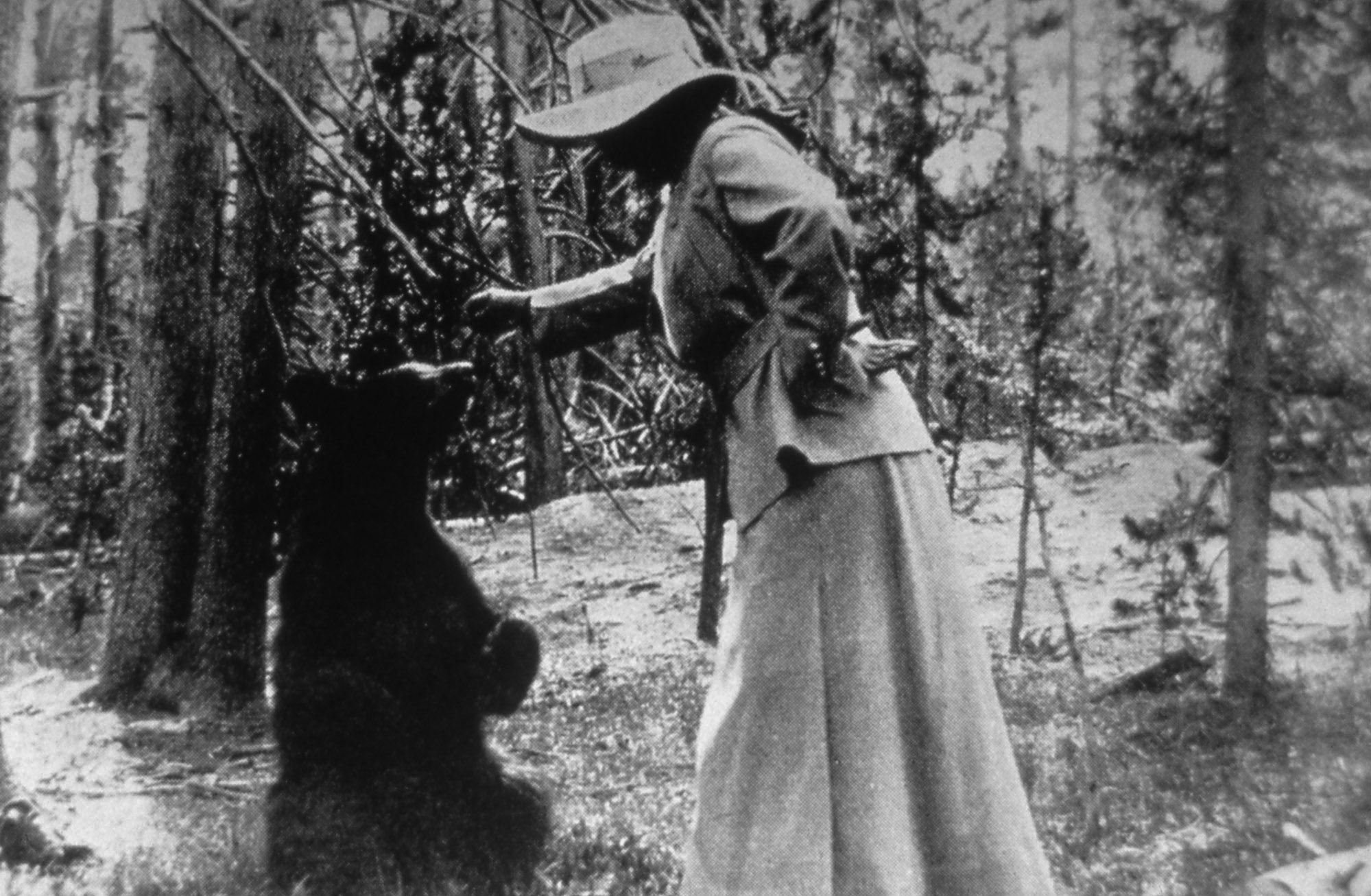
    An anecdote from Eleanor Corthell’s account of her trip to Yellowstone Park illustrates the point. Mrs. Corthell, who left her husband at home and took their seven children to the park in 1903, was camped near the Grand Canyon of the Yellowstone when she encountered a bear. Here’s her story.

    ∞§∞

    Of course, we remained here a day or two, sightseeing, cooking, resting, awaiting a telegram. It seemed sacrilegious to return to camp after that glorious gaze into nature’s proudest wonderland and go baking beans, yet we had to have a change from Van Camp’s. I wouldn’t speak of it now only that is how we came to have a visit from a bear.

    The beans were not done at bedtime, so I put in pine knots, thinking they would be just right for breakfast. It was so hot the stove was outside. About midnight there was a great clatter of falling stove. Sure enough, a bear had tipped it over trying to get my beans. He was trying so hard to work the combination of the oven door that he never noticed our excitement. Not until I threw things at him would he go away. On the whole, I presume, we would have been disappointed if one bear, at least, had not paid us a visit. We never thought of being afraid, but I used all my ingenuity in hiding bacon and sugar from prowling bears, every night.

    ∞§∞

    — Read more about Mrs. Corthell’s trip in my book, Adventures in Yellowstone.

    — Photo from the Pioneer Museum of Bozeman

  • A Tale: Watching Bears Fight at a Dump — 1896

    Tourists watching bears.Bears are remarkably adaptive animals that adjust their behavior to the activities of people they encounter. When people began visiting the Park in the 1870s, bears were fearless and easy to find. But they soon figured out that rifle shots are deadly. By the 1880s bear sightings were rare.

    In 1883 the Army forbade firearms in the Park and soon developers built grand hotels. The hotels began dumping their kitchen scraps in the woods and bears took that as an invitation to dinner. Watching bears at the dump soon became a popular pastime and it continued until the Park Service began locking garbage away in the 1960s.

    When cars were admitted to the Park in 1915, bears discovered they could approach them because there were no horses to scare. Bear jams blocked traffic and became a nuisance until the Park clamped down on feeding bears in the 1960s.

    While visiting Yellowstone Park in 1896, author and naturalist Ernest Thompson Seton decided to study bears. So he spent a day in the garbage dump hiding among the carrot tops, rotting potato peels and tomato cans with his notebook and sketchpad. The bears obliged him by trooping into the dump to eat scraps and lick jam jars. A large female and her three-legged, pot-bellied son caught Seton’s attention. The sickly little bear became the inspiration of Seton’s famous story, “Johnny Bear.”

    Despite his infirmities, Johnny Bear’s mother, Grumpy, loved him dearly. Like all momma bears, Grumpy was fearless when it came to protecting her son. She drove the other bears away from Johnny and left him alone to lick syrup cans.

    When Johnny got his head stuck in a can, he yowled, and complained, and struggled until he was able to pull it off. Then he punished the offending container by smashing it flat with his little paws.

    Suddenly, a huge grizzly ambled into the dump between Johnny and Grumpy. To protect her son, Grumpy charged the much larger animal and thumped him on the head. The grizzly responded with a terrible blow that sent her sprawling. The two bears clinched and rolled around in a battle that left Seaton nothing to watch but clouds of dirt and flailing legs. Johnny climbed to the top on a tree and whined as the battle raged. The grizzly easily defeated Grumpy so she dashed up the tree to join her son.

    While the grizzly ambled though the dump grazing, Seton decided he need photographs the combatants. So he began snapping pictures of Grumpy and Johnny. He then pointed his camera at the grizzly and it began moving toward him. When the giant got within five yards, Seton thought he had met his end. But the bear turned away and began licking tomato cans.

    Seton returned to the hotel after his day of bear watching, but the hotel staff refused to let the stinking naturalist in. They made him take off his clothes in the woods behind the hotel. Then they brought a fresh change from his hotel room. But Seton wasn’t humiliated. He considered the day a great success. After all, he had the material for his most famous story.

    ∞§∞

    —Read a condensed version Ernest Thompson Seton’s “Johnny Bear” in my book, Adventures in Yellowstone.

    — F.J. Haynes Postcard, Copperplate Photo Gallery.

    — To find more stories about bears, click on “Bears” under the “Categories” button to the left.