Tag: Bottlers Ranch

  • On Writing: Narrative History Requires More Than Getting the Facts Right

    I just finished an article for The Pioneer Museum Quarterly on Fred Bottler, a pioneer rancher in the Yellowstone River’s Paradise Valley north of Yellowstone National Park. Bottler built the first ranch in the valley halfway between Bozeman and Mammoth Hot Springs. That made it an ideal stopping point for early expeditions exploring the park so dozens of park journals and reminiscences mention Bottler’s ranch.

    Gustavus Doane

    Bottler knew the Yellowstone Park area well because he had prospected for gold in there 1860s. That made him an ideal guide, and he accompanied several people who visited the upper Yellowstone in the 1870s.

    My article provides Bottler’s biographical information and recounts stories about him. One of those stories, told by Bottler’s son, Floyd, concerns a pair of needle guns, which were an early type of repeating rifle.

    Floyd said his father won the guns in a card game with soldiers at Fort Ellis, an army post near Bozeman. Although Bottler knew the guns technically were government property, he thought they would be handy if Indians attacked his isolated ranch. He decided to keep them.

    An officer at Fort Ellis, Lieutenant Gustavus Doane (who had a remarkable moustache), heard that Bottler had the guns and decided to retrieve them. Floyd said that when Doane arrived at Bottler’s house, the rancher invited him in and seated him where he could see the guns hanging on a wall.

    Floyd said Doane would look at the guns, then look at Fred, and then back at the guns. Finally, Doane told Bottler that a man living on the edge of Indian country needed such guns and he could keep them—but only if he kept them out of sight when he visited the fort.

    Then, Floyd said, “Their eyes met again and held for a long moment. Then both men rose and the hands met in a strong clasp”

    I couldn’t resist quoting that directly in my article. But when I asked Ann Butterfield, the Pioneer Museum Associate Director, to read a draft of my article, she objected.  She said she liked what I had written, except for that “gazed into each other’s eyes” stuff. “Men just don’t act that way,” she added with a scoff.

    I immediately checked my source and confirmed that I had quoted Floyd accurately. I assured Ann of that, but she was’t really  mollified. That made me think.

    It’s my job to present old stories for today’s readers. I want people to read straight through my stuff and say: “That’s interesting.” I don’t want them stop and say: “This just doesn’t sound right”—even if it is right.

    I also like to quote exactly what people wrote because their word choices make personalities and emotions shine through. It’s always a balancing act to decide when modern sensibilities might collide with old fashioned ways of saying things.

    When I turned in final draft of my article, it didn’t contain the “gazed into each others eyes” quote. Writing narrative history is not just about getting the facts right; it’s also about getting the reader’s experience right. If it distracts, it’s got to go.

    The Pioneer Museum Quarterly will publish my article on Fred Bottler in a few weeks.  I’ll let you know when it’s available.  Then you can decide if I made the right choice.

    ∞§∞

    — Photo detail from the Yellowstone Digital Slide File.

    — You can read an excerpt from my article on Fred Bottler here.

    — To see related posts, click on “Narrative History” under the Categories Button on the right side of this page.
  • A Tale: Emma Cowan Visits Mammoth — 1873

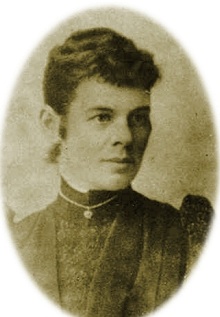
    Emma Cowan

    Most of the women who visited Yellowstone Park in the 1870s were Montana Pioneers. For them, camping out in the wilderness was no big deal. After all, they had already crossed the plains in a covered wagon, or come up the Missouri River on a crowded steamboat.

    Emma Cowan was such a pioneer. She was 10 years old when came to Montana in a covered wagon with her parents during the gold rush of 1864. Shortly after she arrived in Virginia City, Emma began hearing about the wonders of the upper Yellowstone. One day her father brought home a man who told marvelous stories.

    Emma said of the stories, “My fairy books could not equal such wonderful tales. Fountains of boiling water, crystal clear, thrown hundreds of feet into the air, only to fall back into pools of their own forming; pools of water in whose limpid depths tints of various rainbows were reflected; mounds and terraces of gaily colored sand.”

    Emma and her family thought the stories were just fantasies, but she said, “As I grew older and found truth in the statements, the desire to some day visit this land was ever present.”

    Emma’s first trip to Yellowstone Park was a visit to Mammoth Hot Springs in 1873 with her parents. She didn’t say a lot about it, but the normal starting point for such a trip would have been Bozeman, a thriving trade center and agriculture town about 75 miles from the park.

    After they left Bozeman, travelers usually would spend their first night at the Bottler brothers’ ranch—a one-day ride from Bozeman. Bottlers’ ranch was located halfway to Mammoth Hot Springs, which made it an ideal stopping point for early travelers heading to the park.

    After a night at Bottlers, Emma’s family would have gone to Mammoth Hot Springs over a new road through Yankee Jim Canyon. Emma said this road was scarcely more than a trail, but “by careful driving, unhitching the horses, and drawing the wagon by hand over the most dangerous places, we made it safely.”

    The road was so bad, Emma said, that just a few weeks before a man, who was taking his crippled wife to Mammoth to soak in mineral waters that he hoped would cure her, didn’t even try to travel by wagon. Instead, he carried her on an Indian-style travois.

    Although the park was only a year old in 1873 when Emma and her family visited there, Mammoth Hot Springs had already become a tourist destination. When her family arrived, Emma said, “We found an acquaintance or two, a number of strangers, a small hotel and a bath house.”

    At Mammoth, tourists could hire guides to take them into the roadless wilderness to see the Grand Canyon of the Yellowstone, the Falls, and, most important, the Grand Geysers. Here they could also buy supplies that included such luxuries as canned fruit, baked bread, fresh milk, and butter.

    Visitors could either camp nearby, or pay $20 a week to the hotel for room and board. In addition, they could pay five dollars for twice-daily baths in tin tubs that had been coated with a porcelain like finish by the mineral waters. Visitors often made their own souvenirs by leaving items in pools where mineral waters encrusted them.

    Emma and her family stayed at Mammoth for two weeks seeing nearby sights, soaking in hot baths, and making souvenirs. But they decided not to visit the geysers. That would have required an arduous seventy-five mile trip on horseback because there were no roads across the park.

    Several parties returned from the geysers during Emma’s stay, and their accounts intrigued her. People often told her that words couldn’t convey the wonders they had seen. “You must see them for yourself,” they told her.

    Emma’s interest was piqued. When she got home she learned everything she could about the geysers from magazines, newspapers, and friends’ accounts.

    In 1877 Emma’s wish to see the geysers came true. But the adventure was even more that she expected when Indians shot her husband and took her captive.

    Coming Soon: “Doughnuts Fried in Bear Grease, Sarah Tracy — 1874”

    — Related stories you might enjoy: