Tag: camping

  • A Tale: Woman Fends Off Attacking Bear With Zucchini

    This morning newspapers across Montana greeted readers with this story:

    “A woman in the Huson area warded off a charging black bear with a garden fresh zucchini early Thursday after the 200-pound bruin attacked her dog and swiped at the woman’s leg.” [continue reading]

    The story probably amazed many readers, but for people in the know it’s not really surprising that the bear would flee when accosted by a zucchini. Certainly, bears can be dangerous, but early travelers to Yellowstone Park knew they could be persuaded to retreat. In fact, my collection of Yellowstone stories contains several accounts of people driving bears away by doing things like throwing rocks at them or banging together a pair of frying pans.

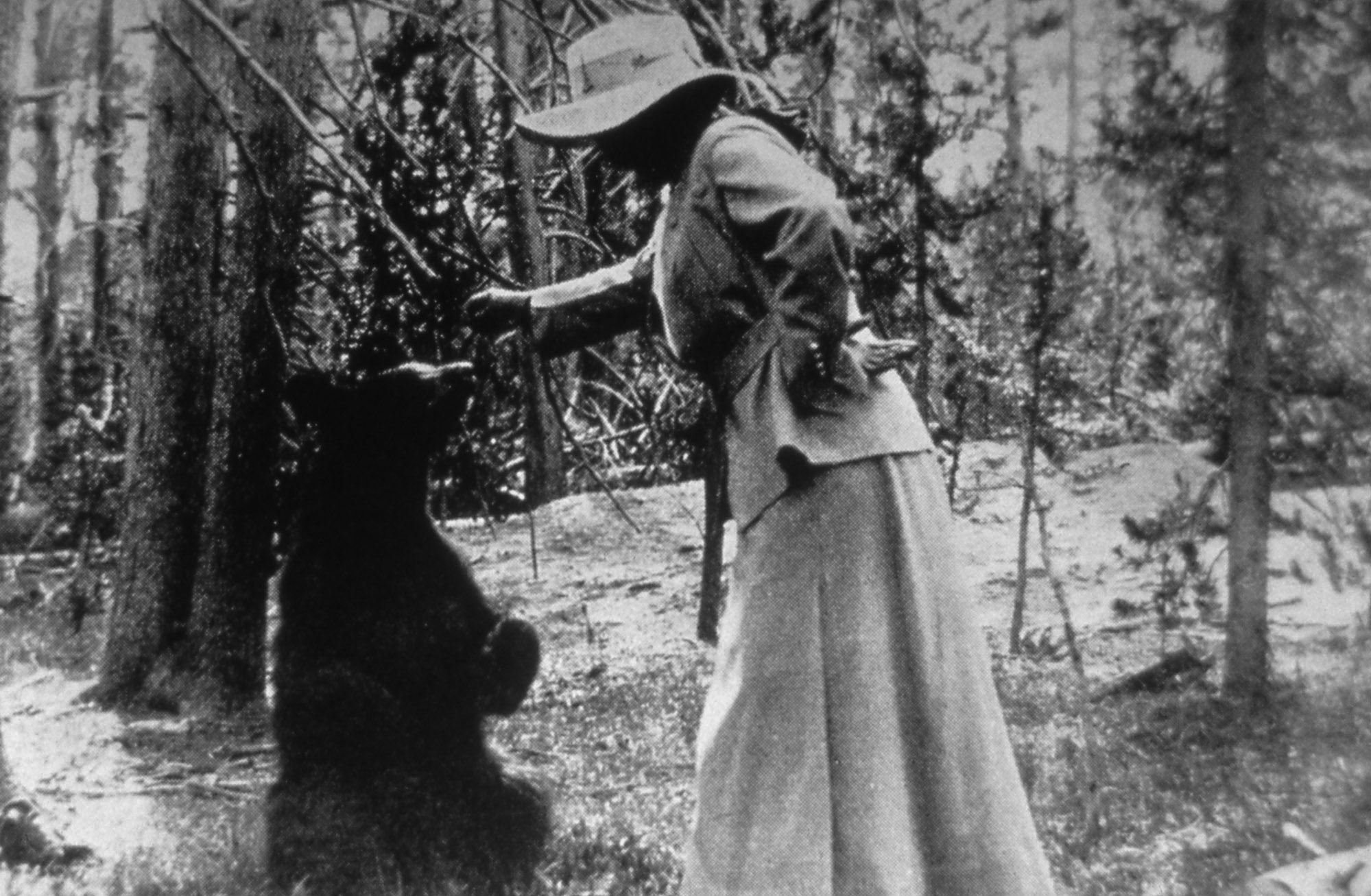
    An anecdote from Eleanor Corthell’s account of her trip to Yellowstone Park illustrates the point. Mrs. Corthell, who left her husband at home and took their seven children to the park in 1903, was camped near the Grand Canyon of the Yellowstone when she encountered a bear. Here’s her story.

    ∞§∞

    Of course, we remained here a day or two, sightseeing, cooking, resting, awaiting a telegram. It seemed sacrilegious to return to camp after that glorious gaze into nature’s proudest wonderland and go baking beans, yet we had to have a change from Van Camp’s. I wouldn’t speak of it now only that is how we came to have a visit from a bear.

    The beans were not done at bedtime, so I put in pine knots, thinking they would be just right for breakfast. It was so hot the stove was outside. About midnight there was a great clatter of falling stove. Sure enough, a bear had tipped it over trying to get my beans. He was trying so hard to work the combination of the oven door that he never noticed our excitement. Not until I threw things at him would he go away. On the whole, I presume, we would have been disappointed if one bear, at least, had not paid us a visit. We never thought of being afraid, but I used all my ingenuity in hiding bacon and sugar from prowling bears, every night.

    ∞§∞

    — Read more about Mrs. Corthell’s trip in my book, Adventures in Yellowstone.

    — Photo from the Pioneer Museum of Bozeman

  • A Tale: Maud Gets Her Revenge — 1913

    In 1913 Louise Elliott publish a book about a young schoolteacher from Lander, Wyoming, who took a job as a camp assistant for a mobile camp tour. In her preface, Elliott confesses that she used several techniques that critics now might label “new journalism.” She created composite characters by combining traits of her camp companions, and made up a “little romance” for her protagonist.

    We can forgive Elliott because she provided an explicit disclaimer—and an entertaining portrait of  travel to Yellowstone Park in the early twentieth century. While her tales must be taken with the proverbial grain of salt, we probably can take her word that “the camp episodes and jokes, the weather and scenery, and the statistics” were all accurate descriptions copied from her diary.

    Elliott gives interesting details of her trip—a cook who makes biscuits “charred on the outside and doughy in the middle,”—a guide who carries “the scratchiest flannels” to be worn by anyone who didn’t heed his warning to bring warm clothing—and, snobbish hotel guests who refuse to return the greetings of lowly campers.

    At one point during the story, Elliott says her protagonist, Violet, and her friend, Maud, became irritated with one of their guests—a Boston lady that they called “The Spinster.” Here’s Louise’s story about that.

    ∞§∞

    Maud and I baked enough biscuits for supper and some cup cakes while the Spinster complained of all the discomforts of camp life as compared with her home conveniences. Neither did she forget to mention her lovely twenty-eight dollar and fifty-cent air mattress.

    “That settles it once for all,” whispered Maud. “Never again!”

    Well Maud had her revenge—and not once today has the Spinster boasted of her comfortable pneumatic mattress. I wondered last night why Maud was anxious to retire early as she is usually the last one to bed.

    The great pine fire was lighting our tent, and the Spinster was peacefully enjoying her first snore when I saw our Irish lassie get stealthily out of bed—and crawl over to the hated mattress. She certainly must have made a thorough study of the mechanism—she knew just where to find the valve screw. She gave a few turns—crept back into bed again—and began breathing hard and steady.

    Maud had not let me into her proposed vengeance because she feared I would not countenance it. But I suspected that the air was slowly leaking out of the mattress under the sleeping Bostonian. Soon that lady stopped her regular breathing and sat up in bed. She began fumbling under her and muttered, “Well, I never.” Finally she got up, punching the mattress, muttering something and reached into her bag.

    Pump, pump, pump—I tried so hard to keep from giggling that a snort escaped from my throat. Maud began to talk incoherently and to toss and throw her arms about to cover my tell-tale noises. “No sir, I told you before that I will not dance—no—no—.” Then her voice died away and she snored vociferously while the—pump, pump, pump—continued. At last the wonderful pneumatic was restored to its proper stage of plumpness and the weary Spinster was soon resuming her snores where she left off.

    She was more silent than usual this morning and did not allude in any way to her mattress. But while Maud and I were doing up the dishes, she went into the tent and gave her bed a thorough examination. She became more talkative after she had read the little pamphlet of directions, which had been attached to the mattress. After that she told the party how Maud had discussed her secrets and love affairs in her sleep.

    Maud asked innocently, “What did I talk about?”

    ∞§∞

    — From L. Louise Elliott, Six Weeks on Horseback Through Yellowstone Park, 1913.

    — Pioneer Museum of Bozeman Photo.