Tag: Carrie Strahorn

  • A Tale: Big Boots to Fill — Carrie Strahorn, 1880

    In October 1880, Carrie Strahorn and her husband, Robert (she called him “Pard”) were the only passengers on the first run of George Marshall’s stage between Virginia City, Montana, and the Lower Geyser Basin. The Strahorns spent their first night in a cabin in the Madison River valley that belonged to Gilman Sawtell, Yellowstone Park’s first commercial guide and builder of the first road to the Lower Geyser Basin.

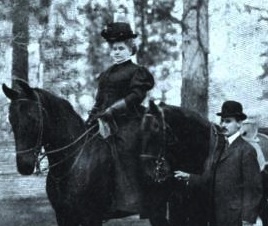
    Carrie Strahorn

    On their second day of travel, the Strahorns crossed the Continental Divide over Raynolds Pass and went to Henrys Lake where Sawtell had built a two-story building he planed to use as a hotel for Yellowstone tourists. Sawtell wasn’t there because, as Carrie put it, “during the late Indian troubles, he had abandoned this house and cached the doors and windows for fear the house would be burned.” The Strahorns made themselves at home anyway and Marshall fixed them a dinner of canned beans. Carrie told this story about what happened next.

    ∞§∞

    Pard and I gathered our blankets to go back to the stage to fix a place to sleep, but Mr. Marshall insisted there was a nice lot of hay upstairs where we could be more comfortable, and handing us a candle, directed us to the stairway. It was a rickety passage, with the wind howling through every aperture and holding high carnival with every loose board in the house.

    Once upstairs, the room to which we were sent seemed about forty feet square. The glimmering candle would light only a corner of the great black space, and a gust of wind would blow out the glim at intervals until the place seemed full of spooks and goblins. Pard and I gazed at each other when we could, and when we couldn’t, well, maybe I cried—I don’t quite remember.

    He had persuaded me to buy a very heavy pair of shoes in Virginia City, because he had been told the ground was so hot in some sections of the park that thin soles were not at all safe to wear, and would soon be burned through. Then he had proceeded to hold them up to ridicule all day, and I had finally wagered five dollars with him that in spite of their looks I could get both of my feet into one of his shoes. So there in the dim candle light, with any number of sashless and paneless windows, with the pallet of hay down in a dark corner, partly covered with canvas, with the wind shrieking requiems for the dead and threats for the living,  and with the rafters full of bats, I called to him to bring me his shoe, and let me win my wager.

    I put on his number seven and declared my foot was lost and lonesome in it, and he cried out, “Well, then, now put in the other one! Put in the other one!” I began at once taking it off to put it on the other foot, when he cried out, “Oh, no, not that way, but both at once.” But I revolted and said, “No, that was not in the bargain; I had not agreed to put both in at the same time.” In deep chagrin, he threw a five-dollar gold piece at me, which was lost for half an hour in the hay before I could find it, while he gave a grunt or two that will be better not translated. And so we went on with our merrymaking, trying to forget our surroundings, and dispel thoughts of our discomfort, but it was a glad hour that saw us started again on our way with a new sun.

    ∞§∞

    —   Excerpt from “Early Days In Yellowstone,” pages 254-286 in Carrie Adell Strahorn, Fifteen Thousand Miles by Stage, New York: Putnam’s Sons, 1911.

    —   Photo detail from Strahorn’s book.

    You also might enjoy:

    — You can read Carrie Strahorn’s account of her 1880 trip to Yellowstone Park in my book, Adventures in Yellowstone.  
  • First Women: Mary Wylie Crosses Yellowstone Park in a Covered Wagon — 1880

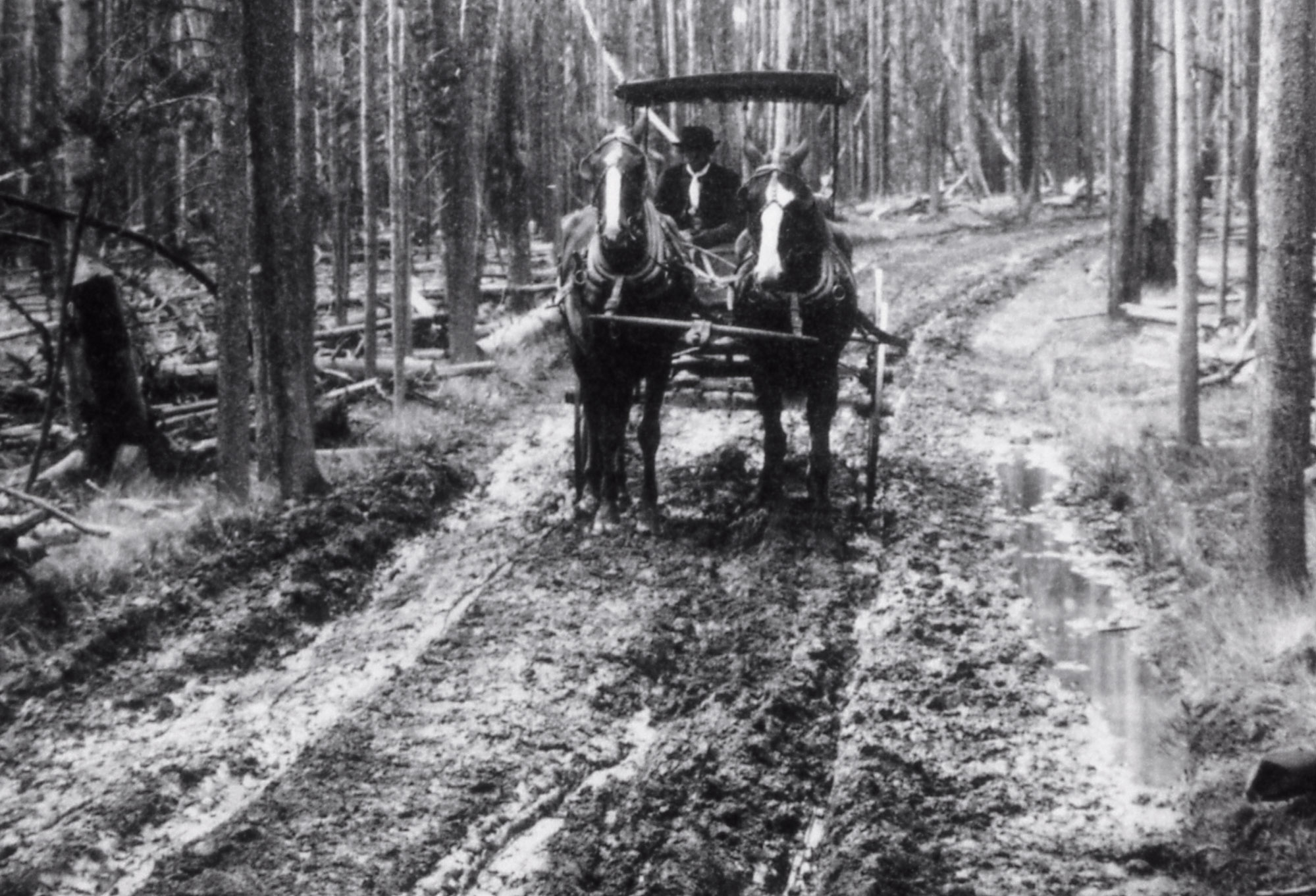
    In 1880, Mary Wylie crossed Yellowstone Park as a member of the first tourist party to use a wheeled conveyance for this trip. She went from Mammoth Hot Springs to the Lower Geyser Basin in a covered wagon.

    Mary came to Montana from Iowa in 1879 with her children. Her husband, William Wallace Wylie, had arrived in Montana the year before to become Bozeman’s first school superintendent.

    Mr. Wylie came west in 1878 on the Union Pacific transcontinental railroad to Corinne, Utah, and then took a stagecoach 400 miles north. When Mary and the children took the same trip a year later, they came north on the Utah and Northern Railroad to the Montana border and traveled about 200 miles by stage from there to Bozeman.

    Mr. Wylie left his mark on Yellowstone Park history as a lecturer, interpreter, and inventor of “permanent camps.” After he did a lecture tour across the nation, school teachers began asking him to guide them into the park. He said this “accidentally” launched him into the tourist business.

    In 1893, he founded the Wylie Permanent Camping Company, which specialized in tours of the park where guests stayed in tents left up for a full season. His moderately priced tours provided competition to the more expensive hotel tours and opened the park to middle class tourists.

    Wylie first visited the park in the spring of 1880. When he learned that Park Superintendent P. W. Norris was building the first road across the park and was going to have it finished by August, Wylie resolved to show his wife the wonders of Yellowstone Park.

    He returned to Bozeman, bought a lumber wagon and rigged it with an emigrant cover. He then assembled a nine-person party that included Mary and two of their children, a woman friend of Mary’s, and three men.

    The party met a couple with a spring wagon at Mammoth who went with them on their tour. This proved to be a good arrangement because the travelers often had to hitch both of their teams to a single wagon to get up steep hills and through rough country.

    Superintendent Norris’s new road was extremely rough. Sometimes tree stumps were too tall to let the wagons pass. When the wagons got stuck, the party had to hitch a team to the back of the wagon and pull it back so they could cut the stump lower. This made travel extremely slow. It took more than a week to travel from Mammoth to the Lower Geyser Basin.

    It was the first time tourists made the trip in wheeled conveyances. Wylie said this fact helped him get licenses to set up his tourists business in the park.

    A few weeks after Mary Wylie crossed the park beginning at Mammoth Hot Springs, Carrie Strahorn and her husband traversed Norris’s new road starting at the other end.  But after starting from the Lower Geyser Basin in a wagon, the Strahorns decided the road was too rough, and continued on horseback.

    Mary’s trip by covered wagon must have been quite an adventure. It’s too bad she didn’t leave a written account of it.

    ∞§∞

    — Photo from Yellowstone Digital Slide File.

    You also might enjoy Carrie Strahorn’s story about traveling Norris’s new road in 1880 and encountering a winter storm.

    — For related stories, look at “First Women in Yellowstone” under the Categories button to the upper left of this page.

  • A Tale : Emma Stone Tours Yellowstone — 1872

    Carrie and Robert Strahorn

    While doing research for my post last week, “An October Snow Storm at Yellowstone Canyon,” I noticed that Carrie Strahorn claimed, “I was the first woman who made a complete detour of the park.” I knew that Carrie was wrong about that, but the statement wasn’t in the excerpt I used so I ignored it.

    Then I started thinking about the first women to visit Yellowstone Park. I checked my files and concluded that I had enough information to provide several posts on the topic. Here’s “First Women Yellowstone, Part 1: Emma Stone Tours Yellowstone — 1872.”

    ∞§∞

    Doubtless, the first women in what is now Yellowstone Park were Indians who had lived there for centuries before Euro-Americans explored it. As for white women, there are no official records of their early park visits. Fortunately, Yellowstone travelers have always thought their adventures were worth saving and sharing so they left a rich record of journals, diaries, reminiscences, and articles in newspapers and magazines. Examination of these documents reveals that white women penetrated the edges of the park by the early 1870s.

    One of the earliest recorded “sightings” of women in Yellowstone Park was by Sidford Hamp, a young Englishman whose rich uncle, Lord Blackmore, got him a job as a surveyor’s assistant on the second Hayden Expedition. Here’s what Hamp said about his arrival at Mammoth Hot Springs on August 27, 1872.

    “When we got about two miles from there we saw a haystack. You can’t imagine what a curiosity it was. We went on and saw a mule tied to a bush, and soon after that, came two men, more curiosities. Then we came upon a man holding in his arms the greatest curiosity of all, a baby! We went on a bit farther and saw a woman! And a house! which almost knocked us down with curiosity.”

    One of the women who visited Mammoth in 1872 was Emma Stone of Bozeman, Montana. She is credited with being the first woman to take a complete tour of the park.

    In 1872, Hiram and Emma Stone and their two sons were visiting Mammoth Hot Springs when two specimen collectors, Dwight Woodruff and E.S. Topping, returned from exploring the park and announced that they had discovered a new geyser basin (now called Norris Geyser Basin.) Such men often hung around the hotel at Mammoth looking for people to guide and the Stones hired them.

    Because there were no roads, people had to travel on horseback along Indian trails and through timber so tall, they could barely see the sky. Horses had to jump fallen logs that covered the ground. Sometimes trees were so close together that pack mules had to get on their knees to squeeze their wide loads under the lower branches.

    Travelers camped at major sights for days or even weeks. This not only provided an opportunity for such things as seeing many geysers play, but also gave spent horses time to graze and regain strength. Often the animals wandered off and many diaries record accounts of searching for them.

    The Stones visited all the geyser basins, Yellowstone Lake and Falls. Topping, in his 1888 book Chronicles of the Yellowstone, said, “It was a hard trip for the lady of the party, Mrs. Stone, but she now has the satisfaction of remembering that to her belongs the honor of being the first white woman to see the beauties of the National Park.”

    ∞§∞

    — Photo adapted from Carrie Adell Strahorn, Fifteen Thousand Miles by Stage, 1911.

    — Related stories you might enjoy:

  • A Tale: An October Snow Storm at Yellowstone Canyon — 1880

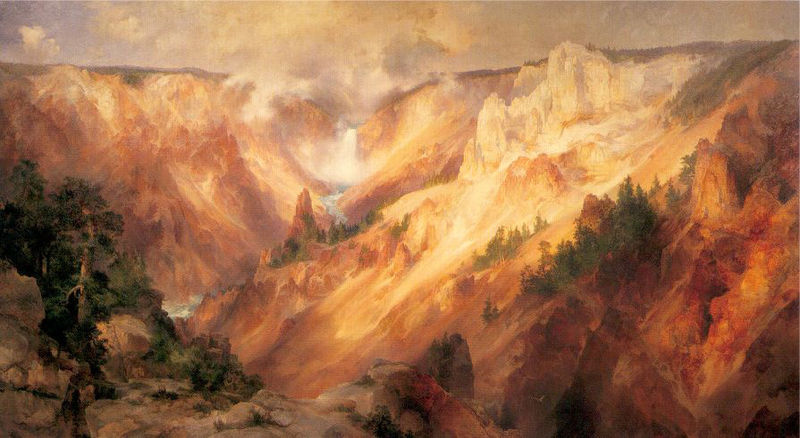
    Thomas Moran, The Grand Canyon of the Yellowstone


    Carrie Strahorn was an adventurous woman who insisted on traveling with her husband  Robert  (she called him “Pard”) as he traveled the country searching for destinations for the Union Pacific Railroad. Carrie wrote newspaper columns about her adventures and eventually collected them in a book,
    Fifteen Thousand Miles by Stage.

    Despite warnings about winter storms, the Strahorns decided to visit Yellowstone Park in October 1880. Their guide was George Marshall, who operated a stage line between Virginia City, Montana, and a hotel he built at the Lower Geyser Basin. Also, Park Superintendent Philetus Norris accompanied the Strahorns during  part of their trip.

    The weather was fine when the Strahorns began, but as they returned to Marshall’s hotel after visited the Mammoth Hot Springs, a snow storm caught them. Here’s Carrie’s story about that.

    ∞§∞

    The rain changed to snow, and through the storm we saw the disconsolate face of Mr. Marshall, as he stood near the smoldering campfire muttering to himself as if he had become demented. Upon inquiring the cause of his trouble, he said as soon as he saw the snow he went to look for the horses—and they were gone.

    “Gone!” we all exclaimed in unison and despair. The horses were gone and we were at the end of our rations with a big storm upon us. The many warnings not to go into the park so late went buzzing through our minds like bumblebees. The snow was several inches deep and falling faster every minute.

    As soon as daylight came the men started in search of the horses. I was left all alone in the camp for several hours waiting with my rifle in hand, until after a hard and hurried chase the horses were overtaken and brought back. We knew that we should hurry home as quickly as possible—but to be within five miles and not to see the falls was asking too much. With the return of the horses we resolved at once to go on.

    Superintendent Norris thought it was not best for me to go to the falls. The trip must be a hasty one, and the start home not to be delayed longer than possible for fear of continued storm. The snow ceased falling soon after daylight, but the sun did not appear and there was every indication of more snow. Pard was reluctant to leave me, and knew what disappointment lurked in my detention, but he was overruled. With Mr. Norris he started off leaving me with Mr. Marshall—who was to have everything ready for the return to Fire Hole Basin on their return.

    The more I meditated the more I felt that I could not give up seeing the canyon and falls. To be balked by a paltry five or ten miles was more than I could stand. I called to Mr. Marshall to saddle my horse at once for I was going to the falls.

    He laughingly said “all right,” but he went right on with his work and made no move toward the horse. I had to repeat the request the third time most emphatically and added that I would start out on foot if he did not get my horse without more delay.

    He said I could not follow them for I would not know the way, but I reminded him of the freshly fallen snow, and that I could easily follow the trail. He was vexed with my persistence as I was with his resistance, and he finally not only saddled my horse but his own, and rather sulkily remarked that if the bears carried off the whole outfit I would be to blame. When well on our way I persistently urged him to return to the camp and he finally did turn back, but waited watched me until I turned out of sight.

    Alone in the wild woods full of dangerous animals my blood began to cool, and I wondered what I should do if I met a big grizzly who would not give up the trail. The silence of that great forest was appalling and the newly fallen snow made cushions for the horse’s feet as I sped noiselessly on. It was a gruesome hour, and to cheer myself I began to sing, and the echoing voice coming back from the treetops was mighty good company.

    The five miles seemed to stretch out interminably. When about a mile from the falls other voices fell on my ear, and I drew rein to locate the sound, then gave a glad bound forward for it was Pard on his way back. Mr. Norris said anyone might think that Pard and I had been separated for a month, so glad were we to see each other.

    Pard could not restrain his joy that I had followed, and sending the superintendent on to the camp he at once wheeled about and went with me to the falls and canyon that I came so near missing. Up and down o’er hills and vales we dashed as fast as our horses would carry us until the upper falls were reached where we dismounted and went up to the edge of the canyon to get a better view.

    These falls are visible from many points along the canyon, and. the trail runs close to them and also by the river for several miles, the tourist many glimpses of grandeur. Above the upper falls the river is a series of sparkling cascades, when suddenly the stream narrows to thirty yards, and the booming cataract rushes over the steep ledge a hundred and twenty feet and rebounds in fleecy foam of great iridescence. The storm increased and the heavens grew darker every hour, but we pushed on.

    Moran has been chided for his high coloring of this canyon, but one glimpse of its rare, rich hues would convince the most skeptical that exaggeration is impossible. We longed to stay for days and weeks and hear this great anthem of nature and study its classical and noble accompaniment, but there was a stern decree that we must return, and that without delay.

    There was no hope for sightseeing as we kept on our way back to the Lower Geyser Basin. Without giving our horses or ourselves over half an hour to rest at noon, we rode on and on, up hill and down, through woods and plains, fording the Fire Hole River again and again, until at last the lights of Marshall camp were in sight. The storm had continued all day, turning again from snow to rain in the valley. How tired I was when we rode up to the door. Our forty-mile ride was ended at seven o’clock, but it took three men to get me off my horse.

    ∞§∞

    — Adapted from Carrie Adell Strahorn, Fifteen Thousand Miles by Stage, 1911.

    — Image, Yellowstone Digital Slide File.

    — You might also enjoy “Big Boots to Fill” by Carrie Strahorn.

    — Read more of Carrie’s story in my book,  Adventures in Yellowstone.