Tag: Chief Joseph

  • A Tale: Gunshot Man Crawls to Safety — George Cowan, 1877

    George Cowan was a 35-year-old attorney from Radersburg, Montana, when he toured Yellowstone Park in August 1877 with his family and friends. That year the Nez Perce passed through the park after fleeing their homeland to make a new life in the buffalo country.

    The Radersburg party was getting ready to go home when a band of Nez Perce captured them. After the Nez Perce shot George Cowan and left him for dead, he regained consciousness only to find himself alone in the wilderness. Despite George’s grievous wounds, his first thought was for the safety of his wife. Here’s his tale of crawling a dozen miles to find help.

    ∞§∞

    George F. Cowan

    In about two hours, I began to come back to life, and as I did so my head felt benumbed. The feeling as near as I can express it was a buzzing, dizziness, and the sensation increased as it grew lighter and lighter. I began to feel soon and then my reason came back to me. My head felt very large, seemingly as large as a mountain, and I mechanically raised my hand and began feeling my face and head. I found my face covered with blood and my hair clotted with blood that had cooled there. I then realized the incidents of the day and remembered the shooting.

    I could not at first discover where I was wounded, but after getting the blood out of my eyes and pulling my hat off with hair and skin sticking to the clotted blood, I discovered that I was shot in the face and head. Running my had over my head, I found great gashes in the scalp, and I then thought the ball had passed entirely through my head some way. Feeling my leg, I found it completely benumbed, but there were no bones broken.

    I again felt the intolerable pangs of thirst, raised myself on my elbow, and looked about me. I then found that I was some ten or twelve feet from the place of shooting. This, I thought, accounted for the wounds in the back of my head. As far as I could see, the Indians were all gone and I could hear nothing but the moaning of the wind in the trees.

    Standing near me was a little pine tree the boughs of which I could just reach, and grasping one, I pulled myself to my feet. My wounds were painful now. As I raised up I saw an Indian close by me sitting on his pony watching me. As I was hobbling away, I glanced backward and saw him on one knee aiming his gun at me. Then followed a twinging sensation in my left side, and the report of the gun and I dropped forward on my face. The ball had struck me on the side above the hip and came out in front of the abdomen.

    I thought that this had “fixed me” beyond hope of recovery and I lay perfectly motionless expecting the Indian to finish the job with the hatchet.

    I must have lain here fully twenty minutes expecting to die every moment, and during the time, I think my mind must have dwelt on every incident of our trip. I supposed my wife had been killed. I knew the fate she and Ida would be subjected, and my whole nature was aroused as I thought of it.

    Directly I heard Indians talking. The were coming up the trail and I could hear them driving numbers of loose horses. They passed within forty feet of me, but I was unnoticed and they were soon out of hearing. I waited for a few moments, then turned over and took a look around me.

    I now took another inventory of my wounds, and in trying to rise found that I could not use either of my lower limbs. They were both paralyzed. I then turned up my face and began crawling by pulling myself with my elbows. I thus managed to get into some willows where I found water which I drank eagerly, and felt greatly refreshed and strengthened. I now began crawling as before, pulling myself on my breast with my elbows. In this way, I crawled to a little stream of warm water, and raised up on my hands and entered the water. I immediately sank to my shoulders in the mud, and the water came up to my chin.

    This would not do, so extricating my hands, I again began crawling as before, and found that I could thus cross it. Having crossed it, I entered the willows on the bank, and began crawling down stream and followed it until I struck the East Fork about a half mile below where I started from. It was now about one or two o’clock in the morning and being completely exhausted I lay down and rested until daybreak.

    At dawn, I again started and crawled until noon, when I again stopped to rest. I had been here but a few moments when I again heard Indians approaching, coming down the trail. They passed within ten feet of me and were soon out of hearing.

    I lay here for an hour or so and again resumed my wearisome journey. By nightfall, I had made four or five miles, and I kept on during the night, resting at short intervals.

    I kept on down the trail, or rather by the side of it, and Indians kept passing by me every little while, driving ponies as they went. I could hear them approaching and then I would lie down and wait till the passed.

    I kept this up until Monday morning, have crossed the East Fork Sunday night, and reached the wagons we had abandoned on Friday. I had crawled about nine miles in sixty hours.

    As I reached the wagon, I found my faithful dog, Dido, laying beneath it. I called to her, and see came bounding to me, and covered my face and wounds with caresses. The pleasure of the meeting was mutual.

    The buggy was laying upon the ground, all of the spokes having been taken from two of the wheels, and I could search it without rising. I found some rags, a portion of a man’s underclothing, which were very acceptable, but I could find nothing to eat.

    It occurred to me that I had spilled some coffee when in camp, on Thursday in the Lower Geyser Basin, and calling my dog we started for it, I crawling as before, and the dog walking by my side. The coffee was four miles distant, but I thought not of that. The only idea was to possess the coffee. I was starving.

    While crawling along close to the trail, my dog stopped suddenly and began to growl. I grasped her by the neck, and placed my hand over her nose to keep her from making noise. Peering through the brush, I saw two Indians sitting beneath a tree but a few feet from me. I began moving back cautiously and made a circuit around them, keeping the dog close by me. I thus avoided them, and reached the Lower Geyser Basin on Tuesday night.

    Here, as I anticipated, I found some coffee, and a few matches. I found about a handful of coffee, and placing it in an empty can that I had found, I pounded it up fine. I then got some water in another empty can that, that had contained molasses, and building a fire, I soon had some excellent hot coffee that refreshed me greatly. This was my first refreshment that I had taken in five days and nights.

    I now began calculating my chances for being picked up. I would not starve, as I could, as a last resort, kill my dog and eat it. I shudder now, as I think of sacrificing my noble, faithful dog, one that money cannot purchase now, but circumstances were such that I did not view it then as I do now. The natural desire for life will force one to any necessity.

    I remained where I was Tuesday night. No one can imagine my thoughts during that time. I supposed that I was the only one of the party left, unless it be my wife, and the speculations upon her fate almost set me mad. It was horrible. All night long I lay there suffering instead of resting, and I hailed with pleasure the break of day.

    I made some more coffee, and drank it, which seemed to give me renewed strength, but as my strength returned I felt more keenly the horrors of my position. I thought now I would crawl to where the East Fork empties into the Fire Hole River, so calling my dog I began my journey.

    I found that I was gradually growing weaker, as I could now crawl but a little ways when I would be compelled to stop and rest. At about a mile and a half distant I came to the place of our first night’s camp on entering the basin. Here again, I had to cross the river, but as the water was not deep, I made it without mishap. Here I rested for a few moments, before starting for the timber, which was about a fourth of a mile distant. I got there about two o’clock in the afternoon, and laid down under a tree and some brush close to the road. I was now exhausted and could go no farther. It was an expiring effort, and having accomplished it I gave myself up for dead.

    In about two hours, I hear the sound of horses coming, but so completely tired out was it that I did not care whether they were Indians or not. My dog began to growl, but I did not try to stop her. The horses drew nearer, and approached and stopped. The riders had seen me. I looked up and saw that they were white men. They alighted and came to me, and one of them asked: “Who are you?”

    I replied that my name was Cowan, and asked them if any news had been received of my wife. They replied that there had not been, and I then cared for nothing further. I turned from them and would have been glad to have died.

    One of them kept talking to me, and asking questions that I cared not to answer, while the other built a fire and made some coffee for me. The told me that they were scouts from Howard’s command, and that the troops would reach me some time during the next day. They left me some “hard tack” and a blanket, and went on to the scene of the massacre to find the bodies of the party. After they were gone and I had eaten, my desire for life returned, and it seems the spirit of revenge took complete possession of me. I knew that I would live and I took a solemn vow that I would devote the rest of my life to killing Indians, especially Nez Perce.

    I laid here until Thursday afternoon, when I heard the sound of approaching cavalry, and shortly afterwards General Howard and some of his officers rode up to me. In a few minutes, I saw Arnold coming. He came up, recognized me, and knelt beside me. We grasped hands, but neither spoke for some minutes. I could only gasp: “My wife!”

    “No news yet, George,” he replied.

    ∞§∞

    The Army took George with them as they pursued the Nez Perce across the roadless wilderness of Yellowstone Park.  He survived the ordeal and was reunited with wife three weeks after he was found.

    — Condensed from George F. Cowan’s account in Frank D. Carpenter, The Wonders of Geyserland, Black Earth, WI: Burnett and Son, 1878, pages  143-148.

    — Image from Progressive Men of the State of Montana.

    — For more stories about tourists’ encounters with the Nez Perce in Yellowstone Park, click “Nez Perce” under the “Categories” button to the left.

    — I’m working on a book about the Nez Perce and tourists, Encounters In Yellowstone.
  • An Event: Ready To Tell “Smart Women” About The Nez Perce In Yellowstone

    The big event on my schedule this week is my presentation, “The Nez Perce in Yellowstone,” to Smart Women on Wednesday at 3 p.m. at Aspen Point, an assisted living facility in Bozeman. I’m still working on my slides and script, but it’s taking shape in my mind.

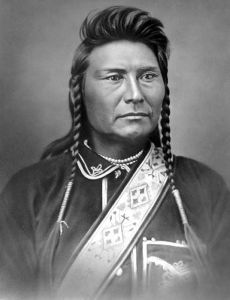
    Chief Joseph

    I’ll begin with an overview of the flight of the Nez Perce who generally lived peacefully with whites for most of the 1800’s. After gold was discovered on Nez Perce land in 1853, settlers began moving in and in 1877 the Indians were ordered onto a tiny reservation. Rather than comply with the order, they decided to flee to the buffalo country on the plains. Most accounts of the flight of the Nez Perce emphasize things that happened outside of Yellowstone Park like broken treaties and battles, but I’ll reverse that pattern and focus in the human drama of the Indians’ encounters with tourists.

    Then I’ll talk about what I call “The Joseph Myth,” the common belief that Chief Joseph was a great general whose genius allowed him to outmaneuver the U.S. Army for months. Joseph was the chief of one of the five bands that led the army on its merry chase, but he was never the principal chief. I’ll speculate on reasons the Joseph Myth was born and why it persistes: (1) Joseph was an important chief who had a conspicuous role in negotiations with whites before the Nez Perce decided to leave and he was the last remaining chief at the Battle of Beartooth so he negotiated the surrender. These things made him the apparent leader. (2) The Army Officers needed a genius opponent, otherwise they would look like fools for letting a band of Indians that included old men, women and children—and 1,600 hundred horses and cow—elude them for months, (3)After the conflict Indian sympathizers needed an Indian hero who sought peace to bolster their case, and (4) Joseph was indeed a noble man who devoted his life to obtaining justice for his people. All true, but he wasn’t a military genius.

    I’ll talk about the Radersburg Party’s trip to the park and read Emma Cowan’s description of her being taken captive by the Nez Perce, which ended with her watching an Indian shoot her husband in the head.

    To slow things down, I’ll talk about “Skedaddlers,” tourists who visited the park in the summer of 1877, but left before the Indians arrived. These include: the famous Civil War General William Tecumseh Sherman; Bozeman Businessman Nelson Story; English Nobleman and park popularizer, The Earl of Dunraven and his companions, Buffalo Bill’s sometime partner, Texas Jack Omohundro, and Dunraven’s friend, George Henry Kingsley, a physician who patched up the Nez Perce’ victims at Mammoth Hot Springs.

    I’ll talk about the Helena Party’s trip and contrast the all-male group that entered the park from the north with the co-ed Radersburg Party that entered from the west. Then I’ll read Andrew Weikert’s description of his gun battle with the Nez Perce.

    Then I’ll describe how survivors of encounters with the Nez Perce were either rescued by soldiers looking for the Indians or made their way to Mammoth Hot Springs. I’ll explain that after Emma Cowan, her sister, and several wounded men left Mammoth for civilization, three men stayed there to see if their missing companions would appear. Then I’ll read Ben Stone’s description of the Indian attack at Mammoth that left another man dead.

    I’ll end with my synthesis of accounts of Emma Cowan’s overnight ride from Helena to Bottler’s Ranch in the Paradise Valley to join her husband who had survived three gunshot wounds and was rescued by the army. That will give me an opportunity to talk about Encounters in Yellowstone, a book I’m writing now.

    ∞§∞

    — The presentation is free and open to the public.  Please tell your friends.

    — You can read about my 2011 presentation to Smart Women.

    — Public Domain Photo.

  • A Tale: A Battle With Fleeing Nez Perce — 1877

    My next book, Encounters in Yellowstone 1877, will tell the stories of the several groups of tourists who tangled with the Nez Perce while they fled through Yellowstone Park after the Big Hole Battle.

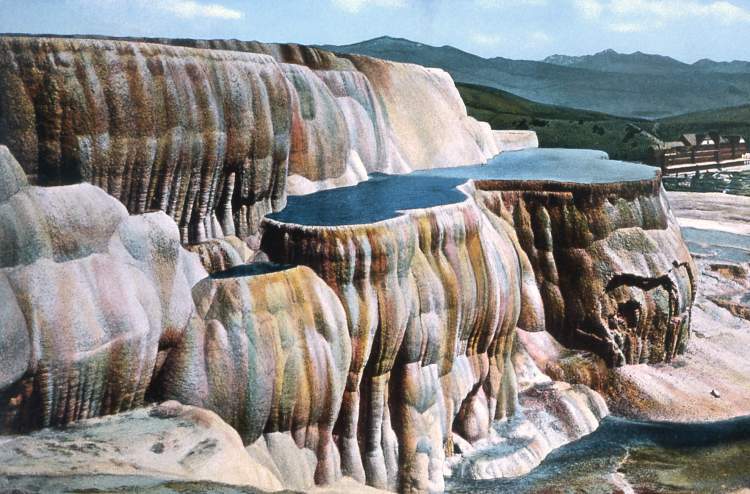
    Mammoth Hot Springs

    The Army’s pre-dawn attack on the sleeping Indian camp left dozens of women and children dead, which enraged many young Indians. Despite chiefs’ efforts to avoid whites, several groups were attacked in or near Yellowstone Park.

    The most famous encounter is Emma’s Cowan’s ordeal of being captured, but there are other chilling events. Andrew Weikert was touring with a group of young men when they spotted the Indians a few miles south of Mammoth Hot Springs. The group beat a hasty retreat to thick grove of trees and spent the night hiding. The next morning, Weikert and a companion named Wilkie decided to leave the others in camp and go see if the Nez Perce had moved on. Here’s how Weikert described what happened.

    ∞§∞

    We could see where the Indians and their horses had made a trail, so we thought the coast was clear. We started back for camp, but, we ran against an obstacle that made our hair raise and the blood rush to our faces.

    We had gotten into the timber not more than a quarter of a mile when we ran onto a lot of the redskins lying in wait for us. They were under the hill, behind a log, so we did not see them until we got within about seventy-five feet.

    I was riding ahead when I saw them raise up their heads from behind the log. I told Wilkie there were Indians ahead and wheeled my horse. At the same time I was getting my gun up ready to fire. Looking back I saw half a dozen guns leveled at me so I made myself small as I could, with my gun across my knees.

    Bang! bang! bang! then zip! zip! zip! went the balls, but none struck me that time. I was perfectly cool and self-possessed, but will own up that my hair was standing on end when I first saw them. My horse had made a few more jumps, when bang! they went again.

    This time they were a little more successful, for they cut a crease in my shoulder blade about four inches long; did not break a bone, but splintered my shoulder bone a little. And another ball took a piece out of my gunstock. I then began hugging my horse still closer, if such a thing was possible, when they gave us another volley.

    By this time, we were out of range, but the balls flew past thick and fast and we could hear them strike the trees. Now for a race!

    I supposed that they had their horses close at hand, but they did not mount them just then. Just at this time, my horse tripped his foot and fell and came near turning a somersault. I went sprawling on the ground directly in front of him.

    My shoulder was paining considerably, but I did not have long to remain there, for the ‘reds’ were running up again to get another shot at me. I up and let them have one from my repeater. You ought to have seen them dodge. I did this all in a few seconds, and my horse was on his feet again ready to start. I just put my hand on the horn of the saddle, made a bound into it, and was off.

    Wilkie had gotten considerably ahead of me by this time, but I soon made up for lost time. We got back on the prairie again on Alum Creek in the valley, then back in the timber again. The Indians did not follow us. We rode as far as we could, then took it afoot, for the under-brush was so thick that we could hardly get our horses through.

    After we got into the timber quite a ways, we halted to take breath and to see what damage was done. Wilkie asked me if I was hurt; I told him judging from the hole in my shirt on the right shoulder, and the way the blood was running in my boot, I thought that there must be a scratch at least.

    We examined it and bound it up the best we could. Wilkie, being a safe distance from the Indians, did not get hurt. We looked our horses over, and found them all sound, thank fortune. So we mounted and took our direction for camp, rode as lively as we could in hopes that the reds had not been there so we could warn the boys.

    ∞§∞

    —Adapted from Weikert’s Journal published in Contributions to the Montana Historical Society, 1900.

    — Frank J. Haynes postcard, Coppermine Photo Gallery.

    — You might also enjoy:

  • Researching Attitudes Toward Indians

    What would it feel like to wake up in a wilderness with a lead slug embedded in your skull and remember watching your wife being dragged away by hostile Indians? That happened to George Cowan when the Nez Perce fled through Yellowstone Park  a hundred and thirty-three years ago.

    I’m writing about George’s ordeal for my next book, Encounters in Yellowstone 1877, so I need to know how he felt. Actually, it’s not hard to empathize with George. We all know that his head hurt from the bullet lodged there. And of course, George felt anger  — maybe even rage — at his attackers, and fear — maybe even terror — at what they might do to his wife.

    George’s story is compelling because it’s easy to identify with him, but can we assume he reacted in the same way we would? Wouldn’t events like the Battle of the Little Big Horn that happen just a year before George’s ordeal have colored his reactions?

    Last week, I did some research to answer questions like those. I started by searching the index of Montana the Magazine of Western History. I scanned subject headings until I saw “Indians, attitudes toward.” Under that heading I found an article published in 1957 by Robert W. Mardock entitled “Strange Concepts of the American Indian Since the Civil War.” Mardock says in the 1870s Americans called Indians everything from “noble savages” to “red devils.”

    New England writers like Cooper and Longfellow promoted the “noble savage” view, but Mardock says things were different on the frontier. He quoted a Virginia City, Montana, newspaper: “It is high time that sickly sentimentalism about humane treatment and conciliatory measures should be consigned to novel writers, and if the Indians continue their barbarity, wipe them out.’”

    According to Mardock, “The apprehensions and viewpoints of our frontier areas were strongly reflected in the Eastern newspapers. Exaggerated dispatches from the West, incredibly wild and inaccurate when reporting Indian ‘massacres’ and depredations, were commonly printed without ever questioning their accuracy. The frontier ‘red devil’ concept dominated the national press with few exceptions.”

    George Cowan was an attorney so he probably read both territorial and national newspapers. Visions of “red devils” must have danced through his mind when he came to that morning.

    And what was George’s wife, Emma, thinking when the Indians hauled her away? I found a 1984 article by Glenda Riley entitled “Frontierswomen’s Changing View of Indians in the Trans-Mississippi West,” that provides some insight.

    Riley says, “Journalists and novelists fed the anti-Indian prejudices of their reading publics with fictionalized accounts of brutal and primitive savages who preyed especially on women. When women’s accounts were published they were usually ‘penny dreadfuls’ or narratives of captivity that further inflamed hatred of Indians.”

    In their accounts, George and Emma Cowan don’t dwell on their feelings toward Indians, but they were creatures of their times so the insights Mardock and Riley provide must apply to them. I’ll use those insights as I scrutinize the Cowans’ accounts and write about their adventures. Encounters in Yellowstone will be a better book because I took the time to dig into these things.  Of course, I will do more research.

  • Outline Complete for Encounters in Yellowstone 1877

    I have completed a major milestone for my next book, Encounters in Yellowstone 1877. I finished an outline. That was a complicated task because I’m writing about a myriad of overlapping events and disparate (often desperate) people.

    First, there are the Nez Perce, who decide to flee their homeland in Idaho and Washington State and make a new life in the buffalo country of Montana. After the army’s predawn attack on their sleeping camp on the banks of the Big Hole River, the Indians fragment. The Chiefs try to avoid whites while leading the main group, but they lose control over small bands of young men who spread out to seek revenge. These young warriors attack settlers along the Montana-Idaho border and tourists in Yellowstone National Park.

    Like a nuclear chain reaction, each attack breaks up a group of people yielding several dramatic stories. For example, when a young warrior named Yellow Wolf and his companions attack a tourist party near the lower geyser basin, they capture a young woman, shoot her husband in the head and leave him for dead, and send several other tourists fleeing into the forrest. This one event yields Emma Cowan’s chilling tales of her captivity and quest for help after being released in the wilderness; George Cowan’s story of regaining consciousness to find himself wounded and alone, and the Cowan’s companions’ efforts to hide, flee and find help. Meanwhile, army units converge on Yellowstone Park from several directions, trying to find and subdue the elusive Nez Perce.

    I’ve organized these events into 20 chapters that chronicle events beginning in 1805 when the Nez Perce befriend several starving men from the Lewis and Clark Expedition, and ending 130 years later with publication of a book entitled Adventures in Geyserland. Doubtless I’ll make changes as my research proceeds. I’ll need to merge some chapters, split others and rearrange things. But I have an outline that organizes a complicated human drama into a coherent narrative. For now, I’m happy with that.

    ∞§∞

  • A Tale: Captured by Indians by Emma Cowan—1877

    Cowan Party
    The Cowans visiting the site of their capture in 1901.

    Emma Cowan and her family visited Yellowstone National Park in 1877—the year the U.S. Army pursued the Nez Perce Indians there. The Nez Perce generally had amicable relations with whites, but in what has become a familiar story, the peace was shattered when gold was discovered on their land. Some Nez Perce acquiesced to government demands that they move to a tiny reservation, but others decided to flee their homeland instead.

    The Army sent soldiers to subdue the defiant Nez Perce, but the Indians defeated them several times. In the most dramatic battle, the Army made a pre-dawn attack on a sleeping Nez Perce camp on the banks the Big Hole River in southwest Montana. The Indians rallied, drove back their attackers, then retreated leaving their equipment, teepees, and at least 89 dead—most of them women and children.

    After the battle, they fled though Yellowstone Park where they captured Emma’s party.  Here’s her account of what happened later.

    ∞§∞

    Every Indian carried a splendid gun, with belts full of cartridges. As the morning sunshine glinted on the polished surface of the gun barrels, a regiment of soldiers could have not looked more formidable. The Indians pretended all the while to be our very good friends, saying that if they should let us go, bad Indians, as they termed them, would kill us.

    Suddenly, without warning, shots rang out. Two Indians came dashing down the trail in front of us. My husband was getting off his horse. I wondered what the reason. I soon knew, for he fell as soon as he reached the ground—fell heading downhill. Shots followed and Indian yells, and all was confusion. In less time than it takes to tell it, I was off my horse and by my husband’s side….

    I heard my sister’s screams and called to her. She came and crouched by me, as I knelt by his side. I saw he was wounded in the leg above the knee, and by the way the blood spurted out I feared an artery had been severed. He asked for water. I dared not leave him to get it.

    I think we both glanced up the hill at the same moment, for he said, “Keep quiet. It won’t last long.” That thought had flashed through my mind also. Every gun in the whole party of Indians was leveled at us three. I shall never forget the picture, which left an impression that years cannot efface. The holes in those gun barrels looked as big as saucers.

    I gave it only a glance, for my attention was drawn to something near at hand. A pressure on my shoulder was drawing me away from my husband. Looking back over my shoulder, I saw an Indian with an immense navy pistol trying to get a shot at my husband’s head. Wrenching my arm from his grasp, I leaned over my husband, only to be roughly drawn aside. Another Indian stepped up, a pistol shot rang out, my husband’s head fell back, and a red stream trickled down his face from beneath his hat. The warm sunshine, the smell of blood, the horror of it all, a faint remembrance of seeing rocks thrown at his head, my sister’s screams, a faint sick feeling, and all was blank.

    ∞§∞

    Two days later the Indians released Emma, her sister, Ida, and her brother, Frank. They made their way to Mammoth Hot Springs where they found help. Emma’s husband, George, survived the shooting. He carried the slug that an Army surgeon dug out of his head as a watch fob for the rest of his life.

    While making their way through the Yellowstone wilderness, the Nez Perce discovered they were not welcome with their old friends, the Crow, who had made accommodations with the whites. The Nez Perce decided to head north to join Sitting Bull and his Sioux in Canada. In October the starving and exhausted remnants of the band surrendered to the Army just 40 miles from the Canadian border.

    ∞§∞

    You can read Emma’s complete story in my book, Adventures In Yellowstone.

    — You might also be interested in:

    — Photo, Pioneer Museum of Bozeman.