Tag: Edwin J. Stanley

  • A Tale: A Circuit Rider Describes the Upper Geyser Basin — Edwin J. Stanley, 1873

    As a Methodist circuit rider, Edwin J. Stanley traveled extensively throughout Montana in the late 1800s. Following a trip to Yellowstone Park Giant Geyser from Stanleyin 1873, Stanley published a series of letters about his experiences there in what he described as “a leading newspaper of the West.” In 1882, he published a compilation of those letters in his book, Rambles in Wonderland.
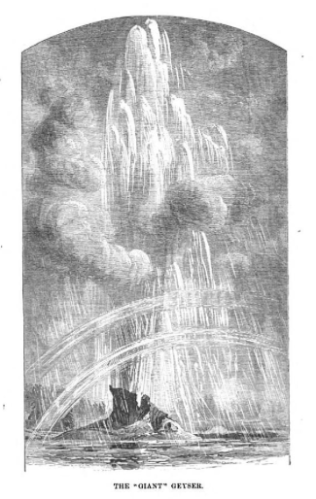
    Stanley supplemented his observations with extensive reading so his book provides a comprehensive summary of what people knew about the park then. Here’s a condensed version of his description of the Upper Geyser Basin.

    ∞§∞

    There are hundreds of springs in the basin, all differing more or less in some particular. There are about twenty regularly acting. On a calm, clear morning, at or just before sunrise, when all the springs are sending up their columns of steam of every magnitude, and all boiling and fussing and splashing away, as if trying each to attract the greatest share of attention, and while one or two of the larger geysers are piercing the heavens with their stupendous columns, the basin presents a lively and interesting spectacle.

    The eruptions as witnessed by moonlight are truly sublime, though deprived of much of their glory, as it is difficult to distinguish between water and steam. Some of the party built bonfires and watched the eruptions by firelight, which were very fine, giving the rising volumes the appearance of fiery liquid hurled forth from the crater of a volcano.

    It is not the most quiet and agreeable place for sleeping. One is frequently disturbed during the night by the alarming detonations and subterranean thunder, making an almost constantly rumbling noise as of heavy machinery in motion, the come and go of ponderous freight trains, the hiss and rush of escaping steam, and the loud plash of falling torrents, as the geysers, the ever vigilant sentinels on the outposts of old Pluto’s infernal regions, sound the alarm and spout forth in the darkness. This is more sensibly realized by sleeping on the ground, and, rest assured, the sensations are not always of the most desirable character.

    A Catholic priest was standing near a hot spring, when the crust gave way, and let him into the seething caldron. The accident would doubtless have proved fatal, but that a strong man who was at his side, and happened to be standing on solid ground, seized him by the collar and saved him from a horrible death. Though he escaped without any injury whatever, imagine his surprise at the appearance in an Eastern paper of a vivid account of his untimely death, together with an illustration showing a party of men dragging the lifeless body of a monk “all shaven and shorn,” and attired in priestly robes, from one of the geysers! He still asserts that it is a mistake, notwithstanding the statements of the newspapers to the contrary.

    Whenever railroads come within reach, or even passable wagon and stage roads are completed through the Park, this will become a favorite place of resort for people from every part of the world, though I prefer going in true pioneer style on horseback, with a pack-horse on which to carry provisions and baggage. A wagon-road is now completed from Virginia City up the Madison to the Lower Basin. But don’t go until you can make the grand rounds, for the geysers, in all their glory, are only part of the wonders of the National Park.

    While here we met with persons from various portions of the Territory, among them a number of friends; and quite a sociable time we had the two evenings spent in the basin. After the sight-seeing of the day was over, we gathered around our brilliant camp-fire, and passed the time relating incidents and anecdotes of a pleasant character; while Miss Clark, a young lady from Chicago, with vocal gifts that all admired, charmed us with some excellent music, presenting quite a contrast as the charming melodies floated out upon the nightwind, and mingled with the hissing reports of a hundred noisy, spouting springs, the wild, weird appearance of everything adding greatly to the novelty of the surroundings.

    ∞§∞

     — Exerpt condensed form Chapter 13 (pages 118-123) in Edwin J. Stanley, Rambles in Wonderland or Up the Yellowstone. New York: Appleton and Company, 1883.

    — Illustration from the book.

    — You might also enjoy:

    For more descriptions click “Geysers” under the Categories button above.

  • Moran’s Legacy 2: Mammoth Hot Springs — Text by Edwin J. Stanley, 1883

    “Hot Springs of the Yellowstone,” Thomas Moran 1871

    Mammoth Hot Springs was the first major feature Thomas Moran encountered when he toured Yellowstone Park in 1871 with the Hayden Expedition. Moron’s diary entries for the three days he spent at Mammoth contain not a word of description. Apparently he was content relying on his watercolor sketches.

    Of course, many travelers did offer written descriptions of the springs. Here’s one by Edwin J. Stanley, a writer, historian, and Methodist minister, who visited Yellowstone Park in 1873.

    ∞§∞

    I came suddenly out in full view of the far famed Hot Springs. Having read glowing descriptions of the place, and being rather despondent from the fatigue of travel, I felt somewhat disappointed, and feared my expectations would not be fully met; but all such impressions vanished at first view of the strangely-beautiful scene, and I felt that the half had not been told, though the sun was obscured by clouds, depriving me of much of the inspiration that the first view would otherwise have furnished.

    The proprietors of the place, two young gentlemen from Bozeman, anticipating the value of these springs as a place of resort for pleasure-seekers and invalids, had taken possession of them before the passage of the bill including them in the National Park, and styled them the Mammoth Hot Springs. But Dr. Hayden, the United States Geologist, doubtless moved by the first impression made upon his mind on arriving here, gave them the title of White Mountain Hot Springs.

    Both titles are quite appropriate, considering their mammoth proportions—surpassing anything of the kind yet discovered—and the vast mountain of white and yellowish deposit made from the mineral solutions contained in the immense volumes of water gurgling up from scores of boiling fountains. This immense calcareous formation, with its numberless and intricate phenomena, baffling all attempts at description, is the chief object of interest here.

    The first impression on beholding it is that of a snowy mountain beautifully terraced, with projections extending out in various directions, resembling frozen cascades, as though the high, foam-crested waves, in their rapid descent over the steep and rugged declivity, were suddenly arrested and congealed on the spot in all their native beauty. There are fifty or sixty of these springs of greater and smaller dimensions, extending over an area of about a mile square; though there are remains of springs of the same kind for miles around, and mountains of the same deposit overgrown with pine-trees, perhaps hundreds of years old.

    Most of the water is at boiling heat, and contains in solution a great amount of lime, sulphur, and magnesia, with some soda, alumina, and other substances, which are slowly deposited in every conceivable form and shape as the water flows along in its course down the mountain-side.

    On each level, or terrace, there is a large central spring, which is usually surrounded by a basin of several feet in diameter, and the water, after leaving the main basin at different portions of the delicately-wrought rim, flows down the declivity, step by step, forming hundreds of basins and reservoirs of every size and depth, from a few inches to six or eight feet in diameter, and from one inch to several feet in depth, their margins beautifully scalloped with a finish resembling bead-work of exquisite beauty. The character of the formation depends upon the temperature and flow of the water, as well as upon the character of prevailing minerals at that particular place. Where the water flows slowly, and with but slight ebullition, the smaller basins and terraces are formed, one below the other, with their delicate partitions and beautifully-fringed borders; and where the volume and momentum are greater, the basins are larger and deeper, and the ornamentation proportionately coarser.

    Where the water flows quite rapidly, the pools are filling up, leaving the deposit in wave-like forms, just like water congealed when flowing over a cascade. Underneath the sides of many of the basins are beautifully-arranged stalactites, formed by the dripping of the water; and, by digging beneath the surface at places where the springs are inactive, the most delicate and charming specimens of every character and form can be obtained—stalactites, stalagmites, grottoes, etc., all delicately arranged as the water filtrates through the crevices and perforations of the deposit. The larger pools, before the erection of bathing-houses, afforded a splendid opportunity to enjoy the luxury of bathing, as water of any temperature desirable could be secured. The sides of the mountain for hundreds of yards in extent are covered with this calcareous incrustation, formerly possessing all the ornamental attractions of the springs now in action. It is a scene sublime in itself to see the entire area with its numerous and terraced reservoirs, and millions of delicate little urns, sparkling with water transparent as glass, and tinged with many varieties of coloring, all glistening under the glare of a noonday sun. But the water is constantly changing its channel, and atmospheric agencies have disfigured much of the work, leaving a great portion of it only the resemblance of an old ruin.

    Every active spring or cluster of springs has its succession of little urns and reservoirs extending in various directions. The largest spring now active, situated about half-way up the mountain on the outer edge of the main terrace, has a basin about twenty-five by forty feet in diameter, in the centre of which the water boils up several inches above the surface, and is so transparent that you can, by approaching the margin, look down into the heated depths many feet below the surface. The sides of the cavern are ornamented with a coral-like formation of almost every variety of shade, with a fine, silky substance, much like moss, of a bright vegetable green, spread over it thinly, which, with the slight ebullition of the water keeping it in constant motion, and the blue sky reflected in the transparent depths, gives it an enchanting beauty far beyond the skill of the finest artist. Here all the hues of the rainbow are seen and arranged.so gorgeously that, with other strange views by Which one is surrounded, you almost imagine yourself in some fairy region, the wonders of which baffle all attempts of pen or pencil to portray them.

    Besides the elegant sculpturing of this deposit, imagine, if you can, the wonderful variety of delicate and artistically-arranged colors with which it is adorned. The mineral-charged fluid lays down pavements here and there of all the shades of red, from bright scarlet to rose-tint, beautiful layers of bright sulphur-yellow, interspersed with tints of green—all elaborately arranged in Nature’s own order. Viewed from the Tower Creek trail, which passes at the base, this section of the mountain has a very architectural appearance.

    But descending the mountain from which we first beheld the springs, and where we left the reader, we come to the first level, or terrace, the base of the principal formation. There are several springs, the water of which is used by the scores of invalids already flocking here to be healed of their maladies. Here, also, are the small bath-houses erected by the proprietors, for the use of which a handsome sum is generally exacted. The medicinal properties of each fountain seem to be different, and the invalid can use that best adapted to his case. Just over there to our right, in the mouth of a little gorge, coming down from the mountain, by the side of the sparkling brook of snowwater, among the pine-trees, where the smoke is curling up from many fires, are the camps of the tourists and invabds who have come hither, and are abiding in rudely-constructed cabins, some in tents, enjoying all the luxuries of camp-life. Rather a motley, though quite a lively, group. Some remarkable cures have been effected here, mostly of diseases of the skin, and rheumatism. But I think that the invigorating mountain-air and the healthful influence of camp-life have much to do with many cures that are effected, as these are known to be wonderful remedies in themselves for many of the ills which flesh is heir to.

    ∞§∞

    — From Edwin James Stanley, Rambles in Wonderland, Or Up The Yellowstone, New York: D. Appleton and Company, 1883.  pages 54-58.

    — Coppermine Photo Gallery Image.

    — You might also enjoy Edwin J. Stanley’s “Guiding the Nez Perce Through Yellowstone Park.”