Tag: elk

  • A Tale: Teddy Roosevelt Bags an Elk on Two Ocean Pass — 1891

    There was no greater supporter of Yellowstone National Park than Theodore Roosevelt. TR was an avid hunter, but he favored prohibition of hunting inside Yellowstone National Park. The idea was that keeping hunters out would make the Park an endless well of trophy animals that could be hunted when they strayed outside its boundaries.

    And Roosevelt knew that areas near the park provided marvelous hunting. Here’s his description of one of his kills while on a hunting expedition in 1891 to the Two Ocean Pass, an area just outside Yellowstone’s southern border.

    ∞§∞

    The weather became clear and very cold, so that the snow made the frosty mountains gleam like silver. The moon was full, and in the flood of light the wild scenery round our camp was very beautiful. As always where we camped for several days, we had fixed long tables and settles, and were most comfortable; and when we came in at nightfall, or sometimes long afterward, cold, tired, and hungry, it was sheer physical delight to get warm before the roaring fire of pitchy stumps, and then to feast ravenously on bread and beans, on stewed or roasted elk venison, on grouse and sometimes trout, and flapjacks with maple syrup.

    Next morning dawned clear and cold, the sky a glorious blue. Woody and I started to hunt over the great tableland, and led our stout horses up the mountainside, by elk trails so bad that they had to climb like goats. All these elk-trails have one striking peculiarity. They lead through thick timber, but every now and then send off short, well-worn branches to some cliff-edge or jutting crag, commanding a view far and wide over the country beneath. Elk love to stand on these lookout points, and scan the valleys and mountains round about.

    Blue grouse rose from beside our path; Clarke’s crows flew past us, with a hollow, flapping sound, or lit in the pine-tops, calling and flirting their tails; the gray-clad whiskyjacks, with multitudinous cries, hopped and fluttered near us. Snow-shoe rabbits scuttled away, the big furry feet which give them their name already turning white. At last we came out on the great plateau, seamed with deep, narrow ravines. Reaches of pasture alternated with groves and open forests of varying size.

    Almost immediately we heard the bugle of a bull elk, and saw a big band of cows and calves on the other side of a valley. There were three bulls with them, one very large, and we tried to creep up on them; but the wind was baffling and spoiled our stalk. So we returned to our horses, mounted them, and rode a mile farther, toward a large open wood on a hill-side. When within two hundred yards we heard directly ahead the bugle of a bull, and pulled up short.

    In a moment I saw him walking through an open glade; he had not seen us. The slight breeze brought us down his scent. Elk have a strong characteristic smell; it is usually sweet, like that of a herd of Alderney cows; but in old bulls, while rutting, it is rank, pungent, and lasting. We stood motionless till the bull was out of sight, then stole to the wood, tied our horses, and trotted after him. He was travelling fast, occasionally calling; whereupon others in the neighborhood would answer. Evidently he had been driven out of some herd by the master bull.

    He went faster than we did, and while we were vainly trying to overtake him we heard another very loud and sonorous challenge to our left. It came from a ridge-crest at the edge of the woods, among some scattered clumps of the northern nut-pine or pinyon—a queer conifer, growing very high on the mountains, its multi-forked trunk and wide-spreading branches giving it the rounded top, and, at a distance, the general look of an oak rather than a pine.

    We at once walked toward the ridge, up-wind. In a minute or two, to our chagrin, we stumbled on an outlying spike bull, evidently kept on the outskirts of the herd by the master bull. I thought he would alarm all the rest; but, as we stood motionless, he could not see clearly what we were. He stood, ran, stood again, gazed at us, and trotted slowly off.

    We hurried forward as fast as we dared, and with too little care; for we suddenly came in view of two cows. As they raised their heads to look, Woody squatted down where he was, to keep their attention fixed, while I cautiously tried to slip off to one side unobserved. Favored by the neutral tint of my buckskin hunting-shirt, with which my shoes, leggins, and soft hat matched, I succeeded. As soon as I was out of sight I ran hard and came up to a hillock crested with pinyons, behind which I judged I should find the herd.

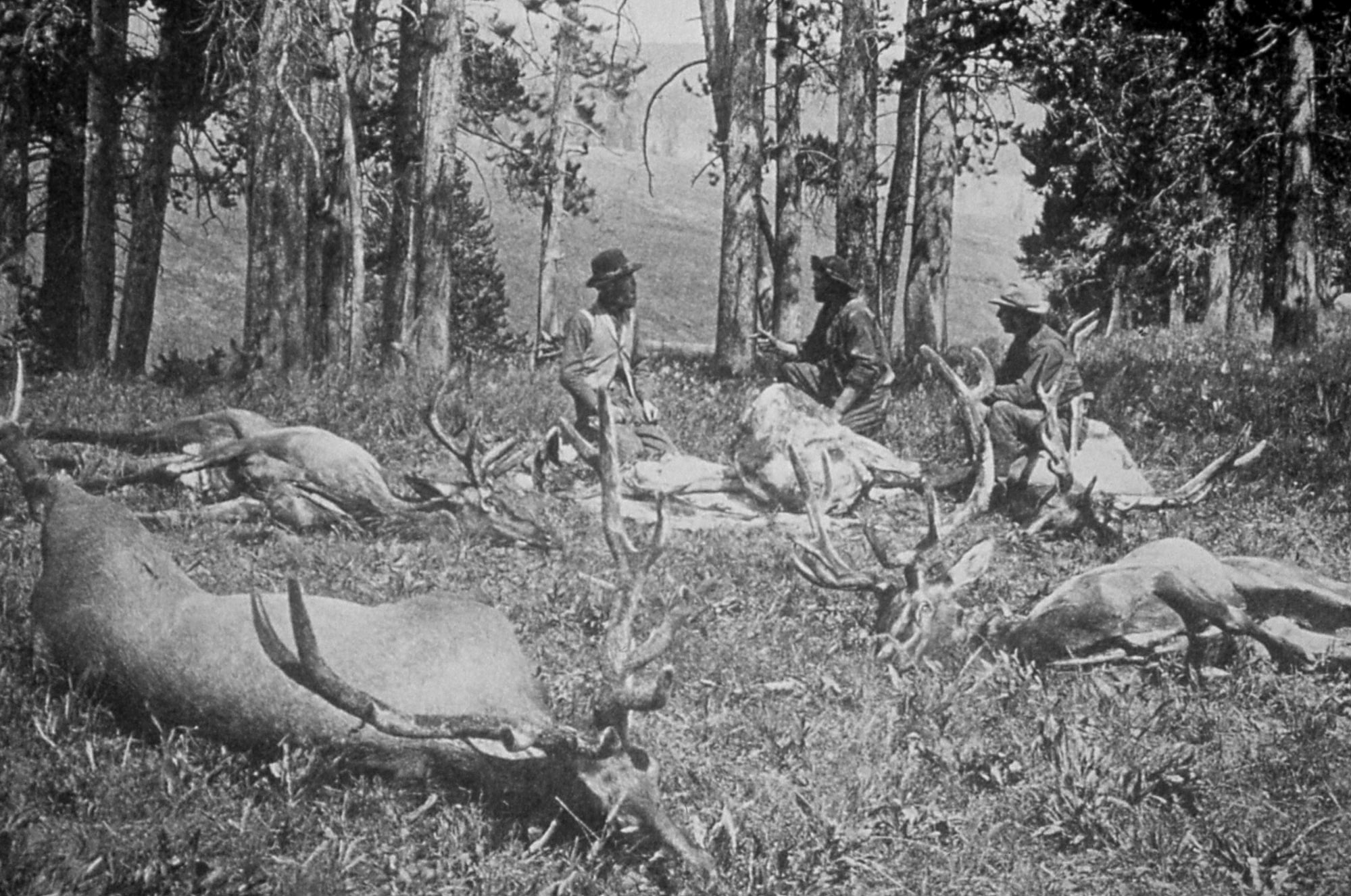
    As I approached the crest, their strong, sweet smell smote my nostrils. In another moment I saw the tips of a pair of mighty antlers, and I peered over the crest with my rifle at the ready. Thirty yards off, behind a clump of pinyons, stood a huge bull, his head thrown back as he rubbed his shoulders with his horns. There were several cows around him, and one saw me immediately, and took alarm. I fired into the bull’s shoulder, inflicting a mortal wound; but he went off, and I raced after him at top speed, firing twice into his flank; then he stopped, very sick, and I broke his neck with a fourth bullet.

    The elk I thus slew was a giant. His body was the size of a steer’s, and his antlers, though not unusually long, were very massive and heavy. He lay in a glade, on the edge of a great cliff. Standing on its brink we overlooked a most beautiful country, the home of all homes for the elk: a wilderness of mountains, the immense evergreen forest broken by park and glade, by meadow and pasture, by bare hill-side and barren tableland.

    ∞§∞

    — Excerpt from Theodore Roosevelt “An Elk Hunt at Two Ocean Pass.”  Pages  177-202 in The Wilderness Hunter: An Account of Big Game in the United States.  Putnam’s Sons: New York, 1902.

    — Photo from The Wilderness Hunter.

    — For other stories about tracking game, click on “Hunting” under the Categories button to the left.

  • A Tale: Pioneer Photographer Documents Hunting Expedition Near Yellowstone Park — 1889

    Jack Bean (left) and a client near Jackson Hole, Wyoming, 1889.

    When I received my copy of the fall issue of the Pioneer Museum Quarterly last week, I was delighted to see an article about Charles D. Loughrey, a Bozeman pioneer photographerI had examined the museum’s collection of Loughrey’s photographs but didn’t know much about him.  

    Jacob Rubow of the museum staff dug through Loughrey’s diary and a reminiscence by his brother-in-law, Jack Bean, to glean stories from their lives. One of those stories was about a hunting trip where Bean guided two Englishmen through the park. Hunting inside the park was illegal then, so Bean took his clients to places nearby so they could bag their trophies. And Loughrey was on hand to document the magnificent specimens.

    I asked Jacob if I could post the hunting story on my blog. I’m delighted that he obliged.

    ∞§∞

    In August, 1889, two Englishmen, Messrs. Lennard and Beach, hired Jack Bean, a resident of Bozeman, Montana, to lead them on a hunting trip through Yellowstone National Park and points beyond. Bean, who then earned a living as a guide for hunters and the cavalry out of Fort Ellis, enlisted his friend and brother-in-law, Charles D. Loughrey, as cook and photographer for the expedition. Loughrey had once owned a photography studio in Bozeman, and although the venture was short lived, his photographs, combined with his dutifully-kept journals, have left behind a rarity among historical sources: an illustrated account of the Gallatin Valley and greater Yellowstone region as he saw it in the late nineteenth century. As a frequent companion on Jack Bean’s hunting trips, Loughrey captured striking views of remote corners of the Gallatin Valley, Yellowstone, and the Snake River and Tetons. His diary entries, which chronicle the daily pace of life in the late nineteenth century as well as his and Bean’s adventures in Yellowstone, run from concise to sparse, but, as the saying goes, his pictures are worth a thousand words.

    On August 8, Loughrey and Bean rode into Bozeman through a haze of late-summer smoke blown before a hard east wind. There, they purchased food and had their horses freshly shod. Loughrey spent the next two days busily repairing and fitting his camera with a new lens, packing supplies, and accompanying his wife Ida and family to town “to see a street dog show given by some medicine men.” Then, on the morning of August 11, Loughrey took a bath and set off through the clearing smoke to meet Bean and his assistant guides. The men camped that night amidst heavy thundershowers in the Gallatin Mountains, and spent the following night cussing the building smoke along the Yellowstone River. On the thirteenth, the party camped above the Yankee Jim Tollgate, and on the fourteenth Loughrey wrote a letter to Ida from their camp above Gardiner. While Bean and the other guides spent the next three days waiting in town for the Englishmen, Loughrey explored Mammoth Hot Springs and claimed the hunting party’s first victim, a rattlesnake.

    On Sunday, August 18, with Englishmen in tow, the expedition crossed into the park, camping first at Tower Falls, then spending a “very wet and disagreeable” night in a snowstorm downstream from the Lower Falls of the Yellowstone. A spell of clear, cold weather followed the snowstorm, and the group traveled quickly past the Grand Canyon and Falls, camped at Yellowstone Lake, and then paused at the Upper Geyser Basin on the 23rd. Loughrey lagged behind to take a view of Lewis Falls before exiting the park on the 25th, and rejoined the party later that afternoon at a camp near the Snake River. The enthusiastic hunters spent their first evening beyond the park boundary searching for elk, but returned to camp empty handed. Loughrey stayed in camp on the 27th, washing clothing and photographing the horses grazing beside a stream in a small park. The hunters went out, and Jack Bean “killed a cow elk, which caused great rejoicing in camp.”

    The men spent the next few weeks crisscrossing the area around the Tetons and Snake River, fishing with great success, but hunting with mixed results. They quickly settled into a routine, with the hunters and guides fishing and hunting in pairs most evenings, and Loughrey tending to the camp, cooking, washing clothing, and diligently maintaining his photographic equipment. The hunters pursued elk, deer, and pronghorn “with blood in their eyes,” and when they met with success Loughrey dutifully marched out to capture views of the hunters posing with their trophies, and to collect the antlers. In addition to these portraits of victorious hunters, Loughrey captured candid views of the men in camp, striking images of the Tetons rising above Jackson Lake, and scenic glimpses of the horses and pack animals grazing in mountain parks. On September 20, returning northward, the party passed through Rexburg, Idaho, where Bean purchased sugar and dried fruit. The next day, they reached Market Lake, and in a flurry of activity, Bean packed the Englishmen’s things while Loughrey made portraits of the group and sent a letter to Ida on the five o’clock train. The men ate dinner that night with Captain Head, with whom they “[drank] liquor and [ate] fruit till half past nine.” The Englishmen left on the three o’clock train the next morning. Loughrey, Bean, and company packed up “with the wind howling and all hands cursing,” and started for home, taking care not to “let any grass grow under the horses [sic] feet.”

    Despite a snowstorm and Loughrey’s brief bout with a bug that prevented his eating breakfast on the 24th, the party continued their rapid pace homeward. They camped at Henry’s Lake, then at a creek near the Upper Madison Basin. From there the men crossed over to the Gallatin River, and set off down the Canyon. The group made a final camp at Sheep Rock on September 29, reaching the Bean and Loughrey farms on Rocky Creek, east of Bozeman, at half-past-two the next afternoon. Bean and Loughrey arrived at Bean’s house to find their wives gone to town. The two ate dinner, and then went out to check the garden. Loughrey ran into the ladies on his way home, and returned with them to Bean’s house where they stayed all night. The following evening, the Beans and Loughreys took dinner in town with their in-laws, the Rowlands. On Wednesday, October 22, 1889, a clear day, Loughrey “pitch forked some potatoes before dinner,” “cleaned the chicken house out and pulled the beans.” It was good to be home.

    ∞§∞

    This piece is a portion of a larger work from the Pioneer Museum Quarterly and draws upon: Jack Bean’s Reminiscences: Real Hunting Trails, and Charles D. Loughrey’s journals both of which are in the collections of the Pioneer Museum of Bozeman.

    — Photo from the Bean Collection, Pioneer Museum of Bozeman.

    — You also might enjoy Jack Bean’s story, Colonel Pickett Gets His Bear.

    — You can read more about Jack Bean in my book Adventures in Yellowstone.

  • News: Climate Change—Not Just Wolves—May Cause Fewer Yellowstone Elk

    Hunters have been blaming the introduction of Wolves for the recent decline in the number of elk in Yellowstone National Park, but new research indicates that climate change may be to blame. New West has provided a nice summary of the evidence.

    The news reminded me that several of the accounts of early travel to Yellowstone Park talk about summer snow storms bigger than anything we see now. Of course, the storytellers may have been exaggerating, but perhaps I should see if travel accounts provide evidence of climate change.

    Also, early travelers who went to the Park in August (apparently to avoid bad weather) often couldn’t find game. Before the Army outlawed hunting in 1886, many groups counted on living off the land, so when game was scarce they went hungry. Several stories tell about the great joy of returning to the ranches near the park and getting “civilized grub.”

    The Earl of Dunraven, who visited the Park in 1874, commented explicitly about how weather affects the migration of elk and other game.

    ∞§∞

    The herds of game move according to the seasons. In Estes Park, for instance, near Denver, you might go out in winter or in early spring, when the snow is deep upon the ranges and shoot blacktail deer till you were sick of slaughter. I daresay you might—if you knew where to go—sit down, and, without moving, get ten, fifteen, or even as many as twenty shots in the day.

    At other seasons you might walk the flesh off your bones without seeing a beast of any kind. Yet the deer are somewhere all the time; and, if you can only find out to what deep recesses of the forest, or to what high mountain pastures they have betaken themselves in their search for cool shelter, or in their retreat from mosquitoes and other insect pests, you would be amply rewarded for your trouble.

    It is the same with wapiti. Sometimes the park will be full of them; you may find herds feeding right down on the plains among the cattle; and in a fortnight there will be none left. All will have disappeared; in what is more, it is almost impossible to follow them up and find them, for they are much shyer than the deer.

    Where do they go? Not across the snowy range, certainly. Where then? Up to the bare fells, just under the perpetual snow, where they crop the short sweet grass that springs amid the debris fallen from the highest peaks; to the deep black recesses of primeval forest; to the valleys, basins, little parks and plains, hidden among the folds of the mountains, where even the wandering miner has never disturbed the solitude.

    ∞§∞

    — Excerpt from The Great Divide by the Earl of Dunraven.

    — New West Photo.

    — You can read a condensed version of the Earl’s 1874 trip to Yellowstone Park in my book, Adventures in Yellowstone.

  • A Tale: Wapiti Are The Stupidest Brutes — 1874

    Most early Yellowstone tourists came from the adjacent territories because getting to the park was too expensive for other people. But a few wealthy adventurers from distant places found the time and money to make the long trip. Hunting, which was perfectly legal until the Army took over administration of Yellowstone Park in 1886, was a prime attraction.

    One such traveler was Windham Thomas Wyndam-Quin, the fourth Earl of Dunraven. A fabulously wealthy Irish nobleman, Lord Dunraven hired several men to accompany him. One of them was Fredrick Bottler, a rancher who settled in the Paradise Valley on the Yellowstone River in 1868. Bottler was familiar with Yellowstone’s wonders and served as an outfitter, guide and hunter for several early expeditions.

    Dunraven, who had been a war correspondent for British newspapers, was an astute observer with a droll wit. In addition to his stories about watching geysers and hunting big game, he offers humorous advice on how to pack a mule, and tells about roasting fresh elk meat over a campfire.

    He wrote several books about his travel adventures. Here’s his description of Elk Hunting from The Great Divide, one of his most popular.

    ∞§∞

    We wound our way towards the head of the valley, half asleep, for the day was very hot. Before long I jerked my horse on to his haunches and slid quietly off. The others followed my example without a word, for they too had caught a glimpse of the dark brown forms of some wapiti feeding quietly in the wood. Bottler, in his enthusiasm, seized me violently by the arm and hurried into the timber, ejaculating at every glimpse of the forms moving through the trees.

    “There they go! There they go! Shoot! Now then! There’s a chance.” At the time he was dragging me along, and I could no more shoot than fly. At last I shook myself clear of him, and, getting a fair easy shot at a large fat doe, fired and killed her.

    Wapiti are the stupidest brutes in creation; and, instead of making off at once, the others all bunched up and stared about them, so that we got two more before they made up their minds to clear out. There was a fine stag in the herd, but, as is usually the case, he managed to get himself well among the hinds out of harm’s way, and none of us could get a chance at him.

    Bottler and I followed his tracks for an hour, but could not come up with him; and, finding that he had taken clear up the mountain, we returned to the scene of action. There we found the rest of the party busily engaged in cutting up the huge deer. One of them was a hind, in first-rate condition and as fat as butter. We were very glad of fresh meat, and, as the ground was very suitable, determined to camp right there, and send some of the flesh down to the main camp in the morning. We pitched our Lilliputian tents at the foot of one of a hundred huge hemlocks, set a fire, and proceeded to make ourselves comfortable for the night.

    We were all smoking round the fire—a most attentive audience, watching with much interest the culinary feats which Bottler was performing—when we were startled by a most unearthly sound.

    Bottler knew it well, but none of us strangers had ever heard a wapiti stag roaring before, and it is no wonder we were astonished at the noise. The wapiti bellows forth one great roar, commencing with a hollow, harsh, unnatural sound, and ending in a shrill screech like the whistle of a locomotive.

    In about ten minutes this fellow called again, a good deal nearer, and the third time he was evidently close to camp, so we started out. Advancing cautiously, we presently, through a bush, distinguished in the gloom the I saw body and antlered head of a real monarch of the forest as he stalked out into an open glade and stared with astonishment at our fire.

    He looked perfectly magnificent. He was a splendid beast, and his huge bulk, looming large in the uncertain twilight, appeared gigantic. He stood without betraying the slightest sign of fear or hesitation; but, as if searching with proud disdain for the intruder that had dared to invade his solitude, he slowly swept round the branching spread of his antlers, his neck extended and his head a little thrown back, and snuffed the air.

    I could not see the fore sight of the little muzzle-loader, but luck attended the aim, for the bullet struck high up the shoulder; and, shot through the spine, the largest wapiti stag that I had ever killed fell stone-dead in his tracks.

    It was early in the season, and his hide was in first rate condition, a rich glossy brown on the sides and jet black along the back and on the legs; so we turned to, cut off his head and skinned him; and, by the time we had done that and had packed the head and hide into camp, it was pitch dark, when we were ready for supper and blankets.

    ∞§∞

    —From Dunraven, The Great Divide, 1875.

    —William Henry Jackson Photo, Yellowstone Digital Slide File.

    — To see more stories by this author, click on “Dunraven” under the “Categories” button to the left.