Apparently, the practice of soaping geysers to make them erupt began in the 1880s after a concessionaire decided that the naturally agitating Chinaman Spring would be the perfect place to do laundry. After tossing in clothing, the concessionaire added soap and the spring erupted spewing clothing over the landscape.
Soon tourists began stripping soap off of store shelves and taking it from hotel bathrooms so they could eliminate the tedium of waiting for geysers to play. Of course, officials soon banned the practice, but it was hard to control. Here’s Georgina Synge’s description of a clandestine soaping of Beehive Geyser.
∞§∞
The geyser we set our hearts on seeing was the “Beehive,” just opposite our camp, the other side of the basin. The cone, which really has all the appearance of a bee-hive
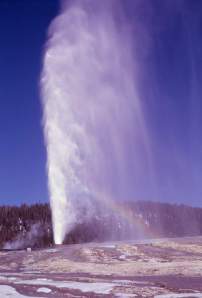 in the distance, is about three feet in height and is beautifully coated with beaded silica. Its action is different to any other geyser, as the water is projected with such force from its comparatively small vent-hole, that it goes up in one perfectly straight pillar to over two hundred feet; and, instead of falling in floods on each side like the others, seems to evaporate into wreaths of steam and vapor.
Now there is a sure and almost certain method for inducing a geyser to play out of its accustomed hours, and this is done by what is called “soaping” them! It may sound incredible, but it is a well known fact (which we attested on several occasions) that a bar or two of common yellow soap, cut up into pieces and slipped into a geyser cone, will have the desired effect in a very short interval. This is supposed to be partly caused by the soap creating a film on the water, which prevents the steam escaping. Smithson was as keen as we were tbat the “Beehive” should play. He assured us he had seen it soaped over and over again, with the most brilliant results.
So that night we sallied forth after all the world had gone to bed, armed with two large bars of Brown Windsor tied up in a pocket-handkerchief. The moon was shining fitfully behind the clouds, and now and then gleamed forth upon us, as, having crossed the river, we climbed up the white sloping sides of the ” Beehive.”
It was not due to play for several days, and as we peered down its dark funnel-like orifice, we could hear a soft peaceful gurgling, but nothing more; and even this quite ceased after we had slipped in the soap. We sat down then and watched. Presently it began to boil up—little by little—with a buzzing sort of noise as if it were hard at work. Every now and then it threw up a few squirts of water, and Smithson, who was getting very excited, laid his ” bottom dollar” it was going to play. But, alas, though it seemed to be trying with all its might, yet it never quite got off, and having watched for nearly an hour, we decided to send Smithson back to camp for some more soap.
Perhaps we had not put in enough, we thought, though Smithson assured us two bars was all it had ever wanted before. Well, in went the second lot, but with just the same result. It showed all the premonitory symptoms, boiled over, made a few gasps, and sent up a few small jets, and then gave it up. We got quite desperate at last. It was nearly twelve o clock, and very cold, as a sharp frost had set in. We thought, however, we would have one more try.
We hurried back to camp. There we found Elijah, stretched fast asleep before the smoldering embers of the fire. We cruelly awoke him, and made him produce the last piece of yellow bar, which we had hitherto thought necessary to leave for washing purposes. And to augment this, A. insisted on my bringing forth our few and treasured cakes of Pears. But no, even this last sacrifice was of no avail—that “Beehive” would not play! Smithson was furious, the first time it had ever refused for him; someone must have soaped it the day before, and if only we would wait it was sure to begin soon. But we decided we could not freeze there all night, even to see the “Beehive” display; and so dejectedly we made our way once more back to camp. Just as we were going off to sleep we heard a roar—something was “guising” at last, but we were too tired to stir even if it had been “Excelsior.” The next morning, however, just as we were dressed, we heard the roar again, like the sound of a sudden hurricane or of numberless distant guns. “She’s off —the ‘Beehive’s guisin’,” shouted Smithson, and off we dashed, helter-skelter, arriving breathless, but in capital time to see a grand eruption.
It was terrific. It seemed as if the whole hill-side must be blown out by the tremendous force with which it burst forth. Higher and higher it soared, in one great round perpendicular column of over two hundred feet, clouding the whole sky with masses of spray and steam. Presently a gust of wind blew up and carried the topmost wreaths in feathery masses over the valley, and we were able to stand quite close to lee of it without getting a drop upon us. It played for about twenty minutes, then wavered, trembled, and finally subsided with sundry gurgles and groans. As we came away, several people who had hurried out from their beds to see the sight, began making remarks on the curious fact of the “Beehive” playing before its proper time. “That’s been soaped,” said a man who belonged to the place, looking suspiciously round, at which we appeared innocently surprised.
∞§∞
— Excerpt from “Geyser-Land,” pages 48-70 in Georgina M. Synge, A Ride Through Wonderland. Sampson, Marston & Company. London, 1892.
— Image from the Coppermine Photo Gallery.
— You might also enjoy Georgina Synge’s tale, “A Nightime Visitor.”
— For more stories about geysers, click “Geysers” under the Categories button to the left.

 M. Mark Miller, Author