 As soon as the Summer issue of the Pioneer Museum Quarterly arrived, I checked for my article on Hester Henshall’s 1903 trip to Yellowstone Park. I contribute regularly to the Quarterly, a publication of the Gallatin Historical Society. It’s always fun to see my stuff in print.
Hester traveled by train from Bozeman to Yellowstone Park, with her husband, Dr. James Henshall, who was director of the Federal Fish Hatchery in Bozeman. Dr. Henshall was a physician, but he made his name as an angler and fish biologist. His Book of the Black Bass, published in 1881, is still in print
The Henshalls toured Yellowstone “The Wylie Way.” That is, with Wylie Permanent Camping Company, which offered tourists a comprehensive package that included transportation, food and lodging in tents tour that were put up in the Spring and left up for the season. The tour included a steamboat cruise across Yellowstone Lake. Here’s Hester’s description of that.
∞§∞
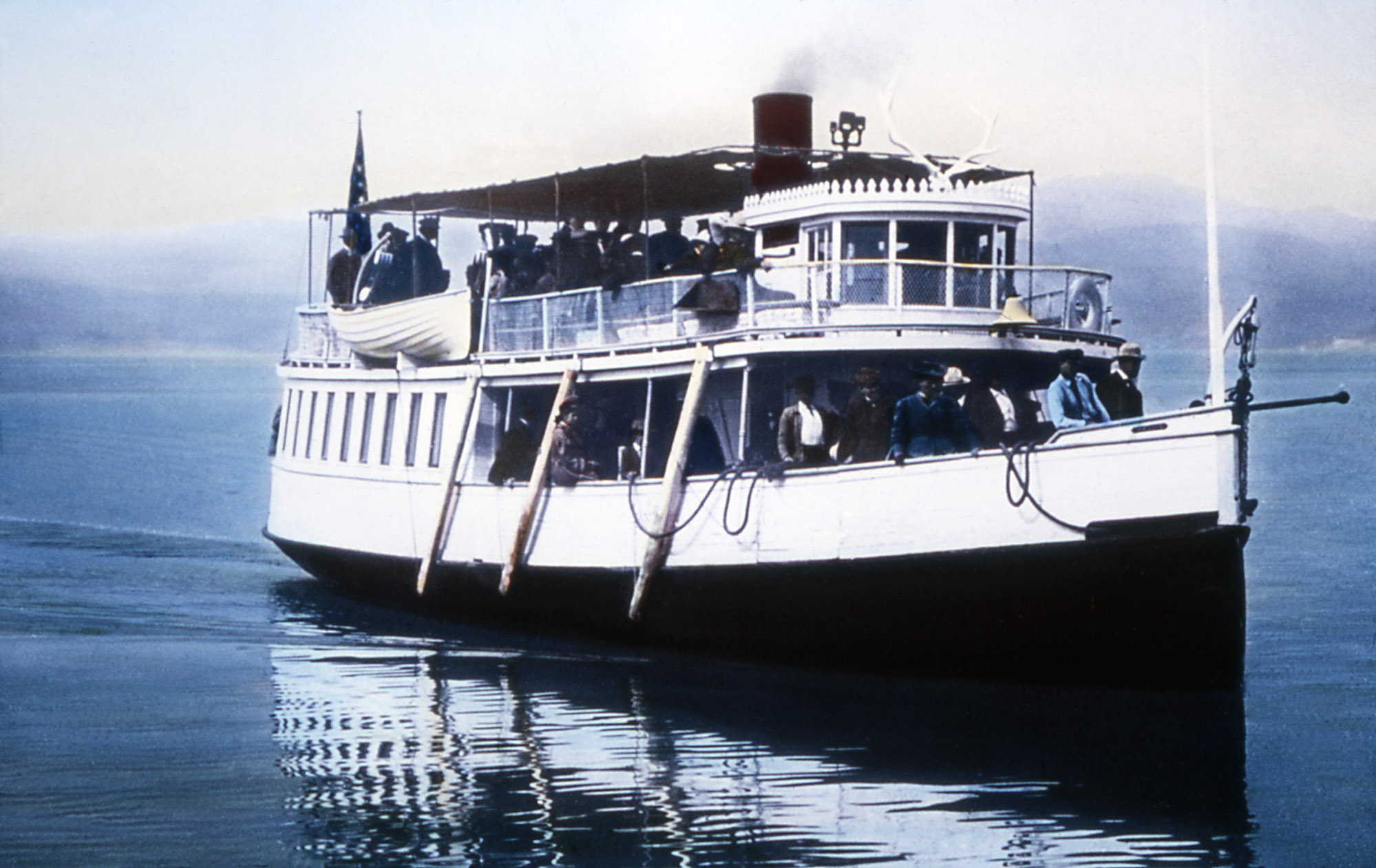
The shrill whistle of the little steamer called us aboard. She is a steel boat, with her name “Zillah” on a white flag floating at her masthead. We were soon steaming out into the lake. The Captain’s name was Waters, a good name for a steamboat captain. Miss Lillian Ehlert was soon at the wheel steering under the care of the pilot.
Doctor Henshall and Doctor Donaldson and myself sat in the bow of the boat. The scene was beautiful and was all very fascinating to me. Upon the mountains was a vague blue efflorescent haze like the bloom upon a grape, that made the tint deeper, richer, softer, whether it were the deep blue of the farthest reach of vision, or the somber gray of the nearer mountains, or the densely verdant slopes of the foot-hills that dipped down into the dark shadowy waters of the lake.
Along the western shore was the Absaroka Range of mountains; and in one place was seen the profile of a human face, formed by two peaks of the lofty range. The face is upturned toward the sky and is known as the Giant’s Face. It was several minutes before I recognized the resemblance, and then I wondered at my stupidity.
We stopped at Dot Island, a tiny green isle in the middle of the lake, on which are a number of animals, buffalo, elk, deer and antelope. They were fed with hay from the steamboat while we were there. The Captain warned us not to go near, as the big bull buffalo was very fierce. He finally did make a terrific rush and butted the fence until I feared the structure would go down before his fierce onslaughts. He was the last animal fed, and the Doctor said that was the cause of his demonstration; that it was all for effect, and to get us aboard again as the Captain wanted to get the passengers to land at his curio store in season. The man brought another bale of hay and fed the big buffalo, who suddenly became very docile, and we left him quietly munching his hay. I guess the doctor was right.
Soon we were again steaming over the lake. We three again took our places at the bow, and thought it queer that others did not want them. We were told that the “Zillah” was brought from Lake Minnetonka, Minnesota, in sections and put together at the lake, which seemed wonderful to me, as she had a steel hull. Too soon our journey was at an end.
∞§∞
—From Hester Ferguson Henshall’s Journal, A Trip Through Yellowstone National Park [1903]. Montana Historical Society Archives.
— Photo, Yellowstone Digital Slide File.
— Read more about Hester Henshall’s trip in the Summer 2010 Issue of the Pioneer Museum Quarterly.
— For more stories about fishing in Yellowstone Park, click on “fishing” under the “Categories” button on the right.
 M. Mark Miller, Author