Tag: Johnny Bear

  • A Tale: Ernest Thompson Seton Describes a Bear Fight — 1896

    In 1886 the army took over administration of Yellowstone National Park and began enforcing a no guns policy. Soon animals that had fled from public view to avoid slaughter reappeared where tourists could see them. When luxury hotels began dumping garbage in nearby forests, bear watching became as popular with tourists as viewing geysers. One tourist who went to the park to watch bears was the famous wildlife artist, naturalist, and writer Ernest Thompson Seton.
    Seton, who helped found the Boy Scouts of America, not only wrote the first Boy Scout Handbook, he also wrote and illustrated popular stories about wild animals for magazines and books. Nearly every boy and girl in America knew about Seton and his stories.

    In 1897 he came to Yellowstone Park to do an inventory of large animals for a magazine that focused on wildlife conservation. On that trip Seton saw a fight between a grizzly and a momma black bear protecting her invalid cub that everybody called “Johnny.” Seton’s story about the fight became the basis for his most famous story, “Johnny Bear.” Seton was so fond of the story that he told it a second time from the perspective of Wahb, the subject of his book Biography of a Grizzly.

    “Johnny Bear” originally appeared in Scribner’s Magazine and was republished in Seton’s book Wild Animals I Have Known. The following is a condensed version.

    ∞§∞

    All the jam pots were at Johnny’s end; he stayed by them, and Grumpy stayed by him. At length he noticed that his mother had a better tin than any he could find, and, as he ran whining to take it from her, he chanced to glance away up the slope. There he saw something that made him sit up and utter a curious little Koff Koff Koff Koff Koff.

    His mother turned quickly, and sat up to see “what the child was looking at” I followed their gaze, and there, oh horrors! was an enormous grizzly bear. He was a monster; he looked like a fur-clad omnibus coming through the trees.

    Johnny set up a whine at once and got behind his mother. She uttered a deep growl, and all her back hair stood on end. Mine did too, but I kept as still as possible.

    With stately tread the grizzly came on. His vast shoulders sliding along his sides, and his silvery robe swaying at each tread, like the trappings on an elephant, gave an impression of power that was appalling.

    Johnny began to whine more loudly, and I fully sympathized with him now, though I did not join in. After a moment’s hesitation Grumpy turned to her noisy cub and said something that sounded to me like two or three short coughs—Koff Koff Koff. But I imagine that she really said, “My child, I think you had better get up that tree, while I go and drive the brute away.”

    At any rate, that was what Johnny did.

    Grumpy stalked out to meet the grizzly. She stood as high as she could and set all her bristles on end; then, growling and chopping her teeth, she faced him.

    The grizzly, so far as I could see, took no notice of her. He came striding tward the feast as though alone. But when Grumpy got within twelve feet of him she uttered a succession of short, coughy roars, and, charging, gave him a tremendous blow on the ear. The grizzly was surprised; but he replied with a left-hander that knocked her over like a sack of hay.

    Nothing daunted, but doubly furious, she jumped up and rushed at him.  Then they clinched and rolled over and over, whacking and pounding, snorting and growling, and making no end of dust and rumpus. But above all their noise I could clearly hear Little Johnny, yelling at the top of his voice, and evidently encouraging his mother to go right in and finish the grizzly at once. . . .

    She scrambled over and tried to escape. But the grizzly was mad now. He meant to punish her, and dashed around the root. For a minute they kept up a dodging chase about it; but Grumpy was quicker of foot, and somehow always managed to keep the root between herself and her foe, while Johnny, safe in the tree, continued to take an intense and uproarious interest.

    At length, seeing he could not catch her that way, the grizzly sat up on his haunches; and while he doubtless was planning a new move, old Grumpy saw her chance, and making a dash, got away from the root and up to the top of the tree where Johnny was perched.

    ∞§∞

    — Excerpt condensed from “Johnny Bear” by Ernest Thompson Seton, Scriberner’s Magazine 28(6):658-671 (December 1900).

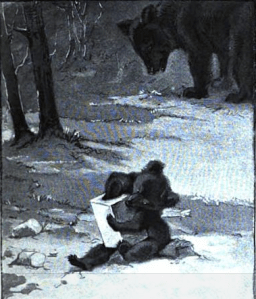
    — Illustration by the Seton from the magazine.

    — You might also enjoy:

  • A Tale: Ernest Thompson Seton Retells the Story of a Bear Fight

    Wahb, The Grizzly

    Some stories are just so good they deserve to be told twice. Ernest Thompson Seton, who was  an enomously popular writer, artist and naturalist at the dawn of the Twentieth Century, found one when he visited Yellowstone Park in 1898.

    At the time, watching bears at the garbage dumps near the park’s grand hotels was a spectacle not to be missed. One day Seton took his notebook, sketchpad and camera to the dump near the Fountain Hotel and hid out in the garbage to watch bears parade in and hold a banquet. That’s when he saw a mother black bear attack a huge grizzly to protect her sickly little cub.

    The incident not only provided material for Seton’s most famous short story, “Johnny Bear,” it also appeared in his book, The Biography of a Grizzly. The biography chronicles the life of Wahb, a grizzly who lived most of the year east of Yellowstone Park in an area called Meteetsee and was the scourge of ranchers there. But as Seton discovered, Wahb spent his summers dining in the dumps in Yellowstone Park. Here’s an excerpt from The Biography of a Grizzly.

    ∞§∞

    The Bears are especially numerous about the Fountain Hotel. In the woods, a quarter of a mile away, is a smooth open place where the steward of the hotel has all the broken and waste food put out daily for the Bears, and the man whose work it is has become the Steward of the Bears’ Banquet. Each day it is spread, and each year there are more Bears to partake of it. It is a common thing now to see a dozen Bears feasting there at one time. They are of all kinds—Black, Brown, Cinnamon, Grizzly, Silvertip, Roachbacks, big and small, families and rangers, from all parts of the vast surrounding country. All seem to realize that in the Park no violence is allowed, and the most ferocious of them have here put on a new behavior. Although scores of Bears roam about this choice resort, and sometimes quarrel among themselves, not one of them has ever yet harmed a man.

    Year after year they have come and gone. The passing travelers see them. The men of the hotel know many of them well. They know that they show up each summer during the short season when the hotel is in use, and that they disappear again, no man knowing whence they come or whither they go.

    One day the owner of the Palette Ranch came through the Park. During his stay at the Fountain Hotel, he went to the Bear banquet-hall at high meal-tide. There were several Blackbears feasting, but they made way for a huge Silvertip Grizzly that came about sundown.

    “That,” said the man who was acting as guide, “is the biggest Grizzly in the Park; but he is a peaceable sort, or Lud knows what ‘d happen.”

    “That!” said the ranchman, in astonishment, as the Grizzly came hulking nearer, and loomed up like a load of hay among the piney pillars of the Banquet Hall.” That! If that is not Meteetsee Wahb, I never saw a Bear in my life!  Why, that is the worst Grizzly that ever rolled a log in the Big Horn Basin.”

    ” It ain’t possible,” said the other, “for he ‘s here every summer, July and August, an’ I reckon he don’t live so far away.”

    “Well, that settles it,” said the ranchman; “July and August is just the time we miss him on the range; and you can see for yourself that he is a little lame behind and has lost a claw of his left front foot. Now I know where he puts in his summers; but I did not suppose that the old reprobate would know enough to behave himself away from home.”

    The big Grizzly became very well known during the successive hotel seasons. Once only did he really behave ill, and that was the first season he appeared, before he fully knew the ways of the Park.

    He wandered over to the hotel, one day, and in at the front door. In the hall he reared up his eight feet of stature as the guests fled in terror; then he went into the clerk’s office. The man said: “All right; if you need this office more than I do, you can have it,” and leaping over the counter, locked himself in the telegraph-office, to wire the superintendent of the Park: “Old Grizzly in the office now, seems to want to run hotel; may we shoot?”

    The reply came: “No shooting allowed in Park; use the hose.” Which they did, and, wholly taken by surprise, the Bear leaped over the counter too, and ambled out the back way, with a heavy thud thudding of his feet, and a rattling of his claws on the floor. He passed through the kitchen as he went, and, picking up a quarter of beef, took it along.

    This was the only time he was known to do ill, though on one occasion he was led into a breach of the peace by another Bear. This was a large she-Blackbear and a noted mischief-maker. She had a wretched, sickly cub that she was very proud of—so proud that she went out of her way to seek trouble on his behalf. And he, like all spoiled children, was the cause of much bad feeling. She was so big and fierce that she could bully all the other Blackbears, but when she tried to drive off old Wahb she received a pat from his paw that sent her tumbling like a football. He followed her up, and would have killed her, for she had broken the peace of the Park, but she escaped by climbing a tree, from the top of which her miserable little cub was apprehensively squealing at the pitch of his voice. So the affair was ended; in future the Blackbear kept out of Wahb’s way, and he won the reputation of being a peaceable, well-behaved Bear.

    ∞§∞

    — Excerpt from The Biography of a Grizzly, Ernest Thompson Seton, 1900.

    — The illustration is a detail from a drawing by Seton in the same source.

    — You might also enjoy:

    — Read Ernest Thompson Seton’s “Johnny Bear” in my book, Adventures in Yellowstone.

    — To find more stories about bears, click on “Bears” under the “Categories” button to the left.