Tag: Langford

  • A Tale: “Into the Scalding Morass,” Langford — 1870

    After the 1862 gold strike in Bannack, Montana, prospectors scoured every canyon and gully looking for pay dirt. That included the region that would become Yellowstone National Park.

    These men told about the wonders they had seen—mountains of glass, towering waterfalls, and fountains of boiling water, but, at first, people dismissed their reports as tall tales. Soon it became clear that there really were marvelous things in the area, so a group of government officials and businessmen decided to mount an expedition to document them. The result was the famous Washburn Expedition of 1870.

    Of course, documenting the wonders included gathering specimens—task that could be downright dangerous. Here’s a description of just how dangerous it could be, written by one of the expedition’s principle chroniclers, Nathaniel P. Langford.

    ∞§∞

    Washburn and I passed over a low divide, which, I think, must be the main range of the Rocky Mountains. Just beyond is another brimstone basin containing forty or fifty boiling sulphur and mud springs. A small creek runs through the basin—and the slopes of the mountains on either side showed unmistakable signs of volcanic action beneath the crust.

    A considerable portion of the slope of the mountain was covered with a hollow incrustation of sulphur, lime, or silica, from which issued in many places hot steam. We found many small craters from six to twelve inches in diameter —  from which issued the sound of the boiling sulphur or mud. In many instances we could see the mud or sulphur water.

    The water was too hot for us to bear the hand more than two or three seconds.  It had overflowed the green spaces between the incrustations, completely saturating the ground. In many places the grass had grown—forming a turf compact and solid enough to bear the weight of a man ordinarily. But when it gave way the underlying deposit was so thin that it afforded no support.

    While crossing one of these green places, my horse broke through—and sank to his body as if in a bed of quicksand.  I was off his back in an instant and succeeded in extricating the struggling animal.  The fore legs of my horse, however, had gone through the turf into the hot, thin mud beneath.

    General Washburn was a few yards behind me on an incrusted mound of lime and sulphur, which bore us in all cases. He had just before called to me to keep off the grassy place.  Now he inquired of me if the deposit beneath the turf was hot. Without making examination I answered that I thought it might be warm.

    Shortly afterwards the turf again gave way—and my horse plunged more violently than before, throwing me over his head. As I fell, my right arm was thrust violently through the treacherous surface into the scalding morass. It was with difficulty that I rescued my poor horse—and I found it necessary to instantly remove my glove to avoid blistering my hand.

    The frenzied floundering of my horse had in the first instance suggested to General Washburn the idea that the under stratum was hot enough to scald him. General Washburn was right in his conjecture. It is a fortunate circumstance that I today rode my light-weight pack horse. If I had ridden my heavy saddle horse, I think that the additional weight of his body would have broken the turf—and that he would have disappeared in the hot boiling mud—taking me with him.

    ∞§∞

    — Text and ilustration from Langford’s book, The Discovery of Yellowstone Park, 1870.

    — You can read a condensed version of Langford’s The Discovery of Yellowstone Park in my book, Adventures in Yellowstone.

    — To see more stories by this author, click on “Langford” under the “Categories” button to the left.

    — For more stories about the Washburn Expedition, click on “Washburn” under the “Categories” button to the left.

  • Views: Yellowstone Park Belongs in Montana

    After I urged my FaceBook Friends last week to buy my book as a Christmas gift, sales surged. In fact, Amazon.com ranked Adventures in Yellowstone Number One among books on Wyoming history for a while.

    Of course, I’m grateful for book buyers, and it’s always fun to be on top, but I think Wyoming history is the wrong category. Although most of Yellowstone Park’s land mass lies in Wyoming, most of its early history is in Montana. In fact, the Montana territorial legislature asked the U.S. Congress to attach the park to Montana twice, in 1872 and 1874. The territorial legislators offered two interrelated reasons for their request: the wonders of the Yellowstone Plateau were accessible only from Montana, and, Montana residents had explored the area and begun to develop it.

    As the accompanying relief map shows, extremely rugged mountains surround the Yellowstone Plateau. As the “Memorial” the territorial legislature drafted in 1872 put it:

    . . . this portion of Wyoming is only accessible from the side of Montana, contains the heads of streams whose courses lie wholly in Montana, while, through the enterprise of citizens of Montana, it has been thoroughly explored, and its innumerable and magnificent array of wonder in geysers, boiling springs, mud volcanoes, burning mountains, lakes, and waterfalls brought to the attention of the world. Your memorialists would, therefore, urge upon your honorable bodies that the said portion of Wyoming Territory be ceded to Montana . . . .

    The legislators had a point. While the trappers of the Mountain Man Era sometimes entered what is now Yellowstone Park over the rugged mountains to the east and south, by the time the Montana and Wyoming Territories were established in the 1860s, most explorers came from north and west. In 1863, Walter DeLacy led a group of prospectors from Bannack, Montana, up the Snake River into what is now Yellowstone Park. In 1869, David Folsom and his friends, Charles Cook and William Peterson, left Diamond City, Montana, and went up the Yellowstone River to the Yellowstone Plateau.

    A year later, an expedition led by General Henry Washburn, with an Army escort under Lt. Gustavus Doane, followed the same route as the Folsom-Cook-Peterson party. In 1871, U.S. Commissioner of Mines Rossiter Raymond led a party of men up the Madison River to see Yellowstone’s wonders.

    Also, in 1871, Montana entrepreneurs were racing to capture the tourist trade. Bozeman businessmen were building a road up the Yellowstone River through the canyon that would come to be named after toll taker, “Yankee Jim” George. At the same time, Virginia City businessmen were extending the road from Henry’s Lake to the Lower Geyser Basin. And, other adventurous Montana businessmen were building a hotel and bathhouses at Mammoth Hot Springs.

    And, what were Wyoming residents doing then to develop Yellowstone Park? Nothing!

    In 1874, the Montana territorial legislature renewed its request to the U.S. Congress that the part of Yellowstone Park that “now lies within the Territory of Wyoming be detached therefrom and attached to the territory of Montana.” Obviously, the Congress demurred. Even today, after more than a century of road building, nearly twice as many visitors enter Yellowstone Park from Montana entrances than from Wyoming entrances.

    I think Montana pioneers made a good case for making all of Yellowstone Park a part of Montana. And, it would make more sense for Amazon.com to categorize Adventures in Yellowstone with Montana books instead of Wyoming books. But I understand that geography trumps history.

    I’m just glad when my book sells—no matter what category it’s in. And remember, Adventures in Yellowstone makes a great gift for Valentines Day.

    ∞§∞

    — Relief map from the Yellowstone Digital Slide File.

    — Related Stories you might enjoy:

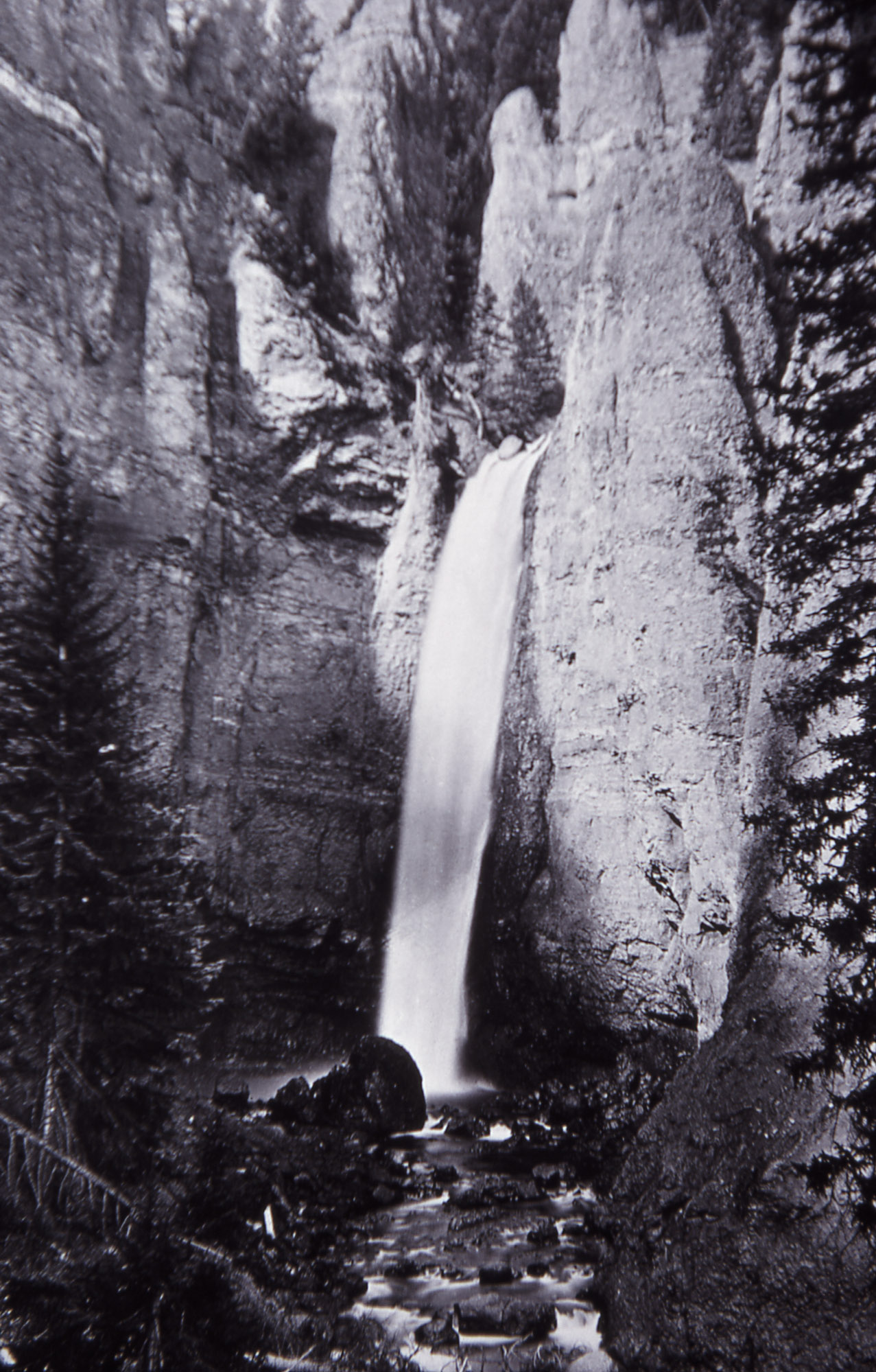
  • A Tale: Naming Tower Fall— Langford, 1870

    In 1870 the famous Washburn Expedition explored the remote area that became Yellowstone National Park. While the explorers always had be be alert for the dangers of Indians, wild animals, and strange geothermal features, they also found ways to have fun. Here’s Nathaniel P. Langford’s description of  one of the pranks they played on each other.

    ∞§∞

    At the outset of our journey we had agreed that we would not give to any object of interest that we might discover the name of any of our party nor of our friends. This rule was to be religiously observed.

    While in camp on Sunday, August 28th, on the bank of this creek, it was suggested that we select a name for the creek and fail. Walter Trumbull suggested “Minaret Creek” and “Minaret Fall.” Mr. Hauser suggested “Tower Creek” and “Tower Fall.” After some discussion a vote was taken, and by a small majority, the name “Minaret” was decided upon.

    During the following evening Mr. Hauser stated with great seriousness that we had violated the agreement made relative to naming objects for our friends. He said that the well known Southern family—the Rhetts—lived in St. Louis, and that they had a most charming and accomplished daughter named “Minnie.” He said that this daughter was a sweetheart of Trumbull, who had proposed the name her name, “Minnie Rhett” — and that we had unwittingly given to the fall and creek the name of this sweetheart of Mr. Trumbull.

    Mr. Trumbull indignantly denied the truth of Hauser’s statement, and Hauser as determinedly insisted that it was the truth. The vote was therefore reconsidered, and by a substantial majority it was decided to substitute the name “Tower” for “Minaret.” Later, and when it was too late to recall or reverse the action of our party, it was surmised that Hauser himself had a sweetheart in St. Louis — a Miss Tower.

    ∞§∞

    —Excerpt from N. P. Langford, The Discovery of Yellowstone Park.

    —William Henry Jackson Photo, Yellowstone Digital Archive.

    — You can read a condensed version of Langford’s The Discovery of Yellowstone Park in my book, Adventures in Yellowstone.

    — To see more stories by this author, click on “Langford” under the “Categories” button to the left.

    — For more stories about the Washburn Expedition, click on “Washburn” under the “Categories” button to the left.

  • A Tale: Little Invulnerable —Langford, 1870

    Private Moore's drawing.

    The remote area that became Yellowstone National Park was a roadless wilderness when the famous Washburn Expedition explored there in 1870. That meant they had to carry supplies on packhorses. Vital as these animals were to survival, the explorers rarely mentioned them. But, one horse’s antics earned him a place in several journals and a nickname. Here’s Nathaniel P. Langford’s description of “Little Invulnerable.”

    ∞§∞

    One of our packhorses is at once a source of anxiety and amusement to us all. He is a remarkable animal owned by Judge Hedges, who makes no pretentious to being a good judge of horses.

    Mr. Hedges says that the man from whom he purchased the animal, in descanting upon his many excellent qualities, said: “He is that kind of an animal that drives the whole herd before him.” The man spoke truly, but Mr. Hedges did not realize that the seller meant to declare that the animal, from sheer exhaustion, would always be lagging behind the others of the herd.

    From the start, and especially during our journey through the forest, this pony, by his acrobatic performances and mishaps, has furnished much amusement for us all.

    Progress today could only be accomplished by leaping our animals over the fallen trunks of trees. Our little bronco, with all the spirit necessary, lacks oftentimes the power to scale the tree trunks.

    As a consequence, he is frequently found resting upon his midriff with his fore and hind feet suspended over the opposite sides of some huge log. “The spirit indeed is willing, but the flesh is weak.” He has an ambitious spirit, which is exceeded only by his patience. He has had many mishaps, any one of which would have permanently disabled a larger animal, and we have dubbed him “Little Invulnerable.” One of the soldiers of our escort, Private Moore, has made a sketch of him as he appeared today lying across a log, of which I am to have a copy.

    ∞§∞

    —You can read a condensed version Langford’s book, The Discovery of Yellowstone Park, in my book, Adventures in Yellowstone: Early Travelers Tell Their Tales.

    —Illustration from Langford’s book.

    — You can read a condensed version of Langford’s The Discovery of Yellowstone Park in my book, Adventures in Yellowstone.

    — To see more stories by this author, click on “Langford” under the “Categories” button to the left.

    — For more stories about the Washburn Expedition, click on “Washburn” under the “Categories” button to the left.

  • A Tale: Shooting Jake Smith’s Hat by N.P. Langford

    Jake Smith

    One of the members of the famous Washburn Expedition that explored  the uppper Yellowstone in 1870, a jocular man named Jake Smith, was always ready to gamble. Unfortunately, he lost all his money in a card game the night before the trip started. But Jake came up with a way to replenish his stake. N.P. Langford tells the story.

    ∞§∞

    Descending the range to the east, we reached Trail creek, a tributary of the Yellowstone about 3 o’clock in the afternoon, where we are now camped for the night. We are now fairly launched upon our expedition without the possibility of obtaining outside assistance in case we need it. Our safety will depend upon our vigilance. We are all well armed with long range repeating rifles and needle guns, though there are but few of our party who are experts at off-hand shooting with a revolver.

    In the course of our discussion Jake Smith expressed his doubt whether any member of our party is sufficiently skilled in the use of the revolver to hit an Indian at even a close range. He offered to put the matter to a test by setting up his hat at a distance of twenty yards for the boys to shoot at with their revolvers, without a rest, at twenty-five cents a shot.

    Several members of our party blazed away with indifferent success—with the result that Jake was adding to his exchequer without damage to his hat. I could not resist the inclination to quietly drop out of sight behind a clump of bushes. From my place of concealment I sent from my breech-loading Ballard repeating rifle four bullets in rapid succession, through the hat—badly riddling it.

    Jake inquired, “Whose revolver is it that makes that loud report?” He did not discover the true state of the case, but removed the target with the ready acknowledgment that there were members of our party whose aim with a revolver was more accurate than he had thought.

    ∞§∞

    — Excerpt Langford’s book, The Discovery of Yellowstone Park. in my book, Adventures in Yellowstone.

    — Photo, Yellowstone Digital Slide.

    — You can read a condensed version of Langford’s The Discovery of Yellowstone Park in my book, Adventures in Yellowstone.

    — To see more stories by this author, click on “Langford” under the “Categories” button to the left.

    — For more stories about the Washburn Expedition, click on “Washburn” under the “Categories” button to the left.